Former Vice President and Principal Analyst
Constellation Research
Steve Wilson is former VP and Principal Analyst at Constellation Research, leading the business theme Digital Safety and Privacy. His coverage includes digital identity, data protection, data privacy, cryptography, and trust. His advisory services to CIOs, CISOs, CPOs and IT architects include identity product strategy, security practice benchmarking, Privacy by Design (PbD), privacy engineering and Privacy [or Data Protection] Impact Assessments (PIA, DPIA).
Coverage Areas:
- Identity management, frameworks & governance- Digital identity technologies- Privacy by Design
- Big Data; “Big Privacy”- Identity & privacy innovation
Previous experience:
Wilson has worked in ICT innovation, research, development and analysis for over 25 years. With double…...
Public blockchain consensus algorithms – the most famous of which is Bitcoin’s “Proof of Work” – literally create order out of chaos. They produce an agreed ordering of potentially contentious entries made in real-time on a shared ledger, in a special case where we choose to have no administrator to rule on the sequence in which entries are received, creating an official account of all transactions (and that's actually all the Bitcoin blockchain does).
“Consensus” is one of those beguiling properties of blockchain – along with “trust” and “decentralised” – which are actually difficult to generalise beyond the narrow confines of the cryptocurrency use case. The consensus reached in the public blockchains is not what many people think it is. Instead of a general type of agreement, blockchain consensus is tightly defined for a singular purpose. In most of the broader business applications for which blockchains are being planned or deployed, we don’t need to reach “consensus” about the state of a ledger in the same way as Bitcoin does, because we have different authority structures. It is important to appreciate the special purpose of blockchain consensus, so that the algorithm doesn’t add enormous overhead and real-time delays in cases where it is not warranted.
The problem space of the Bitcoin blockchain is non-fiat digital money; that is, electronic cash transacted with no intermediaries or regulator, and no registration of account holders. Since the 1990s at least, there had been stored value smartcard and digital money solutions using a central reserve or “mint” to oversee transactions and prevent Double Spend (Mondex and David Chaum’s Digicash being the prime examples). However, many cryptocurrency advocates reject central control, and thus remained unhappy with these architectures, until the arrival of Satoshi Nakamoto in 2008.
Nakamoto’s pioneering blockchain architecture cleverly crowd-sources the monitoring of each and every Bitcoin transaction, with the network periodically reaching agreement on blocks of accepted transactions, which it commits to the shared ledger. Account holders do not need to be registered but are allowed to generate their own keys as they join the network. Nobody knows which user goes with which key pair; the blockchain ascribes transactions to key pairs, and the community simply assumes that users remain in control of their keys. If a private key is lost or destroyed, then the corresponding balance can never be spent again; if a private key is stolen or copied, its original owner has no recourse to a system operator.
The consensus reached by the blockchain is about one thing only: the order in which transactions are deemed to have occurred. Agreement on ordering of the ledger is sufficient to prevent Double Spend of the cryptocurrency. In later generation synchronous ledgers without an intrinsic underlying currency, like Hyperledger Fabric, this function is explicitly named the Ordering Service.
Consensus about the order of ledger entries cannot be readily generalised to any other property of the data. Anyone contemplating broader blockchain applications should be wary of how the word “consensus” can be stretched too far.
Furthermore, the architects of non-fiat cryptocurrency are at liberty to simply reject central administration as they build their special new world. Yet very few real-world business settings are like that. If a program has a natural or inherent administrator (as with education, healthcare, elections or land titles) then it doesn’t need to crowdsource any question about the state of its data. There isn't much that a distributed consensus algorithm can tell that the administrator can’t work out for itself, more quickly and for far less cost.
Finally remember that blockchain consensus creates order out of the deliberate chaos of cryptocurrency where key holders are allowed to go unregistered. In many of the extended blockchain use cases – such as Internet of Things or supply chain – there is no such disorder. IoT devices tend to have serial-numbered chips to securely hold the private keys; supply chain operators are generally authorised employees, typically using dedicated terminal equipment in warehouses, field locations and delivery vehicles. These types of networks are orderly to begin with, and don’t need an elaborate consensus algorithm to work out what’s going on.
When analysing potential blockchain use cases, always ask precisely what any consensus is about, and what’s the point of it. What do you need to know about the application’s users in operation? And is it beneficial to crowdsource the monitoring of a user network if it’s cheaper or more natural to have a manager?
Vice President and Principal Analyst
Constellation Research
Holger Mueller is VP and Principal Analyst for Constellation Research for the fundamental enablers of the cloud, IaaS, PaaS and next generation Applications, with forays up the tech stack into BigData and Analytics, HR Tech, and sometimes SaaS. Holger provides strategy and counsel to key clients, including Chief Information Officers, Chief Technology Officers, Chief Product Officers, Chief HR Officers, investment analysts, venture capitalists, sell-side firms, and technology buyers.
Coverage Areas:
Future of Work
Tech Optimization & Innovation
Background:
Before joining Constellation Research, Mueller was VP of Products for NorthgateArinso, a KKR company. There, he led the transformation of products to the cloud and laid the foundation for new Business Process as a…...
We had the opportunity to attend Amazon AWS reinvent user conference, held from November 26th till 30th 2018, across Las Vegas. With over 50k attendees, reinvent has become the yearly come and get together of the IT industry, a unique position that AWS first achieved in 2017 and has more than well defended in 2018.
Prefer to watch – here is my event video … (if the video doesn't' show up – check here)
Here is the 1 slide condensation (if the slide doesn't show up, check here):
AWS announces AWS Outposts – An area where AWS risked falling behind against the rest of the IaaS competition was the area of workload portability from cloud to on-premises. The next generation computing platform as I call it has been described in the Market Overview that can be found here… And AWS was holding out likely the longest being the public cloud market leader. With the Outposts announcements, together with VMware, AWS will now bring key services to on premises, giving customer a choice between an AWS or VMware control plane. It will be available in the 2nd half of 2019 – so still a little time out. But probably the most impactful announcement from AWS – ever. It catapults AWS into the hardware maker and tech stack maker market… something you could not see coming a little back.
AWS takes AI to hardware – An area where AWS in our view was behind as well, was in custom hardware for AI loads. It has partnered with Nvidia as many others – but not brought forward a custom design… that changes with the new Amazon EC2 P3dn instances, that run a custom / optimized version of Tensorflow that increased efficiency from, 65 to 95%. They also support (vanilla?) Tensorflow, PyTorch, Apache MXNet, Caffe, Caffe2, Microsoft Cognitive Toolkit (CNTK), Chainer, Theano, Keras, Gluon, and Torch. Not enough, AWS announced a custom chip, AWS Inferentia, that will become an alternative to GPUs, and will be optimized for high throughput and low latency. Last but not least, Amazon added Amazon Elastic Inference - making it more efficient for customers to provision just the GPU istances they need for their AI / ML worklodas. All four announcements are key make AWS more competitive vs Google, that still has a 2-3-year lead in custom AI hardware. But it is good to see AWS (finally) engaging here, more competition is good for enterprises and fosters innovation as well as price competition… all good trends for enterprises.
AWS launches AI apps – Making it easier for business users to use AI apps is key these days and the strategy for vendors is to help them with specific, targeted apps. With Amazon Personalize, Amazon Forecast (both re-using and building on expertise and technology from Amazon.com), Amazon Textract (an OCR replacement)-and Amazon Comprehend Medical (Healthcare use case with NLP) there has been a broad push into AI apps. We will have to see how well practical adoption will pan out, but interests were big at reinvent.
Database Innovation is alive and well – Amazon execs know how important databases are and how much critical enterprise load is in relational databases. The strategy of AWS is to combat the generic, all-purpose databases with more dedicated databases, all in a suite of database products. Last year Amazon unveiled AWS Neptune, it's graph database, this year it unveiled Amazon Quantum Ledger Database (QLDB – a distributed ledger database, but what a confusing name), what a confusing name) and Amazon Timestream (a time series database). A good strategy that seems to get more traction in enterprises. But AWS knows that entrenched vendors are the challenge, and Oracle specifically has almost become an obsession. Multiple references in Jassy's and Vogels' keynote as well as almost 30 minutes on the topic in Vogels' keynote are almost too much attention.
AWS open sources Firecracker – Influencing industry standards via open source has been the trend of the last two three years. Google has shown the way with Kubernetes and TensorFlow… so AWS did not want to stand back and open sources its serverless framework (Amazon likes to call it virtual machine manager) Firecracker… with Google focusing a level higher currently at the service mesh level, with Istio, this is an open space for anyone. And AWS has good chances given that Firecracker runs Lamba at AWS, and Lambda is the leading serverless platform in the cloud (from a load / uptake perspective). Now we must see if other IaaS vendors will support Firecracker and how successful AWS is at stewarding a strategic open source project. CxOs have accepted open source by now, so it really comes back to show traction in the offering from a roadmap and consumption perspective.
Amazon QuickSight Renaissance – Two years ago Amazon debuted Amazon QuickSight a product that targets to replace the usual BI tools (remember Business Objects, Cognos, MicroStrategy?). The most promising capability was its automatic capability to visualize data. A key vision and step towards user free software, ahead of its time back then. Then it got quiet around Amazon QuickSight… but AWS does not give up easy and came back with a new attempt to win this market, and the value proposition remains strong. Time to look and evaluate this product for CxOs. True to cloud DNA, the pricing is now no longer per seat, but per session (with a maximum of $5 per reader user per month) – an innovation on the licensing side.
AWS Tooling everywhere – Last year Amazon announced its own IDE, a key strategy to get closer to developers. But switching IDEs is not easy, so this year AWS is bringing the AWS Toolkit to PyCharm, IntelliJ (Preview), and Visual Studio Code (Preview). It's important to help developers build apps fast and bringing the toolkit to the 'living room' (aka IDE) is the right strategic move.
MyPOV
Another monster re:Invent with progress across the board. If there are areas where AWS was weaker, or even behind (on premise support, AI hardware), AWS has reacted and is making product available. The AWS Outposts announcement is changing the market for hardware fundamentally. Given AWS readiness to commit to aggressive pricing and ability to manage tight margins successfully, it is bad news for the Dell, HPs et al… and good news for CxOs. It's a great reward for long term AWS customers, who now can move loads from the AWS cloud to on premise – should they need or wish. On the hardware front AWS is correcting its miscalculation from a few years ago when it thought Machine Learning is all about… linear regression. With the adoption of Tensorflow across the board AWS acknowledges that MxNet has not won, but is also not giving up on the toolset yet. Both are important course corrections and innovations that are key to keep AWS in the overall IaaS market leadership position.
In general AWS is impressive when it comes to delivering innovation across the board, across the product set. An astonishing feat that the AWS product teams manage to repeat year over year. And that raises the bar for innovation for the overall industry to keep up with.
On the concern side, the AWS portfolio is broader and deeper than ever before. AWS keeps staying with the Chinese menu philosophy, and it means massive choice… but staying with the analogy, when a Chinese restaurant adds a full menu every year, even the most loyal customers will have a hard time to keep an overview of the menu – and manage to repeat-order the same dishes (aka products) at the next visit (aka implementation project). I was not around to ask Andy Jassy my traditional question (Is AWS getting too complex?) but he came prepared (very Amazons style) and negated the question (no surprise). Customers though are struggling to find repeatable success across the vast AWS services portfolio. And cross portfolio QA and testing is getting close to impossible. So, simplification by grouping services, testing them together, aligning roadmaps, versioning and more … must be in AWS future – at some point. To be fair at re:Invent, AWS has made steps to make it easier for customers to run the large product portfolio - with new offerings like Landing Zone (AWS Control Tower); Security (AWS Security Hub); and, Data Lakes (AWS Lake Formation), customers should be faster and have an easier time to setup, operate and maintain AWS offerings. That is a good step in the right direction.
But overall respect to AWS to a massive, well organized and amazing event, sharing the breadth and depth of the AWS services portfolio and innovation. Here is to another year taming the dragon.
Vice President & Principal Analyst
Constellation Research
Alan Lepofsky - VP and Principal Analyst, Constellation Research. With almost two decades of experience in the collaboration software industry, Lepofsky helps organizations improve the way their employees work together to get their jobs done. Lepofsky’s primary research area The Future of Work, focuses on: integrating collaboration and business processes (Purposeful Collaboration), structuring work via Social Task Management, leveraging analytics and digital assistants to work more productively, the strategic impact of mobile computing on business transformation, and measuring workforce culture based on Digital Proficiency instead of age.
Twitter: @alanlepoLinkedIn: https://ca.linkedin.com/in/alanlepo
, Title: Big IdeasIntelligent Collaboration: The Intersection of…...
On December 10, 2018, Constellation Research hosted a historic event with key Internet pioneers, the People-Centered Internet coalition, as well as the next generation of positive change agents. Titled “Our People-Centered Digital Future,” the event recognizes that 50% of the world is now connected to the Internet. This inflection point marks an important moment for examining the “unfinished work” of the Internet and discussing the community norms, human rights and social contracts required in this exponential digital era. The event also aligns with the 70th Anniversary of the Universal Declaration of Human Rights by the United Nations.
People-Centered Internet (PCI) is an international coalition of positive #ChangeAgents created to ensure that the Internet continues to improve people’s lives and livelihoods and that the Internet is a positive force for good with helping people achieve their goals and aspirations.
The Universal Declaration of Human Rights (UDHR) is a milestone document in the history of human rights. Drafted by representatives with different legal and cultural backgrounds from all regions of the world, the Declaration was proclaimed by the United Nations General Assembly in Paris on 10 December 1948 as a common standard of achievements for all peoples and all nations.
Vice President and Principal Analyst
Constellation Research
Holger Mueller is VP and Principal Analyst for Constellation Research for the fundamental enablers of the cloud, IaaS, PaaS and next generation Applications, with forays up the tech stack into BigData and Analytics, HR Tech, and sometimes SaaS. Holger provides strategy and counsel to key clients, including Chief Information Officers, Chief Technology Officers, Chief Product Officers, Chief HR Officers, investment analysts, venture capitalists, sell-side firms, and technology buyers.
Coverage Areas:
Future of Work
Tech Optimization & Innovation
Background:
Before joining Constellation Research, Mueller was VP of Products for NorthgateArinso, a KKR company. There, he led the transformation of products to the cloud and laid the foundation for new Business Process as a…...
We had the opportunity to attend Ultimate Software's yearly analyst summit, held November 13th and 14th 2018 at the vendor's headquarters in Weston, Florida. Good attendance from the key influencers and a great evening program with a cooking demonstration.
Prefer to watch – here is my event video … (if the video doesn't' show up – check here)
Here is the 1 slide condensation (if the slide doesn't show up, check here):
Ultimate keeps executing on growth – Practically most HCM vendors are doing well these days, fueled by the move of HCM to the cloud and the need to replace aging technology that is no longer in synch with the best practices that people expect in 2018. Ultimate is not only growing on the revenue front, but also on the product side, innovating with AI (Xander) and pushing forward the overall functionality of the UltiPro Suite.
HR Services is next – For a long time I have been asking Ultimate CEO Scherr on how the vendor wants to keep growing on a longer-term perspective. Until now he has always been confident that the focus on North America and HCM SaaS is enough to fuel Ultimate Software growth. And performance has proven Scherr right. Internationalization was more lukewarm effort so far, but it has not hurt the vendor. It all changed with the acquisition of PeopleDoc, unveiled July 18th, 2018. With PeopleDoc Ultimate becomes a player in HR Services (Delivery, or Integrated HR Service Delivery as Ultimate likes to call it - I refer to it simply as "HR Services) and gets a lot of exposure in Europe, particularly France ang Germany. Now it will be key to see if Ultimate can leverage PeopleDoc assets and expertise beyond the upsell in North America, making it the growth engine beyond North America. End users care for growth of their software suppliers, as it reduces the cost of R&D across them and allows the vendors to deliver more functionality.
Momentum in AI / Xander remains strong – The acquisition of Kanjoya by Ultimate Software a little more than two years ago, on September 3oth, was Ultimate's entry into AI / Machine Learning… specifically leveraging the NLP assets of Kanjoya. The acquisition has been a success, with assets and people talent having made a substantial difference for Ultimate. What is impressive is the wide adoption of AI services / Xander in the Ultimate install base and how Ultimate is moving innovation into the core of its install base. In contrast to that, many competitors see delays and hesitation in using AI technologies on a wider scale.
People first culture. Ultimate prides itself in people centricity and live these values. The core tenet of the philosophy is to treat your people right and good things will follow, most importantly, they will treat customers right. Examples for the people centricity is the inclusion of the families of employees are the fully funded healthcare. Many HCM vendors do much in this area – but none I am aware takes it to this point. The question for customers is of course, how much that matters, but most of them admire the philosophy and culture, and though not reachable for them, see it at least as an example and inspiration.
MyPOV
Overall it is impressive progress that Ultimate is showing on all fronts, from business overall people to technology. What matters most for customers is product and technology progress and Ultimate is innovating across the suite, with a strong push on AI / Machine Learning with Xander. The PeopleDoc acquisition is opening new potential, but also a new category software wise, as Ultimate is on the BPaaS game now and needs not only to make its customers employees, managers and HR professionals more productive, but is adding the call center reps to the equation.
On the concern side, Ultimate has added more moving pieces to an already big puzzle of moving pieces. It needs to reach the critical escape velocity in its development processes to finish the application work on an ever-evolving technology stack, without adding more technology pieces to the puzzle, that can quickly become the great idea from yesteryear. A challenge for all established and successful vendors, and it's time for Ultimate to master it.
But overall very good progress by Ultimate, the next 12 months will be key to watch. Stay tuned.
Vice President & Principal Analyst
Constellation Research
Alan Lepofsky - VP and Principal Analyst, Constellation Research. With almost two decades of experience in the collaboration software industry, Lepofsky helps organizations improve the way their employees work together to get their jobs done. Lepofsky’s primary research area The Future of Work, focuses on: integrating collaboration and business processes (Purposeful Collaboration), structuring work via Social Task Management, leveraging analytics and digital assistants to work more productively, the strategic impact of mobile computing on business transformation, and measuring workforce culture based on Digital Proficiency instead of age.
Twitter: @alanlepoLinkedIn: https://ca.linkedin.com/in/alanlepo
, Title: Big IdeasIntelligent Collaboration: The Intersection of…...
What's in a name? That which we call Notes
by any other company name would smell as sweet;
So Notes would, were it not IBM call'd,
Retain that dear perfection which it owes
Without that title.
Ok, perfection may be a stretch, but there is no denying the significance Notes has had in the collaboration market over the last 30 years, both in terms of email, applications, offline support, security, and more. It’s no secret that Lotus Notes (Plato Notes? VAX Notes?), I mean IBM Notes has played a vital role in my professional life, so I greet this week’s announcement from IBM and HCL with both nostalgia and hope.
Before we begin, let's look back at some key timeline events: 1982 - Lotus Development Corporation was founded
1984 - Iris Associates was founded
1989 - Iris released Notes v1
1994 - Lotus acquired Iris
1995 - IBM acquired Lotus for $3.5B
1996 - The server was renamed Domino (v4.5)
1998 - IBM acquired Databeam and Ubique which together would form the foundation of Sametime
2007 - IBM Lotus Connections v1 (built on WebSphere, not Domino)
2017 - IBM partnered with HCL for the development of Notes and Domino, with IBM retaining Sales and Marketing
2018 - IBM and HCL release Notes/Domino v10 (after quite a gap since v9)
2018 - IBM sells the collaboration portfolio of Notes/Domino, Connections and WebSphere Portal to HCL for $1.8B, essentially exiting the collaboration software market
2019 - sometime in 2019 the IBM era of Notes/Domino will end and HCL Notes/Domino (unless they rename it) will begin
Dec. 6, 2018 IBM and HCL announced a definitive agreement under which HCL will acquire select IBM software products for $1.8 billion.
Appscatn for secure application development,
BigFix for secure device management,
Unica (on-premise) for marketing automation,
Commerce (on-premise) for omni-channel eCommerce,
Portal (on-premise) for digital experience,
Notes & Domino for email and low-code rapid application development, and
Connections for workstream collaboration.
I’ll focus on the last three items: Notes/Domino, Connections and Portal, and how this announcement differs from the initial 2017 partnership between IBM and HCL.
2017 announcement: The deal was limited to Notes/Domino, Sametime, and Verse
2018 announcement: Notes/Domino and Verse, Sametime, Connections, WebSphere Portal
MyPOV: The original deal focused only on the Domino-based platform, leaving the WebSphere based products with IBM. Now HCL will take over Connections and Portal as well. HCL executive Jason Roy Gary was one of the architects behind rebuilding Connections using a more modern modular architecture (a project codenamed Pink). When he left for HCL, the future of Connections was uncertain. With Connections now falling under his management again, it will be interesting to see where HCL places their focus and prioritization.
I believe customers benefit from unified/seamless experiences between products. When Notes/Domino and Connections were “separated” I was concerned about the future of integration between the two platforms. With HCL now owning both, it will be easier for them to develop a platform that can compete against the likes of Microsoft SharePoint.
However, the flip side is that when the two were separated, it appeared HCL would be able to direct all their focus on rejuvenating the rapid application development features of Notes/Domino, leaving IBM to focus on the social/collaboration features of Connections.
Many customers and partners struggled with the complexity of Connections based on its WebSphere architecture and preferred the simplicity of Domino. Will HCL continue both product lines given their architectural differences? Will they have the resources to develop, market and sell both?
It’s important to note that IBM Watson Workspace is not mentioned in this deal, most likely signalling the end of this product.
2017 announcement: IBM retained responsibility for sales, marketing and product management while HCL took over the development of Notes/Domino.
2018 announcement: HCL will completely own all aspects of the product line.
MyPOV: Under the original terms, HCL had a responsibility to deliver specific things to IBM, but was additionally free to innovate Notes/Domino on their own. An example is the work they are doing on HCL Places, which many speculate could replace the Notes client. While the pace of delivery of V10 was excellent under HCL, there were still limitations based on the alliance with IBM. As the standalone owner, it should be much simpler for HCL to focus unencumbered by IBM.
2017 announcement: Organizations were customers of IBM
2018 announcement: Organizations will eventually become customers of HCL, purchasing licenses, maintenance renewals and support from HCL
MyPOV: Previously HCL was mainly a services company. How will they evolve to include sales and marketing functions? How much staff from IBM will be coming over to handle those roles?
Other Questions:
What does this mean for the business partner community? Will those who previously worked with IBM be seamlessly transitioned to a similar HCL Partner Program? What will this program offer in terms of training, go to market assistance, pipeline generation and more?
Will HCL acquire any of the leading business partner products that provide additional functionality to Notes/Domino, Sametime, Connections and WebSphere Portal?
Previously customers engaged with IBM via events like IBM Think. Will HCL partner with IBM and hold “sub-events” tied to IBM, or will HCL start their own stand-alone events?
Will HCL seize this milestone as an opportunity to rebrand any of the existing products? While the old names provide heritage, they also carry with them some negative baggage. Is it better to leverage the past, or try something new?
What is the fate of IBM's Talent Management / Learning portfolio?
Conclusions
IBM no longer saw these products as strategic to their current focus in areas like AI (Watson), security (blockchain) and IoT.
I was never comfortable with the 2017 “half-way" deal around Notes/Domino, as it seemed like an awkward arrangement that was not exactly what either side wanted. Now that HCL will be in complete control of these product lines, I think they will be able to evolve and innovate unencumbered by IBM.
Customers knew and understood IBM. They had relationships will account teams, often spanning much more than just collaboration software. HCL will be completely new to many of them. Will customers and partners stay, or will this be an opportunity to migrate to a competitor?
My biggest concern is that the HCL portfolio is now back to containing the Notes/Domino family, Connections and WebSphere Portal. When it was just ND I was optimistic about their focus, but now will that be diluted across the three areas, or will they be able to capitalize on email + rapid application development + social/collaboration/communities + digital experiences (internal intranets and external websites) better than IBM did?
For additional information, it’s worth looking back at my thoughts on the original HCL partnership and the highlights of the Notes/Domino 10 launch.
Vice President and Principal Analyst
Constellation Research
Holger Mueller is VP and Principal Analyst for Constellation Research for the fundamental enablers of the cloud, IaaS, PaaS and next generation Applications, with forays up the tech stack into BigData and Analytics, HR Tech, and sometimes SaaS. Holger provides strategy and counsel to key clients, including Chief Information Officers, Chief Technology Officers, Chief Product Officers, Chief HR Officers, investment analysts, venture capitalists, sell-side firms, and technology buyers.
Coverage Areas:
Future of Work
Tech Optimization & Innovation
Background:
Before joining Constellation Research, Mueller was VP of Products for NorthgateArinso, a KKR company. There, he led the transformation of products to the cloud and laid the foundation for new Business Process as a…...
We had the opportunity to attend Kronos' yearly user conference, Kronos Works, held from November 4th till 7th 2018 in Las Vegas at the Aria Resort. Attendance was similar like the year before with 3k+, usual influencer presence.
Prefer to watch – here is my event video … (if the video doesn't' show up – check here)
Here is the 1 slide condensation (if the slide doesn't show up, check here):
Kronos is doing really well – The vendor has record results and is doing well. That is remarkable, as it just has created a new product on a new platform and is moving customers towards it… while making the bulk of revenue on the old platform, that the vendor still supports. A 'dance' few vendors manage to dance without a revenue dip, so remarkable and kudos to the Kronos team.
Kronos is in HCM – For the longest time, Kronos has played the role of 'Switzerland' when it came to HCM vendors, providing them with Time and Attendance as well as Workforce Management capabilities. That has worked well for Kronos, who has become the proverbial "800-pound gorilla" in Workforce Management. With Kronos now competing, it will be interesting how the HCM vendors will react. Lack of good workforce management solutions that are standalone and customer install base are all key factors helping Kronos at the moment.
Aimee is Kronos' AI assistant – Somewhat late, but better late than never, Kronos unveiled Aimee, it's AI assistant. She will debut in 2019 and help people with 4 AI uses cases, that are the typical initial load of vendors getting started.
Workforce Dimensions has good traction – Launched last year, Kronos new flagship product suite, Workforce Dimensions is doing well, and has now 220 customers, fewer live, more implementing… for the count being at 10 implementing 12 months ago – that's very good progress.
Maintenance ROI – The key for Kronos doing well overall is that it keeps creating value for the customers on Workforce Central and Workforce Now. Taking a cue from the Oracle Apps Unlimited strategy (former Oracle executive Ron Wohl is an advisor) – Kronos is providing a rich roadmap for Kronos customers on the existing, older products. This takes the typical upgrade pressure out of the process and allows customer to upgrade at their own schedule, while not being 'stranded' on an old solution that see no longer advancement (as often the case in the enterprise software industry.
MyPOV
Kronos is doing well and is on a roll. The verdict on the HCM move is still out, but it was a logical step that Kronos had to take – to keep growing. CEO Ain negated the intention long enough, but now more than the writing is on the wall. Kronos customers like the move in general… they know that workforce management is key and usually most complex piece in their HCM automation puzzle… so it is relatively easy to expand into HR Core and Payroll… Roadmaps are rich, and customers are excited on what is to come… always an advantageous position for any vendor to be in.
On the concern side, Kronos needs to accelerate on the AI side, it is relatively late with Aimee and it needs to come up with a voice driven UI, which is key for end users. That is all not too far away for Kronos, but it needs to happen. Moving from Workforce Management to HCM means that vendors cannot hide under the complexity and compliance blanket but must show some style and appeal to motivate users… and we are not even talking Talent Management here. Kronos also needs to get their buying center to step up inside the HR buying center, quite a change for the current Kronos supporters.
But overall an impressive event, Kronos is on a roll, partners are interested, users energized. Interesting 12 months to come. Stay tuned.
Want to learn more? Checkout the Twitter Moment below (if it doesn't show up – check here).
Principal Analyst and Founder
Constellation Research
R “Ray” Wang is the CEO of Silicon Valley-based Constellation Research Inc. He co-hosts DisrupTV, a weekly enterprise tech and leadership webcast that averages 50,000 views per episode and blogs at www.raywang.org. His ground-breaking best-selling book on digital transformation, Disrupting Digital Business, was published by Harvard Business Review Press in 2015. Ray's new book about Digital Giants and the future of business, titled, Everybody Wants to Rule The World was released in July 2021. Wang is well-quoted and frequently interviewed by media outlets such as the Wall Street Journal, Fox Business, CNBC, Yahoo Finance, Cheddar, and Bloomberg.
Short Bio
R “Ray” Wang (pronounced WAHNG) is the Founder, Chairman, and Principal Analyst of Silicon Valley-based Constellation Research Inc. He…...
The Future Of The Internet And Human Rights In A Digital Age
In an era where some believe privacy is dead and that human rights will be taken over by dystopian AI, the pioneers of the internet are convening on the 70th international human rights day to talk about the future of the internet and human rights in a digital age. By December 10th, 2018, almost 50% of the world will have access to the internet just as the world celebrates the 70th anniversary of the universal declaration of human rights by the United Nations.
Vint Cerf's non profit, the People Centered Internet is working with the Web Foundation and Constellation Research to convene many of the early Internet pioneers to not only share the lessons of how we got here, but more importantly determine where we need to go for the next 50 years. The conversations from this historic opportunity on December 10th, intend to raise a call to action in addressing this issue.
Key highlights of the event include:
A call to action by Tim Berners-Lee and Vint Cerf
Unveiling of the latest World Economic Forum report on Digital Economy and Society
Recognition by the United Nations as an official 70th anniversary event
Ready to start a discussion on the future of the internet? Where do you see human rights in a digital age? We’re more than happy to take a call and provide some perspective. Add your comments to the blog or reach me via email: R (at) ConstellationR (dot) com or R (at) SoftwareInsider (dot) org.
Please let us know if you need help with your Digital Business transformation efforts. Here’s how we can assist:
Developing your digital business strategy
Connecting with other pioneers
Sharing best practices
Vendor selection
Implementation partner selection
Providing contract negotiations and software licensing support
Demystifying software licensing
Negotiating your ServiceNow contract
Selecting and negotiating with competent implementation partners.
Reprints can be purchased through Constellation Research, Inc. To request official reprints in PDF format, please contact Sales.
Vice President and Principal Analyst
Constellation Research
Holger Mueller is VP and Principal Analyst for Constellation Research for the fundamental enablers of the cloud, IaaS, PaaS and next generation Applications, with forays up the tech stack into BigData and Analytics, HR Tech, and sometimes SaaS. Holger provides strategy and counsel to key clients, including Chief Information Officers, Chief Technology Officers, Chief Product Officers, Chief HR Officers, investment analysts, venture capitalists, sell-side firms, and technology buyers.
Coverage Areas:
Future of Work
Tech Optimization & Innovation
Background:
Before joining Constellation Research, Mueller was VP of Products for NorthgateArinso, a KKR company. There, he led the transformation of products to the cloud and laid the foundation for new Business Process as a…...
Taking a look back, we had the chance to attend AWS reInvent in Las Vegas in 2017. The conference grew beyond the original limits of the Sands Convention Center and sprawled all over Las Vegas - from the Mandalay Bay all the way to the Encore. reInvent has become the get together of the IT industry, effectively wrestling that crown from VMware's VMWorld. As we head into the 2018 event, let's reflect on my observations and analysis from last year. I'll cross compare and share my insights from this year's event soon.
Prefer to watch – here is my event video … (if the video doesn't' show up – check here)
Here is the 1 slide condensation (if the slide doesn't show up, check here):
4 Key Product Developments People Leaders need to track
Global Cloud Connect – Simplify Payroll Integration
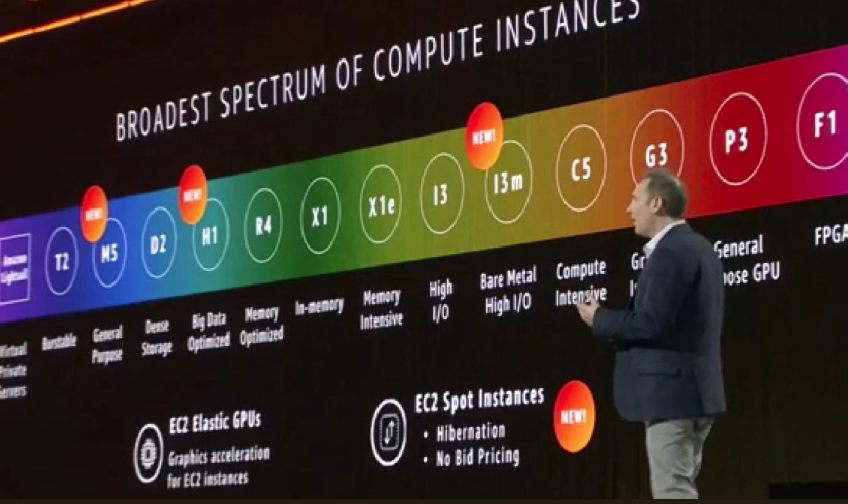
AWS has used re:Invent conference as platform to launch new instance types – and 2017 was no exception: There is a new, general purpose instance with the new EC2 M5, that uses the new Nitro Hypervisor, giving customers more compute and memory than the older machines (see Fig #1). Bowing to the storage trends, AWS started a new instance line with EC2 H1, optimized for high disk throughput and high sequential disk I/O for very large data sets. And in preview, AWS is providing EC2 Bare Metal instances, something previously not expected, but likely a by product of the VMware partnership, and of course a great way to access hardware features (like all bare metal services). On the pricing side, AWS unveiled a new spot pricing model and is now offering hibernation for spot instances.
Figure 1 – Andy Jessy and all AWS instance types
Source: Twitter, @holgermu
Constellation POV:Necessary new instance innovation by AWS, but less than usual. Likely instance development cycles and the re:Invent schedule may not have aligned. But an era to watch. On the flipside CxOs will be happy if they number of instance types will reach a stable level, and with that make the choice, selection and operation of instance types a more stable business. In the past each instance type would cause a little bit of a 'head stir' to CxOs responsible for AWS deployments in regards of optimal allocation of budget vs. compute. Less new instance types and more learning will create a higher comfort level for CxOs to operate on the right instance mix in AWS. AWS did also not address the general instance refresh it promised in spring of 2017 around the S3 caused service disruption[i]. An opportunity to address this important housekeeping item that all IaaS vendors need to address – has been missed. And with that the opportunity to set the standard in the hardware replacement / refreshment debate that is going to happen soon given the general maturation of the industry.
Kubernetes becomes a 1st class citizen for AWS
At the core of IaaS providers are their methods to virtualize instances, achieved with hypervisors. Beyond hypervisors the questions are how can containers be managed efficiently at scale. And as IaaS load moves to microservices, the AWS answer was Amazon Elastic Container Service (ECS), but Amazon had to pay tribute to the rising popularity of Kubernetes, and announced Amazon Elastic Container Service for Kubernetes (EKS). Amazon ECS for itself has done well with user growth up over 450% since 2016 and over 100k active clusters managed by the service and customers launched hundreds of millions of containers each week. Nonetheless Amazon had to pay tribute to the popularity of Kubernetes, not being tired of mentioning that AWS runs more Kubernetes load than anybody else in the cloud. Amazon EKS provides a Kubernetes control plane that is highly available (HA) with three masters across three availability zones (AZs).
And with more container options, AWS also announced AWS Fargate (see Fig. #2), taking care of the often-arduous infrastructure management under a control plane for containers. Fargate supports ECS today, and support for EKS is planned in 2018.
Figure 2 – Andy Jassy announces AWS Fargate
Source: Twitter @holgermu
Constellation POV:At the end of the day, IaaS providers, like AWS, need to scale and scale comes from load that enterprise can / want to run on the respective IaaS. When certain forms of load, in this case Kubernetes container load become critically popular, IaaS providers – no matter how large – need to adopt the new form of load in order to participate in the potential growth. And even very large, even market leading IaaS providers like AWS need to acknowledge the popularity with EKS. Good for enterprises, that have compatible container support for Kubernetes across the popular IaaS infrastructures. Apart from cost, the competition now moves to ease of use of running these container loads, and there AWS has a made a good start with Amazon Fargate. Not surprisingly Amazon Fargate starts with ECS, pointing to the more recent addition of EKS, but with EKS support coming in 2018, this is history.
Databases remain key
One functional area that anchors enterprise load are databases, and Amazon knows that well, offering a large variety of database options on AWS. The one that recently had gotten the most attention has been Aurora, launched a few years ago. Every year Aurora sees new enterprises grade features being added and re:Invent 2017 was no difference, with Andy Jassy unveiling Aurora Multi-Master capabilities, that allows to run Aurora across multiple AWS AZs. And AWS also leverages benefits of a distributed system beyond the HA benefits, which are faster write performance across the instances. Moreover, Amazon wants to make Aurora adoption and rollout easier, making Aurora available serverless, in container, with by the second pricing. Both capabilities are projecting Aurora past market leader Oracle (Jassy mentioned RAC), for the first time – so the RDBMS replacement game that AWS is trying to play will get a little more intense in 2018. For now, both capabilities are in preview, which is AWS way of a controlled beta.
On the Amazon DynamoDB front, AWS caters to the enterprise demand of having to run more and more global systems, adding the ability of global tables. This is the ability of tables being replicated across global dispersed availability zones, taking care of mutual updates. And as enterprises put global applications on Amazon DynamoDB, they also want more efficient ways to backup data (and with a feature like Global Tables, that gets a magnitude more tricky) so Amazon announcing an on-demand backup for DynamoDB is a key and welcome new feature for Amazon DynamoDB.
Not enough with Aurora, Amazon also launched Neptune (see Fig. 3), its native graph database at re:Invent. Graph databases are seeing a recent renaissance, after being largely replaced by relational systems in the last 40 years. The reason for the rise in popularity of graph databases lies in their inherent capability to model relationship – and relationships matter when capturing complex social relations and IoT things relations. Traversing graphs turns out to be faster, more efficient and intuitive and it's clear that AWS wants to have a slice of the use case, announcing Neptune, AWS own native graph database offering. Neptune supports all the popular open source standard for graph database (Apache TinkerPop Gremlin and W3Cs SPARQL, making adoption easier. For now Amazon Neptune is in preview.
Figure 3 – Andy Jassy announces Amazon Neptune
Source: Twitter @holgermu
Constellation POV:Database are critical load anchors for enterprises. When considering moving an enterprise application to the cloud, the question of database portability, migration and replacement always comes up. Amazon has been playing the long game for databases, understanding the demand and continuing to innovate with its native database offerings, Aurora being the most prominent recent example. Good to see the innovation with Amazon Neptune as well, the graph database use case for next generation applications must have bene substantial and too hard to ignore for AWS not to have a native offering in place… we expect good uptake for Amazon Neptune for several next generation application use cases, most prominently IoT. Good to see the innovation on the DynamoDB side, the need for more global support and out of the box replication is very high on the list when CxOs select platforms and / or databases for next generation applications.
The question remains, when will it be enough of capabilities and AWS will be able to entice enterprises to move to e.g. Aurora with larger workloads. It's clear in the long run there need to be more migrations for AWS database bets to turn off – otherwise a lot on premise load will just go to the respective database vendor's cloud. But too early to tell and CxOs like that AWS keeps trying and keeps giving them options.
Machine Learning - Lots of new offerings - Sagemaker and Deeplens stand out
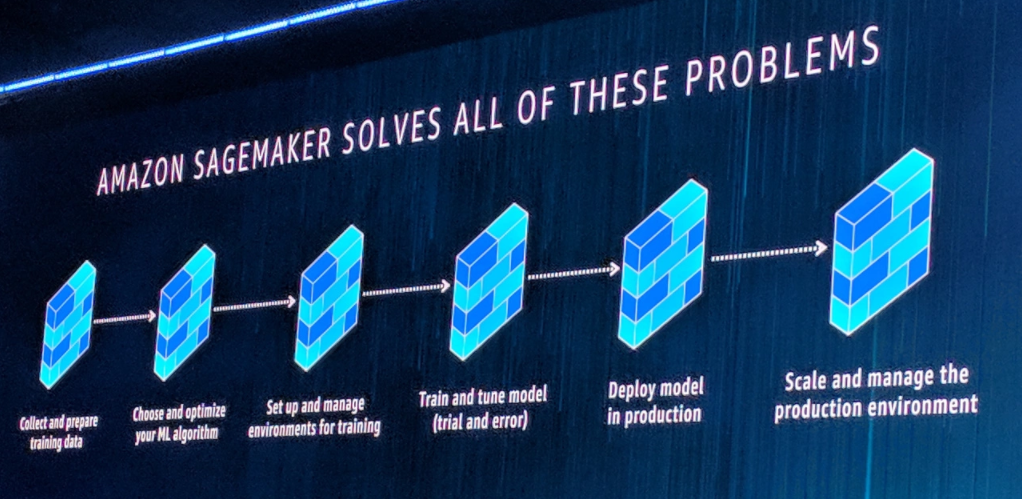
Machine Learning is the new crown jewel for IaaS providers to attract enterprise load, as enterprises need cheap compute and storage to feed their machine learning models. AWS had to reset its Machine Learning approach and strategy in 2016 when it re-positioned to MXNet. But at re:Invent MXNet did not feature very prominently either anymore. Instead, AWS was proud to mention multiple times that it runs the most TensorFlow models in the industry. More specifically, AWS focused on making it easier for enterprise and developers to become builders of machine learning modes, a general trend amongst IaaS providers. To that purpose, AWS made available Amazon SageMaker (see Fig. 4), its product to help both developers and data scientists to build, train and deploy machine learning models. We had time get a detailed demo and presentations and SageMaker is a sold V1 for the product category.
To help customers come up to speed with Machine Learning, AWS announced the Amazon ML Solutions Lab. Amazon machine learning experts will help customers come up to speed with AWS machine learning offerings and help to foster first solutions. Good to see AWS helping its install base get their heads and arms around a modern technology that has a lot of promise for much of software. Along the same intentions Amazon also announced the AWS DeepLens, a camera device that helps developers to build machine learning applications around image and video recognition use cases. In true developer ecosystem seed mode, AWS also offered a free AWS DeepLens to any participant of re:Invent who would pass many Machine Learning sessions.
Figure 4 – Amazon SageMaker and functionality it provides
Source: Twitter (@holgermu)
Constellation POV: Good to see AWS making Machine Learning a priority, one of the key areas of automation that is in high demand by enterprises, as it traverses all next generation application use cases. It's also important, as if one had to pick an area of relative weakness towards other IaaS competitors, then it is Machine Learning. Partnerships with other players around Gluon are the right direction to create value for customers. On the tool side Amazon SageMaker is a good start, first version to convert developers into AI developers. A long path, but definitively worth to try. AWS should and could have aimed higher at also targeting the (technically savvy) business users, who in Constellation view is the ultimate prize inmany dimensions: Propel their own business needs, help enterprises to accelerate with AI and give IaaS vendors the massive load from these applications.
Alexa comes to Business
Amazon has seen tremendous success with its Alexa platform. Not only from a design, technology and architecture approach, but also (and remarkably) from a go to market and partner perspective. Alexa stole the show at CES and MWC in 2017, remarkable for a vendor like AWS, who is not used to play big at these events. Partner enablement has also been a very strong point for Alexa.
But so far Alexa was a consumer, focused home appliance. At re:Invent AWS unveiled its more business-related plans with the voice assistant, starting with hospitality industry and business room use cases. Both are compelling usage of voice assistants, getting a hotel room or conference room to do what guests / users want to do is a substantial challenge, as many have experienced firsthand. Amazon has partnered with the Wynn in Las Vegas (see Fig. 5), and took groups of influencers over to the Encore resort, showing how Alex can automate a hotel room: Lights, drapes, TV, media, customer service andmore are working use cases and the roll out at Wynn resorts and other properties are on the way. Of course, Amazon had to provide some enterprise tweaks to the consumer device, such as mass management, updates and user drive resets, just to name a few.
Unfortunately, not shown (or I missed it) was the meeting room automation. Hours of productivity can be missed (multiplied by the number of participants) in meeting settings while participants are trying to figure out conference call and video conference equipment, display and projector management, AV settings and many more. Overall a very powerful use case for voice assistants.
Figure 5 – The announcement of Google as a IaaS and early adopter of Workforce
Source: Twitter (@holgermu)
Constellation POV: A good move by Amazon, keeping its lead with Alexa over the competition. And what was shared wasn't future, but ongoing projects. Once a vendor has technology that is successful, it only makes sense to apply to more use cases and distribute it widely. Especially when a vendor has done so many things right as Amazon with taking Alexa to market, especially with partners. Will be interesting to learn about more use cases and to follow adoption and rollout through 2018. Very much looking forward to sitting in the first voice assisted conference room.
A key AWS mover- an IDE
In summer 2016 AWS acquired San Francisco based startup Cloud9, who had created a cloud (that is browser) based IDE (Integrated Development Environment). AWS now used re:Invent to properly launch the IDE as an integrated offering with the rest of AWS (see Fig. 6).
A cloud based IDE is a powerful tool for developers, as traditionally all software development happened local to a machine. Moving the development artefacts to the cloud allows more points of access and faster sharing of development work. Collaborative aspects are easier to support, and AWS showed those successfully in the keynote at re:Invent. Cloud9 is well integrated into AWS. It supports all the latest FaaS (Function as a Service) development options and it gives direct terminal access to AWS. Finally, AWS has done well to allow developers to come up to speed quickly, as Cloud9 comes with tooling for over 40 programming languages. Provision, wait for servers etc. is not necessary with Cloud9.
Figure 6 – Vogels unveils Cloud9
Source: Twitter (@holgermu)
Constellation POV: A good move by AWS. Developers tend to stick with their IDEs for a long time, and not having an IDE was a gap for traditionally very developer friendly AWS. But IDEs are like living rooms or sofas – once you have moved in, it takes a lot of effort and motivation to move out. AWS provided all the enticements needed: Starting with programming language support and related tooling, it's easier for developers to try new things. Integration into AWS is another strong argument for Cloud9. Last but not least FaaS needs a hook / starting point and that's the IDE. AWS could simply not afford for developers to live in a living room (that is the IDE) from competitors. Future will have to tell how well Cloud9 gets adopted, but for now it is off to a strong start.
The Bottom Line: AWS executes on all fronts, few but key questions remain
Another record re:Invent, that has literally busted out of the seams of the original Sands Convention Center. It is now sprawling all over the Las Vegas strip. With over 60 product announcements, AWS has certainly not slowed down on the innovation side. With over 40000 attendees, re:Invent has overtaken VMworld and is becoming quickly the yearly get together of the IT industry, an advantageous position for AWS and testament to its relevance for enterprises and vendors.
Effectively, AWS is pushing forward on all fronts, instances, databases, serverless and microservices, machine learning, IoT (no space to cover here) and many more. Notably absent was the traditional new product going after the "old guard" vendors (as AWS likes to call them) as we had seen in past years, with AWS launching email, VDI, center and BI capabilities. The verdict is out if AWS management does not see the 1x% profitable software categories to go after, or if product development timelines and re:Invent collided.
We will see at the many AWS Summits coming in the next months.
On the concern side, AWS needs to keep working on simplification / packaging of the portfolio. The good news is that both Jassy and Vogels picked up on the need for better management and bundling, but that strategy has not reflected itself. The challenge for AWS is to transform itself from a developer's paradise into an enterprise platform that can deliver repetitive results to build next generation applications and puts CxO concerns in regards of replicability at ease. That does not mean the end of innovation, but an easier way for CxOs to choose AWS as a platform as it gives / shows repeatable paths to they desired solution.
One of the emerging concerns is around Machine Learning. Expectations that AWS may announces its own neural network and compete with Google's TensorFlow seem unlikely to happen at this point. Who would have thought that AWS would enter multiple partnerships with Seattle neighbor Microsoft on Machine Learning? The risks for AWS are tangible, if any other IaaS vendor can show faster, cheaper and better Machine Learning performance, it will create a magnetic effect on data. And with data goes load, not to mention that Machine Learning itself creates a lot of load. And load is the mother milk of IaaS vendors success.
Overall CxOs who are charged to build next generation applications for their enterprises, have few things not to like when considering AWS. AWS is doing well, often leading in regards of instance and location build out. If offers the largest number of instance types to match to specific load profiles. Its database offerings are maturing fast and becoming quickly a valid alternative to the traditional databases (that AWS is also more than happy to operate). AWS IoT offerings are doing well, combined with its Snowball appliance, that effectively is becoming more and more an application server. Lock-in concerns can be mitigated to a certain point with EKS, given the broad adoption of Kubernetes. AWS has a strong position on serverless and microservices with lambda and Kinesis, key ingredients for next generation applications. AWS and CxOs care for developer productivity, another key alignment and attraction point. The main concern for CxOs remains around their inhouse developer talent, if their team can find the path to a successful enterprise application – relying on their talent and intuition given the innovation maelstrom AWS presents itself as.
But for now, all things look up for AWS. Cloud9 is a strategic move that must pan out more before it can be fully assessed in regards of potential. Keeping developers happy is vital for AWS success. And Alexa's new use cases show with what laser like focus and industrial strength precision Amazon / AWS can execute. If the competition has not been on notice, it is now.
Vice President and Principal Analyst
Constellation Research
Holger Mueller is VP and Principal Analyst for Constellation Research for the fundamental enablers of the cloud, IaaS, PaaS and next generation Applications, with forays up the tech stack into BigData and Analytics, HR Tech, and sometimes SaaS. Holger provides strategy and counsel to key clients, including Chief Information Officers, Chief Technology Officers, Chief Product Officers, Chief HR Officers, investment analysts, venture capitalists, sell-side firms, and technology buyers.
Coverage Areas:
Future of Work
Tech Optimization & Innovation
Background:
Before joining Constellation Research, Mueller was VP of Products for NorthgateArinso, a KKR company. There, he led the transformation of products to the cloud and laid the foundation for new Business Process as a…...
We had the opportunity to attend Ceridian's yearly user conference Insights 2018, held from October 15th till October 19th at Cesar's Palace Hotel in Las Vegas. Attendance was over 3k, a new record for Ceridian, which has outgrown the Aria, the location of previous Insights conferences.
Prefer to watch – here is my event video … (if the video doesn't' show up – check here)
Here is the 1 slide condensation (if the slide doesn't show up, check here):
Good customer and prospect traction. When vendors do well, good things come to them, in form of more market traction. And Ceridian is doing well, signing up more customers, getting more interest of prospects and gaining in the partner ecosystem. It's frequent that I meet passengers on a plane ride to the event town, but I have had not had conversation with three prospects and one client - across seat rows - on the 50-minute short flight from San Diego to Las Vegas. Take it as an indicator for Ceridian traction. Moreover, Ceridian keeps up the impressive performance of actively converting its legacy payroll customers to its new platform, something I am not aware of anyone else doing in the industry at this scale… all signs of product strength resulting in customer traction.
On demand pay debuts, key for underfunded employees. Cash flow remains an issue for many employees in today's economy… it's the season of 'on demand pay' – as pretty much all vendors in the payroll business are delivering instant pay options to employees / workers. The winner is the employee / worker who can request effectively a cash advance on delivered work – before the pay day. It's an important contribution of the industry to get employees / workers out of the claws of the sometimes-shady paycheck advance industry. Behind the scenes the capability first and foremost requires an 'always on' payroll, meaning a payroll that is always ready to show employees / workers what their current and up to date earnings are. To be efficient, the functionality requires a payroll that is 'always on' – continuously updating earnings positions as payroll relevant events happen. This is what Ceridian has since a while (2012 to be specifc), so the technology behind this new capability is already available.
Ceridian goes deeper into Talent with Succession Planning. Ceridian has been on the long-term quest of completing its Talent Management suite capabilities, and with Succession Planning that journey is concluded. Succession Management remains an important, albeit not critical component of Talent Management, so customers and prospects took note, but were not overly excited about the new capability. Nonetheless, good to see Ceridian finishing up the Talent Management Suite capability now having capability for Recruiting, Onboarding, Performance Management, Learning (own and partners), Compensation Management and Succession Management.
MyPOV
Good to see the market traction for Ceridian, who is a vendor that needs to be shortlisted for any workforce management intensive industryas well as payroll selection scenarios (see the Constellation Shortlist here and here). The in-build combination of workforce management, an always on payroll and now a full Talent Management suite, makes Ceridian a very attractive player for enterprises in the industry. Good to see the vendor also getting the user experience in good shape, historically a challenging area of Ceridian.
On the concern side, Ceridian needs to push the envelope in the direction of Machine Learning / AI in general and voice as the new UI more. Last year at the user conference the vendor showed the most impressive voice demos of all HCM vendors in 2017 – a worker talking to Alexa (?) for an understanding of their shift situation and executing a shift swap. No demo this year, the vendor citing keynote time reasons… Behind an effective Machine Learning / AI strategy is the move to public cloud, to be able to leverage cheaper compute, spare capacity, low cost storage and overall compute elasticity. And Ceridian says the Dayforce suite runs on public cloud IaaS (Azure) but needs to move there for good. When the whole industry is moving to IaaS, it's time for all vendors to move there to level the field.
But overall an impressive event, Ceridian is doing well and for now the technology concerns mentioned do not concern customers and prospects, so Ceridian is … on a roll and critical to do what enterprises need to do move - be ready to accelerate and effectively accelerate in order to survive and / or thrive.
Vice President and Principal Analyst
Constellation Research
Holger Mueller is VP and Principal Analyst for Constellation Research for the fundamental enablers of the cloud, IaaS, PaaS and next generation Applications, with forays up the tech stack into BigData and Analytics, HR Tech, and sometimes SaaS. Holger provides strategy and counsel to key clients, including Chief Information Officers, Chief Technology Officers, Chief Product Officers, Chief HR Officers, investment analysts, venture capitalists, sell-side firms, and technology buyers.
Coverage Areas:
Future of Work
Tech Optimization & Innovation
Background:
Before joining Constellation Research, Mueller was VP of Products for NorthgateArinso, a KKR company. There, he led the transformation of products to the cloud and laid the foundation for new Business Process as a…...
We had the opportunity to attend Workday's Rising conference, held from September 30th till October 3rd, 2018, held at the Mandalay Bay resort in Las Vegas. The event had record breaking attendance, in every dimension: Attendees, hotel, partners, expos, conference program etc. always a sign of a growing vendor.
Prefer to watch – here is my event video … (if the video doesn't' show up – check here)
Here is the 1 slide condensation (if the slide doesn't show up, check here):
One more analytics push – Reporting, BigData, Analytics, Machine Learning are all topic that Workday has been addressing continuously across the 6 Workday Risings I have covered. No surprise, this year – given the recent acquisition of Adaptive Insights, the topic was given substantial keynote time. Question remain on integration, UI harmonization and it's too early to declare that Workday has solved the overall analytics challenge, but it is closer than ever to close this 6+ year journey.
Workforce Planning and Skills Cloud – A long term desire from HR practitioners is to solve the planning problem, that across the board has not been addressed well by the vendors in the market, leaving enterprises to use with 3rd party platforms and tools. Given the importance not a good solution, so good to see that Workday is trying to tackle this important area. The other key functional announcement was around the Skills Cloud – an area that as well has eluded practitioners in the past from a standpoint of out-of-the-box automation by all vendors. Skills have been a long-term ambition by Workday as well, trying to solve tricky ontology question with acquisitions and inhouse.
PaaS for Build gets Real – The move into PaaS is key for Workday customers, as for all SaaS vendors. In the era of business process uncertainty, a PaaS gives customers the confidence to use a SaaS vendor – as when automation does not fit, they can build what the need. In 2018 it requires also to build standalone apps, a capability that Workday promised at Rising in 2017, and delivered this year. Always good to see vendors keeping their roadmap promises.
Update from Rising 2018 – Vienna
Being uncharacteristically late with this job post, opened it to be overtaken news wise by Workday Rising Europe, held in Vienna, November 13th – 15th 2018. Largest user conference for Workday in Europe as well. The big news was Workday disclosing its progress moving its offering to AWS. First customers in North America are live, so no it comes to rollout. After Canada, USA is next, and Germany has been announced to come first half of 2019. The latter is key to allow customer to comply with GDPR and ease Patriot Act related concerns of running their servers in North America. Good to see Workday deliver on its announcement from AWS reinvent conference a year ago.
MyPOV
Good progress by Workday, pushing functionality across the board and (hopefully) solving the Analytics challenge now with Adaptive Insights, it's largest acquisition ever. Good to see the PaaS progress and interesting innovation with the Skills Cloud.
On the concern side, Workday for a long time claimed the thought leadership for HCM, but to keep that lead it needs thought leading functionality and innovation in the core business applications. This was missing (at both) Workday Risings, and it possibly caused by the re-platform efforts that are happening in the background. For 2019 Workday will have to deliver some big thought leadership functionality to keep that lead. That the competition is idling in this key department is a frustration for HR practitioners all across the world
But overall an impressive, well-choreographed event, as usual at Risings. Good news on customer traction, partner interest and platform /analytics innovation. Now it comes to see how customers and prospects will update the new capabilities.