Principal Analyst and Founder
Constellation Research
R “Ray” Wang is the CEO of Silicon Valley-based Constellation Research Inc. He co-hosts DisrupTV, a weekly enterprise tech and leadership webcast that averages 50,000 views per episode and blogs at www.raywang.org. His ground-breaking best-selling book on digital transformation, Disrupting Digital Business, was published by Harvard Business Review Press in 2015. Ray's new book about Digital Giants and the future of business, titled, Everybody Wants to Rule The World was released in July 2021. Wang is well-quoted and frequently interviewed by media outlets such as the Wall Street Journal, Fox Business, CNBC, Yahoo Finance, Cheddar, and Bloomberg.
Short Bio
R “Ray” Wang (pronounced WAHNG) is the Founder, Chairman, and Principal Analyst of Silicon Valley-based Constellation Research Inc. He…...
This just in! 📣 FinancialForce announces its rebrand to Certinia to better reflect its evolution around delivering Services as a Business.
In the following interview, Chief Product and Strategy Officer Dan Brown explains to R "Ray" Wang why Certinia outgrew the "FinancialForce" name in its shift towards #customercentricity and #customersuccess.
Certinia's strategies are enabling enterprises like Hewlett Packard Enterprise and DocuSign to achieve successful #GTM strategies, improved operations, and better customer outcomes.
Keep an eye on Certinia as it keeps rolling out new and exciting projects in the coming months! #ServicesAsABusiness #PSA #CloudERPc
Editor in Chief of Constellation Insights
Constellation Research
Larry Dignan is Editor in Chief of Constellation Insights at Constellation Research, where he leads editorial coverage focused on enterprise technology, digital transformation, and emerging trends shaping the future of business. He oversees research-driven news, analysis, interviews, and event coverage designed to help technology buyers and vendors navigate complex markets with clarity and context. ...
The debate over process and business automation platforms is about to heat up as enterprises look to optimize their technology spending.
This bake-off between best-of-breed process automation offerings and the "suite or platform always wins" will likely become more evident as ServiceNow and SAP both hold their big customer conferences, Knowledge and Sapphire, next week.
Here's a look at some of the recent and upcoming process automation moves:
UIPath is broadening its focus from robotic process automation to its business automation platform.
SAP launched SAP Datasphere, which collects and federates business data across SAP and non-SAP data sources.
SAP has partnered with UIPath to couple the UIPath automation platform with SAP's process automation efforts. SAP has also partnered with Collibra, Confluent, Databricks and DataRobot on the data layer.
ServiceNow's Utah release includes process mining, RPA and other new features to fuel enterprise automation efforts. "ServiceNow has AI, process mining, RPA, low-code and many other technologies built natively into a single workflow automation platform," said ServiceNow CEO Bill McDermott on the company's first quarter earnings conference call.
Celonis has its Execution Management System (EMS) with its World Tour conferences coming up. Disclosure: I used to work for Celonis.
And Microsoft is fusing its generative AI push with its automation platform plans. "From customer experience and service to finance and supply chain, we continue to take share across all categories we serve as organizations like Asahi, C.H. Robinson, E.ON, Franklin Templeton, choose our AI-powered business applications to automate, simulate and predict every business process and function," said Microsoft CEO Satya Nadella on the company's fiscal third quarter earnings conference call.
Simply put, you're going to hear a lot about process and business automation platforms. Toss in generative AI and it won't be hard to play a tech conference drinking game or two. You can also expect more vendors to enter the process automation mix. Is it much of a reach to see Salesforce taking Mulesoft, which already has connectors to enterprise applications, becoming an automation platform?
The big picture
Anyone who has been in the enterprise tech industry knows that all of these aforementioned vendors see themselves in the middle of the process automation ecosystem and then expanding into new industries and verticals.
Until recently, enterprises were fine with using multiple vendors and platforms for process automation. Today, companies are looking to optimize and be more efficient. Not all vendors are going to win.
What the process automation argument in the US will come down to is whether enterprises think more best of breed or go with the discounts associated with consolidating vendors.
This debate has been bubbling up for months. In January, UIPath CEO Rob Enslin said at an investor conference:
"At certain point, best-of-breed solutions become complex to manage because there's too many pieces to it. So, if you look at our UiPath platform, business platform, you could probably plug in 20, 30 different product vendors into that platform.
And if you go to many of these Global 2000 companies, they've got 10, 15, 20 vendors running on process modeling, process mining, another one for task mining, something else for testing, right, somebody else for document understanding and so on. You can go through the whole process. And then, they have logs going to Splunk to manage the thing. And it's just very complex for them to manage, and it's very complex for them to bring in a systems integrator, because they don't have somebody that has that kind of skill set. They don't have -- they don't want to bring in 10 people, it's just not cost effective."
Enslin's point is that large enterprises will take good enough process mining for the overall automation play.
The scrum ahead
The battle to be the business process automation platform of choice will likely heat up with SAP, ServiceNow and Microsoft making cases at their big conferences in the weeks ahead. Consider:
SAP systems already hold most critical data from operations. Via the acquisition of Signavio, SAP added process modeling and mining tools. Datasphere aims to go beyond SAP data stores. SAP CEO Christian Klein said SAP will outline how AI fits into the mix at its Sapphire conference May 16 and May 17.
"Our AI is built for business, with AI capabilities built in to deliver strong business outcomes for our customers' most critical business functions. And with Datasphere, we laid the strongest data foundation in business. We are in the advanced stages to apply generative AI across our portfolio, and we are working as an early release partner of OpenAI and together with other vendors. We are planning to announce new disruptive AI use cases. Stay tuned for Sapphire."
ServiceNow CEO McDermott is looking at process automation through a workflow lens. ServiceNow is betting its platform can be extended throughout business processes. He said:
"The ServiceNow Utah release was engineered to drive faster business outcomes for our customers. The release includes AI-powered process mining, with robotic process automation capabilities, additional search enhancements, expanded workforce optimization and health and safety incident management. These are all designed to help increase automation, simplify experiences and offer greater organizational agility.
It bears repeating that while customers are aware of market excitement for individual technologies like generative AI, they expect a platform strategy to integrate the various tools. ServiceNow has AI, process mining, RPA, low-code and many other technologies built natively into a single workflow automation platform. Of course, we will have much more to say about all of this at our Knowledge event in Las Vegas on May 16."
Microsoft's Build 2023, which kicks off May 23, is heavy on the generative AI and ChatGPT, but there are multiple sessions on automation. Celonis holds its first World Tour 2023 stop in Munich May 23.
Learn more about Doug's latest report on analytics and BI markets:
Vice President & Principal Analyst
Constellation Research
About Liz Miller:
Liz Miller is Vice President and Principal Analyst at Constellation, focused on the org-wide team sport known as customer experience. While covering CX as an enterprise strategy, Miller spends time zeroing in on the functional demands of Marketing and Service and the evolving role of the Chief Marketing Officer, the rise of the Chief Experience Officer, the evolution of customer engagement, and the rising requirement for a new security posture that accounts for the threat to brand trust in this age of AI. With over 30 years of marketing experience, Miller offers strategic guidance on the leadership, business transformation, and technology requirements to deliver on today’s CX strategies. She has worked with global marketing organizations to transform everything from…...
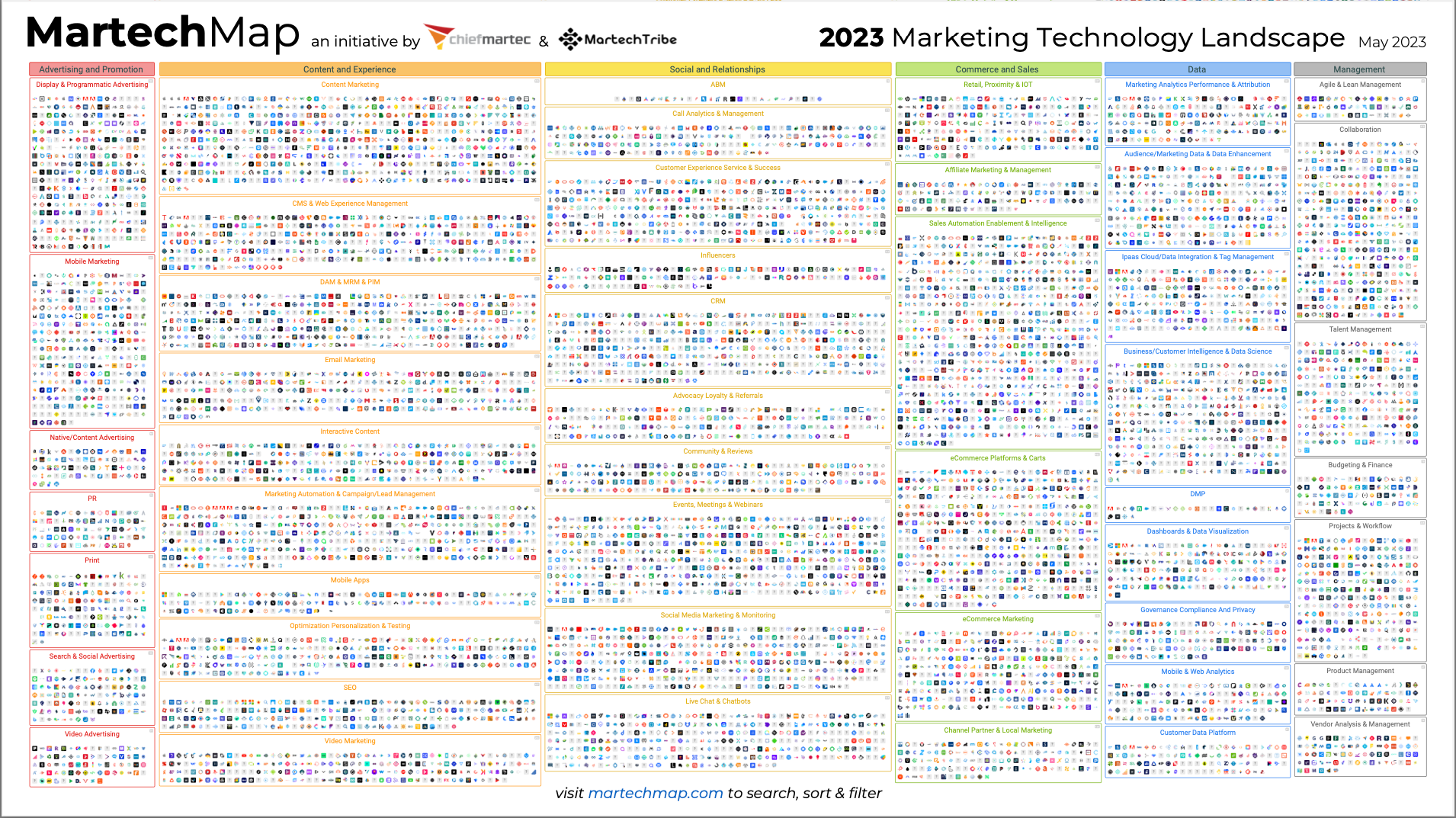
Every year, ChiefMarTech…helmed by the ever-brilliant Scott Brinker…puts on the magnifying glasses, throws on the digital muck boots and wades through the swamp of Marketing Technology to compile the annual extravaganza called the MarTech Landscape Supergraphic. You can check it out as an interactive experience at Martechmap.com thanks to the teams at ChiefMartech and the Martech Tribe.
In April 2020, when I was still a “rookie” here at Constellation Research, I wrote in wonder and exhaustion that the landscape had ballooned to include 8,000-plus solutions. At that time, I called the graphic a representation of a beast chasing down marketers…a manifestation of the Frankenstack that was lumbering about promising engagement while delivering confusion and complexity. I called it a Clash of Clans map where you could imagine the rebel land of CDP was poised to devour the kingdom of DMP.
Had you told me that 3 years and 1 pandemic later I would be talking about 11,000+ solutions arranged into something that looked like a DNA sequencing map, I would have laughed. I would have also hoped it was a lie. But here we are. 11,038 solutions categorized, organized and searchable depicting the chaos known as the marketing stack.
Let’s dig in with a couple highlights:
The landscape is split into 6 primary categories across 49 individual segments but take a closer look…the column that once dominated the marketing landscape, namely advertising and promotion, has shrunk, much like the DMP section within the Data column. The reality here is that many of those DMP players have escaped, some seeking asylum within the Audience Data category, others masquerading as CDPs.
689 companies were removed from the landscape between 2022 and 2023 (7% churn), some thanks to acquisition, but others because of business closure.
The growth rate of the space has slowed to 10% year over year. By comparison, in 2020, the growth rate for new market entries was 24.5% with a churn rate of 8.7%. While the slowdown has provided a bit of respite for weary marketers exhausted by the endless sales pitches, don’t expect the slowdown to remain. Afterall, AI hasn’t earned its own segment yet.
11,038 products are included but there are a couple omissions which is bound to happen. For example, Oracle Unity is a CDP not included in the category. Salesforce CDP or even mention of Genie or Data Cloud is missing. Brightspot is listed as a DAM, but not a CMS. HCL has a DAM offering that is included with their DX solution…should it be listed, or not because it isn’t sold as a standalone? On and on it goes. I mean Constellation Research isn’t included in the Vendor Analysis & Management section…not that I’m feeling left out or anything. Let’s just agree the actual number of solutions is actually higher 11,038.
While a by-the-numbers view of the sprawling landscape can feel overwhelming, the continued growth is also totally understandable. Customer engagement and more specifically the ways our most profitable customers want to engage with brands has become increasingly complex. While we need the data to power ambient experiences, we also need the traditional investments in events and moments that are indelibly etched into a customer’s lifetime of experiences.
We need to accept that any collapse or consolidation of the market will happen in small corners…like adtech or DMPs…for now. The moral of this year’s landscape is that this is not getting easier. We haven’t hit a point of mandatory and potentially cataclysmic consolidation. For every logo that disappears, 8 more emerge like an angry Gremlin confronted with water.
There is still the AI factor that could shift this landscape in any number of ways. Instead of disconnected point tools, AI could be the great consolidator, pulling data across these segmented systems and driving new efficiency in intelligence operations in new ways. The connection between AI’s capacity to analyze data at machine scale and empower work at human scale is undeniable. Joining AI’s intelligence output with automated workflows promises to herald in a new age of near real time customer journey optimization. Instead of collaboration tools to connect people around conversations, expect to see AI empowered work and collaboration tools that start to manage how humans collaborate with AI and, eventually, how machines collaborate with other AI managed machines.
Perhaps the very section I lament not being included in is the very section that could save us. I’m not suggesting that we analysts will save the stack…rather that 2023 might be the year of the vendor catalogs and technology management tools. We have officially hit the phase of operations where we must step back and admit that we can’t know what we don’t know.
So, use the stack builder page on the MarTechMap site. I myself have the urge to build out a stack using nothing but icons in the form of animals. Take the time to build a bill of materials for experience on a solution like CabinetM…start with MarTech but expand out beyond marketing’s walls to include any and all solutions that touch the customer or deliver experiences. Even if you think you took a single vendor approach…I guarantee you have a rogue implementation of something hiding in a corner.
If there is a single call to action I land upon after analyzing this landscape it is this: get on those muck boots and wade through the known and unknown of all the engagement stacks out there. Drag it all out into the light. Get your CIO colleagues involved. Let it be a bonding exercise in radical tech and data transparency. But do it now. Choice drives innovation and transformation. It also sows chaos. Time to go tame the chaos.
Editor in Chief of Constellation Insights
Constellation Research
Larry Dignan is Editor in Chief of Constellation Insights at Constellation Research, where he leads editorial coverage focused on enterprise technology, digital transformation, and emerging trends shaping the future of business. He oversees research-driven news, analysis, interviews, and event coverage designed to help technology buyers and vendors navigate complex markets with clarity and context. ...
Apple's fiscal second quarter revenue fell as expected, but the drop was less than feared. The results highlight how Apple has been able to weather a weakening economy.
The company reported second-quarter revenue of $94.8 billion, down 3% from a year ago. Apple reported second quarter earnings of $1.52 a share.
Wall Street was expecting second quarter earnings of $1.43 a share on revenue of $92.96 billion. For the June quarter, Apple is expected to deliver earnings of $1.21 a share and revenue of $84.5 billion.
Constellation Research analyst Holger Mueller's take:
"Apple’s product and service portfolio is not recession proof. CEO Tim Cook and team managed to keep selling, general and administrative costs constant year over year, while R&D investment is up by $1B.
Once more Apple is becoming even more the iPhone company, with the iPhone the only product category growing. After 6 months into the fiscal year, we see that Apples is more the iPhone company than ever. The pressure on strong iPhone launch in 2023 is rising."
Here's a look at the key takeaways:
Apple is a cash cow.
Apple is a cash machine and its dividend and stock buyback reinforce the company's image as a safe haven for investors in what Cook called a "challenging macroeconomic environment." Apple generated operating cash flow of $26.8 billion in the March quarter and authorized $90 billion to repurchase common stock.
Apple is a cash cow because it's increasingly a services company.
For the three months ended April 1, Apple services revenue was $20.9 billion, up from $19.8 billion. Apple's installed base enables the company to sell you more services.
Apple CFO Luca Maestri said:
"The continued growth in Services is the reflection of our ecosystem strength and the positive momentum we are seeing across several key metrics. First, our growing installed base of over 2 billion active devices represents a great foundation for future expansion of our ecosystem."
Hardware has taken a hit.
Product revenue for Apple checked in at $73.93 billion, down from $77.46 billion. Apple's revenue decline isn't completely unexpected given that IDC said first quarter global smartphone shipments fell 14.6% from a year ago. However, Apple's first quarter shipments were down 2.3% from a year ago, according to IDC. That tally was better than Samsung's first quarter decline of 18.9%.
PC sales fell 29% in the first quarter compared to a year ago, said IDC. Apple's shipments fell 40.5% in the first quarter compared to a year ago. That decline was worse than other global vendors such as Lenovo, HP and Dell, which saw declines between 24% to 31%.
But it's still all about the iPhone.
Apple's iPhone sales were $51.33 billion in the second quarter, up from $50.6 billion a year ago.
Mac sales tanked and iPad didn't do much better.
Apple's second quarter Mac revenue was $7.17 billion, down from $10.43 billion a year ago. Like most PC vendors, Apple has a hangover from pandemic era laptop purchases.
Cook said:
"Mac faced a very difficult compare because of the incredibly successful rollout of our M1 chip throughout the Mac lineup last year. And like our other product lines, Mac is facing some macroeconomic and foreign exchange headwinds as well."
Ditto for the iPad, which saw sales of $6.67 billion, down from $7.65 billion a year ago.
Apple Watch keeps wearables and accessories steady.
Apple's wearables business held the revenue line with second quarter sales of $8.76 billion, down from $8.8 billion a year ago.
Apple sales steady in Europe.
Apple's regional results are worth noting. Americas second quarter revenue was $37.78 billion, down from $40.9 billion a year ago. Europe had a slight gain with sales of $23.94 billion. China sales in the second quarter were $17.8 billion, down from $18.34 billion.
Japan second quarter revenue was $7.2 billion, down from $7.72 billion a year ago. Rest of Asia Pacific sales were $8.12 billion, up from $7.04 billion a year ago.
Bonus: Is Apple an enterprise company?
Cook was asked whether Apple's enterprise sales were large enough to worry about IT spending trends. Apple doesn't break out corporate vs. consumer sales. He said:
"Internally, we have our estimates for how much is enterprise versus consumer. And the enterprise business is growing. We have been focusing a lot on BYOD programs and there's more and more companies that are leaning into those and given employees the ability to select which is plays to our benefit, I believe, because I think a lot of people want to use a Mac at work or an iPad at work."
But we're certainly primarily a consumer company in terms of our revenues, obviously.
Editor in Chief of Constellation Insights
Constellation Research
Larry Dignan is Editor in Chief of Constellation Insights at Constellation Research, where he leads editorial coverage focused on enterprise technology, digital transformation, and emerging trends shaping the future of business. He oversees research-driven news, analysis, interviews, and event coverage designed to help technology buyers and vendors navigate complex markets with clarity and context. ...
Salesforce's Slack launched SlackGPT, its generative AI technology, that will enable customers to use the language model of choice, summarize conversations and offer writing tips.
According to Slack, Slack GPT will be able to use a series of models. For instance, Slack will be able to leverage OpenAI's ChatGPT or other partner apps, feature native AI and tap into Salesforce data via a new Einstein GPT app.
This approach reflects the reality that enterprises are likely to use multiple AI services as well as bots. While OpenAI ChatGPT has captured mindshare, there are a bevy of services for enterprises to consider as well as legacy investments.
Salesforce and Slack announced the news ahead of its New York World Tour stop.
Slack said:
“As the ecosystem of generative AI tools expands, flexibility will only become more important. Whether you build with clicks, code, or a bit of both, our open, extensible platform lets you decide when and how you bring AI into Slack.”
According to the company, generative AI should be incorporated into the way people work today. The Slack vision, which rhymes with what Microsoft is planning with its Co-Pilot initiative, is that generative AI will be built into your existing applications.
Slack said that Slack GPT can offer assistance to tweak drafts, adjust tone and distill content.
Editor in Chief of Constellation Insights
Constellation Research
Larry Dignan is Editor in Chief of Constellation Insights at Constellation Research, where he leads editorial coverage focused on enterprise technology, digital transformation, and emerging trends shaping the future of business. He oversees research-driven news, analysis, interviews, and event coverage designed to help technology buyers and vendors navigate complex markets with clarity and context. ...
Zoho outlined a broad set of products as well as a generative AI roadmap that fuses OpenAI's ChatGPT with its own Zia AI engine. Overall, Zoho, known best as a business operating suite for small businesses, is reaching for midmarket and larger enterprises as well as "solopreneurs" as it expands from its core SMB market.
The news, delivered at its Zoholics user conference in Austin, comes at an interesting time. For starters, larger enterprises are looking to optimize their tech spending and CXOs may look more to Zoho. In addition, the layoffs at technology firms mean that many productive employees are going to be starting their own small businesses and Zoho is a strong turnkey option.
Indeed, Zoho has a three-year 65% CAGR among midmarket and enterprise customers, which represents a third of its business. Zoho has more than 90 million users across more than 600,000 global businesses of all sizes. Zoho CEO Sridhar Vembu said the company's "humble roots in SMB" have given it the ability to be a seamless enterprise vendor.
The following items will get a deeper dive from Constellation Research analysts on scene, so we'll keep it brief. Here's everything that Zoho announced.
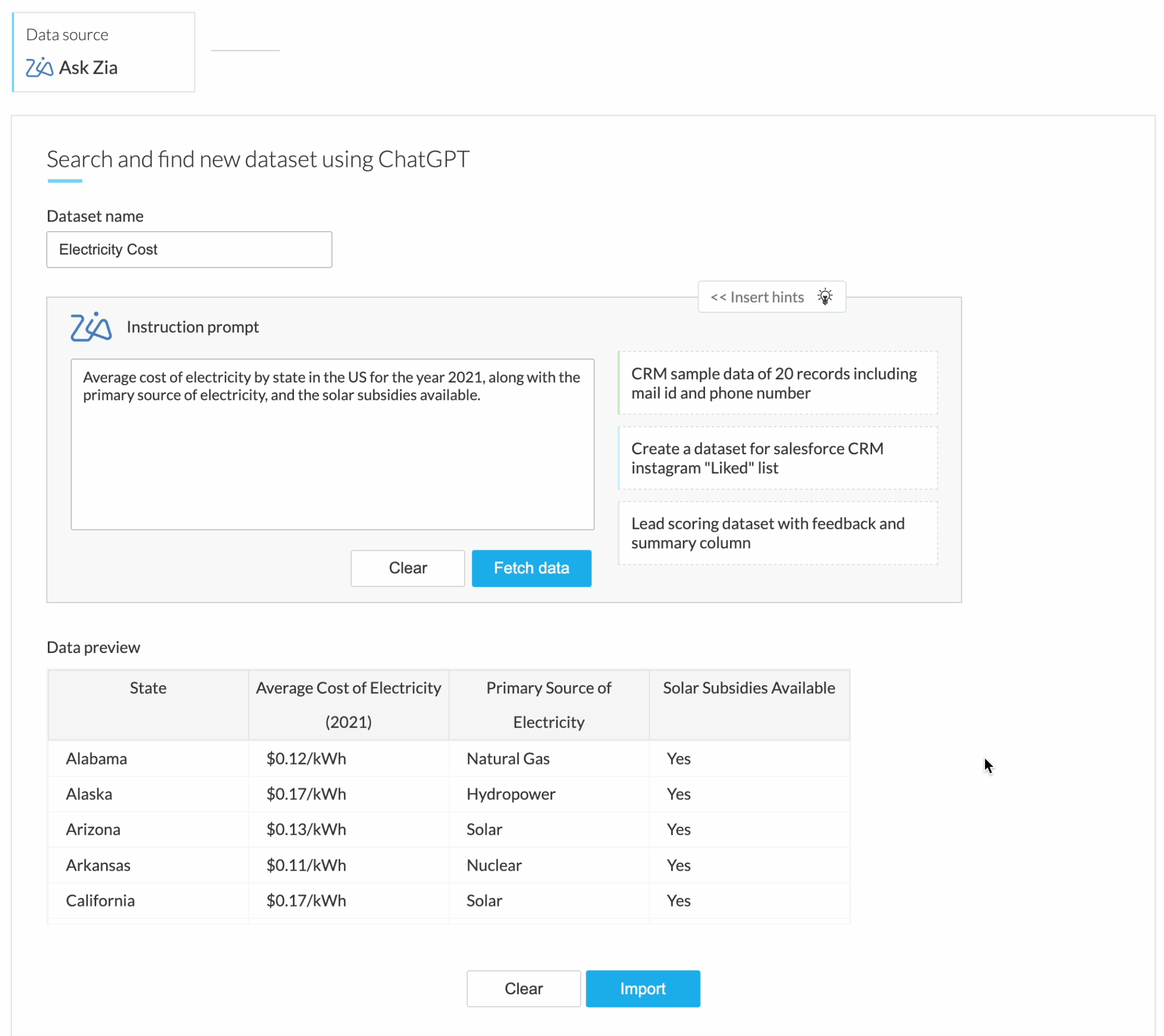
Zoho launched ChatGPT for Zoho, which will combine OpenAI's software with Zoho Zia. ChatGPT will be integrated with Zoho Desk, Social, Writer, Mail, Assist, SalesIQ and Landing Pages.
According to the company, this ChatGPT integration will be the first of many to address image creation, translation and speech to text.
Zia, Zoho's AI engine, will be utilized for analytics, reports, sales prediction and other prescriptive actions.
Midmarket and large enterprise investments
Zoho said it will expand its Zoho Marketplace reach and extend integration with enterprise incumbent software. Large enterprises can leverage more than 1,800 extensions and build their own workflows to Zoho applications.
This extensibility will be available through no-code and low-code deployments. These low-code tools have been integrated into Zoho design, data collection, orchestration and access control tools to name a few. Among other moves:
The company launched Zoho Contracts to address the contract management lifecycle, a common enterprise pain point. The goal is to offer contract authoring, approval, negotiations and signatures in one spot with Zoho's Zia AI engine providing automated workflows and reminders.
Zoho said it will integrate Zoho DataPrep with Zoho CRM to transform and cleanse customer data, integrate with third party systems and weed out data issues.
On the security front, Zoho outlined enhancements to Zoho OneAuth and Zoho Directory as well as launched Ulaa, a web browser with built-in privacy.
Zoho said it will invest in its Enterprise Business Services (EBS) organization to expand its global and industry reach. Zoho's services group serves multiple verticals today.
The company is developing its partnerships with systems integrators including Tata Consultancy Services, Deloitte, PricewaterhouseCoopers, Infosys, Tech Mahindra, Hexaware and Wipro.
Zoho will also add new regional offices to support large enterprises. It will also better support large global procurement offices by accepting multiple currencies for payment.
Targeting freelancers and solopreneurs
Zoho also announced the public beta for Zoho Start, Zoho Publish, Zoho Tables and Zoho Solo.
The general idea is to make it easier to start businesses. Zoho Solo is a unified mobile-first system for running a business priced at $9.99 a month. Zoho Solo will be connected to the following:
Zoho Start, a tool for filing legal paperwork to start a business. Zoho Start will include integrations with Zoho Books for financing, Zoho Domains for online presence and Zoho Voice for telephony.
Zoho Publish, which will publish business contact information on listing services, Google Maps and review sites.
Zoho Tables, a spreadsheet for mobile business.
Zoho Start is in public beta with availability in Texas with California and Delaware on deck. Pricing starts at $99 plus the state filing fee.
Editor in Chief of Constellation Insights
Constellation Research
Larry Dignan is Editor in Chief of Constellation Insights at Constellation Research, where he leads editorial coverage focused on enterprise technology, digital transformation, and emerging trends shaping the future of business. He oversees research-driven news, analysis, interviews, and event coverage designed to help technology buyers and vendors navigate complex markets with clarity and context. ...
Starbucks CEO Laxman Narasimhan, who took the helm March 20, said the company is revamping processes in stores as well as the supply chain to enable a strong customer experience. The goal: Enable human connections digitally.
Narasimhan said Starbucks is starting to see a payoff from its digital transformation and efficiency efforts outlined last year. "There is more work to do to tailor our stores for the demand that we see, advance our technology, advance how we innovate our equipment and more fundamentally get back to focusing on fundamental operations and executing better," he said on Starbucks' fiscal second quarter earnings conference call.
"We see significant efficiencies in our supply chain, support systems and processes," added Narasimhan, who noted that Starbucks is trying to simplify. For instance, the company currently has more than 1,500 cup and lid combinations across its network. Starbucks has 36,634 stores globally.
In front of that efficiency drive, Starbucks is leveraging its digital footprint and Starbucks Rewards membership. In the first quarter, Starbucks added 400,000 members for 30.8 million members in the US. That membership program creates a data flywheel for Starbucks to personalize customer experiences. "Starbucks is uniquely in the business of human connection," said Narasimhan.
In the second quarter, Starbucks Rewards accounts represented 57% of US company-operated revenue. Mobile orders represented 47% of US sales. Narasimhan added that Starbucks will continue to invest in its technology stack and roll out tools like scheduling applications that improve employee and customer experiences.
Narasimhan said Starbucks is just starting to see the payoff from its digital transformation efforts and has a long runway ahead. "We can enhance our tech stack both to lower costs and reinvest it back into the tech stack to support the large digital push we are making," he said.
Starbucks is a confirmed ServiceNow, AWS, SAP, Microsoft and Salesforce customer based on job listings and vendor case studies.
Here's a look at Starbucks digital transformation plans currently underway.
The process optimization effort
The second quarter earnings and debut of new CEO come a few months after Starbucks outlined a far-reaching overhaul at its 2022 Investor Day. Starbucks outlined how it is revamping processes across its stores and supply chain, deploying more automation and simplifying work for its all-important baristas. The takeaway: Starbucks is planning to continually improve technology and processes to hit its targets for 2025.
In September, Starbucks projected earnings per share growth of 15% to 20% annually over the next three years with global and US same-store sales rising 7% to 9% annually. By the end of 2025, Starbucks expects to have 45,000 locations worldwide. Starbucks reiterated its 2023 outlook on its second quarter earnings call.
Deb Hall Lefevre, Starbucks Chief Technology Officer, said during Investor Day that the company's technology strategy and processes will revolve around enabling partners as well as customers. "We will never replace our baristas," said Lefevre. "We are instead laser focused on how we enable our partners. Our job is to automate the work and simplify it, so their job is easier and more joyful."
Lefevre said Starbucks will leverage real-time data to automate store tasks, provide task management tools and build playbooks for shifts. "Things just need to work," she said.
The customer experience plan
The returns on digital transformation at Starbucks clearly intersect with customer experience.
Frank Britt, Executive Vice President and Chief Strategy and Transformation Officer at Starbucks, said the company approach is designed to include the lifetime value of a partner (employees) as well as a customer. "If we create more value for partners, the benefits are enormous. We spend less money to acquire relationships because we have higher retention, and we get more value. This idea is very much in the new thinking of Starbucks," said Britt.
Starbucks created an experience innovation center with complementary store and operations processes, said Britt. Starbucks will reinvent its stores to be more purpose-built for demand shifts such as cold brew, mobile ordering and drive-through.
"We are reimagining the future of our stories and what it looks like for our partners as well as customers," said John Culver, group president of Starbucks North America and Chief Operating Officer.
Culver added that Starbucks would "reduce complexity and make work easier for our partners" so they can spend more time with customers. To get there, Starbucks will simplify tasks tied to preparing drinks and food and leverage automation. Culver added that Starbucks will invest $450 million in its existing US store base in fiscal 2023 with continued investment in fiscal 2024 and 2025.
The art of simplification
To simplify processes for front-line workers, Starbucks is simplifying tasks across beverages and food as well as modernizing its IT architecture.
Lefevre said the company will focus on multi-tasking tools, multi-use hardware and supporting shifts with technology to speed up service, remember customer favorite orders and automate tasks. "We have a number of things in flight that automate tasks and streamline processes," said Lefevre, who added that handheld ordering, automated receiving and counting and automated ordering are efforts that will free up partners to connect with customers.
Other transformation efforts include:
New processes that will enable a barista to make a Mocha Frappuccino 51 seconds faster than the 86 seconds for the current process today.
A new brewing system called Clover Vertica can freshly grind and brew a cup of coffee in 30 seconds with improvement in quality and waste reduction.
Faster cold brew technology. Cold brew today is steeped for 20 hours and takes more than 20 steps to make. The new process automatically grinds and presses coffee beans and cuts waste by 15%. Culver said: "Across 16,000 stores, 365 days a year, (cold brew) takes a lot of time. When you consider that we spend more than $50 million a year on labor to brew our cold coffee this is a significant game changer for us. From 20 steps to 4 and from 20 hours to a matter of seconds we are completely reinventing the experience for our partners and customers."
Supply chain automation. Culver said Starbucks has implemented automated ordering for merchandise and food in stores. Culver explained how automation in the supply chain would free up time for partners.
Culver said:
"We implemented automated ordering across all of our stores for food, as well as merchandise. This work we've done on automation has enabled us to reduce the time spent by partners doing manual counting of SKUs daily. In addition, we're leveraging our analytics and insights team to get the right products in the right stores at the right time."
Editor in Chief of Constellation Insights
Constellation Research
Larry Dignan is Editor in Chief of Constellation Insights at Constellation Research, where he leads editorial coverage focused on enterprise technology, digital transformation, and emerging trends shaping the future of business. He oversees research-driven news, analysis, interviews, and event coverage designed to help technology buyers and vendors navigate complex markets with clarity and context. ...
OpenAI's ChatGPT-4 may be coming to a real estate traction near you as Zillow and Redfin start testing the generative AI technology in their applications.
“The past few months have marked a tectonic shift in the broader technology landscape with the introduction of OpenAI’s ChatGPT-4. The arrival of conversational generative artificial intelligence (AI) may be a platform shift on par with the introduction of the graphical user interface or the touch interface on the first smartphones. “
Zillow noted that it has been using AI, machine learning, computer vision and data science since 2006. The company's well-known Zestimate for properties uses machine learning algorithms to crunch data. In February, Zillow outlined its Neural Zestimate, which is based on deep learning to reflect market trends nationally.
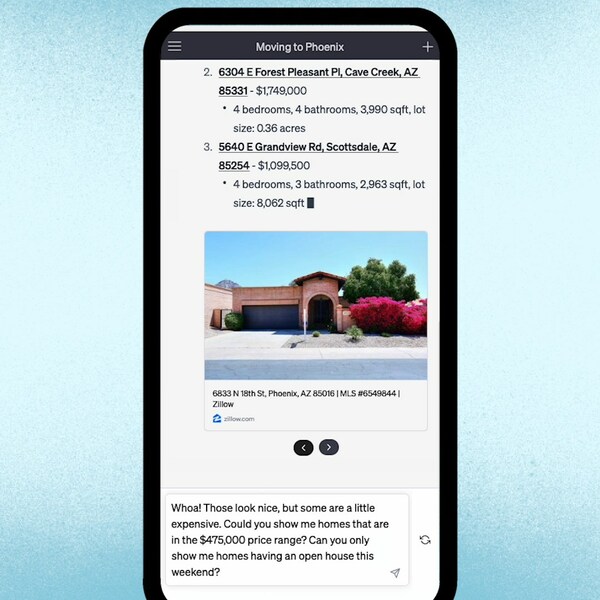
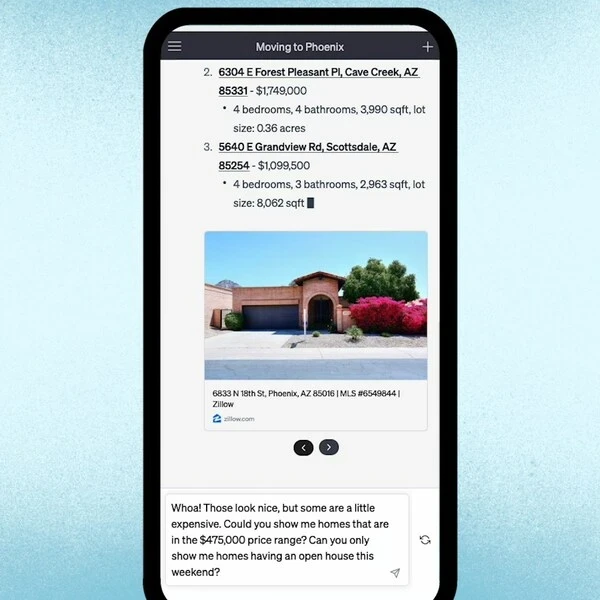
The company launched its alpha-version plugin for Zillow real estate searches with ChatGPT. According to Zillow, the alpha-version plugin is "a small sandbox in which we will learn and iterate rapidly."
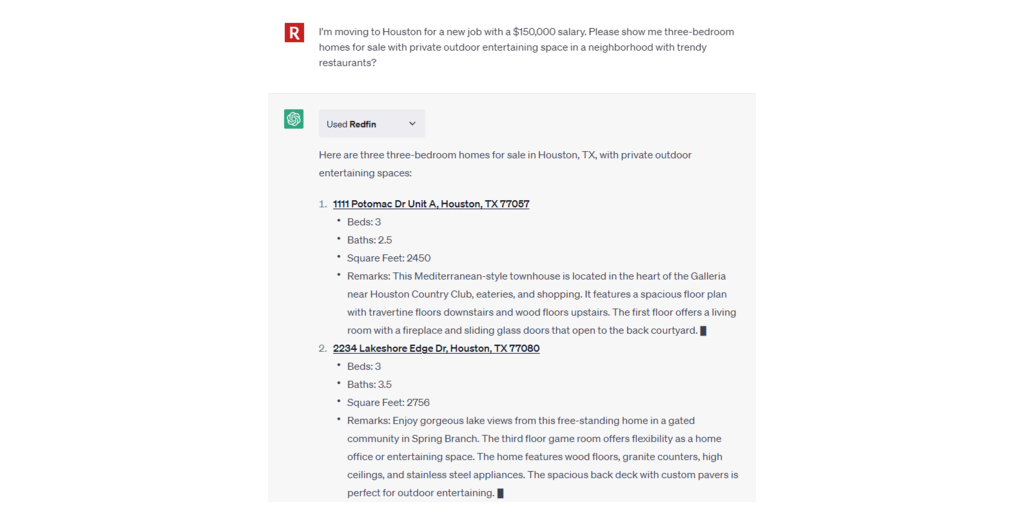
Redfin also announced that its ChatGPT plugin is now available. Redfin said the ChatGPT plugin will enable customers to describe ideal neighborhoods to find listings to suit their needs. The results will drive Redfin users to listing pages that meet their criteria.
Both Zillow and Redfin are navigating a volatile housing market amid inflation and increasing interest rates. The bet for the real estate rivals is that they can capture more demand by investing through the downturn.
Here's how Zillow sees the ChatGPT integration working.
Vice President & Principal Analyst
Constellation Research
About Liz Miller:
Liz Miller is Vice President and Principal Analyst at Constellation, focused on the org-wide team sport known as customer experience. While covering CX as an enterprise strategy, Miller spends time zeroing in on the functional demands of Marketing and Service and the evolving role of the Chief Marketing Officer, the rise of the Chief Experience Officer, the evolution of customer engagement, and the rising requirement for a new security posture that accounts for the threat to brand trust in this age of AI. With over 30 years of marketing experience, Miller offers strategic guidance on the leadership, business transformation, and technology requirements to deliver on today’s CX strategies. She has worked with global marketing organizations to transform everything from…...
Vice President and Principal Analyst
Constellation Research
Holger Mueller is VP and Principal Analyst for Constellation Research for the fundamental enablers of the cloud, IaaS, PaaS and next generation Applications, with forays up the tech stack into BigData and Analytics, HR Tech, and sometimes SaaS. Holger provides strategy and counsel to key clients, including Chief Information Officers, Chief Technology Officers, Chief Product Officers, Chief HR Officers, investment analysts, venture capitalists, sell-side firms, and technology buyers.
Coverage Areas:
Future of Work
Tech Optimization & Innovation
Background:
Before joining Constellation Research, Mueller was VP of Products for NorthgateArinso, a KKR company. There, he led the transformation of products to the cloud and laid the foundation for new Business Process as a…...
Episode 56 features Constellation analysts Liz Miller & Holger Mueller sharing the latest #tech news, Holger recaps IBM’s 2023 Hybrid #Cloud virtual event & Liz interviews an #AXS2023 panel about #CXOs at the board level (feat. Cindy Zhou and Helena Verellen).
Editor in Chief of Constellation Insights
Constellation Research
Larry Dignan is Editor in Chief of Constellation Insights at Constellation Research, where he leads editorial coverage focused on enterprise technology, digital transformation, and emerging trends shaping the future of business. He oversees research-driven news, analysis, interviews, and event coverage designed to help technology buyers and vendors navigate complex markets with clarity and context. ...
Generative artificial intelligence (AI) is best known for providing answers quickly and creating AI art on the fly, but business use cases abound. Here's a primer on generative AI and its application.
What is generative AI?
Generative AI is a type of artificial intelligence that can produce content such as text, imagery, audio and data based on what it has learned from a massive training set of data. Generative AI has reached a tipping point as technologies such as OpenAI's ChatGPT and DALL-E have become popular.
In addition, technology vendors are racing to include generative AI into products and services. Businesses are also exploring how to integrate generative AI into multiple use cases.
Generative AI takes inputs from training data and produces similar outputs with a unique spin. As a result, generative AI can seem creative. More specifically, generative AI relies on a few different models.
Here’s a look:
Generative Adversarial Networks (GANs), which have two neural networks. One is a generator and the other is a discriminator. The two networks compete as the generator creates new data instances and the discriminator values the quality. The generator improves its output based on feedback from the discriminator, which aims to distinguish between generated data and the real training data. You could think of a GAN as a model that somewhat replicates the writer and editor relationship.
Variational Autoencoders (VAEs), which introduces a probabilistic component to create diverse and realistic outputs.
Transformer models, which include GPT (Generative Pre-trained Transformer). Transformer models are a type of deep learning architecture used for natural language processing tasks. These models generate text with context based on patterns from training data.
Github, which offers Github CoPilot generative AI, has more on the various models as does Nvidia.Generative AI models have limitations including the need to compute at scale and outputs that are only as good as the quality of training data. Nevertheless, generative AI is showing it can create new content such as marketing content, social media posts, scripts and books to name a few. Beyond content, generative AI can create new data to train other AI systems, compress data by removing redundant information and create new data as well as programming code.
Where is generative AI being used?
The bigger question is where generative AI isn't being used. Technology companies are moving quickly to integrate generative AI into productivity applications. For instance, Microsoft is integrating ChatGPT throughout its applications, Salesforce is doing the same and Slack has plans to use generative AI and consumer apps from the likes of Redfin and Zillow are doing the same. When you consider search engines such as Microsoft's Bing and Google have generative AI plans it's likely that most of the software you touch will have ChatGPT or a similar technology embedded.
Simply put, technology vendors are embedding generative AI and related tools everywhere. However, enterprise buyers are wary of AI and its implications for compliance, first party data and security even as boardrooms push for rapid adoption.
Generative AI creates new content, chat responses, designs, images and programming code. Traditional AI has been used for detecting patterns, making decisions, surfacing and classifying data and detecting anomalies to produce a simple result.
Machine learning is a type of artificial intelligence. Machine learning is used to learn from data patterns without human support. Given the scale of data, machine learning enables the models used for AI.
A LLM is a machine learning model that's trained on text data from multiple sources at scale. LLMs can complete natural language processing tasks and answer questions in a conversational way. Vendors are creating proprietary LLMs as well as tuning for specific use cases and behaviors.
LLMs are trained with books, articles, code and forms of text. This training data is then used to generate text, translate languages and answer questions via natural language processing (NLP). While LLMs are still being developed, CXOs have noted that they can be used for code generation, technical document creation, marketing and data analysis.
How will generative AI impact work?
For now, generative AI is being seen as a grand experiment rolling out in real time. However, as numerous companies--Microsoft, Google, Salesforce to name a few--look to embed generative AI in productivity tools the technology's reach will be broad.
In a research note, Constellation Research analyst Dion Hinchcliffe said the impact of generative AI will advance industry use cases as well as work in general.
He said:
"The broadest and most impactful area of AI will be in general purpose capabilities that quickly enable the average professional to get their work done better and faster. In short, helping knowledge workers work more effectively to achieve meaningful outcomes to the business. It's in this horizontal domain that generative AI has dramatically raised the stakes in the last six months."
Companies are likely to put resources behind creating generative AI models, algorithms and tools for competitive advantage. CXOs should spend time exploring OpenAI's ChatGPT 4 subscription service as well as Google's Bard to find use cases.
Marketing. Diffusion models will dynamically generate content, provide translation capability, and run A/B and experimentation tests for user experiences. Personalization models will gain greater context, enabling hyper targeting for campaigns, ad networks, and polling with ChatGPT.
Sales. Sales specific tasks such as pipeline reviews, scheduling meetings, install base analysis, and forecasting will move from manual to automated.
Service. Crawlers inside one’s internal systems can scan knowledge bases, augment case history, and hasten issue resolution. The AI can create new case tickets, augment missing information, and predict customer satisfaction.
Commerce. Speed of product catalog creation will improve as diffusion models will take prompts from regulatory requirements enabling faster global rollouts of new products and services content.
Customer success. Generative AI will identify accounts with low adoption and automatically identify at risk customers based on their level of interaction to increase the frequency of engagement.
There will be other personal use cases too. For starters, generative AI tools can be entertaining. They can also write thank you letters, email responses and data profiles.
In earnings conference calls, executives typically get a question or two about generative AI. The answers fall into a few key categories.
Technology vendors are integrating generative AI rapidly. Whether it's ServiceNow, SAP, C3 AI or Google there's a generative AI story that revolves around integration with their respective platforms. If these tech vendors hold their timelines, you'll be using generative AI indirectly through your personal and business productivity apps.
Broad industry usage. Generative AI is turning up in financial services, insurance, healthcare, hospitality, fast food and a bunch of industries. CEOs are watching generative AI closely, pondering integration scenarios, new experiences and compliance issues. These CEOs are very interested in generative AI but do want more transparency into the models.
What are the benefits of generative AI?
Generative AI is likely to have a bevy of benefits including automating manual tasks, augmented writing, increased productivity and summarizing information and data.
The technology can also be used to explore new markets, enhance products, personalize experiences, create new knowledge, educate, boost decision making, gather information and optimize processes.
These benefits may become more evident as technology vendors embed generative AI into their applications. Amazon CEO Andy Jassy said on the company's first quarter earnings conference call:
"I think if you look at what’s happened over the last 9 months or so is that these Large Language Models and generative AI capabilities, they’ve been around for a while, but frankly, the models were not that compelling before about 6, 9 months ago. And they have gotten so much bigger and so much better, much more quickly that it really presents a remarkable opportunity to transform virtually every customer experience that exists."
Data biases. Generative AI algorithms can only be as good as the data set it is being trained on. If generative AI is being trained on a flawed model it'll only scale mistakes.
Transparency. Generative AI models are complex, and it will be hard for businesses and consumers to understand how an answer was generated. This problem will become more important as various generative AI technologies and algorithms are integrated.
Ethics. Generative AI applications are trained by data provided by humans. There's the potential to scale unethical behavior and bias.
Business models. Sourcing of material has been abstracted in more popular generative AI technologies. In other words, it's unclear how intellectual property owners will get paid.
Black box thinking. Humans will still need to offer expertise for decision making.
Model sprawl. It's increasingly clear that enterprises will use multiple generative AI technologies. At some point (probably soon), these early adopters will have to wrangle these tools and make them work together.
Security. Enterprises are concerned about sharing first party data with LLMs. Speaking at Domino Data Lab's Rev 4 conference in New York City, Jan Zirnstein, Director of Data Science at Honeywell Connected Enterprise, said the company has been looking at generative AI use cases but questions remain. "Generative AI has tipped the public perception of what AI is, but tipped it a little too far," said Zirnstein. "There's nothing in the actual training model and architecture that's tied to truth and factual correctness. We're looking at use cases tied to where factualness isn't imperative like saving time on the creative side. There are also use cases on the summarization side."