Results

What's in a generative AI name? Not much

This post first appeared in the Constellation Insight newsletter, which features bespoke content weekly.

Generative AI may be running out of names as vendors max out on monikers for new services and features.

Way back when (more like 5 months ago) naming a generative AI service was easy. You just put a GPT on the back of everything. Then Microsoft ushered in the era of copilots to name generative AI services. Microsoft will still toss in a GPT here and there, but OpenAI has that naming convention cornered.

This naming issue is no small matter. Generative AI product names have a shelf life of a few months at best. Salesforce's Dreamforce conference will likely feature a few name changes. Salesforce was early on the GPT bandwagon, but that name only goes so far. Why? Salesforce, like other enterprise vendors, are following bring your own model arrangements. Simply put, not everything is a GPT.

I'll bet Salesforce will keep Einstein around as a product, but we'll see if Genie sticks. Who knows about GPT. And with enterprise technology conference season here we're going to hear all kinds of names for generative AI services. 

There are three routes to go with generative AI naming conventions.

Naming conventions for generative AI services got me so wound up that I had to consult with Google’s Bard for ideas just like every other marketing department. First, I asked: “What’s in a name?” Bard riffed on Shakespeare quotes and how it’s personal preference. To some people names matter. To others, names are meaningless.

Thanks for nothing Bard.

Then I refined my prompt since I’m a prompt engineer in training. I asked Bard: “What should I name my generative AI service? Bard gave me a lot more. The answer in full:

“Here are some ideas for names for your generative AI service:

  • Generative AI. This is a straightforward name that accurately describes what the service does.
  • AI Writer. This name emphasizes the service's ability to generate text.
  • AI Artist. This name emphasizes the service's ability to generate images.
  • AI Creator. This name is more general and could be used for any type of generative AI service.
  • Imagine. This name is creative and evokes the idea of creating new things.
  • Create. This name is similar to Imagine, but it is more direct.
  • Spark. This name suggests that the service can help people to be creative.
  • Inspire. This name is similar to Spark, but it is more focused on the emotional impact of the service.
  • Dream. This name is creative and evokes the idea of creating new possibilities.
  • Avataar. This name is a reference to the Hindu concept of an avatar, which is a divine being that takes on human form. This could be a good name for a generative AI service that can create realistic images or videos.

Ultimately, the best name for your generative AI service is the one that you think is most appropriate and memorable. Consider the purpose of the service, the target audience, and the overall branding when choosing a name.

I hope this helps!”

It sure does Bard. Thanks. As for the rest of you struggling to name your generative AI you may want to give Bard attribution should you crib one of those names. Spark may have some mojo.

Data to Decisions Innovation & Product-led Growth Future of Work Tech Optimization Next-Generation Customer Experience Digital Safety, Privacy & Cybersecurity AI GenerativeAI ML Machine Learning LLMs Agentic AI Analytics Automation Disruptive Technology Chief Information Officer Chief Executive Officer Chief Technology Officer Chief AI Officer Chief Data Officer Chief Analytics Officer Chief Information Security Officer Chief Product Officer

Smartsheet vs. Asana vs. Monday: What you need to know

Work coordination platforms have been busy adding generative AI, retooling infrastructure to scale better for enterprises and growing revenue at a rapid clip.

The category is notable because these platforms are a window to how work is actually executed. As a result, these platforms are churning out data that enables enterprises to optimize. As Constellation Research analyst Dion Hinchcliffe has said: "The cornerstone to the significance and value of work coordination platforms is that they are at the heart of the real work that is getting done."

In recent weeks, three key vendors on the Constellation ShortListâ„¢ Work Coordination Platforms have reported results and previewed upcoming conferences. Here's a tour and what you need to know about Smartsheet, Asana and Monday.com results.

Smartsheet

Smartsheet reported second quarter revenue of $235.6 million, up 26% from a year ago. The company reported a second quarter net loss of $33.4 million, or 25 cents a share. Non-GAAP earnings were 16 cents a share.

CEO Mark Mader said the company saw strong demand from enterprises for its work management suite. Customers with annual contract values topping $100,000 were 1,665.

As for the outlook, Smartsheet said third quarter revenue will be $240 million to $242 million, up 20% to 22%. Non-GAAP earnings will be between 8 cents a share to 9 cents a share. For fiscal 2024, Smartsheet projected revenue of $950 million to $953 million, up 24%, with non-GAAP earnings of 53 cents a share to 57 cents a share.

Here's what you need to know.

Momentum. While rivals have cited varying degrees of longer buying cycles and economic concerns, Smartsheet hasn't seen much of a slowdown. Mader said Smartsheet landed expansions with HPE, Airbus, Iron Mountain and Pacific Life. Smartsheet has more than 9,400 enterprise customers defined as companies with more than 2,000 employees.

Smartsheet executives noted that it saw stabilization among enterprise customers, but there is some caution about budgets.

AI. The company has launched a series of generative AI features in beta and plans to outline more at its Engage conference soon. Smartsheet is using generative AI to create charts quickly, write formulas and offer guidance and insights on the fly. AI Assistant and AI Solution Builder are products to watch.

"I do expect over Q3 that number to expand to many thousands of customers who are using this. The things we've heard so far are validating. People are saying that they are seeing a dramatic reduction in cost to doing things like building visualizations with dashboard widgets which is our AI Insights product," said Mader. "And we've started to now also show some of our customers what we are doing on those other premium AI theses around formula building and content generation."

Vision. Smartsheet is using its platform to offer a portfolio of products and capabilities. It has also been focused on scaling as it lands larger enterprises. Smartsheet recently increased compute and cross-sheet linking capacity to 30,000 to 500,000 per sheet to manage more interconnected projects. The company is also looking to automate and enable customers to discover insights and workflows.

Product. Smartsheet said a bevy of products led to wallet share expansion including Smartsheet Advance and Data Shuttle, which allows customers to pull information from disparate data sources to create reports without integrations.

Innovation. Smartsheet's Mader said Engage will be a forum where the company will outline its platform strategy, role of generative AI and scale. Mader said Smartsheet will keep innovating on many fronts to give people a reason to subscribe and get licenses. "We have a huge population measured in millions of people who are actively engaged, who do not pay us today, and we are giving them reasons to subscribe," said Mader.

Asana

Asana reported solid second quarter results with revenue of $162.5 million, up 20% from a year ago. The net loss was $71.4 million, or 33 cents a share. Non-GAAP loss per share in the quarter was 4 cents a share.

The company projected third quarter revenue of $163.5 million to $164.5 million, good for growth of about 16% from a year ago. Asana projected a third quarter non-GAAP loss of 10 cents a share to 11 cents a share.

For fiscal 2024, Asana projected revenue between $642 million to $648 million, up 17% to 18%. The non-GAAP loss for the fiscal year will be between 39 cents a share and 42 cents a share.

Here's what you need to know.

Momentum. CEO Dustin Moskovitz said Asana continues to expand its share at large enterprises, but budgets and seats are being scrutinized with expansion plans being pushed out. Moscovitz said:

"Even with continued macro headwinds and heightened budget scrutiny in the enterprise, sentiment seems to be stabilizing. Customers are looking for ways to consolidate their vendors, getting more ROI out of everything they’re doing, and they’re turning to Asana. Asana can help them to achieve their goals and objectives more efficiently and faster than ever before. In fact, we have seen an increase in multi-year commitments both year over year and sequentially, in the quarter."

AI. Moscovitz said Asana was bullish on AI but argues that enthusiasm is waning for generative AI. "I believe chatbots are just demos, not really the end game. The real potential of AI is going to manifest when it gets deeply integrated into other software, making it possible for end users to get great results without themselves becoming prompt engineers, and for developers to radically accelerate their productivity," he said.

Vision. Asana's architecture is based on the Asana Work Graph data model and the company is betting that it will become the linchpin to future AI use cases. The goal: Make Asana Work Graph the single source of truth for work data so enterprises will know how work actually gets done.

Products. Aside from Asana's Work Management Platform and the Work Graph, Moscovitz touted Asana Intelligence, which will be a shared map that helps "align human intention with AI guidance." Asana also has scale with a platform that can scale up to 200,000 seats and companywide deployments.

Asana is adding a bevy of new AI features in beta including Writing Assistant, Instant Summaries and Work Organizer. Asana also has goal-based resource management and AI assisted smart workflows on tap.

Innovation: Asana has an event Oct. 3 in new York focused on work management across industries and functions. Asana will also share with customers a Work Innovation Score, powered by the Work Graph and AI.

Monday.com

Monday.com, which is best known for its work operating system, delivered second quarter revenue of $175.7 million, up 42% from a year ago. The company reported a net loss of 15 cents a share in the second quarter and non-GAAP earnings of 41 cents a share.

As for the outlook, Monday.com raised its outlook and projected third quarter revenue between $181 million to $183 million, up 32% to 34%. For 2023, Monday.com is projecting revenue of $713 million to $717 million.

Here's what you need to know.

Momentum. On Monday's earnings conference call co-CEOs Roy Mann and Eran Zinman were upbeat. "Demand from our customers remains healthy," said Mann. The company is adding a more scalable infrastructure to become a multi-product work suite.

AI. Monday has launched an AI Assistant and a series of new AI capabilities including automated task generation, formula builder, email composition and content generation. AI solution builder enables customers to build personalized Monday boards via an Azure OpenAI chatbot.

Vision. Monday.com has rebuilt the infrastructure behind its Work OS platform. It has launched the Monday DB 1.0 to all accounts so customers can load large boards 5 times faster and manage complicated workflows. Monday.com is also building out its developer marketplace to develop more AI applications. Monday.com is also optimizing its interface.

Products. Zinman said the company remains "focused on our multiproduct strategy and ensuring that our products can enable cross-functional collaboration. The company launched Monday CRM, mass emailing capabilities and the ability to reach multiple contacts. Monday Dev has been launched to track bugs and application development. Monday is also adding workflows as an add-on.

Innovation. Monday's plan is to provide an integrated platform that gives enterprises more capabilities and products. Mann said:

"The differentiator we see for Dev and all our products, also CRM and the work management the fact that we are in a platform. The products are built on top of the platform, which allows our customers to shape the solution to whatever they see fit and how their organization works. And we see this as a huge advantage also on deals and with customers when we talk with them, it's a major thing that it's built on top of the Work OS.

Future of Work Data to Decisions Innovation & Product-led Growth New C-Suite Tech Optimization Next-Generation Customer Experience Digital Safety, Privacy & Cybersecurity AI GenerativeAI ML Machine Learning LLMs Agentic AI Analytics Automation Disruptive Technology Chief Information Officer Chief Experience Officer Chief Executive Officer Chief Technology Officer Chief AI Officer Chief Data Officer Chief Analytics Officer Chief Information Security Officer Chief Product Officer

SAP buys LeanIX, aims to couple it with Signavio, system transformation

SAP said it will acquire LeanIX GmbH, an enterprise architecture management software company, in a move that will optimize processes connected to system migrations.

The acquisition of LeanIX will give SAP another process optimization piece to combine with SAP Signavio. In addition, LeanIX will give SAP a path to more easily migrate SAP customers to S4/HANA and cloud operations.

Use cases for the LeanIX platform include application rationalization, portfolio assessment, migration and modernization and ERP transformation.

Indeed, SAP noted that "many CIOs rely on LeanIX's offerings as part of their digital transformation with the RISE with SAP solution." SAP has a lot riding on migrating customers smoothly and the company can use Signavio to continuously improve processes based on the output of LeanIX.

Constellation Research analyst Holger Mueller said:

"A key challenge for SAP customer to upgrade to S/4HANA utilizing the vendor's Grow and Rise initiatives, is to understand their system landscape. LeanIX can help here, and with that help SAP customer assess, plan and access their SAP upgrades better. How well this will work in practice needs to be seen, as the details to be considered and the degree of automation expected as an SAP company are significantly higher than as an independent vendor. Time will tell."

SAP said the acquisition is expected to close in the fourth quarter. Terms of the deal weren't disclosed.

It's also notable that Celonis and UiPath also offer system transformation using process mining. Many of those migrations involve SAP systems.

During UiPath's second quarter earnings call, co-CEO Rob Enslin said:

"We are also making great progress with SAP, engaging with customers and building a joint pipeline. During the quarter, a German agricultural company challenged by their S/4 migration, selected UiPath in a competitive win based on our holistic integrated platform. They are in the process of implementing test suite for regression testing on their S/4 migration and testing of all SAP modules. They also plan to automate processes in their finance department and incorporate process mining and AI into their automation program."

SAP said that LeanIX complements SAP Signavio and gives customers "unique clarity on IT landscapes that they need to reap the full benefit of business transformation."

SAP CEO Christian Klein said systems and processes go together and "we'll embed generative AI to offer self-optimizing applications and processes that can help businesses achieve key goals such as maximizing cash flow while minimizing their environmental impact."

LeanIX has about 1,000 customers for its IT visualization software. LeanIX also recently launched an AI assistant for enterprise architecture management.

According to SAP, LeanIX will be combined with SAP Signavio Process Transformation Suite, RISE with SAP, and SAP Business Technology Platform. The company did note that LeanIX will continue to serve non-SAP architectures. SAP also has Demosphere, which aims to optimize and automate processes for multiple systems beyond SAP.  

Tech Optimization Innovation & Product-led Growth Data to Decisions Future of Work Next-Generation Customer Experience Revenue & Growth Effectiveness Digital Safety, Privacy & Cybersecurity SAP AI ML Machine Learning LLMs Agentic AI Generative AI Analytics Automation B2B B2C CX EX Employee Experience HR HCM business Marketing SaaS PaaS IaaS Supply Chain Growth Cloud Digital Transformation Disruptive Technology eCommerce Enterprise IT Enterprise Acceleration Enterprise Software Next Gen Apps IoT Blockchain CRM ERP Leadership finance Customer Service Content Management Collaboration M&A Enterprise Service Chief Information Officer Chief Technology Officer Chief Digital Officer Chief Data Officer Chief Analytics Officer Chief Information Security Officer Chief Executive Officer Chief Operating Officer

UiPath,Q2 better than expected, sees second half strength

UiPath reported better-than-expected second quarter results and said its automation platform is gaining momentum.

The company, which is best known for its robotics process automation but has moved to become a broader platform, reported second quarter non-GAAP earnings of 9 cents a share with revenue of $287.3 million, up 18.6% from a year ago. Annual recurring revenue in the second quarter was up 25% from a year ago. The company reported a second quarter net loss of $60.36 million, or 11 cents a share. 

Wall Street was looking for a second quarter non-GAAP profit of 3 cents a share.

As for the outlook, UiPath said revenue for the third quarter will be between $313 million to $318 million, which is higher than estimates of $315 million. For fiscal 2024, UiPath said revenue will be between $1.273 billion and $1.278 billion. That range was better than estimates of $1.27 billion.

More:

Rob Enslin, co-CEO of UiPath, said in the second half "momentum is building as customers recognize the need for efficiency in the current operating environment and the long-term structural advantages of automation."

Daniel Dines, co-CEO of UiPath, added that the company's automation platform aims to "operationalize the promise of AI."

UiPath also authorized a $500 million share repurchase program. The company ended the quarter with cash and equivalents of $1.8 billion.

The company has partnered with SAP to couple automation platforms and data sources. Both UiPath and SAP compete with Celonis as does Microsoft, which recently announced Power Automate Process Mining.

Enslin spoke at an investment conference in June and outlined the following:

  • UiPath's sales effort to focus on industries and value are paying off. "Northstar is our value platform where we actually go into the order of how we really help companies drive super efficiencies and get significant benefits from the solution," he said. 
  • The company is incorporating generative AI into its automation platform. "We showcased a live demo in earnings of something we call Wingman, which is really using generative AI to actually produce automations on the fly basically," said Enslin. 
  • The SAP partnership is promising. Enslin said "we have engineers working together to build out the products and connectors specifically with SAP's Signavio product and how it fits into our solutions so that customers see it from a holistic point of view."
Data to Decisions Tech Optimization Innovation & Product-led Growth Future of Work Next-Generation Customer Experience Revenue & Growth Effectiveness Chief Information Officer

C3 AI launches domain-specific generative AI models, targets industries

C3 AI launched 28 new domain-specific generative AI models across its platform as it steps up its efforts for industries. The launch was part of the C3 Generative AI Suite, which was initially released in March.

The company said the launch will cover structured and unstructured data and incorporate lessons from pilots. CEO Tom Siebel added that C3 AI will offer pre-built offerings with object models and attached generative AI. On a conference call with analysts, Siebel said generative AI demand appears to be "accelerating exponentially." He said pipeline for C3 AI applications are gaining momentum. 

Overall, the generative AI focus for C3 AI revolves around industries, processes and enterprise systems. Siebel said that C3 AI can expand generative AI through its core industries including defense, oil & gas, manufacturing, financial services, intelligence, and utilities. C3 AI has closed 12 generative AI agreements and has a pipeline of more than 140 qualified C3 Generative AI enterprise opportunities. 

Constellation ShortListâ„¢ Artificial Intelligence and Machine Learning Cloud PlatformsGet ready for a parade of domain specific LLMs | C3 AI CEO Tom Siebel: Generative AI enterprise search will have wide impact

C3 AI's business process focus for generative AI will be focused on sales, customer service, finance, reliability and supply chain with integrations across the major enterprise systems. The company is looking to enable enterprises to deploy generative AI with scale, speed and security. C3 AI said it is emphasizing choice with its generative AI offerings. For instance, the C3 Generative AI Suite is available on Google Cloud, AWS and Microsoft Azure. LLM support is available for Falcon 40B, Llama 2, Flan-T5, Azure GPT-3.5, AWS Bedrock Claude 2, Google PaLM 2, OpenAI GPT-3.5 and MPT-7B. The company said it will add LLMs as the market develops. 

The company's pricing is straightforward. C3 AI supports the customer to bring its generative AI application into production within 12 weeks at a cost of $250,000. After that, the customer pays per vCPU/vGPU hour, with volume discounts.

Key points about the C3 AI domain-specific generative AI offerings, which will have multi-hop reasoning designed to get the user an answer and then provide reasoning and value exchange for situational awareness, include:

  • C3 AI will have a human-like natural language interface along with enterprise access controls.
  • Customers will be able to bring their own models from OpenAI, AWS, Google Cloud and HuggingFace.
  • Connectors to Salesforce, SAP, Oracle, ServiceNow, Snowflake, Palantir and Databricks to name a few will be available.
  • C3 AI will also connect to SCADA systems, non-traditional information and external data sources such as news and weather engines.

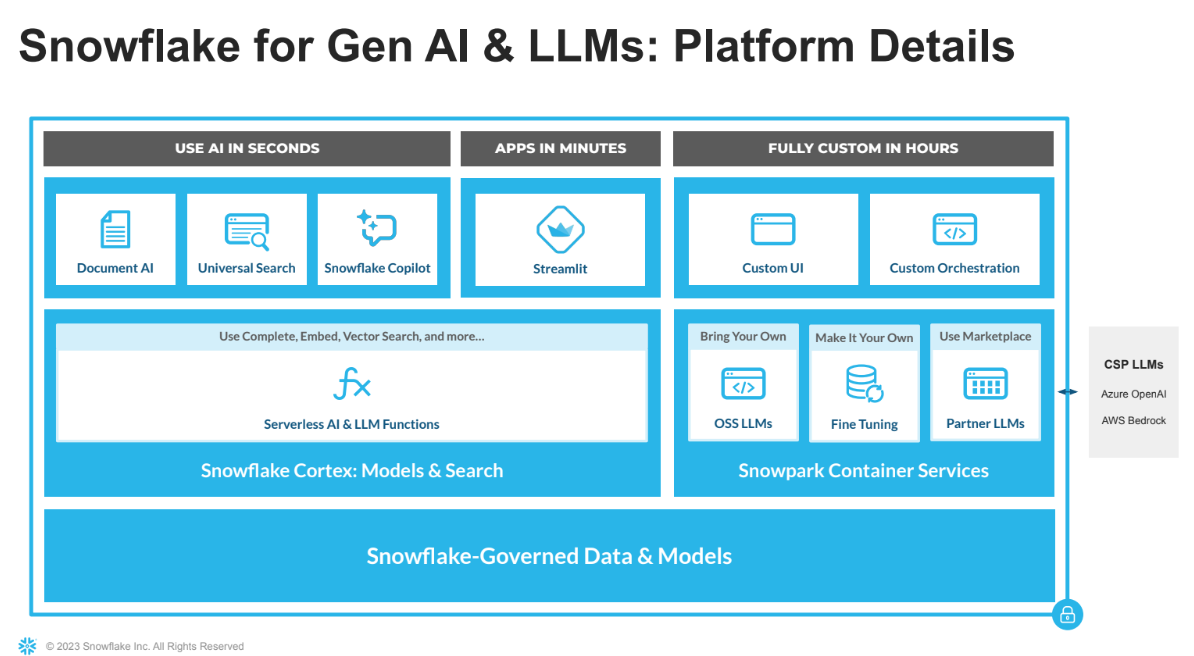
With these launches, C3 AI is positioning itself as a platform and more of a Palantir rival. Enterprises are increasingly examining data platforms such as MongoDB, Snowflake and Databricks to cobble together domain-specific models. The hyperscale cloud providers are also offering a choice of models for industry focused applications.

Recent events to know:

C3 AI said that its generative AI suite now has projects in place at Georgia-Pacific, Flint Hills Resources, Nucor, Pantaleon, Con Edison, the U.S. Missile Defense Agency, and a U.S. intelligence agency.

There's a bevy of C3 Generative AI offerings including:

  • C3 Generative AI for Aerospace
  • C3 Generative AI for Defense
  • C3 Generative AI for Financial Services
  • C3 Generative AI for Healthcare
  • C3 Generative AI for Intelligence
  • C3 Generative AI for Manufacturing
  • C3 Generative AI for Oil and Gas
  • C3 Generative AI for Telecommunications
  • C3 Generative AI for Utilities
  • C3 Generative AI for Customer Service
  • C3 Generative AI for Energy Management
  • C3 Generative AI for ESG
  • C3 Generative AI for Finance
  • C3 Generative AI for Human Resources
  • C3 Generative AI for Process Optimization
  • C3 Generative AI for Reliability
  • C3 Generative AI for Sales
  • C3 Generative AI for Supply Chain
  • C3 Generative AI for Databricks
  • C3 Generative AI for Microsoft Dynamics 365
  • C3 Generative AI for Oracle ERP
  • C3 Generative AI for Oracle NetSuite
  • C3 Generative AI for Palantir
  • C3 Generative AI for Salesforce
  • C3 Generative AI for SAP
  • C3 Generative AI for ServiceNow
  • C3 Generative AI for Snowflake
  • C3 Generative AI for Workday

Separately, C3 AI reported fiscal first quarter earnings. The company reported a net loss of $64.3 million, or 56 cents a share, on revenue of $72.4 million. C3 AI's non-GAAP loss for the quarter was 9 cents a share. Wall Street was looking for a non-GAAP loss of 17 cents a share on revenue of $71.6 million. 

Siebel said the company is seeing strong traction with enterprise AI and generative AI applications.

The company said it expanded agreements with a bevy of customers and closed 20 agreements with partners. C3 AI is also seeing strength in federal government bookings, which were up 39% from a year ago.

However, C3 AI pushed off its profitability target since it will invest heavily in generative AI. Siebel said:

"After careful consideration with our leadership and our marketing partners, we have made the decision to invest in Generative AI, to invest in lead generation, to invest in branding, to invest in market awareness, and to invest in market and customer success related to our Generative AI solutions.

The market opportunity is immediate and we intend to seize it. So while we still expect to be cash positive in Q4 this year and in fiscal year '25, we will be investing in our Generative AI solutions and at this time do not expect to be non-GAAP profitable in Q4, '24, you can expect though, we're still, we want to see what actually happens in the market in the next couple of quarters and how this plays out, but it looks right now, you can expect us and will update you on this as we know more, but you're going to see this happen in some place in the Q2 to Q4 time frame of fiscal year '25.

We have a tight rein on our financial controls. We are operating a disciplined business and we're making this decision to invest in Generative AI because we are confident that is in the best interests of our shareholders. C3.AI was well ahead of its time predicting the scale of the opportunity in enterprise AI applications."

Data to Decisions Innovation & Product-led Growth Future of Work Tech Optimization Next-Generation Customer Experience Digital Safety, Privacy & Cybersecurity AI GenerativeAI ML Machine Learning LLMs Agentic AI Analytics Automation Disruptive Technology Chief Information Officer Chief Data Officer Chief Executive Officer Chief Technology Officer Chief AI Officer Chief Analytics Officer Chief Information Security Officer Chief Product Officer

Intuit rolls out Intuit Assist generative AI across platform

Intuit launched Intuit Assist, a generative AI assistant that will provide personalized recommendations across the company's platform, which includes TurboTax, Credit Karma, QuickBooks and Mailchimp.

The Intuit Assist effort, outlined at Intuit's Innovation Day, is also an example about how vendors and enterprises are rolling out domain specific large language models. While Intuit doesn't cater to large enterprises, it is the ERP system and tech stack for 100 small business and consumer customers. 

According to the company, Intuit Assist is built on the company's GenOS, a proprietary LLM that specializes in tax, accounting, marketing, cash flow and personal finance. GenOS launched in June and included a development environment (GenStudio), a runtime layer (GenRuntime), a library of user experience components (GenUX), and financial LLMs.

While foundational LLMs get the attention, the real returns are going to be tailoring those models to various use cases with first-party data. Intuit's platform has 60PB of data, 500,000 customer and financial attributes per small business, 2 million models running in production per day and 20 billion transactions imported from financial institutions a year.

Intuit's approach to generative AI will also include hooks to live human help as needed. The initial rollout of Intuit Assist includes the following.

  • Intuit Assist for TurboTax, which will create a personalized tax checklist on data shared by the customer. Intuit's TurboTax and human experts can provide answers, insights and recommendations. Intuit said it plans to launch more AI features ahead of the 2023 tax season.
  • Intuit Assist for Credit Karma, which will provide recommendations based on a customer's financial data. Intuit Assist for Credit Karma will provide plans to avoid a cash crunch, financing options and tradeoffs involved to maximize cash flow.
  • Intuit Assist for QuickBooks will flag potential cash flow issues, identify bestselling products and anomalies. For non-QuickBooks customers, Intuit Assist will streamline onboarding. The tools is live to select beta customers.
  • Intuit Assist for Mailchimp aims to streamline marketing by personalizing content and optimize campaigns for intent and targeting and be able to change text, tone and images on the fly. Intuit Assist will also add customers to Mailchimp sales pipelines to track leads and the journey to a sale.
Data to Decisions Innovation & Product-led Growth Future of Work Tech Optimization Next-Generation Customer Experience Digital Safety, Privacy & Cybersecurity ML Machine Learning LLMs Agentic AI Generative AI AI Analytics Automation business Marketing SaaS PaaS IaaS Digital Transformation Disruptive Technology Enterprise IT Enterprise Acceleration Enterprise Software Next Gen Apps IoT Blockchain CRM ERP finance Healthcare Customer Service Content Management Collaboration Chief Information Officer Chief Data Officer Chief Executive Officer Chief Technology Officer Chief AI Officer Chief Analytics Officer Chief Information Security Officer Chief Product Officer

Lead times for generative AI systems extending into 2024

Lead times for systems for generative AI and AI workloads are lengthy to the point where infrastructure ordered today may not be installed until Spring 2024.

That's the takeaway from a bevy of earnings conference calls from infrastructure providers. Dell Technologies reported better-than-expected second quarter results and noted that its PowerEdge XE9680 GPU-enabled server is the fastest ramping product it has launched.

Dell's problem: Orders are off the charts, but parts--namely GPUs--are hard to come by even though the company has a strong partnership with Nvidia. Dell Chief Operating Officer Jeff Clarke said the company has about $2 billion of XE9680 orders in backlog with a higher sales pipeline.

Yes, generative AI investment is taking off. But the revolution--and the enterprise use cases on premises and locally--will be delayed due to supply and demand imbalances. Clarke later put a number on the backlog issue (emphasis mine):

"Maybe the easiest measure to determine where we are with supply is demand is way ahead of supply. If you order a product today, it's a 39-week lead time, which would be delivered the last week of May of next year. So, we are certainly asking for more parts working to get more parts. It's what we do. I'm not the allocator, I'm the allocatee. We’re advocating our position on our demand. Again, we are winning business signaled by the $2 billion in backlog today with a pipeline that's significantly bigger I was in the discussion yesterday with two different customers about AI, the day before about AI. It is constantly something that's coming into our business that we're fielding the opportunities. From different cloud providers to folks building AI as a service to enterprises now beginning to do proof of concept and trying to figure out how they do exactly what I just said earlier, use their data on-premises to actually drive AI to improve their business."

A few notable takeaways from Clarke's comments:

To that end, Clarke added that supply will catch up.

"We're tracking at least 30 different accelerator chips that are in the pipeline in development that are coming. So, there are many people that see the opportunity. Some of these new technologies are fairly exciting from neuromorphic type of processors to types of accelerators there's a series of new technologies and quite frankly, new algorithms that we think open up the marketplace and we'll obviously be watching that and driving that across our businesses and helping customers."

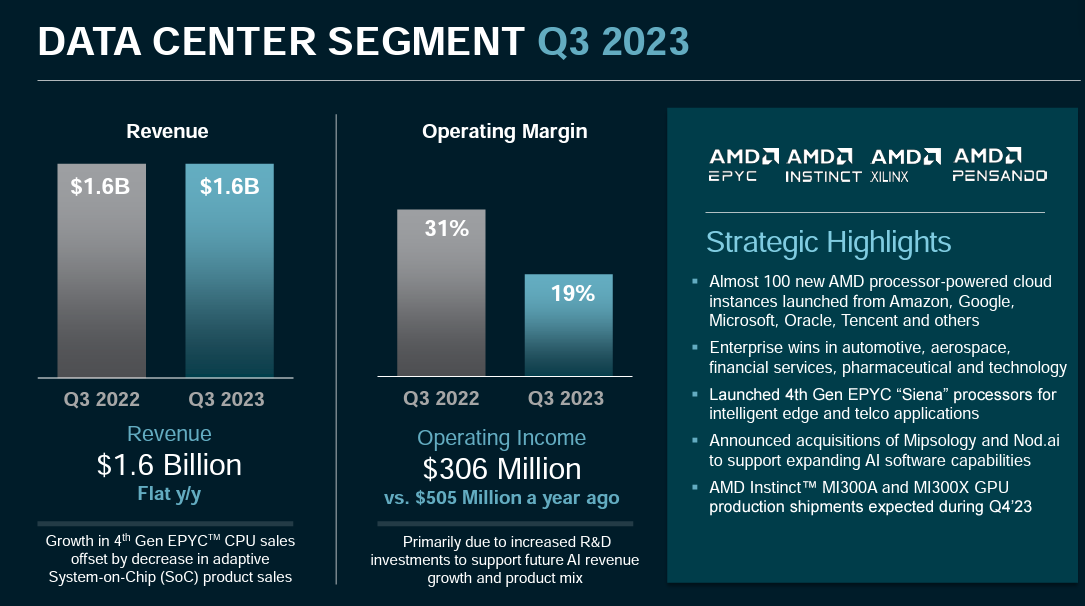
AMD is the likely beneficiary with its fourth quarter ramp of next-generation GPUs.

This GPU supply issue is also affecting other infrastructure players.

HPE CEO Antonio Neri said on the company's latest earnings call:

"We start now shipping some of those orders, those wins, but it's a long way to go. And remember that there's two components related to that. Number one is availability of supply, which obviously in the AI space is constrained. Number two is the fact that when you deploy these deals, you have to install it and then drive acceptances, which means elongated times for revenue recognition. And then maybe in a specific win or two, there are other conditions related to the contractual agreements."

Neri added that he's pleased with the quality of AI deals the company is making. HPE, like Dell, is building a lineup that aims for a portfolio of gear for AI training to tuning to inferencing for enterprises looking at domain-specific models.

Broadcom CEO Hock Tan said AI systems take time and supply issues are going to impact a bevy of infrastructure players. "These products for generative AI take long lead times," said Tan. "We're trying to supply, like everybody else wants to have, within lead times. You have constraints. And we're trying to work through the constraints, but it's a lot of constraints. And you'll never change as long as demand, orders flow in shorter than the lead time needed for production."

According to Intel CEO Pat Gelsinger, who spoke at an investor conference last week, competitors will start grabbing some of that GPU demand. Intel's entry in the GPU and AI accelerator race is its Gaudi lineup. Gaudi is a line of AI accelerators built off the acquisition of Habana in 2019.

Gelsinger said Nvidia "has a great leadership position," but "there's a bit of false economy there." He said there's huge demand, high prices and supply chain constraints for Nvidia GPUs but that won't last forever. "Lots of people are showing up, including us, to compete," said Gelsinger. "We've seen a rapid expansion of our Gaudi pipeline. We're building our supply chains to get much larger for our footprint there as we start competing as well as others will."

Intel's argument is that GPUs and CPUs will be used for AI models and enterprises will follow pricing vs returns. "There is a bit of euphoria so overall I expect to see more moderation," he said. "We're going to be competing more for the GPU and accelerator, but we also see workloads driving energy that will create opportunities for our CPU offerings as well."

Research:


Data to Decisions Tech Optimization Innovation & Product-led Growth Future of Work Next-Generation Customer Experience Digital Safety, Privacy & Cybersecurity Big Data AI GenerativeAI ML Machine Learning LLMs Agentic AI Analytics Automation Disruptive Technology Chief Information Officer Chief Technology Officer Chief Information Security Officer Chief Data Officer Chief Executive Officer Chief AI Officer Chief Analytics Officer Chief Product Officer

Zoom sets AI Companion roadmap across platform

Zoom Video Communications' generative AI digital assistant is now available for no additional cost to paid Zoom accounts.

The Zoom AI Companion, formerly known as Zoom IQ, will be rolled out across various services on the Zoom platform, including Meetings, Team Chat, Phone, Email and Whiteboard and be available in a side panel.

Separately, Zoom said that Zoom IQ for Sales will be renamed Zoom Revenue Accelerator.

Zoom launched its generative AI efforts in June with free trials of Team Chat compose and Meeting Summary. The launch Zoom AI Companion marks a more significant rollout across the company's platform. Zoom said it will incorporate its own large language models as well as third party models such as Meta's Llama 2, OpenAI and Anthropic.

The collaboration software space is rapidly adopting generative AI. For instance, Google Cloud is adding a bevy of AI-driven features to Workspace and its platform. Microsoft Teams will have co-pilots.

Another thread to consider is whether vendors are charging for add-ons for generative AI capabilities. Some vendors are adding it to the platform without additional costs while others are adding new SKUs.

Zoom emphasized that it won't use customer audio, video, chat, screen-sharing, attachments or other customer content to train models. In addition, AI Companion is turned off by default.

Here's a look at AI Companion and the roadmap ahead.

  • In Zoom Meetings, AI Companion will enable highlights, smart chapters, review summaries and next steps. Attendees can catch up on meetings using an AI Companion side panel. Hosts can get an automated meeting summary. In spring 2024, Zoom said it will add real-time feedback on their presence in meetings and coaching on presentation skills.
  • Zoom Team Chat will use AI Companion to draft messages based on chat thread context and change tone and length. Long threads will get summaries shortly and Zoom said users will be able to auto-complete sentences and schedule meetings from chat in early 2024.
  • In the fall, Zoom Whiteboard will get AI Companion to help generate ideas. In spring 2024, users will be able to use whiteboard content to generate images and populate templates.
  • Zoom Mail will have the option for draft email suggestions from AI Companion in the fall. In spring 2024, Zoom Phone will be able to summarize SMS threads and calls.
  • The company added that in the spring of 2024, AI Companion will have a conversational interface for pre-meeting preparation, in-meeting support and post meeting summaries, stakeholder recap and action items.

As for Zoom Revenue Accelerator, the company said it will expand capabilities in the fall with Virtual Coach, Deal Risk Signals and Discover Monthly for sales teams. Virtual Coach aims to dynamically train sales teams with conversation simulations. Deal Risk Signals will send alerts for stalled deals. And Discover Monthly looks at competitor trends from sales calls. 

More:

Constellation Research's take

Constellation Research analyst Liz Miller handicapped the Zoom moves. She said:

"Zoom, like many vendors in the CX space, have realized that the high-fidelity signal of customer voice at the moment of engagement, be it in a sales call or in a customer service call, can no longer sit in a silo of communication channel. That voice, thanks to talk to text transcription and AI models trained to extract key signals including sentiment and intent, can now lead to powerful workflows that benefit the buyer and the business. And, thanks to Zoom’s pre-built CRM integrations, this intelligence and conversation doesn’t just sit in the conversation channel but can now be included with CRM data.

The real question for me is where Zoom will pivot next. It isn’t enough to apply AI to voice and engagement. It needs to connect across the silos of sales, service and marketing--something that CRM has proven to do poorly in previous incarnations. Will Zoom become that next platform? Will Zoom be the connection point for all conversations and points of collaboration, including those being held in and at events and marketing-led experiences? While Zoom is keeping pace with the CX platforms out there (and by that I specifically mean those solutions that span Sales, Marketing and Service not just CCaaS and UCaaS tools) is there enough in the innovation engine to think beyond and deliver something more than what the rest of the market has? Right now, it feels like a bigger game of keeping up rather than surging ahead."


Future of Work Data to Decisions Innovation & Product-led Growth New C-Suite Sales Marketing Next-Generation Customer Experience Digital Safety, Privacy & Cybersecurity Tech Optimization zoom AI GenerativeAI ML Machine Learning LLMs Agentic AI Analytics Automation Disruptive Technology Chief Information Officer Chief Executive Officer Chief Technology Officer Chief AI Officer Chief Data Officer Chief Analytics Officer Chief Information Security Officer Chief Product Officer

Get ready for a parade of domain specific LLMs

This post first appeared in the Constellation Insight newsletter, which features bespoke content weekly.

Generative AI and large language models (LLMs) have received plenty of buzz, but enterprises need to stay focused on how domain-specific models develop. Why? That's where the returns will be.

At Constellation Research, we've kicked around small language models, safeguarding corporate data while tuning LLMs and how the real wins will be for specific use cases. Generative AI is nice for search and consumer use cases, but the magic happens when enterprises drive returns.

Fortunately, domain specific models are developing quickly. For instance, Google Cloud outlined Med-PaLM 2, a medically tuned LLM, that's aimed at healthcare. Google Cloud launched a bevy of AI tools at Google Cloud Next for CIOs to digest.

Bayer is using Google Cloud’s Vertex AI Search and exploring Med-PaLM 2 use cases. Hospital giant HCA is working with Google Cloud to leverage Med-PaLM to support doctors treating patients. Google Cloud fleshed out the HCA collaboration a bit more in a release, but the gist is that the two parties, along with Augmedix, is tuning models to support doctors and nurses. HCA is targeting:

  • Generative AI to improve patient handoffs between nurses.
  • Speech to text with ambient medical documentation.
  • Google AI to document key medical information more easily from conversations during patient visits.

According to Google Cloud, prompts were designed to guide the LLM toward topics such as medication changes, lab results, vital sign fluctuations and patient concerns. HCA is collecting nurse feedback to refine the tool. Ultimately, HCA wants to use Med-PaLM 2 LLM to support caregivers.

8 takeaways from Constellation Research's Healthcare Transformation Summit

My bet is that these domain-specific LLMs are going to be the real win for enterprises since they can leverage models and refine with their own data. These large LLMs such as PaLM, ChatGPT and LLama will have versions for various industries and use cases.

And this trend is going to go beyond healthcare. See:

Aneel Bhusri, CEO of Workday, said during the company's second quarter earnings call that it is using customer anonymized data to train LLMs. "We can then do domain-specific large language models, and those are smaller and less expensive. And we turn around and use those models to either make our products more competitive or they're the basis of new SKUs like the Skills Cloud," explained Bhusri. The real takeaway is that Workday isn't going to go add-on happy with charges. He said:

"I think you see us more in the mode of new SKUs like Skills Cloud rather than actually charging for any insight from the data -- that it's the customer's data. They allow us to use it in an anonymized way and we give them the results back. But I think what it allows us to do is train these large language models and then domain specific ones that will create new SKUs."

Intuit CEO Sasan Goodarzi was also bullish on domain-specific LLMs. Goodarzi said that Intuit "has incredibly rich longitudinal, transactional and behavioral data for 100 million customers."

Goodarzi added:

"For small businesses, we have a 360-degree view of their business and customers. We have 500,000 customers and financial attributes per small business on our platform and this data gives us insights into behaviors, income streams, expenses, profitability, and cash flows, enabling us to provide personalized experiences and recommendations to help them prosper.

Additionally, we have 60,000 financial and tax attributes per consumer on our platform. We are using our data to fine-tune our own financial large language models that specialize in solving tax, accounting, cash flow, marketing, and personal finance challenges."

Another key thought about domain specific LLM and AI use cases is that workloads will be spread around across multiple industries. 

Dell Technologies' Jeff Clarke, Chief Operating Officer, said the domain-specific use of LLMs and AI models will touch every industry. He said:

"What we think really happens on the enterprise level and in business is sort of the notion of domain-specific process-specific or field of study type of AI, where we actually use customers' data business will use their data they will tune the model and then run inference at site on edge, whether that be in a smart factory, smart hospital in a transportation network. So when you think about the vertical nature of this and how it will actually work in the real world, we think that technology makes its way all the way out to the edge, AI follows where the data is going to be created."

Data to Decisions Innovation & Product-led Growth Next-Generation Customer Experience Future of Work Tech Optimization Digital Safety, Privacy & Cybersecurity Big Data AR AI GenerativeAI ML Machine Learning LLMs Agentic AI Analytics Automation Disruptive Technology Chief Information Officer Chief Data Officer Chief Technology Officer Chief Information Security Officer Chief Executive Officer Chief AI Officer Chief Analytics Officer Chief Product Officer

MongoDB sees Q2 surge, ups fiscal 2024 outlook

MongoDB raised its outlook for the third quarter after delivering strong second-quarter results. The earnings land after a bevy of MongoDB launches focused on generative AI workloads.

The company projected third quarter revenue of $400 million to $404 million with non-GAAP earnings of 47 cents a share to 50 cents a share. For fiscal 2024, MongoDB projected revenue of $1.596 billion to $1.61 billion with non-GAAP earnings of $2.27 a share to $2.35 a share.

MongoDB previously projected fiscal 2024 revenue between $1.52 billion to $1.54 billion with non-GAAP earnings of $1.42 to $1.56 a share.

That optimistic outlook is partly fueled by the strong second quarter. MongoDB said it is capturing workloads and bolstering margins as developers seek a unified platform for AI workloads. CEO Dev Ittycheria said MongoDB's Atlas platform was gaining enterprise traction.

At MongoDB's local developer conference in New York, the company launched a bevy of features including Atlas Vector Search, Atlas Stream Processing and Atlas for Industries. 

The company reported second-quarter revenue of $423.8 million, up 40% from a year ago, with non-GAAP earnings of 93 cents a share. MongoDB's net loss was 53 cents a share.

Wall Street was looking for non-GAAP earnings of 45 cents a share on $390.87 million.

Data to Decisions Innovation & Product-led Growth Future of Work Tech Optimization Next-Generation Customer Experience Digital Safety, Privacy & Cybersecurity mongodb Big Data AI GenerativeAI ML Machine Learning LLMs Agentic AI Analytics Automation Disruptive Technology Chief Information Officer Chief Data Officer Chief Technology Officer Chief Information Security Officer Chief Executive Officer Chief AI Officer Chief Analytics Officer Chief Product Officer