Constellation 2025 Enterprise Awards
2025 was the year enterprises demanded more: more automation, more intelligence, and more impact. Agentic AI moved from hype cycle to boardroom mandate, reshaping everything from customer experience to cybersecurity to core operations. The vendors that rose to the top weren’t just innovating…they were delivering results under pressure.
This year’s Enterprise Awards honor the trailblazers driving this next chapter of enterprise transformation. After a spirited debate across our analyst team, we’re proud to present the technologies and companies that defined enterprise excellence in 2025.
BEST ENTERPRISE SOFTWARE VENDOR
This category recognizes the enterprise software vendor that improved their customer relevance, market share, customer satisfaction, and brand standing.
WINNER: Oracle

Why did they win?
Oracle has shown remarkable progress across its overall software portfolio - from SaaS to PaaS to IaaS. On the SaaS side, Oracle has further deepened its overall lead as the most complete ERP suite in the market, with its SCM capabilities making the most relevant progress. On the vertical side, healthcare has been Oracle's primary focus, with the rewrite of its former Cerner applications on a modern cloud stack as the most prominent deliverable of 2025. On the platform side, Oracle has remained a good steward to the Java community. Java remains the largest developer community, building enterprise software applications. The crown jewel on the PaaS side remains the Oracle Database that has become the de facto transactional database of record across traditional use cases. With its sharding capabilities, it is the first database that enables enterprises to meet data residency requirements (e.g., for HCM). With the Oracle Database available on every central public cloud, Oracle makes it easy for CxOs to adopt and expand their use of the Oracle Database. Oracle also innovated on the software side of Oracle Cloud Infrastructure, with Oracle Acceleron standing out as a modern, cloud-native approach to managing data. Oracle has innovated across every layer of its technology stack, delivering offerings that are hard for CxOs to ignore.
RUNNERS UP: Anthropic

Why were they recognized?
Anthropic is best known for its Claude family of large language models. Still, in reality, the company more closely resembles an enterprise software play in how it operates, focuses on industry use cases, and builds what could be the front end of corporate software. In 2025, Anthropic hit multiple milestones, many of which centered on redefining work and productivity.
The company is consistently building out its enterprise software portfolio. Anthropic announced its acquisition of the JavaScript runtime company Bun and noted that Claude Code has reached a $1 billion revenue run rate. It has also expanded its partnerships with Snowflake and Microsoft.
A few select moves from Anthropic include:
- IFS teams up with Anthropic, Siemens, Boston Dynamics, 1X, and showcases industrial AI use cases
- Anthropic launched Claude for Life Sciences, which follows an established enterprise playbook.
- The company outlined Agent Skills, which is an interesting way to bring agentic AI to the LLM. A file system is notable because it can reduce a real enterprise pain point: token costs.
- Claude now has multiple integrations with productivity apps and data stores, as well as partnerships with integrators like Deloitte.
- Anthropic expands international presence, enterprise reach.
- Anthropic follows enterprise software industry playbook, hires Smith as commercial chief.
RUNNERS UP: Adobe

Why were they recognized?
Adobe continues to power experiences from idea to execution with even more purpose-built, functionally focused, commercially safe AI. What stands out in 2025 is Adobe’s continued progress in seamlessly integrating a focused AI strategy into its expansive portfolio of tools and solutions. Early headlines focused on Adobe’s Firefly suite of foundation models for image, video, vector, and audio generation, and on its ability to deliver stunning, human-realistic photos and creative illustrations to crowd-surfing raccoons. While other providers focused on how far boundaries could be pushed, Adobe doubled down on innovating with the pack. Adobe pulled the aperture back to help its customers deliver enterprise content and assets in this new age of generative technology. 2025 saw a notable deepening of partnerships including Microsoft (integration with Microsoft 365 copilot), Google (integration of Premiere mobile for YouTube Shorts), AWS, SAP, Salesforce and ServiceNow (to deepen integrations for infrastructure, data, and enterprise AI), AI model development (building culturally relevant AI models with Humain using Firefly Foundry) and IBM Consulting, Accenture and Deloitte.
RUNNERS UP: Databricks
Why were they recognized?
Databricks reframed what an enterprise data vendor looks like in 2025 by turning the lakehouse into a unified data-to-AI decision fabric that enterprises can use to build, govern, and operationalize AI at scale. Its lakehouse foundation remains the anchor, but this year Databricks delivered distinctive innovations that raised expectations for the entire category. Agent Bricks is the clearest example: enterprises define the desired outcome, and the platform automatically generates domain-specific synthetic data, task-aware evaluation benchmarks, and optimized agent configurations to reduce manual trial-and-error that stalls agent adoption. Unity Catalog has become the backbone of Databricks’ cross-cloud governance strategy, treating business metrics and enriched metadata as first-class, shared assets, thereby driving semantic consistency and interoperability beyond peers that still fragment governance across tools. And with Genie, natural-language analytics, and improved developer experiences such as vibe-coding, Databricks tightened the loop between data, AI, and application development on a single platform, reducing friction and time to value. The payoff? Databricks is growing rapidly and commands some of the highest valuation multiples among large enterprise software vendors.
BEST CEO
This category recognizes the best enterprise CEO. Enough said.
WINNER: Sundar Pichai, Google

Why did they win?
For Sundar Pichai, 2025 was a tale of two years--the first half and the second half. The narrative at the beginning of 2025 was that Google was under intense pressure from AI and OpenAI. Could Google maintain its Google Search share? What would happen with an antitrust lawsuit? Could Google monetize its AI capital spending?
Pichai said in early February that Google was following its full-stack approach to AI and had multiple use cases to drive ROI internally. He delivered, as Google saw strong uptake in its AI Mode search results, launched Gemini models that gained market share, and oversaw Google Cloud growth.
In September, a federal judge ruled against the harshest penalties sought by the U.S. government in its ongoing antitrust lawsuit against Google. That ruling was just the beginning of a series of Google wins in the second half. All of Google's year-to-date stock returns of about 70% have come in the last six months of 2025.
- Google launched Gemini 2.5, which put it in the conversation among leading large language model providers.
- Google Cloud continued to grow.
- Concerns about Google's search demise were seriously overblown.
- And now Google has scored big with Gemini 3 on the consumer and enterprise fronts.
RUNNERS UP: Arvind Krishna, IBM

Why were they recognized?
Arvind Krishnan, Chairman and CEO, IBM: As Chairman and CEO of IBM, Arvind Krishna has led the tech giant since April 2020. In the past 5 years, his tenure has transformed the culture from a staid, top-down corporate culture to a “Geek Way” that empowers fast-paced teams. With Arvind at the helm, the technology giant has placed concentrated bets on Quantum Computing, AI, CyberSecurity, and hybrid cloud. Strategic divestitures, such as Kyndryl, and acquisitions, such as Red Hat, have bolstered the overall portfolio and IBM’s standing with customers. Deep tech investments revolve around semiconductors and impact science. Partnerships with frontier companies have helped restore IBM's luster among customers and investors. Since Arvind took over at IBM, the stock has increased by ~ 160%.
RUNNERS UP: Sam Altman, OpenAI

Why were they recognized?
No CEO spurs as much debate as Sam Altman. He’s either the leader of the AI economy or leading the revolution. Or Altman is merely a master at fundraising and beginning to lose ChatGPT’s lead. In either case, it’s hard to argue that Altman’s ability to build on ChatGPT’s first-mover advantage has been impressive. OpenAI’s 800 million users aren't chump change, and the company continues to land enterprise accounts. Don’t spend too much time celebrating Sam because in 2026, the risks (competition, financing, and a move into devices) are real.
BEST ENTERPRISE SERVICES VENDOR
This category recognizes the enterprise services vendor that transforms delivery models and crafts new client–centric market approaches.
WINNER: Cognizant
Why did they win?
CEO Ravi Kumar S is credited with the best turnaround in the enterprise services business. As CEO, inheriting a wounded brand, he not only restored Cognizant to its former glory but also surpassed it across multiple metrics, including customer satisfaction, revenue, margins, and internal morale. Cognizant is seen as a go-to AI transformation partner, and its process know-how is paying off in AI agent deployments across key industries, including health sciences, financial services, communications, media, and technology.
RUNNERS UP: Infosys
Why were they recognized?
Infosys delivered a steady, practical year in 2025, with strong results across cloud modernization, engineering services, and applied AI programs. Customers appreciated the company’s focus on measurable outcomes rather than big slogans, which made engagements feel predictable and transparent. Infosys also strengthened its global delivery model by expanding its co-innovation hubs and cross-functional teams that work closely with clients. Many enterprises said Infosys felt like a dependable partner during a year of constant technology change.
RUNNERS UP: Thoughtworks

Why were they recognized?
When APAX funds took ThoughtWorks private for a 48% premium of the Volume Weighted Average Price (VWAP) in August 2024, many industry observers thought this was the end of the Tier 2 services firm. What’s happened over the past 12 months tells a different story. Under veteran services CEO Mike Sutcliff’s leadership, the company started a transition to an AI-first approach in software engineering. This began with management team changes in product, delivery, and go-to-market. New additions have all taken an AI First mindset. In December, ThoughtWorks won a coveted AWS Partner award and has shown that they could be one of the few legacy services firms to make the transition to an AI First, outcomes-based model.
BEST ENTERPRISE SOFTWARE STARTUP
This category recognizes when an enterprise software startup achieves escape velocity in mind share and relevance.
WINNER: Cursor and Loveable

Why did they win?
AI is transforming every aspect of software, including how it is built, with vibe coding becoming not only a new term but a reality for developers of all kinds. Two start-ups stand out in the space, each catering to different user communities among software builders. Cursor caters to professional developers. The key success factor here is developer velocity, and Cursor has propelled velocity forward with numerous innovations, of which the following two stand out: The Composer AI model has shown significant acceleration in developer productivity, with some reporting up to 4x faster code completion. The other is the ability for developers to run up to 8 agents in parallel, effectively serving as a force multiplier.
Lovable, on the other hand, has catered to the low- and no-code developer community, delivering complete enterprise applications with a vibe-coding user experience. The ability to build enterprise applications within a conversational UX while maintaining full ownership of the generated code stands out, as does what matters most for enterprise applications: seamless backend integration, starting with a database that will pass both CIO and CISO muster.
RUNNER UP: Gamma
Why were they recognized?
Gamma has emerged as an example of a new breed of startup dubbed by Constellation as an AI Exponential. Founded in 2020, achieving product availability in 2022, and hitting a $2 billion valuation with $100 million in annual recurring revenue and only 50 employees in 2025, Gamma has shocked financial market and technology watchers alike. Gamma is best known as the AI-powered creation tool that turns prompts, outlines, or briefs into interactive presentations, websites, and social media content. The AI-native has scaled quickly, welcoming 70 million users and producing 1 million creations per user since 2023, promising to set the bar for storytelling and presentations in the AI era.
BEST AI MODEL LAUNCH -
This category recognizes the enterprise partnership that delivered the most impact for customers and the market.
WINNER: Google Gemini 2.5

Why did they win?
At Google I/O in March 2025, Google dropped Gemini 2.5 Pro and paired it with Nano Banana, the fastest, most controllable image generation model we’d seen to date.
Why was this launch the best of the year for us?
- Not just another benchmark flex. Nano Banana demos went viral overnight. People were editing photos using text prompts such as “turn this cat into a cyberpunk samurai” and achieving pixel-perfect results in under a second. Absolute delight, not just scores.
- Google shipped it instantly to 200+ countries, sovereign/air-gapped ready, baked it into the $20 Gemini Advanced plan, and opened the API the same week with zero waitlist.
- The “thinking budget” toggle lets you slide from 0.1-second Flash answers to full-pro "Deep Think" reasoning mode and pristine Nano Banana images in one model call.
- It stayed #1 on LMSYS Chatbot Arena for four straight months and powered half the viral AI images we all saw in 2025. That combination of raw capability, instant accessibility, and pure fun factor? Nobody else matched it all at once.
Gemini 2.5 brought a unique combination of raw capability, instant accessibility, and pure fun factor.
Additionally, Gemini had a sleeper hit: Gemini 2.5 shipped edge-ready. With on-device Nano variants, you could run personal summaries to do things like auto-condensing your messy meeting notes or news feeds, or making Nano Banana edits while offline.
Gemini 2.5 + Nano Banana wasn’t the most powerful model of the year, but it was the launch that made the most significant number of people go “holy shit, this is really cool" in a single week. And now, it's everywhere you need it.
That’s why it’s top-tier 2025.
RUNNERS UP: Chinese Open Source LLMs
Why were they recognized?
DeepSeek rattled the AI world with a performant, cheap model that didn't need Nvidia horsepower. DeepSeek was even open source. Soon, Alibaba's Qwen model ramped up efforts, and it became clear that China's AI was formidable. What was most comical about the DeepSeek launch was that it was out about a week before a big Wall Street freakout ensured.
RUNNERS UP: Claude
Why were they recognized?
Anthropic didn’t stun the world with 2025 Claude launches, but was consistently at the top of the LLM ratings. In addition, Claude landed distribution via multiple companies beyond AWS and Google Cloud. A deal with Microsoft is promising, as is Claude’s growing enterprise footprint.
RUNNERS UP: Grok
Why were they recognized?
Founded in 2023 by Elon Musk, Grok is owned by xAI. The AI offering competes head-on with OpenAI, Gemini, and Anthropic. Users choose xAI for its speed, snarkiness, real-time data access, strong coding, and authenticity. Grok can use multiple AI agents for collaborative problem-solving in Grok 4 Heavy. These advanced versions deliver multitasking, and users appreciate their deep, nuanced analysis. Consequently, Grok is one of the top 3 chatbots, coding tools, and real-time information access tools.
RUNNERS UP: Amazon Nova Sonic
Why were they recognized?
Amazon Nova Sonic is the voice generation foundation model within the larger Nova suite of models that can deliver human-like conversations…that don’t break the bank. In line with Amazon Web Services' classic strategy of offering higher price-to-performance than competitors, the Nova suite focuses on delivering and optimizing output to enable application and experience developers to achieve performance and pricing goals. Nova Sonic can deliver bidirectional human conversations that retain context, even in complex, subject-jumping, interruption-rife real-life conversations. Nova Sonic doesn’t skip a beat and doesn’t settle for one voice for every situation. With expressive voices that feel as if they are filled with emotion, developers have leapt at the chance to give voice a try.
BEST AI APPLICATION LAUNCH -
This category recognizes the enterprise software vendor that launched the best AI application or tool in 2025.
WINNER: Adobe Brand Concierge

Why did they win?
In a sea of conversational AI moments that are dressed-up chatbots that have learned some new generative tricks, please leave it to the creative leader to reimagine what a conversation engagement could look and feel like. With agents, bots, and more text-based assistance than any consumer could imagine, Adobe’s foray into conversational assistants targets the earliest experiences a consumer can have with a brand: discovery and acquisition. Powered by Adobe’s suite of generative and agentic AI, Brand Concierge turns digital chat into discovery conversations enhanced by a customer’s context and intent. Not only are the conversations relevant and resonant with customers, but the wildly vivid, creative, on-brand interfaces also pull customers in deeper through personalization. Much like other conversational AI offerings, Brand Concierge includes all the guardrails, governance, and controls an enterprise can and should expect, giving brands the power to define the voice, tone, and tenor of their conversational assistant. But Adobe also delivers a critical unlock by applying all of its creative knowledge and expertise, especially in areas like image and content generation, to uplevel the overall conversational agent experience into something that appeals to the senses and brings creativity and humanity to conversational expertise.
RUNNERS UP: Sierra.ai

Why were they recognized?
Sierra made one of the most memorable AI application launches of 2025 by turning the idea of an “AI agent” into something practical enough for real customer workflows. The product focused on clear tasks, guardrails, and measurable outcomes rather than vague promises, which set it apart in a noisy market. Teams appreciated that Sierra agents actually did the work rather than offering inspirational quotes about automation. Several early users joked that Sierra was the first AI tool that felt less like a science experiment and more like a new hire who shows up on time.
RUNNERS UP: SAP Joule Everywhere

Why were they recognized?
At SAP’s user conference in Sapphire, the vendor launched several valuable innovations in the AI space around its Joule brand, but one stood out both for its elegance of architecture as well as its transformative reach. SAP Joule Everywhere leverages SAP WalkMe's browser plug-in and screen-understanding capabilities to feed data into Joule. Effectively, this allows enterprises to use Joule as the AI automation for any browser-based application content, combining third-party browser content (and applications) with the same AI engine and AI framework of their SAP applications. A unique, innovative, and powerful approach to use a vendor’s AI framework beyond its traditional application borders.
RUNNERS UP: Microsoft 365 Copilot Research Agent

Why were they recognized?
Microsoft is helping put the final nails into the coffin of legacy dashboards with its Copilot Researcher Agent. This new agent - part of a slew of agents released over the past year by Microsoft - enables both business leaders and “everyday users” alike to ask plain language questions and receive not just answers but high-powered charts and data visualizations that are highly contextual. For example, building a dashboard for “Black Friday sales comparisons” was a challenging task in the old world of analytics dashboards… now it can be done with a simple prompt. The agent understands the nuances and context required to create graphs and datasets that answer a seemingly innocuous but, for years, tricky question. The Researcher Agent further democratizes data analysis in new and inventive ways for even the most casual of users.
BEST PARTNERSHIP -
This category recognizes the enterprise partnership that delivered the most impact for customers and the market.
WINNER: ServiceNow and everyone

Why did they win?
Google Cloud. NTT Data. Cisco. Dynatrace. NiCE. Genesys. Five9. Adobe. 3CLogic. Cognizant. Infosys. These are just a handful of the ServiceNow partnerships that were announced and deepened in 2025. Every enterprise services vendor has seemingly teamed up with ServiceNow, as data, AI, and automation stood top of mind for every CXO. And this sample of ServiceNow partnerships doesn’t even begin to catalog all those that focus on building on the Now Platform for workflow automation across increasingly complex enterprise AI stacks. The next partnership frontier? ServiceNow made it clear that they would be a major CRM player, connecting the often-disconnected and even forgotten workflows of the contact center, uniting communications and marketing with the rest of the intelligent enterprise. ServiceNow’s own pivot with CRM has made powerful partnerships a necessity. You could pick just one ServiceNow partnership, but the winner is the entire partnership program, which drives connections among AI, data, and work.
RUNNERS UP: Oracle
Why were they recognized?
If there is an enterprise vendor that has delivered on the most frenemy partnerships, that is clearly Oracle. Traditional competitors like AWS, Google, and Microsoft, both from a PaaS and IaaS perspective, have become partners with integrated admin consoles, support processes, and billing - all following the true north star in the enterprise - the customer. The result is that customers have the choice to provision an Oracle Database where they want and need to - not only with Oracle in OCI, but also in the other three major clouds. CxOs wish to see more frenemy partnerships like the one above, where vendors set aside their traditional competitive stances for the good of the enterprise, because, ultimately, the customer has to win.
RUNNERS UP: OpenAI

Why were they recognized?
OpenAI’s partnership program is in its infancy, but there are two threads to consider. First, most enterprises felt compelled to announce a partnership with the creator of ChatGPT. A few recent ones include Accenture, T-Mobile, and its parent, Target; Intuit; and Foxconn. We could go on with a definitive list. The other partnership thread to watch in the year ahead is a wave of software vendors looking to use ChatGPT as the front door to their offerings. When OpenAI launched its Apps SDK earlier this year, it became a partner and distribution channel for multiple players, including Booking.com, Canva, Coursera, Figma, Expedia, Spotify, and Zillow. OpenAI has become the unofficial “stamp of relevance” for any idea, good or bad.
BEST TECH ACQUISITION
This category recognizes the enterprise tech acquisition with the most significant impact on customers, the market landscape, and the overall industry direction.
WINNER: Google Acquires Wiz
Why did they win?
Google's acquisition of Wiz was the kind of move that made the whole cloud security world stop mid-meeting and say, “Well… that escalated fast.” Wiz had tremendous momentum, clean product design, and a tendency to show up in every security budget conversation, so Google basically skipped the slow courtship phase and just bought the whole thing. The deal gives Google a real shot at becoming the security vendor enterprises actually want to standardize on. Many CISOs joked that this was the first acquisition in years that made their security architecture diagrams more straightforward rather than more complex.
RUNNERS UP: Salesforce + Informatica
Why were they recognized?
While this may appear at first glance as a traditional data-platform acquisition, the strategic value of Salesforce’s purchase of Informatica becomes clearer when viewed through the lens of Salesforce’s broader AI and Data Cloud ambitions. On its own, Informatica provides leading data integration, quality, and governance capabilities to address gaps in Salesforce’s CRM, automation, and Einstein AI initiatives. But when combined with Salesforce’s Data Cloud and its agentic workflow capabilities, the acquisition becomes exponentially more valuable for customers looking to unify, cleanse, and govern data across every system that feeds customer insights and actions. Informatica will also help simplify integrations and improve the trustworthiness of AI-driven recommendations and automation. Together, Salesforce and Informatica create a customer experience intelligence platform that modernizes the full customer lifecycle and leapfrogs legacy CRMs. Salesforce’s goal with Informatica is to deliver an AI-ready platform that provides cleaner signals, more intelligent decisions, and faster time-to-value across sales, service, marketing, and revenue operations.
RUNNERS UP: Adobe + Semrush
Why were they recognized?
Adobe announced the agreement to acquire Semrush in an all-cash transaction worth $1.9 billion. In the near term, Semrush will supercharge Adobe’s brand intelligence offerings, deliver actionable insights across GEO and search. Importantly, Semrush’s premier solution, Semrush One, serves as a one-stop shop for visibility, merging views of traditional keyword-based SEO metrics and analytics with insight and visibility tracking across AI models from ChatGPT, Google, Perplexity, and Claude. In the long term, which we know is where these acquisitions get exceedingly interesting, watch for Adobe to make its intelligence capabilities available across all of Adobe’s product lines. For Adobe, the Semrush deal is a solid investment in AI and intelligence innovation. The agreement is also a bet that brand visibility data will play a critical role in the broader enterprise brand intelligence.
RUNNERS UP: ServiceNow + Logik.ai + Moveworks


Why were they recognized?
While the two acquisitions occurred at different times, we believe the strategic value of ServiceNow’s acquisition of both Logik.ai and Moveworks is best assessed when analyzed together. While Logik.ai provides strong CPQ (configure, price, quote) capabilities to bolster ServiceNow’s burgeoning CRM efforts, when combined with Moveworks' agentic platform, the ability to build brilliant, automated commerce-optimization motions is amplified exponentially. Moveworks speeds ServiceNow’s ability to aid its customers in deploying and managing agentic AI flows - but also allows it to leapfrom most legacy CRMs with a platform that can modernize all aspects of GTM - and when its CRM focus is on sales and order management, Logik.ai and Moveworks together proves a strategically solid move towards making ServiceNow a serious player in the CRM and specifically sales and revenue optimization game.
WORST TECH ACQUISITION
This category recognizes the enterprise tech acquisition with the least impact on customers, the market landscape, and the overall industry direction.
WINNER: HP Acquires Humane

Why did they win?
Humane launched an AI-driven pin that was supposed to be the future of consumer devices. It didn't work out, and HP acquired Humane and its Cosmos platform and IP for a reported $116 million. HP will also land 300 patents, but it’s unclear whether Humane will advance "HP’s transformation into a more experience-led company." Time will tell, but the acquisition closed in February, and we've heard little about Humane. My hunch is the Humane IP will reside in the same closet that holds the remnants of Palm, a 2010 HP acquisition.
RUNNERS UP: Windsurf + +OpenAI + Google + Cognition
Why were they recognized?
Some might say that in the end, the acquisition of the parts known as Windsurf was not necessarily a flop, but few can argue that it was an absolute mess. At first, OpenAI was poised to acquire Windsurf, an AI coding company, with a deal on the table for $3 billion, only for that deal to crash and burn when Windsurf’s CEO balked at the idea of competitor Microsoft getting access to any IP, which would be possible thanks to the partnership agreement between Microsoft and OpenAI. Once that deal crashed, the real drama began. Within hours of OpenAI’s exclusivity clock running out, Google laid out $2.4 billion to “license” Windsurf’s tech and “acqui-hire” the company’s CEO (yup…same one…), co-founder, and numerous R&D execs and employees, leaving about 200 employees and a whole basket of parts hanging out at HQ. Cognition entered the chat around 5 pm on Friday, negotiated a deal for the remaining employees and assets, and closed it in time for an all-hands on Monday morning. Today, Windsurf remains under Cognition and, by all accounts, is still alive and well, but the drama and trauma of the acquisition were enough to earn a spot on the flops list.
RUNNERS UP: CoreWeave + Core Scientific

Why were they recognized?
Sometimes the timing is just off. CoreWeave announced in July plans to buy Core Scientific for $9 billion to boost its AI infrastructure capacity, and the strategy was sound. However, Core Scientific investors wanted more money. On Oct. 30, Core Scientific terminated the merger agreement after failing to secure enough votes. Time will tell how this plays out for both sides. Core Scientific's market cap today is a smidge above $5 billion. It wouldn’t be too surprising if the two sides give it another shot in the future.
BEST NEW IPO
This category recognizes the most successful IPO for the year
WINNER: Figma
Why did they win?
Just two years ago, in December 2023, Figma and Adobe mutually agreed to their $20 billion acquisition after a tumultuous journey, leaving Figma with a $1 billion breakup note. By July 2025, Figma rang the bell on what would prove to be an even more intense roller coaster ride. With ticker FIG, the collaborative digital design platform priced its IPO at $33 per share. The IPO started at $85 and closed at $115.50. While the initial price set by Figma was about $19.3 billion, the opening surge pushed the valuation over $55 billion. For roller coaster lovers, this would have been a wild enough ride, but then the wild ride started all over again. Despite volatility, Figma remains committed to its vision of making design accessible to all and bridging the gap between imagination and reality. Heading into 2026, the company has sharpened its focus on platform capabilities and its push to move beyond mockups, ensuring that design technology stays ahead of design trends.
RUNNERS UP: ALL THE ONES WE WISHED HAD GONE
Why were they recognized?
Thanks for the warm-up act in 2025, but we’re looking forward to debating the IPOs of Databricks, Canva, Discord, and Stripe, to name a few.
RUNNERS UP: CoreWeave
Why were they recognized?
Like Figma, CoreWeave went public in May and shares have seen a lot of volatility. CoreWeave is a go-to AI infrastructure provider, consistently gaining AI workloads while expanding its optimized software stack. The company priced its shares at $40 and has a 52-week range of $33.52 to $187.
BEST NEW ENTERPRISE CATEGORY
This category recognizes the best new enterprise category that has made an impact on the market.
WINNER: Sovereign AI Cloud
Why did it win?
Sovereignty has been a key paradigm for nations, economies, and societies for centuries. And in the traditional IT world of the 20th century, it was not even an issue: The servers were assets owned by an enterprise, run in a data center the enterprise built or chose, in the same country, operated by the enterprise's own employees or contractors, with software being updated at the enterprise's leisure. In swept the 21st century, where all that was gone, the servers, the data centers, the employees -all for the mostly more cost-efficient achievement of workload elasticity. In the early days of cloud, there were not enough cloud data centers in most sovereign regions, so sovereignty was not a significant concern for enterprises that wanted or needed to leverage cloud. With more data center locations available, with more data privacy and residency legislation becoming the law of the land, and with fears of state actors spying and coercing citizens into espionage, sovereignty is back. As is often the case these days, the rise of AI and the need to create AI-powered automation have further accelerated the conversation, leading to the creation of a new enterprise software category: Sovereign AI Cloud (SAC).
Constellation sees the following generations of SACs:
- First Generation of SACs addresses data residency and privacy demands.
- 2nd Generation of SACs addresses data and training residency and privacy demands.
- 3rd Generation of SACs address data residency, inference residency, and privacy demands.
- 4th Generation of SACs address data residency, inference, and training, and source code residency and privacy demands.
A sovereign cloud operated solely by citizens of the country where its data centers are located can add 0.5 to its SAC evolution.
Example: A SAC at the 2.5 level is a cloud infrastructure vendor that offers a cloud in the country of interest, fulfills all data residency and training requirements, and provides no inference in its cloud, no code transparency/review, and is operated only by citizens of the country of interest.
Most cloud provider data centers are First Generation today, with more and more 2nd Generation and a few 3rd Generation. In a country operation, local citizen engagement is achieved by partnering with local service providers. As of today, there is no publicly known 4th-generation SAC.
RUNNERS UP: Retrieval and Context Platforms
Why was this recognized?
This category gained traction as teams tried to fix messy RAG setups. Enterprises sought context systems that could scale. The focus moved from “add more tokens” to “structure your information correctly. It became the backbone for many AI deployments.
BEST NEW ENTERPRISE SOFTWARE MARKETING OF THE YEAR
This category showcases the best marketing campaign, demand-generation initiative, messaging, or perception-transformation in the enterprise.
WINNER: Google Cloud Gemini Enterprise
Why did they win?
Gemini Enterprise wins the 2025 Best Marketing Campaign award. The campaign was highly effective because it successfully pivoted the narrative from basic AI assistants to autonomous AI agents and focused on three major, high-impact themes: the agent economy & “automating entire workflows, not just tasks;” cross-platform interoperability and openness; and democratization via the “no-code agent workbench.” Perhaps the most significant change was the shift in terminology and scope. The campaign framed Gemini Enterprise as the "new front door for AI in the workplace" and the foundation of the "Agent Economy.” It focused on the ability to "automate entire workflows, not just tasks." Instead of simply summarizing a document (a basic Copilot function), Gemini agents were marketed as capable of: Triggering a sales order, updating the CRM, notifying the fulfillment team, and generating an invoice, as well as taking a product document and generating a whole marketing campaign (social copy, visuals, and ad copy). Agentic tools from several vendors would catch up by the end of 2025, but Gemini Enterprise jumped out ahead with early GTM examples. In addition, Google emphasized interoperability with tools such as Microsoft 365, SAP, and others to underscore its openness and usability across the enterprise. And finally, highlighting its no-code platform approach reinforced an “AI for everyone” approach in the enterprise, a message quickly echoed by other vendors.
RUNNERS UP: ServiceNow’s “People First”

Why were they recognized?
ServiceNow’s “People First” marketing platform centered around the idea that AI wasn’t the star of the work show…people came first, and AI should be put to work for people. Central to the message was a recurring theme: AI should help employees focus, be rewarded for more meaningful tasks and projects, and avoid getting lost in the hype. ServiceNow has always embraced an irreverent and accessible tone in its marketing initiatives, including firing off the confetti canon with every closed service request. But 2025 brought a focused call to action: "Putting AI to Work for People." And to make sure the message was not ignored, Idris Elba, or Professor Elba in some campaigns, was there every step of the way. Across all marketing touchpoints and channels, ServiceNow, under the leadership of CMO Colin Fleming, has never lost sight of the people at the core of modern AI workflows, driving compelling, creative business- and brand-building initiatives. In fact, Fleming slashed demand generation budgets by an estimated 63%, disregarded conventional wisdom on marketing-qualified leads, and shifted to a 50/50 brand vs. demand model. It was a risky lane change that paid off, with conversions up by nearly 133%, demonstrating that putting AI to work in marketing is possible and profitable.
BEST NEW ENTERPRISE SOFTWARE AD CAMPAIGN
This category showcases the best ad campaign in the enterprise.
WINNER: ServiceNow “You Don’t Need AI Agents” Ad
Why did they win?
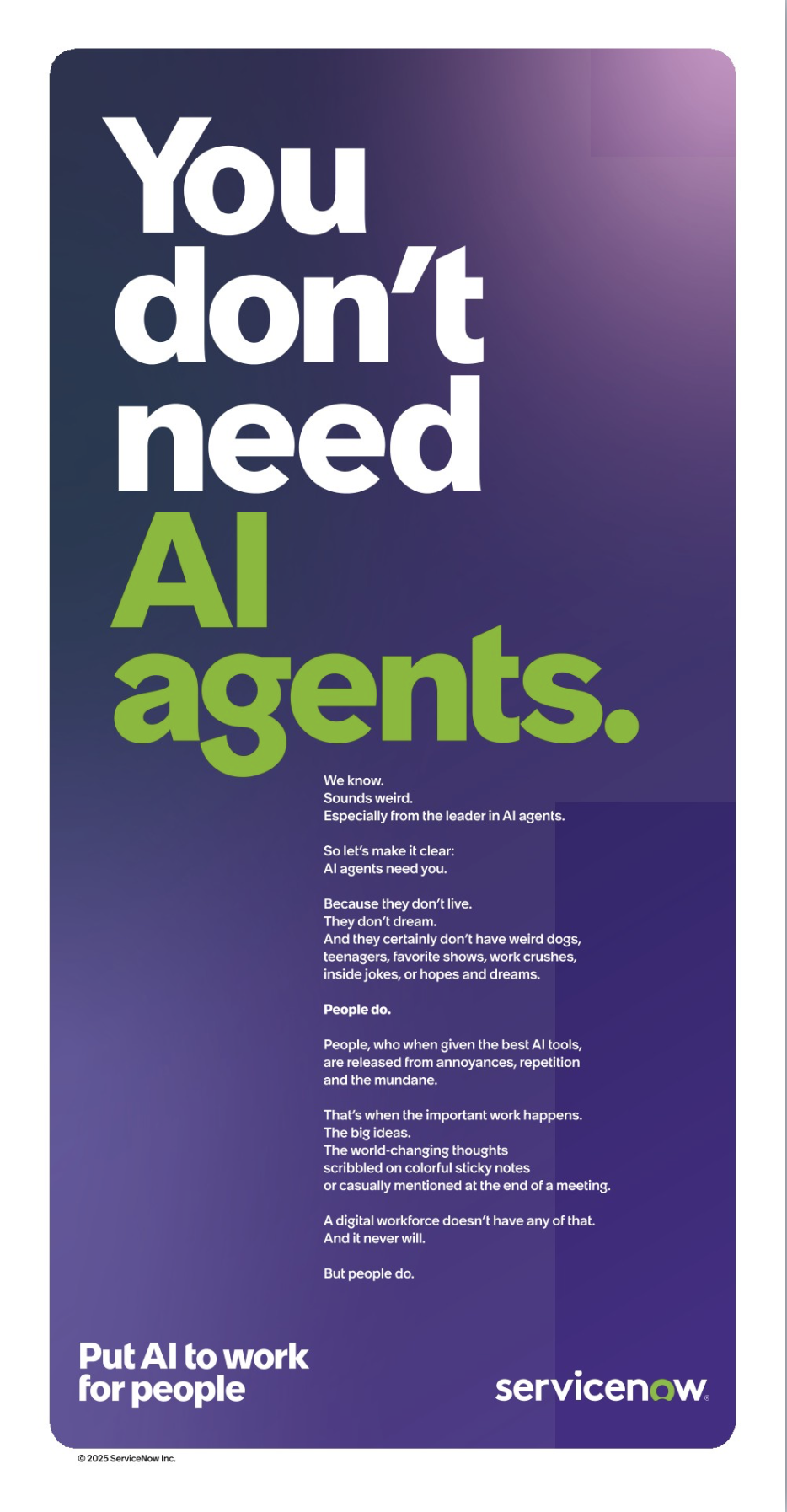
Telling the world you don’t need AI agents is a bold move for a company that sells AI agents. But that’s precisely what Colin Fleming, CMO of ServiceNow, launched…by way of a full-page ad unit in the Wall Street Journal…on the first day of Salesforce’s Dreamforce. If Marketing could make a dis-track, this ad campaign hit Kendrick Lamar-level messaging. “AI Agents need you. Because they don’t live, they don’t dream, and they certainly don’t have weird dogs, teenagers, favorite shows, work crushes, inside jokes, or hopes and dreams.” Setting aside that Idris Elba, ServiceNow’s traditional brand spokes-superstar and everyone’s work crush, was nowhere to be seen in the ad unit, the simple and consistent message that AI agents are here to be put to work for humans screamed from the page. In a year when AI was cast as the star in every enterprise movie, the simple clarity and humanity of ServiceNow's ad campaign cut through the hype, promises, and disappointments of agency shortcomings and data failures.
RUNNERS UP: UKG Make Work Work
Why were they recognized?
On October 2, 2025, UKG launched its When Work Works, Everything Works rebrand, featuring a new identity with a color system and typography. More than a superficial refresh, the rebrand reflects a form-follows-function approach, including the launch of AI-enabled workforce intelligence. By pulling real-time data from multiple sources, front-line workers gain operational intelligence. Users can now put workforce understanding to work with HR, pay, and workforce management tools. This innovative campaign aims to stand out in a crowded, staid HR Tech market.
BEST LIVE-EVENT
This category showcases the team that succeeded in bringing their live, in-person/hybrid, high-touch event to life.
WINNER: Canva Create
Why did they win?
What takes thousands of enthusiastic creators from all walks of life, drops them into a football stadium, lets them swim in a ball pit manned by a lifeguard and ducks, leaves no color of the rainbow off the show floor, and ends the keynote with confetti cannons, a full choir, a guitar playing singer, a rapper, a marching band and grants 45 wishes (aka product updates driven by customers) all while not minimizing the important of kerning, widgets or AI? Welcome to Canva Create, the annual user event where community takes center stage and creativity is celebrated in wild, wonderful and uncharted ways. Canva’s customers represent a vastly diverse user group ranging from professional designers and content creators to parents just trying to get their school’s fundraising flyers designed. At Canva Create, nobody is left out or left behind…amateur or newbie users are never asked to dine at the kids table. It is a literal tailgate picnic of product launches and major updates and upgrades, new applications, new skills and the sharing of strategies that cross life and livelihood. For the enterprise customer, it is an opportunity to be inspired as much as it is to learn, especially for organizations deploying Canva in less traditional creative spaces from finance to sales. Canva has also done an exceptional job of identifying speakers and panels that feel non-traditional…but are overwhelmingly creative. One minute you are being inspired by the music and creative process of Jon Batiste, then next you are hearing from Anthropic’s Co-Founder, Daniela Amodei, discussing trust and innovation in AI. Canva Create 2025 was a wonderfully quirky and deeply educational reminder that creativity is not limited, and self-expression can be a business model.
RUNNERS UP: Adobe MAX

Why were they recognized?
It is an open challenge for content creators, artists, and dreamers to come to Adobe MAX and not leave inspired. For an event that continues to grow and expand, you still find renegade pockets of artists and designers huddled in hallways around their laptops, showing off and showing up for each other. While Adobe’s suite of tools still remains at the center of the keynotes, Adobe MAX continues to be about those carpet classes in the nooks between classrooms and demos. Over 10,000 live attendees descend on MAX, making it the largest creative conference, and while Adobe has expanded to host more regional sessions like MAX London, the homecoming in October remains a highlight of the year.
RUNNERS UP: AWS ReInvent
Why were they recognized?
Amazon’s yearly user conference Re:Invent is back on a tear with over 60,000 attendees finding their way to Las Vegas. Not yet back to pre-pandemic attendee levels but is the de facto get-together of the IT industry - with attendees making it to the casinos on the strip - even if they are not AWS customers - but providers/vendors are all there. A testament to the gravitas that AWS has in the IT and developer community.
RUNNERS UP: Databricks Data + AI Summit

Why were they recognized?
Databricks Data + AI summit cemented their shift from lakehouse to the Data Intelligence Platform storyline with heavyweight speakers from Jamie Dimon and Dario Amodei to Satya Nadella, more than 100 customer stories, and messaging for data scientists and engineers that drew mass applause from the 20,000 in-person attendees.
RUNNERS UP: Google Cloud Next
Why were they recognized?
Google Cloud Next has quickly evolved into the premier cloud event of the first half of the year, with key innovations being announced and released from Google. It is quickly becoming the counterpart of AWS Re:Invent in late fall, which is great progress for Google Cloud and shows uptake, interest, and usage of Google Cloud products. That is likely not going to change with Google aggressively making its mark with Gemini 3.0 in the enterprise.
RUNNERS UP: ServiceNow Knowledge
Why were they recognized?
ServiceNow’s Knowledge event encapsulated the company’s shift into a quest to be “THE AI platform” for enterprise CX motions. Its “data+AI+workflows” message was well supported by key acquisitions leading into the event: Moveworks, Logik.ai, and data.world. But that’s not all - in addition to its broader AI message, Knowledge 25 was the coming-out party for another bold new vision: Unified CRM. The company officially unveiled its CRM aspirations, which aim to unify Sales, Fulfillment, and Customer Service Management (CSM) on a single, AI-first platform - making a big move beyond ITSM and customer support operations.
RUNNERS UP: UKG Aspire
Why were they recognized?
Under Jennifer Morgan’s leadership, the management team has been refreshed with emerging internal stars and a cadre of external executive talent. This year’s UKG Aspire elevated the brand in the minds of customers and partners. From more curated executive and partners sessions, to a show case of new AI products, attendees left impressed with the new team and the company’s direction.
BIGGEST TECH FLOP OF THE YEAR
This category simultaneously recognizes the highest potential and largest failure in enterprise tech.
WINNER: DNS Failures
Why did they win?
You'd think DNS failures would be something from yesteryear. Surprise! 2025 was the year of DNS failures highlighted by major outages at Amazon Web Services and Microsoft. And then there was a Cloudflare outage. We could go on, but the big takeaway is that faulty database DNS records and misconfigurations are still a thing. The other takeaway is that automation is scaling DNS screwups. And yet another takeaway is that business is so dependent on interconnected systems that one DNS screwup can take out banking, social media (probably a good thing), gaming, small businesses and any service you use daily.
RUNNERS UP: Humane AI
Why were they recognized?
Who wouldn’t want an AI pin that you could clip on, talk to, and get stuff done? Apparently, no one. Humane made a splash and went extinct in the blink of an eye. On the bright side, Humane managed to get HP to buy the remnants, so at least investors got something back. Humane wasn’t necessarily wrong, but was early. OpenAI is likely to build something similar with Jony Ive, and don’t be surprised if Google does something similar. Anyone that has used Gemini Live sees the potential that could be embedded in a new device category.
RUNNERS UP: The Metaverse Revival
Why were they recognized?
Let’s face it, naming the metaverse a flop almost seems like a crutch. We could have put metaverse here for the last three years (at least). The funny part is Meta actually seems to be catching on that metaverse, via its Reality Labs unit, is a money pit. Who could argue? Meta is reportedly planning big budget cuts at Reality Labs after losing more than $70 billion since late 2020. Investors would have loved a one-time dividend and less Reality Labs pain.
RUNNERS UP: Meta Edits
Why were they recognized?
It was the slayer of TikTok’s CapCut. It promised AI, music, green screen, timeline editing, longer recording times and AI…SO. MUCH. AI! Launched in April 2025 in a move some believed was more about the impending doom of TikTok in the US, Meta promised a near continuous stream of updates but delivered glitchy performance, failed demos, mediocre output, and lackluster creator reaction. By November 2025, it had some creators wondering if they should still post to Instagram or just stick with TikTok.
About Liz Miller: Liz Miller is Vice President and Principal Analyst at Constellation, focused on the org-wide team sport known as customer experience. While covering CX as an enterprise strategy, Miller spends time zeroing in on the functional demands of Marketing and Service and the evolving role of the Chief Marketing Officer, the rise of the Chief Experience Officer, the evolution of customer engagement, and the rising requirement for a new security posture that accounts for the threat to brand trust in this age of AI. With over 30 years of marketing experience, Miller offers strategic guidance on the leadership, business transformation, and technology requirements to deliver on today’s CX strategies. She has worked with global marketing organizations to transform everything from…...
Read moreLarry Dignan is Editor in Chief of Constellation Insights at Constellation Research, where he leads editorial coverage focused on enterprise technology, digital transformation, and emerging trends shaping the future of business. He oversees research-driven news, analysis, interviews, and event coverage designed to help technology buyers and vendors navigate complex markets with clarity and context. ...
Read moreR “Ray” Wang is the CEO of Silicon Valley-based Constellation Research Inc. He co-hosts DisrupTV, a weekly enterprise tech and leadership webcast that averages 50,000 views per episode and blogs at www.raywang.org. His ground-breaking best-selling book on digital transformation, Disrupting Digital Business, was published by Harvard Business Review Press in 2015. Ray's new book about Digital Giants and the future of business, titled, Everybody Wants to Rule The World was released in July 2021. Wang is well-quoted and frequently interviewed by media outlets such as the Wall Street Journal, Fox Business, CNBC, Yahoo Finance, Cheddar, and Bloomberg. Short Bio R “Ray” Wang (pronounced WAHNG) is the Founder, Chairman, and Principal Analyst of Silicon Valley-based Constellation Research Inc. He…...
Read moreHolger Mueller is VP and Principal Analyst for Constellation Research for the fundamental enablers of the cloud, IaaS, PaaS and next generation Applications, with forays up the tech stack into BigData and Analytics, HR Tech, and sometimes SaaS. Holger provides strategy and counsel to key clients, including Chief Information Officers, Chief Technology Officers, Chief Product Officers, Chief HR Officers, investment analysts, venture capitalists, sell-side firms, and technology buyers. Coverage Areas: Future of Work Tech Optimization & Innovation Background: Before joining Constellation Research, Mueller was VP of Products for NorthgateArinso, a KKR company. There, he led the transformation of products to the cloud and laid the foundation for new Business Process as a…...
Read moreMartin Schneider has had a unique career that has spanned both analyst and marketing practitioner roles, focused on high technology and related industries. The unifying factor has always been both a keen analysis of go-to-market trends, while also having achieved success as a marketing leader. Schneider started his career as a journalist covering B2B technologies, and quickly transitioned into a leading analyst covering application software for the 451 Group in NYC, where he specialized in CRM, marketing automation, and business intelligence/analytics technologies. After analyzing various go-to-market strategies of dozens of technology vendors, Schneider made the move to the vendor side, where he led successful go-to-market teams for several startups and established tech providers,…...
Read moreChirag Mehta is Vice President and Principal Analyst focusing on cybersecurity, next-gen application development, and product-led growth. With over 25 years of experience, he has built, shipped, marketed, and sold successful enterprise SaaS products and solutions across startups, mid-size, and large companies. As a product leader overseeing engineering, product management, and design, he has consistently driven revenue growth and product innovation. He also held key leadership roles in product marketing, corporate strategy, ecosystem partnerships, and business development, leveraging his expertise to make a significant impact on various aspects of product success. His holistic research approach on cybersecurity is grounded in the reality that as sophisticated AI-led attacks become…...
Read moreMichael Ni is Vice President and Principal Analyst at Constellation Research, covering the evolving Data-to-Decisions landscape—where CDOs, CIOs, and CPOs must modernize data infrastructure, integrate AI into decision-making, and scale automation to improve business outcomes. Ni’s research examines how enterprises operationalize AI, automate decision-making, and integrate data management and analytics into core business processes. He focuses on the challenges of scaling AI-driven decision systems, aligning data strategy with business goals, and the growing role of data and decisioning “products” in enterprise ecosystems. With 25+ years as a product and GTM executive across enterprise software, AI platforms, and analytics-driven technologies, Ni brings a practitioner’s perspective to…...
Read moreEsteban Kolsky spent the first part of his professional career working on the customer service front line and in management roles, culminating in early implementations of first-generation CRM tools. In 2000, he became a research analyst at Gartner, focused on CRM, customer service, customer experience management, enterprise feedback management, and voice of the customer, among topics that later became the basis for the current field of CX. During his tenure at Gartner, Kolsky assisted vendors and Global 2000 organizations with their customer strategies. He left Gartner to focus his career on strategic advisory services and influenced all the major software vendors, as well as many smaller vendors, in the CX industry and advised executive leadership teams across industries and countries…...
Read morePublished
Authors