


Welcome to the context chorus: There’s no AI without context
Don't look now, but enterprise technology vendors have a new fascination with context engineering to give AI agents the data and insights to go from pilot to production. You can almost see "context" trending as a theme the more enterprise vendors talk.
Elastic on its investor day earlier this month talked extensively about context. Elastic has enterprise search, observability and security platforms that are leveraged to ingest data from multiple sources, process it and create AI agent experiences and workflows.
Ashutosh Kulkarni, CEO of Elastic, led the charge with a focus on context. Kulkarni said that large language models (LLMs) have transformed what you can do with unstructured data and represent the new enterprise operating system.
- Agentic Automation Doesn’t Fail at Reasoning. It Fails at Inputs.
- Elastic's Agent Builder is generally available, Elastic Workflows in tech preview
To make that AI operating system work though, you need context and data. "To use LLMs within the enterprise, you have to provide them with context. You have to provide them with relevant data to be able to address the problem that they're trying to address. So, AI fundamentally depends on data, being able to have access to it. And relevance is key to making any AI system worthy, production grade," said Kulkarni.
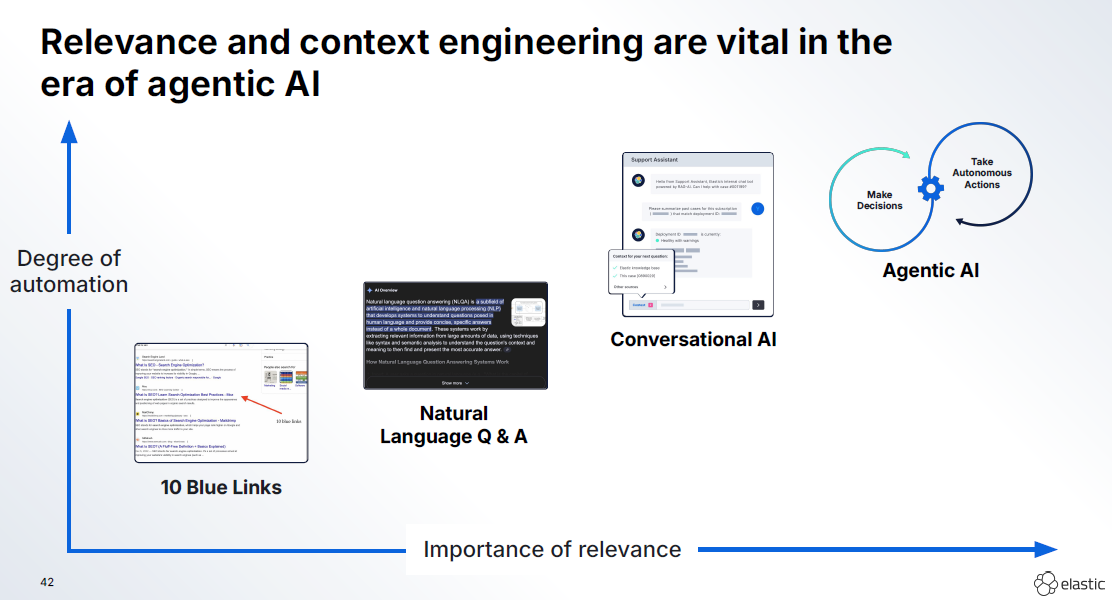
In other words, data matters, but context and relevance may matter more.
Kulkarni made the case that Elastic is set up as a premier platform for context engineering. Context engineering is a set of technology approaches designed to give LLMs the right data and right tools at the right time to do job accurately.
Elastic launched its Agent Builder and the Elastic Inference Service, which will give users access to the company's embedding, retrieval and reranking models. Kulkarni said context and relevance needs more than just a vector database. Elastic also acquired Jina AI to build out its multimodal models for looking at documents.
Ken Exner, Chief Product Officer at Elastic, said the company's long-running focus on relevance has given it the ability to pull context out of data and present it to other systems.
Exner said LLMs have to be grounded with the right data and context to be accurate. Agentic AI only ups the ante. "Now that an AI agent is performing an action, it's doing a task and potentially doing it badly," said Exner. "The consequence of not grounding that LLM or that agent, not giving it the right context could be disruptive and damaging. I think relevance matters so much in the age of AI. Context engineering as a concept is going to be talked about constantly as people move forward with agentic AI because it's all about having relevance. It's all about having context. That's what you need to do AI correctly."
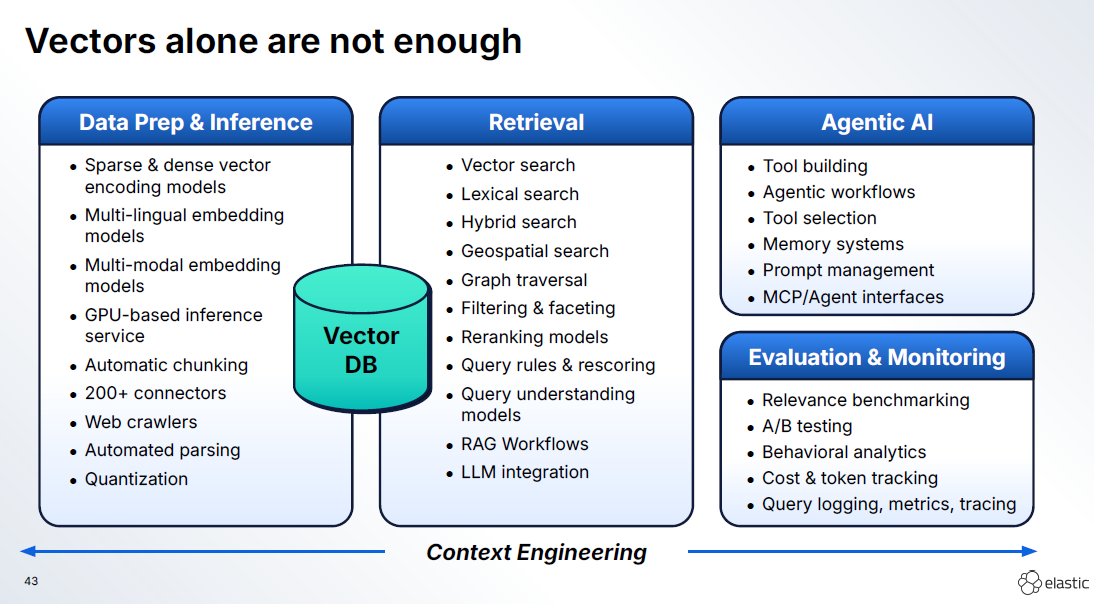
Elastic's discussion of the importance of context was a notable theme by itself, but then the context chorus revved up.
At Dreamforce 2025, Salesforce CEO Marc Benioff's keynote had a hefty dose of context. The pitch for Agentforce is that the Salesforce platform has your customer data and can personalize at scale. "AI alone is not enough. It's not enough just have an LLM. It needs (Agentforce) capabilities to connect it, to give it the context, to give it the guardrails, and all of the critical pieces," said Benioff.
The argument for Agentforce, according to Benioff and a bevy of Salesforce executives, is that you need the customer data, the ability to navigate unstructured and structured information, and trust to bring context to every conversation.
Dreamforce 2025
- Salesforce sets $60B revenue target: Will unlimited Agentforce plans drive growth?
- Salesforce CEO Benioff: Context is king
- Salesforce makes its Agentforce 360 case to be your AI agent platform
- Salesforce's acquisition of Apromore highlights how process intelligence, agentic AI converging
- Salesforce expands OpenAI, Anthropic partnerships, eyes Agentforce everywhere
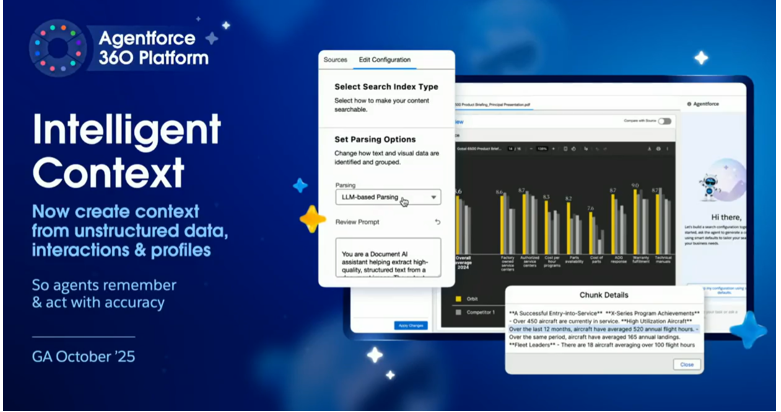
The context engineering topic is one worth pondering as enterprises start designing different types of agents with unique architectures. Salesforce updated its enterprise agentic architecture whitepaper as did Google Cloud. Both are worth a read since each AI agent type will have a unique flow and design. One obvious takeaway is that context will be critical throughout that AI agent design.
Workday Rising also featured a bit of the context thread, largely because Workday is building its Data Cloud to combine the data on people and money. “We're building the best AI agents for HR and finance that deliver real business value. Our data has context, and we're deeply embedding AI into HR and finance processes,” said Workday CTO Peter Bailis. “We're shifting from the system of record for people and money to a system of action for people and money that understands their customer businesses, understands what they need and helps them reimagine what work gets done.
The working theory is that most vendors are going to talk about context just as much as they do data, AI and AI agents. For instance, Constellation Research analyst Michael Ni recently attended Teradata's conference and reported the following:
Joining this month's parade of vendors focused on context, Teradata believes there's no AI without context. For them, context isn't just data & it's the metadata, business logic, and domain know-how that make AI decisions relevant and reliable. Over 95% of enterprise AI projects fail, they argue, because models are built in isolation from business context. Without that grounding, even the best algorithms can’t deliver the accuracy or explainability needed in real-world, regulated environments.
To close that gap, Teradata is turning decades of decision analysis experience into domain and industry knowledge models. These include pre-built layers of business logic, KPIs, and rules from managing customer lifetime value to financial services metrics that give AI agents real context from day one. Their context intelligence framework captures how industries actually operate, so organizations don't have to start from scratch. The goal: help teams build agents faster, with enterprise-grade performance, governance, and trust already built in.
Larry Dignan is Editor in Chief of Constellation Insights at Constellation Research, where he leads editorial coverage focused on enterprise technology, digital transformation, and emerging trends shaping the future of business. He oversees research-driven news, analysis, interviews, and event coverage designed to help technology buyers and vendors navigate complex markets with clarity and context. ...
Read morePublished
Author
