


IFS teams up with Anthropic, Siemens, Boston Dynamics, 1X, showcases industrial AI use cases
IFS CEO Mark Moffat said industries need to embed AI into physical operations in manufacturing, utilities, defense systems and supply chains to better compete globally and become autonomous. IFS launched new AI-powered products as well as partnerships with Anthropic, Siemens, Boston Dynamics and 1X Technologies.
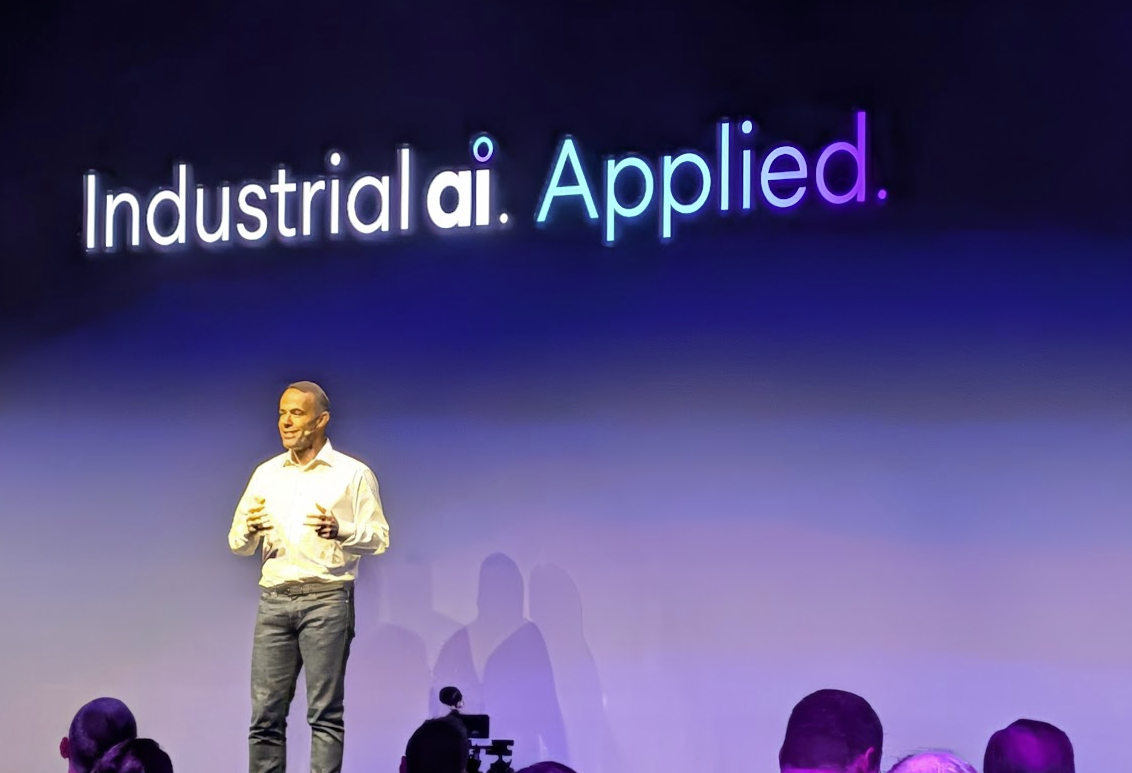
Speaking at IFS' Industrial X Unleased conference in New York, Moffat outlined a vision of Industrial AI -- Applied. "We're at a fork in the road," said Moffat. "This isn't a tech cycle. It's a fundamental choice about whether AI becomes the backbone of the industries that power our world or remains a toy."
Moffat said the $10 trillion flowing into industrial infrastructure and assets is a positive, but there's a gap because little of those funds are going into applying knowhow about running a factory, fixing a turbine or preventing a wildfire. Moffat said IFS is looking to be the control layer that connects industry infrastructure and AI.
"Generic AI misses the context and deep understanding of the physical world," said Moffat, who laid out the IFS strategy combining AI, enterprise applications and processes and industrial use cases.
Moffat said:
"We're moving from demos and brochures and marketing into as my son would call it, IRL, in real life, in the real world. AI that can orchestrate physical operations and supply chains and plants in real time, AI that can unleash a new 10x capacity from the workforce."
The IFS CEO said that investment into AI is staggering, but there's a big gap. "There's a gap between the application of financial capital into the practical, real world AI going into factories, fixing turbines and preventing wildfires. We've focused on the practical application of this technology and bringing it into the real world," said Moffat.
Building an industrial AI ecosytem
IFS' approach is to orchestrate robotic workers, designed for dangerous jobs, human experts, and digital AI workers as one integrated system. To reach this goal, IFS is teaming up with the likes of Anthropic, Siemens and Boston Dynamics and layering AI throughout its enterprise software platform that includes enterprise resource planning, asset management, field service applications and energy and resources software.
At its Industrial X Unleashed conference in New York, the company announced the following:
An Anthropic strategic partnership that will bring Claude models to industrial applications with tooling for specific use cases. For instance, IFS and Anthropic unveiled a voice-first offline AI for frontline technicians working in extreme conditions. According to IFS, 70% of the industrial workforce works in areas where connectivity in spotty.
IFS said its Anthropic partnership revolves around its IFS Nexus Black unit and its IFS Nexus Black Industrial AI applications, which are powered by Claude models. Key items include:
- The partnership combines the expertise of IFS Nexus Black, a team that adapts AI to industrial AI specific use cases, and Claude models.
- IFS launched Resolve, which gives technicians and field workers to Claude trained on use cases in aerospace and defense, construction and engineering, manufacturing, energy and utilities.
- Resolve will help frontline workers predict and prevent faults faster with multi-modal data, connect technicians to the right parts with optimized scheduling and streamline workflows.
- IFS is looking to use AI to address industries dealing with aging infrastructure as well as expertise.
- William Grant & Son, the distiller behind Grant's whisky and Hendrick's gin, used Resolve to cut downtime and revamp operations.
IFS outlined a partnership with Siemens Grid Software to use IFS as part of its intelligent grid infrastructure updates. Siemens and IFS said they will combine Siemens' grid planning, electrification and smart infrastructure applications with IFS's enterprise asset management, field service management and AI scheduling optimization software.
Key items include:
- IFS software will be integrated into Siemens Gridscale X applications.
- The goal is to provide a platform that will create a path to an autonomous, self-optimizing grid operations stack.
- The integration will be modular and designed to be deployed without rip-and-replace projects.
Boston Dynamics, IFS and 1X Technologies said they will collaborate to integrate robotic and humanoids into industrial workflows. The partnership with Boston Dynamics combines the robotics company's autonomous inspection robots with IFS.ai to enable decision-making in the field. According to the companies, the Boston Dynamics and IFS collaboration can address labor and skills shortages for industrial customers.
Key items include:
- The companies showcased a Boston Dynamics Spot robot doing inspection and feeding multimodal data to IFS.ai for analysis and decision-making.
- IFS.ai takes that data and triggers workflows in the field.
- The collaboration focuses on field operations in manufacturing, energy, utilities, mining and other asset-intensive sectors.
- Use cases include autonomous inspections to reduce human exposure to hazardous environments, efficiency for faster response times, and uptime improvements.
Under the 1X Technologies partnership, IFS and 1X will collaborate to combine humanoid robots with IFS.ai. The companies said they will develop and deploy production-ready robotics packages for manufacturing, utilities, aviation and other industries. Here's a look at the 1X-IFS plan:
- IFS and 1X will aim to create a unified digital-physical operational environment that combines robotics and enterprise business processes.
- The two companies will work with customers to industrial and validate humanoid robot use cases including factory automation, IoT powered operational data collection and field service and maintenance.
- IFS and 1X said that integrated offerings will be commercially available in 2026.
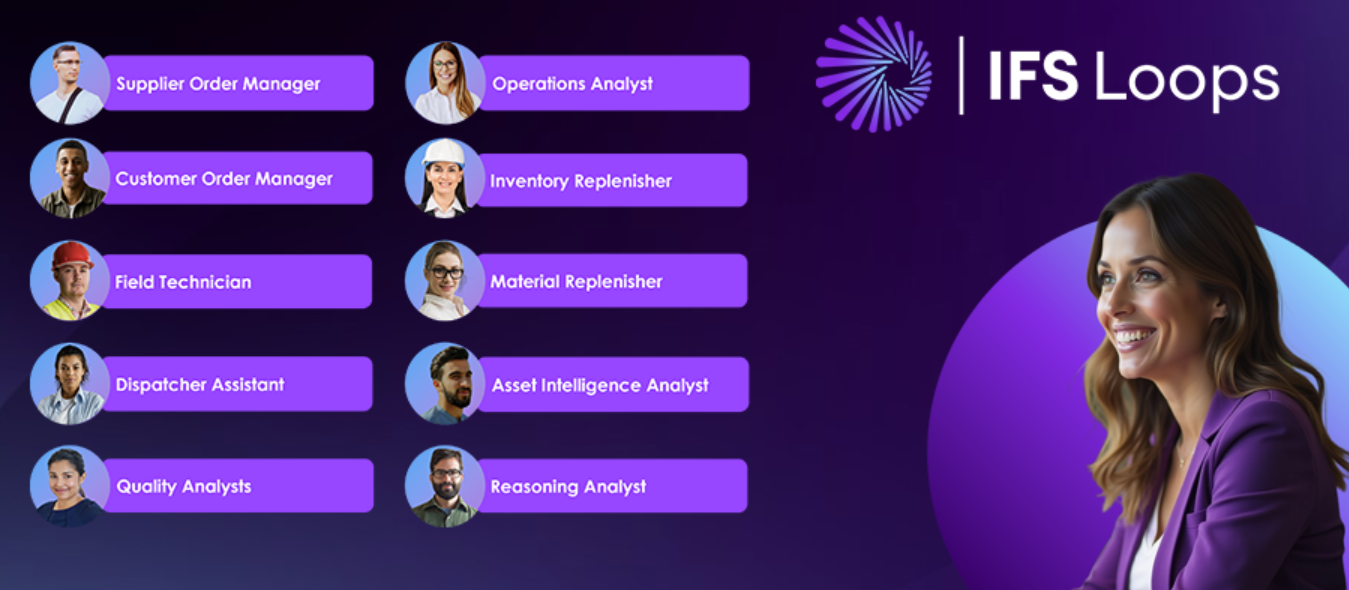
IFS saw its annual recurring revenue surge 22% from a year ago with cloud revenue growth of 31%. The company's industrial AI stack includes IFS.ai, which is designed to embed industry-specific intelligence across its applications, Nexus Black, an AI innovation accelerator, and IFS Loops, a portfolio of agentic digital workers.
The company also acquired 7Bridges in the third quarter for AI-powered supply chain, logistics and transportation optimization tools as well as TheLoops, an AI workforce provider.
In October, IFS outlined 10 digital workers with 50 agentic AI skills as it builds to a roadmap of 100 skills that will be embedded into manufacturing, energy, utilities, telecom, construction, aerospace and defense and service industries. IFS Loops Digital Workers are designed to manage complex workflows and make decisions that continually optimize processes.
The big picture
Here's a look at the high-level takeaways from IFS' conference in New York.
- Moffat's take is that AI can retool industrial infrastructure while maintaining jobs. Manufacturing already faces sever worker shortages.
- According to Moffat, there are multiple trends pointing to the power of AI and industries including aging industrial infrastructure, labor shortages and retiring expertise and the need for automation and faster decision-making. IFS’ core industries include aerospace and defense, energy utilities, construction and engineering, manufacturing and telecommunications.
- IFS is emphasizing industrial AI and that approach can stand out in a stagnant ERP space.
- The company is also highlighting real-world deployments throughout its conference and showing real business impact. IFS is showcasing blue-collar AI and how new technology can empower frontline workers.
- IFS is focused on building ecosystem alliances that can bridge the digital and physical worlds. These partnerships include Microsoft, Nvidia, Siemens, Anthropic and Boston Dynamics to name a few.
- The company is looking to productize its AI applications rather than build custom-built systems, but will use forward deployed engineers to speed up deployments.
- Mohamed Kande, Global Chairman at PwC, said industrial AI will be required to get returns from the $1.7 trillion invested in AI infrastructure. "Do you deploy today the old way, or do you use industrial AI to power all that infrastructure? Imagine being a company investing all of this money and you build something that doesn't have the right artificial intelligence in it. What happens in three or five years?" said Kande, who said boards of directors and CEOs are increasingly comfortable with placing big AI bets.
Constellation Research's take
Constellation Research CEO R "Ray" Wang said:
"While frontier AI models and infrastructure platforms grab headlines, the critical missing piece has been the orchestration layer, the industrial operating system that embeds AI directly into mission-critical workflows. Customers seek deep domain expertise from their trusted AI partners, especially in manufacturing, utilities, aerospace, and energy. The AI Age isn’t about adding AI features to legacy software. It’s about architecting the control plane for the next generation of intelligent industrial operations where autonomous execution happens at scale, in real-time and achieving decision velocity for tangible business outcomes."
Constellation Research analyst Holger Mueller said:
"AI is changing everything and with physical AI and robotics it changes the manufacturing process. Vendors like IFS need to cater to a mix mode shop floor where humans and robots work together with the common goal of delivering projects at high quality and on time. Laying the groundwork for the agentic / robotic factory is a key step for enterprises that like will happen sooner than later."
Larry Dignan is Editor in Chief of Constellation Insights at Constellation Research, where he leads editorial coverage focused on enterprise technology, digital transformation, and emerging trends shaping the future of business. He oversees research-driven news, analysis, interviews, and event coverage designed to help technology buyers and vendors navigate complex markets with clarity and context. ...
Read morePublished
Author
