Results

SAP's Supervisory Board to nominate Ala-Pietilä as Plattner successor, Renjen to resign

SAP on Sunday shook up its Supervisory Board. SAP's Supervisory Board nominated Pekka Ala-Pietilä to the board as the successor to Chairman Prof. Dr. Hasso Plattner.

SAP and Dr. h.c. Punit Renjen said they have "mutually agreed to part ways because of a difference in perspective on the role of SAP Supervisory Board." In a statement, SAP didn't elaborate on the split. Renjen was designated to assume Plattner's spot on the Supervisory Board.

Ala-Pietilä (right) will stand for election for a two-year term at SAP's annual meeting on May 15. Renjen will officially resign on May 15.

SAP's Supervisory Board swap comes a month after the company added Muhammad Alam to the company's Executive Board to succeed Thomas Saueressig for the company's product engineering. Saueressig will focus on accelerating SAP customers adoption of the cloud.

The Supervisory Board shakeup comes as SAP is going through multiple transitions to move customers to the cloud, popularize AI across its business applications and manage a sometimes vocal user base. 

Ala-Pietilä, 67, has been a member of SAP's Supervisory Board from 2002 to 2021. He was also President of Nokia from 1995 to 2005.

In addition, Ala-Pietilä will bring artificial intelligence heft to SAP's Supervisory Board. He was the Chairman of the EU Commission’s High-Level Expert Group on Artificial Intelligence from 2018-2020 and chair of Finland's Artificial Intelligence Program from 2017-2019.

Plattner, who has been Chairman of SAP's Supervisory Board since 2003, said Ala-Pietilä will bring "vision and a well-measured approach" to ensure SAP's success. Plattner also thanked Renjen for his contributions.

Ala-Pietilä's statement indicated he would be focused on developing and deploying SAP's Business AI.

Constellation Research analyst Holger Mueller said:

"Cultural change is hard for SAP. Outgoing Chairman and partial owner Hasso Plattner wants change but the executives installed tend to run into insourmountable challenges on the cultural side. From Shai Agassi to Vishal Sikka to Jennier Morgan and now Punit Renjen executives are installed as change agents who get initial backing but then overshoot on what is feasible and achievable in a multinational company. Ironically, it is back to Ala-Pietilä, who was passed over before, to start the transition to the post Plattner era."

Data to Decisions Digital Safety, Privacy & Cybersecurity Innovation & Product-led Growth Tech Optimization Future of Work SAP Chief Information Officer Chief Technology Officer Chief Information Security Officer Chief Data Officer

GenAI trickledown economics: Where the enterprise stands today

This post first appeared in the Constellation Insight newsletter, which features bespoke content weekly and is brought to you by Hitachi Vantara.

Generative AI is supposed to be a boon for vendors, enterprises and overall productivity and efficiency, but so far, the economic benefits have gone to just a few. Simply put, it is very early in tracking the trickledown effects of generative AI, but worth pondering the economic impacts.

There's little doubt that generative AI will have an economic impact both good and bad. Some enterprises are seeing returns as they move from pilots to production. It's no secret that software development is the premier genAI use case. Vendor spoils from generative AI are a bit harder to track because pure plays are hard to find. Beyond Nvidia and Supermicro there have been few generative AI winners among enterprise technology vendors.

Here are the moving parts to ponder regarding trickledown genAI economics.

  • Nvidia and Supermicro are clear beneficiaries.
  • Other vendors are anticipating demand pops that haven't showed up yet. These vendors often talk about pipelines and interest instead of revenue.
  • Hyperscalers such as Microsoft Azure, Google Cloud and Amazon Web Services are seeing sequential revenue gains as the cloud optimization phase ends and genAI gooses workloads.
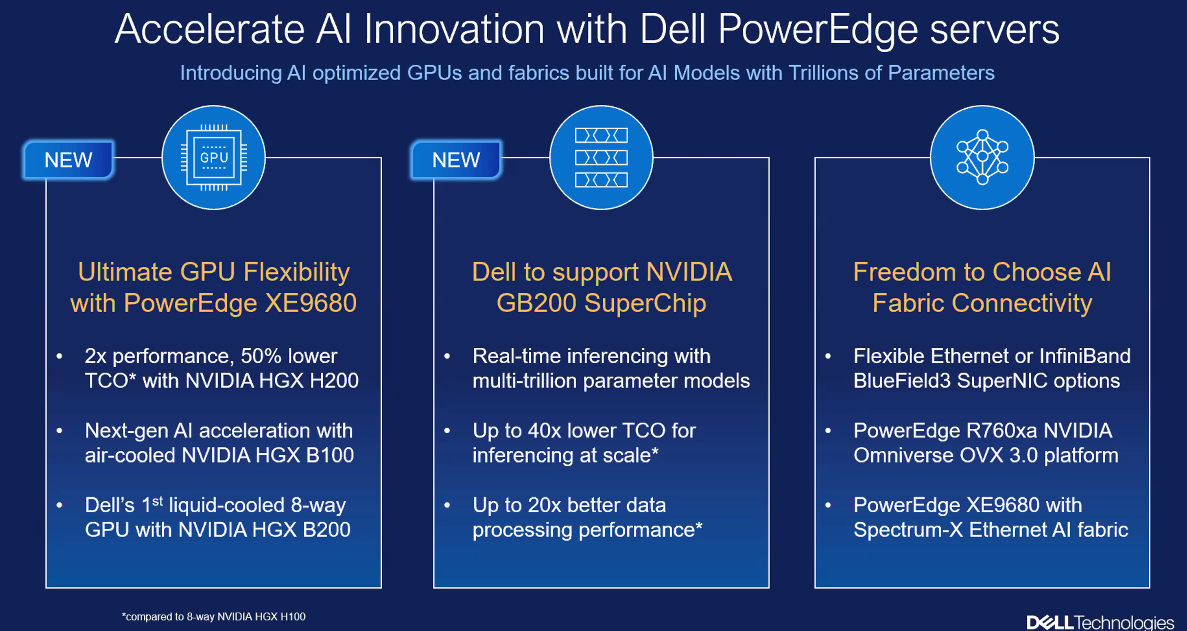
  • Traditional enterprise hardware vendors--Cisco, Dell, HPE--are seeing demand in AI optimized systems as enterprises ponder hybrid workload approaches to large language models (LLMs).
  • Component vendors that feed into those AI-optimized systems will see benefits. Think AMD, Intel and Western Digital to name a few.
  • SaaS vendors may benefit from generative AI, but CXOs are already pushing back on the copilot upsell. Copilots are boosting SaaS contracts and CXOs will choose what workers get access to generative AI.
  • Enterprises are in early stages of genAI deployments and many of them are focusing on the data management and architectures to innovate. As a result, data platforms including Snowflake and Databricks will benefit.

Here's a look generative AI's trickledown economics so far.

Nvidia wins (always).

To say expectations are inflated for Nvidia's fourth quarter earnings on Feb. 21 would be an understatement. However, Nvidia has been able to be at the right place at the right time with the research and development and GPUs for generative AI workloads.

Nvidia is expected to deliver fourth quarter revenue of $20.23 billion with non-GAAP earnings of $4.52 a share. In the third quarter, Nvidia beat revenue estimates by $2 billion. For a bit of perspective, Nvidia quarterly revenue is approaching what it used to put up a year. In fiscal 2023, Nvidia revenue was $26.97 billion.

Until Supermicro crushed estimates with its AI-optimized gear, there weren't any other pure genAI winners. Supermicro's fourth quarter results indicate that there will be other winners. Keep in mind, Supermicro's gains are largely due to Nvidia-powered systems.

You can expect other vendors to start touting generative AI system demand. Dell and HPE have already said pipelines are being built for generative AI systems.

What's unclear at this point is how much of Nvidia's strength will trickle down to server makers. Most of the genAI buildout has revolved around hyperscale cloud players and Meta. Those hyperscale providers buy white box servers.

Rob Mionis, CEO of contract equipment manufacturer Celestica, said on the company's fourth quarter earnings call:

"We're still in the early innings of the upgrade cycle. It just started about a year or so ago. About 50% of any data center needs to be upgraded, I think we're still in the very early innings of that upgrade cycle. It's a multi-year process. It's certainly five plus years."

In addition, networking gear is being upgraded too. Generative AI is also driving upgrades for AI and machine learning workloads.

Meta's capital spending highlights how Nvidia will be poised to win. "By the end of this year, we'll have about 350,000 (Nvidia) H100s, and including other GPUs, which will be around 600,000 H100 equivalents of compute. We're well positioned now because of the lessons that we learned from Reels. We initially underbuilt our GPU clusters for Reels. And when we were going through that, I decided that we should build enough capacity to support both Reels and another Reels-sized AI service that we expected to emerge so we wouldn't be in that situation again," said Meta CEO Mark Zuckerberg.

The boom is coming for these vendors (maybe).

AMD is seen as a major challenger to Nvidia and Intel will get some portion of the genAI pie too. These vendors see demand coming, but real revenue surges will take time to develop.

AMD has increased its accelerated computing chip demand forecast from $2 billion to $3.5 billion. AMD CEO Lisa Su said:

"It really is mostly customer demand signals. So as orders have come on books and as we've seen programs moved from, let's call it, pilot programs into full manufacturing programs, we have updated the revenue forecast. As I said earlier, from a supply standpoint, we are planning for success. And so, we worked closely with our supply chain partners to ensure that we can ship more than $3.5 billion, substantially more depending on what customer demand is as we go into the second half of the year."

Arm Holdings appears to be another winner. Arm licenses its designs to chipmakers and CEO Rene Haas said on the company's third quarter earnings conference call that AI driving revenue growth. "We've seen a significant transition now continuing from our v8 product to our v9 product. Our v9 product garners roughly 2x the royalty rate of the equivalent v8 product," he said.

Haas added that Nvidia's Grace Hopper 200 are Arm v9 based as are custom data center chips from Amazon Web Services with Graviton and Microsoft Azure with Cobalt. Haas said:

"There's definitely growth coming from the data center side. So proof points such as Nvidia's Grace Hopper, the Microsoft Cobalt design, the work that AWS has been doing in Graviton. What we are seeing is more and more AI demands in the data center, whether that's around training or inference. And because the Arm solution in the data center, in particular, is extremely good in terms of performance per watt and the constraints that are on today's data center is relative to running these AI workloads puts a huge demand on power, that's a great tailwind for Arm."

Storage is also going to see trickle down generative AI gains.

Western Digital CEO David Goeckeler said on the company's fiscal second quarter earnings call:

"In addition to the recovery in both Flash and HDD markets, we believe storage is entering a multi-year growth period. Generative AI has quickly emerged as yet another growth driver and transformative technology that is reshaping all industries, all companies, and our daily lives...We believe the second wave of generative AI-driven storage deployments will spark a client and consumer device refresh cycle and reaccelerate content growth in PC, smartphone, gaming, and consumer in the coming years. Our Flash portfolio is extremely well positioned to benefit from this emerging secular tailwind."

Goeckeler said to date the investment is being made by hyperscalers for genAI and that'll expand to edge devices moving forward.

Hyperscale cloud players driving demand and will reap rewards.

Microsoft, Alphabet (Google) and Amazon earnings results made it clear that the cloud optimization phase has ended, and generative AI workloads were driving demand.

Amazon CEO Andy Jassy said cloud migrations are picking up again. "If you go to the generic GenAI revenue in absolute numbers, it's a pretty big number, but in the scheme of $100 billion annual revenue run rate it's still relatively small. We really believe we're going to drive 10s of billions of dollars of revenue over the next several years (with GenAI). It's encouraging how fast it's growing, and our offerings really resonate with customers," said Jassy, who noted that Amazon Web Services is preaching model choices to land genAI workloads. Also keep in mind that Amazon is leveraging genAI across its commerce and delivery businesses too.

On a conference call with analysts, Alphabet Sundar Pichai said Google Cloud is seeing strong usage of Vertex AI. "Vertex AI has seen strong adoption with the API requests increasing nearly 6x from the first half to second half last year," said Pichai. Pichai also said Duet AI was boosting productivity.

Microsoft CEO Satya Nadella added on his company’s most recent earnings: "We now have 53,000 Azure AI customers, over a third are new to Azure over the past 12 months."

Direct generative AI revenue for these hyperscalers will be hard to pin down. Why? These cloud providers will likely benefit from the workloads and usage from generative AI, which will drive compute, storage and managed cloud revenue. For instance, enterprises are likely to use custom processor options from AWS and Google Cloud for generative AI workloads that don't require Nvidia's price tag.

Enterprises’ hybrid genAI deployments to benefit legacy providers.

Hyperscale cloud providers won't garner all the genAI revenue. Enterprises are already thinking of small language models, specific use cases and on-premise deployments for security reasons. Cisco, Dell and HPE should all see gains from generative AI deployments via sales of converged and hyperconverged systems.

These traditional vendors will also benefit due to inferencing at the edge.

Comments from these traditional vendors indicate that there will be an on-prem upgrade cycle too.

Also keep in mind that enterprises eyeing generative AI are likely to turn to their preferred service partners. Accenture and Infosys are just a few services companies citing strong genAI demand. Accenture CEO Julie Sweet noted in December that its GenAI sales in the first quarter were $450 million, up from $300 million three months earlier. Sweet said:

"We are now focusing on helping our clients in 2024 realize value at scale. We are excited about the recent launch of our specialized services to help companies customize and manage foundation models. We're seeing that the true value of generative AI is to deliver on personalization and business relevance. Our clients are going to use an array of models to achieve their business objectives."

SaaS, data platforms, the copilot game.

Trickle down generative AI economics is clearly making its way through the tech ecosystems for companies involved in the infrastructure buildout and those involved with strategy and expertise. Enterprise software providers will be the battleground to watch.

Before we get into the state of play for software companies, it's worth noting a few winners. Databricks is a winner. Snowflake is a winner. Palantir appears to be landing commercial accounts. MongoDB is surging as developers eye generative AI apps. I can take an educated guess and say ServiceNow and its use-case specific model approach is a winner. Salesforce's Data Cloud looks like a winner. But there are some big questions ahead: How many enterprise software vendors can realistically charge extra for generative AI capabilities? How many copilots am I willing to pay for? Why would I pay extra for what will be a standard feature in a few years? Won't generative AI be table stakes for any application in the future?

Constellation Research analyst Dion Hinchcliffe noted on the most recent CRTV news segment that CXOs are already pushing back. The pushback is understandable. Simply put, copilots are blowing the budget. Meanwhile, the genAI approaches from Adobe, Workday and Zoom make more sense for customers in the long run.

Sure, Microsoft created a model where there's a $30 per user/month charge for copilot functionality. Some applications--such as GitHub Copilot--justify the upsell due to the returns provided. Other areas are going to be a tougher sell. Should an enterprise forgo the copilot upsell if they can't generate 50% returns? What's the number? And if generative AI drives consumption or economic value for vendors elsewhere (compute, storage, consumption) shouldn't the copilot tax be waived?

Multiply that math across the entire software stack and CXOs have budget issues ahead. One thing is clear: Not every software vendor is going to be able to charge extra for a copilot or generative AI feature (even if heavily discounted).

My take: Trickledown economics for GenAI isn't going to make it to all enterprise software vendors. Not every enterprise vendor is going to be a generative AI winner.

From our underwriter

Hitachi Vantara and Cisco launched a suite of hybrid cloud services, Hitachi EverFlex with Cisco Powered Hybrid Cloud, that aims to automate deployments and provide predictive analytics. The combination aims to bring Hitachi Vantara's storage, managed services and hybrid cloud management and integrate them with Cisco's networking and computing stack. Hitachi Vantara and Cisco said customers will see a consistent experience across on-premises and cloud deployments.

Data to Decisions Innovation & Product-led Growth Future of Work Tech Optimization Next-Generation Customer Experience Digital Safety, Privacy & Cybersecurity AI GenerativeAI ML Machine Learning LLMs Agentic AI Analytics Automation Disruptive Technology Chief Executive Officer Chief Information Officer Chief Technology Officer Chief AI Officer Chief Data Officer Chief Analytics Officer Chief Information Security Officer Chief Product Officer

Cohesity bulks up, combines with Veritas data protection unit

Cohesity and Veritas' data protection unit, best known for its NetBackup software, will merge to form a company with $1.6 billion in annual revenue.

The companies said in a statement that the combined entity will be able to scale better, serve an installed base of more than 10,000 customers and focus research and development on cloud, security and artificial intelligence.

Cohesity CEO Sanjay Poonen will be CEO and Greg Hughes, CEO of Veritas, will be a board member and advisor to Poonen. Cohesity is backed by Softbank and Veritas is owned by the Carlyle Group, which bought Veritas from Symantec for $7.4 billion in 2016.

As for the products, Poonen said Cohesity will be committed to Veritas NetBackup, NetBackup appliances and Alta data protection. "Cohesity’s scale-out architecture ideally suited for modern workloads and strong Generative AI and security capabilities and Veritas’ broad workload support and significant global footprint, particularly in the Global 500 and large public sector agencies," said Poonen.

Constellation Research cybersecurity analyst Chirag Mehta said:

"In today's threat landscape, AI-driven attacks are becoming increasingly sophisticated, making data protection in hybrid environments more critical than ever before. Data security and data-resiliency are critical components of cyber-resilience. By combining forces with Veritas, Cohesity will be better positioned to help their customers in their cybersecurity journey."

AI is transforming the security industry and next-gen security companies such as Palo Alto Networks, Crowdstrike and ZScaler are grabbing wallet share and market cap. Cohesity primarily competes with Rubrik, Veritas NetBackup, Zerto and a host of others.

Although the companies didn't share roadmaps, the product lines appear to be complementary. Here's the Veritas NetBackup platform.

Cohesity has one platform and user interface combining Cohesity DataProtect, FortKnox, DataHawk, SmartFiles and SiteContinuity. The Cohesity platform, which runs across the big three cloud providers, is designed to thwart ransomware and recover from attacks, product documents, offer disaster recovery and provide data protection to a wide range of enterprise applications.


Digital Safety, Privacy & Cybersecurity Security Zero Trust Chief Information Security Officer Chief Privacy Officer

Google launches Gemini Ultra 1.0, rebrands Bard, Duet AI as Gemini

Google rebranded Bard as Gemini and replaced Google Cloud's Duet AI as Gemini for Workplace, launched the Gemini Ultra 1.0 model and launched a $19.99 a month Google One Premium plan.

Simply put, Google's AI efforts now have a unified brand under Gemini, which is Google's chief rival to OpenAI's ChatGPT.

In a blog post, Alphabet CEO Sundar Pichai said:

"Gemini is evolving to be more than just the models. It supports an entire ecosystem — from the products that billions of people use every day, to the APIs and platforms helping developers and businesses innovate."

Google's subscription revenue was $15 billion in 2023 primarily due to YouTube. 

For Google, the Gemini rebrand makes sense. The Gemini effort is also a way to upsell subscriptions, which are becoming increasingly important to the company. Google One will get Gemini Advanced under a $19.99 a month plan that will include Google's state-of-the-art model designed for complex tasks along with 2TB of storage and other perks.

Google One has nearly 100 million subscribers. The price point is no shock either as ChatGPT charges $20 a month for ChatGPT Plus. As a ChatGPT Plus subscriber, I'm likely to choose OpenAI or Google One with Gemini Advanced. There's no chance that I'm going to treat digital assistants like streaming subscriptions.

The search giant has pitched Gemini Advanced as a way to get a personal tutor, coder and creative helper. Gemini Advanced has the potential to rattle a host of subscription plans.

Key items in Google's Gemini effort include:

  • Workspace will get Gemini for Workspace as a replacement for Duet AI. Consumers with the Google One Premium plan can use Gemini in Gmail, Docs, Sheets, Slides and Meet.
  • Google Cloud customers will see Duet AI become Gemini in the weeks ahead for tasks such as security, coding and productivity.
  • Google said it will outline more details about what Gemini Advanced means for developers and Google Cloud customers.
  • Gemini Advanced will be available as a standalone app on iOS and Android.
Data to Decisions Next-Generation Customer Experience Digital Safety, Privacy & Cybersecurity Innovation & Product-led Growth Tech Optimization Future of Work Google Cloud Google SaaS PaaS IaaS Cloud Digital Transformation Disruptive Technology Enterprise IT Enterprise Acceleration Enterprise Software Next Gen Apps IoT Blockchain CRM ERP CCaaS UCaaS Collaboration Enterprise Service AI GenerativeAI ML Machine Learning LLMs Agentic AI Analytics Automation Chief Information Officer Chief Technology Officer Chief Information Security Officer Chief Data Officer Chief Executive Officer Chief AI Officer Chief Analytics Officer Chief Product Officer

MicroStrategy best known for bitcoin, but watch AI and BI strategy

MicroStrategy has transformed its offerings with cloud, artificial intelligence and a unified platform that runs on all three big hyperscalers. But you'd never really know it since MicroStrategy is best known as a bitcoin development company.

When MicroStrategy reported its fourth quarter earnings I got a serious case of whiplash. Sure, I'm used to companies that have multiple businesses and tech conglomerates. But the dueling banjos with MicroStrategy CEO Phong Le, CFO Andrew Kang and Executive Chairman Michael Saylor was jarring. One minute MicroStrategy is talking like a Bitcoin ETF and investor and the next minute we’re transitioning from perpetual licenses to cloud subscriptions.

The two businesses--business intelligence and analytics software and Bitcoin investing--only go together because they reside in one company. The other thread is that the software business helps fund investments in bitcoin. MicroStrategy is the largest corporate holder of bitcoin on its balance sheet.

Indeed, MicroStrategy's fourth quarter earnings press release touted holdings of 190,000 bitcoins at a total cost of $5.93 billion. And oh by the way, MicroStrategy revenue (the software business) was $124.5 million, down 6% from the previous year, and net income was $89 million including a $150 million tax benefit. Le noted that MicroStrategy has a unique model but drives shareholder value.

Given MicroStrategy's enterprise installed base it would almost make sense to have separate calls--one on the software business and one on the bitcoin investing. Simply put, MicroStrategy can be confusing to enterprise buyers even as it's loved by Wall Street.

Le explained (or tried to) on an earnings conference call:

"With our bitcoin strategy being so significant to our overall business value, while we also continue to pursue growth in our enterprise analytics business, some may ask, what kind of a company is MicroStrategy now? It's a fair question and a question that takes on even more significance with the approval of Spot Bitcoin ETFs in the United States. We consider MicroStrategy to be unique. We consider MicroStrategy to be the world's first bitcoin development company.

Let me explain what we mean. We are a publicly traded operating company committed to the continued development of the bitcoin network through activities in the financial markets, advocacy, and technology innovation. As an operating business, we're able to use cash flows as well as proceeds from equity and debt financing to accumulate bitcoin, which serve as our primary treasury reserve asset. We also develop and provide industry leading AI powered enterprise analytics software that promotes our vision of intelligence everywhere and are also using our software development capabilities to develop bitcoin applications. We believe that the combination of our operating structure, bitcoin strategy, and focus on technology innovation provides a unique opportunity for value creation."

Perhaps you get MicroStrategy and how it fits together, but CIOs need to focus. After all, a buying decision can't be made on how much bitcoin a vendor owns.

Here's a look at the key points about MicroStrategy's software business for CIOs.

  • Le said that MicroStrategy has had its most transformative year with the launch of MicroStrategy One, MicroStrategy AI and MicroStrategy Cloud for Microsoft Azure, AWS and Google Cloud. "
  • MicroStrategy boasts that it is the largest independent business intelligence company. It competes with Qlik, Salesforce Tableau, Microsoft's PowerBI and SAP among others.
  • There are 1,900 employees focused on the software business.
  • Subscription revenue for 2023 was $81.2 million, up 34% from a year ago. However, product license revenue is falling as product support and maintenance is flat. Support and maintenance revenue was $263.89 million in 2023, down from $266.5 million in 2022.
  • The MicroStrategy transition to a cloud model has been done before. In general, the company's software business will see lumpy quarters for roughly a year to 18 months before growing again. "The strong growth in our subscription services revenue was driven by both existing customer migrations to the cloud and new customer wins," said Le, who noted that 2024 will be a transition year as support and license revenue falls and subscription revenue grows.
  • MicroStrategy has launched a customer success organization to improve experience, onboarding, adoption, migration and upsell. The company has also rebuilt its marketing team and just named a CMO.
  • Partners include Microsoft, AWS, Google and Snowflake.
  • Le said that the software business is the core revenue and cash flow generator and allows MicroStrategy to acquire bitcoin. He did note that MicroStrategy can pursue software innovations that leverage the bitcoin blockchain.
  • In 2024, MicroStrategy will focus on AI and BI and accelerate the transition to a cloud model. MicroStrategy will also launch a private cloud version later this year.
  • The game plan is to make MicroStrategy Cloud the most flexible and easy to deploy.

Add it up and MicroStrategy is hoping to sit at the intersection of AI and BI. "Our platform's AI/BI capabilities enable customers to automate their BI workflows, including building data wrangling, dashboard creation, and data exploration. This elevates the role of data throughout the organization, allowing companies to make better database decisions and take actions," said Le, who also highlighted the company's large language model development with MicroStrategy AI.

In the end, MicroStrategy's overshadowed AI-BI software is worth a look. The platform sits on two Constellation Research shortlists and Le noted that CXOs are interested in moving MicroStrategy workloads to the cloud.

And about that bitcoin plan...

Whether you buy into MicroStrategy's bitcoin play or not is up to you. Saylor is positioning the company's strategy as one that revolves around the digital transformation of capital.

Saylor said:

"Bitcoin is up 260% since we embarked on our bitcoin strategy. That's why it's outperforming the S&P and the NASDAQ. That's why it's outperforming gold, silver and bonds. Bitcoin isn't a company. And it's profoundly important to understand that it's not a company, it's an asset class. And as such, based on a commodity, it has spawned an entire universe of companies, products, and services built on that asset class. So part of the driver of bitcoin's performance is not just its protocol and superior fundamental characteristics, but another driver is the industry of bitcoin miners that secure the network and bitcoin custodians and a set of bitcoin exchanges."

MicroStrategy has published its bitcoin development playbook and Saylor said that new bitcoin ETFs will take the digital asset mainstream. Saylor said MicroStrategy has control over its capital structure and will do whatever it can to advance the bitcoin network and acquire digital assets.

Ultimately, MicroStrategy will develop bitcoin network applications. "As we develop this software, we will release it either to the benefit of the bitcoin network or we'll release it to generate more revenue and work to generate more cash flow so that we can buy more bitcoin. Another thing that we can do uniquely as an operating company is, we can generate cash from operations," said Saylor.

According to Le, CIOs shouldn't fret about bitcoin development. Le said:

"On the R&D piece, we will invest more in R&D into bitcoin software development. It will not be at the expense of our business intelligence and AI and cloud-based software development. Some of the things that we've been doing, you've seen at our Bitcoin and Lightning and MicroStrategy World event last year, where we implemented a Lightning Rewards program on the Layer 2 network. We're also looking at some things that will leverage the native bitcoin blockchain technology, some security applications that we'll reveal at our next MicroStrategy World Conference."

MicroStrategy World be held in Las Vegas April 29 to May 2 in Las Vegas and features a Business Intelligence track and Bitcoin for Corporations track.

Data to Decisions Innovation & Product-led Growth Matrix Commerce Digital Safety, Privacy & Cybersecurity Sales Marketing Next-Generation Customer Experience Tech Optimization Future of Work intel Marketing B2B B2C CX Customer Experience EX Employee Experience AI ML Generative AI Analytics Automation Cloud Digital Transformation Disruptive Technology Growth eCommerce Enterprise Software Next Gen Apps Social Customer Service Content Management Collaboration Machine Learning LLMs Agentic AI business SaaS PaaS IaaS Enterprise IT Enterprise Acceleration IoT Blockchain CRM ERP finance Healthcare Chief Information Officer Chief Technology Officer Chief Information Security Officer Chief Data Officer Chief Executive Officer Chief AI Officer Chief Analytics Officer Chief Product Officer

Generative AI in CX, Tech News, AXS 2024 | ConstellationTV Episode 73

ConstellationTV episode 73 just in! 🎬 Catch this week's co-hosts Dion Hinchcliffe and Doug Henschen talking enterprise tech news with Larry Dignan, then Dion shares Generative AI trends in CX and Liz Miller explains why you don't want to miss Constellation's 2024 Ambient Experience Summit in Austin, TX.

00:00 - Welcome from our hosts!
01:00 - Enterprise tech news (Apple Vision Pros, cost optimization, acquisitions.)
14:43 - Generative AI in Customer Experience
18:54 - Ambient Experience Summit Preview
26:13 - Bloopers!

ConstellationTV is a bi-weekly Web series hosted by Constellation analysts, tune in live at 9:00 a.m. PT/ 12:00 p.m. ET every other Wednesday!

On ConstellationTV <iframe width="560" height="315" src="https://www.youtube.com/embed/xS_Fj2XYYDQ?si=74FnVBDge9jR2y4r" title="YouTube video player" frameborder="0" allow="accelerometer; autoplay; clipboard-write; encrypted-media; gyroscope; picture-in-picture; web-share" allowfullscreen></iframe>
Media Name: YouTube Video Thumbnails (1).png

Uber Q4 strong, eyes platform expansion

Uber reported strong fourth quarter results as it capped a year focused on profitable growth and CEO Dara Khosrowshahi said the company in 2024 will "use our data advantage to drive more efficient pricing, matching, and incentive spend."

While Uber is best known for its mobility and delivery services, the company is really a data platform that is extensible into new businesses. For instance, Uber has 19 million Uber One subscribers globally and has an ad business that's on a $900 million annual revenue run rate.

Uber also has been leveraging artificial intelligence as well as machine learning alongside process mining and automation. Uber has been cited as a reference customer for Oracle Cloud Infrastructure, Databricks, Celonis and UIPath.

The company will outline more about its data strategy during an Investor Update call Feb. 14.

Uber reported fourth quarter earnings of $1.4 billion, or 66 cents a share, including a $1 billion gain due to revaluing of equity investments. Revenue for the quarter was $9.94 billion, ahead of $9.76 billion expected by analysts.

In the quarter, Uber saw gross booking surge 22% with mobility up 29% and delivery up 17%. For the first quarter, Uber projected gross bookings of $37 billion to $38.5 billion with adjusted EBITDA of $1.26 billion to $1.34 billion.

Khosrowshahi said:

“2023 was a year of sustainable, profitable growth for Uber as we executed against our strategy. We grew our business by improving marketplace health and scaling new products, bolstering our competitive position in key markets.

Turning to 2024, I want to highlight several key priorities. First, our goal is to make the Uber use case even more of an everyday reality. We’ll continue to enhance the power of our platform by expanding the number of consumers who use multiple Uber products, turbocharged by our Uber One membership program. Second, we will strategically reinvest into promising new growth vectors to deliver strong multi-year growth with healthy long-term unit economics. Lastly, we will maintain our industry-leading cost structure and use our data advantage to drive more efficient pricing, matching, and incentive spend."

By the numbers:

  • Uber had 150 monthly active platform consumers in the fourth quarter, up 15% from a year ago.
  • Trips in the quarter were up 24%.
  • Mobility revenue in the fourth quarter was $5.54 billion, up 34% from a year ago.
  • Delivery revenue was up 6% in the fourth quarter to $3.12 billion.
  • Freight revenue was $1.28 billion, down 17% from a year ago.
  • For 2023, Uber reported net income of $1.89 billion on revenue of $37.3 billion.


Data to Decisions Next-Generation Customer Experience Innovation & Product-led Growth Future of Work Tech Optimization Digital Safety, Privacy & Cybersecurity ML Machine Learning LLMs Agentic AI Generative AI AI Analytics Automation business Marketing SaaS PaaS IaaS Digital Transformation Disruptive Technology Enterprise IT Enterprise Acceleration Enterprise Software Next Gen Apps IoT Blockchain CRM ERP finance Healthcare Customer Service Content Management Collaboration Chief Information Officer Chief Executive Officer Chief Technology Officer Chief AI Officer Chief Data Officer Chief Analytics Officer Chief Information Security Officer Chief Product Officer

Alibaba Cloud focuses on revenue quality, boosts Q3 profitability

Alibaba's cloud unit in the fiscal third quarter delivered revenue growth of 3%, but improved its adjusted earnings before interest, taxes and amortization by 86%.

In its third quarter earnings results, Alibaba's cloud unit delivered third quarter EBITA of $333 million on revenue of $3.5 billion, up 3% from a year ago.

Alibaba had planned to spin off its cloud unit, but shelved plans citing uncertainty over trade restrictions. Alibaba reported third quarter revenue of $36.67 billion, up 5% from a year ago, with net income of $2.03 billion, and announced another $25 billion to its share repurchase program.

The company has improved its cloud economics by focusing on revenue quality. The company said: "We continue to improve revenue quality by reducing the revenue from low-margin project-based contracts. On the other hand, revenue from public cloud products and services grew healthily which contributed to profitability improvement."

Constellation ShortListâ„¢ Global IaaS for Next-Gen Applications | Constellation ShortListâ„¢ Artificial Intelligence and Machine Learning Cloud Platforms

Alibaba CEO Eddie Wu said:

"In cloud computing, we're committed to our strategy of prioritizing public cloud. We have proactively optimized our business structure, reduced revenue from project-based contracts and increased investment in public cloud products. These structural adjustments are showing results and Alibaba Cloud's overall profitability capability continues to improve.

We've also upgraded Alibaba Cloud's sales operations establishing different sales and service systems to serve different types and sizes of customers by improving our customer coverage and service capabilities, we will enhance our growth rate."

Alibaba's Cloud Intelligence Group delivered the company's second highest EBITA in the third quarter. The company added that it rolled out its new elastic compute instances aimed at AI inferencing and is gaining database workloads.

For the nine months ended, Dec. 31, 2023, Alibaba's cloud unit had revenue of $11.4 billion, up 3% compared to a year ago, with EBITA of $660 million.

Data to Decisions Tech Optimization SaaS PaaS IaaS Cloud Digital Transformation Disruptive Technology Enterprise IT Enterprise Acceleration Enterprise Software Next Gen Apps IoT Blockchain CRM ERP CCaaS UCaaS Collaboration Enterprise Service Chief Information Officer Chief Technology Officer Chief Information Security Officer Chief Data Officer Chief Executive Officer

SAP's German speaking user group takes aim at cloud contracts, BTP and more

The German-speaking SAP User Group (DSAG) is holding its Technology Days conference in Hamburg with a series of demands to alleviate concerns about recent SAP policy changes.

DSAG, one of the more vocal user groups in enterprise technology, has previously had gripes with SAP's move to tether innovation to cloud operating models. At its Technology Days 2024, DSAG elaborated on customer concerns, which often revolve around SAP Business Technology Platform (BTP).

In a statement, DSAG said:

"The hype surrounding generative artificial intelligence (AI) systems is currently attracting the attention of many companies, which are increasingly looking for suitable areas of application. From DSAG's point of view, integrating AI into existing products to improve their functionality makes sense and can be helpful. However, there is still a world of difference between vision and reality or between sales and usable software."

The upshot here is that DSAG is arguing that what is good for SAP's business model isn't necessarily in customer interests. DSAG noted that customers are unsettled over SAP's plans to only make AI innovations available via RISE with SAP Premium since many customers have opted for S/4HANA Private Cloud or on-premises deployments. "Offering AI only in a single cloud contract and operating model is also technically untenable, as large-language models can be implemented independently of this at any time," said Sebastian Westphal, Board Member Technology of DSAG.

Constellation Research CEO Ray Wang said:

"SAP users continue to pay for upgrades, acquisitions, and technical platforms that should have been covered with their original maintenance dollars.  This is why many customers are looking to independent maintenance options like Rimni Street and are waiting until 2030 to postpone their upgrade.  All this financial engineering is not helping SAP make the case to customers that they should upgrade."

DSAG's demands come as SAP just outlined its 2024 and 2025 ambitions and strategy. In addition, enterprises are looking at more hybrid cloud models for generative AI and the reality is that a one-cloud-fits-all model will encounter pushback.

DSAG outlined the following demands:

  • The technical integration of AI models must be open and must not be made dependent on commercial contract models. "Transparent and proven billing models and metrics are needed. It must also be possible to prove that valid guidelines have been implemented and documented when AI makes process decisions," said DSAG.
  • Identity management requires a clear target solution from SAP with migration scenarios and services.
  • Uniform Harmonized Document Management across the entire SAP portfolio including Ariba and SuccessFactors and BTP.
  • Consistency across BTP services. DSAG noted that monitoring and logging of individual BTP services is not standardized. BTP needs a uniform strategy.
  • Comprehensive end-to-end business applications for SAP Datasphere and SAP Analytics Cloud as well as an extended license model for business users. "In addition to the live connection of the SAP Analytics Cloud to all SAP products, this is also needed for non-SAP sources. Appropriate migration scenarios that take existing solutions into account and a license model for occasional users have also been necessary for years," said Westphal.
  • Considerable progress in the areas of data fabric/data mesh and modern data warehouse architectures.
  • Security tools for Solution Manager beyond 2027. "Initial signals from SAP that these functionalities will be provided in the SAP Cloud ALM target platform in the future can only be the beginning," said DSAG.
  • Flexibly controllable cloud services to replace always-on scenarios and re-served instances.
  • Energy consumption must be taken into account for cloud services and the development of cloud-based infrastructures.
  • Green ledgers for sustainability requirements must not be provided at extra cost and only for RISE-with-SAP premium customers.
Data to Decisions Digital Safety, Privacy & Cybersecurity Innovation & Product-led Growth Tech Optimization Future of Work Next-Generation Customer Experience SAP ML Machine Learning LLMs Agentic AI Generative AI AI Analytics Automation business Marketing SaaS PaaS IaaS Digital Transformation Disruptive Technology Enterprise IT Enterprise Acceleration Enterprise Software Next Gen Apps IoT Blockchain CRM ERP finance Healthcare Customer Service Content Management Collaboration Chief Information Officer Chief Technology Officer Chief Information Security Officer Chief Data Officer Chief Executive Officer Chief AI Officer Chief Analytics Officer Chief Product Officer

Cisco rolls out AI infrastructure with Nvidia, aims to track generative AI deployments

Cisco launched a series of artificial intelligence applications, infrastructure and services aimed at generative AI deployments and their data management, security and cost tracking issues.

Announced at Cisco Live Amsterdam, the company moved to address enterprises that will be deploying generative AI on-premises and in hybrid cloud models. Last week, Cisco announced a partnership with Hitachi Vantara

Here's a breakdown of was announced.

Cisco said it will offer converged data center infrastructure for AI workloads via a partnership with Nvidia. While AI infrastructure buildouts have been focused on hyperscale cloud providers, enterprises are also looking to run workloads in their data centers for better security and lower costs in some cases.

Specifically, Cisco and Nvidia will offer integrated systems and add Tensor Core GPUs in Cisco's M7 generation of UCS servers, including Cisco UCS X-Series and UCS X-Series Direct. Nvidia AI Enterprise, which includes frameworks, pretrained models and tools will also be available.

Cisco and Nvidia said there will be a host of validated designs for AI deployments with converged and hyperconverged systems.

These AI optimized systems are seeing strong demand that's surfacing in Supermicro results. CXOs in the BT150 are looking at various generative AI use cases and exploring hybrid cloud models. Both Dell Technologies and HPE have signaled strong pipelines for generative AI systems.

Related:

Cisco also launched Motific, which was hatched in the company's incubation unit. Motific provides a central view of generative AI deployments allowing central IT and security teams to track risks, data privacy, responsible AI and costs.

According to Cisco, Motific can cut generative AI implementation times by automatically configuring APIs, data sources and foundational models with built in compliance tool, audit trails and analytics.

Cisco added new AI capabilities to its Security Cloud, including Identity Intelligence, which runs on top of customers' existing identity stores to provide visibility, analytics and tools to flag vulnerable accounts, manage privileges and thwart attacks.

Cisco Observability Platform will get a natural language interface for troubleshooting. Cisco AIOps will aim to automate IT processes.

Tech Optimization Data to Decisions Innovation & Product-led Growth Future of Work Next-Generation Customer Experience Digital Safety, Privacy & Cybersecurity ML Machine Learning LLMs Agentic AI Generative AI Robotics AI Analytics Automation Quantum Computing Cloud Digital Transformation Disruptive Technology Enterprise IT Enterprise Acceleration Enterprise Software Next Gen Apps IoT Blockchain Leadership VR SaaS PaaS IaaS CRM ERP CCaaS UCaaS Collaboration Enterprise Service GenerativeAI Chief Information Officer Chief Executive Officer Chief Technology Officer Chief AI Officer Chief Data Officer Chief Analytics Officer Chief Information Security Officer Chief Product Officer