Editor in Chief of Constellation Insights
Constellation Research
Larry Dignan is Editor in Chief of Constellation Insights at Constellation Research, where he leads editorial coverage focused on enterprise technology, digital transformation, and emerging trends shaping the future of business. He oversees research-driven news, analysis, interviews, and event coverage designed to help technology buyers and vendors navigate complex markets with clarity and context. ...
Snowflake CFO Michael Scarpelli said it's foolish to pigeonhole new CEO Sridhar Ramaswamy as a technology when the business he ran at Google, the ad unit, had more employees than Snowflake has today.
A week later, Scarpelli put some perspective on the CEO change. First, Scarpelli noted he has been through many CEO transitions before, and succession is part of being a chief executive. He noted that the board of Snowflake had been talking about succession for two years.
"When we acquired Neeva last May, I remember telling Frank, you've got to spend some time with Sridhar, and Frank quickly did. And we brought Sridhar onto our executive staff, and he quickly was running all of our AI and ML initiatives and the more time Frank, and the Board spent with him, we realized that he could be a successor to Frank," said Scarpelli, who just signed on for another three years as CFO. "If Sridhar were not the CEO here, I would just tell you, he'd be working at a very large company, maybe running all their AI Initiatives."
Scarpelli added that Ramaswamy scaled Google's ad business to $120 billion in revenue and had roughly 12,000 employees. Snowflake is just north of 7,000 employees. "A lot of people mistake that he's a technologist and doesn't have operational chops. He ran a very large team at Google," said Scarpelli, who noted later that Ramaswamy has a PhD in databases.
According to Scarpelli, Ramaswamy is going to be a good recruiter. "With where the company is and where it's going, you need to have someone with strong technical background to be able to run the company to help be able to attract good people as well too. He's very, very good at attracting the top technical talent," said Scarpelli.
Ramaswamy recently hired 5 core engineers from Microsoft, said Scarpelli, who quipped that he cringes as a CFO over the pay packages. "Some of these people you're talking $3 million, $4 million a year. A lot of that's equity," said Scarpelli.
With the extra talent, Snowflake is planning to speed up its path to product GA. "We need to shorten that time frame," he said. "I personally think the selection of Sridhar as the CEO is the right choice for what the company really needs."
Former Vice President and Principal Analyst
Constellation Research
Doug Henschen is former Vice President and Principal Analyst where he focused on data-driven decision making. Henschen’s Data-to-Decisions research examines how organizations employ data analysis to reimagine their business models and gain a deeper understanding of their customers. Henschen's research acknowledges the fact that innovative applications of data analysis requires a multi-disciplinary approach starting with information and orchestration technologies, continuing through business intelligence, data-visualization, and analytics, and moving into NoSQL and big-data analysis, third-party data enrichment, and decision-management technologies.
Insight-driven business models are of interest to the entire C-suite, but most particularly chief executive officers, chief digital officers,…...
Doug Henschen talks Zoho #analytics with Kris James of Sparex Limited. Kris describes his experience with Zoho's unique features, pricing, and #AI/natural language query capabilities (specifically with Ask Zia).
If you're considering adopting Zoho #AI technology, watch the full interview to learn why Kris chose to continue with Zoho rather than other competitors...
Editor in Chief of Constellation Insights
Constellation Research
Larry Dignan is Editor in Chief of Constellation Insights at Constellation Research, where he leads editorial coverage focused on enterprise technology, digital transformation, and emerging trends shaping the future of business. He oversees research-driven news, analysis, interviews, and event coverage designed to help technology buyers and vendors navigate complex markets with clarity and context. ...
The impacts from a Feb. 21 Change Healthcare ransomware attack continue to be felt as physicians still cannot file claims in many cases and practices are beginning to feel the squeeze.
As Constellation Research analyst Chirag Mehta noted, this ransomware attack had a real impact at the human level. Prescriptions couldn't get filled and physician practices are running out of cash. The American Medical Association issued a letter to the US Department of Health and Human Services to ensure practices can continue to function.
"The cybersecurity incident that has impacted Change Healthcare and resulted in disruptions in claims processing, eligibility checks, and other impacts on day-to-day practice operations that has severely hampered physicians’ ability to care for patients..."
"The AMA is concerned about the undue financial hardships facing physician practices if this incident is not resolved quickly. It is especially challenging financially at the beginning of the year since many practices do not carry over reserves. We are particularly concerned about small, safety net, rural, and other less-resourced practices that often serve underserved patient communities. We urge HHS to utilize any available emergency funds and authorities to provide critical financial resources to physicians, ensuring they can continue to deliver essential health care services during these challenging times."
Meyer is also an example of the admin burden that the AMA is also complaining about.
UnitedHealth Group has said it is working with Mandiant and Palo Alto Systems to remediate the ransomware damage and "patient care is our top priority, and we have multiple workarounds to ensure people have access to the medications and the care they need." The company also added links for funding options.
Optum, UnitedHealthcare and UnitedHealth Group systems are unaffected, according to the company. However, it was noted in feedback to Meyer's post that those systems aren't helping much. And UnitedHealth Group's workarounds are a burden. The burden briefly can be found on this FAQ:
"Change Healthcare recommends that providers use the applicable payer’s portal to check claim status, as well as complete eligibility verifications and prior authorizations. If a portal is not available, the recommended approach is calling the appropriate payer’s provider service line."
In its letter, AMA blasted those workarounds.
Practices are being instructed to use direct data entry and portals to submit claims, which are quite labor-intensive compared with using their regular practice management systems that prepopulate data. These “workarounds” are adding extensive administrative burdens as well as substantial costs to physician practices for this extra manual work. In addition, practices are filing claims on paper when available, but many insurance companies no longer accept paper claims."
AMA also said HHS needs to prod Change Healthcare to be more transparent with communication. For now, UnitedHealth Group doesn't have a timeline on when Change Healthcare's systems will return.
"We will not take shortcuts or any additional risk when it comes to safeguarding our information, customer and consumer information, or the connectivity back to our systems. Our systems remain offline because of our diligence, not because of compromise. They will remain offline until we are certain we can turn them back on safely. We took action so you did not have to disconnect."
UnitedHealth completed the acquisition of Change Healthcare in 2022 after winning in court against the US Justice Department, which was against the deal due to antitrust concerns. UnitedHealth's Optum unit said the Change Healthcare can achieve "a simpler, more intelligent and adaptive health system for patients, payers and care providers."
Director of Marketing, Communications & Operations
Constellation Research
Elle is the Director of Marketing at Constellation Research and producer of the weekly enterprise tech show, DisrupTV. She leads marketing and communications efforts across all avenues while also managing an array of programs including the SuperNova Awards, Business Transformation 150, AX100, AI150, S50 and ShortLists. She has previous experience in public relations and has a strong passion for the marketing world.
Contact Elle at [email protected]
...
Hannah Mason is a marketing director at Constellation Research. She oversees brand positioning, creative direction, and content development across digital platforms, events, and campaigns. Her work spans branding and design—including graphics, sales collateral, and event presentations—along with website content management, newsletters, and Constellation Insights.
Mason also manages surveys and produces Constellation’s video collateral, including ConstellationTV. Her role ensures that the Constellation brand is communicated with clarity, creativity, and consistency across all channels.
Contact Hannah at [email protected].
...
We are excited to announce the launch of our fourteenth annual SuperNova Awards. This prestigious program recognizes early adopters who demonstrate true leadership in digital business and shines a light on those teams who have overcome the odds to successfully apply emerging and disruptive technologies.
Are you or your team working on an innovative or disruptive initiative? Are you reinventing customer experiences or taking on new technologies and seeing substantial impact? If you or someone you know transformed their organization with disruptive technology apply for a SuperNova Award. Fill outthe application here.
Few things to note as you get started:
Timeline
June 21, 2024 - Deadline for Submissions
July 31, 2024 - Finalists announced
August 5, 2024 - Voting opens to the public
September 6, 2024 - Polls close for voting
October 30, 2024 - Winners announced at the SuperNova Awards Gala Dinner at Connected Enterprise (CCE)
Benefits
SuperNova Award finalists receive a VIP invite to Constellation’s Connected Enterprise 2024. This includes a free ticket to the conference, as well as potential speaking opportunities.
Winners will be announced and awarded at the Gala Dinner at CCE.
Judges
Technology thought leaders, analysts, and journalists selected for their futurist mindset and ability to separate substance from hype. Judges carefully evaluate each SuperNova Award application against a rigorous set of criteria. They will identify individuals who demonstrate true leadership in the application and adoption of new and emerging technologies. Want to catch a judge's eye? Judges look for projects where elements can be replicated in other enterprises.
Categories
AI and Augmented Humanity - bestows awards for organizations and individuals who apply machines that possess the intelligence and learning capabilities of humans to transform their businesses or mission. This category also includes solutions that address the issues of digital and AI ethics, and the impact of AI on society.
Data to Decisions - grants recognition to organizations and individuals employing data to make informed business decisions. (big data, predictive analytics)
Digital Safety, Governance, Privacy and Cybersecurity- spotlights organizations and individuals that support policies and technologies to manage how personal information is used, strategies for effective compliance, and privacy best practices. Cybersecurity will include the full spectrum of cybersecurity products and services.
Sustainability - demonstrates how organizations address sustainability using technologies including, but not limited to, greenhouse gas, water and waste metrics reporting, upstream and downstream traceability, and analysis and planning solutions. Sustainability solutions address carbon, water, waste management and material sourcing and Scope 1, Scope 2 and Scope 3 impacts.
Future of Work: Employee Experience - determines organizations and individuals that deliver the best possible employee experience as a means to maximize wellness and productivity using tools that support the future of work and people analytics.
Future of Work: Human Capital Management - identifies organizations and individuals that view the workforce as a competitive asset and applies technologies to gain competitive advantage and improve employee effectiveness. Key technologies include talent management, recruiting, benefits, payroll, and core HR.
Marketing & Sales Effectiveness- recognizes organizations, teams and individuals evolving marketing operations and strategies to transform campaign-driven points of engagement into comprehensive growth-focused marketing machines. This includes championing marketing and omnichannel engagement technologies to deploy proactive, contextual experiences while aggregating rich customer insights to inform corporate engagement strategies. Technologies being deployed may include marketing automation, advanced analytics, revenue exploration and allocation optimization, advertising, social, video, and mobile relationship drivers, and dynamic digital asset management solutions.
Next-Generation Customer Experience - recognizes organizations that are transforming their operations to simultaneously improve business performance and customer experience. This includes accurately identifying customer intent and shaping interactions to make it easy for customers to buy and do business. Critical technologies include CPQ, sales enablement platforms, sales performance management, mass personalization, journey orchestration, CRM, and field and customer service management to build win-win relationships.
Tech Optimization and Modernization - shows how organizations and individuals reduce technical debt to fund innovation using technologies such as but not limited to cloud computing, back office efficiencies, RPA and process mining, licensing optimization, ERP, integration, and others.
Before submitting your case study, be sure to check out the previous winners and finalists on our website:
Editor in Chief of Constellation Insights
Constellation Research
Larry Dignan is Editor in Chief of Constellation Insights at Constellation Research, where he leads editorial coverage focused on enterprise technology, digital transformation, and emerging trends shaping the future of business. He oversees research-driven news, analysis, interviews, and event coverage designed to help technology buyers and vendors navigate complex markets with clarity and context. ...
PC giants are all betting that AI-enabled PCs will get sales growing again and create new use cases, but it's unclear whether technology buyers will play along.
Apple's launch of the new 13- and 15-inch MacBook Air with the M3 processor dedicated a good bit of space to AI applications. Apple noted:
"Combined with the unified memory architecture of Apple silicon, MacBook Air can also run optimized AI models, including large language models (LLMs) and diffusion models for image generation locally with great performance. In addition to on-device performance, MacBook Air supports cloud-based solutions, enabling users to run powerful productivity and creative apps that tap into the power of AI, such as Microsoft Copilot for Microsoft 365, Canva, and Adobe Firefly."
Get used to similar statements from other PC vendors. In fact, the AI PC talk is already starting as companies hope for a second half sales rebound. Here's a sampling of recent comments from earnings calls from PC giants HP, Lenovo and Dell.
HP CEO Enrique Lores:
"We remain extremely excited about the opportunity that AI PCs will bring in terms of both the customer value that they will deliver in terms of security, in terms of latency, in terms of cost and also the impact it will have over time in the company."
Lenovo CEO Yuanqing Yang:
"AI PC could represent an inflection point for the PC industry. It could drive a new product cycle with premium pricing, which is key to delivering premium to market growth, strong ASP and sustainable profitability."
Dell Technologies Chief Operating Officer Jeff Clarke:
"We have hardware enabled AI PCs with an application base coming that should make it an exciting opportunity to own an AI PC."
All of these executives said their take on an improving second half 2024 for PC sales was based on third party validation, notably an IDC report. IDC expects AI PCs will represent 60% of all PC shipments worldwide and grow from 50 million units in 2024 to 167 million in 2027.
The argument for the ramp of AI PC shipments is that the installed base is already long in the tooth and AI can change the future of work. These AI PCs will be able to improve productivity, offer faster performance and lower inferencing costs as they leverage compressed language models.
All that's missing is the killer application, which Microsoft is working to provide in the latest versions of Windows. Lenovo said it is starting to ship AI PCs and the portfolio will expand through 2025. Yang said AI PCs will be a win for users as well as their employers due to hybrid AI that will leverage local compute.
"AI PC comes with a personal intelligent agent using natural language user interface, a compressed local large language model, heterogeneous computing with CPU, GPU, NPU, privacy and security protection and our AI application ecosystem. We believe this trend will stimulate another industry refresh cycle, as the users require devices designed for more creativity and productivity."
Lores said HP is working with partners to make sure applications can leverage the new PC capabilities. Lores noted that HP has seen more stability in small business sales and education and AI PCs will drive gradual sales improvements over the next two years.
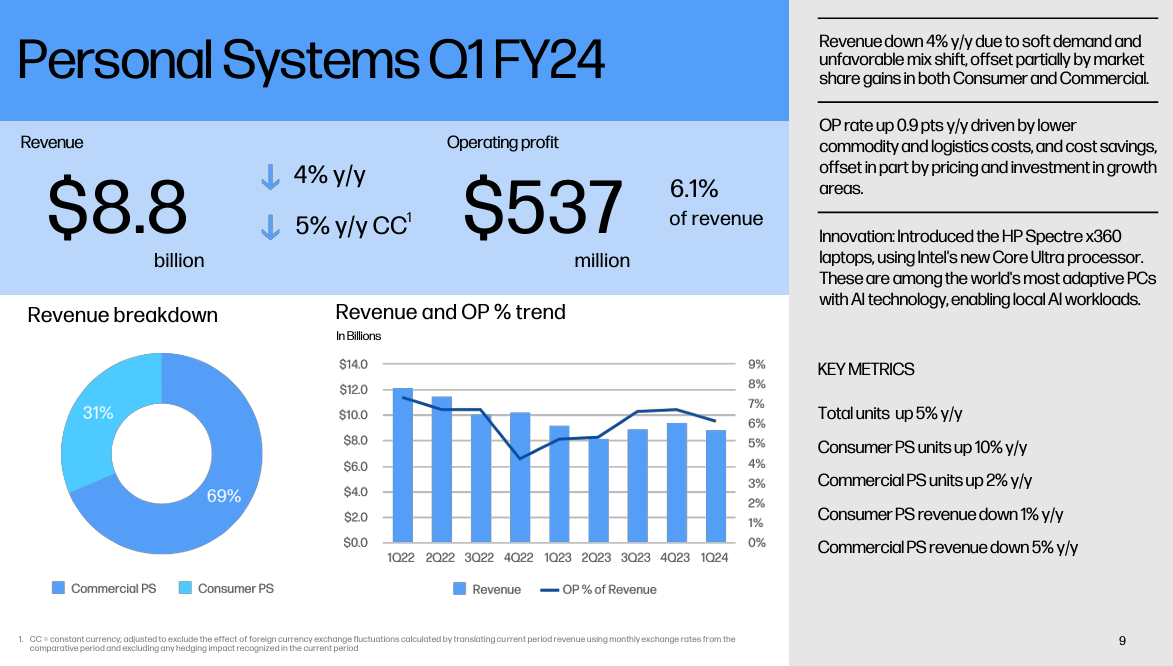
For HP and Lenovo, AI PCs will have to appeal to consumers and enterprises to move the needle. HP's PC sales in the first quarter skewed commercial.
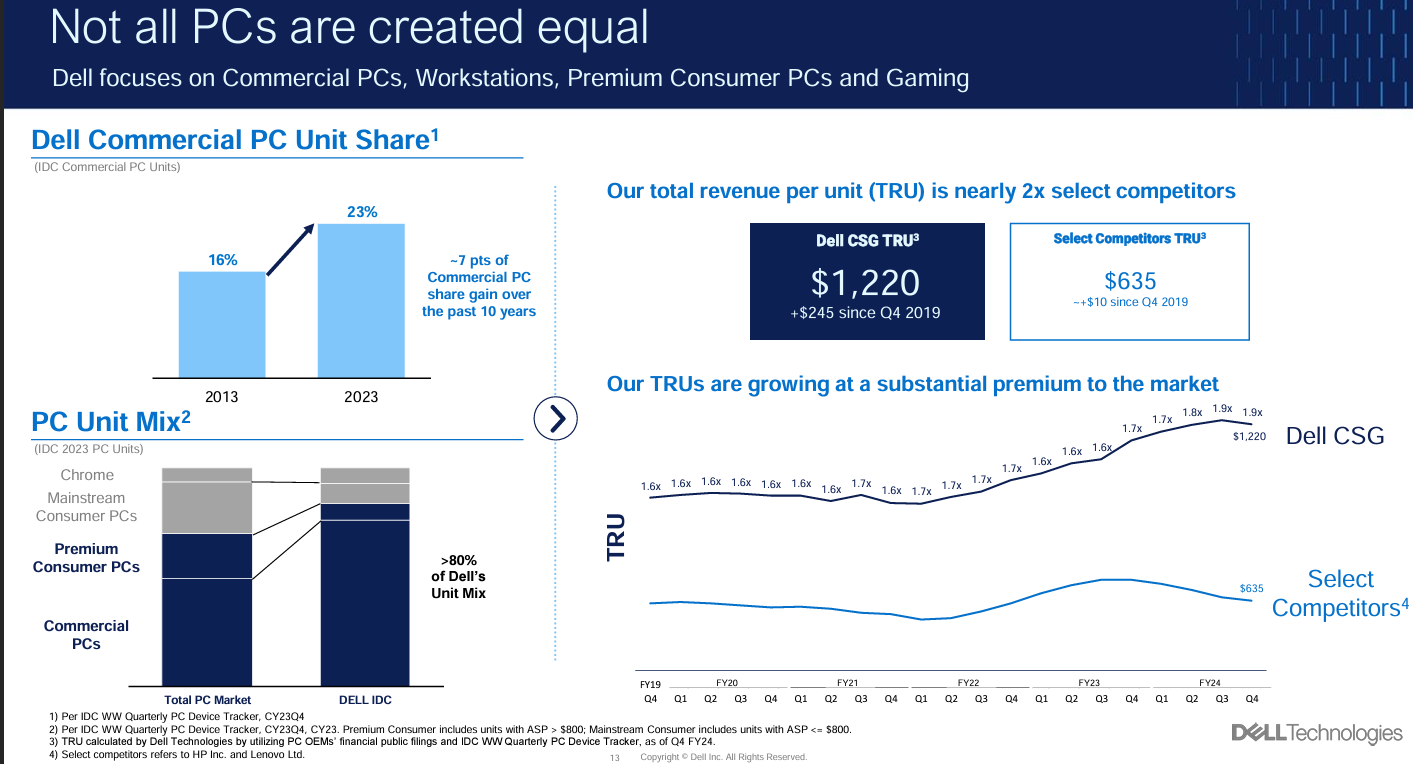
Dell is mostly focused on sales to corporate customers. The bulk of Dell's PC sales go to enterprises and the focus pays off as total revenue per unit is nearly twice as large as the competition.
Clarke said AI PCs will drive sales, but Dell's guidance doesn’t include them. Simply put, Dell isn't seeing the upside yet. Clarke's bet is that the Windows upgrade cycle is likely to drive corporate sales.
"Do I expect the PC market to be bigger in calendar 24 than 23? Yes. Do I think the PC market is likely bigger in the second half of 24 than it is in the first half? Absolutely. We believe the opportunity in PCs is second half driven. That is primarily a result of an aging install base. It has never been bigger or older than it is today. We have a version of Windows that is retiring.”
What can derail the AI PC dream? Inflation and constrained budgets for both consumers and enterprises. Consumers are stretching out used cars well beyond historical life spans and PCs aren't going to be much different. Enterprises have steadier refresh cycles, but will want to see productivity gains from AI PCs, which will cost more than regular PCs. Enterprises will also be looking to leverage those pandemic-era PCs as long as possible because IT budget priorities rest elsewhere.
Bottom line: There's hope that PC sales will improve in the second half of 2024, but it's telling that major players aren't including any uplift in their financial guidance. In the end, that approach makes sense. Hope isn't strategy.
Editor in Chief of Constellation Insights
Constellation Research
Larry Dignan is Editor in Chief of Constellation Insights at Constellation Research, where he leads editorial coverage focused on enterprise technology, digital transformation, and emerging trends shaping the future of business. He oversees research-driven news, analysis, interviews, and event coverage designed to help technology buyers and vendors navigate complex markets with clarity and context. ...
The lowly enterprise data center may be making a comeback as companies look to leverage generative AI but keep corporate data secure.
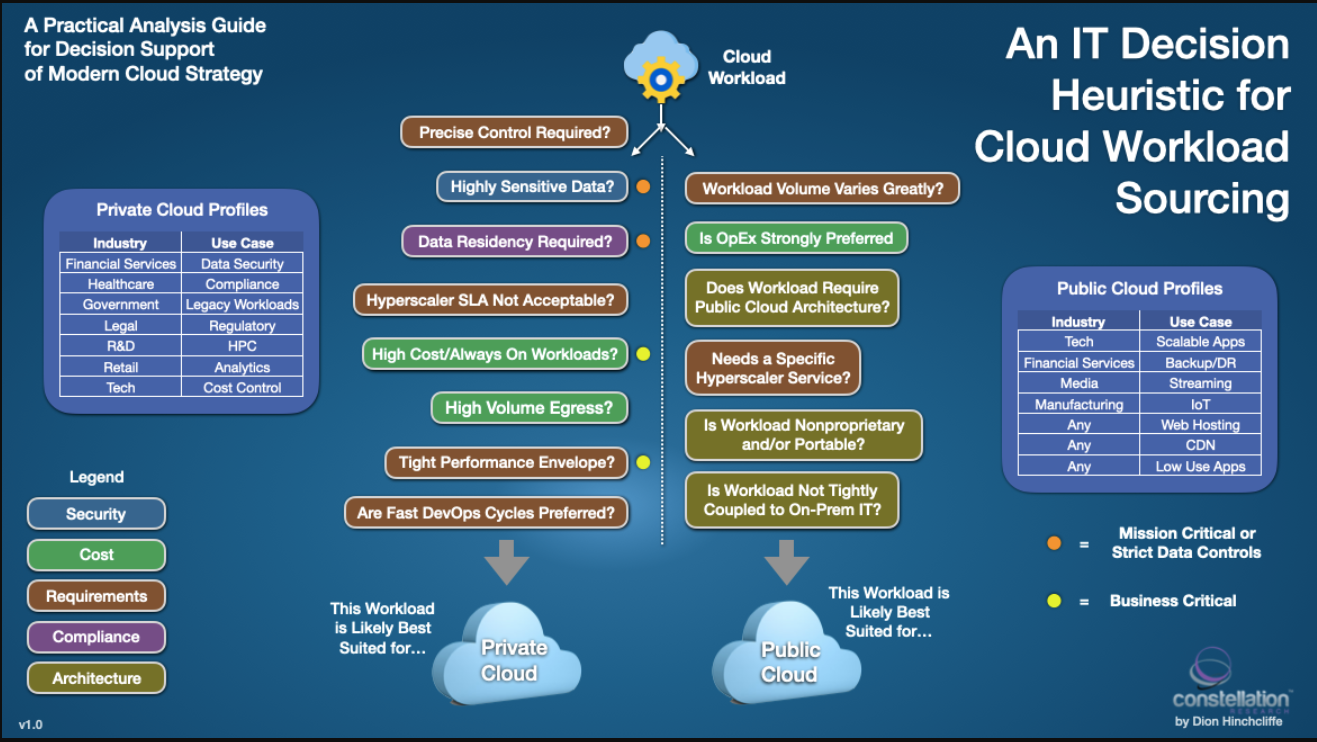
This burgeoning trend may not come as a complete surprise. Constellation Research analyst Dion Hinchcliffe noted in a report last year that CIOs were scrutinizing public cloud workloads because they could get better total cost of ownership on-premises. What's emerged is a hybrid cloud approach where generative AI may tip the scales toward enterprise data centers.
On C3 AI's third quarter earnings call, CEO Tom Siebel talked generative AI workloads. He said: "The interesting trend we're seeing--and this is really counterintuitive--is we're going to see the return of in-house data centers where people have the GPUs inside. I'm hearing this in the marketplace and even my engineers have talked about it. Some are saying, 'it's going to be cost effective for us to build.'"
Siebel isn't the only one seeing generative AI making the data center cool again.
Nutanix CEO Rajiv Ramaswami said the company is "seeing more examples of people repatriating" workloads from the public cloud to data centers and private cloud arrangements. Enterprise concerns about generative AI are likely to equate to more data center buildouts than you'd think.
"I'm talking about enterprise workloads, because what has gone to the public cloud largely has been net new applications. So, for these workloads are still sitting in the enterprise environment, I think CIOs are being a lot more careful about how much of that do they take to the public cloud," said Ramaswami. "There's some repatriation happening from the public cloud back on-prem. But there's also a lot more scrutiny and forethought being applied to what should go into the public cloud."
Nutanix, which just reported earnings, is also seeing traction with its GPT-in-a-box offering, which accelerates generative AI across an enterprise while keeping data secure. Many of the industries interested in GPT-in-a-box cited by Ramaswami were noted by C3. Federal agencies, defense, pharmaceutical, and finance.
It's not surprising that defense, federal agencies and banking and finance are driving on-premises generative AI workloads. These companies are well-capitalized, have critical security needs and operate as technology companies in many ways.
Enterprises in these industries, along with nation-states, are the ones most likely to build their own data centers for AI workloads. Nvidia CEO Jensen Huang equates these next-gen data centers as AI factories.
"You see us talking about industrial generative AI. Now our industries represent multi-billion-dollar businesses, auto, health, financial services. In total, our vertical industries are multi-billion-dollar businesses now. And of course, sovereign AI. The reason for sovereign AI has to do with the fact that the language, the knowledge, the history, the culture of each region are different, and they own their own data.
They would like to use their data, train it to create their own digital intelligence and provision it to harness that raw material themselves. It belongs to them, each one of the regions around the world. The data belongs to them. The data is most useful to their society. And so, they want to protect the data. They want to transform it themselves, value-added transformation, into AI and provision those services themselves."
The rest of us just want better TCO on AI workloads, but you get the idea. Dell Technologies appears to be capitalizing on AI-optimized servers along with SuperMicro.
"83% of all data is on-prem. More data will be created outside of the data center going forward that inside the data center today, that's going to happen at the edge of the network, a smart factory and oil derrick. We believe AI will ultimately get deployed next to where the data is created driven by latency.
We sold to education customers, manufacturing customers, and governments. We've sold the financial services, business, engineering and consumer services. Companies are seeing vast deployments, proving out the technology. Customers quickly find that they want to run AI on-prem because they want to control their data. They want to secure their data. It's their IP and they want to run domain specific and process specific models to get the outcomes they're looking for."
Power problems
What could derail the march to in-house data centers? Today, it's procuring GPUs, but that'll work itself out. Power will be the big issue going forward. Siebel explained:
"The constraint today is you have to call up Jensen and beg for GPUs. Let's say we can figure out how to do that. Maybe we know somebody who knows Jensen. Okay, the hard part is we can't get power. You cannot get the power to build the data center in Silicon Valley. Power companies will not give you power for a data center. So, I think this GPU constraint is ephemeral and soon it's going to be power."
Pure Storage Charles Giancarlo cited power as a limiting factor for AI adoption on the company's fourth quarter earnings call. "The energy demands of AI are outstripping the availability of power in many data center environments," he said.
"Where are we going to get the power cost effectively and environmentally sustainable power to be able to run all the models we want to run? How are we going to keep the cost at a level that companies can realistically invest in?" asked Tarkoff, who added that scaling data and compute isn't cheap. "All of this sounds really cool in production, but it's an expensive and energy consuming value proposition."
Constellation Research's take
This thread about enterprises potentially building out data centers for generative AI spurred a bit of debate internally. Here's what a few analysts had to say.
Doug Henschen: "Data warehouse/lakehouse workloads are selectively remaining on or moving back on premises. Warehouse and lakehouse workloads are often data- and compute-intensive, and in many cases, organizations that have moved these workloads to the cloud have had sticker-shock experiences. Among those firms that have maintained on-premises systems and data center capacity, we've seen some instances where they've either delayed migration of data warehouse workloads to the cloud or even repatriated workloads to on-premises platforms. When workloads are stable and predictable and there's no need for cloud elasticity, it can be more cost effective to run these workloads on premises."
Dion Hinchcliffe: "Here's the problem with public cloud and today's increasingly always-on, high performance computing workloads (basically, a lot of ML + AI, both training and ops): 1) The hyperscalers' profit margins, 2) R&D costs for I/PaaS, and 3) the massive build-out Capex to support high growth. All three numbers are high right now. Public cloud customers cover all three expenses as major cost components in their monthly bills. Many CIOs have now realized they can bring in a good percent of workloads back in, sweat their private DC assets to the last penny, and largely avoid paying these markups (that at the end of the day aren't really their problem.) So, the big question: Is the pendulum swinging back to private data centers? Not hardly, but as my CIO interviews and research on the topic last year showed, there is definitely an active rebalancing of workloads to where they run best. That means a good bit of AI, especially training, will go back in-house or to specialty partners that are highly optimized for this, that will also keep the private training data away from the hyperscalers."
Chirag Mehta: "The reality doesn't quite add up. Even with AI, running GPU on-prem is Capex intensive and requires highly skilled people. Other than a few companies this is not a practical thing to do."
Andy Thurai: "The repatriation/migration is happening on a selected workload basis. For AI workloads, especially the training, it is a bit complicated and requires a ton of MLOps and scaling tools that the private data centers don't have. The GPU shortage and scale needed for model training are also constraints. While it is easy to move ML workloads, AI workloads are still a challenge from what I hear."
Principal Analyst and Founder
Constellation Research
R “Ray” Wang is the CEO of Silicon Valley-based Constellation Research Inc. He co-hosts DisrupTV, a weekly enterprise tech and leadership webcast that averages 50,000 views per episode and blogs at www.raywang.org. His ground-breaking best-selling book on digital transformation, Disrupting Digital Business, was published by Harvard Business Review Press in 2015. Ray's new book about Digital Giants and the future of business, titled, Everybody Wants to Rule The World was released in July 2021. Wang is well-quoted and frequently interviewed by media outlets such as the Wall Street Journal, Fox Business, CNBC, Yahoo Finance, Cheddar, and Bloomberg.
Short Bio
R “Ray” Wang (pronounced WAHNG) is the Founder, Chairman, and Principal Analyst of Silicon Valley-based Constellation Research Inc. He…...
Zoho CEO Sridhar Vembu has scaled the company with humility, a focus on giving back to smaller communities, and playing the long game when it comes to #technology, people and customer value...
At #ZohoDay2024, Constellation Research CEO R "Ray" Wang sat down with Sridhar to talk about approaching #business and social good, #innovation and focusing on #customers. Their conversation touches on the following topics...
📌 Transnational localism
📌 Taking a long-term view
📌 Jobs, #automation and #AI
📌 Zoho's technology investments
📌 Giving customers choice.
📌 #Enterprise-class #software for SMBs
📌 Perils of the hard sell
It is always a priviledge to listen to Sridhar's proven insights on building a strong and successful enterprise, so this is one interview you won't want to miss!
👉 Want a deeper dive? Catch Larry Dignan's article summarizing the key takeaways: https://lnkd.in/gdU6cSsY
Editor in Chief of Constellation Insights
Constellation Research
Larry Dignan is Editor in Chief of Constellation Insights at Constellation Research, where he leads editorial coverage focused on enterprise technology, digital transformation, and emerging trends shaping the future of business. He oversees research-driven news, analysis, interviews, and event coverage designed to help technology buyers and vendors navigate complex markets with clarity and context. ...
Zoho CEO Sridhar Vembu has scaled a company with humility, a focus on giving back to smaller communities and playing the long game when it comes to technology, people and customer value.
Vembu's approach is refreshing and effective--not to mention a touch quirky compared to many CEOs we encounter.
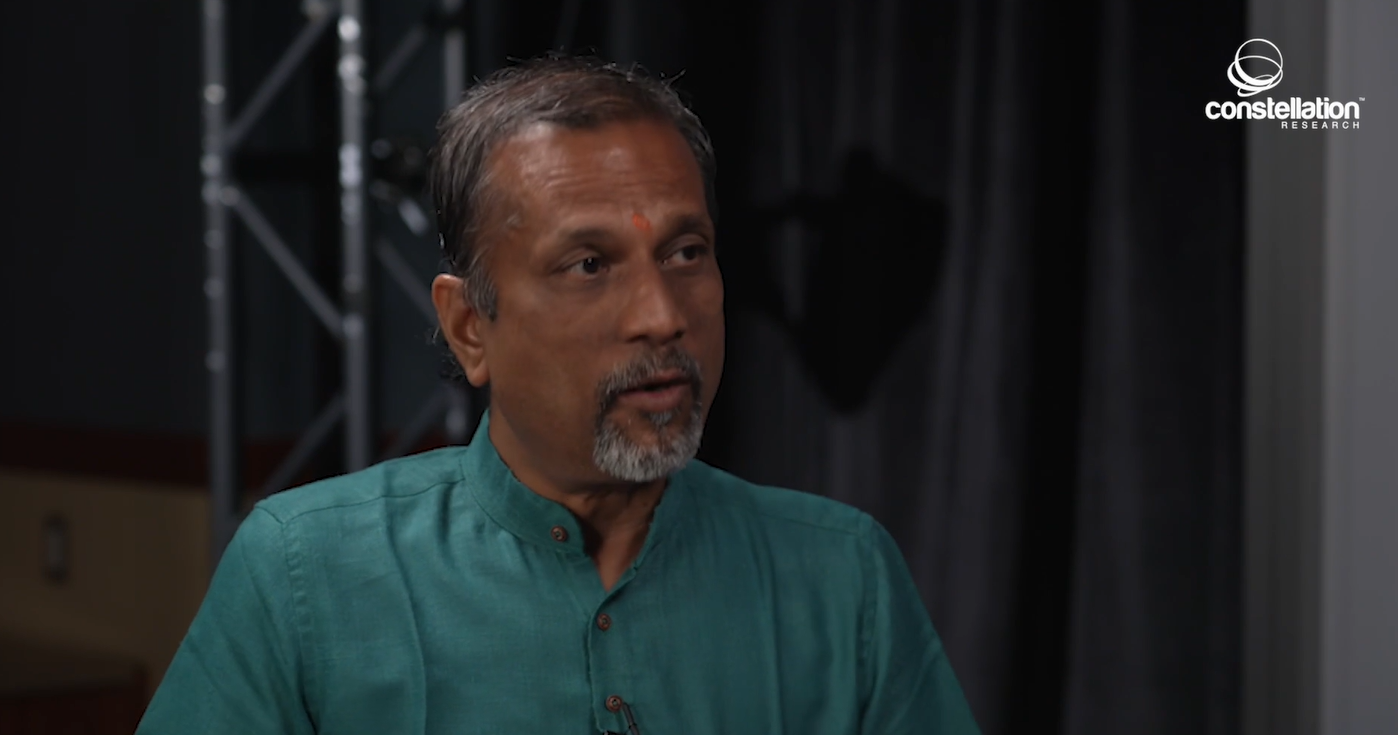
At Zoho Day 2024, Constellation Research CEO Ray Wang caught up with Zoho CEO Sridhar Vembu (right) to talk about how to approach business and social good, innovation and focusing on customers. Here's are some of the takeaways from the conversation.
Transnational localism. "It's really about getting closer to the customers at one level, and just talking about business first. But beyond that, it's also putting back into communities that income needed from technology, create good jobs, in smaller communities, which people are not doing enough," said Vembu.
The approach to giving back to smaller communities is a bit part of Zoho's strategy. Zoho has offices in Chennai, India; McAllen, TX; and a bevy of other locations in UK, US, India, Egypt, Nigeria, Kenya to name a few.
"You can operate out of smaller towns and create high impact R&D. And that helps the customer from smaller places and creates opportunities for people who didn't have it before," said Vembu.
McAllen, Texas. Zoho has built out its operations in McAllen, Texas. Vembu explained why McAllen was chosen.
"We looked around for communities that are small, but not too small and there are enough people that are similar to our value system, and the demographic where we can recruit and train people and there's a low cost of living and affordable housing. We want this for our employees because we want to keep them forever. If our employee can buy a home and build families, they're more contented. They're more likely to be satisfied employees, which will lead to more satisfied customers. McAllen checked all the boxes, and then we sent an email to the Mayor's office and got an instant response."
Taking a long-term view. Vembu said Zoho is running its own schools, which is about giving back but also building a talent base for the years ahead. "That requires us to take a long-term view that you cannot just go hire for today and then be productive two weeks later," said Vembu. "40% to 50% of hires don't actually work out. In an interview process, you really cannot tell culture fit and a lot of things that go into making someone successful at work. We believe that first we have to nurture the talent and that automatically brings in good people to us over time."
Jobs, automation and AI. Wang asked Vembu about the future of meaningful work, AI and automation and what a long-term view looks like. Vembu said there has to be a way to balance automation and human work as well as wealth.
"We have to balance this out if we want a sustainable society so there isn't a civil war. We have to balance things out. We cannot just create all the wealth in one place. Income as a percentage of GDP is at all-time lows or near all-time lows. Profit as a percentage of GDP is near all-time highs. This can't go on forever. This has run this for 20, 30, 40 years now, but the bills are coming due. We have to think differently. This is not a political statement. I actually believe that the solutions aren't in the political arena today. We have to try new experiments like a scientist trying new things."
Zoho's technology investments. Vembu said the company's strategy has been evolving rapidly from building individual products to complete platforms that appeal to large companies with more complex requirements. Zoho is also infusing artificial intelligence throughout the platform.
"We are particularly very happy with smaller domain specific models, which are also cheaper to run," explained Vembu. "We're getting good payoff from the approach where we have a mix of smaller models, not one chain model."
Vembu said Zoho has long-run experiments on raising developer productivity with smaller models that ensure the correctness of code that will build future products.
Giving customers choice. Vembu said that software as a service should be about freedom of choice and simple payment plans. He said:
"We actually believe in two cardinal virtues as a company to keep ourselves grounded. One is humility. The customer always comes first. Their needs take precedence over immediate revenue. The second is contentment. We have to stay contented because there are times where you end up chasing growth for its own sake. And companies get in trouble when they do that. These two principles we practice which is why we say that if you don't need all of this just buy the stuff you need."
Zoho offers a monthly plan but doesn't force customers to pay annually. In other words, Zoho has reached hit scale with $50 a month as other vendors have gone from that sum to $500 today and priced companies out.
Enterprise class software for SMBs. "SMB software is relegated to a niche where it is not as powerful and doesn't scale," said Vembu. "We deliver so you can go from two employees to 200 to 20,000 to 200,000. We will scale with you."
Wang noted that one large services firm asked whether Zoho could scale to a 500,000 to 1 million user organization. Vembu said Zoho has won a deal that size but hasn't announced it yet. "We will show you if you give us the opportunity," he said. "We will not say give us the money. Give us the opportunity. We'll show you."
Perils of the hard sell. Vembu said Zoho isn't into the hard sell and pushing limits for sales. "We let the customer slowly figure us out and understand us. I want to sleep at night. I don't want to piss off customers by pushing hard. A lot of people do that and the result of it is employee burnout," said Vembu. "Not a lot of CEOs can't do this job for a long period. I've done this for nearly 27 years now. I'm still going strong. I say okay, we can win this customer next year. Let's not push this hard if you're not ready."
Editor in Chief of Constellation Insights
Constellation Research
Larry Dignan is Editor in Chief of Constellation Insights at Constellation Research, where he leads editorial coverage focused on enterprise technology, digital transformation, and emerging trends shaping the future of business. He oversees research-driven news, analysis, interviews, and event coverage designed to help technology buyers and vendors navigate complex markets with clarity and context. ...
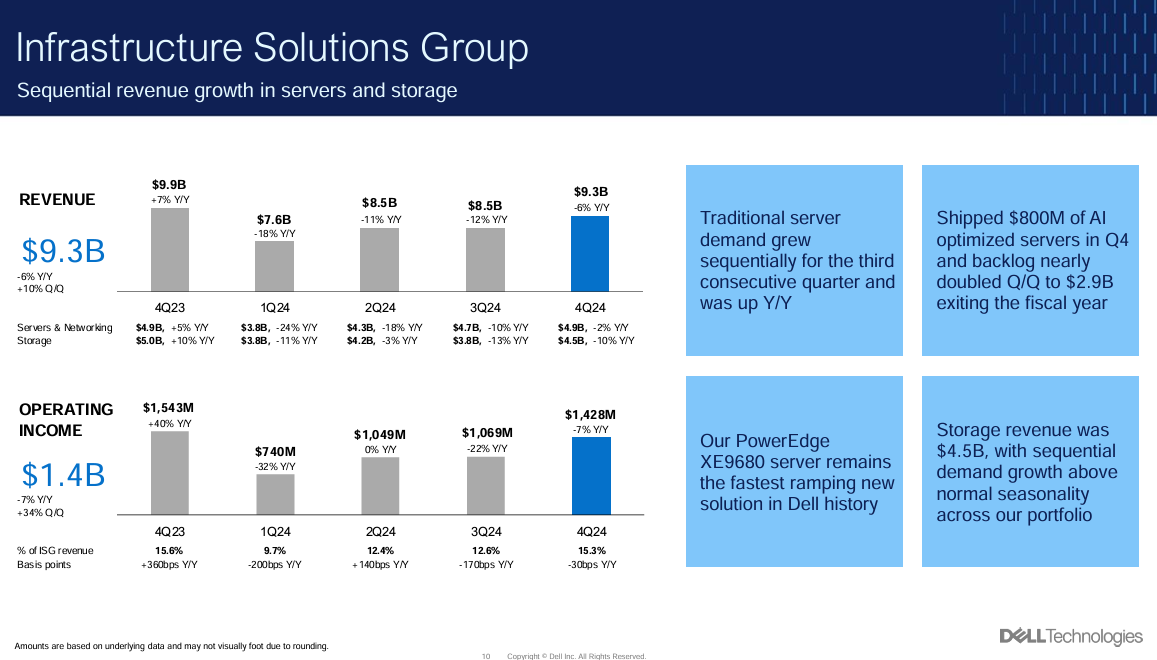
Dell Technologies reported a better-than-expected fourth quarter as the company saw strong demand for AI-optimized servers.
Jeff Clarke, vice chairman and chief operating officer, Dell Technologies, said orders for AI-optimized servers grew 40% sequentially and backlog doubled to $2.9 billion. "We've just started to touch the AI opportunities ahead of us, and we believe Dell is uniquely positioned with our broad portfolio to help customers build GenAI solutions that meet performance, cost and security requirements," said Clarke.
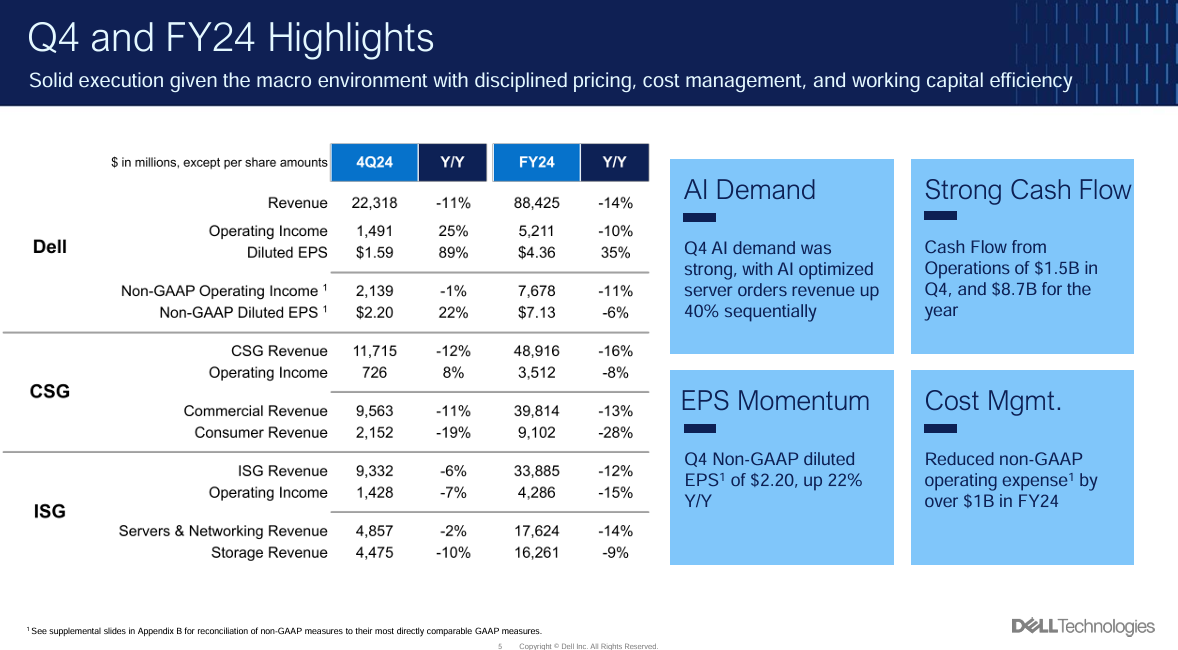
During the quarter, Dell Technologies managed through revenue declines compared to a year ago. The company reported fourth-quarter revenue of $22.32 billion, down 11% from a year ago, with net income of $1.16 billion, or $1.59 a share. Non-GAAP earnings for the quarter were $2.20 a share. Dell also unveiled a 20% hike to its annual dividend to $1.78 per share.
Wall Street was expecting Dell Technologies to report fourth quarter earnings of $1.72 per share on revenue of $22.17 billion.
For fiscal 2024, Dell reported net income of $3.2 billion, or $4.36 a share, on revenue of $88.42 billion, down 14% from a year ago. The company said it expects to return to growth in fiscal 2025.
By unit, Dell's Infrastructure Solutions Group had revenue of $9.3 billion, down 6% from a year ago. Operating income was $1.4 billion. Clarke said there's the obvious buildout in the public cloud for AI workloads, but enterprises are increasingly buying AI-optimized servers too. Dell can sell more richly configured GPU servers and attach services to them as enterprises build out.
"83% of all data is on-prem. More data will be created outside of the data center going forward that inside the data center today, that's going to happen at the edge of the network, a smart factory and oil derrick. We believe AI will ultimately get deployed next to where the data is created driven by latency.
We sold to education customers, manufacturing customers, governments. We've sold the financial services, business, engineering and consumer services. Companies are seeing vast deployments, proving out the technology. Customers quickly find that they want to run AI on-prem because they want to control their data. They want to secure their data. It's their IP and they want to run domain specific and process specific models to get the outcomes they're looking for."
The PC business had fourth quarter revenue of $11.7 billion, down 12$ from a year ago. Commercial PC revenue was $9.6 billion of that total. Operating income was $726 million.
In prepared remarks, Clarke said:
"FY 24 was one of those years that didn’t go as planned, but I really like how we navigated it. We showed our grit and determination by quickly adapting to a dynamic market, focusing on what we can control, and extending our model into a high growth AI opportunity."
Clarke added that AI-optimized PowerEdge XE9680 server sales were ramping quickly. He added that Dell's storage business should also fair well due to projected growth in unstructured data.
Editor in Chief of Constellation Insights
Constellation Research
Larry Dignan is Editor in Chief of Constellation Insights at Constellation Research, where he leads editorial coverage focused on enterprise technology, digital transformation, and emerging trends shaping the future of business. He oversees research-driven news, analysis, interviews, and event coverage designed to help technology buyers and vendors navigate complex markets with clarity and context. ...
Hewlett Packard Enterprise posted a mixed first quarter where sales fell short of expectations due to what CFO Marie Myers said were "challenges brought by the softening of the networking market and GPU deal timing."
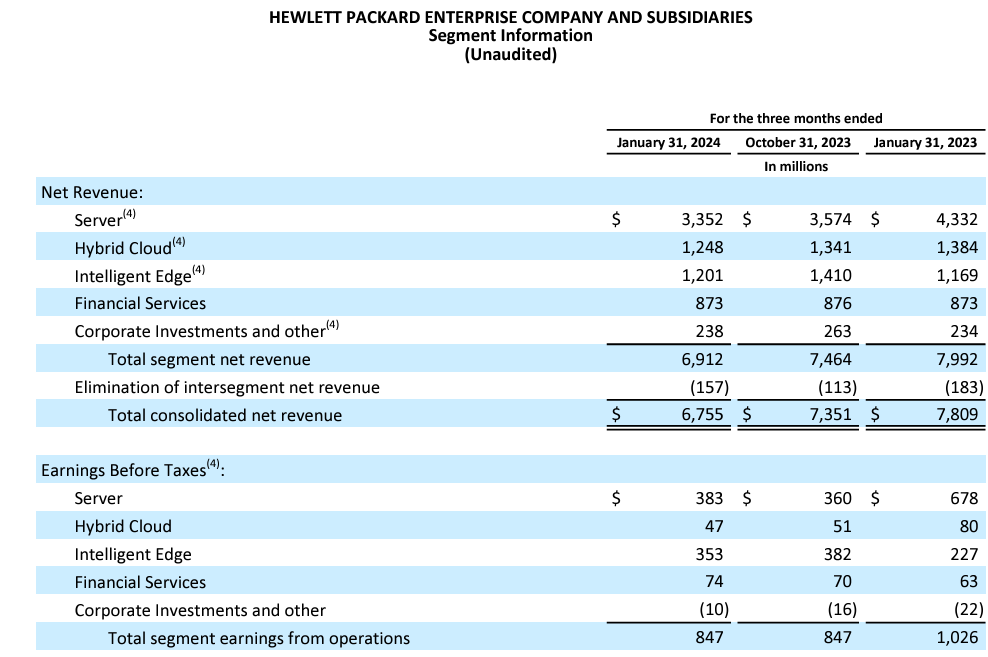
The company reported first quarter non-GAAP earnings of 48 cents per share, GAAP earnings of 29 cents a share and revenue of $6.8 billion, down 14% from a year ago. Wall Street was expecting HPE to report adjusted earnings of 45 cents per share on revenue of $7.1 billion. HPE is planning to buy Juniper Networks in a deal valued at $14 billion.
By unit, HPE said server revenue fell 23% in the first quarter to $3.4 billion. Intelligent edge revenue was $1.2 billion, up 3% from a year ago. Hybrid cloud revenue was $1.2 billion in the first quarter, down 10% from a year ago.
CEO Antonio Neri said HPE had operational discipline to manage through the quarter and remained confident in the strategy. Myers added that "we are controlling what we can control, and we are optimistic about delivering strong shareholder returns over the remainder of the fiscal year.”
As for the second quarter, HPE said revenue will be between $6.6 billion to $7 billion with non-GAAP earnings of 36 cents per share to 41 cents per share. For fiscal 2024, revenue growth will be flat to up 2% from a year ago. HPE non-GAAP earnings per share will be between $1.82 and $1.92.
On a conference call with analysts Neri said HPE lacked GPU supply and customers were digesting Aruba networking orders. The networking comments have been echoed by Cisco, who said something similar in its most recent earnings call. Regarding AI-optimized servers, Neri said "several large GPU acceptances shifted" and the company "did not have the GPU side."
Here's a look at the key points from the conference call via Neri:
"We saw campus networking weaken and the decline late in the quarter was greater than expected. There was a large headwind relative to our expectations. Customers are taking longer to digest prior orders than we had anticipated."
"We expect weakness in the networking market to persist and impact reveneu through fiscal year 2024."
"Server demand remains very strong evidenced by our growing cumulative order book. However, GPU availability remains tight and our delivery timing has also been affected by the increase in length of time. Customers required to set up the data center space power and cooling requirements needed to run these systems. As a result of our AI server orders conversion was below our expectations."
"We have already a lot of GPUs that we already built that the customers will take time to assemble systems. But the reality is that we need more supply against the backlog that we announced today, which was $3 billion at the end of the q1."
"Our pipeline is large and growing across the entire AI lifecycle from training to tune into inferencing. We are starting to see a demand pull through for other solutions, including storage. We expect our server and hybrid cloud segments to grow sequentially through the fiscal year."
"Given the softening network in market GPU deal timing and to some extent GPU availability. We're focused on execution as we navigate the fluctuations in demand we see in certain areas of the market."
"This quarter is a moment in time and does not at all dampen our confidence in the future ahead of us."






 At Zoho Day 2024, Constellation Research CEO Ray Wang caught up with Zoho CEO Sridhar Vembu (right) to talk about how to approach business and social good, innovation and focusing on customers. Here's are some of the takeaways from the conversation.