Editor in Chief of Constellation Insights
Constellation Research
Larry Dignan is Editor in Chief of Constellation Insights at Constellation Research, where he leads editorial coverage focused on enterprise technology, digital transformation, and emerging trends shaping the future of business. He oversees research-driven news, analysis, interviews, and event coverage designed to help technology buyers and vendors navigate complex markets with clarity and context. ...
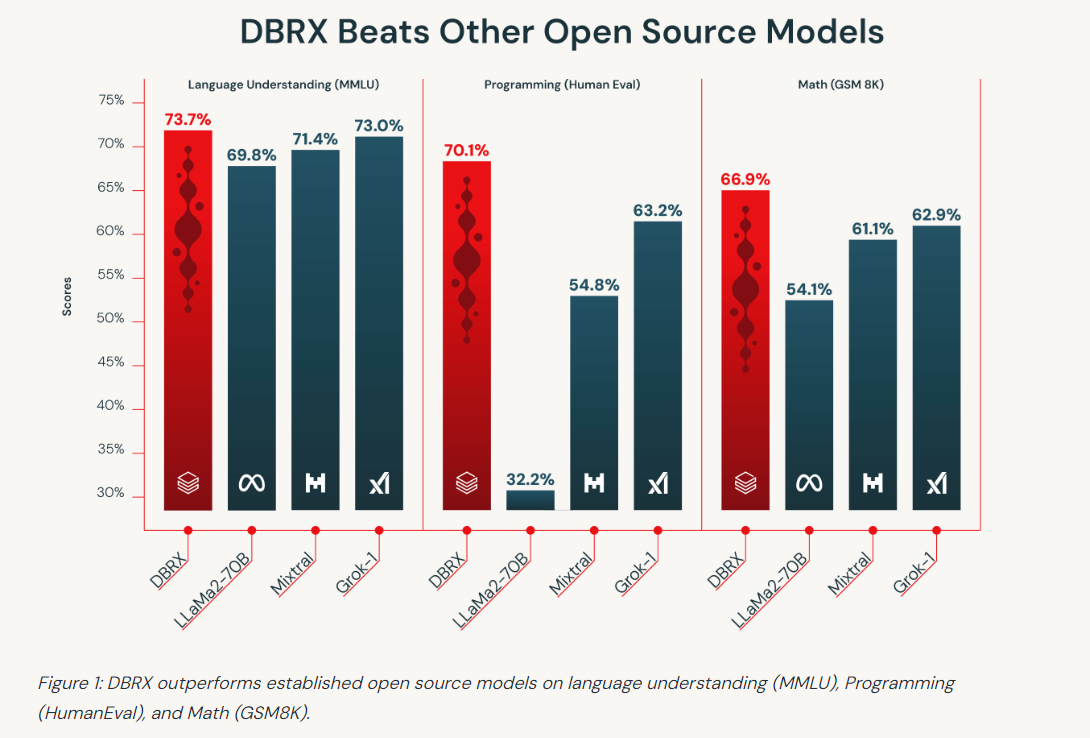
Ali Ghodsi, CEO of Databricks, said DBRX is designed to help enterprises to "understand and use their private data to build their own AI systems." Using private data to tailor LLMs securely has been a recurring theme in recent months from multiple vendors. The most cost effective way to customize models is to use smaller language models and leverage open source models.
Doug Henschen, analyst at Constellation Research, said the Databricks move with DBRX fills a need to enable enterprises to customize open-source models. Henschen said:
"With its DBRX launch, Databricks is a step ahead of rivals in helping customers to use their private data to build their own AI systems. Yes, having another open LLM to choose from is great, but the point is accelerating the move to custom models built on the customer’s own data."
As for the technical details, here are some key points about DBRX:
DBRX was trained on 3072 NVIDIA H100s connected by 3.2Tbps InfiniBand. Databricks built DBRX on its suite of tools used by customers.
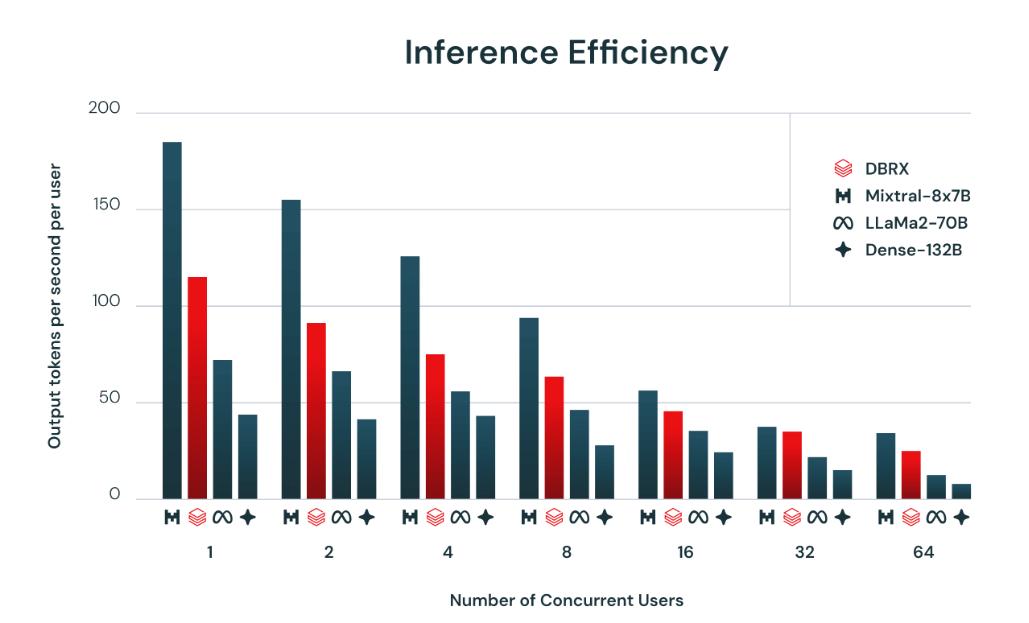
The LLM uses a mixture-of-experts architecture, which is cost effective and efficient leveraging tokens per second. DBRX is efficient for inference tasks.
DBRX is a transformer-based decoder only LLM with 132B total parameters with 36B parameters active on any input.
DBRX was pretrained on 12T tokens.
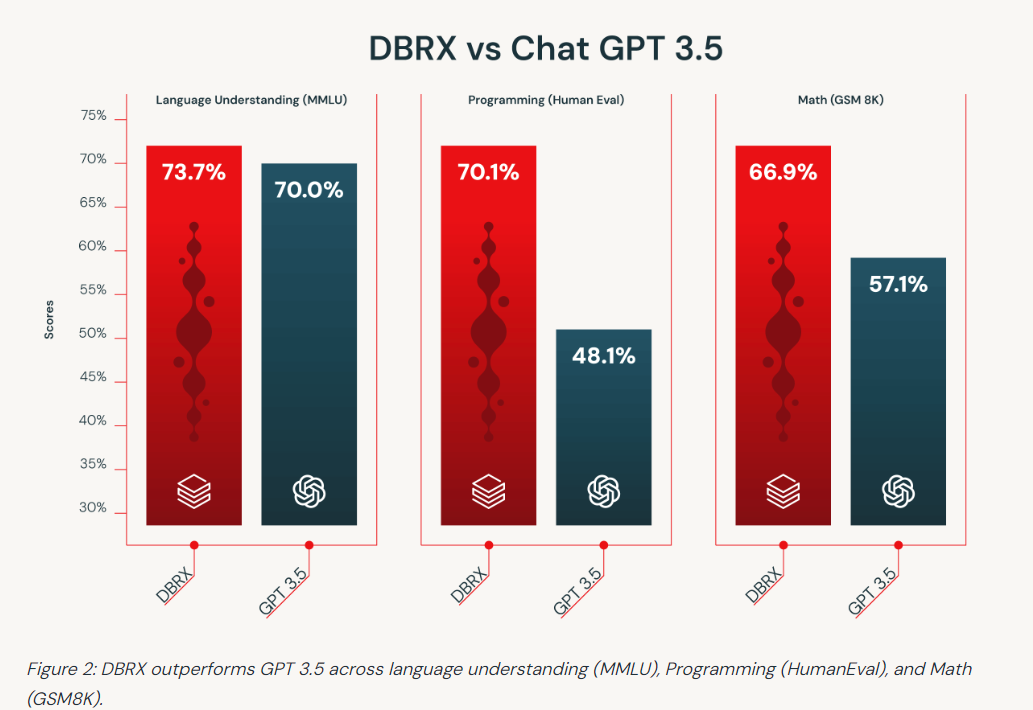
DBRX is being integrated into Databricks' GenAI products and has surpassed GPT 3.5 Turbo in applications like SQL and retrieval augmented generation (RAG) tasks.
Early customers and partners include Accenture, Allen Institute for AI, Block, Nasdaq and Zoom.
Databricks Platform customers can leverage DBRX for RAG and to build custom models. DBRX is also on AWS, Google Cloud and Microsoft Azure via Azure Databricks. DBRX will also be available through Nvidia's API Catalog and supported on Nvidia's NIM inference microservice.
Editor in Chief of Constellation Insights
Constellation Research
Larry Dignan is Editor in Chief of Constellation Insights at Constellation Research, where he leads editorial coverage focused on enterprise technology, digital transformation, and emerging trends shaping the future of business. He oversees research-driven news, analysis, interviews, and event coverage designed to help technology buyers and vendors navigate complex markets with clarity and context. ...
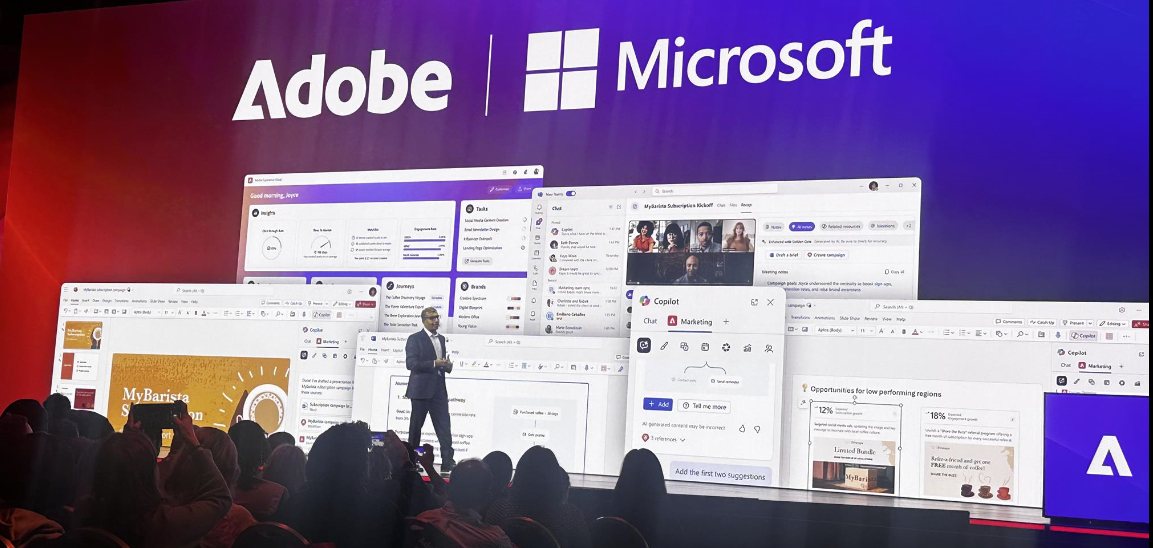
Adobe laid out a host of Experience Cloud enhancements, data collaboration and customer journey applications, custom Firefly models and a marketing copilot co-developed with Microsoft to connect Adobe's Experience platform with Microsoft 365 applications.
The barrage of news kicked off Adobe Summit in Las Vegas, the company's enterprise focused conference. With a format that targets CIOs and CMOs and everything in between, Adobe is hitting on the core themes of the content supply chain, generative AI and insights that drive returns.
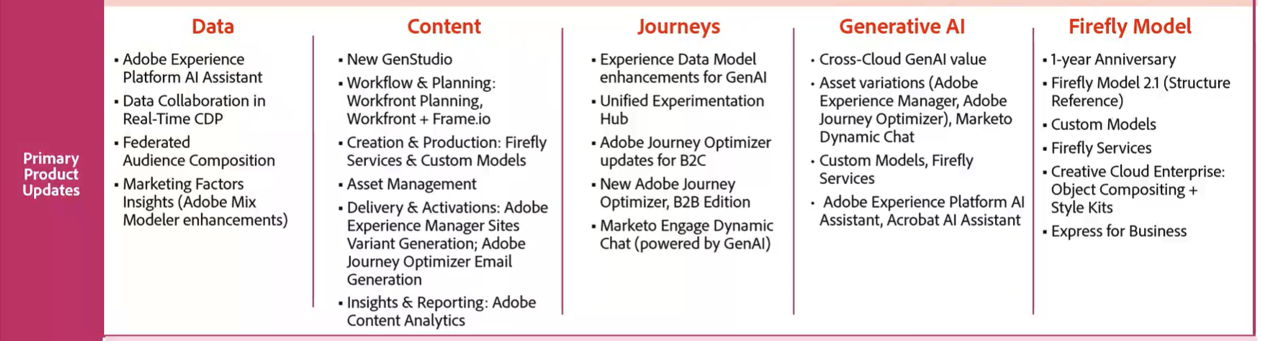
At a high level, here's a look at Adobe's product updates across its portfolio. In addition to the marketing copilot collaboration with Microsoft, Adobe Summit will feature partnerships with IBM, Accenture, and Omnicom and customer thought leadership from companies such as GM, Delta and Pfizer.
During his keynote at Adobe Summit, Adobe CEO Shantanu Narayen said: "When we think about the magic and value of AI, we know that it actually comes only from the seamless integration into the workflows that all of you as customers already know and love."
Narayen added that generative AI led by Firefly will be embedded across its creative production and marketing workflows. He added that Adobe has leveraged generative AI to bolster its marketing returns. Narayen said:
"I loved engaging with our marketing teams, the products, the engineering and design teams to develop as they developed Adobe Gen studio so that we could empower marketers to quickly plan, create, store, deliver and measure all marketing content. What's constant is that content, data and journeys will at the core of how you engage with customers."
For Adobe, generative AI is seen as a technical bridge between experience, creative and marketing teams. "Our goal is to make sure that creative professionals and marketing professionals can use generative AI in their workflows. And our plan is to do that through a mix of models," said Ely Greenfield, CTO, Digital Media at Adobe.
Adobe Summit kicks off as marketing is in flux as a function with generative AI readiness, cookie depreciation and driving returns as key issues. Adobe is also infusing generative AI across its platform as it increasingly caters to multiple personas ranging from CFOs to CIOs to CMOs and digital and data chiefs.
"For enterprise users, we really see the combination of generative AI and the predictive AI unlocking genAI applications to go from toys to tools," said Lily Chiu-Watson, Director of Product Marketing, Adobe.
Here's a look at the enterprise-focused news from Adobe Summit.
Microsoft and Adobe teamed up on a Marketing Copilot. The two companies co-developed a marketing copilot that uses the data assets and insights within Adobe Experience Cloud and makes them available in Microsoft applications. Adam Justis, Director of Product Marketing for Adobe Experience Cloud, said the Microsoft copilot collaboration is "a meaningful way to democratizing access to insights from Experience Cloud.
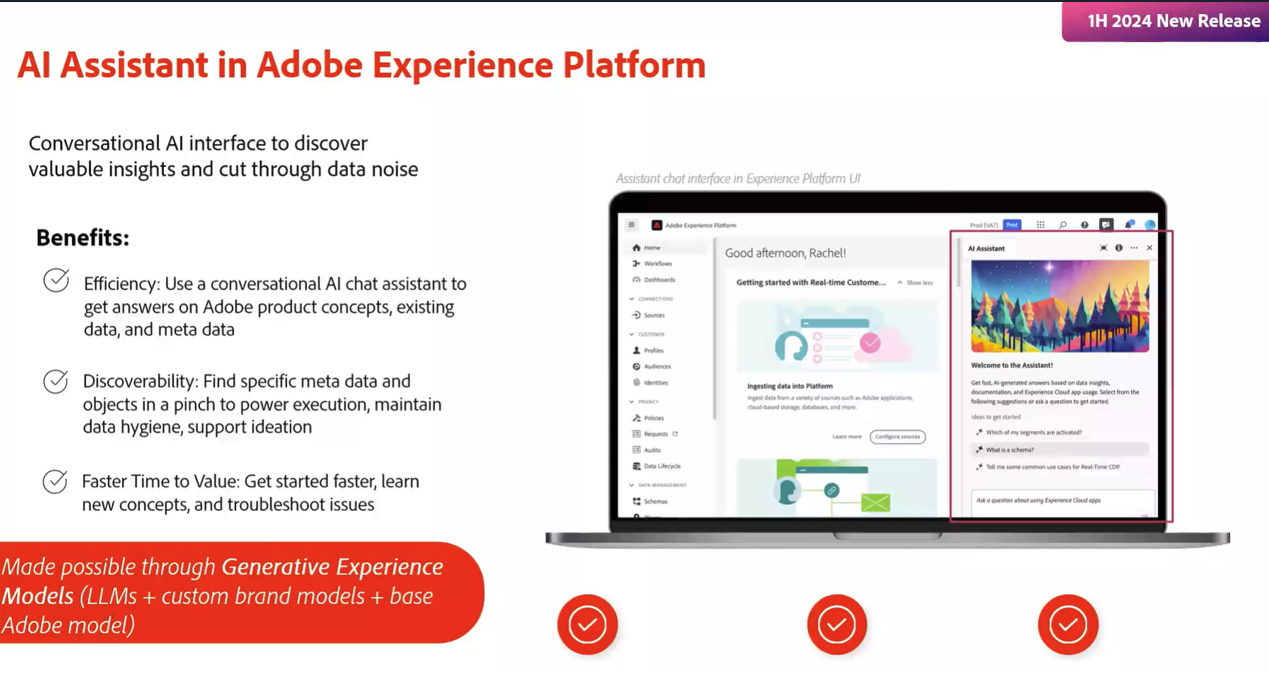
Adobe Experience Platform AI Assistant is a conversational AI interface that will enable Adobe Experience Cloud customers to easily get answers on status of data, audience segments and recommendations. AI Assistant can automate routine tasks, answer multiple types of questions, and serve a broad range of users.
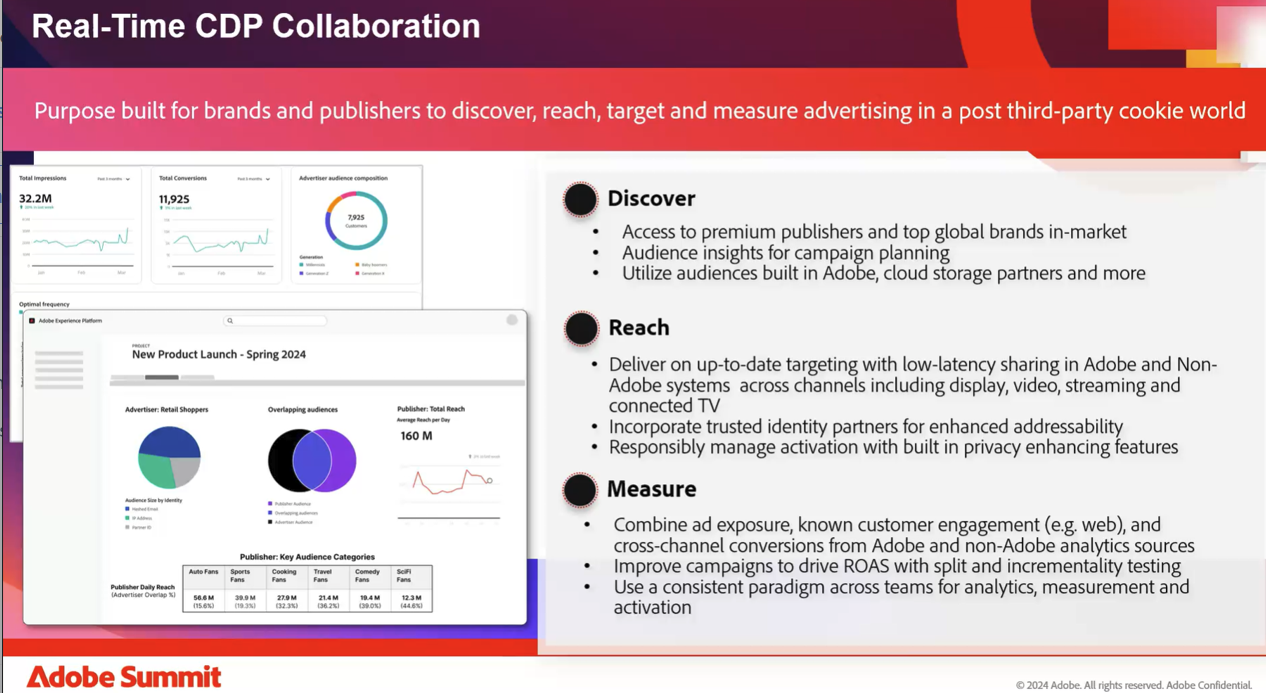
Real-time data collaboration in Adobe Customer Data Platform. As cookies are phased out, first party data collaboration between brands, publishers and advertisers will be critical to identify audiences and market to them within strict privacy guidelines. Adobe will also add federated audience capabilities and the ability to tap into enterprise data in on-premise systems as well as cloud data warehouses such as Snowflake, Google Cloud's Big Query, AWS Redshift and others.
Adobe Gen Studio, which will be more integrated into the content supply chain and analytics workflows across customer journeys and campaigns.
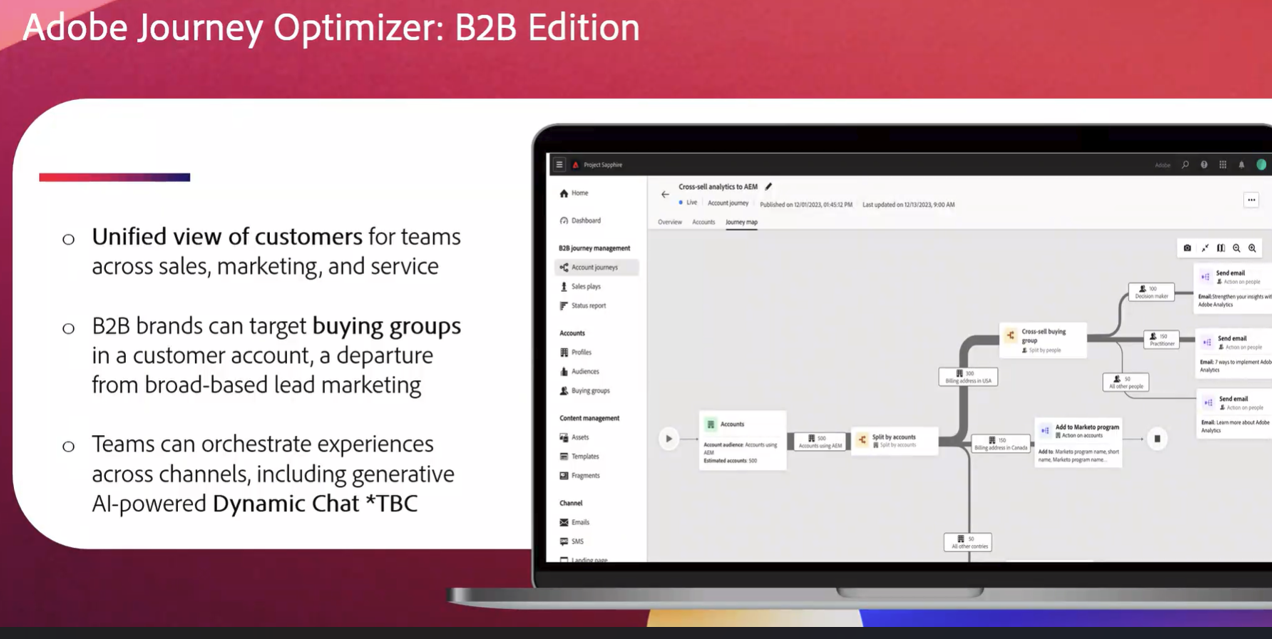
Enhanced Adobe Journey Optimizer for B2C use cases as well as a standalone B2B edition. Customers will be able to harmonize brand campaigns as well as one-to-one customer interactions on the same surface.
As for Adobe Journey Optimizer B2B Edition, Adobe is taking the leads focus with Marketo and combining it with Accounts Based Marketing features. The biggest enhancement is the Adobe is adding the ability to target buying groups and the individuals with them.
Firefly 2.1, custom models and Firefly Services. Adobe Summit will mark the one-year anniversary of Adobe's Firefly text-to-image generative AI model. Adobe will add capabilities to customize Firefly with brand assets to create content variations with guardrails. Firefly Services will include a host of APIs that will automate asset variations to account for audiences, channels and geographies.
"The more we learn and observe the way people are using Firefly, the more we can identify ways to remove more friction out of the system and allow them to focus on the work that they that is meaningful for their business," said Justis.
A pilot for new commercial terms on Experience Cloud. Justis said Adobe has been running a pilot with its largest Adobe Experience Cloud customers revolving on unifying metrics.
"There's an interest in some inherent flexibility in the purchase process where rather than just having a kind of a line item or a contract for all of these given applications, we have been exploring a unified metric commercial model," said Justis. "Our arrangement with a given organization might be credit models where customers can apply those credits across multiple products. So, it gives them the flexibility of not feeling completely locked into how they intend to use one product for a year, two years, three years. They can say this is the level of commitment that we're willing to make to Adobe, and the Adobe Experience Cloud and have the flexibility to leverage credits."
Adobe said the pilots have been well received and are available to the company's top 1,000 accounts.
Editor in Chief of Constellation Insights
Constellation Research
Larry Dignan is Editor in Chief of Constellation Insights at Constellation Research, where he leads editorial coverage focused on enterprise technology, digital transformation, and emerging trends shaping the future of business. He oversees research-driven news, analysis, interviews, and event coverage designed to help technology buyers and vendors navigate complex markets with clarity and context. ...
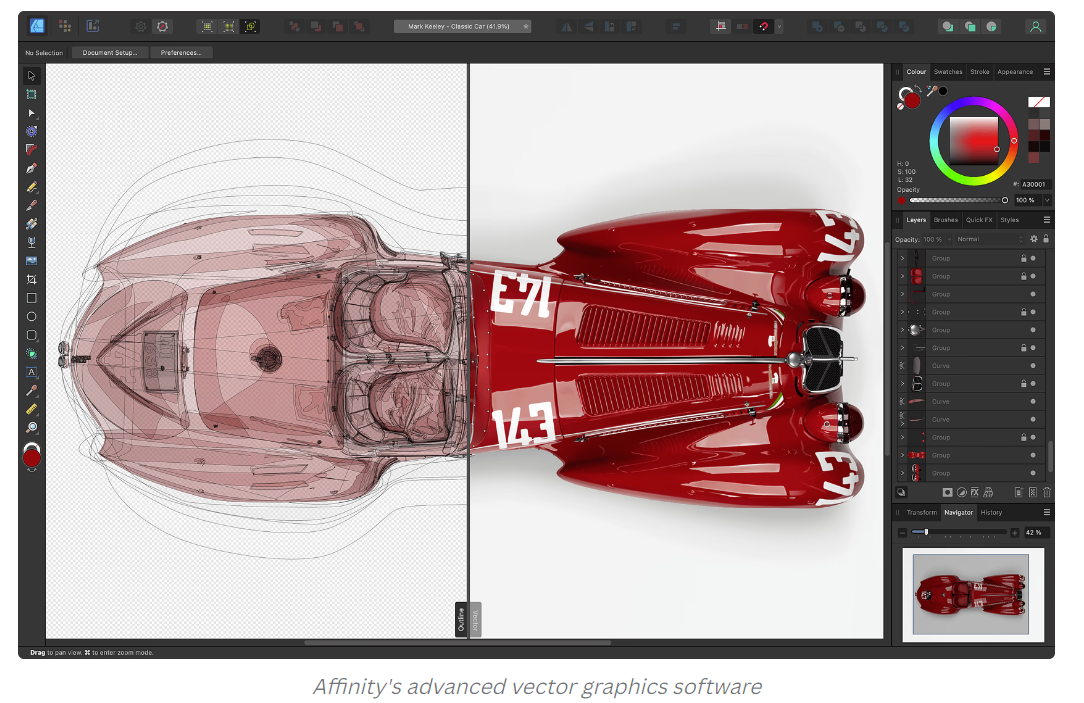
Canva said it will acquire Affinity, a UK company with a design suite that competes with Adobe's Creative Cloud.
The timing of the Canva-Affinity deal is notable given Adobe Summit kicks off this week.
In a blog post, Canva Co-Founder and COO Cliff Obrecht said Affinity's photo editing and design software is used by more than 3 million people. Canva plans to scale that reach by pitching Affinity to the 175 million people who have used its software.
"While our last decade at Canva has focused heavily on the 99% of knowledge workers without design training, truly empowering the world to design includes empowering professional designers too. By joining forces with Affinity, we’re excited to unlock the full spectrum of designers at every level and stage of the design journey."
Affinity's software is available on Windows, Mac and iPad. The company has 90 employees. The stack includes:
Affinity Designer, a vector-based graphics application for illustrations, art, graphics and brand design.
Affinity Photo, an image editor to cover a wide range of use cases.
Affinity Publisher, a layout application for Web, publications and marketing content.
Version 2 of the Affinity suite for individuals goes for $164.99, but is on sale for $114.99. The company runs on a license model without subscriptions. A universal license for multiple business users is $109.24 per license currently. Each application in the Affinity family is also sold separately.
Canva has a free version of its software with tiers for businesses, teams and enterprises. Canva Pro for one person is $119.99 for a year, $300 for a team of 5 people and a range of plans for a minimum of 100 people.
Editor in Chief of Constellation Insights
Constellation Research
Larry Dignan is Editor in Chief of Constellation Insights at Constellation Research, where he leads editorial coverage focused on enterprise technology, digital transformation, and emerging trends shaping the future of business. He oversees research-driven news, analysis, interviews, and event coverage designed to help technology buyers and vendors navigate complex markets with clarity and context. ...
If 2023 was the year of generative AI pilots, 2024 will be about moving to production and 2025 will likely be warp speed. Why? The generative AI building blocks are falling into place.
In recent weeks, three mileposts have highlighted where enterprise generative AI was headed.
SAP, ServiceNow, Cohesity, CrowdStrike, Snowflake, NetApp, Dell, Adobe and a bevy of others are rallying behind NIMs.
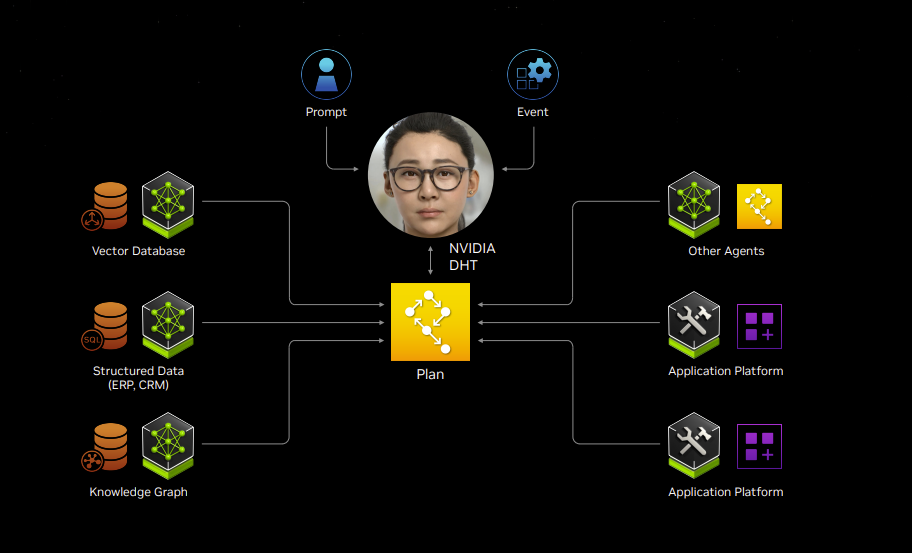
Nvidia's AI Enterprise 5.0, which will include NIMs and capabilities that will speed up development, enable private LLMs and create co-pilots and generative AI applications quickly with API calls.
Palantir held its AIPCon meetup and customers outlined how they delivered value quickly. The use cases ranged from supply chain to defense to logistics to smarter workflows among field workers. Palantir has been using its AI Platform (AIP) to land, generate value and then expand.
C3 AI held its Transform event where Baker Hughes highlighted how they used C3 AI's platform to optimize sourcing and inventory along with value delivered to the US Department of Defense, Con Edison, GSK and others. C3 AI's formula rhymes with Palantir's approach.
Taken as a whole, the generative AI use cases today are delivering value, but won't set the technology world on its ear. Frankly, some of the use cases sit at the intersection of AI, process mining and data science and you'd be hard pressed to declare the implementations as solely artificial intelligence.
Jensen Huang's keynote highlighted where generative AI use cases are going to go. First, the sheer pull of Nvidia's ecosystem--AWS, Microsoft Azure, Google Cloud Platform, Oracle Cloud Infrastructure, data platforms such as Databricks and Snowflake and enterprise software vendors--will put NIMs on the map. Enterprise AI 5.0 will be ubiquitous.
And priced at $4,500 per GPU for AI Enterprise, there's a big market opportunity for Nvidia, but nothing that breaks the bank. The cash register for Nvidia is still the GPU. That said, the software math for Nvidia is compelling--especially if Nvidia has 1 million GPUs in the field attached to AI Enterprise.
Simply put, Nvidia is flooding the zone for generative AI use cases. Speaking to industry analysts, Huang was asked about enterprise use cases. He said:
"We have two avenues to take AI into enterprise. One avenue is people build up applications in the IT department. We have business application developers writing applications for forecasting and supply chain management. We have to create these AI modules and AI libraries for them. Business applications are just AI applications. Somebody's going to go off and build.
The other avenue is through the enterprise IT platforms, and I think that they're all sitting on a goldmine. They created tools and you can now create AI copilots to go use those tools. You're gonna have SAP create copilots and they're gonna get better and better. Instead of instead of hiring 100 business application developers, you have 100 and another 500 that are APIs."
Platforms appear to be the primary vendor goal at the moment. Palantir said on its fourth quarter earnings conference call that the company has covered nearly 200 use cases coming from its AIP Bootcamps. Palantir CTO Shyam Sankar said AIP is enabling the company "to integrate so many types of new data, video conferences, incident response calls, Slack rooms, PDFs, images, video, audio, and exploit them through the power of LLMs and ontology."
Sankar said the real data that defines a process is in the conversations than the enterprise system. "What's in the enterprise process system is a lousy latent representation of this reality," said Sankar. "With AI and LLMs, you can't think your way through it. You have to get your hands dirty and work in anger to get use cases into production. In AIP, we have built a platform to deliver proof, not just proofs of concept, to our customers."
C3 AI CEO Tom Siebel said during one of his Transform 2024 talks that if you fast forward three years, you'll find that the entire enterprise application stack will be transformed. AI applications will be predictive and prescriptive and save billions of dollars.
"Let's fast forward three years March 2027. No CEO in the world will be able to withstand a board meeting where he or she was standing up without reporting what customer churn was, what device failure was, and the level of fraud. When the tools are in place to prevent the failures, prevent the customer churn and make sure you can deliver the products on time it's big," said Siebel.
C3 AI as of Transform 2024 has deployed more than 47 use cases in generative AI across multiple industries.
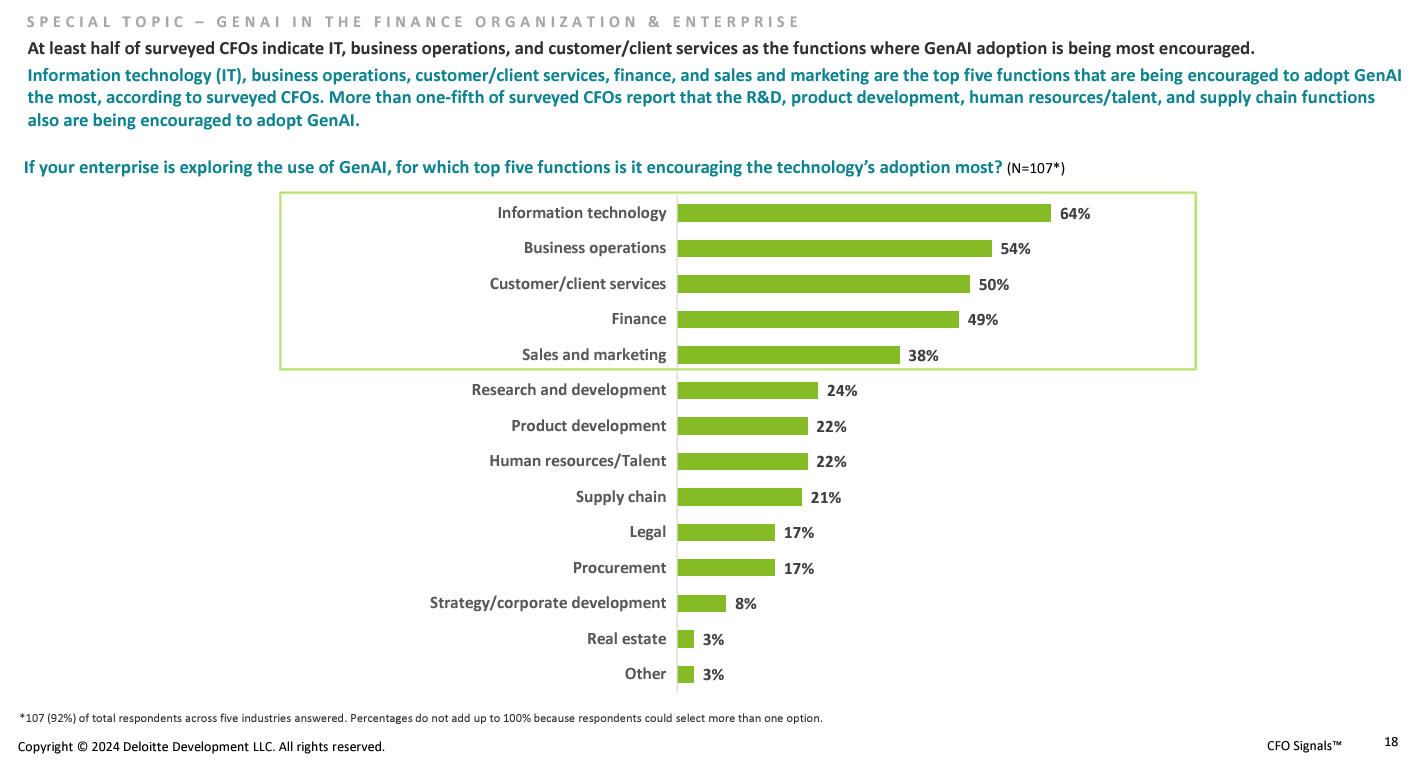
The bet here is that we're going to see a lot more enterprise use cases soon, but the real business value will be at the intersection of generative AI, process transformation, automation, scale and speed. It's also worth noting that enterprises are planning to allocate money to generative AI even if they haven't scaled funding yet. Deloitte's first quarter CFO Signals survey found that 64% of North American CIOs are looking to adopt generative AI with a focus on IT, business operations, customer service, finance and sales and marketing.
Editor in Chief of Constellation Insights
Constellation Research
Larry Dignan is Editor in Chief of Constellation Insights at Constellation Research, where he leads editorial coverage focused on enterprise technology, digital transformation, and emerging trends shaping the future of business. He oversees research-driven news, analysis, interviews, and event coverage designed to help technology buyers and vendors navigate complex markets with clarity and context. ...
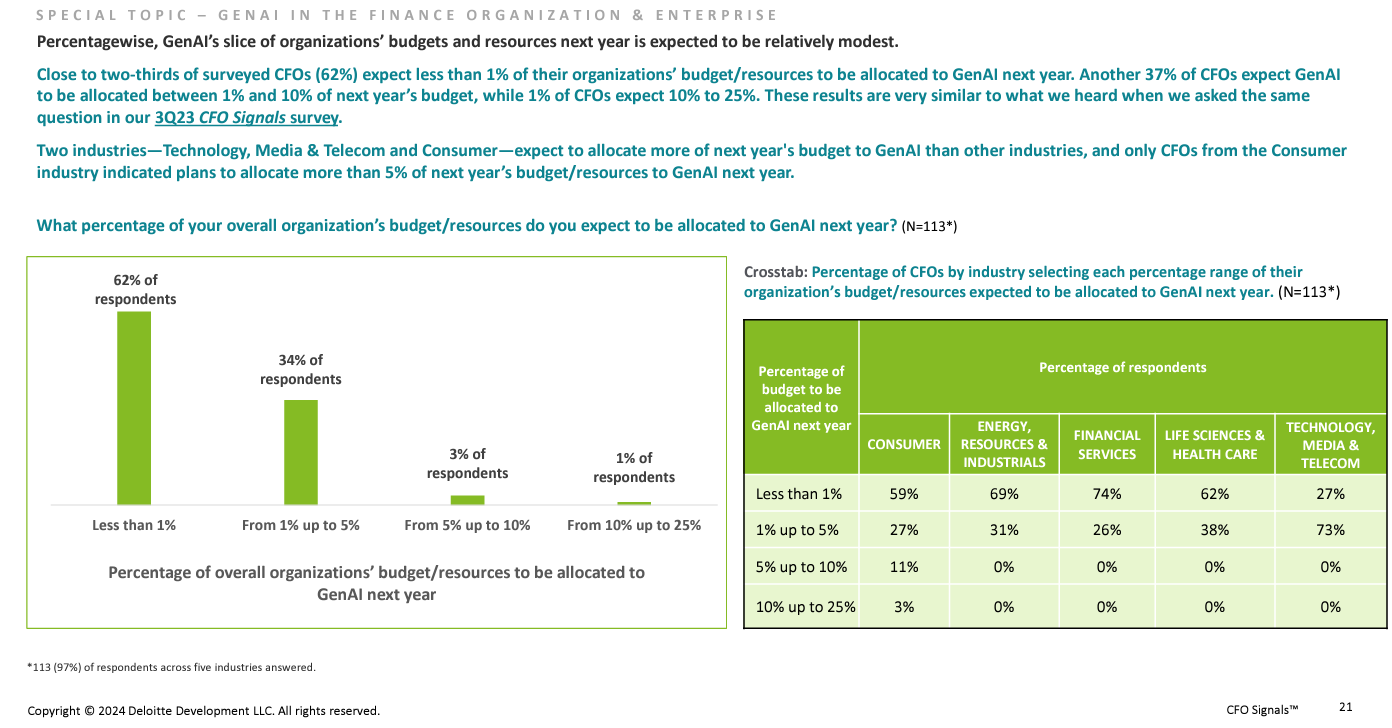
Sixty-two percent of CFOs say their organizations are allocating less than 1% of corporate budgets to generative AI next year, according to Deloitte's CFO Signals survey for the first quarter. Another 37% of CFOs expect 1% to 10% of budgets to be allocated to generative AI.
The findings, based on 116 respondents, are notable because they highlight how actual enterprise movement on generative AI has trailed headlines and vendor proclamations. Consumer companies plan to allocate more than 5% of their budgets to generative AI. Another notable takeaway is that 58% of CFOs say their boards are somewhat or very much encouraging genAI adoption in the enterprise.
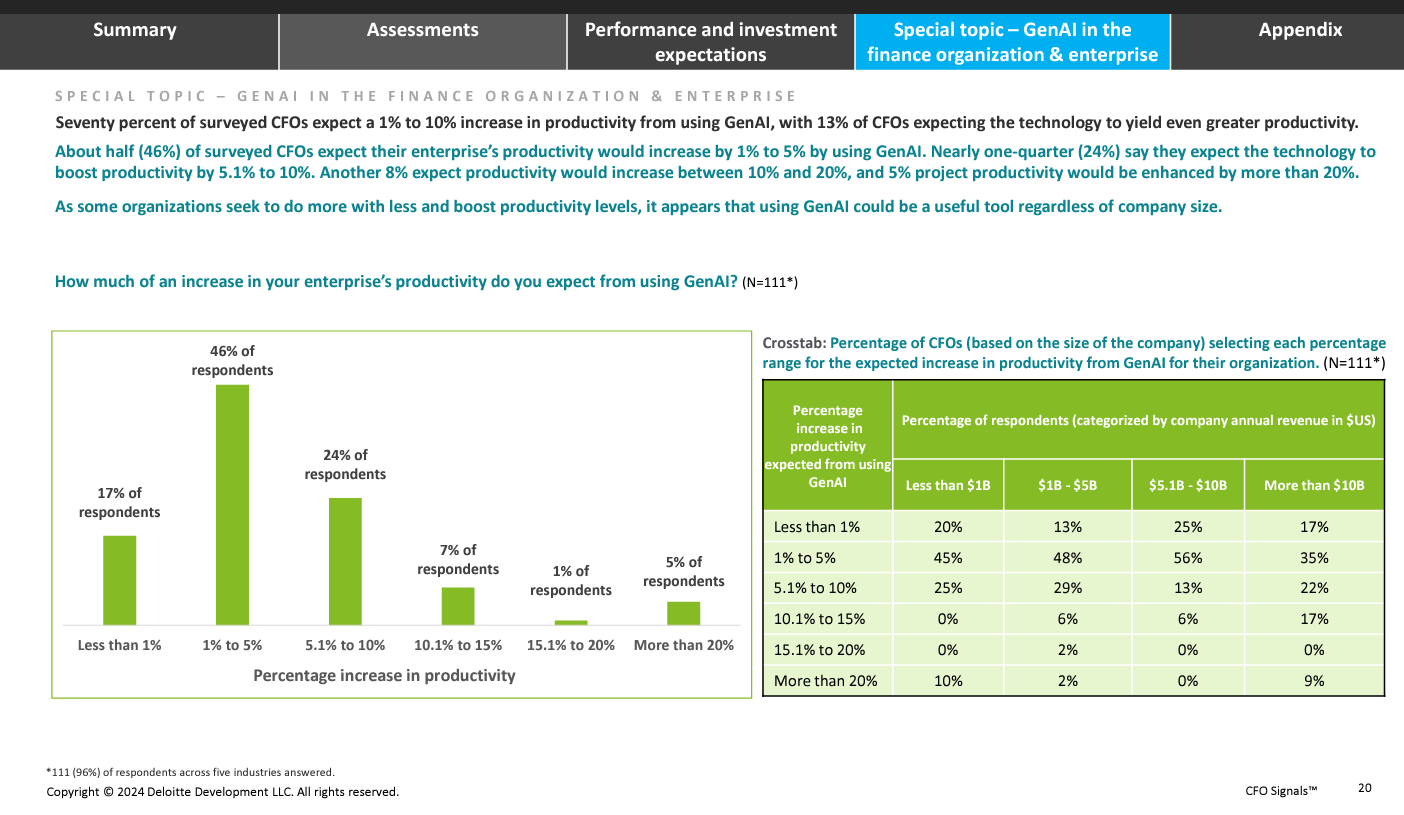
The budgets may move once the returns on generative AI become clearer. Seventy percent of CFOs expect a 1% to 10% increase in productivity from using genAI with 13% of CFOs seeing higher gains. Productivity is the return metric of choice among CFOs. CFOs from larger companies expect the biggest generative AI productivity gains.
For instance, 9% of CFOs from companies with more than $10 billion in revenue are expecting productivity gains of more than 20% from genAI. Five percent of CFOs surveyed expect productivity gains of more than 20%.
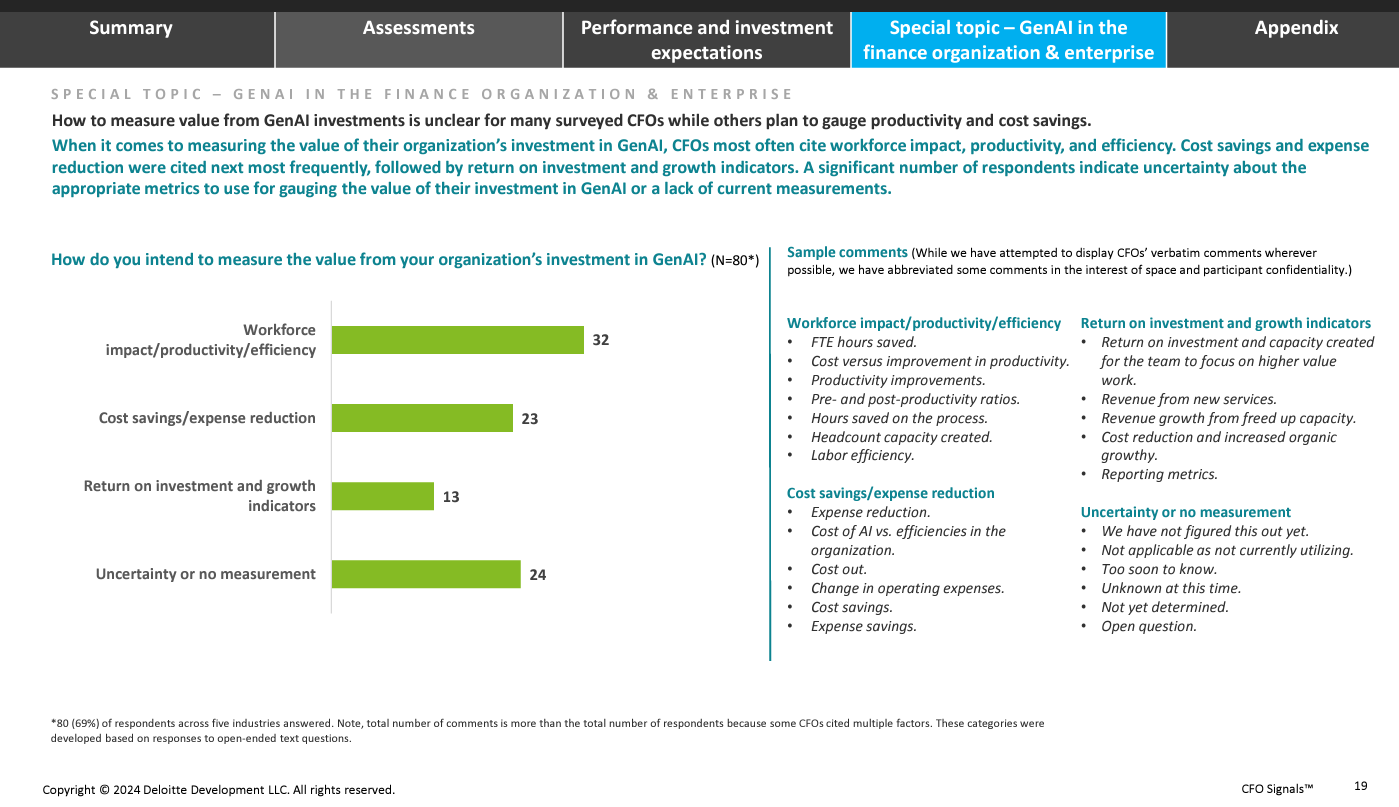
Going forward, CFOs are valuing generative AI on workforce productivity and cost savings. A big chunk of CFOs surveyed, 24%, are uncertain how to value generative AI or had no measurement.
Across the enterprise, CFOs say IT, business operations, customer service, finance and sales and marketing are the top functions ripe for generative AI transformation.
The generative AI data from the CFO Signals survey come amid other key themes. Other takeaways include:
40% of CFOs say now is a good time to take greater risks and the remainder are risk averse.
65% of CFOs say they believe the US equity markets are overvalued.
42% of CFOs say they were more optimistic about their own companies' financial prospects.
59% of CFOs saw North American economic conditions as good or very good, but 12% of CFOs saw Europe that way. Just 3% of CFOs China economic conditions as good.
Editor in Chief of Constellation Insights
Constellation Research
Larry Dignan is Editor in Chief of Constellation Insights at Constellation Research, where he leads editorial coverage focused on enterprise technology, digital transformation, and emerging trends shaping the future of business. He oversees research-driven news, analysis, interviews, and event coverage designed to help technology buyers and vendors navigate complex markets with clarity and context. ...
Enterprises are betting on generative AI and digital transformation at the expense of other IT projects, but scaling AI is difficult and more foundational work is needed, according to Accenture CEO Julie Sweet.
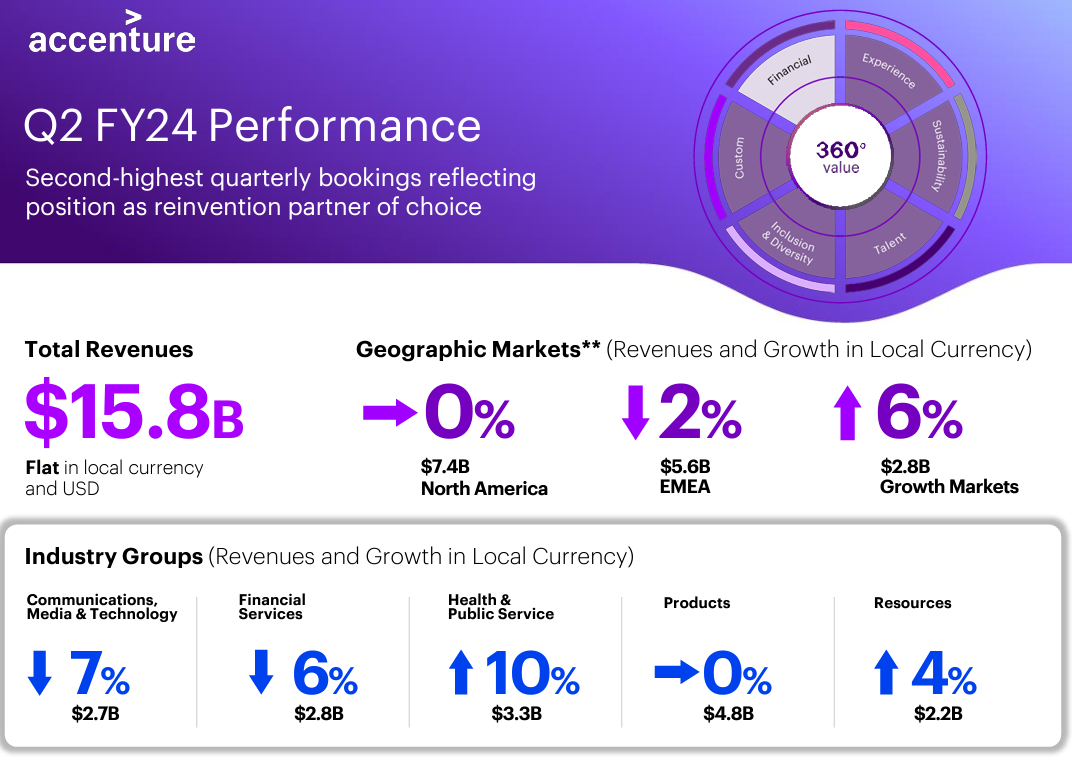
Sweet, speaking on the company's second quarter earnings call, said Accenture saw 39 clients with quarterly bookings topping $100 million. The company also had more than $600 million in generative AI bookings to reach $1.1 billion in generative AI sales for the first half.
That's the good news. The bad news is enterprises are prioritizing large transformation projects that convert to revenue more slowly. Sweet said:
"We see clients continuing to prioritize investing in large-scale transformations which convert to revenue more slowly, while further limiting discretionary spending particularly in smaller projects. We also saw continued delays in decision-making and a slower pace of spending.
Our clients are navigating an uncertain macro-environment due to economic, geopolitical, and industry-specific conditions. And in response, we are seeing them thoughtfully prioritize larger transformations, building out their digital core to partnering, to improve productivity, to free-up more investment capacity to focus on growth and other initiatives with near-term ROI."
Revenue in the quarter was flat for the second quarter even though Accenture saw mid-single digit growth or higher in six of its 13 industries.
Overall, Accenture reported second-quarter revenue of $15.8 billion, flat from a year ago, with earnings of $1.71 billion, or $2.63 a share.
Accenture's outlook for the third quarter fell short of expectations. The company projected third quarter revenue between $16.25 billion to $16.85 billion, below Wall Street estimates of $17 billion. Full year revenue will be between 1% and 3%. Analysts were looking for growth of 2% to 5%.
Sweet said enterprises are now "near universal recognition of the importance of AI," but "most clients are coming to grips with the investments needed to truly implement AI across the enterprise and nearly all are finding it difficult to scale, because the AI technology is a small part of what is needed."
Indeed, Sweet said companies with strong data and digital cores are moving quickly. Laggards are investing in digital core and new processes. "We are working closely with our ecosystem partners to help our clients understand the right data and AI backbone that is needed and how to achieve tangible business value," said Sweet, who noted that 2024 budgets were just recently set and there's caution about the economy.
Here's a look at some of the enterprise technology spending takeaways from Accenture:
Enterprises pulled back on spending for Accenture services and smaller projects at the beginning of the year.
Accenture is focused on market share and meeting customers where they are.
Cloud, data and AI are leading priorities.
Companies are substituting projects instead of adding to budgets.
Foundational data projects are necessary, and those transformation projects are heavier lifts.
Companies are dialing back services because they are more discretionary. Large transformations are happening because the need to replatform is critical.
Sweet said:
"You can't just jump to the great data foundation. You need to be in the cloud. You have to have modern platforms. The clients during these higher bookings rate are making big transformations oftentimes to be ready to put in the data foundation. Only 40% of workloads are in the cloud and 20% of those roughly haven't been modernized. Many of our clients haven't put in the platform--if you don't have the major ERP platforms that are modern, you don't create a data foundation to fuel GenAI. You've got to build the digital core. And there's a lot more to go."
Former Vice President and Principal Analyst
Constellation Research
Doug Henschen is former Vice President and Principal Analyst where he focused on data-driven decision making. Henschen’s Data-to-Decisions research examines how organizations employ data analysis to reimagine their business models and gain a deeper understanding of their customers. Henschen's research acknowledges the fact that innovative applications of data analysis requires a multi-disciplinary approach starting with information and orchestration technologies, continuing through business intelligence, data-visualization, and analytics, and moving into NoSQL and big-data analysis, third-party data enrichment, and decision-management technologies.
Insight-driven business models are of interest to the entire C-suite, but most particularly chief executive officers, chief digital officers,…...
iPaaS vendors are filling out their capabilities with API management, workflow automation, AI/ML, and, on the cutting edge, GenAI.
I’ve been covering the path from data to decisions for nearly nine years here at Constellation Research, and it’s a path that invariably starts with integration – integrating data sources and data-generating applications so organizations can connect business processes, gain insight, make decisions, and act. With the steady rise of the cloud over these last nine years, the integration platform as a service (iPaaS) has come to the fore. Here’s a closer look at the latest trends in iPaaS, which is one of the three core markets I cover, along with analytical data platforms (data lakes, data warehouses and lakehouses), analytics/BI and citizen data science capabilities including artificial intelligence (AI), machine learning (ML) and generative AI (GenAI).
iPaaS have emerged as the cloud-based platforms for connecting databases, applications and mission-critical systems both in the cloud and from on-premises environments to the cloud. It’s not just about connecting sources to targets, as in the batch-oriented extract/transform/load (ETL) days of yore. Integration is increasingly a two-way street, with updates and data streams sent to AI models, source systems, automated business processes, and data platforms.
iPaaS have helped organizations move on from brittle, hard-coded, point-to-point integrations. The iPaaS becomes the consistent intermediary between points of integration, facilitated by the platform’s hundreds of out-of the-box connectors to popular apps and data sources (all of which are maintained by the vendor). The work of connecting sources and systems becomes much more accessible to non-IT types by way of drag-and-drop and point-and-click interfaces. What’s more, the components of integrations created with the iPaaS are modular and can be reused to quickly assemble new integrations. When systems change, components can be quickly updated across all integrations in which they are used, helping teams work faster and be more productive.
When the iPaaS emerged more than a decade ago, vendors typically came out of the data-integration or application-integration arena, but what Constellation calls a next-generation iPaaS has to be able to do it all. Many iPaaS vendors also address business-to-business integration and the electronic data interchange (EDI) requirements seen in supply chain environments. In addition to offering hundreds of prebuilt connectors and templates for common integration flows, iPaaS typically provide monitoring, alerting and debugging capabilities to keep tabs on and troubleshoot integrations, pipelines and jobs.
As detailed below, the three main areas where iPaaS vendors are stepping up are:
API management. Connecting cloud apps and data sources is all about using application programming interfaces (API) that abstract away complexity and promote agility and flexibility. Unfortunately, APIs also introduce a new source of complexity in the form of API sprawl. Here’s where API management capabilities come in. iPaaS vendors are stepping up with 1. API lifecycle management capabilities, 2. Unified control planes for wrangling all those APIs, and 3. Governance frameworks to ensure that APIs are tracked and managed.
Workflow and automation. Organizations continue to face pressure to do more with fewer people, so workflow and automation capabilities are on the rise. It makes sense to automate wherever possible. Where there’s any doubt about next steps, use the iPaaS to create a workflow with humans in the loop for exception handling. Where there is confidence about exactly what an event or an analytic threshold or a prediction means, choose straight-through automation without unnecessary human intervention.
AI/ML. As the name suggests, an iPaaS is a cloud-based platform provided as a service. That puts vendors in the position to provide recommendations based on observable integration patterns. The customer’s private data remains secure and unseen by the vendor, but leading iPaaS vendors are learning from the metadata patterns and graphs of interactions behind the scenes in order to suggest appropriate data sources, pre-existing integrations, and/or next-best integration steps to users. These recommendations help save time and enhance productivity for professional and novice users alike.
GenAI. The latest innovation in iPaaS is the use of GenAI, which is being used to design and deploy new integrations and to explain and document new or existing integrations. GenAI will make the iPaaS accessible to an even broader swath of users through natural language interfaces, and it will help organizations to modernize legacy integrations by explaining, recreating, and optimizing code created by people who have long since left an organization.
Streaming capabiliites. The pace of business is always accelerating, so it’s a must to consider low-latency data integration. A next-gen iPaaS should address streaming requirements.
To summarize, modern iPaaS are benefitting professional integrators and tech-savvy business users alike. Using an iPaaS enhanced with augmented capabilities including AI/ML and GenAI, tech-savvy business types can create integrations for themselves rather than having to wait in line for IT to do the work. For the professionals, an iPaaS can accelerate and scale up their integration work, enabling them to:
Create, monitor, maintain and modify integrations much more quickly and productively.
Validate, troubleshoot and optimize integrations created by the tech-savvy business types.
Explain, document and streamline legacy integrations and code.
Recommendations
If there’s a risk in investing in an iPaaS, it’s that the platform might not support all the types of integration or the scale of integration that the organization will need. A next-generation iPaaS is one that is complete and able to serve as the companywide standard. If you can do it all with one platform you’ll get much more out of the investment, both in terms of the technology and the training of people, and there will be no need for point solutions.
Look beyond the next integration project to consider the breadth of integration requirements in recent history and in the foreseeable future. Do you have on-premises requirements? Will you need to work with more than one public cloud? Are investments anticipated in new enterprise apps, such as ERP or CRM systems? What are the workflow and automation requirements?
On the cutting edge, if an iPaaS vendor doesn’t have an AI/GenAI strategy by this point – let alone GenAI-based features in preview – I’d say it’s time to cut them from your short list.
Costs and licensing regimes are crucial. Does the platform you are considering offer modularity? As noted above, a complete iPaaS is a future-proof choice, but if you don’t have plans to use subsets of capabilities, is it possible to add them (and pay for them) only as and when needed? What subscription models are available? Is it per user, per connection or capacity based? The more choices available the better, as the model that makes sense today may get expensive as the number of users or integrations multiplies.
To give you a head start on your tech selection process, I recently updated my Constellation ShortListTM for Integration Platform as a Service. If you don’t see a candidate you are considering on my ShortList, feel free to contact me at [email protected] for an advisory consultation. I wish you the best of success in your technology selection process.
Vice President and Principal Analyst
Constellation Research
Chirag Mehta is Vice President and Principal Analyst focusing on cybersecurity, next-gen application development, and product-led growth.
With over 25 years of experience, he has built, shipped, marketed, and sold successful enterprise SaaS products and solutions across startups, mid-size, and large companies. As a product leader overseeing engineering, product management, and design, he has consistently driven revenue growth and product innovation. He also held key leadership roles in product marketing, corporate strategy, ecosystem partnerships, and business development, leveraging his expertise to make a significant impact on various aspects of product success.
His holistic research approach on cybersecurity is grounded in the reality that as sophisticated AI-led attacks become…...
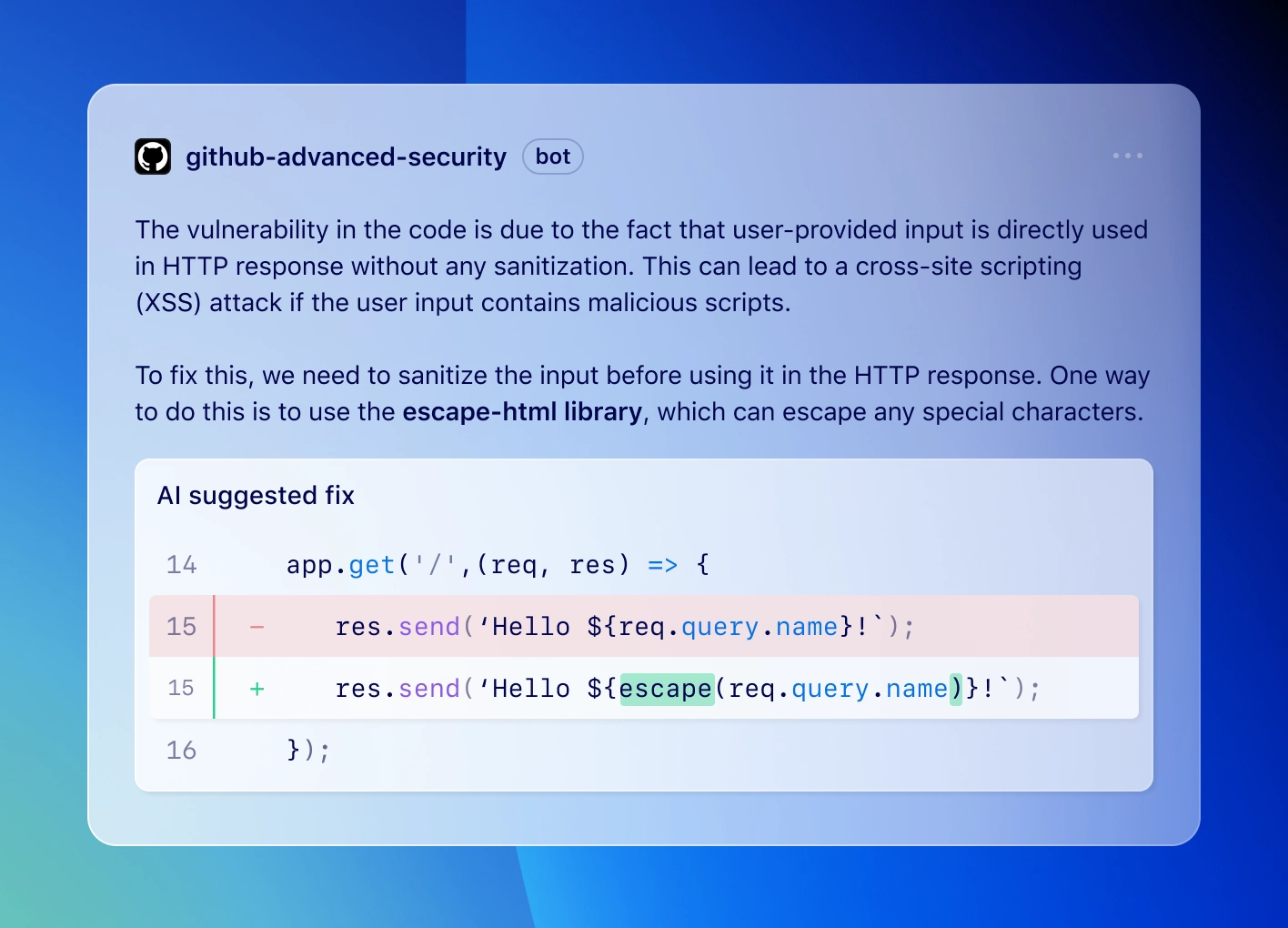
In a major advancement for developer productivity and security, GitHub has announced “code scanning autofix,” a new feature powered by GitHub Copilot and CodeQL. Starting today, it will be available in public beta for all GitHub Advanced Security customers. This AI-driven tool helps developers identify and fix vulnerabilities in their code with suggested fixes, streamlining the development process and improving code security. Here’s how it works.
Scanning code is crucial for preventing security breaches and maintaining a strong software supply chain. Vulnerabilities in code can be exploited by malicious actors to gain unauthorized access to systems or steal sensitive data. By proactively identifying and fixing these vulnerabilities, developers can significantly reduce the risk of attacks.
Image courtesy: GitHub
Features such as autofix make life easier for developers of all skill levels. Novice programmers can leverage the suggested fixes to learn from experts and improve their coding practices. Experienced developers can benefit from the automation, allowing them to focus on more complex tasks. Ultimately, any developer working on a codebase with potential vulnerabilities can benefit from this new feature.
As AI-driven tools continue to mature, code scanning tools will become even more sophisticated. In addition, we can expect to see code scanning tools become more and more integrated directly into the development process. This will make it easier for developers to scan their code for vulnerabilities early and often, an ongoing desire from CIOs and CISOs we work with.
Editor in Chief of Constellation Insights
Constellation Research
Larry Dignan is Editor in Chief of Constellation Insights at Constellation Research, where he leads editorial coverage focused on enterprise technology, digital transformation, and emerging trends shaping the future of business. He oversees research-driven news, analysis, interviews, and event coverage designed to help technology buyers and vendors navigate complex markets with clarity and context. ...
Micron Technology CEO Sanjay Mehrotra said artificial intelligence workloads are boosting demand for memory chips as AI-optimized systems with GPUs and upcoming AI PCs are faring well.
In prepared remarks with Micron Technology's second quarter results, Mehrotra said AI server demand for high-bandwidth memory, data center solid-state drives and DDR5 are boosting prices. he said:
"We expect DRAM and NAND pricing levels to increase further throughout calendar year 2024 and expect record revenue and much improved profitability now in fiscal year 2025."
Mehrotra's argument is that Micron is well positioned for edge and data center inference workloads.
We are in the very early innings of a multiyear growth phase driven by AI as this disruptive technology will transform every aspect of business and society. The race is on to create artificial general intelligence, or AGI, which will require ever-increasing model sizes with trillions of parameters. On the other end of the spectrum, there is considerable progress being made on improving AI models so that they can run on edge devices, like PCs and smartphones, and create new and compelling capabilities. As AI training workloads remain a driver of technology and innovation, inference growth is also rapidly accelerating. Memory and storage technologies are key enablers of AI in both training and inference workloads."
Micron said it is seeing the following tailwinds:
Its high-memory offerings with better bandwidth are seeing demand due to better power consumption.
Micron is making progress qualifying its memory products with multiple customers. The company recognized its first revenue from HBM3E, which will be part of Nvidia's H200 Tensor Core GPUs, in the fiscal second quarter.
Data center SSD revenue hit a record for Micron in calendar 2023.
The PC market is expected to grow modestly and accelerate due to AI PC demand, which uses more memory.
AI will also drive smartphone memory specs over time.
For its second quarter, Micron reported net income of $793 million, or 71 cents a share, on revenue of $5.82 billion, up 58% from a year ago. Non-GAAP earnings were 42 cents a share.
Wall Street was expecting a non-GAAP second quarter loss of 24 cents a share on revenue of $5.35 billion.
As for the outlook, Micron said third quarter revenue will be $6.6 billion give or take $200 million with non-GAAP earnings of about 45 cents a share, give or take 7 cents. Wall Street was expecting third quarter non-GAAP earnings of 9 cents a share on $6 billion in sales.
Vice President and Principal Analyst
Constellation Research
Holger Mueller is VP and Principal Analyst for Constellation Research for the fundamental enablers of the cloud, IaaS, PaaS and next generation Applications, with forays up the tech stack into BigData and Analytics, HR Tech, and sometimes SaaS. Holger provides strategy and counsel to key clients, including Chief Information Officers, Chief Technology Officers, Chief Product Officers, Chief HR Officers, investment analysts, venture capitalists, sell-side firms, and technology buyers.
Coverage Areas:
Future of Work
Tech Optimization & Innovation
Background:
Before joining Constellation Research, Mueller was VP of Products for NorthgateArinso, a KKR company. There, he led the transformation of products to the cloud and laid the foundation for new Business Process as a…...
Vice President & Principal Analyst
Constellation Research
About Liz Miller:
Liz Miller is Vice President and Principal Analyst at Constellation, focused on the org-wide team sport known as customer experience. While covering CX as an enterprise strategy, Miller spends time zeroing in on the functional demands of Marketing and Service and the evolving role of the Chief Marketing Officer, the rise of the Chief Experience Officer, the evolution of customer engagement, and the rising requirement for a new security posture that accounts for the threat to brand trust in this age of AI. With over 30 years of marketing experience, Miller offers strategic guidance on the leadership, business transformation, and technology requirements to deliver on today’s CX strategies. She has worked with global marketing organizations to transform everything from…...
🎬 ConstellationTV episode 76 just dropped! This week, hilarious analyst duo Liz Miller and Holger Mueller unpack enterprise #tech news (Oracle/Microsoft partnerships, impending layoffs and Adobe's new AI assistant).
Then Liz explains why Pantheon Platform made the 2024 #DXP ShortList and Holger hears from Rob O'Brien of ITV Studios about his experience using Zoho #technology. Watch until the end for bloopers!
0:00 - Introduction
1:30 - #Enterprise tech news coverage (partnerships,#layoffs and #AI)
13:49 - Let's Talk About #DXPs with Liz Miller
32:06 - #ZohoDay2024 interview with ITV Studios
42:05 - Bloopers!
ConstellationTV is a bi-weekly Web series hosted by Constellation analysts, tune in live at 9:00 a.m. PT/ 12:00 p.m. ET every other Wednesday!