Results

Zscaler delivers strong Q4, fiscal 2026 outlook

Zscaler reported better-than-expected fourth quarter results and delivered a strong outlook for the fiscal year ahead.

The security vendor reported a fourth quarter net loss of $17.6 million, or 11 cents a share, on revenue of $719.2 million, up 21% from a year ago. Non-GAAP earnings in the fourth quarter were 89 cents a share.

Wall Street was expecting Zscaler to report non-GAAP earnings of 80 cents a share on revenue of $707.14 million.

Jay Chaudhry, CEO of Zscaler, said the company topped $3 billion in annual recurring revenue with record operating margin. "We are rapidly expanding our AI security portfolio to address the emerging risks of AI models and applications," said Chaudhry.

Chaudhry added:

“We are seeing significant customer interest in our powerful AI security solutions, including our new AI Guard and GenAI security offerings. An increasing number of enterprises are choosing Zscaler because of our technology leadership and platform scale. I’m pleased to share that our platform now secures nearly 40% of the Global 2000 and over 45% of the Fortune 500 companies.”

Zscaler’s report landed after strong quarters from CrowdStrike, Palo Alto Networks and SentinelOne. Fortinet’s latest quarter was ahead of estimates, but the outlook was light due to the firewall refresh cycle.

For fiscal 2025, the company reported a net loss of $41.5 million, or 27 cents a share, on revenue of $2.67 billion, up 23% from a year ago. Non-GAAP earnings were $3.28 a share for the fiscal year.

As for the outlook, Zscaler projected first quarter non-GAAP earnings of 85 cents a share to 86 cents a share on revenue of $772 million to $774 million. For fiscal 2026, Zscaler projected non-GAAP earnings of $3.64 a share to $3.68 a share on revenue of $3.68 billion to $3.7 billion.

Zscaler’s plan is to grow via agentic security operations.


Data to Decisions Innovation & Product-led Growth Future of Work Tech Optimization Next-Generation Customer Experience Digital Safety, Privacy & Cybersecurity AI GenerativeAI ML Machine Learning LLMs Agentic AI Analytics Automation Disruptive Technology cybersecurity Chief Information Officer Chief Information Security Officer Chief Privacy Officer Chief AI Officer Chief Experience Officer

OpenAI acquires Statsig, adds CTO of applications

OpenAI will acquire Statsig, a startup focused on product testing, in a deal that highlights how the company is building out applications around ChatGPT. Statsig CEO Vijave Raji will become OpenAI's CTO of applications.

In a blog post, OpenAI outlined the deal. Statsig's platform focuses on A/B testing, feature flagging and feedback loops that move products into production. Fidji Simo, CEO of OpenAI's applications unit, said Raji will head product engineering for ChatGPT and Codex, one of OpenAI's first applications.

According to Simo, Raji will have responsibilities "that span core systems and product lines including infrastructure and integrity."

Terms of the deal weren't disclosed, but reports put the deal at $1.1 billion.

Raji said Statsig will continue to provide its services and invest in its core products.

For OpenAI, Statsig brings a platform that already counts Atlassian, Notion, Brex and Bloomberg as customers. OpenAI is also a customer. Statsig will complement OpenAI's ChatGPT Business and Enterprise plans as well as its API Platform.

Like Anthropic, OpenAI is building an application stack and ecosystem that can complement and extend ChatGPT. Anthropic is more focused on the enterprise while OpenAI is also looking at the consumer market too. As LLM capabilities all converge to be good enough, it'll be critical to create applications and ecosystems for staying power.

Statsig is a big step toward building out OpenAI's application lineup.

Data to Decisions Future of Work Innovation & Product-led Growth Tech Optimization Next-Generation Customer Experience Digital Safety, Privacy & Cybersecurity openai ML Machine Learning LLMs Agentic AI Generative AI Robotics AI Analytics Automation Quantum Computing Cloud Digital Transformation Disruptive Technology Enterprise IT Enterprise Acceleration Enterprise Software Next Gen Apps IoT Blockchain Leadership VR Chief Information Officer Chief Executive Officer Chief Technology Officer Chief AI Officer Chief Data Officer Chief Analytics Officer Chief Information Security Officer Chief Product Officer
Protecting AI Workloads: Microsoft's Vision for Cybersecurity

Join Constellation analyst Chirag Mehta as he sits down with Efim Hudis, VP of Security at Microsoft, for an in-depth conversation on the transformative impact of artificial intelligence in cybersecurity. Read the full recap below:

Balancing Adoption and Risk

As AI adoption accelerates, organizations face a unique challenge: implementing non-deterministic systems while ensuring security. This creates a dilemma for CSOs and CIOs, who must balance innovation with risk management. Business leaders are under increasing pressure to integrate AI into their operations. While AI offers significant potential, it also introduces new security considerations. Organizations must develop strategies that leverage AI's benefits while mitigating associated risks.

By addressing these key areas, organizations can position themselves to harness AI's potential while maintaining a strong security posture.

AI's adoption in enterprises is inevitable and accelerating. This shift necessitates a focus on securing AI systems effectively, rather than debating adoption. As AI transforms cybersecurity, it's crucial to understand its impact. AI is altering the economics of cyberattacks, presenting new challenges. Malicious actors are early AI adopters, using it to enhance existing attack methods, reduce operational costs, and expand their reach. This trend demands a proactive approach to cybersecurity.

AI's Evolving Impact on Cybersecurity

AI is reshaping the cybersecurity landscape, presenting both challenges and opportunities. The economics of attacks are shifting, with AI-powered spear phishing becoming more accessible and cost-effective for malicious actors. To address this evolving threat landscape, organizations must adapt their cybersecurity strategies. Three key areas require attention:

  • AI-Enhanced Defense: Leveraging AI to bolster security measures and detect sophisticated threats.
  • AI System Protection: Addressing the unique vulnerabilities associated with AI workloads and infrastructure.
  • Countering AI-Driven Attacks: Developing strategies to mitigate the impact of AI-powered cyber threats.

By focusing on these areas, businesses can proactively safeguard their digital assets and stay ahead of emerging risks.

AI-Enhanced Security: Balancing Innovation and Protection

As AI reshapes the threat landscape, organizations must adapt their defenses. Hackers now leverage AI to refine their strategies, necessitating a proactive approach from security teams.

This duality of AI underscores both its potential and inherent risks. Protecting AI workloads is now crucial. These systems introduce unique weaknesses and create new enterprise risks that demand specialized safeguards.

"AI workloads present distinct security challenges. We must identify and mitigate these vulnerabilities while managing the associated organizational risks."

As AI integrates deeper into business processes, a forward-thinking security approach is crucial. Organizations must anticipate and address potential vulnerabilities in AI systems, particularly as autonomous agents become more prevalent.

Microsoft's AI-Focused Security Solutions

Microsoft's Defender suite is evolving to meet the unique challenges of AI security. New features are being introduced across the product line to:

  • Discover and inventory AI models
  • Monitor AI-specific threats
  • Manage security posture for AI systems

These enhancements aim to provide comprehensive protection for AI applications, enabling businesses to innovate safely and confidently in the AI era.

The rise of "agentic AI" presents a new frontier in enterprise productivity. These AI teammates, capable of reasoning and acting autonomously, offer immense potential but introduce novel security considerations. As AI agents become integral team members, traditional security models must evolve. These systems require unique identities and carefully managed access rights to ensure they operate safely within enterprise environments.

The key challenge lies in harnessing the efficiency of AI agents while maintaining robust security measures. Organizations must develop strategies that enable these digital teammates to thrive without compromising data integrity or system safety.

AI's Impact on Identity and Access Management

As AI agents become more sophisticated, they'll require identities similar to humans, revolutionizing identity management. This shift demands a new approach to access control and risk assessment for security teams.

Managing AI agents may resemble human resource practices, with robust role-based access controls governing their capabilities. This approach ensures appropriate limitations on AI actions while maximizing their potential.

  • AI Reshapes Cybersecurity: Rapid AI adoption brings both opportunities and challenges. Enterprises must prioritize securing AI systems alongside implementation.
  • Identity Evolution: AI agents will need human-like identities, necessitating new identity management strategies.
  • Access Control Adaptation: Security teams must develop innovative approaches to manage AI agent access and permissions.

AI's Dual Role in Cybersecurity

  • AI-Enhanced Cyber Risks: Attackers now use AI to amplify and innovate threats cost-effectively, pushing defenders to adapt quickly.
  • Safeguarding AI Systems: Novel approaches are essential to protect AI applications, addressing their specific vulnerabilities.
  • Microsoft's Security Advancements: The Defender suite leads in integrating tools to monitor and secure AI systems in business settings.
  • Autonomous Agents and Identity: As AI becomes more independent, we need identity management strategies similar to those used for humans.

The conversation explores both the opportunities and risks AI introduces — from securing AI systems themselves to countering AI-powered threats. With leading tech companies driving innovation, organizations now have new tools to build safer, AI-driven environments.


Watch the full discussion for practical insights enterprise leaders can use to prepare for what’s next in AI and security.

Data to Decisions Future of Work Digital Safety, Privacy & Cybersecurity Chief Information Officer Chief Procurement Officer Chief Data Officer Chief Information Security Officer Chief Privacy Officer Chief Product Officer On <iframe width="560" height="315" src="https://www.youtube.com/embed/kiZKVa27vQ4?si=93Q3Z8bwpo3JTg8t" title="YouTube video player" frameborder="0" allow="accelerometer; autoplay; clipboard-write; encrypted-media; gyroscope; picture-in-picture; web-share" referrerpolicy="strict-origin-when-cross-origin" allowfullscreen></iframe>

Anthropic lands $183 billion valuation, hits $5 billion annual revenue run rate

Anthropic has raised $13 billion in Series F funding to give the company a $183 billion valuation.

The funding round for Anthropic landed days after Databricks was valued at $100 billion in its latest funding round.

In a blog post, Anthropic said the funding round was led by ICONIQ with Fidelity Management & Research Co. and Lightspeed Venture Partners.

Other investors in the round included Altimeter, BlackRock, Blackstone, General Atlantic, Goldman Sachs, Insight Partners and T. Rowe Price among others.

Anthropic said the funding reflects its "position as the leading intelligence platform for enterprises, developers, and power users."

Indeed, Anthropic annual revenue run rate was $1 billion at the beginning of 2025 and now tops $5 billion. Anthropic, which is more enterprise focused than rival OpenAI, said it has more than 300,000 business customers.

Key points:

  • Anthropic added that customers with more than $100,000 in run-rate revenue has grown 7x in the past year.
  • Claude Code has more than $500 million in annual run rate revenue with usage growing 10x in three months.
  • Anthropic is focused on industry-specific products.

Anthropic said that the Series F investment will help it invest to meet enterprise demand, safety research and support international expansion.

More LLMs


Data to Decisions Future of Work Chief Information Officer

SAP expands sovereign cloud portfolio in Europe

SAP said it will invest more than €20 billion Euros in sovereign cloud efforts for European customers as it rolled out a series of offerings.

Sovereign cloud infrastructure is seen as a big growth area for technology vendors as countries aim to keep data in country and build up AI infrastructure.

For instance, SAP CEO Christian Klein said on the company's second quarter earnings conference call that European customers are focused on digital sovereignty. "Sovereignty is a huge aspect what SAP can contribute to the competitiveness of Europe, especially in areas like public sector and of course, also defense," said Klein.

According to SAP, SAP Cloud Infrastructure and SAP Sovereign Cloud On-Site will give European customers the ability to keep data and AI operations in the region. The effort also means that SAP will be running its own cloud for public sector and regulated customers in Europe.

SAP said SAP Business Suite, SAP Business Technology Platform and SAP Business AI will run in SAP Sovereign Cloud. SAP's platform can run on any hyperscale cloud provider, local clouds and data centers run by the vendor.

Here's a look at the expansion of SAP Sovereign Cloud:

  • SAP Cloud Infrastructure in Europe. SAP will offer infrastructure-as-a-service in its own data centers with open-source technologies. All data will be stored in the EU.
  • SAP Sovereign Cloud On-Site. SAP will offer SAP-operated infrastructure in customer-owned or customer-selected data centers.
  • Delos Cloud. SAP will offer Delos Cloud in Germany, a sovereign cloud for public sector customers.

SAP said SAP Sovereign Cloud will run in multiple countries.

Constellation Research analyst Holger Mueller said:

"SAP has known about the sovereign cloud demands and expectations of its European customer base for a long time, and evidently has not seen the traction and interest from its cloud partners to provide sufficient sovereign cloud offerings and reassurances. As a result, SAP is stepping up its offering. This is interesting as SAP has de-emphasized its inhouse cloud since a long time. Will SAP have the appetite to put the capital expenditures into its own cloud infrastructure? With the cloud at customer SAP is  setting itself up to significant more cloud revenue. Revenue in this category was NOT cloud revenue so far, but will be going forward."

Data to Decisions Digital Safety, Privacy & Cybersecurity Innovation & Product-led Growth Tech Optimization Future of Work SAP Chief Information Officer Chief Technology Officer Chief Information Security Officer Chief Data Officer

Pondering the future of enterprise software

Enterprise software will be reinvented with headless platforms, AI agents and enterprises that will aim to build their own systems. But a lot has to happen for enterprise software and SaaS incumbents to be disrupted.

The storyline that's emerging is one that revolves around enterprise software disruption due to AI agents that can traverse multiple systems and data silos. Today, enterprise software resides in buckets of acronyms--ERP, CRM, HCM--with multiple silos and data stores. AI agents threaten to break down that hierarchy.

Here's the big question: If all you're buying from a SaaS vendor is a browser-based user experience and a database underneath what are you really purchasing?

Simply put, enterprise applications are going to look a lot different in the future. Your guess on timing is as good as mine.

Speaking at a ServiceNow meetup in New York, IBM Research Vice President Sriram Raghava said agentic AI is going to create a new future for enterprise applications.

Get Constellation Insights newsletter

Raghava noted that every inflection point in enterprise technology had a new application paradigm. The emergence of the web created a new application approach. Mobile also meant enterprises need to think through mobile apps.

"I see agents as basically the emerging application paradigm of the AI. We're going to have enterprise applications of the future," said Raghava. "They're all going to be agent based and the way we build applications for the future."

After Raghava spoke, I caught up with him for a follow-up. He said that the current chat-based approach may be part of the enterprise mix, but companies are going to need an abstraction layer that can handle tasks like model selection, use cases, processes and testing to ensure the data is correct.

The challenge for enterprises is that agentic AI constructs have been consumer-based and corporations will need more than model context protocol (MCP) and Agent2Agent (A2A) to address needs. Developers could leverage Android and Apple iOS to deploy mobile applications. That layer for enterprise AI agents isn't baked yet, but standards are moving faster than previous technology inflection points.

I couldn't help but quip that the enterprise abstraction layers for quantum computing seem to be more baked than agentic AI. Raghava didn't disagree. Then again, quantum computing due to the raw science underneath needs an abstraction layer to work for real use cases.

MongoDB CEO Dev Ittycheria, speaking on the company's second quarter earnings call, hit a similar theme. "The quality of the output of these AI systems is high. Obviously, AI systems are probabilistic in nature, not deterministic in nature. So you can't always guarantee the output. You can hope that you've trained the models well. You've hoped that you've given it the right information, but you can't always guarantee the output," said Ittycheria. "It's going to take a little bit of time for people to really get comfortable that they can really deal with the last mile issues."

While we don't know how the future of enterprise software turns out, there are some common themes to ponder. Here's a look:

Build may catch up to buy. SVPG riffed on the build vs. buy equation for enterprises in the age of AI. Marty Cagan, founder and partner in charge of Product at SVPG, makes the argument that new AI-driven tools are going to make building enterprise applications more appealing. If you know the business logic behind the processes, you can likely use AI to spin up your own enterprise systems. The reality is that you’ll probably build and buy more.

Constellation Research analyst Esteban Kolsky said that the build-vs.-buy debate is picking up again. “This debate is not about building core functionality for business functions (e.g., ERP, CRM, and HCM) but about how to build a better infrastructure to support the growth of AI and coming technologies,” said Kolsky. “The debate about the value of having data available is over: We need data everywhere—protected, accessible, and available. However, the connections necessary to provide that, and the security and elements necessary to make it happen, are far from settled.”

Platforms win. ServiceNow has been able to expand into CRM and various industries due to a platform approach. The company aims to provide AI, data, workflow, security, automation and governance in one platform vs. SaaS vendors focused on a lucrative niche.

In a platform driven world, cloud providers could pull together building blocks that function as enterprise applications via AI agents without the business model disruption. Customers are used to consumption models with hyperscale cloud providers.

Orchestration will be at the core. It's highly unlikely that enterprises will move to one data lake or application platform. The current state of heterogeneous enterprise systems will also be the future. Given that reality, orchestration between humans, processes, AI agents, data and tools will be critical.

Processes and value will be everything. Enterprise software will be sold by value and what process problems can be solved. Corporations will move toward solving problems and generating value over simply buying an acronym.

Terence Chesire, VP of CRM and Industry Workflows at ServiceNow, noted how Blackhawk Network, which processes gift cards for brands, was able to resolve disputes with scale and speed with AI agents with a 95% to 98% approval rate. "At the end of the day, AI needs to flow in an actual business process," said Chesire.

Box CEO Aaron Levie, speaking on the company's second quarter earnings call, said "enterprises are going to spend quite a bit of time trying to figure out what is the right AI architecture, what are the AI solutions that are working, which ones actually are driving ROI."

Don't assume that incumbent enterprise software vendors will win. Ittycheria said AI native startups have been choosing the company's Atlas platform as a foundation for their applications. Ittycheria cited DevRev as an example as a company looking to disrupt the help desk market.

A look at DevRev may indicate the future of enterprise software. An army of AI agents that can traverse multiple systems.

"Enterprises know that AI agents are going to bring a new level of automation and deliver deeper business insights to their businesses. Software has historically been good for automating processes that deal with structured data, take payroll, CRM systems, accounting, HRIS or supply chain workflows," said Box's Levie. "We can imagine a future where there are over 100x more agents than people inside of an organization, where any task you want done in a company is only a matter of how much compute you want to throw at the problem. You'll have agents running in the background and in parallel for any workflow around content that you can imagine."

The new enterprise software model will take time to develop. Speaking on Snowflake’s second earnings conference call, CEO Sridhar Ramaswamy was asked about whether AI and LLMs have plateaued. Ramaswamy’s answer was instructive. He said:

  • "Every prediction that we have made about various kinds of plateauing has not really turned out to be true some 6- odd months later."
  • "Experiences only become useful only when data that matters to the enterprise, all of the PDFs that are sitting in SharePoint or the various other data sources that there are also become accessible to these models."
  • "You're going to see situations in which every complicated task that humans are involved in is going to have agentic solutions that are human-assisted where the model using tools does some of the work and then the humans guide the model to be able to be a lot more productive."
  • "Think of all the work that happens in an enterprise, whether it is insurance claims processing or regulatory reporting or anomaly detection of various kinds or even going through the due diligence process for an M&A or a complicated legal thing that you have to do. Those are areas where application of data and AI is very much in its infancy. There are years of work ahead in terms of the value that we can get from AI."
New C-Suite Data to Decisions Innovation & Product-led Growth Future of Work Tech Optimization Next-Generation Customer Experience Digital Safety, Privacy & Cybersecurity Leadership ML Machine Learning LLMs Agentic AI Generative AI Robotics AI Analytics Automation Quantum Computing Cloud Digital Transformation Disruptive Technology Enterprise IT Enterprise Acceleration Enterprise Software Next Gen Apps IoT Blockchain VR B2B B2C CX EX Employee Experience HR HCM business Marketing Metaverse developer SaaS PaaS IaaS Supply Chain Growth eCommerce CRM ERP finance Social Healthcare CCaaS UCaaS Customer Service Content Management Collaboration M&A Enterprise Service Chief Executive Officer Chief Information Officer Chief Experience Officer Chief Technology Officer Chief AI Officer Chief Data Officer Chief Analytics Officer Chief Information Security Officer Chief Product Officer Chief Digital Officer Chief Financial Officer Chief Operating Officer Chief Marketing Officer Chief Revenue Officer
The Compass Within: Core Values, AI, and the Future of Leadership | DisrupTV Ep. 409

The Compass Within: Core Values, AI, and the Future of Leadership | DisrupTV Ep. 409

In DisrupTV Episode 409, hosts R “Ray” Wang and Vala Afshar explore a powerful theme: how core values—not algorithms—should guide leadership in the age of AI. Through the “Compass Within” framework, they illuminate the “Big Three” life decisions shaped by values and explore how aligning individual and organizational values can redefine leadership, culture, and the digital workplace.

Meet the Guests

Robert Glazer – Founder & Board Chairman at Acceleration Partners and #1 Wall Street Journal Bestselling Author, offering deep perspectives on leadership, personal growth, and aligning core values with professional success. Robert discusses his “Compass Within” framework for guiding life and career decisions through values.

Jim Sullivan – Executive Coach and Leadership Consultant, specializing in helping leaders and organizations clarify their values and align them with strategy, culture, and performance outcomes. Jim provides practical insights on embedding values into leadership behaviors.

Jacqueline Carter – Strategic Advisor and Organizational Development Expert, focusing on coaching, culture, and leadership development programs that foster ethical, sustainable, and human-centered organizational practices. Jacqueline explores how values-driven leadership transforms workplace culture and drives impact.

Key Takeaways

  • Values as True North – Effective leadership in AI-infused environments requires leaders to root decisions in clear, authentic values rather than reactive data points.
  • The “Big Three” Life Decisions – The episode introduces a framework of three core decisions shaped by one’s values—essential for navigating career, culture, and technology challenges.
  • Human-Centered AI – Values serve as the ethical foundation for building AI systems that enhance human experience rather than replacing human judgment.
  • Culture and Strategy Alignment – Leaders must bridge personal values with organizational vision to create workplaces that are both innovative and grounded in purpose.

Memorable Quotes

  • “What truly guides great leaders? Core values are often misunderstood—but they matter more than ever in the age of AI.” – Robert Glazer
  • “Aligning personal and organizational values can transform leadership, culture, and the future workplace.” – Vala Afshar
  • “The Compass Within framework helps us navigate critical life decisions—especially when technology accelerates change.” – Jim Sullivan
  • “When values guide decisions, culture becomes the engine for sustainable performance and innovation.” – Jacqueline Carter

Final Thoughts

Episode 409 reminds us that the next frontier of leadership demands a values-first mindset. In a world captivated by algorithms and automation, the timeless guidepost for human-centered leadership remains our internal compass—our core values.

By prioritizing values over velocity, leaders can develop AI strategies that build trust, nurture culture, and empower teams. When values and innovation coalesce, people—not just data—become transformative agents of progress.

Related Episodes


Data to Decisions Future of Work Innovation & Product-led Growth Chief Executive Officer Chief Information Officer Chief Technology Officer Chief Product Officer On DisrupTV <iframe width="560" height="315" src="https://www.youtube.com/embed/SWFWHFPqLzQ?si=pPwq0NAFUFYG7NJ-" title="YouTube video player" frameborder="0" allow="accelerometer; autoplay; clipboard-write; encrypted-media; gyroscope; picture-in-picture; web-share" referrerpolicy="strict-origin-when-cross-origin" allowfullscreen></iframe>
BT150 zeitgeist: Inside a ransomware attack, AI project success

CxOs in the BT150 recount recovering from a ransomware attack and the ingredients for successful AI projects.

In our August BT150 meetup, CxOs in our network discussed cybersecurity and insurance as well as AI projects that actually work. The best advice was to not be blinded by LLMs. Here's a recap of our CxO call, which operates under Chatham House rules.

Live inside a ransomware attack. One CxO recounted a recent ransomware attack at his company. The attack exposed a big gap between cybersecurity awareness and execution. "The house of cards finally got revealed, which is good and bad, but also made me feel even more helpless," the CxO said.

Post-attack challenges abound. The company that was hit by the ransomware attack faced multiple challenges as it recovered. Here's a look:

  • Insurance complications. It took nine months to get pricing for a cybersecurity insurance pricing. Many insurers didn't want to cover ransomware attacks, but would cover recovery.
  • FBI guidance conflicts. The company was advised not to pay the ransom, but that advice conflicted with insurance policies that might cover ransom payments.
  • Extended recovery. Daily meetings were held as the company tried to assess what files were taken, encrypted, or compromised.
  • Boards are actively discussing ransomware recovery processes and debating whether it's better to get cybersecurity insurance or invest money in better security.

AI success

AI bubble or not, targeted success stories abound. CxOs discussed the ongoing conversation about the AI bubble and potential ramifications. It's a debate we've been having at Constellation Research. AI has been used for management training, warehouse operation optimizations and manufacturing. The key words across these AI projects were targeted, governed and measurable.

"Don't be blinded by large language models." The successful projects are likely to feature smaller models and industry models focused on use cases including physical AI.

Without governance, AI pilots fail. "I've seen a lot of projects where companies don't know what they're looking for and throwing AI blindly against the wall and hoping something sticks instead of identifying a specific process to fix," said one CxO.

Manufacturing's AI transformation. CxOs talked about the evolution toward industry 5.0 in manufacturing with the use of AI and digital twins driving transformation. AI agents are being developed for functional testing, defect detection and assembly line optimization. The takeaway: AI-enhanced processes are reinventing manufacturing.

Leadership and governance matters. CxOs on the call emphasized that successful AI implementation required strong leadership and governance frameworks. Participants noted that without proper executive oversight and targeted approaches, AI initiatives often fail to deliver expected value, reinforcing the importance of senior leadership in driving AI strategy and execution.


Data to Decisions Digital Safety, Privacy & Cybersecurity Innovation & Product-led Growth New C-Suite BT150 Leadership Security Zero Trust Chief Executive Officer Chief Information Officer Chief Information Security Officer Chief Technology Officer Chief Experience Officer Chief Privacy Officer

Alibaba Cloud revenue growth accelerates in Q1, $19 bilion revenue run rate

Alibaba's cloud business accelerated in the company's fiscal first quarter with revenue growth of 26% and an annual revenue run rate approaching $19 billion.

The company's Cloud Intelligence Group reported first quarter revenue of $4.66 billion, up 26% from a year ago, with earnings before interest, taxes and amortization of $2.34 billion. According to the Wall Street Journal, Alibaba has created its own chip for AI workloads similar to other cloud providers. AWS, Microsoft and Google Cloud all have custom silicon to lessen their dependence on Nvidia. In Alibaba’s case, the custom chip is designed to be a substitute for Nvidia’s H20.

Alibaba said its cloud revenue growth was driven by public cloud services as well as AI-related workloads.

For comparison, AWS has an annual revenue run rate of $124 billion compared to $50 billion for Google Cloud and $75 billion in annual sales for Microsoft Azure. Alibaba’s annual revenue run rate is in the ballpark of Oracle Cloud, which is at about $27 billion pending Oracle’s earnings report in September.

Alibaba, however, represents AI workloads in China, which has been leveraging open source models without the latest Nvidia chips to advance its ambitions. Alibaba will capture a lot of those workloads and its Qwen open source LLM is popular. During Nvidia’s second quarter earnings call, CEO Jensen Huang said China is critical to the AI market.

“About 50% of the world's AI researchers are in China. The vast majority of the leading open source models are created in China. And so it's fairly important, I think, for the American technology companies to be able to address that market,” said Huang. “And open source, as you know, is created in one country, but it's used all over the world. The open source models have come out of China."

Eddie Wu said Alibaba's cloud demand is driven by external customers with AI workloads. "We remain committed to investing in our two strategic pillars of consumption and AI + Cloud to capture historic opportunities and drive long-term growth," said Wu.

According to Alibaba, AI-related product revenue delivered triple-digit revenue growth for the eighth consecutive quarter. AI demand is also driving increased demand for Alibaba's compute and storage services to support AI adoption.

The company noted that it will continue to invest in its cloud unit to meet demand.

Alibaba, including its e-commerce operations, reported first quarter net income of $6.02 billion on revenue of $34.57 billion.

Data to Decisions Big Data Chief Information Officer Chief Technology Officer Chief Information Security Officer Chief Data Officer

Dell Technologies delivers strong Q2 as AI system demand surges

Dell Technologies said demand for AI servers and systems remains strong, but the PC business is showing some weakness.

The company reported second quarter earnings of $1.70 a share on revenue of $29.8 billion, up 19% from a year ago. Non-GAAP earnings for the second quarter came in at $2.32 a share.

Wall Street was expecting Dell to report second quarter earnings of $2.29 a share on revenue of $29.19 billion.

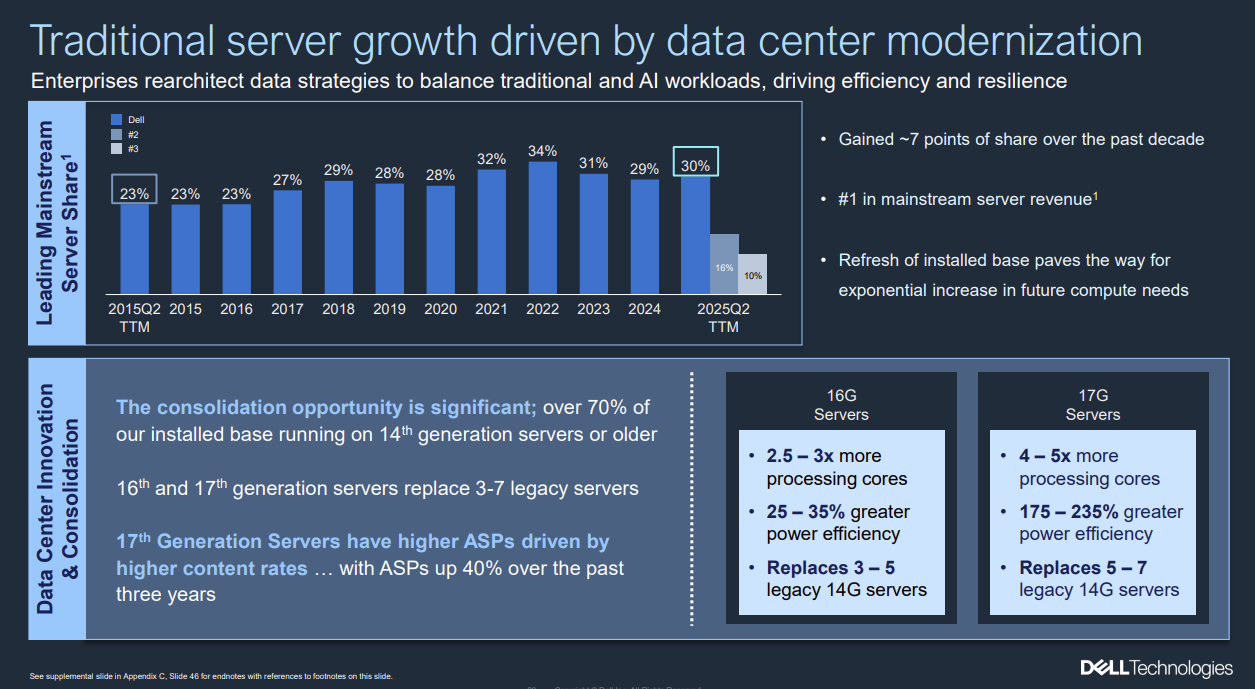
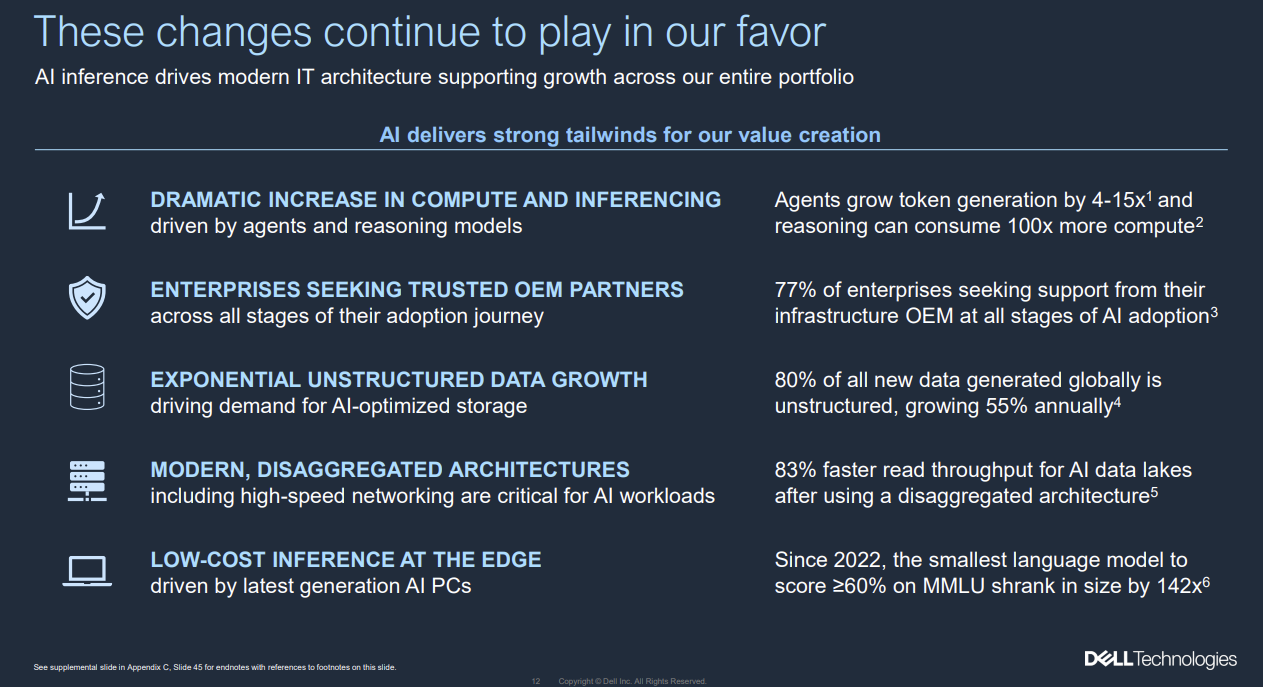
The story for Dell remains the same: Strong demand for AI systems and adjacent hardware.

Jeff Clarke, chief operating officer of Dell, said the company shipped $10 billion in AI systems in the first half of fiscal 2026 and topped all shipments in fiscal 2025. Clarke said "demand for our AI solutions continues to be exceptional, and we’re raising our AI server shipment guidance for FY26 to $20 billion dollars."

Dell delivered record revenue in servers and networking. The company's infrastructure solutions group (ISG) delivered revenue of $16.8 billion, up 44% from a year ago. Server and networking revenue was $12.9 billion, up 69%. Operating income for ISG was $1.5 billion.

The PC business for Dell remains an issue. Dell's client solutions group revenue in the second quarter was $12.5 billion, up 1% from a year ago. Commercial revenue was up 2% and consumer revenue was down 7%. Operating income was $803 million.

As for Dell's outlook, the company projected third quarter revenue of $26.5 billion and $27.5 billion, up 11% from a year ago, with non-GAAP earnings of $2.45 a share. Fiscal 2026 revenue is expected to be between $105 billion and $109 billion, up 12% from a year ago at the midpoint. Non-GAAP earnings for the fiscal year is expected to be $9.55 a share.

In prepared remarks, Clarke noted the following:

  • "We booked $5.6 billion in orders in the second quarter and shipped a record $8.2 billion, resulting in an ending backlog of $11.7 billion."
  • "Our five quarter pipeline continued to grow sequentially, with double digit growth across enterprise and sovereign opportunities."
  • "We are seeing strong Enterprise interest in our new Nvidia RTX Pro 6000 AI Factory solutions."
  • "We expect moderate growth as the PC refresh continues, driven by an aging installed base and the Windows 10 end-of-life, which is now 48 days away. To fully seize the refresh opportunity, we’ve taken steps to improve execution and expand our PC TAM."

Constellation Research analyst Holger Mueller said:

"If an enterprise needs to run on premises, it's really down to two options with Dell and HPE. Those two are slowly but steadily outgrowing other competitors. AI is also the big sales point for Dell for on-premises servers, not surprisingly its strongest segment. Growing AI systems revenue from zero in the first half of 2024 to a projected $20 billion in fiscal 2026 is an accomplishment. It is clear that Dell customers are replacing traditional servers with AI servers."

Data to Decisions Tech Optimization dell Big Data Chief Information Officer Chief Technology Officer Chief Information Security Officer Chief Data Officer