


The road to AI Exponential will be bumpy
Companies that are AI native are likely to deliver better returns, run autonomously and thread the needle between human and digital labor. The catch? Getting to that AI native status isn't going to be easy.
Constellation Research CEO Ray Wang outlined an AI maturity model that ranges from AI Luddites to AI Exponentials.
The five levels look like this:
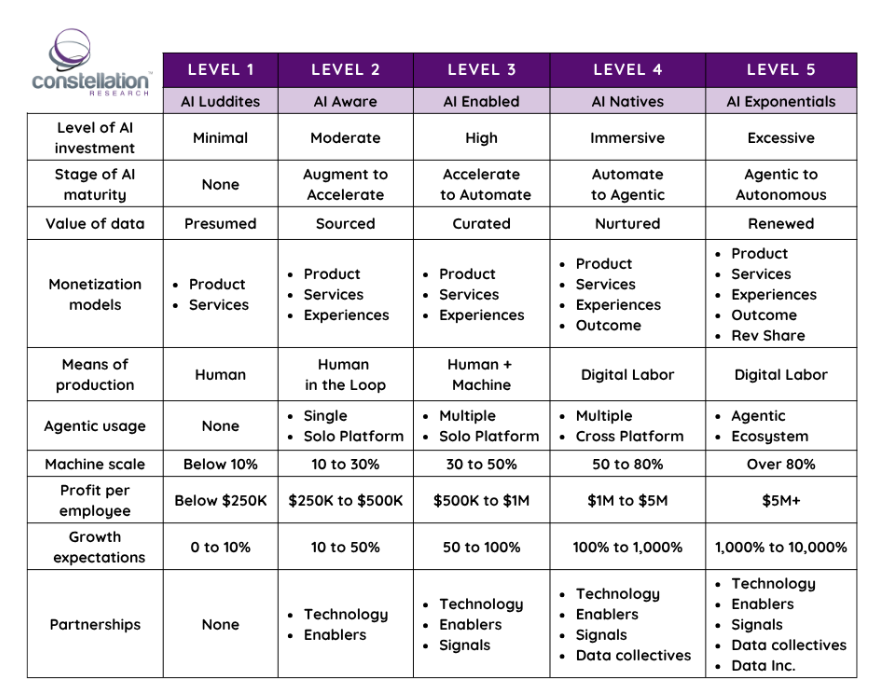
Most companies are trying to get to AI native and that aspiration will lead to a lot of IT spending. The reality is that many companies are going to be AI enabled and way more efficient than they are today.
AI Natives are going to be largely digital and autonomous with heady growth figures. AI Exponentials probably don't exist today, but there will be a few.
Get Constellation Insights newsletter
For most the journey starts with the chase to be AI Native. Wang wrote: "While at first this may sound like more AI hyperbole, the early indications for organizations who begin their journey as AI Natives by design show a tremendous advantage versus the AI Enabled who have to reduce their legacy technology, cultural, and financial debt."
Given that framework, I went on a quick tour of enterprises reporting results in recent weeks. Here's a look at a few household names and where they land in the matrix.
Marriott: AI Aware
Marriott CEO Anthony Capuano said the company has a multi-year transformation plan that revolves around its three main systems: Loyalty, property management and central reservations.
"We expect to start deploying the new cloud-based central reservations, PMS (property management system) in the U.S. and Canada select service hotels later this year," said Capuano. "It should make the experience for our guests, both on property and when they're engaging with our customer engagement centers, much more seamless, much more efficient."
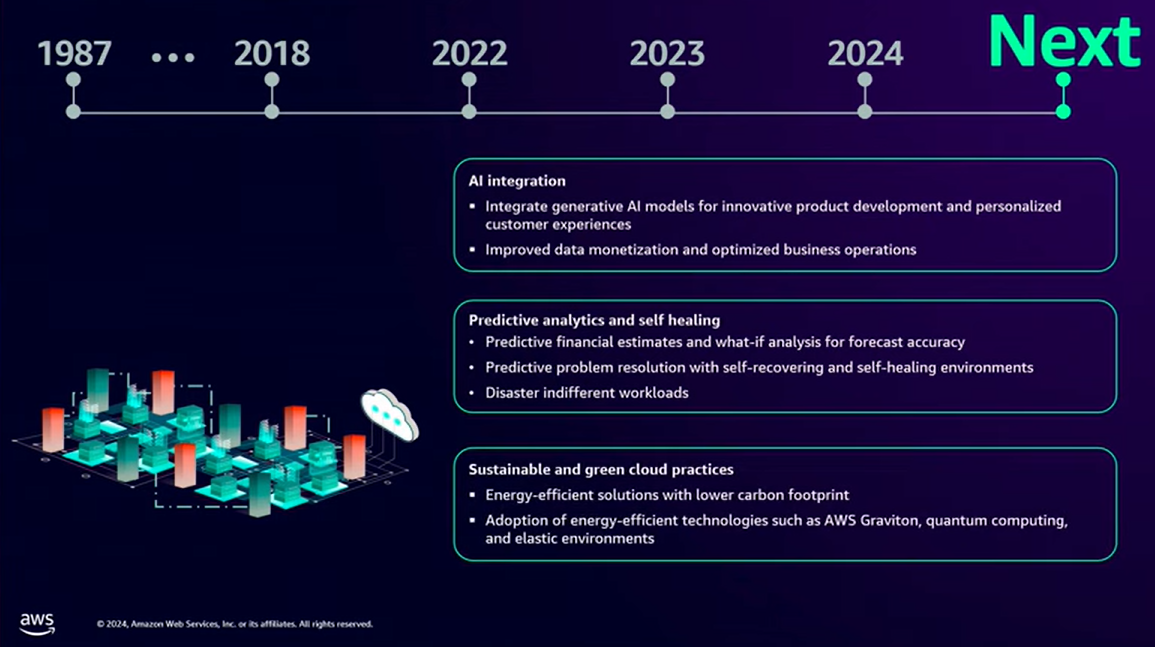
That transformation, built on AWS, is designed to make Marriott more agile and ready for AI. Marriott has also set up a team focused on AI. "We have stood up a Marriott AI incubator that is working on a variety of proof of concepts," said Capuano. "Some of those early proof of concepts were in areas like reimagining the concierge function where we think there's a real opportunity to take advantage. We're also looking at pilots in our customer engagement centers to help those agents navigate such a broad and diverse portfolio."
Marriott has incorporated AI into the Marriott Homes and Villas platform and launched an ambassador trip planning tool. At AWS re:Invent 2024, Adnan Haq, Managing Vice President of Cloud, DevSecOps and Infra Platforms at Marriott, said the company started its cloud transformation in 2022 to create a differentiated guest experience with AI, integrate digital experiences, drive revenue with customized promotions and offers and move faster.
Wayfair: AI Aware to AI Enabled
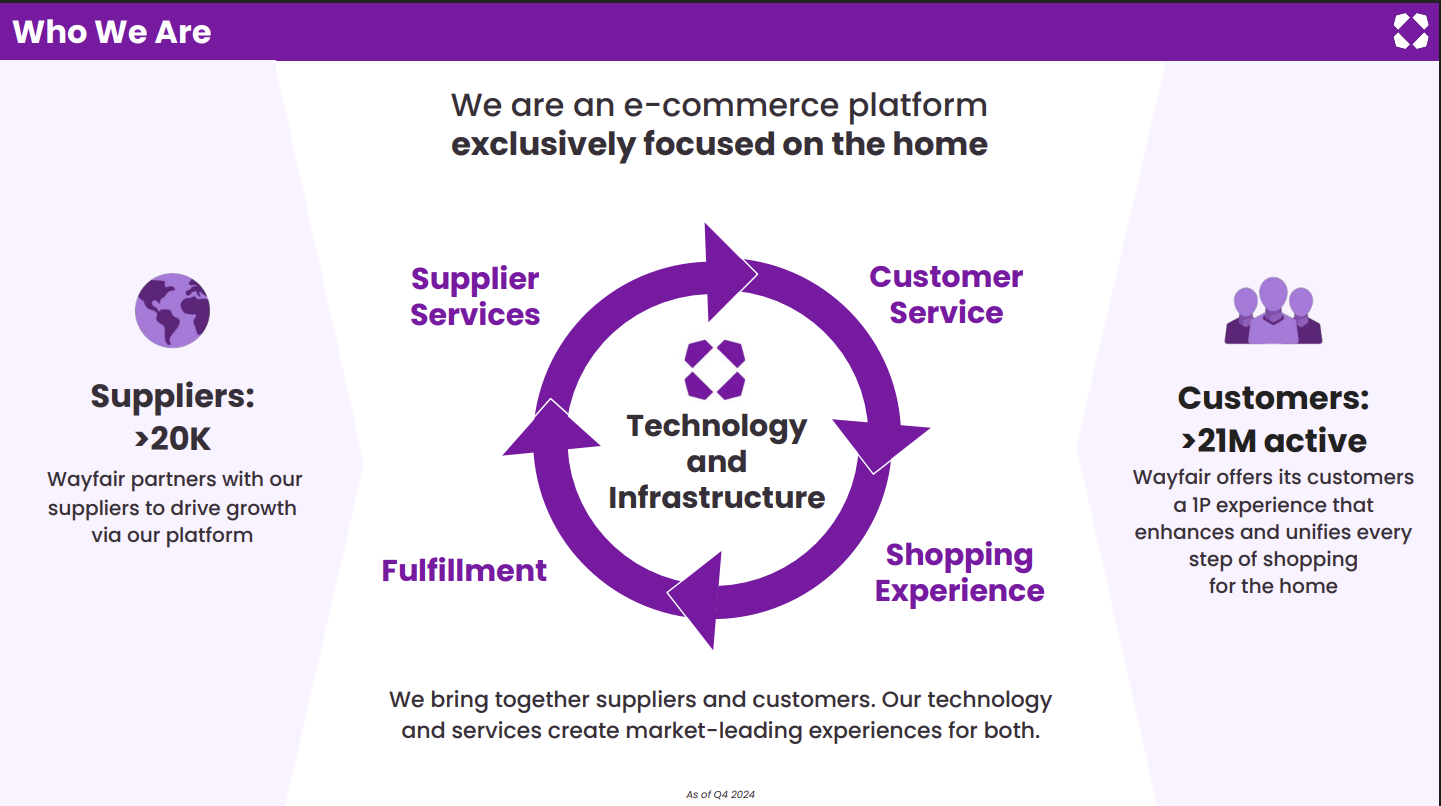
Wayfair, which reported earnings this week, has moved to Google Cloud and is starting to reap the rewards with a strong second quarter despite a sluggish home market.
Niraj Shah, CEO of Wayfair, said the company now is in a position to grow and take market share.
Shah said that Wayfair has a 2,500 person technology organization that has been focused on the replatforming of core systems to Google Cloud. Now that migration is complete, that team is focused on increasing product velocity and innovation.
"Now that we're very far into that replatforming effort, a lot of the cycles of the team are now back building features and functions to improve the customer experience and supplier experience," said Shah. "And you see that affect things, whether it's conversion rates, enabling suppliers to do more, launching new genAI-powered features and delivering efficiency gains in our operations."
Intuit: AI Enabled aiming for AI Native
Intuit has been setting itself up well for each technology inflection point. Before AI, Intuit focused on honing its data game and creating the flywheel that connected its platform to customer experience.
Those data efforts, which included a strong cloud game, enabled Intuit to take advantage of generative AI early.
Now Intuit is well on the way to leveraging AI agents. At AWS Summit New York, the company outlined some of its agentic AI plans. It's early in Intuit's AI agent plans, but the focus is on driving returns and cash flow improvements for customers and ultimately the company.
- Intuit embraces LLM choice for multiple use cases
- Intuit sees 'green shoots' from its generative AI strategy
- Intuit’s bets on data, AI, AWS pay off ahead of generative AI transformation
Airbnb: AI Enabled aiming for AI Native
Airbnb CEO Brian Chesky made it really easy to categorize his company. Speaking on a second quarter earnings call, Chesky outlined a retooled tech stack, expanded product and feature cadence and AI strategy that revolves around making its app AI native.
Chesky said Airbnb will become an AI-native app. He said today, the top 50 applications on Apple's App Store aren't AI native. ChatGPT is the top app with a few other AI natives, but for the most part the top players are not AI-native.
He said:
"You've got basically AI apps and kind of non-AI native apps. And Airbnb would be a non- AI native application. Over the next couple of years, I believe that every one of those top 50 slots will be AI apps--either start-ups or incumbents that transform into being AI native apps. And I think at Airbnb, we are going through that process right now of transitioning from a pre- generative AI app to an AI native app. We're starting to customer service. We're bringing into travel planning. So it's really setting the stage."
Uber: AI Native
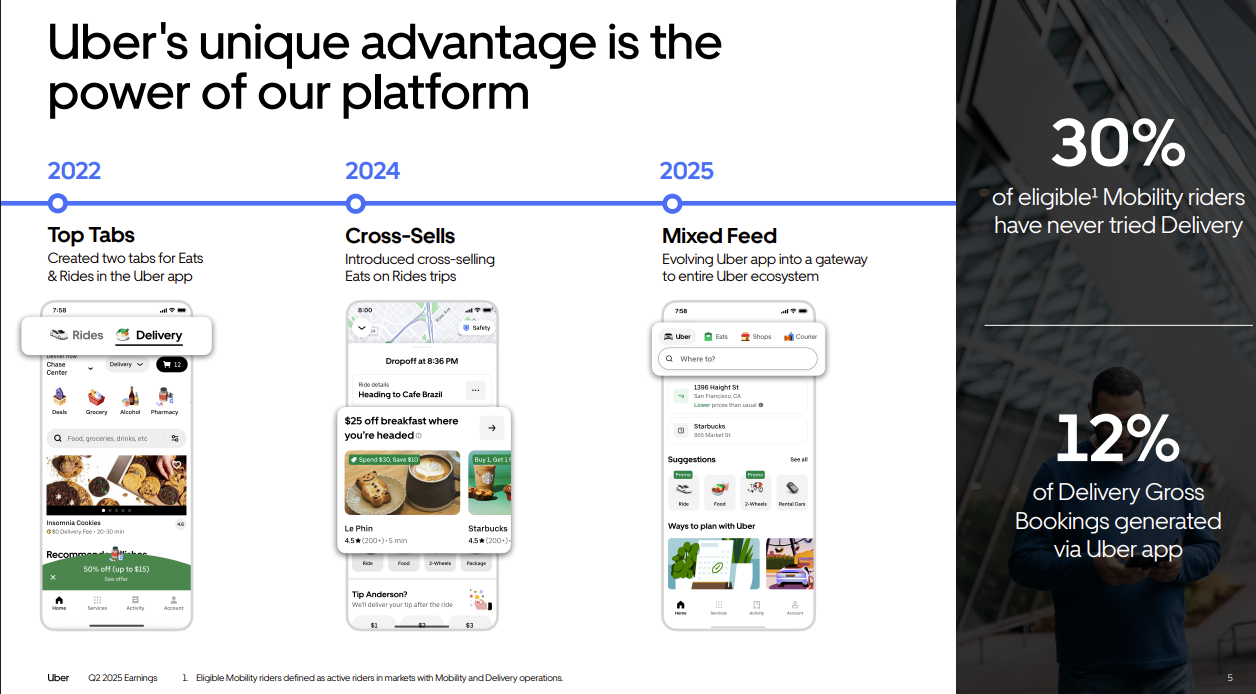
Uber was using machine learning and AI before it was the big thing. Now the company is using its models to drive interaction between its mobility and delivery services.
Speaking on Uber's second quarter earnings call, CEO Dara Khosrowshahi said Uber is using larger models that can take contacts from a consumer, history and seasonality to send promotions at the right time. With its models, Uber has extended into advertising and other additional businesses.
"Larger and more sophisticated AI models are also improving our ability to encourage cross-platform activity for the right consumers at the right time—for instance grabbing coffee on your way to the office, or having your groceries delivered right as you arrive at your vacation rental. This is a key focus area that’s still in its early innings, and you will continue to see us innovate in both the Uber and Uber Eats apps to supercharge cross-platform activity," said Khosrowshahi.
Uber is also pondering a super app that will combine its services and build on top of the platform.
And by the way, Uber is offering its own AI services on its platform. In addition, Uber's data flywheel will also play a big role in autonomous vehicle and the AI models behind them.
Maybe everything should be a holding company
Over time, most leading enterprises will become AI native. In fact, many of the category leaders are well on the way there.
However, the AI exponential companies--which will operate 80% of the business by machine and generate more than $5 million in profit per employee--are going to have to start from scratch. These companies are lean and mean and frankly may never get beyond 10 employees.
Simply put, a legacy company with a thriving business isn't going to cut and transform its way to the growth of AI exponentials. It's quite possible that every category leader will be a holding company to stand up companies that could become AI exponentials. Think Alphabet and Waymo. Given you can start a company today that's saddled with tech debt and legacy infrastructure after six months it may be better to invest in AI exponentials than transform into one.
Larry Dignan is Editor in Chief of Constellation Insights at Constellation Research, where he leads editorial coverage focused on enterprise technology, digital transformation, and emerging trends shaping the future of business. He oversees research-driven news, analysis, interviews, and event coverage designed to help technology buyers and vendors navigate complex markets with clarity and context. ...
Read morePublished
Author
