Results

Broadcom pitches VMware Cloud Foundation 9 as the future, but rivals eye disgruntled customers

Broadcom CEO Hock Tan said enterprises can bet on VMware's platform for on-premises AI workloads as well as private cloud. But the competition is only going to increase as rivals aim to poach VMware customers.

Tan's talk landed as VMware held its Explore conference. Given Broadcom's business is being driven by custom AI processors it's easy to overlook the VMware acquisition. Despite intense competition from Microsoft, HPE, hyperscalers and Nutanix to name a few, Broadcom has delivered on what it said it would do with VMware.

Broadcom's plan was to simplify pricing, focus on VMware Cloud Foundation (VCF) and large enterprises.

Tan said:

"Most of you continue to be weighed down by your legacy infrastructure, and you're afraid to move forward. How do you let go of your IT path so you can build for the future?

Well, I can tell you for sure, the answer is not to run straight to public cloud as you did 5, 10 years ago. If you're going to do cloud, do it right, embrace VCF 9.0 and stay on-prem. That VCF 9.0 is the culmination of 25 years of VMware technology and innovation. And this is the platform for the future."

At VMware Explore, the company announced the following:

It remains to see if Tan's wooing of enterprises will pay off. It does appear that VMware has battled back vs. the competition either by favorable pricing or technology roadmap. Tan's biggest argument is that Broadcom has delivered on its promises.

"Since the acquisition two years ago, we rolled up our sleeves, did the tough engineering work and the result today is VMware Cloud Foundation 9.0, a real software-defined platform to run all your application workloads with compute, networking and storage tightly integrated," he said. "We deliver VCF as a single SKU. We made it plug and play. And with VCF 9.0, just want you to know, private cloud now outperforms public cloud."

The Explore keynote also featured a heavy dose of customers including Barclays and Grinnell Mutual that modernized on VCF. "With VCF, it's really allowing my small team to extract maximum value from a really cohesive set of tools. And that unifying software, it extends to that pain point that exists between infrastructure and developers," said Jeremy Wright, Director of IT Infrastructure, Grinnell Mutual.

Not so fast, say rivals

Tan's argument that VCF 9.0 is your future isn't going to give pause to rivals. Just ahead of the Explore keynote, Microsoft launched a VM Conversion tool that makes it easy to convert VMware to Windows Server and Hyper-V.

Before that Microsoft announcement, Platform9 launched a tool to migrate entire VMware vSphere clusters.

In May, AWS launched AWS Transform for VMware all designed to migrate VMware customers. Now generally available, AWS Transform for VMware is just getting traction.

And Nutanix's second quarter earnings call featured its usual batch of VMware questions. CEO Rajiv Ramaswami said Nutanix is taking workloads from VMware, but it's a long game. He said:

"I think the vast majority of the opportunity is still in front of us. And if you were to characterize this as a multi- inning baseball game, I'd probably say we're in the second inning at this point. The fact we've added 2,700 customers over the last year is a good sign that there are people moving. But there's 200,000 customers out there for VMware.

It's going to take time. And for the bigger customers, it's going to take even longer. The real big ones out there will take a long time to migrate. The smaller you are, the faster it is to migrate. The longer you are -- the bigger you are, the longer it's going to take."

Tech Optimization vmware Chief Information Officer

Snowflake Q2 earnings strong with revenue growth of 32%

Snowflake delivered strong second quarter earnings as its AI Data Cloud gains traction.

The company reported a GAAP second quarter net loss of $298 million, or 89 cents a share, on revenue of $1.144 billion, up 32% from a year ago. Snowflake reported second quarter non-GAAP earnings of 35 cents a share.

Wall Street was expecting Snowflake to report second quarter non-GAAP earnings of 27 cents a share on revenue of $1.09 billion.

Snowflake said it has 654 customers with trailing 12-month product revenue greater than $1 million. Product revenue in the second quarter was $1.09 billion.

Sridhar Ramaswamy, CEO of Snowflake, said the company is executing well and “thousands of customers are betting their business on Snowflake and more than 6,100 accounts are using Snowflake’s AI every week.“

Nevertheless, Snowflake is valued at about $65 billion by the public markets compared to Databricks' $100 billion private market valuation

As for the outlook, Snowflake projected product revenue in the third quarter of $1.125 billion and $1.13 billion, up 25% to 26%. Operating income margin will be 9% on a non-GAAP basis.

For fiscal 2026, Snowflake projected product revenue of $4.395 billion, up 27% from a year ago.

On an earnings call, Snowflake cited BlackRock, Cambia Medicare, Thomson Reuters and Duck Creek Technologies as customers.

Ramaswamy said the following on the earnings call:

  • "In the first half of the year alone, we launched approximately 250 capabilities to general availability, demonstrating both the pace of our innovation and the breadth of our platform expansion. But we aren't stopping there. As we innovate, we are continuing to strengthen our platform and help our customers do more with their data to deliver great business outcomes."
  • "We are continuing to see strong adoption of open data formats, especially truly open modern table formats like Apache Iceberg. We now have over 1,200 accounts using Iceberg."
  • "There is more and more recognition that the AI components of our data platform can deliver enormous value. And we are seeing budgets get allocated from large customers for AI projects."
  • "I think there is honestly years of work ahead in terms of the value that we can get from AI. The models have advanced so much that I think just effectively using them in all of the workflows that matter to enterprises is going to create enormous value for all of us."

Data to Decisions snowflake AI ML Machine Learning LLMs Agentic AI Generative AI Robotics Analytics Automation Cloud SaaS PaaS IaaS Quantum Computing Digital Transformation Disruptive Technology Enterprise IT Enterprise Acceleration Enterprise Software Next Gen Apps IoT Blockchain CRM ERP CCaaS UCaaS Collaboration Enterprise Service developer Metaverse VR Healthcare Supply Chain Leadership Chief Information Officer Chief Technology Officer Chief Information Security Officer Chief Data Officer

Nvidia delivers strong Q2, rides data center demand, but China a wild card

Nvidia reported better-than-expected second quarter results and said revenue for the third quarter will be about $54 billion. Nvidia recorded no sales of its H20 processors in China in the second quarter and doesn’t assume any shipments in the third quarter.

The AI chip giant reported second quarter earnings of $26.42 billion, or $1.08 a share, on revenue of $46.74 billion, up 56% from a year ago and up 6% sequentially. Non-GAAP earnings were $1.05 a share.

Wall Street was expecting Nvidia to report second quarter non-GAAP earnings of $1.01 a share on revenue of $46.13 billion.

Simply put, there is a lot of noise around Nvidia results given China sales, US government headlines and talk of an AI bubble.

Key takeaways:

  • Nvidia released $180 million or previously reserved H20 inventory from $650 million unrestricted H20 sales to a customer outside of China.
  • CEO Jensen Huang said, “production of Blackwell Ultra is ramping at full speed, and demand is extraordinary.”
  • The company approved an additional $60 billion in its stock repurchase program.
  • Data center revenue was $41.1 billion, up 56% from a year ago.
  • Second quarter gaming revenue was $4.3 billion, up 49% from a year ago.
  • Professional visualization revenue as $601 million, up 32% from a year ago.
  • Automotive and robotics revenue was $586 million, up 69% from a year ago.
  • Networking revenue was $7.3 billion, up 98% from a year ago.
  • Hyperscale cloud providers drove 50% of data center revenue. 
  • Data center revenue was a bit lighter than estimates.
  • Inventory was $15.0 billion, up from $11.3 billion sequentially, to support the ramp of Blackwell Ultra.

As for the outlook, Nvidia projected third quarter revenue of $54 billion with non-GAAP gross margins of 73.3% to 73.5%.

CFO Colette Kress said in prepared remarks.

Data center growth was “driven by demand for our accelerated computing platform used for large language models, recommendation engines, and generative and agentic AI applications. We continue to ramp our Blackwell architecture, which grew 17% sequentially, including our newest architecture, Blackwell Ultra.”

Constellation Research analyst Holger Mueller said:

"Nothing seems to be able to slow down Nvidia, which reported record revenue in each of their segments, with 'very little brother' gaming topping $4 billion in revenue. Closer to the data center, networking revenue practically doubled, and is now 1/7th of data center revenue. Headwinds are not foreseeable for the short term future - as Nvidia braved the China/H20 challenge. Things keep looking up for Nvidia." 

On a conference call, Kress said:

  • "The transition to the GB300 has been seamless for major cloud service providers due to its shared architecture, software and physical footprint with the GB200 enabling them to build and deploy GB300 racks with ease."
  • "Factory builds in late July and early August were successfully converted to support the GB300 ramp, and today, full production is underway. The current run rate is back at full speed, producing approximately 1,000 racks per week."
  • "Rubin remains on schedule for volume production next year."
  • "We have not included H20 in our Q3 outlook as we continue to work through geopolitical issues. If geopolitical issues recede, we should ship $2 billion to $5 billion in H20 revenue in Q3 and if we had more orders, we can build more."
  • "The market for AI inference is expanding rapidly with reasoning and agentic AI, gaining traction across industries."
  • "We are on track to achieve over $20 billion in sovereign AI revenue this year, more than double than that of last year."

Huang's mission on the conference call was to allay concerns that the easy money has been made. He said the following:

  • "The amount of computation that is that has resulted in agentic AI has grown tremendously. And of course, the effectiveness has also grown tremendously because of agentic AI."
  • "Enterprises have been opened up as a result of agentic AI and vision language models. We now are seeing a breakthrough in physical AI, in robotics, autonomous systems. So the last year, AI has made tremendous progress and agentic systems, reasoning systems, is completely revolutionary."
  • "The last couple of years, you have seen that capex has grown in just the top four CSPs by has doubled and grown to about $600 billion so we're in the beginning of this build out."
  • "We're in every cloud for a good reason. Not only are we the most energy efficient, our perf per watt is the best of any computing platform, and in a world of power limited data centers, perf per watt drives directly to revenues."
  • "About 50% of the world's AI researchers are in China. The vast majority of the leading open source models are created in China. And so it's fairly important, I think, for the American technology companies to be able to address that market. And open source, as you know, is created in one country, but it's used all over the world. The open source models have come out of China."
Data to Decisions Tech Optimization Innovation & Product-led Growth nvidia Big Data Chief Information Officer Chief Technology Officer Chief Information Security Officer Chief Data Officer

CrowdStrike acquires Onum, reports strong Q2

CrowdStrike said it will acquire Onum, a company that specializes in real-time telemetry data pipelines, in a move that will bring more data into the cybersecurity vendor’s platform.

CEO George Kurtz said Onum “is both a pipeline and a filter, which will stream high-quality, filtered data directly into the platform to drive autonomous cybersecurity at scale.” Onum data will be folded into CrowdStrike’s Falcon Next-Gen SIEM.

The company also reported second quarter results. CrowdStrike reported a second quarter net loss of $77.7 million, or 31 cents per share, on revenue of $1.17 billion, up 21% from a year ago. Non-GAAP earnings in the quarter checked in at 93 cents a share.

Wall Street was looking for second quarter non-GAAP earnings of 83 cents a share on revenue of $1.15 billion.

CrowdStrike’s quarter landed following a strong outlook from Palo Alto Networks, which also recently said it would acquire CyberArk for $25 billion.

As for the outlook, CrowdStrike projected third quarter revenue between $1.208 billion and $1.218 billion with non-GAAP earnings of 93 cents a share to 95 cents a share. For fiscal 2026, CrowdStrike is projecting revenue between $4.75 billion and $4.8 billion with non-GAAP earnings of $3.60 a share to $3.72 a share.

CrowdStrike CEO George Kurtz on a conference call said AI is complicating the cybersecurity landscape even as it leads to opportunities.

Kurtz said:

"In cybersecurity as well as the broader technology market, AI's impact is palpable. As organizations of all sizes embrace AI transformation, I hear several thematic concerns from executives and Boards. One, where is shadow AI emerging in my business? Two, how do I control what data enters AI systems? Three, how do I control what AI systems can do in my enterprise? Which ultimately leads to the focal question of four, how do I secure AI agents? AI has made the role of CISOs and CIOs more complicated than ever.

CrowdStrike's role in the agentic era is staying ahead of AI-armed threat actors to secure AI at every layer. Beginning with the AI model itself to the workloads and hosts on which they run to the actual human and agentic identities, to the end-user devices accessing these systems and applications."

Kurtz also outlined the reasoning behind the Onum purchase and the company's goal to use it to secure every stage of the AI life cycle.

"Onum will bring Falcon's AI-powered detections closer to third-party data sources in pipeline, starting analysis before data even enters the Falcon platform. Here's why Onum stood out to us. One, speed. Onum delivers 5x more events per second than its nearest competitor and processes data in real-time versus legacy batch and store methods. Two cost. Onum's smart filtering reduces data storage costs by 50%. Three, superior outcomes. Onum's real-time pipeline detection starts before data enters the Falcon platform, delivering up to 70% faster incident response with 40% less ingestion overhead."

Other takeaways from Kurtz:

  • The company had more than 1,000 Falcon Flex customers with the average Flex customer representing more than $1 million of annual recurring revenue.
  • "I think a big part of it is going to be the AI story of understanding how all these interdependencies work in the build environments, in code and obviously, in sort of these interactions with MCP-type services. So this is something that we continue to invest in this area."
  • "Customers are in the early journey of how they leverage AI. And it's moving from, hey, this is really a cool technology to how do we implement it and implement it securely and do it in a way that actually accrues value back to the business. If we believe in AI, and we think there's going to be more AI in the future, in the next year, 3 or 5 years, then security is a necessity. You're not going to have more AI without security."

Data to Decisions Innovation & Product-led Growth Future of Work Tech Optimization Next-Generation Customer Experience Digital Safety, Privacy & Cybersecurity crowdstrike AI GenerativeAI ML Machine Learning LLMs Agentic AI Analytics Automation Disruptive Technology cybersecurity Chief Revenue Officer Chief Information Security Officer Chief Privacy Officer Chief AI Officer Chief Experience Officer

Anthropic: Vibe hacking and weaponizing agentic AI

Anthropic released a threat intelligence report that introduces "vibe hacking" and a bevy of other examples where criminals weaponized agentic AI.

In a blog post, Anthropic outlined how Claude has been misused including extortion, ransomware and vibe hacking. To its credit, Anthropic has developed defenses, but even the best perimeters get tested and thwarted.

By penning its threat intelligence report, Anthropic is winning enterprise credibility with the transparency. Nevertheless, the attacks and threat actors are a little jarring. In short, agentic AI has lowered the bar for cybercrime and criminals are weaponizing AI for profiling, data analysis, stealing and creating false identities.

Here's a look at some of the more interesting items in Anthropic's report.

Meet vibe hacking. Anthropic said it thwarted a cybercriminal that used Claude Code to steal personal data targeting 17 organizations. The hacker said it would expose the data to extort victims into paying ransoms topping $500,000.

Claude Code was used for automation, harvesting credentials and penetrating networks.

No-code ransomware as a service. In this case, Claude was used to develop, market and distribute ransomware including evasion capabilities.

Chinese and North Korean threat actors used Claude for various attacks and to enhance operations. North Korea used Claude to distribute malware and land fraudulent IT jobs. A Chinese threat actor used Claude to attack infrastructure in Vietnam.

The full report has in-depth case studies and are worth the read.

Data to Decisions Digital Safety, Privacy & Cybersecurity Chief Information Officer

AI Bubble, Agentic Strategy, Revenue Intelligence | ConstellationTV Episode 112

Is enterprise tech in an AI bubble, or are we finally seeing real value? In our latest episode, co-hosts Martin Schneider and Larry Dignan talk enterprise tech news, including breaking down the hype vs. reality in AI and Salesforce’s AgentForce strategy.

Next, an exclusive interview with Raju Malhotra, Chief Product & Technology Officer at Certinia. He shares best practices for building effective #aiagents and a vision for the future of hybrid human-agent workforces.

Finally, Martin shares insights from his new “Big Idea” report on why it’s time to rethink expansion revenue and how agentic AI is transforming customer engagement.

00:00 - Introduction
00:29 - Enterprise News
11:00 - Interview with Certinia (Raju Malhotra):  
22:44 - Martin's Big Idea Report 
27:55 - Bloopers!

Watch now and subscribe to Constellation Research's YouTube channel for consistent enterprise tech insights!

Data to Decisions Digital Safety, Privacy & Cybersecurity Future of Work Innovation & Product-led Growth Marketing Transformation Matrix Commerce New C-Suite Next-Generation Customer Experience Tech Optimization Chief Analytics Officer Chief Customer Officer Chief Data Officer Chief Digital Officer Chief Executive Officer Chief Financial Officer Chief Information Officer Chief Information Security Officer Chief Marketing Officer Chief People Officer Chief Privacy Officer Chief Procurement Officer Chief Product Officer Chief Revenue Officer Chief Supply Chain Officer Chief Sustainability Officer Chief Technology Officer On ConstellationTV <iframe width="560" height="315" src="https://www.youtube.com/embed/_PwGZyKWk3E?si=2msAF-uIIm3iGtHe" title="YouTube video player" frameborder="0" allow="accelerometer; autoplay; clipboard-write; encrypted-media; gyroscope; picture-in-picture; web-share" referrerpolicy="strict-origin-when-cross-origin" allowfullscreen></iframe>

ShortList Spotlight: Amplitude, Leading Marketing Analytics Solutions

Marketing analytics has evolved from simple measurement to driving real-time action and growth. 📈 Today’s tools don’t just report results—they help us understand WHY and empower us to act, often with the help of AI and automation. In the clip below, Constellation analyst Liz Miller highlights one standout tool from her Marketing Analytics Solutions ShortList: Amplitude.

Liz explains how Amplitude doesn't just track digital product performance, but connects the dots across campaigns, experiences, and outcomes—helping marketers and product teams work smarter, together.

💡 Curious about the full ShortList of top marketing analytics solutions? Check it out at https://lnkd.in/ezbjRdQ9.

Marketing Transformation Next-Generation Customer Experience Chief Marketing Officer On ShortList Spotlights <iframe width="560" height="315" src="https://www.youtube.com/embed/sYFCcMytm40?si=9Fj8nYMAbBzeLUk_" title="YouTube video player" frameborder="0" allow="accelerometer; autoplay; clipboard-write; encrypted-media; gyroscope; picture-in-picture; web-share" referrerpolicy="strict-origin-when-cross-origin" allowfullscreen></iframe>

Boxs preps no-code tools, aims for content workflow automation after strong Q2

Box is planning to launch new workflow and no-code app tools for customers looking to automate processes around their unstructured content in the second half.

The launches, which will be outlined at BoxWorks 2025 Sept. 11 and Sept. 12, highlight how Box is looking to meld its content management platform with AI agents and multiple business processes. Box CEO Aaron Levie on the company's second quarter earnings conference call said "we have quite the road map in store for the second half of the year."

Levie said new AI features are on tap for Box Notes, Box Hubs will be enhanced and there will be "all new core Box AI experiences to make it easy for customers to interact with AI agents and find information across their Box accounts."

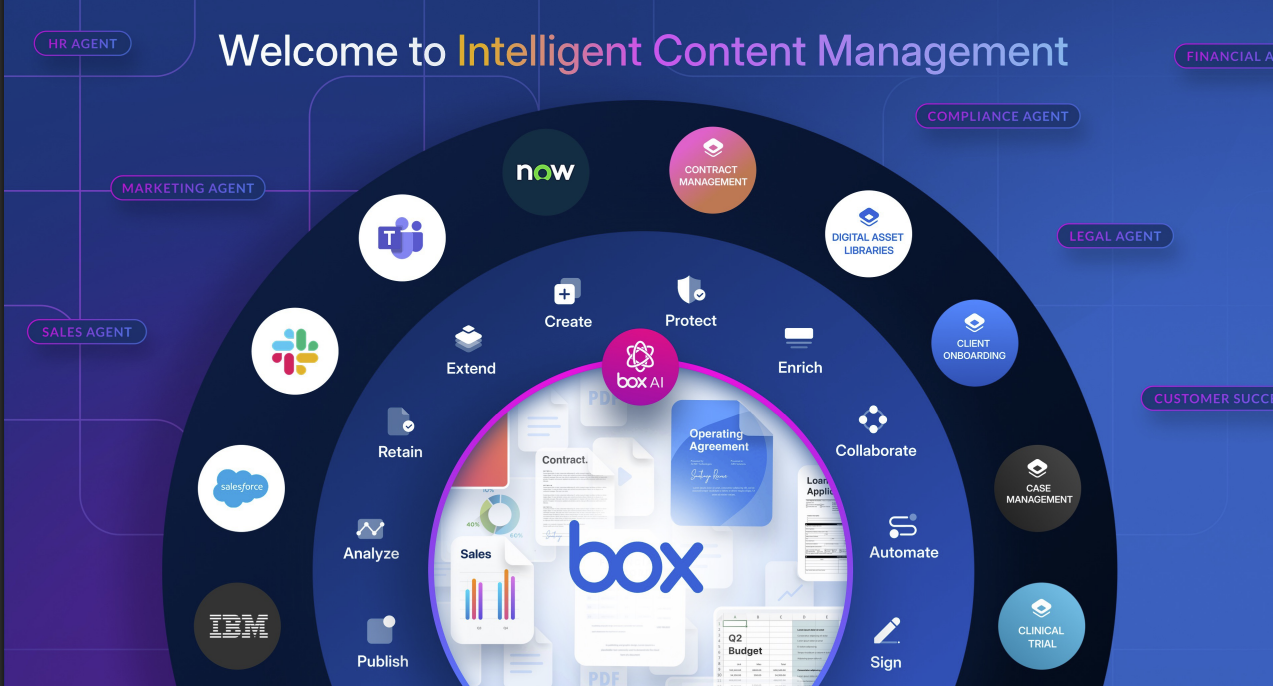
Box has integrated with multiple models and enterprise platforms. The goal is to put Box in the middle of managing business processes whether it's automating work with contracts, digital assets, leases or research.

"With AI agents operating on unstructured data, enterprises can now accelerate product development processes, automate end-to-end hiring and training workflows, surface insights and automate clinical studies and speed up loan applications for better client engagement," said Levie.

Box is looking to position itself for a day where there are more AI agents than people running in the background and developing workflows around content.

With a bevy of integrations and updates to Box AI including tools to admin console improvements, a Box MCP server in beta, Box AI Studio and AI units, Levie is betting that his company can be an enabler for agentic AI.

To that end, Box is landing more adoption for its Enterprise Advanced plans, which include the full set of Box AI tools. Metadata extraction features and the ability to automate workflows are key selling points for Enterprise Advanced, which was rolled out in January.

Box also named Jeff Newsom as Chief Revenue Officer. Newsom was most recently at Google Cloud and Oracle, SAP and Workday before that.

Box's second quarter performance

The comments about the second half roadmap for Box landed as the company delivered better-than-expected financial results.

Box reported second quarter earnings of 5 cents a share on revenue of $294 million, up 9% from a year ago. Non-GAAP earnings of 33 cents a share were ahead of Wall Street estimates of 31 cents a share.

Remaining performance obligations (RPO) checked in at $1.5 billion, up 16%.

As for the outlook, Box said third quarter revenue will be between $298 million and $299 million, up 8% from a year ago. Non-GAAP earnings will be between 31 cents a share to 32 cents a share.

For fiscal 2026, Box is projecting revenue of $1.17 billion to $1.175 billion, up 8%, with non-GAAP earnings of $1.26 a share to $1.28 a share.

Data to Decisions Future of Work box Chief Information Officer

MongoDB's Q2 shines, company raises its outlook

MongoDB's second quarter was well ahead of expectations and the company raised its outlook as its platform is landing more consumption due to AI applications.

The company reported a second quarter net loss of $47 million, or 58 cents a share, on revenue of $591.4 million, up 24% from a year ago. Non-GAAP earnings for the quarter were $1 a share.

Wall Street was expecting MongoDB to report second quarter non-GAAP earnings of 66 cents a share on revenue of $553.57 million.

Dev Ittycheria, CEO of MongoDB, said Atlas revenue was up 29% from a year ago and the company added 5,000 customers. Ittycheria said MongoDB's flexible document model, expanded database search and vector search and ability to run anywhere is landing workloads. "Many of our recently added customers are building AI applications," he said.

Key figures:

  • MongoDB has 59,900 total customers at the end of the quarter.
  • The company ended the quarter with $2.3 billion in cash, cash equivalents and short-term investments.
  • The company had 2,564 customers in the second quarter with more than $100,000 in annual recurring revenue.
  • Direct sales customers at the end of the second quarter were more than 7,300, down from more than 7,500 in the first quarter.
  • MongoDB launched new Voyage AI models in the quarter and expanded partnerships with the likes of LangChain, Temporal and Galileo.

As for the outlook, MongoDB projected third quarter revenue between $587 million to $592 million with non-GAAP earnings of 76 cents a share to 79 cents a share. For fiscal 2026, MongoDB is projecting revenue of $2.34 billion to $2.36 billion with non-GAAP earnings of $3.64 a share to $3.73 a share.

Ittycheria said the following on MongoDB's second quarter conference call:

  • MongoDB will hold its investor day Sept. 17 along with its .local conference. The key topic will be durable growth and margin expansion. 
  • "Atlas enable one of the world's largest automakers to overcome Postgres scalability and flexibility limits while reducing complexity. The company's management console tracks over 8.5 million vehicles requiring a modern schema to handle both structured and unstructured data, something Postgres could not handle. Ultimately, Atlas consolidated infrastructure, accelerated innovation and support the scale of millions of connected vehicles."
  • "Deutsche Telekom selected MongoDB Atlas as the foundation for its internal developer platform, which includes mission-critical workloads like contract management, device purchases and billing for 30 million customers. With 90 Atlas clusters managing over 60 million customer records, Deutsche Telekom's customer data platform now handles 15x the concurrent logins of legacy systems."
  • "Comparing MongoDB to another database like Postgres is not an apples-to-apples comparison. The choice is between MongoDB or Postgres plus other offerings like Pinecone, Elastic and Cohere for embeddings."
  • "DevRev, a well-funded AI-native platform with proven founders disrupting the help desk market built AgentOS, it's a complete agentic platform that autonomously handles billions of monthly requests on Atlas. DevRev accelerated development velocity, lower cost and scale globally with low latency by using Atlas. AgentOS also leverages Atlas Vector Search for semantic search enriching its knowledge graph and LLMs with domain-specific content."
  • "What we're hearing clearly from the startup community that Postgres, in many cases, is not scaling for them, and they're now coming to us. And so we feel really good about our position. But the reality is that a lot of these AI founders kind of start with what they know or what they've used in the past and only when the business starts scaling, do they start recognizing the challenges."
Data to Decisions Innovation & Product-led Growth Future of Work Tech Optimization Next-Generation Customer Experience Digital Safety, Privacy & Cybersecurity ML Machine Learning LLMs Agentic AI Generative AI Robotics AI Analytics Automation Quantum Computing Cloud Digital Transformation Disruptive Technology Enterprise IT Enterprise Acceleration Enterprise Software Next Gen Apps IoT Blockchain Leadership VR Chief Information Officer Chief Executive Officer Chief Technology Officer Chief AI Officer Chief Data Officer Chief Analytics Officer Chief Information Security Officer Chief Product Officer


Stanford study: AI is eating entry level jobs

A Stanford University study found that generative AI is eating entry level jobs for workers 22 to 25 year old. The paper, which is based on ADP data, found that early career workers in occupations exposed to genAI have seen a 13% relative decline in employment.

Some of the occupations with the biggest genAI hit included software development and customer service.

The findings aren't terribly surprising for anyone that knows a recent university graduate. It's tough sledding out there as entry level work is being automated.

Stanford researchers found that that generative AI didn't have as large of an impact among more experienced workers. The open question with AI and human labor is this: If AI takes entry level jobs what happens to the bench of workers needed to take on more complex roles?

According to researchers:

"While we find employment declines for young workers in occupations where AI primarily automates work, we find employment growth in occupations in which AI use is most augmentative. These findings are consistent with automative uses of AI substituting for labor while augmentative uses do not."

Keep that quote in mind as vendors dance around automating work and eliminating jobs to talk more about augmenting human labor.

The paper outlines six facts about genAI's impact on young workers.

  • Employment for young workers has declined in AI-exposed occupations. By July 2025, employment for software developers aged 22 to 25 declined by nearly 20% from its peak in 2022.
  • Overall employment is growing, but growth for young workers has been stagnant. AI takes some of the blame here, but researchers said other factors could be driving the lack of growth.
  • Entry level employment has declined in industries where AI is being used to automated work. If AI is being used to augment humans, the impact is muted.
  • The employment declines hold even when adjusting for other factors.
  • Employment is declining, but compensation isn't.
  • The patterns in young worker employment declines hold across multiple samples and conditions.
Data to Decisions Future of Work Innovation & Product-led Growth Chief Information Officer