Results

Broadcom delivers a strong Q3, cites custom AI chips, networking, VMware

Broadcom reported better-than-expected third quarter results and cited strong demand for custom AI accelerators, networking and VMware.

The company reported third quarter earnings of $4.14 billion, or 85 cents a share, on revenue of $15.95 billion, up 22% from a year ago. Non-GAAP earnings were $1.69 a share.

Wall Street was expecting Broadcom to report non-GAAP earnings of $1.66 a share on revenue of $15.82 billion.

CEO Hock Tan said third quarter AI revenue was $5.2 billion, up 63% from a year ago. "We expect growth in AI semiconductor revenue to accelerate to $6.2 billion in Q4, delivering eleven consecutive quarters of growth, as our customers continue to strongly invest," said Tan.

Broadcom is a design partner for Google's Tensor Processor Units. Google announced its TPUs in 2016.

In the quarter, semiconductors represented 57% of sales with revenue of $9.17 billion, up 26% from year ago. Infrastructure software was 43% of sales with revenue of $6.79 billion, up 17% from a year ago.

As for the outlook, Broadcom projected fourth quarter revenue of $17.4 billion with adjusted EBITDA at 67% of projected revenue.

On a conference call with analysts, Tan said:

  • "Demand for custom AI accelerators from our 3 customers continue to grow as each of them journeys at their own pace towards compute self-sufficiency. And progressively, we continue to gain share with these customers."
  • "We have been working with other prospects on their own AI accelerators. Last quarter, one of these prospects released production orders to Broadcom, and we have accordingly characterized them as a qualified customer for XPUs and, in fact, have secured over $10 billion of orders of AI racks based on our XPUs."
  • "We know the biggest challenge to deploying larger clusters of compute for generative AI will be in networking. And for the past 20 years, Broadcom has developed for Ethernet networking that is entirely applicable to the challenges of scale up, scale out and scale across in generative AI."
  • VMware: "First phase is convincing people to convert from perpetual subscription and so doing purchase VCF (VMware Cloud Foundation). Second phase now is make that purchase they made on VCF create the value they look for in private cloud on their premise, on their IT data center. That's what's happening. And that will sustain for quite a while because on top of that, we will start selling advanced services, security, disaster recovery, even AI, running AI workloads on it."

Constellation Research analyst Holger Mueller said:

"Broadcom is on a roll. Not only does the vendor seem to be affected the competition trying to replace VMware, but it also growing nicely with its custom AI chips. This quarter more than a third of Broadcom revenue will come from custom AI chips.  Notably these chips are desired by the cloud providers, in contrast to their initial posture towards AI giant Nvidia. Remarkably, Hock Tan and team delivered the 20% revenue growth with no increase in selling, general and administrative expenses--something very rare in technology companies. If things go well in Q4 Broadcom will have record revenue and profitability for the fiscal year."

Data to Decisions Tech Optimization vmware Chief Information Officer

ServiceNow offers US government discounts as high as 70% on ITSM

ServiceNow will give the US government discounts as high as 70% off list prices for upgrades to its Information Technology Service Management (ITSM) Pro and ITSM Pro Plus bundle.

The ServiceNow discounts, announced by the US General Services Administration, land as vendors line up to offer discounts to the US government for applications and AI services. Microsoft became just the latest vendor to give the US government a sweet deal on software. Microsoft is offering the Feds its suite of productivity, cloud and AI services including Microsoft 365 Copilot for no cost for up to 12 months.

Meanwhile, Google Cloud offered the US government discounts on Gemini and before that OpenAI and Anthropic lined up discounts. LLMs on sale: What happens when OpenAI, Anthropic offer Feds value meal pricing?

In 2025, the GSA announced agreements with AWS, DocuSign, Oracle, Elastic, Salesforce, Adobe, Google and Microsoft.

The ServiceNow discounts with the GSA also land a day after Salesforce touted government traction with Agentforce and said it would be going after the ITSM market. Key points about the GSA-ServiceNow deal include:

ITSM Pro and Pro Plus will be available at a 70% discount from the unrestricted user list price through September 2028. The bundle is designed for faster adoption of AI features.

ITSM Pro upgrade as a standalone option are available at a 40% discount off the Pro unrestricted user list price through September 2026.


Data to Decisions Future of Work servicenow Chief Information Officer

Quantinuum valued at $10 billion after $600 million venture round

Quantinuum raised $600 million in venture funding led by Nvidia's venture capital arm, Quanta Computer and QED for a valuation of $10 billion.

The quantum computing company said that existing shareholders JPMorganChase, Mitsui, Amgen, Cambridge Quantum Holdings, Serendipity Capital and Honeywell also invested in the latest venture round.

Quantinuum has been busy building out its quantum software stack and launch of Helios, its next-generation system. The company is aiming to be among the first to deliver universal fault-tolerant quantum systems.

Along with the funding, Quantinuum said it will work with Nvidia in its Accelerated Quantum Research Center.

Quantinuum has doubled its valuation since January 2024.

"Nvidia has quickly turned from a skeptical observer to an investor in quantum. With Quantinuum it covers the laser gate technology approach to quantum as it is keeping tabs on the different technology approaches," said Constellation Research analyst Holger Mueller. "One can expect Nvidia to do the same for the other platforms – and future will tell if Nvidia was able to pick the winners."

Recent Quantinuum developments include:

Data to Decisions Innovation & Product-led Growth Tech Optimization Quantum Computing Chief Information Officer

Atlassian buys The Browser Co. for $610 million

Atlassian said it will acquire the Browser Company of New York, which is the company behind the Dia and Arc browsers, in a $610 million bet that enterprises need secure browsers designed for SaaS and AI applications.

The purchase comes as browsers are seen as critical software for everything from knowledge work to agentic AI.

Atlassian said that browsers are typically built for consumers and not workers that need to get work done in sometimes dozens of tabs. Atlassian is betting that the browser can enable new collaborative workflows.

According to Atlassian CEO Mike Cannon-Brookes, the plan is to make The Browser Company's Dia the AI browser for work optimized for SaaS with security built in and personal work memory.

In a statement, Cannon-Brookes said:

"By combining The Browser Company’s passion for building beloved browsers with our two decades of understanding how knowledge workers operate, we see a huge opportunity to transform the way work gets done. Together, we'll create an AI-powered browser optimized for the many SaaS applications living in tabs."

As for distribution, Atlassian can bring Dia to its more than 300,000 customers and more than 2.3 million active users of AI on its platform.

Data to Decisions Future of Work Innovation & Product-led Growth Next-Generation Customer Experience New C-Suite Tech Optimization Chief Information Officer Chief Experience Officer

Salesforce heads into Dreamforce 2025: A look at the big themes

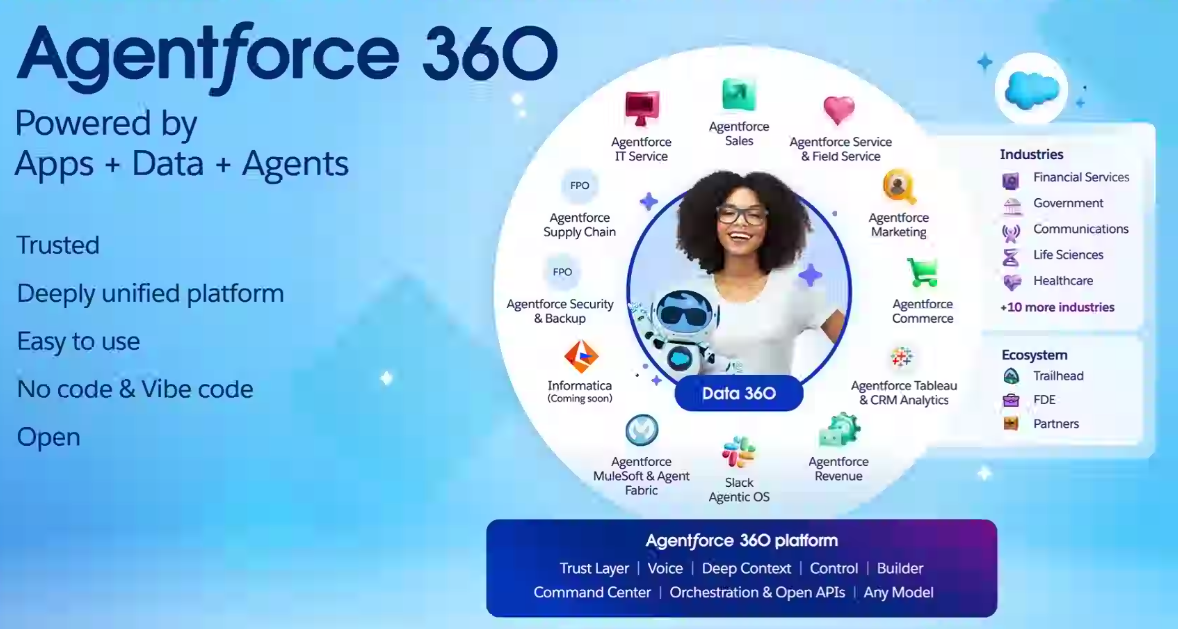
Salesforce is going to launch IT service management at Dreamforce 2025 as well as Agentforce 4, outline its take on the future of enterprise software and lay the groundwork to get from pilot to scale on agentic AI.

On Salesforce's second quarter earnings call, CEO Marc Benioff previewed the big themes that'll emerge at Dreamforce 2025 with a few tangents worth noting on the future of enterprise software. Here's a look:

Agentforce to production and scale with a hefty dose of Agentforce 4.

If Dreamforce 2024 was about how easy it is to set up an Agentforce pilot, 2025 will have to be about production and scale. Agentforce launched three quarters ago and it has 6,000 paid deals and 12,500 overall. "We've seen a 60% increase in quarter-over-quarter in customers who've gone from pilot to production and they're expanding use cases and scaling production," said Benioff.

Getting those customers to scale Agentforce and show value will be an overarching theme of Dreamforce sessions.

Srinivas Tallapragada, Salesforce's President, Chief Engineering & Customer Success Officer, said the company has been working with customers using forward deployed engineers to scale pilots. Salesforce is working with customers on "a series of tactical, practical features with a very closed-loop with our customers and hardening, deep integration with our Data Cloud and platform, really increasing the scale, and then just some engineering, customer success, cycle and the product adoption cycle."

My take: If Salesforce's growth is going to accelerate practical tools and features in Agentforce 4 will be needed. Dreamforce sessions will need to get into the weeds of data management, lessons learned so far, engineering value and best practices.

It's worth noting the Agentforce wish list, which was highlighted in a recent interview with Certinia.

Customer zero and beyond.

Salesforce will talk about customer zero a lot at Dreamforce. The idea here is to show Agentforce can scale and provide examples of how customers can implement it. Note the Benioff quotes from the second quarter earnings call:

  • "Our Sales Cloud for years has been an app that thousands or millions of salespeople use to manage their sales every single day. But now riding alongside every salesperson is an agentic salesperson. And that agentic salesperson is calling every single person back. And how that relates to Salesforce, well, let me tell you that, well, maybe somewhere between 20 million and 100 million people who have contacted Salesforce in the last 26 years haven't been called back. It's just because we didn't have enough people. But now with our new agentic sales, everybody is getting called back. It's a huge breakthrough and something that every company is going to benefit from."
  • "And in service, we've been talking about that now for months, you can see our agents are handling millions of conversations while humans are delivering the empathy and expertise."
  • "These agents are operating across apps, departments, silos, all running off of our Data Cloud, all running off of Agentforce. It's an incredible transformation of our product line, but really of our company. Not just of our company, but of our customers, too."

My take: Customer zero case studies can be handy, but lining up enterprises from multiple industries will be more imperative. It would also be good to know how many Agentforce implementations needed integrators, forward deployed engineers and other extras.

Let customers do the talking.

Benioff on the earnings conference call cited DirectTV, Under Armour, Reddit, Pandora, Williams Sonoma and others as customers adopting Agentforce. Benioff also touted a push into US government accounts such as the US Army.

Benioff quipped that his keynote should just be a dozen customers on stage talking Agentforce in his annual "rip up the script" theme. I'd say go for it.

My take: Not surprisingly, Salesforce noted Data Cloud's growth, up 140% from a year ago to become a $7 billion business. What we want to hear from Salesforce customers is whether Agentforce was scaled not using Data Cloud completely or across multiple data stores. After all, your data is never going to be in one place.

Salesforce vs. ServiceNow.

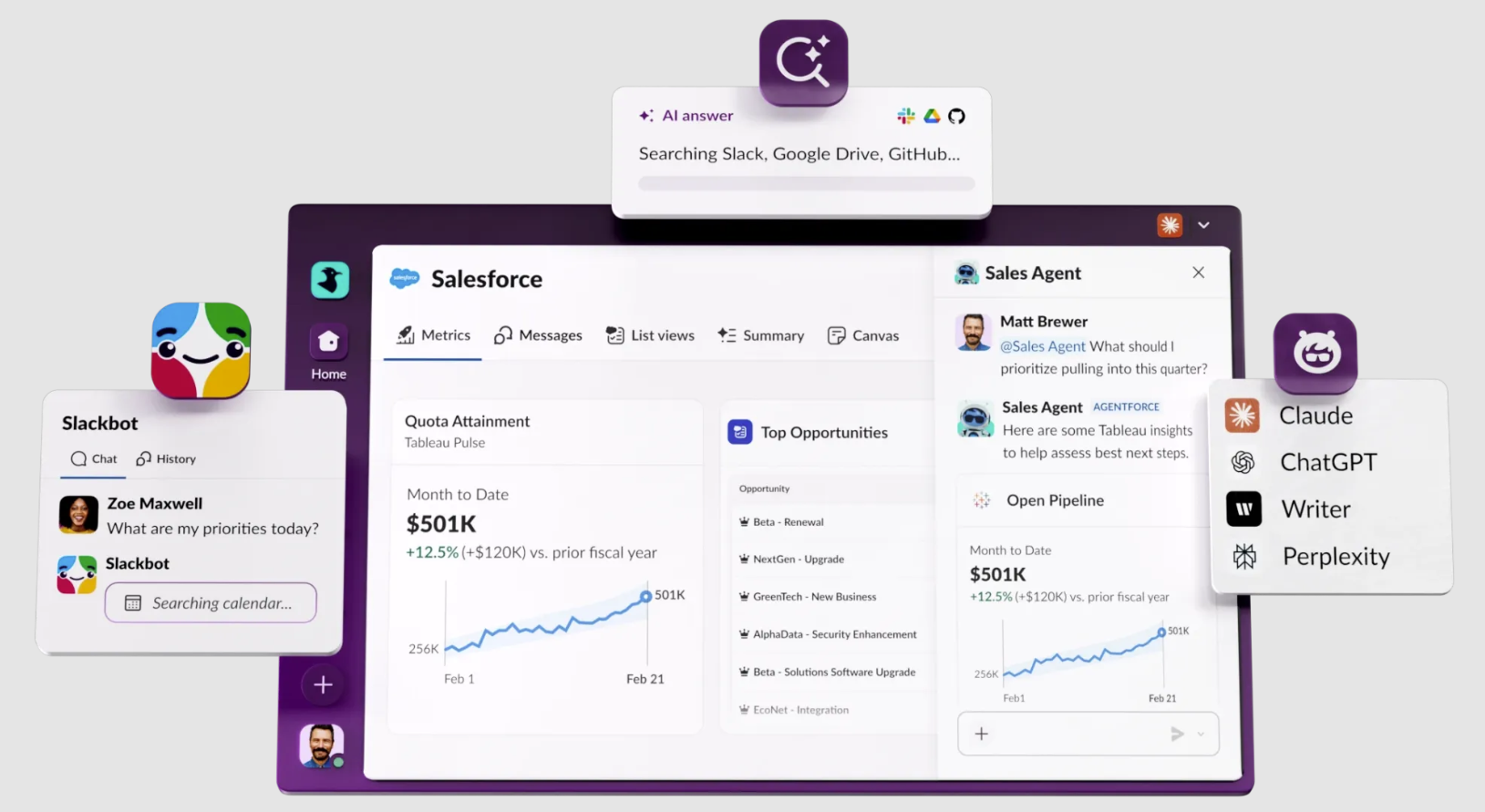
ServiceNow did CRM. Salesforce will launch ITSM at Dreamforce. "We're launching our own agentic IT service platform. A lot of our existing customers have been asking for this. We're bringing a whole new level of capability. It's agent-first and it's Slack-first, that is right inside Slack, you're going to be using our agentic IT service capability," said Benioff. "It's natively embedded where employees already work with zero learning curve. And with agentic IT service, well, every request is becoming a conversation where agents work hand-in-hand with IT teams proactively fixing their problems."

Benioff said Salesforce's ITSM will appeal to multiple enterprises, not just the largest.

My take: It's so easy to fall into the Salesforce vs. ServiceNow storyline. I'm going to refrain. Yes, the two companies are on a collision course to become the AI agent platform of choice. But here's the reality: ServiceNow can expand in CRM and never bump into Salesforce. ServiceNow is going after the "other" part of the CRM pie. ITSM is a similar story. Salesforce's ITSM efforts aren't going to upend ServiceNow as much as be a threat to a vendor like Freshworks.

Overall, the Salesforce vs. ServiceNow theme rhymes with SAP vs. Oracle. Both seem to do fine and neither company really poaches from the other one.

The future of SaaS.

Benioff was asked about the future of SaaS and whether agentic AI would upend the industry. Benioff said AI is "the fundamental extension of SaaS." Here are a few choice quotes:

  • "There's this strange narrative that's out there that somehow enterprise SaaS or apps or something are going away. I guess nothing lasts forever. But I just look at how I'm running my own business and the business of our customers, I don't understand what the replacement is."
  • "To hear some of this nonsense that's out there in social media or in other places, people say the craziest things, but it's not grounded in any customer truth."
  • "You got to separate the forest from the trees or for those of us who are kind of Bible readers, maybe we separate the wheat from the chaff. And I'll just tell you, as we separate the wheat from the chaff, just know there is truth out there, and you have to go out there and really find it. And the truth is always with the customers and also right here at Customer Zero. And I plan to like lay it all out for you at Dreamforce as well on October 14."

Benioff said that the future of software will play out with large enterprises that are "being pitched a lot of different technology right now. And a lot of it is fantasy land."

My take: The debate on the future of enterprise software is only going to pick up. Benioff does have a point that a lot of what's being pitched is fantasy. The divergence to watch is going to be how AI natives scale enterprise software.

SMB and midmarket.

Benioff said AI agents aren't just for large companies. AI may be the enabler to accelerate smaller company growth as well as the midmarket.

On SMBs, Benioff said:

"Those companies need real software, too, but they don't have CIOs. They don't have DIY. They need prepackaged software and they're not really dealing with the hyperscalers or the large-scale SIs. They're dealing with us. We are their hyperscaler. We are their software hyperscaler."

On the midmarket, Benioff said:

"This mid-market and general business is growing super-fast. And when I talk to my friends who run the large SIs, I've been encouraging them to move their business downstream to serve these companies (with) 1,000 to 10,000 employees."

Salesforce President and Chief Revenue Officer Miquel Milano said:

"AI is creating more small and medium companies. So that opportunity is huge and that's why we're investing significantly. We're investing significantly more in the mid and low end of the market."

My take: Enterprise software giants looking for growth always pay homage to smaller enterprises. The issue is that SMBs and midsized companies are forgotten once vendors get their growth game back. That’s why enterprise vendors that actually stay focused on the midmarket have a lot of customer loyalty.

Data to Decisions Future of Work Marketing Transformation Matrix Commerce New C-Suite Next-Generation Customer Experience Innovation & Product-led Growth Tech Optimization Digital Safety, Privacy & Cybersecurity salesforce ML Machine Learning LLMs Agentic AI Generative AI Robotics AI Analytics Automation Quantum Computing Cloud Digital Transformation Disruptive Technology Enterprise IT Enterprise Acceleration Enterprise Software Next Gen Apps IoT Blockchain Leadership VR Chief Information Officer Chief Executive Officer Chief Technology Officer Chief AI Officer Chief Data Officer Chief Analytics Officer Chief Information Security Officer Chief Product Officer

Salesforce Q2 solid, outlook light with expansion into ITSM on deck

Salesforce said more than 40% of Data Cloud and Agentforce bookings in the second quarter came from existing customers. The company also said it will expand into ITSM in a move to compete with ServiceNow. 

Since Agentforce's launch, Salesforce has closed more than 12,500 deals and nearly half of them are paid.

The company reported second quarter earnings of $1.89 billion, or $1.96 a share, on revenue of $10.24 billion, up 10% from a year ago. Non-GAAP earnings were $2.91 a share.

Wall Street was expecting Salesforce to deliver non-GAAP second quarter earnings of $2.78 a share on revenue of $10.14 billion.

Salesforce CEO Marc Benioff said the company remains "on track for fiscal 2026 to be a record year with nearly $15 billion in operating cash flow." However, Wall Street is looking for more growth from Salesforce. Benioff said that Salesforce plans to expand into IT service management in a move that counters ServiceNow's move into CRM

Speaking on a conference call, Benioff said: 

"ITSM is an application area that we just haven't gone to before. But I'm very excited. A lot of our customers have been asking for this. We're bringing a whole new level of capability. We know how to do this because our own first customer is us. We are customer zero over the last six months."

By the numbers:

  • Data Cloud and AI annual recurring revenue topped $1.2 billion, up 120% from a year ago.
  • Salesforce closed more than 60 deals worth more than $1 million in the second quarter that included Data Cloud and AI.
  • Platform revenue in the second quarter was up 16% with sales and service revenue up 8% each. Integration and analytics revenue was up 12%. Marketing and commerce revenue was the laggard in the quarter with revenue growth of 3% in the second quarter.

On a conference call, Benioff outlined Agentforce use cases. He said:

  • "I spent weeks on the road this summer, CEOs, CIOs, one thing is extremely clear to me, every single one of our customers is becoming it's a good vision for the future. It's a good vision for the future of business, and really it's a good vision for the future of Salesforce."
  • Agentic AI is "a shift from traditional hierarchies to moving a company from busy work into natural conversations."
  • "We are adding these native capabilities into every single one of our products. In sales, every prospect is getting a callback. We didn't have enough peole to call everyone back. With agentic sales everyone is getting called back."
  • Salesforce will launch a new email platform that will turn messages into two-way conversations with AI agents.

As for the outlook, Salesforce came in lighter than expected. The company said third quarter revenue will be between $10.24 billion to $10.29 billion, up 8% to 9%. Non-GAAP earnings for the third quarter will be between $2.84 a share to $2.86 a share.

For fiscal 2026, Salesforce is projecting revenue of $41.1 billion to $41.3 billion, up about 9%, with non-GAAP earnings of $11.33 a share to $11.37 a share. GAAP earnings will be between $6.99 a share to $7.03 a share.

Data to Decisions Future of Work Marketing Transformation Matrix Commerce Next-Generation Customer Experience Innovation & Product-led Growth Tech Optimization Digital Safety, Privacy & Cybersecurity salesforce ML Machine Learning LLMs Agentic AI Generative AI Robotics AI Analytics Automation Quantum Computing Cloud Digital Transformation Disruptive Technology Enterprise IT Enterprise Acceleration Enterprise Software Next Gen Apps IoT Blockchain Leadership VR Chief Customer Officer Chief Information Officer Chief Marketing Officer Chief Revenue Officer Chief Data Officer Chief Executive Officer Chief Technology Officer Chief AI Officer Chief Analytics Officer Chief Information Security Officer Chief Product Officer

Figma Q2 revenue growth hits 41%

In its first quarter as a public company, Figma reported a second quarter profit with revenue growth of 41%.

The company, which launched its IPO priced at $33 in July, reported second quarter net income of $28.2 million on revenue of $249.6 million, up 41% from a year ago. Non-GAAP earnings in the quarter checked in at $19.8 million.

Figma ended the quarter with cash and equivalents of $1.6 billion.

CEO Dylan Field said Figma's record revenue in the second quarter was powered by the launch of four new products including Figma Make, Figma Draw, Figma Sites and Figma Buzz. "Looking ahead, we’re excited to keep building for our customers and help define the next era of digital products and experiences. Design is more important than ever, and we have so much more to build," said Field.

By the numbers:

  • Figma had 11,906 paid customers with more than $10,000 in annual recurring revenue.
  • There were 1,119 paid customers with more than $100,000 in ARR.
  • More than 80% of Figma customers used two or more products. Two-thirds of customers used three or more products.

As for the outlook, Figma projected third quarter revenue between $263 million and $265 million, up 33% from a year ago. For 2025, Figma is projecting revenue growth of 37% to $1.021 billion and $1.025 billion. Non-GAAP operating income for the year will be between $88 million and $98 million.


Data to Decisions Marketing Transformation Next-Generation Customer Experience Chief Information Officer Chief Marketing Officer

HPE reports strong Q3 with Juniper Networks in the fold

HPE, reporting earnings for the first time since it closed the acquisition of Juniper Networks, delivered better-than-expected fiscal third quarter results with a fourth quarter outlook that was a bit light.

The company reported third quarter earnings of 21 cents a share on revenue of $9.1 billion, up 19% from a year ago. Non-GAAP earnings were 44 cents a share.

Wall Street was looking for non-GAAP earnings of 42 cents a share in the third quarter on revenue of $8.83 billion.

CEO Antonio Neri said "customer demand stretched broadly across our portfolio and was particularly strong in our server and networking segments." CFO Marie Myers said Juniper Networks added to results with "with more profit accretion expected."

By the numbers:

  • AI revenue in the third quarter was $1.6 billion with AI backlog of $3.7 billion.
  • Sequential AI orders nearly doubled in exiting the third quarter.
  • Sovereign AI orders were up 250% sequentially.
  • Server revenue was $4.9 billion in the third quarter, up 16% from a year ago. Operating profit for the server unit was $317 million.
  • Networking revenue in the third quarter was $1.7 billion, up 54% from a year ago due to the Juniper Networks acquisition. Operating profit in the quarter was $360 million.
  • Hybrid cloud revenue was $1.5 billion, up 12% from a year ago. Operating profit was $87 million.

For the fourth quarter, HPE projected non-GAAP earnings of 56 cents a share to 60 cents a share with revenue between $9.7 billion to $10.1 billion. Wall Street was expecting non-GAAP earnings of 59 cents a share on revenue of $10.1 billion.

HPE said fiscal 2025 revenue growth will be between 14% to 16% with non-GAAP earnings between $1.88 a share to $1.92 a share.
On a conference call, Neri said:

  • "We significantly lowered our inventory driven by higher AI backlog conversion to revenue and strong supply chain execution. We continue to transform our business through Catalyst, the structural cost-saving program we announced last quarter, including enhancing operational efficiency, simplifying our portfolio, adopting AI and optimizing our workforce."
  • "On the demand front, the networking market recovery continues. In enterprise, we continue to see robust demand in campus and branch, driven by the wire and wireless refresh, SASE and data center switching. Wi-Fi 7 demand is ramping with orders up triple digits sequentially. In cloud, we see strong demand for networking for AI, particularly in data center switching and Juniper PTX routing."
  • "Server operating margin improved sequentially, benefiting from the changes we made in pricing and discounting early in the year, which returned traditional server product margins to historical levels. This was partially offset by higher AI mix, including a large deal."
Data to Decisions Tech Optimization HPE Big Data Chief Information Officer Chief Technology Officer Chief Information Security Officer Chief Data Officer

C3 AI names new CEO, cuts outlook

C3 AI named Salesforce veteran Stephen Ehikian CEO as the company cut its outlook for the fiscal second quarter and pulled full year guidance.
The company warned that its first quarter results would fall short of expectations and said Thomas Siebel would step down as CEO due to health issues.

Ehikian most recently was the Acting Administrator of the U.S. General Services Administration (GSA). Siebel will remain as Executive Chairman of C3 AI. Ehikian was CEO of RelateIQ and Airkit.ai, two companies that were acquired by Salesforce. RelateIQ turned into Salesforce Einstein and Airkit became the precusor to Agentforce.

The first chore for Ehikian is to stabilize sales. "I am confident that we will be able to capture an increasing share of the immense market opportunity in Enterprise AI," he said.

C3 AI reported a first quarter net loss of $116.8 million, or 86 cents a share, on revenue of $70.3 million, down from $87.2 million a year ago. The non-GAAP loss was 37 cents a share.

Siebel said C3 AI has restructured its sales and services organization and the company can accelerate growth from this base.

As for the outlook, C3 AI projected second quarter revenue of $72 million to $80 million with a non-GAAP loss from operations of $49.5 million to $57.5 million.

Data to Decisions Chief Information Officer

US v. Google ruling: GenAI will do our work for us

A federal judge ruling in the Google antitrust trial is more damning than you'd think. Yes, Google won't have to divest Chrome or Android, but the ruling is basically a bet that generative AI is going to erode the company's search dominance.

In other words, the LLMs are coming for Google search.

The coverage of the ruling basically boils down to this:

  • Google gets the win and won't have to divest Chrome or Android.
  • Apple still will get paid for using Google search.
  • Google has to share its search data with "qualified competitors," but the remedy is manageable.
  • The remedies fall short say some observers.
  • And Google will continue to rake in dough.

However, I can't ignore the generative AI comments in the ruling.

U.S. District Judge Amit Mehta wrote:

  • “Much has changed since the end of the liability trial, though some things have not. Google is still the dominant firm in the relevant product markets. No existing rival has wrested market share from Google. And no new competitor has entered the market. But artificial intelligence technologies, particularly generative AI (“GenAI”), may yet prove to be game changers. Today, tens of millions of people use GenAI chatbots, like ChatGPT, Perplexity, and Claude, to gather information that they previously sought through internet search. These GenAI chatbots are not yet close to replacing general search engines (GSEs), but the industry expects that developers will continue to add features to GenAI products to perform more like GSEs."
  • "The emergence of GenAI changed the course of this case...These remedies proceedings thus have been as much about promoting competition among GSEs as ensuring that Google’s dominance in search does not carry over into the GenAI space."
  • And finally, the court defined a qualified competitor in a way that ensures search data is shared with OpenAI, Anthropic and Perplexity. As defined in the ruling a qualified competitor is (1) a provider or potential entrant in search, search ads, or GenAI; (2) that meets strict data security/privacy standards; (3) agrees to oversight by the Technical Committee; (4) shows a credible plan to invest and compete in/with Google’s monopolized markets; and (5) poses no national security risk.

In the long run, sharing search and user interaction data may hamper Google and give genAI rivals a fast-forward button to compete.

Constellation Research analyst Holger Mueller said:

"In this landmark case, a government moved forward with no parties showing damages and asked for massive market changes with the sale of Chrome. Judge Mehta prevailed with this rationale: Exclusive deals always have the potential to lock out the competition. We will now see how enterprises will revisit thousands of these deals, fearing that antitrust authorities may potentially prosecute them."

Marketing Transformation Google Chief Information Officer Chief Marketing Officer