Vice President and Principal Analyst
Constellation Research
About Andy Thurai
Andy Thurai is an accomplished IT executive, strategist, advisor, enterprise architect and evangelist with more than 25 years of experience in executive, technical, and architectural leadership positions at companies such as IBM, Intel, BMC, Nortel, and Oracle. Andy has written more than 100 articles on emerging technology topics for publications such as Forbes, The New Stack, AI World, VentureBeat, DevOps.com, GigaOm and Wired.
Andy’s fields of interest and expertise include AIOps, ITOps, Observability, Artificial Intelligence, Machine Learning, Cloud, Edge, and other enterprise software. His strength is selling technology to the CxO audience with a value proposition rather than the usual technology sales pitch.
Find more details and samples of Andy’s work on his…...
Editor in Chief of Constellation Insights
Constellation Research
Larry Dignan is Editor in Chief of Constellation Insights at Constellation Research, where he leads editorial coverage focused on enterprise technology, digital transformation, and emerging trends shaping the future of business. He oversees research-driven news, analysis, interviews, and event coverage designed to help technology buyers and vendors navigate complex markets with clarity and context. ...
OpenAI has built momentum by closing a big partnership with Apple, a channel deal with PwC and a series of enterprise wins. These events put an exclamation point on the enterprise traction that OpenAI is seeing directly and raise a big question: Will OpenAI eventually compete with its primary investor Microsoft?
Let's start with the big stuff. Apple's WWDC keynote outlined the company's generative AI strategy, which melds on-device processing, private cloud and a partnership with OpenAI. OpenAI will be a big part of iPhone queries that need to go to the cloud even though Bloomberg reported there is no money being exchanged. In other words, OpenAI is like an NFL Super Bowl halftime performer—it’s all about the exposure, marketing and distribution. Rest assured, that Apple has its own large language models (LLMs) to ensure it is closest to the customer experience, but OpenAI is in the mix.
That Apple partnership, however, only highlighted other recent data points. Consider:
The company landed a big deal with PwC, which will adopt ChatGPT Enterprise throughout consulting giant, and resell OpenAI to clients. PwC will be the first reseller of ChatGPT Enterprise and its largest user of the product. Once an enterprise lands one big consulting firm others follow.
The big takeaway from these deals is that enterprises are going direct to OpenAI. Plenty of enterprises are exposed to OpenAI via Microsoft. The Microsoft-OpenAI partnership has made OpenAI the biggest ingredient brand since Intel.
It's clear that OpenAI doesn't intend to be just an ingredient brand. Yes, Microsoft is a huge OpenAI investor, but the latter has bigger ambitions and a looming IPO at some point. Naming Sarah Friar CFO and Kevin Weil chief product officer only drives home that OpenAI is building out its management team ahead of an IPO.
What's next? Okta CEO Todd McKinnon said on CNBC something that a few observers have been wondering. McKinnon noted that Microsoft is effectively outsourcing its best AI R&D to OpenAI. Microsoft could become more like a consultancy than an innovator. I'm not sure that's exactly fair given Microsoft has been rolling out its own models and more choice, but McKinnon's perception isn't that surprising.
After all, we at Constellation Research have been debating this topic. Microsoft went with OpenAI to be first to market and the bet went swimmingly. The long run may look different for both sides.
My bet: OpenAI will increasingly compete with Microsoft to some degree, but the software and cloud giant will benefit either way since it is an investor. Over time, OpenAI and Microsoft will more resemble frenemies. The partnership will be a great business school case study a few decades from now. The frenemy outcome looks even more likely when you consider that regulators are sniffing around OpenAI and Microsoft. Looking like competitors could suit both companies in the near term.
"For OpenAI to be taken seriously, Microsoft must let it partner with the entire ecosystem or face threats of anti-trust. The symbiotic relationship today was born out of Microsoft's desire to catch up and leap ahead in AI. But going forward, Microsoft is making investments to build its own capabilities. It would behoove Sam Altman to just partner with Microsoft. For AI to succeed, the approach Meta is taking will ultimately win - open source, open, and part of a larger ecosystem for data collectives."
Barry Briggs, analyst with Directions on Microsoft and former CTO of Microsoft's IT org, said:
"Tiny OpenAI has not one but three tigers by the tail, managing multibillion dollar relationships with not only Microsoft but Apple and Oracle as well. With growing demands from each of these mega players, OpenAI will, over time, be forced to navigate its own course among them – which may result in its “special relationship” with Microsoft becoming more distant. Microsoft in turn, hardly a wallflower in AI, has not only created its own language models but has already started partnering with other firms, Mistral being an example. Symbiotic? Maybe. Exclusive? Hardly."
Editor in Chief of Constellation Insights
Constellation Research
Larry Dignan is Editor in Chief of Constellation Insights at Constellation Research, where he leads editorial coverage focused on enterprise technology, digital transformation, and emerging trends shaping the future of business. He oversees research-driven news, analysis, interviews, and event coverage designed to help technology buyers and vendors navigate complex markets with clarity and context. ...
As new technologies such as generative AI and robotics proliferate, the connection between humans will become even more important. That's a high-level takeaway from DisrupTV Episode 366, which took a few interesting turns.
Christopher Lochhead, thirteen-time No. 1 bestselling author and a "godfather" of category design, and Matt Beane, Author of The Skill Code: How to Save Human Ability in an Age of Intelligent Machines and UCSB professor, were the guests that connected the human dots between three seemingly disparate topics.
Apple
Lochhead, a godfather of category design, said Apple pulled off a massive coup with its AI presentation this week largely because he took a new technology and made it human. "Tim Cook pulled something absolutely legendary here," said Lochhead. "What we had this week was a master class in category design and business strategy. In category design, one of the things we teach entrepreneurs and marketers is listen to the words. Listen to the words. Most people don't pay attention to the words. Apple this week did not announce a new product. Apple announced a new category design, a new category of AI called a personal intelligence system. And they branded it Apple Intelligence."
He added that most people forget that Apple was the category designer of personal computing. Apple put the focus on where it should be for Apple--on the people.
"Strategically, it's beyond genius," he said. "AI is not a new category of technology. AI is every category of technology. It's not a product. It's an enabling technology. Apple is going to use AI as a personal system."
"The last piece of this is that you don't have a strategy unless you can put it on one page. You lead the future and that's exactly what Tim Cook did. It was the result of clarity of strategy and a focus on the categories where Apple wins."
Bill Walton, the teacher
Lochhead met Walton through complete serendipity. He was speaking at an Oracle event where Walton was the closing speaker.
"If you know anything about Bill and that magical mystical deadhead, he read everything. He read because he had that stutter. He read because his mother was a librarian. He spent his entire childhood reading, playing basketball and on his bike. He was an incredibly learned man."
Naturally, Walton read Lochhead's books, notably Play Bigger, and they became fast friends.
"After one of my dear friends was murdered, Bill called me three times a week for the six months after it happened. He was on the road doing calling games doing all this stuff at an incredibly busy time in his life and he always wanted to make sure how I was. A text message from Bill Walton or an email from Bill Walton would just go on and on about how he loved you, and 'thank you for my life.' He said, thank you for my life to everybody. Thank you for my life.
"He was a dichotomy because he could talk about his stories and his life forever, and you would think a person like that might be egotistical. Yet as he was doing it, he was connecting with you, empathizing with you and he wanted to know how you were. He deeply gave a shit about other people.
"He made you feel like the greatest person in the world, he was the greatest, he taught me and everybody how to be a fan.
"He's left me with many things, and one is teaching. He said to me at the time I was calling myself retired just like an uncle: "Chris, you can't use the word retired. You're not retired. You're just like John Wooden. You're a teacher. Go be a teacher."
"What there is to do? I think it is to live like Bill. Bill embraced different. He followed the things that he loved and the people that he loved, he allowed himself to fall in love quickly and to support other people."
Skills and humans in the AI and robotic age
That human connection is also going to be critical for skill building, argued Beane. In his book, The Skill Code: How to Save Human Ability in an Age of Intelligent Machines, Beane examined various technologies through a lens of skill building--that ongoing connection between an expert and a novice. "To have table stakes, you got to have that knowledge to be able to play, but to build skill. There's 160,000 years’ worth of archaeological evidence that we build skill with elbow-to-elbow contact with somebody, who knows more, trying to get some real work done," said Beane.
Beane used robotic surgery as example of how new technologies are inventing new ways to work and build skill. What's lost is that human skill building connection and mentorship.
"A novice by definition is slower and makes more mistake than an expert. You put a tool in an expert hand, that allows them to do more better by themselves. They're gonna love that deal. They take that deal. And it means they're just gonna need help from that novice less."
The trick to leveraging today's new technologies decades from now will be building productivity gains in a way where people also build their capabilities. Beane argued that roles that require a physical presence will adapt better to new technologies and build skills relevant to those workers who are remote. “If you have authority, run a budget, can invest and are developing tools you can build skills, but you have great responsibility to bring novices along for the ride," said Beane.
"If you're going to make healthy progress toward skill and keep it healthy for other people, the challenge, complexity, and connection matters. Human connections that built Walton's story, bonds of trust and respect. We don't think of those as connected to your skill journey. They are essential. The challenge is that the world has become a bit of a padded playground in places, and that is dangerous to skill. You've got to struggle; you've got sweat and you have to be uncomfortable humans. Humans don't like being uncomfortable, but it is required."
Editor in Chief of Constellation Insights
Constellation Research
Larry Dignan is Editor in Chief of Constellation Insights at Constellation Research, where he leads editorial coverage focused on enterprise technology, digital transformation, and emerging trends shaping the future of business. He oversees research-driven news, analysis, interviews, and event coverage designed to help technology buyers and vendors navigate complex markets with clarity and context. ...
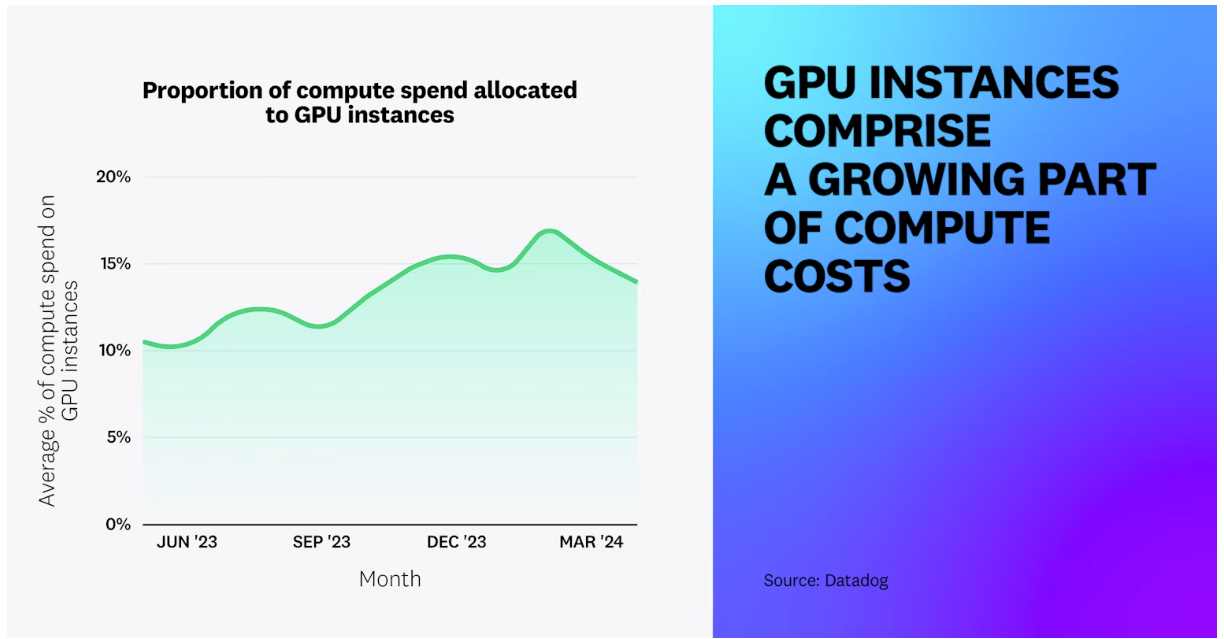
GPU instances are taking a larger share of cloud enterprise spending and now are 14% of compute costs compared to 10% a year ago, according to a Datadog report analyzing AWS customer usage.
The report highlights how enterprises are experimenting with training and inference for large language models. A report from Flexera also highlighted how enterprises were experimenting with AI workloads. Datadog said:
"GPU-based EC2 instance types generally cost more than instances that don’t use GPUs. But the most widely used type—the G4dn, used by 74 percent of GPU adopters—is also the least expensive. This suggests that many customers are experimenting with AI, applying the G4dn to their early efforts in adaptive AI, machine learning (ML) inference, and small-scale training. We expect that as these organizations expand their AI activities and move them into production, they will be spending a larger proportion of their cloud compute budget on GPU."
That increased spending is good for Nvidia as well as AWS customers using the cloud vendor's Trainium and Inferentia chips. The focus on GPU instances may also benefit AMD, which is rolling out its new accelerators.
Arm appears to be another downstream winner as cloud workloads are GPU based. Arm-based CPUs are also popular on AWS as enterprises leverage Graviton2 processors. Arm-based instances only account for 18% of EC2 compute costs, but that's double from a year ago.
"Arm-based instances still account for only a minority of EC2 compute spending, but the increase we’ve seen over the last year has been steady and sustained. This looks to us as if organizations are beginning to update their applications and take advantage of more efficient processors to slow the growth of their compute spend overall."
Overall, enterprises are mixing various compute instances and containers to optimize costs, but companies aren't adopting the latest technologies. Datadog found that 83% of organizations are still using previous-generation EC2 instance types.
Editor in Chief of Constellation Insights
Constellation Research
Larry Dignan is Editor in Chief of Constellation Insights at Constellation Research, where he leads editorial coverage focused on enterprise technology, digital transformation, and emerging trends shaping the future of business. He oversees research-driven news, analysis, interviews, and event coverage designed to help technology buyers and vendors navigate complex markets with clarity and context. ...
Adobe reported a better-than-expected second quarter as the company expanded its customer base due to generative AI features.
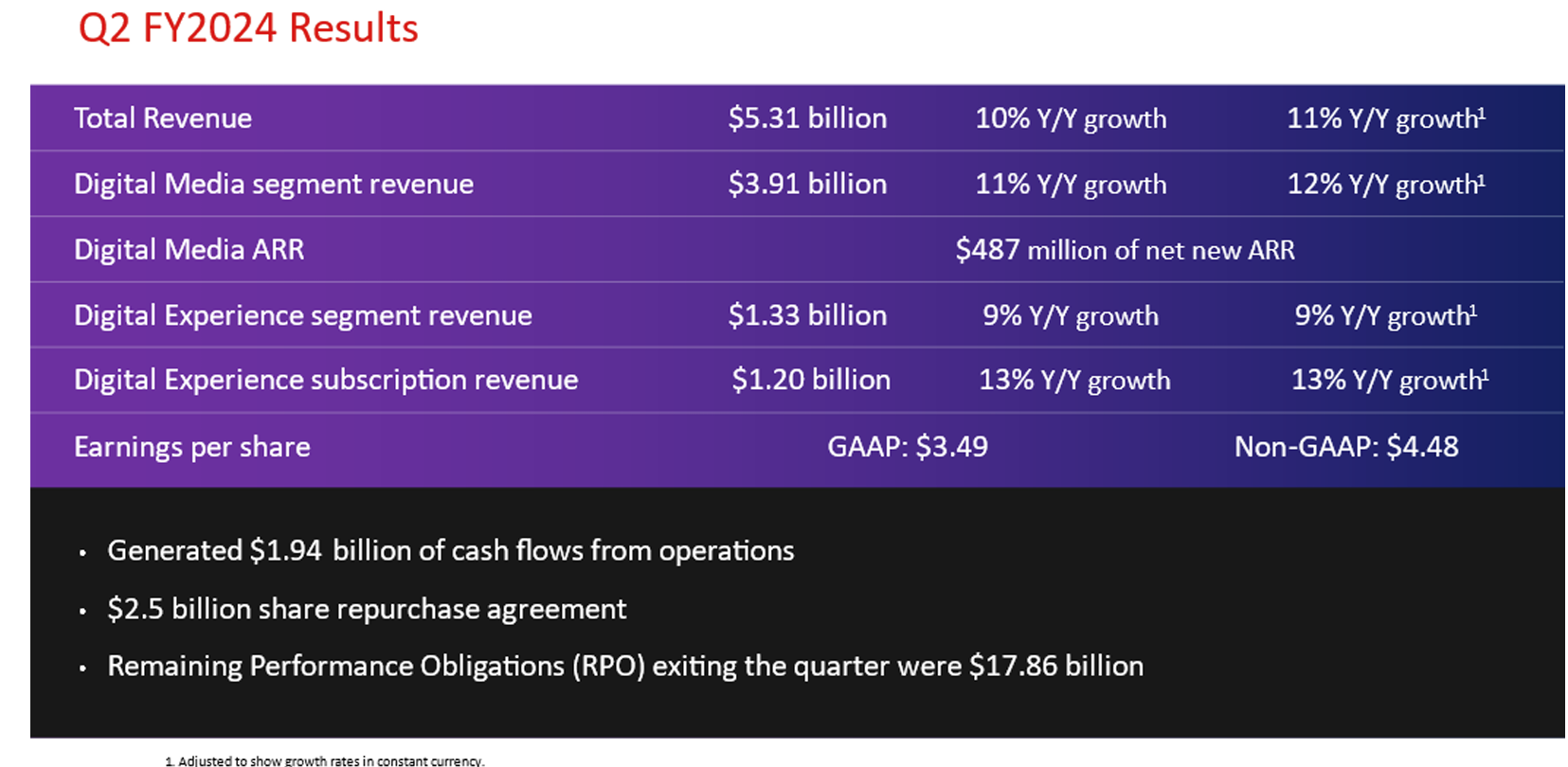
The company reported second-quarter earnings of $3.49 a share on revenue of $5.31 billion, up 10% from a year ago. Non-GAAP earnings in the quarter were $4.48 a share.
Wall Street was expecting Adobe to deliver second quarter earnings of $4.39 a share on revenue of $5.29 billion.
Adobe CEO Shantanu Narayen said the company's "highly differentiated approach to AI and innovative product delivery" is delivering value to current customers and attracting new ones.
The company's Digital Media revenue was $3.91 billion, up 11% from a year ago. Most of that was Creative Cloud revenue, but Document Cloud delivered 19% revenue growth compared to a year ago.
Digital Experience revenue was $1.33 billion, up 9% from a year ago.
In prepared remarks, Narayen said:
"In Creative Cloud, we have invested in training our Firefly family of creative generative AI models with a proprietary data set and delivering AI functionality within our flagship products including Photoshop, Illustrator, Lightroom and Premiere."
He added that Firefly has been used to generate more than nine billion images.
As for Document Cloud, Narayen said Acrobat AI Assistant is now available as an add-on subscription for Reader and Acrobat enterprise customers.
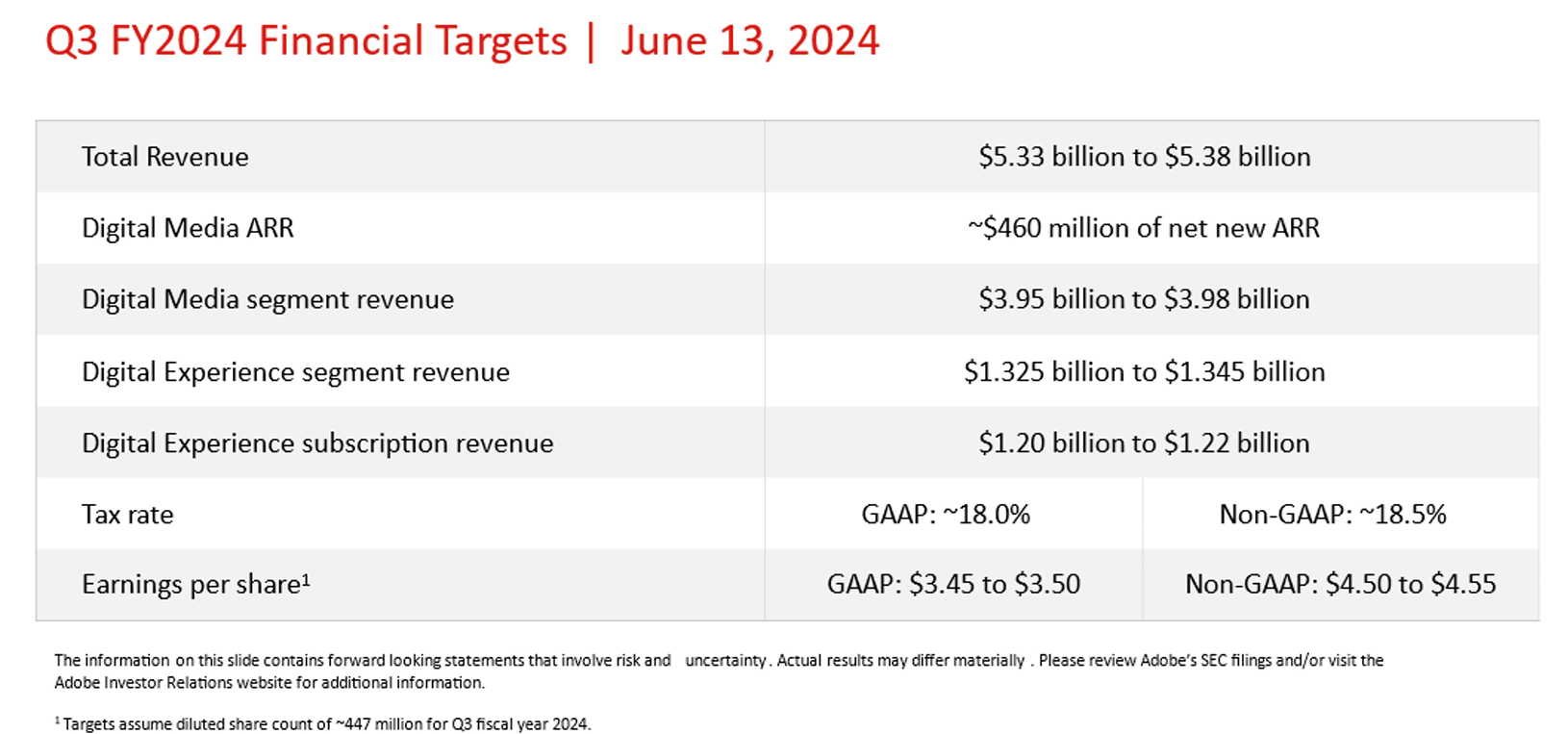
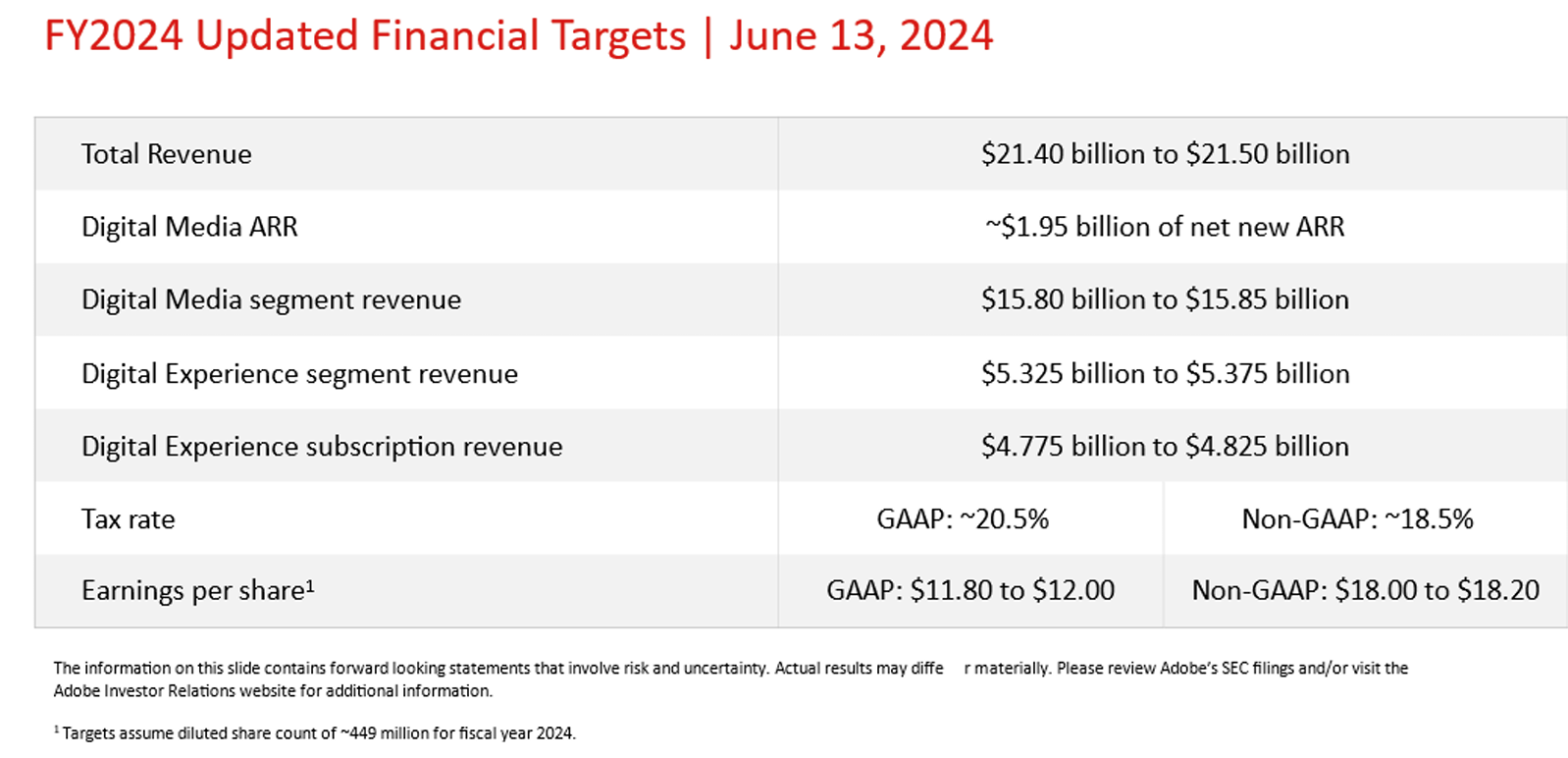
Adobe raised its guidance with third quarter revenue of $5.33 billion to $5.38 billion with non-GAAP earnings of $4.50 a share to $4.55 a share. For fiscal 2024, Adobe projected $21.4 billion to $21.5 billion with non-GAAP earnings of $18 a share to $18.20 a share.
Other key points:
Adobe is extending its applications to integrate third-party multi-modal LLMs.
The company is seeing early success monetizing AI across its Digital Media and Digital Experience platforms.
Adobe is seeing strong usage and demand for AI across all customer segments.
The company said it was seeing new demand for Creative Cloud apps powered by new releases and digital channels.
Editor in Chief of Constellation Insights
Constellation Research
Larry Dignan is Editor in Chief of Constellation Insights at Constellation Research, where he leads editorial coverage focused on enterprise technology, digital transformation, and emerging trends shaping the future of business. He oversees research-driven news, analysis, interviews, and event coverage designed to help technology buyers and vendors navigate complex markets with clarity and context. ...
Epicor has acquired two companies in recent months as it rounds out its strategy to infuse artificial intelligence across its ERP platform.
The company, which recently passed the $1 billion mark in annual recurring revenue, on Wednesday announced the acquisition of KYKLO, which provides product information management and lead-gen tools for manufacturers and distributors.
Epicor CEO Steve Murphy said the purchase is part of the company's AI-driven cognitive ERP vision that aims to turn systems of record into an insights engine.
KYKLO will complement Epicor's Commerce software with product information, real-time catalogs and content syndication.
The KYKLO acquisition follows last month's purchase of Smart Software, which provides cloud inventory planning and optimization applications. Smart Software was already a Epicor independent software vendor partner and integrated into multiple Epicor ERP modules.
At Epicor's Insights 2024 user conference last month, the company launched its Epicor Grow portfolio, which includes AI and business intelligence tools aimed at the supply chain.
Epicor Grow includes generative AI, machine learning, analytics and natural language processing for more than 200 industry use cases.
The Epicor Grow portfolio includes, Epicor Prism, which is a genAI service across Epicor Industry ERP Cloud, and Epicor Grow AI, which surfaces insights across industries. Arturo Buzzalino, VP of Products and Innovation at Epicor, said Prism is the company's first LLM pipeline.
Epicor also launched Epicor Grow Inventory Forecasting, which leverages forecasting engines from Smart Software, Epicor FP&A and Epicor Grow BI.
The company also launched Epicor Grow Data Platform to manage enterprise data, create pipelines and leverage business intelligence.
Vice President & Principal Analyst
Constellation Research
About Liz Miller:
Liz Miller is Vice President and Principal Analyst at Constellation, focused on the org-wide team sport known as customer experience. While covering CX as an enterprise strategy, Miller spends time zeroing in on the functional demands of Marketing and Service and the evolving role of the Chief Marketing Officer, the rise of the Chief Experience Officer, the evolution of customer engagement, and the rising requirement for a new security posture that accounts for the threat to brand trust in this age of AI. With over 30 years of marketing experience, Miller offers strategic guidance on the leadership, business transformation, and technology requirements to deliver on today’s CX strategies. She has worked with global marketing organizations to transform everything from…...
Liz Miller comes to you LIVE again from #PegaWorld with another CR #CX convo! 📣 This time, with Matt Healy, director of product strategy and marketing at Pegasystems.
Learn how Pegasystems brings together hashtag#applications, systems, #AI, workflows and #automation to improve #customerexperience and customer journeys.
Plus the ever-engaging commentary from Liz Miller about #marketing, #digital technology and more! Watch the full convo below👇
Editor in Chief of Constellation Insights
Constellation Research
Larry Dignan is Editor in Chief of Constellation Insights at Constellation Research, where he leads editorial coverage focused on enterprise technology, digital transformation, and emerging trends shaping the future of business. He oversees research-driven news, analysis, interviews, and event coverage designed to help technology buyers and vendors navigate complex markets with clarity and context. ...
Broadcom saw strong AI demand in the fiscal second quarter and said VMware accelerated its software business.
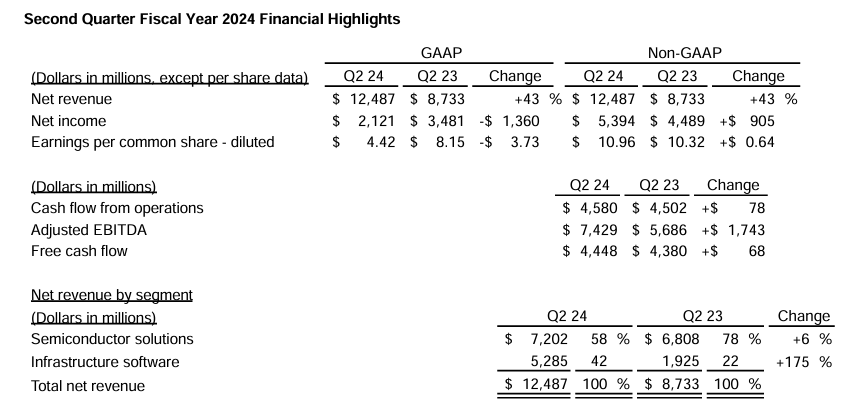
The company reported fiscal second quarter net income of $2.12 billion, or $4.42 a share, on revenue of $12.49 billion, up 43% from a year ago. Non-GAAP earnings were $10.96 a share. The company also said it will split its stock 10-for-1 on July 15.
Wall Street was looking for second quarter non-GAAP earnings of $10.84 a share on revenue of $12.1 billion.
Broadcom also raised its revenue guidance for fiscal 2024 to $51 billion compared to estimates of $50.28 billion.
CEO Hock Tan said the second quarter results were "once again driven by AI demand and VMware." AI product revenue was $3.1 billion in the quarter.
By unit, Broadcom's semiconductor revenue, which is being driven by AI data centers, was $7.2 billion, up 6% from a year ago. Infrastructure software revenue was $5.28 billion, up 175% from a year ago due to the VMware acquisition.
Broadcom ended the quarter with cash and cash equivalents of $9.81 billion.
Key points from the earnings conference call include:
VMware revenue in the second quarter was $2.7 billion, up from $2.1 billion in the first quarter. Tan said the integration was going well and the company is making "good progress on the transition. The company has signed up nearly 3,000 of its largest 10,000 customers to deals, mostly multi-year contracts.
Tan reiterated that VMware would deliver $4 billion a quarter in revenue, but declined to give a time frame.
Networking revenue for Broadcom is expected to grow 40% in the third quarter. Tan said networking products were benefiting from AI data centers.
Tan downplayed any Nvidia competition. He said Broadcom uses its IP portfolio to create custom AI accelerators so the companies don't compute much. "We are not competitors to them and don't try to be either," said Tan. "On networking that may be different, but we are approaching it from different angles. We are very deep in Ethernet and have been doing it for over 25 years. It's a natural extension for us to go into AI, but we don't do GPUs. We enable GPUs to work very well."
Vice President & Principal Analyst
Constellation Research
About Liz Miller:
Liz Miller is Vice President and Principal Analyst at Constellation, focused on the org-wide team sport known as customer experience. While covering CX as an enterprise strategy, Miller spends time zeroing in on the functional demands of Marketing and Service and the evolving role of the Chief Marketing Officer, the rise of the Chief Experience Officer, the evolution of customer engagement, and the rising requirement for a new security posture that accounts for the threat to brand trust in this age of AI. With over 30 years of marketing experience, Miller offers strategic guidance on the leadership, business transformation, and technology requirements to deliver on today’s CX strategies. She has worked with global marketing organizations to transform everything from…...
Liz Miller had a chance to catch up with Matthew Camuso, Senior Product Marketing Manager at Pegasystems, while attending #PegaWorld. What does Moose (you gotta watch...there's even a hand signal) think about the intersection point of Marketing, Experience, Data, Analytics and AI? A lot...and they have a blast catching up and talking strategy in the blazing heat of cool Las Vegas.
Editor in Chief of Constellation Insights
Constellation Research
Larry Dignan is Editor in Chief of Constellation Insights at Constellation Research, where he leads editorial coverage focused on enterprise technology, digital transformation, and emerging trends shaping the future of business. He oversees research-driven news, analysis, interviews, and event coverage designed to help technology buyers and vendors navigate complex markets with clarity and context. ...
Brian Ames, senior manager of production AI and data products at General Motors, said the company has stood up its data factory and plans to layer in generative AI capabilities in the next year.
Ames' talk at the Databricks Summit conference is one part of a broader effort at GM to improve its data and software game. In February, GM CEO Mary Barra said the company is "determined to get the software right" to deliver good customer experiences. GM is working to improve its software in autos as well as revamp the technology behind Cruise.
In May at an investor conference, Barra noted that artificial intelligence will be critical to Cruise and the company overall. "When you talk about artificial intelligence, the ultimate application of that is autonomy is our Cruise operations that use machine learning and AI. But there's a lot that we're working on to leverage AI in some of the business processes to take cost and complexity out of what we do," said Barra.
With that backdrop, Ames' talk highlighted how companies need to get their cloud and data strategies right before embarking on generative AI. We've documented this trend repeatedly in customer stories on CVS, Wayfair, Equifax, Intuit, Rocket and JPMorgan Chase to name a few.
Ames said GM's first move was to create an infrastructure that could surface data more easily. "GM has a ton of data. That's not the problem. We had a beautiful on prem infrastructure. Why change? Well, two reasons. Number one was data efficiency. More importantly, the world changed. And GM understood that if we didn't have AI and ML in our arsenal, we could find ourselves at a competitive disadvantage," he said.
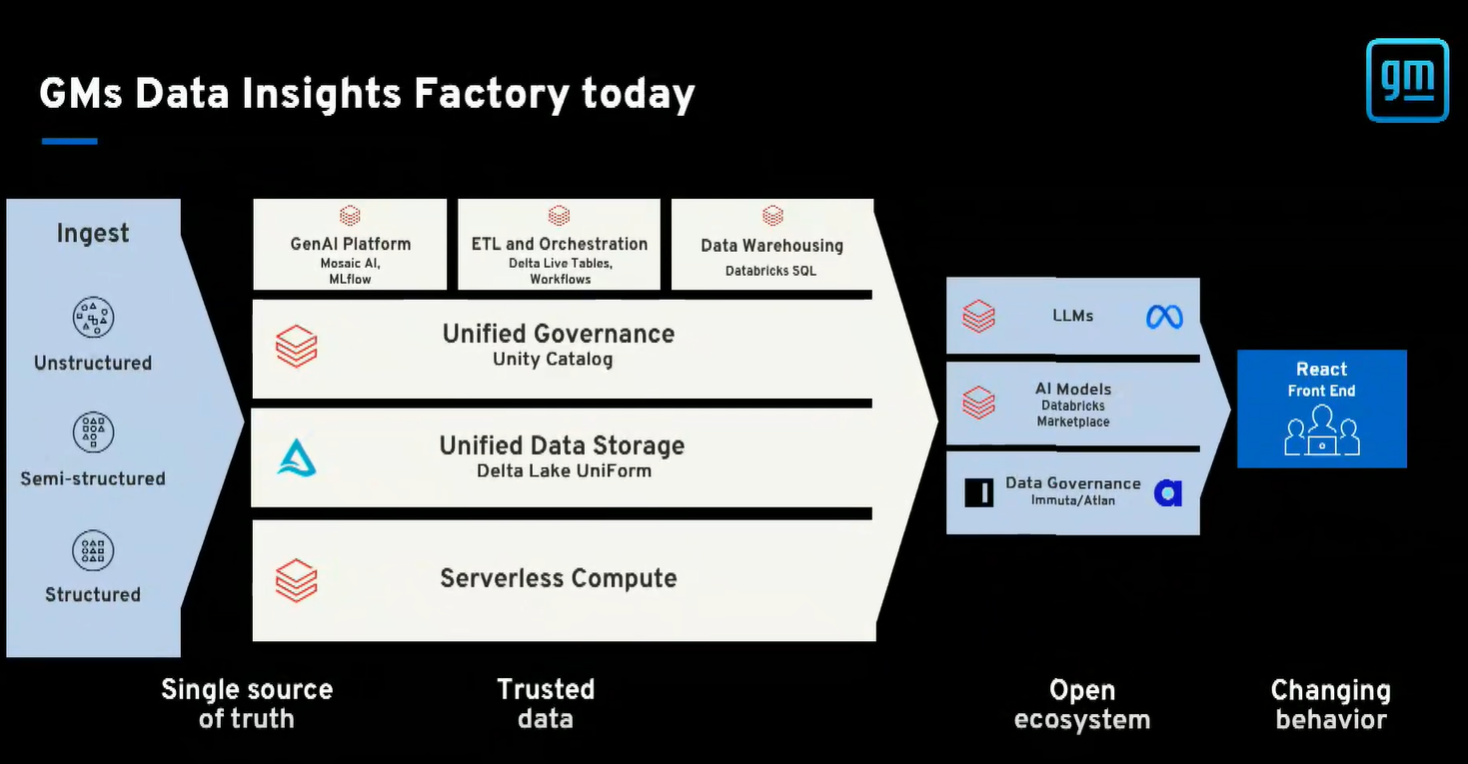
GM set out to transform its data infrastructure about 15 months ago to go all cloud. The plan was to build a data insight factory that could democratize information that can be used for safety and vehicle telemetry. "We needed to move from solution silos to single sources of truth with rapid collaboration. We needed to move away from fragmented governance into a simple unified governance. And we felt if we did those two things extremely well, that we'd be able to go from pockets of limited AI and ML execution to really building AI and ML into the DNA of GM," said Ames.
Today, GM has this architecture built on Databricks. GM also built an interface that can distribute insights by brand and product. The killer app for this data platform has been telemetry data from GMs fleet to be used to gauge the health of the autos on the road as well as predictive maintenance and safety. The fleet includes 10s of millions of cars with multiple combination of sensors. The goal? Zero crashes.
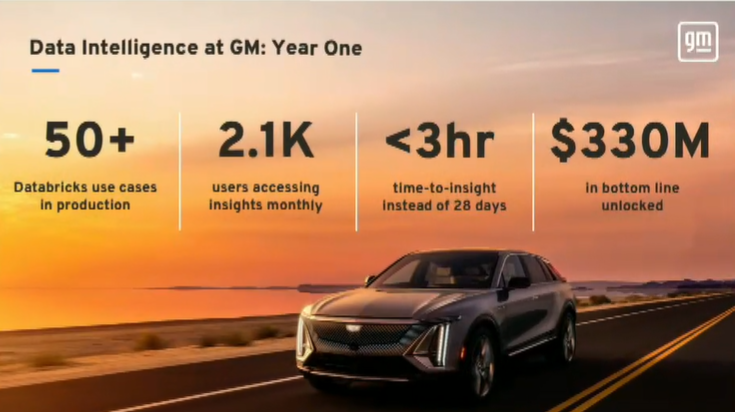
Going forward, Ames said GM's plan is to break down silos for various AI and machine learning projects around the company and move them to production faster. "we're reducing the time to insight and we're finding ways to contribute value. In year two, we're going to layer on genAI and perhaps take another step at GM towards our mission of zero crashes," said Ames.