Editor in Chief of Constellation Insights
Constellation Research
Larry Dignan is Editor in Chief of Constellation Insights at Constellation Research, where he leads editorial coverage focused on enterprise technology, digital transformation, and emerging trends shaping the future of business. He oversees research-driven news, analysis, interviews, and event coverage designed to help technology buyers and vendors navigate complex markets with clarity and context. ...
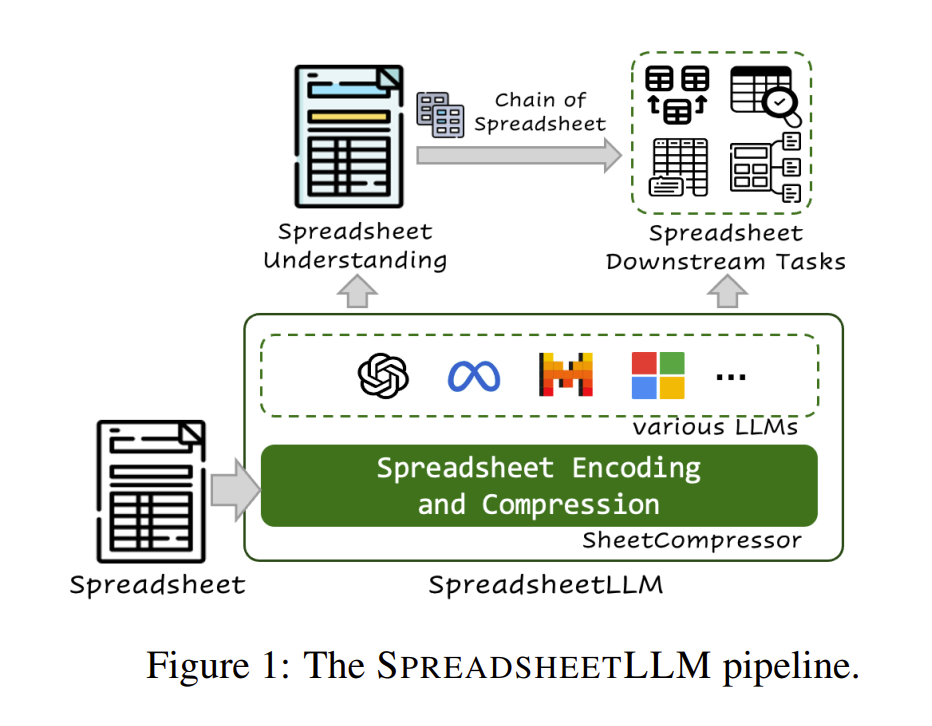
Microsoft researchers have cooked up SpreadsheetLLM, a method that encodes and optimizes large language models (LLMs) so they can understand spreadsheets.
Now there are only a few companies that would care about this use case--Microsoft and Google--but the impact of Spreadsheet LLM could be huge. Why? Despite analysts and every enterprise software company telling you that you shouldn't run your business on a bunch of spreadsheets flung around the office, you all still do it. You know who you are.
The interesting thing about SpreadsheetLLM is that it's a great lifehack to the reality that you'll have your damn Excel spreadsheets anyway and the rest of us need to understand what's going on.
Enter SpreadsheetLLM. In a paper outlining the project, researchers said they also created SheetCompressor, which is an encoding framework that compresses spreadsheets for LLMs. Researchers said:
"Spreadsheets pose unique challenges for LLMs due to their expansive grids that usually exceed the token limitations of popular LLMs, as well as their inherent two-dimensional layouts and structures, which are poorly suited to linear and sequential input. Furthermore, LLMs often struggle with spreadsheet-specific features such as cell addresses and formats, complicating their ability to effectively parse and utilize spreadsheet data."
Ultimately, SpreadsheetLLM can make understanding and analyzing spreadsheet data more accessible. The paper is a bit wonky, but SpreadsheetLLM appears to be an advance in processing and understanding spreadsheet data via various LLMs. SpreadsheetLLM could also be handy for data cleansing and all those functions we always Google for how-to videos (yes folks, Excel tips are a cottage industry).
Holger Mueller, Constellation Research analyst, said:
"Right after transactional databases, spreadsheets run the world. And the platform is Excel, so it's key for Microsoft to be at the forefront of using AI for better use of spreadsheets. Microsoft has done exactly that with SpreadsheetLLM, which could fundamentally change its UX and user reach. Verbal access to spreadsheets has massive value both for creating and analyzing spreadsheets. If Microsoft nails this, it not only secured the future of Excel but also change the future of work."
Editor in Chief of Constellation Insights
Constellation Research
Larry Dignan is Editor in Chief of Constellation Insights at Constellation Research, where he leads editorial coverage focused on enterprise technology, digital transformation, and emerging trends shaping the future of business. He oversees research-driven news, analysis, interviews, and event coverage designed to help technology buyers and vendors navigate complex markets with clarity and context. ...
CxOs are racing to invest in generative AI but skimping on the data foundation needed to execute, according to an Ernst & Young (EY) survey.
EY's AI Pulse Survey, based on 500 US senior leader respondents, highlights the generative AI enterprise conundrum. Here's a look at some of the moving parts.
Among companies already investing in AI, the number of companies investing $10 million will roughly double from 16% to 30% in the next year.
But 36% of senior leaders say they're investing in data infrastructure at scale.
And 34% said they are building on an AI governance framework.
37% of senior leaders said their organizations are training and upskilling employees on AI at scale.
These moving parts highlight how some enterprises may be headed to a crap in, crap out wall if they jump into AI without a strong data game.
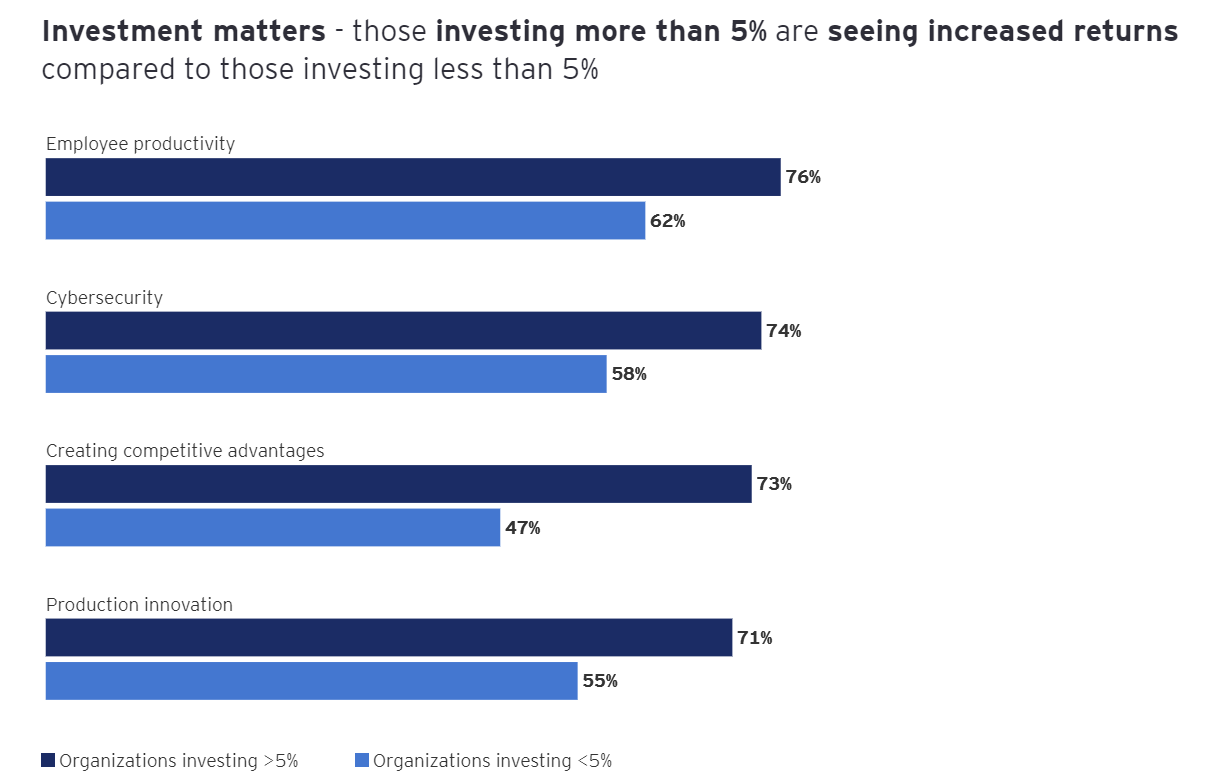
Nevertheless, EY found that CxOs are doubling down on generative AI. Three-quarters of executives said their firms are seeing positive returns across business functions. Indeed, 77% said they were seeing operational efficiencies, 74% saw employee productivity gains and 72% saw improved customer satisfaction.
Other items from the survey:
Companies investing 5% or more of total budgets on AI are seeing more returns.
50% of senior leaders say they will dedicate 25% or more of total budgets toward AI investments.
54% of CxOs investing in AI said their organizations are investing in ethical AI over the next year.
Vice President and Principal Analyst
Constellation Research
Martin Schneider has had a unique career that has spanned both analyst and marketing practitioner roles, focused on high technology and related industries. The unifying factor has always been both a keen analysis of go-to-market trends, while also having achieved success as a marketing leader.
Schneider started his career as a journalist covering B2B technologies, and quickly transitioned into a leading analyst covering application software for the 451 Group in NYC, where he specialized in CRM, marketing automation, and business intelligence/analytics technologies. After analyzing various go-to-market strategies of dozens of technology vendors, Schneider made the move to the vendor side, where he led successful go-to-market teams for several startups and established tech providers,…...
The pace of M&A seems to be increasing as we move through the summer. One area where we are seeing an interesting flurry of deals is around companies that help foster growth in one form or another. This might be around promotions optimization for B2C, or around further empowering the strategic power of RevOps teams.
RevOps teams are slowly becoming more and more strategic members of the team, in terms of leveraging the data in their operations wheelhouse to analyze and predict how revenue activities might play out for the quarter, year, etc. A slew of startups have formed to aid this transition - aiming to leverage Gen AI and other new technologies to provide low/no code tools for RevOps teams to build and manage sophisticated analytical and predictive models aimed at various system data sets (lead management, CRM, ERP, etc.). Similar in how we saw CMOs become more like CIOs in the past decade plus...RevOps leaders are now required to have even more technical acumen in the age of AI and the expectation of predictive analytics inside the RevOps tech stack.
So, it is not surprising that we are starting to see a wave of M&A to support this shift. We are seeing larger established players add this functionality via tuck-in acquisitions. And a few smaller firms are joining forces to build out a more data rich, predictive platform for RevOps to leverage every day.
The latest of such moves is by startup Forwrd.ai scooping up LoudnClear.ai. Forwrd has been building up its business as an analytics dashboard of sorts that guides RevOps leaders. The addition of LoudnClear brings more conversational AI, allowing users to harness and act on revenue opportunity signals that may stem from multi-channel, synchronous or asynchronous interactions from both inside and outside the usual real of sales interactions.
For example, RevOps teams can use the combined entity to model alerts and workflows based on upsell opportunity signals arising inside a contact center conversation. Since many customer support agents are either not trained nor permitted to act on potential revenue opportunities, uncovering these signals and routing them to the right sales or success team member can make the most of every potential revenue opportunity if configured properly. Again, this is important, as RevOps teams need to be more data-driven, predictive and strategic, but have not traditionally come from technical backgrounds, so the addition of low/no code tools and conversational intelligence is a big evolution for the market.
A few weeks prior we saw RevOps analytics provider Setsail get acquired by Zoominfo. SetSail provides a number of interesting analytics and dashboard tools for RevOps teams to better analyze sales interactions, pipeline and deal flow etc., leveraging data from various social media and other internal systems to better understand how deals track. With Zoominfo being a data provider for pre-sales teams, you can see how the strategic combination empowers both RevOps teams and sellers with more data, recommendations around prioritization of daily actions, outreach cadence and identification of buyer committee members, etc.
The recent M&A in the growth operations area isn't limited to a RevOps focus. Infor recently closed its acquisition of Acumen which fleshes out its growth optimization offerings for CPG companies. (More on Infor's recent industry-focused M&A activities here.) As CPG companies need to be closer to both their distributors, retail partners and downstream customers, Acumen helps gather and analyze the right sets of data to best optimize promotions and other offers to drive the highest profitability for all players in the CPG value chain. As Infor continues to flesh out its vertical offerings, Acumen will fit nicely inside the Infor CloudSuite Food & Beverage and CloudSuite Fashion offerings, providing more trade promotion and other capabilities inside those existing industry focused cloud products.
As the M&A activity heats up in this sector, we are slowly seeing the RevOps management, data enrichment providers and others come together to become what is looking like a true full journey growth operations platform. As more and more enterprises create offices of the Chief Growth officer, these platforms and tools will equip these new C-suite members with the right data, insights and workflows to better drive strategic growth plans and empower their downstream supporting cast.
Editor in Chief of Constellation Insights
Constellation Research
Larry Dignan is Editor in Chief of Constellation Insights at Constellation Research, where he leads editorial coverage focused on enterprise technology, digital transformation, and emerging trends shaping the future of business. He oversees research-driven news, analysis, interviews, and event coverage designed to help technology buyers and vendors navigate complex markets with clarity and context. ...
Enterprise software could be disrupted as category windows become collateral damage to generative AI. The scenario: Today's go-to systems are relegated to plumbing as generative AI becomes the de facto user interface that democratizes data, insights, analytics and automation.
Today, enterprise software is dominated by category winners such as Salesforce in CRM, Workday in HR, Oracle and SAP in ERP, Microsoft in productivity and ServiceNow in workflows starting with IT service management.
Generative AI may upend this situation as horizontal services connect systems and provide an interface that essentially composes applications on the fly. In other words, genAI is the new UI and without the surface layer enterprise systems are simply data stores.
In recent days, we've seen the following:
Runway launched its financial planning application that aims to make it easier for businesses to run their finances. Runway is more about an ambient experience than something trying to replace your existing systems. Directionally, what Runway is trying to accomplish makes sense.
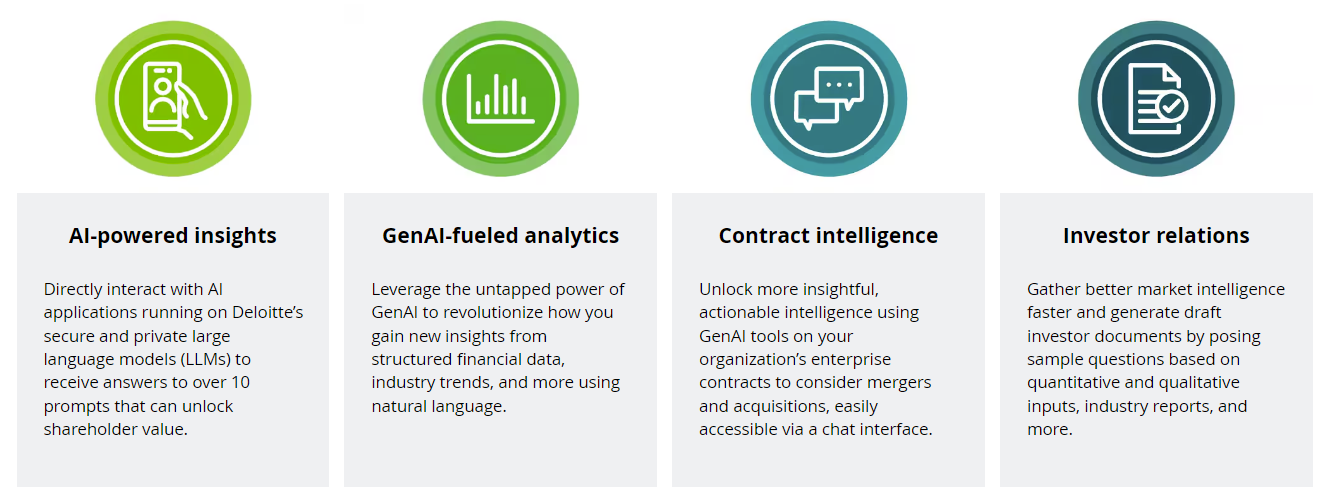
Deloitte launched an AI suite for CFOs and will likely expand into the rest of the C-suite. The general concept is generative AI that speaks finance and is trained on Deloitte, third party and enterprise proprietary data. This GPT for CFOs approach collects data from various source systems to provide a real-time view into enterprise financial health, insights and scenario modeling. The source systems for this GPT for CFO suite? Oracle and SAP (finance), Coupa (procurement), Salesforce (revenue), AWS Redshift, Snowflake and Databricks with more connections on deck.
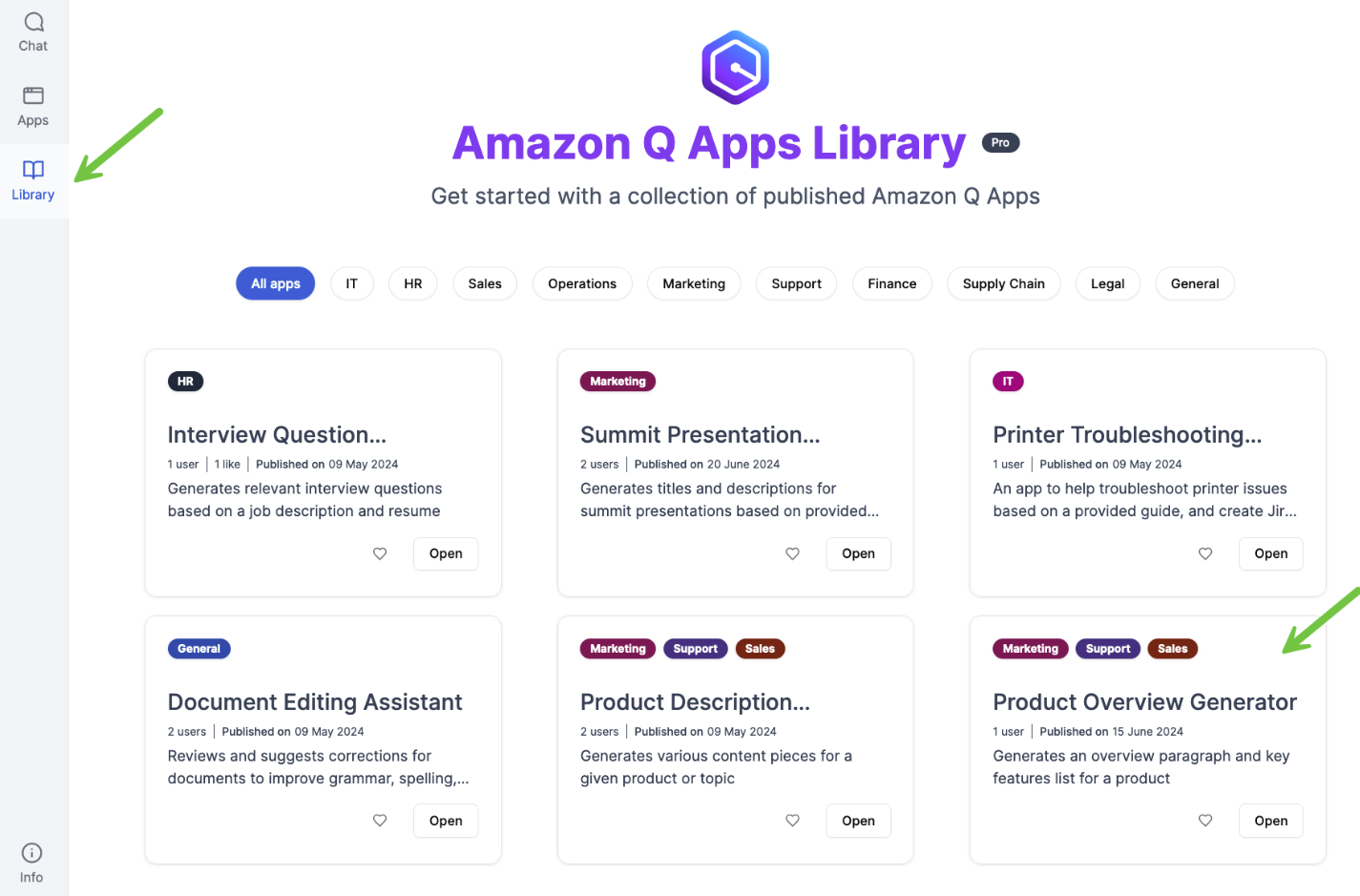
AWS said its Q Apps are generally available. AWS' Q effort is a horizontal approach to generative AI that enables enterprises to automate workflows, create agents that act on your behalf, and automate tasks. Amazon Q is already boosting developer productivity, but its Q Business effort is likely to be a long-tail play for C-levels.
Anthropic is also on the way toward bespoke software. The company’s Artifacts effort is about melding collaboration with genAI.
The theme for these new efforts is simple: Combine data sources, find issues and deliver fixes that drive value. All that is missing from these various efforts is the process mining and automation component that could pair up with evolving genAI interfaces. ServiceNow is tying these disparate enterprise parts together as a platform, but AWS could be downright disruptive. ServiceNow CFO outlines method to Pro Plus SKU pricing
How could Q be disruptive to enterprise software? A few reasons:
AWS has the infrastructure layer and tooling to drive efficiency and potentially compress enterprise software margins. AWS also doesn't have an enterprise software business to protect. AWS did it to data center hardware, moves fast and is focused on customer needs.
CIOs are receptive to hearing more about AWS, Amazon Q and Q Apps because they are tired of software vendors that are looking to maintain margins over customer needs. Enterprise vendors are bifurcating between those that are trying to preserve margins and those that'll absorb some compression.
It’s been a year of disgruntled CXOs in our BT150 meetups.
Enterprises realize technology is at an inflection point, but generative AI is moving so fast they will want horizontal approaches so they can abstract the systems underneath (and avoid lock-in).
Generative AI has created a market that's split between customers that want to build vs. want to buy. An enterprise operating system that enables you to adapt regardless of the enterprise software underneath is compelling. That enterprise OS will have to be built and AWS is all about builders.
Vice President and Principal Analyst
Constellation Research
About Andy Thurai
Andy Thurai is an accomplished IT executive, strategist, advisor, enterprise architect and evangelist with more than 25 years of experience in executive, technical, and architectural leadership positions at companies such as IBM, Intel, BMC, Nortel, and Oracle. Andy has written more than 100 articles on emerging technology topics for publications such as Forbes, The New Stack, AI World, VentureBeat, DevOps.com, GigaOm and Wired.
Andy’s fields of interest and expertise include AIOps, ITOps, Observability, Artificial Intelligence, Machine Learning, Cloud, Edge, and other enterprise software. His strength is selling technology to the CxO audience with a value proposition rather than the usual technology sales pitch.
Find more details and samples of Andy’s work on his…...
Editor in Chief of Constellation Insights
Constellation Research
Larry Dignan is Editor in Chief of Constellation Insights at Constellation Research, where he leads editorial coverage focused on enterprise technology, digital transformation, and emerging trends shaping the future of business. He oversees research-driven news, analysis, interviews, and event coverage designed to help technology buyers and vendors navigate complex markets with clarity and context. ...
Amazon Web Services' Summit New York 2024 is complete and here's a look at a few takeaways and between the lines items you need to know. Overall, there's a #genAI turn to the practical as projects aim to go from pilots to production. Constellation Insights Editor-in-Chief Larry Dignan talks with Constellation VP & analyst Andy Thurai about #cloud-based genAI, industry plays and AWS' sustainability play.
Editor in Chief of Constellation Insights
Constellation Research
Larry Dignan is Editor in Chief of Constellation Insights at Constellation Research, where he leads editorial coverage focused on enterprise technology, digital transformation, and emerging trends shaping the future of business. He oversees research-driven news, analysis, interviews, and event coverage designed to help technology buyers and vendors navigate complex markets with clarity and context. ...
Infor said it has acquired two companies to bolster its data migration and industry cloud efforts.
The company said it acquired Albanero, a data migration and management company, and Acumen, a revenue growth management and consulting firm. Infor's plan is to use Albanero and Acumen to serve up industry-specific data within ERP systems.
Albanero has been an Infor data migration and management partner since 2022. Albanero has a data platform that combines information from multiple systems and migrates it to Infor's CloudSuite applications. With Albanero, Infor said it will be able to consolidate enterprise data within its industry applications for midmarket companies.
Infor said Albanero’s data migration services and API connector are available for its CloudSuite for Food & Beverage, Fashion and Distribution industries. Infor said it will add other industries.
Acumen is focused on consumer-packaged goods (CPG) companies and offers consulting and analytics for pricing, trade terms, promotions and processes. Infor said that Acumen will bring Trade Promotion Management to its stack and will be integrated into Infor CloudSuite Food & Beverage and CloudSuite Fashion.
The two purchases closed July 1. Terms of the deal weren't disclosed. Albanero founders, Bruce Douglas and Manish Sharma, Acumen founders Nick Ryan and Matt Wills, and employees of both organizations will join Infor.
Editor in Chief of Constellation Insights
Constellation Research
Larry Dignan is Editor in Chief of Constellation Insights at Constellation Research, where he leads editorial coverage focused on enterprise technology, digital transformation, and emerging trends shaping the future of business. He oversees research-driven news, analysis, interviews, and event coverage designed to help technology buyers and vendors navigate complex markets with clarity and context. ...
AT&T said that customer data covering "nearly all" of its customers from May 1, 2022, to October 31, 2022, and Jan. 2, 2023 was downloaded from a third-party cloud platform.
The breached AT&T data includes metadata such as cell site ID numbers and interactions as well as phone numbers. Personally identifiable information such as Social Security numbers and dates of birth were not breached, according to AT&T.
In a regulatory filing, AT&T said it learned of the incident April 19 with the attack happening between April 14 and April 25. AT&T said:
"While the data does not include customer names, there are often ways, using publicly available online tools, to find the name associated with a specific telephone number."
AT&T's breach is just the latest in a long line of high-profile attacks that are now required to be disclosed. These attacks mean enterprises need to map out response and resilience over prevention.
Editor in Chief of Constellation Insights
Constellation Research
Larry Dignan is Editor in Chief of Constellation Insights at Constellation Research, where he leads editorial coverage focused on enterprise technology, digital transformation, and emerging trends shaping the future of business. He oversees research-driven news, analysis, interviews, and event coverage designed to help technology buyers and vendors navigate complex markets with clarity and context. ...
Quantum computing software provider Classiq has been busy forging partnerships with everyone from Nvidia to BMW to Citi as it aims to expand enterprise use cases with a software layer that abstracts the underlying hardware.
A customer win with Citi that includes Amazon Braket.
We caught up with Classiq CEO Nir Minerbi to talk about quantum computing and where it's headed.
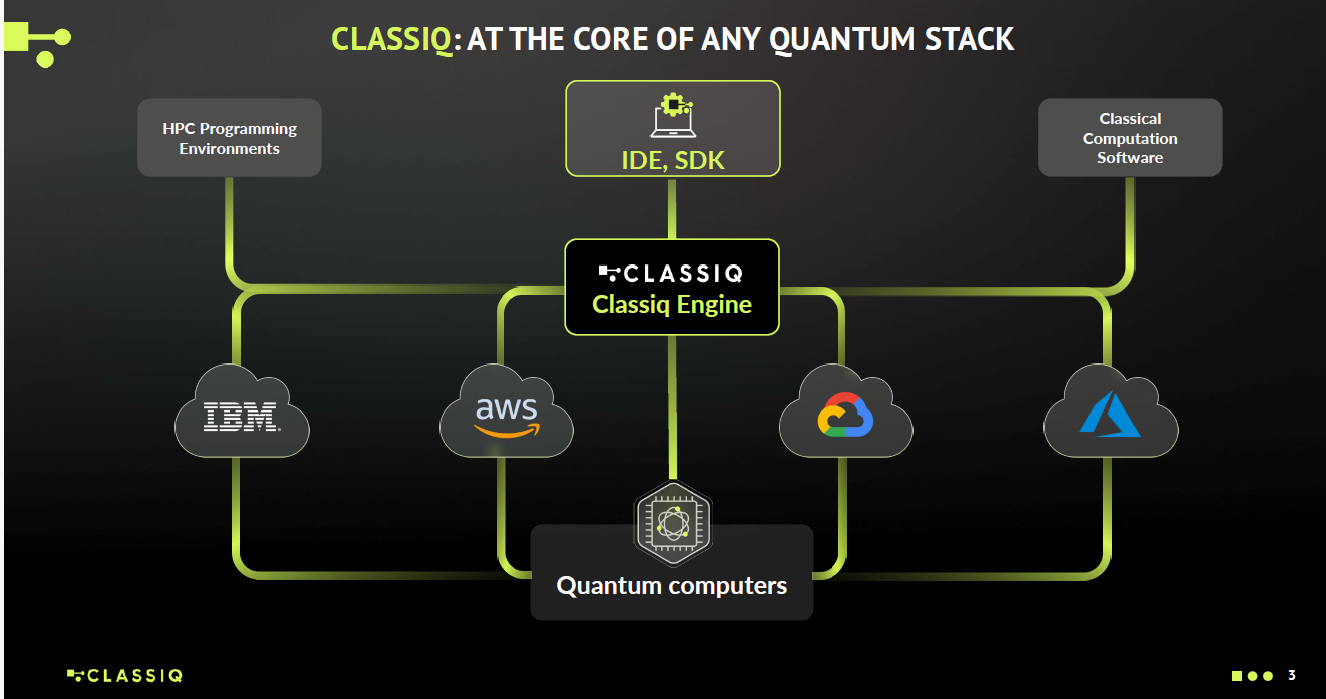
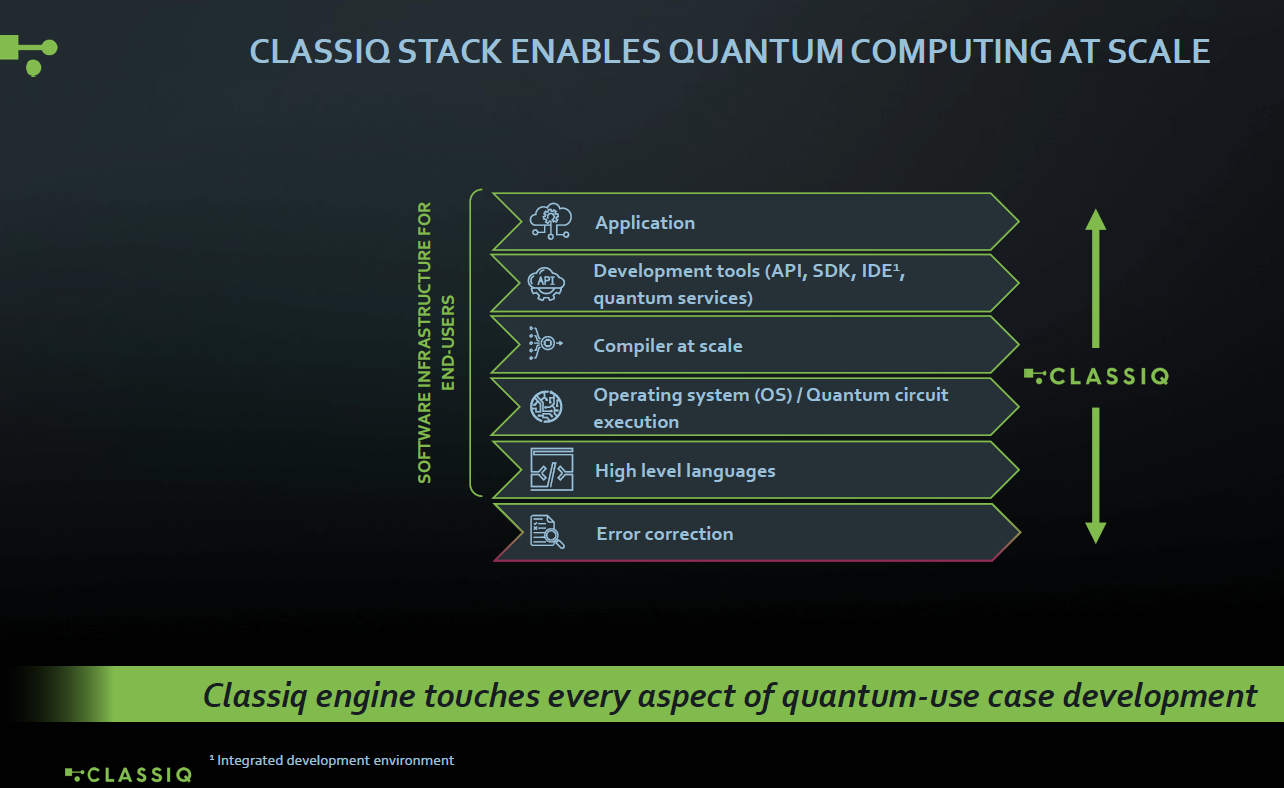
Classiq's role and state of quantum computing. Minerbi said the goal of Classiq is to build out the software layer for quantum computing. "We developed the operating system and compiler for any quantum computer," he said. "We established this company four years ago because no one could really program on quantum computers. We knew software is essential to developing this new field."
He added that Classiq's role is to work across multiple quantum computing providers since there are many players and approaches. Minerbi said:
"The quantum computing revolution has turned from a question of when to one of relatively soon. In order to realize the potential, we need software. Many good companies are focused on developing hardware and it's too early to bet on a winner. We see amazing progress in the industry."
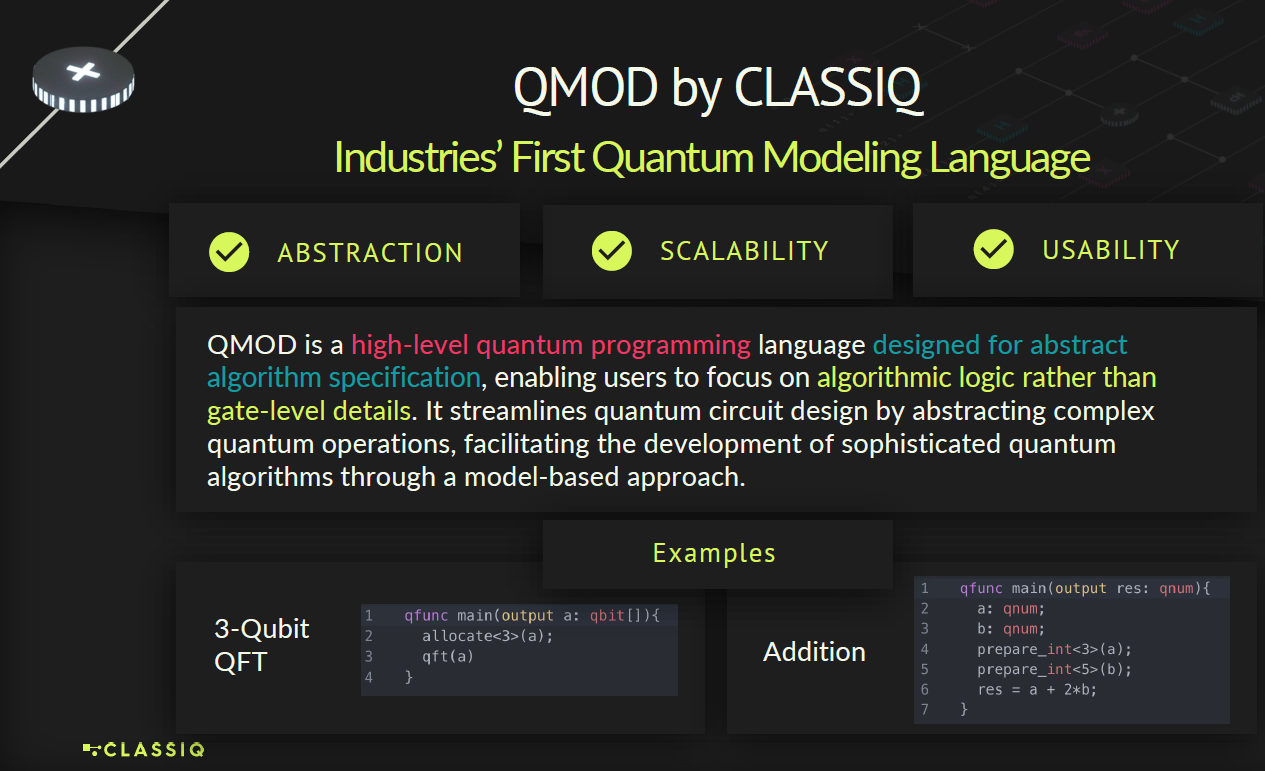
An agnostic approach. Minerbi said Classiq's approach is to be able to integrate with multiple quantum platforms. "We want to be focused on what you want to achieve on the application or algorithm," he said. "Our complier is taking a high-level functional model that optimizes for the specific machine and the software stack automates the rest of the processes." In other words, Classiq is focused on use cases and abstraction layers instead of hampering developers with details about the quantum circuit, error correction and other hardware issues.
Supercomputing and quantum computing. Minerbi said most quantum algorithms are hybrid with some parts for quantum computing and other parts classical. "Today it's definitely a hybrid workflow," said Minerbi. "We see many HPC providers trying to embed quantum computers within the HPC stack. We'll see more HPC centers buying quantum computers and integrating them. From the software perspective, this hybrid approach is something we're very much involved in."
Minerbi noted that HPE is a close partner as is Nvidia, which has its CUDA platform for quantum computing. "Quantum and supercomputing will be integrated so software integration will be very important," he said.
Nvidia's role in quantum. Minerbi said Nvidia is a key partner since many of the quantum simulations were running on GPUs. "These simulations are essential for development of quantum applications and algorithms," said Minerbi. "It's a natural partnership between Classiq and Nvidia."
Minerbi said QPUs, GPUs and CPUs will all be a part of the data center mix and work together.
Meeting developers where they are. Minerbi said Classiq is looking to enable developers to create quantum applications without being experts in quantum computing. "The level of abstraction is tight. You don't need to specify gate level operations and can use Python," he said.
Enterprise use cases. Classiq recently announced partnership with BMW, which established a quantum team a few years ago. Minerbi said BMW understood that to truly leverage quantum you have to create a team to develop applications, algorithms and the IT to be proficient before that hardware is ready. BMW is optimizing cooling systems with quantum algorithms and other use cases. A Classiq partnership with Citibank is different since the bank is just establishing its quantum efforts. Minerbi aid those two examples represent the extremes in quantum, but Classiq aims to be the software stack that appeals to all levels.
The roadmap ahead. Minerbi said Classiq's roadmap for the past few years has been to "take the best practices and technologies from the classical stack and bring them to quantum."
"We eventually want the quantum stack to be almost the equivalent in abstract development and high-performance results," said Minerbi. "All of the pillars are already in the platform, but there's so much work to be done. You'll be able to model a quantum program in a visual way with blocks with python embedded and more integrations. We need to progress the hardware to extract more value with less quantum resources."
Editor in Chief of Constellation Insights
Constellation Research
Larry Dignan is Editor in Chief of Constellation Insights at Constellation Research, where he leads editorial coverage focused on enterprise technology, digital transformation, and emerging trends shaping the future of business. He oversees research-driven news, analysis, interviews, and event coverage designed to help technology buyers and vendors navigate complex markets with clarity and context. ...
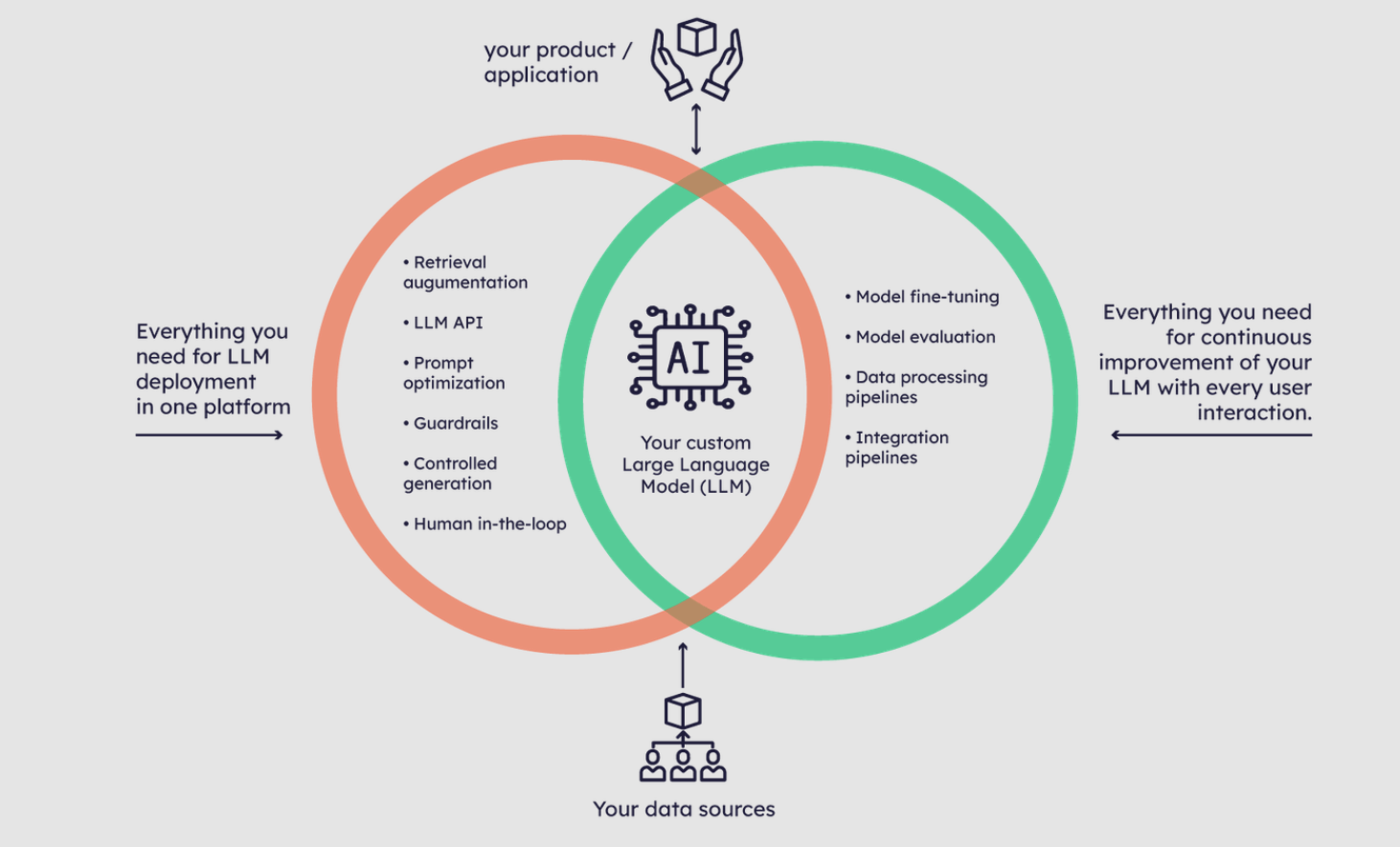
Amazon Web Services is focused on enabling generative AI throughout its platform in a bid to move projects from pilots to production. The strategy is to meet enterprises where they are with practical features including fine-tuning of large language models (LLMs), guardrails and additons to Amazon Bedrock.
At AWS Summit in New York, the company set out to layer genAI throughout its tech stack along with services that will make it more part of the everyday workflows. To make genAI move from proof of concept to production, AWS is rolling out a series of services. Bayer is rolling out Amazon Q across its organization and Amazon's One Medical is doing the same. AWS, which has launched 326 genAI features since 2023, also touted use cases at Ferrari to ingest data from vehicles and create new designs and models.
Add it up and AWS' big goal was to highlight its genAI stack n a way that equates to a series of productivity gains and business wins. Matt Wood, VP of AI Products at AWS, said: "It's better to focus on what's not going to change."
In other words, genAI will have to deliver business value to move from pilot to production. Wood said genAI is early in its development with leaps in business value appearing in the next 12 to 18 months. "It's becoming apparent that genAI will be woven throughout all of our applications," said Wood.
Here's a look at what AWS announced:
Q Apps goes to GA
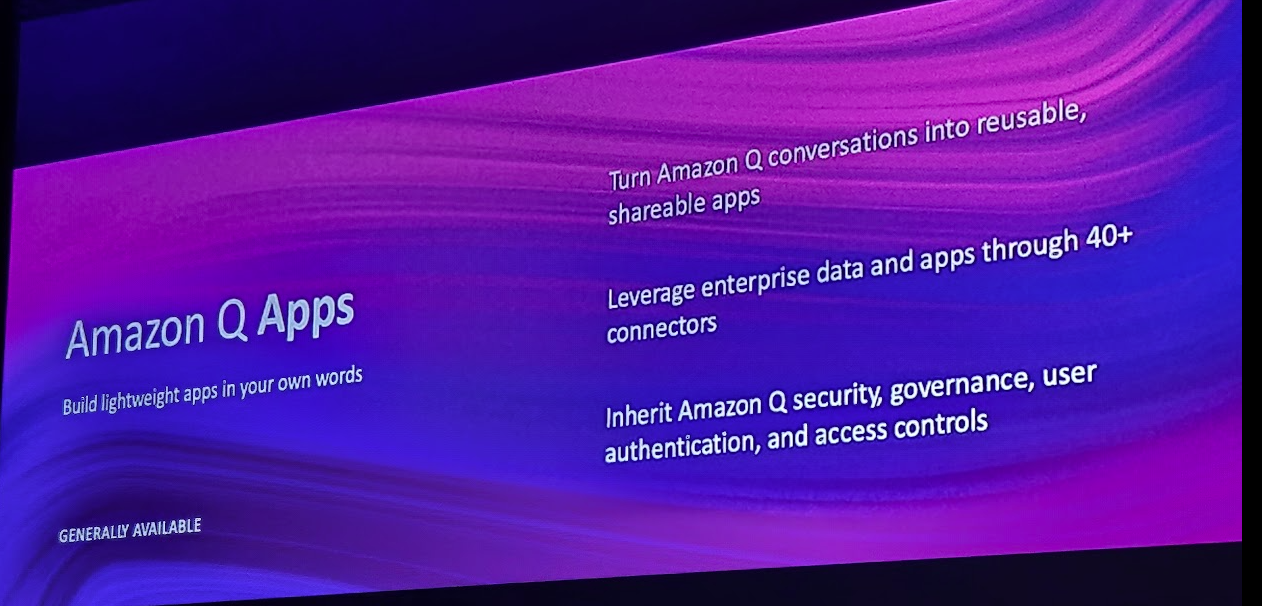
Q Apps will be generally available. AWS said Q Apps will enable customers to build apps that can execute tasks via a natural language interface. Q Apps can then be shared with others if useful. AWS pitch for Q Apps focused more on optimizing processes. For instance, Q Apps can distill CRM data to generate insights that go into new RFPs saving hours spent digging through documents and content repositories.
The shift with Q Apps is that AWS is moving from finding an answer to a question to figuring out what the problem is. What remains to be seen is whether a horizontal interface such as Q effectively becomes the engagement layer to other enterprise applications.
Q Apps can turn Amazon Q conversations into apps, leverage enterprise data and inherit security and governance controls.
AWS is enabling developers to generate custom code inside Amazon Q Developer since Q can become familiar with an enterprise's coding practices, terminology and comments. "Picture a world where developers are running multiple agents in parallel," said Wood.
The upshot is that customers are starting to use Amazon Q as a vehicle to build assistive systems. Wood said Q can be used for large applications as well as ones for small teams. Smartsheet uses Amazon Q chatbots to connect teams, write account plans and complete other tasks.
Bedrock improvements
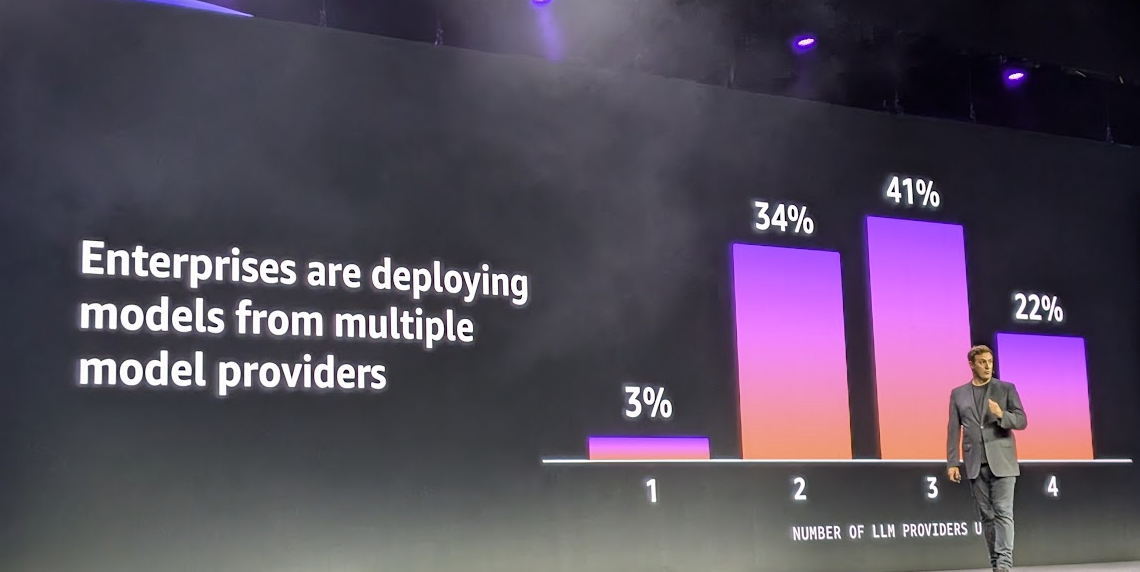
Bedrock will add a new image model from Stability AI to complement the addition of Anthropic's Claude 3.5 Sonnet. Wood said that 41% of large enterprises were using 3 or more large language models.
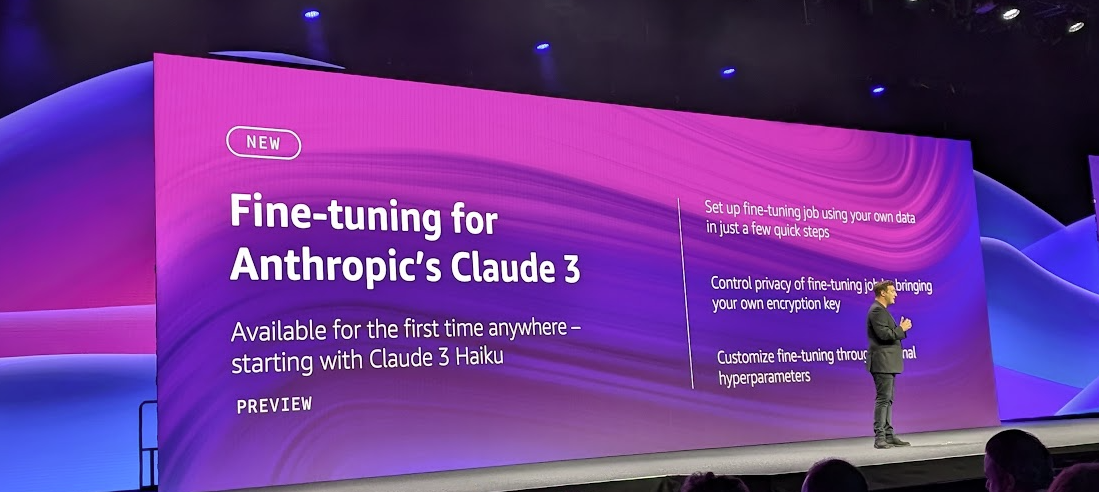
Claude 3 Haiku will also be fine-tunable via Bedrock. The ability to fine tune models in Bedrock will be a win for enterprises since fine tuning a smaller model is more cost effective and useful. Fine-tuning for other Claude models will follow. Wood said a few quick steps will enable enterprises to tune with internal data, control privacy with encryption keys and customize with hyperparameters.
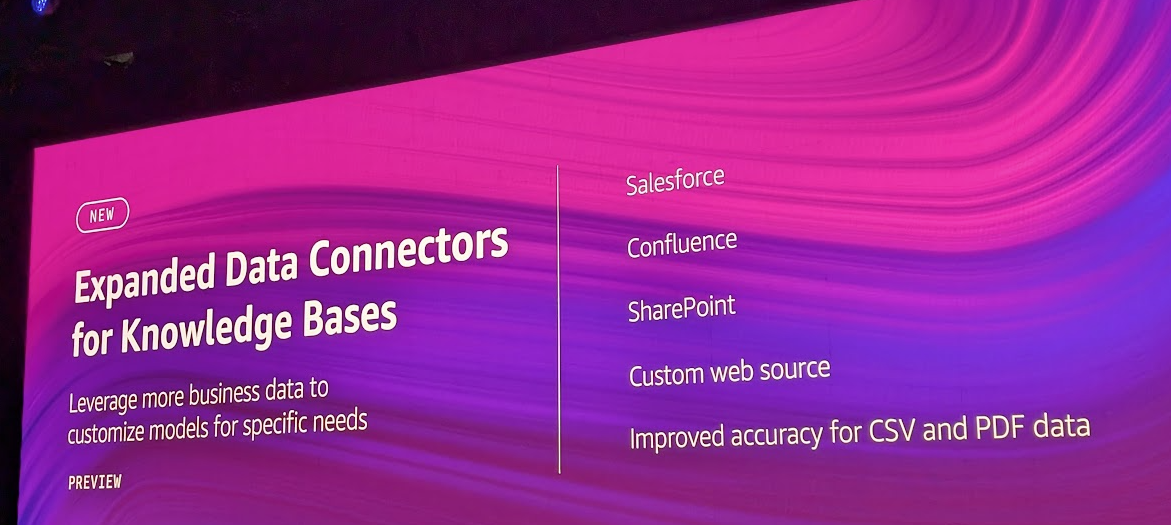
"Customers are using RAG for a wide range of use cases," said Wood. "We're expanding the type of data you can connect beyond S3 into additional data connectors and Web data from user provided public URLs."
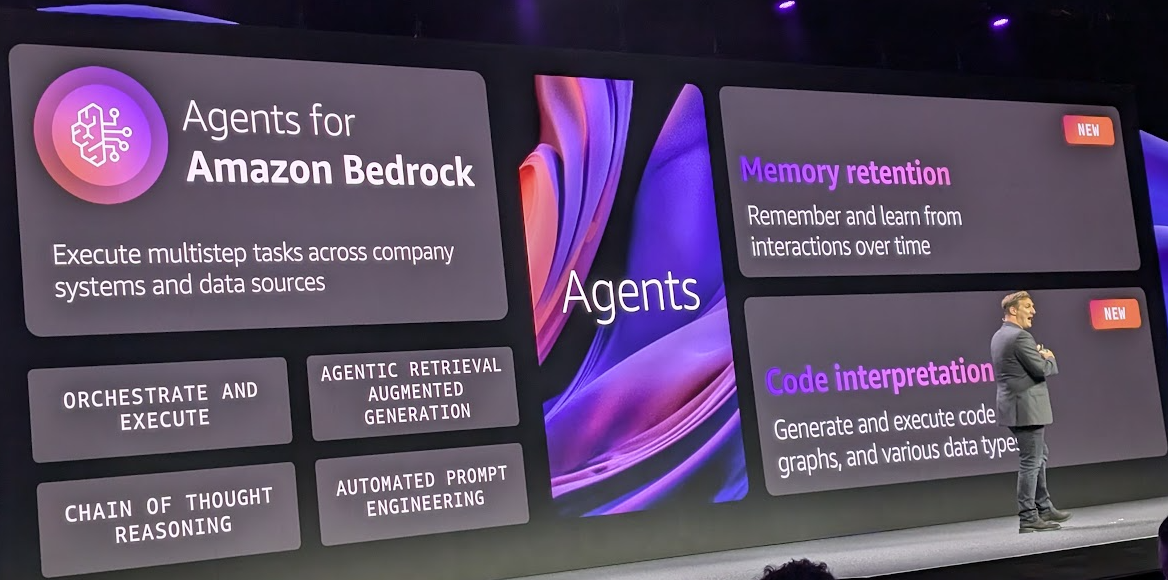
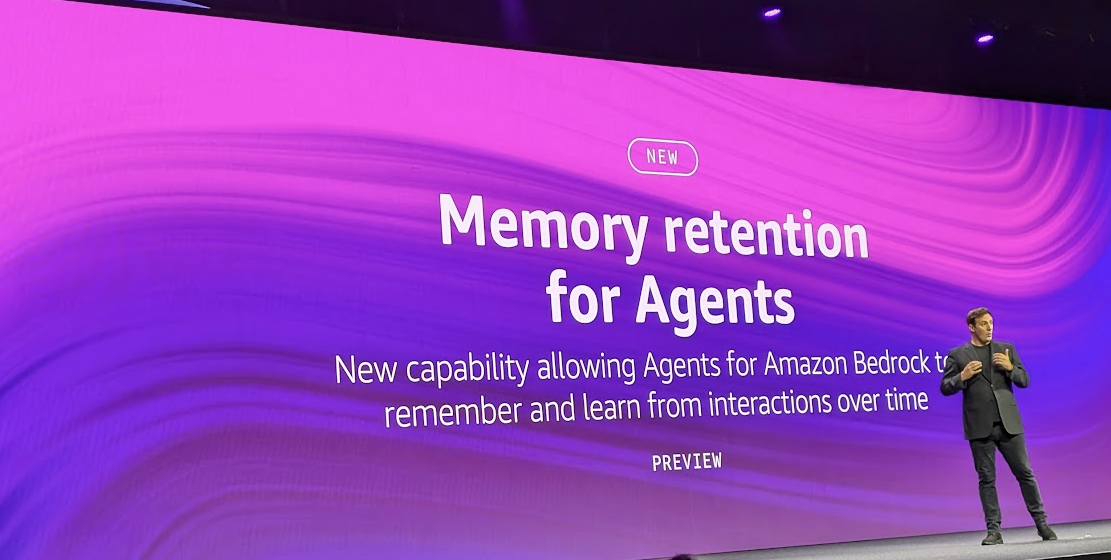
AWS said it is also adding more capabilities to Agents for Amazon Bedrock including the ability to retain memory over multiple interactions. This ability is being integrated into customer facing use cases at Delta, United and Booking.com.
"You can carry over the context from different agent workflows," said Wood.
Wood added that Agents for Amazon Bedrock will be able to generate code, analyze data and generate graphs.
Guardrails
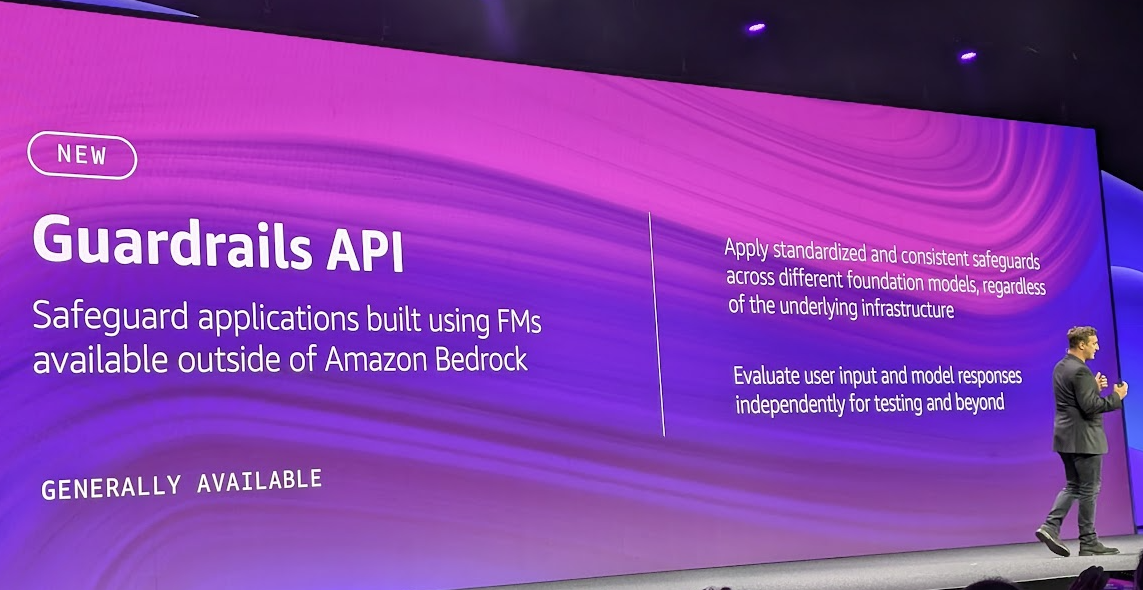
The company is also launching guardrails beyond Bedrock that are independent of models, Guardrails can ground based on context, search for a subset of acceptable answers via knowledge base connectors and increase response rates. AWS is betting that the ability to add a guardrail layer that's LLM and application agnostic will be a win.
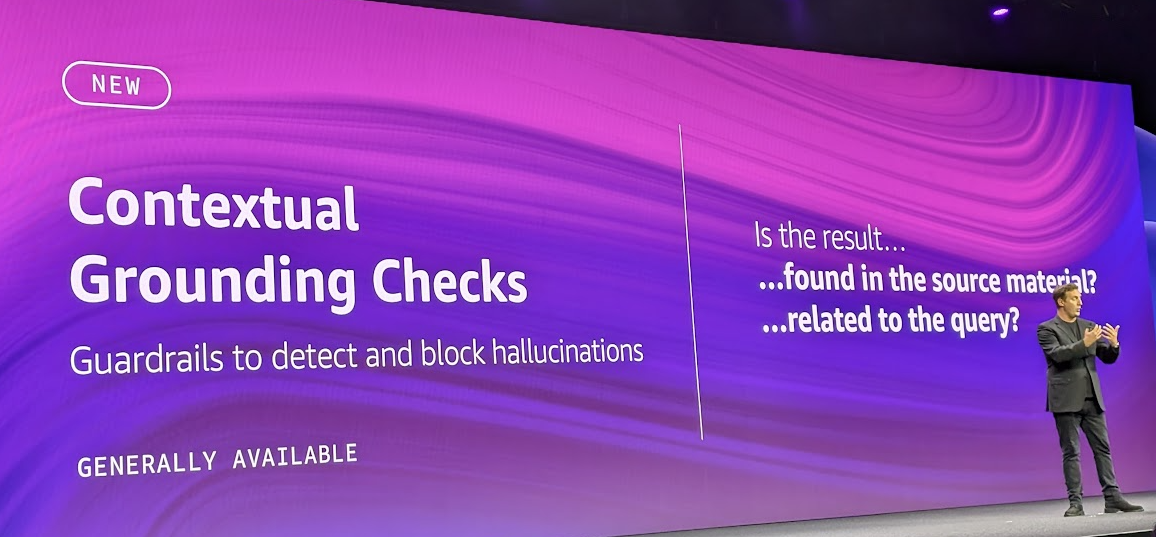
AWS launched Contextual Grounding Check in Guardrails to ground answers via knowledge bases and corporate data. The grounding check asks if the RAG result is found in source material and whether it's related to the query.
AWS is also adding a new interface for prompt flows and prompt management. These prompt tools will be specific to model families but will enable faster upgrades.
Amazon is matching 100% of the electricity consumed by global operations with renewable energy. The play here for AWS is offsetting sustainability concerns due to genAI workloads.
Editor in Chief of Constellation Insights
Constellation Research
Larry Dignan is Editor in Chief of Constellation Insights at Constellation Research, where he leads editorial coverage focused on enterprise technology, digital transformation, and emerging trends shaping the future of business. He oversees research-driven news, analysis, interviews, and event coverage designed to help technology buyers and vendors navigate complex markets with clarity and context. ...
AMD has invested $125 million across a dozen AI companies in the last 12 months and acquired Mipsology and Nod.ai. The spending spree is designed to bolster AMD as a full-stack AI player.
Peter Sarlin, CEO of Silo AI, will continue to lead the company, which will become a part of AMD Artificial Intelligence Group. The deal is expected to close in the second half of 2024. Vamsi Boppana, senior vice president of the Artificial Intelligence Group at AMD, said Silo AI will accelerate AMD's AI strategy.
Key facts about Silo AI include:
The company is based in Helsinki, Finland.
Customers include Allianz, Philips, Rolls-Royce and Unilever.
Silo AI has open-source multilingual LLMs including Poro and Viking.
The company is known for its SiloGen model platform and Silo OS.