Results

CoreWeave raises $7.5 billion in debt financing for AI data center buildout

CoreWeave, a hyperscale cloud provider focused on AI workloads, raised $7.5 billion in debt financing to build out data centers primarily with Nvidia GPUs to go with $1.1 billion in equity funding earlier this month.

In the last 12 months, CoreWeave has raised more than $12 billion in equity and debt financing. CoreWeave's funding highlights how the generative AI boom has fueled a new category of specialized cloud vendors.

The debt financing, led by Blackstone, Magnetar and Coatue, will be used to develop compute infrastructure for existing contracts. CoreWeave customers are using its infrastructure to train models.

CoreWeave is also building out its European footprint, which includes a headquarters in London and a commitment to invest $1.25 billion in the region.

By the end of 2024, CoreWeave expects to have 28 data centers double its 2023 footprint, which was up from 3 data centers in 2022.

Michael Intrator, CoreWeave CEO and co-founder, said the company is looking to provide specialized GPU cloud infrastructure that can "reshape the cloud landscape, accelerate the AI race, and power the next generation of AI innovation." CoreWeave's infrastructure is designed for AI and machine learning, graphics and rendering and life sciences and other intensive workloads.

Nvidia is a CoreWeave investor, and the cloud provider is adopting its latest technology in its data centers whether it's GPUs, networking systems, applications and architecture. For Nvidia, CoreWeave is a key cog in its plans to scale AI factories. Microsoft is reportedly among CoreWeave’s largest customers.

According to CoreWeave, its infrastructure is purpose built for intensive workloads and can deliver performance 35x times faster and 80% less expensive than general purpose clouds. Here's a look at CoreWeave's Nvidia GPU pricing.


Data to Decisions Tech Optimization Innovation & Product-led Growth Future of Work Next-Generation Customer Experience Digital Safety, Privacy & Cybersecurity nvidia Big Data ML Machine Learning LLMs Agentic AI Generative AI AI Analytics Automation business Marketing SaaS PaaS IaaS Digital Transformation Disruptive Technology Enterprise IT Enterprise Acceleration Enterprise Software Next Gen Apps IoT Blockchain CRM ERP finance Healthcare Customer Service Content Management Collaboration Cloud CCaaS UCaaS Enterprise Service GenerativeAI Chief Information Officer Chief Technology Officer Chief Information Security Officer Chief Data Officer Chief Executive Officer Chief AI Officer Chief Analytics Officer Chief Product Officer

BT15O Zeitgeist: Vendor procurement, cool projects and margin compression

CxOs aren't thrilled with their enterprise technology vendors, becoming frustrated with copilots that don't play well together, and spending a good amount of time on procurement and consolidation.

Those were some of the takeaways from Constellation Research's BT150 CXO meetup

Projects from the BT150. We typically start off these calls with a simple question: What are you working on? Here are some of the projects that stood out.

  • A virtual customer rep. One of our CxOs worked on a virtual space that combines the website with a physical store and a synthetic employee, which operates in a store and can show products and promotions as well as transact. The virtual employee can leverage the website content, generative AI and multiple language. The pilot is still in the learning stage but looks promising.
  • Data centers in Africa. One person in the BT150 is working on data center buildouts in Africa and noted challenges ranging from rain forests, lack of roads and other infrastructure. The upside to these data center challenges is that the jobs involved can form a middle class.
  • Mainframe migrations aren't easy. You work through a multi-year transformation and the final step is moving off of the mainframes. The hardest part of moving off mainframes are data migration, risk and cost. Mainframes are stable and can also be the most cost effective. The challenge isn't the compute, but the underlying data.

Security consolidation. Enterprises are looking to consolidate security vendors and platforms and not buying a tool unless it replaces something the company already has. Enterprises have realized more tools don't equate to better results. Vendors are either pitching platforms or forming alliances to work better with the rest of the security stack.

BT150 2024:

Data breach resiliency and response moves to the forefront. CxOs are tasked with post breach plans and execution. The biggest challenge to responding to a cyberattack is that key parties (security intelligence), analysts and key stakeholders aren't talking.

Copilots aren't working well together even when they're on the same platform. Customers highlighted frustration with copilots breaking and not being well integrated with sibling applications. The problem? Vendors are racing to launch AI and scrimping on product development and integration.

Vendor management, procurement and margin compression. There were multiple takeaways about vendors and some of the comments from our CxOs were less than flattering. Key takeaways include:

  • Oracle has a second life as a cloud provider and relevant IT vendor due to its database as well as its Oracle Cloud Infrastructure. The tech stack Oracle has created is strong. What's the problem? Oracle is a pain to deal with. Oracle is great at getting you set up and terrible when you're locked in. Oracle has done a few great things--cutting data egress fees, the Azure partnership and cloud efficiency--but is saddled with a bad reputation due to audits, compliance and sales practices. Oracle's reputation isn't about tech as much as it is the sales approach.
  • ServiceNow's platform reduces costs even as customers consolidate on the company. ServiceNow has become a key abstraction layer for enterprise IT. ServiceNow gets the margin compression game and appears to be on the right side to make it work.
  • Categorize your vendors based on whether they are trying to preserve margins or enable you to save by compressing them. Salesforce, Microsoft and SAP are playing the margin preservation game, which will require a different negotiation strategy.  The bet is that the vendors that become a lever for margin compression will win out over those trying to preserve margins.
  • The bench of enterprise disruptors is thin. The CxO dance with massive enterprise software and cloud providers will continue because there aren't enough new vendors to disrupt them. Disruptive challenges are either acquired or stuck due to a dismal IPO market.

Disruption will have to be home grown. Given the state of the enterprise vendor landscape, companies that want competitive advantage will have to build their own automation and best process practices. You can't wait for an enterprise vendor to innovate.

New C-Suite Data to Decisions Future of Work Innovation & Product-led Growth Tech Optimization Leadership Chief Information Officer Chief Experience Officer

Palo Alto Networks buys IBM's QRadar security offerings in broad alliance

Palo Alto Networks will acquire IBM's QRadar Software assets in a broad partnership that gives the security vendor IBM Consulting as a channel.

As security vendors race to consolidate platforms and customer wallet share, IBM and Palo Alto Networks moved to forge an alliance that on paper looks like a win-win.

Here are the moving parts:

  • IBM will use Palo Alto Networks as its preferred security platform internally.
  • Palo Alto Networks will use watsonx large language models (LLMs) in Cortex XSIAM.
  • IBM will offer more security services and feature Palo Alto Networks' platform and train more than 1,000 of its security consultants. These consultants will focus on migrating enterprises to Palo Alto Networks.
  • Palo Alto Networks will acquire QRadar's software as a service assets and migrate customers to Cortex XSIAM at no cost. QRadar on-premises customers remain with IBM for features, support and bug fixes, but can also migrate to Cortex XSIAM.
  • IBM will receive payments from Palo Alto Networks for QRadar on-prem customers that migrate to Cortex XSIAM.
  • Palo Alto Networks to become the lead partner for IBM's hybrid cloud and AI efforts.

With IBM as a partner, Palo Alto Networks is looking to fend off multiple players including CrowdStrike. IBM can focus on its core strengths and leverage security services and AI models. CrowdStrike recently expanded its partnership with AWS

Chirag Mehta on the intersection of cybersecurity, design thinking and AI

The companies also said they will form a Joint Security Operations Center. IBM Consulting will be the preferred managed security services provider for Palo Alto Networks customers. Palo Alto Networks will also be accessible on IBM Consulting's Advantage AI services platform.

Financial details of the partnership weren't disclosed.


Digital Safety, Privacy & Cybersecurity Data to Decisions Innovation & Product-led Growth Future of Work Tech Optimization Next-Generation Customer Experience palo alto networks AI GenerativeAI ML Machine Learning LLMs Agentic AI Analytics Automation Disruptive Technology cybersecurity Chief Information Officer Chief Information Security Officer Chief Privacy Officer Chief AI Officer Chief Experience Officer

Cisco Q3, Q4 outlook better as company preps Splunk integration

Cisco's third quarter was better-than-expected and the company outlined its next steps in the Splunk integration. The acquisition of Splunk means Cisco's subscription revenue is 54% of the total.

The company reported third quarter revenue of $12.7 billion, down 13% from a year ago. Splunk's revenue contribution in a partial quarter was $413 million. Earnings for the third quarter were 46 cents a share (88 cents on a non-GAAP basis).

Wall Street was expecting Cisco to report third quarter non-GAAP earnings of 82 cents a share on revenue of $12.6 billion.

As for the outlook, Cisco projected fourth quarter revenue of $13.4 billion to $13.6 billion, above estimates of $13.54 billion. Non-GAAP earnings in the fourth quarter will be 84 cents a share to 86 cents a share. Wall Street expected fourth quarter non-GAAP earnings of 84 cents a share.

For fiscal 2024, Cisco is projecting revenue of $53.6 billion to $54.6 billion. Non-GAAP earnings will be $3.69 a share to $3.71 a share.

Cisco also said former Splunk CEO Gary Steele will become President of Go-to-Market effective immediately. Steele will lead the Splunk integration process. Jeff Sharritts, Cisco’s Chief Customer and Partner Officer will depart in mid-July.

Here's a breakdown of Cisco's third quarter by product line:

  • Networking revenue was down 27% from a year ago, but Cisco did note that customers were installing inventory.
  • Security revenue was up 36%.
  • Collaboration was flat.
  • And observability was up 27%.

Splunk integration

Speaking on a conference call, Cisco CEO Chuck Robbins outlined the Splunk integration. The first effort is focused on sales synergies. Robbins said:

"The closing of the Splunk acquisition in q3 will also enable us to begin driving revenue synergies in our security and observability markets. Upon closing the deal, we identified 5,000 existing Cisco customers who have the potential to become meaningful Splunk customers and our sales teams are already making those connections."

Robbins added that Splunk will be added to Cisco's partner ecosystem where the acquired company had little presence.

The companies also plan to integrate products and made a first installment at RSA Conference.

"We're working on rapid integration, investing in both product integration and go to market resources, starting with aligning our Cisco and Splunk sales forces and accelerating challenge enablement processes for cross selling and upselling our combined solutions."

Cisco plans to converge its security portfolio with Splunk. For now, the two companies are rolling out new features and integrations. Cisco said Extended Detection & Response (XDR) is now integrated with Splunk Enterprise Security to provide one detection to remediation workflow. Cisco also said its unified AI Assistant for Security is available in Cisco XDR. The company also said its Panoptica application protection platform includes AI and machine learnings for real-time alerts. Cisco also said Hypershield, launched last month, will get tools to isolate attacks from unknown vulnerabilities within the runtime. See: Splunk’s Acquisition by Cisco Accelerates Convergence of Network, Security, and Observability, Fueled by AI | 11 Top Cybersecurity Trends for 2024 and Beyond

AI infrastructure a focus

Robbins added that Cisco designs for AI architecture are doing well in hyperscale cloud deployments. Enterprises are also interested.

He said:

"We continue to see momentum with three of the top four hyperscalers deploying our Ethernet AI fabric, leveraging Cisco validated designs for AI infrastructure in the past two quarters.

Additionally, for those leading-edge enterprise customers who seek to be the early adopters of AI, our partnership with Nvidia will offer easy to deploy cloud based and on prem networking solutions for AI inferencing."

Constellation Research's take

Constellation Research analyst Holger Mueller said Cisco has challenges ahead:

"Chuck Robbins really thinks he can keep the cost structure of Cisco in place, and grow back to a level that justifies the current setup. Revenues were down about $2 billion year over year, but operating expenses are up (incl. restructuring). Splunk's impact was minimal overall, with the executive change of Gary Steele becoming President Go-To-Market for Cisco overall. It is clear that Robbins wants to make up for the networking revenue shrinkage with growth in security and observability, helped of course by Splunk, but with all regions shrinking, this will be a tough 3 to 4 quarters for Cisco ahead – again. The good news is subscription revenue is now 54% of revenue. Can Cisco find a way to gain from cloud and AI growth? So far it has not, but maybe Gary Steele will unlock this challenge."


Tech Optimization cisco systems Chief Information Officer

ServiceNow, Oracle Cloud Infrastructure, Event Analysis | ConstellationTV Episode 80

We've made it to ConstellationTV episode 80! 🎉 Watch co-hosts Liz Miller and Holger Mueller analyze the latest h#enterprise tech news (#Data accelerating ServiceNow, enterprise #tech companies to watch)

Then hear Liz's "live from the road" takeaways of Smartsheet ENGAGE and Avaya ENGAGE, and round out the episode with Holger's view that Oracle Cloud Infrastructure is on a roll!

0:00 - Introduction
1:17 - Enterprise #technology news coverage
16:05 - Analysis of #SmartSheetENGAGE and #AvayaENGAGE
27:03 - Update on Oracle Cloud Infrastructure
41:54 - Bloopers!

ConstellationTV is a bi-weekly Web series hosted by Constellation analysts, tune in live at 9:00 a.m. PT/ 12:00 p.m. ET every other Wednesday!

On ConstellationTV <iframe width="560" height="315" src="https://www.youtube.com/embed/7oS5PoRjOEk?si=LRbP_wru1RilIYuc" title="YouTube video player" frameborder="0" allow="accelerometer; autoplay; clipboard-write; encrypted-media; gyroscope; picture-in-picture; web-share" referrerpolicy="strict-origin-when-cross-origin" allowfullscreen></iframe>

Will Meta's Workplace shutdown be a boon for Zoom's Workvivo?

Meta is shuttering its Workplace enterprise platform with a June 1, 2026, sunset and the move could be a boon for Zoom's Workvivo, which was acquired a little more than a year ago.

Workvivo is the sole migration partner for Meta Workplace, which had as many as 7 million subscribers in 2021. Workplace emerged as an employee engagement suite during the COVID-19 pandemic and was an avenue to connect frontline workers. Connecting frontline workers is still a big priority for enterprises. 

The Workplace from Meta timeline goes like this.

  • Until Aug. 31, 2025: Workplace functions as usual. Meta will discount Workplace by 50% from Sept. 1, 2024, to Aug. 31, 2025.
  • Sept. 1, 2025, to May 31, 2026: Workplace will be only accessible to read and download existing data.
  • June 1, 2026: Workplace will be terminated and deleted.

According to Meta, Workplace's Graph API will be able to export information from your instance to Workvivo. However, Meta noted: "we will be working with Zoom to provide additional tools and services to facilitate a better transition for customers from Workplace to Zoom’s Workvivo product. We will follow up with more details for Workplace admins in the coming days and weeks."

The bet here is that most enterprises have Zoom so the migration to Workvivo won't be totally foreign.

What's unclear is how much of a boon the Workspace shutdown will be for Workvivo. For starters, the number of active Workspace subscribers remains a mystery. In addition, there's plenty of time for Workspace customers to consider other options.

The Constellation Research Shortlist for Employee Digital Workspaces includes Workplace competitors such as Microsoft Teams, SAP SuccessFactors Work Zone, Unily and others. Microsoft Teams is likely to be the biggest player looking to court Workplace users.

When Zoom reports its first quarter earnings, Workvivo is likely to get more play. In the fourth quarter, Zoom CEO Eric Yuan said that Workvivo upsold a Fortune 10 company and Zoom customer. A Workvivo customer adopted the broader Zoom platform. "As you can see, adding new products both organically and inorganically creates a virtuous cycle, allowing us to sell more product into a larger base," said Yuan.

If Zoom is successful, the deal as the sole migration partner should give Workvivo some momentum. It remains to be seen how many Workplace customers convert. For now, Workvivo and Meta have to execute and give customers a seamless migration

John Goulding, CEO and founder of Workvivo, said: "It's our top priority to support customers through this transition, and our team is working to make this process as frictionless as possible." 

Workvivo and Meta will provide migration tools and free implementation services. 

Future of Work Next-Generation Customer Experience Data to Decisions Innovation & Product-led Growth New C-Suite Sales Marketing Digital Safety, Privacy & Cybersecurity Tech Optimization Chief Information Officer Chief Experience Officer

Google I/O 2024: Multimodal Gemini, Project Astra, AI agents and 'teammates'

Google I/O 2024 featured a bevy of generative AI advances that will be layered throughout Google's product portfolio--photos, music, Workspace, search, video and other areas--but the real takeaway was that the company laid out its vision for agents, models training models, and creating systems that work for you.

Sundar Pichai, Alphabet CEO, outlined the vision a day after OpenAI laid out GPT-4o.

"With multi-modality soon you'll be able to mix and match inputs and outputs. This is what we mean when we say it's an IO for a new generation. That's one of the opportunities we see with AI agents. I think of them as intelligent systems that show reasoning, planning and memory and are able to think multiple steps ahead. They work across software and systems, all to get something done on your behalf and most importantly, under your supervision.

We are still in the early days, and you will see glimpses of our approach throughout the day."

Search is obviously the most important venue for Google generative AI given that it funds the model buildout. Google rolled out multistep reasoning in search and features such as AI Overview. Google search will ultimately reason, do research for you and tap into real-time data. We assume that this work on your behalf will feature advertising, but the data loop may be more important. 

But search was just the obvious headliner--for developers and Wall Street. Here are the takeaways to note from Google I/O's barrage of news, which served as a sequel to Google Cloud Next.

Project Astra. Astra is a "universal AI agent" designed to be helpful in everyday life. Astra is one of the reasons Gemini is multimodal and has AI training AI models. Google Deepmind Chief Demis Hassabis said Astra makes is a creation that's based on models training models and data feedback loops.

"At any one time, we have many different models in training, and we use our very large and powerful ones to help teach and train our production ready models together with user feedback," said Hassabis.

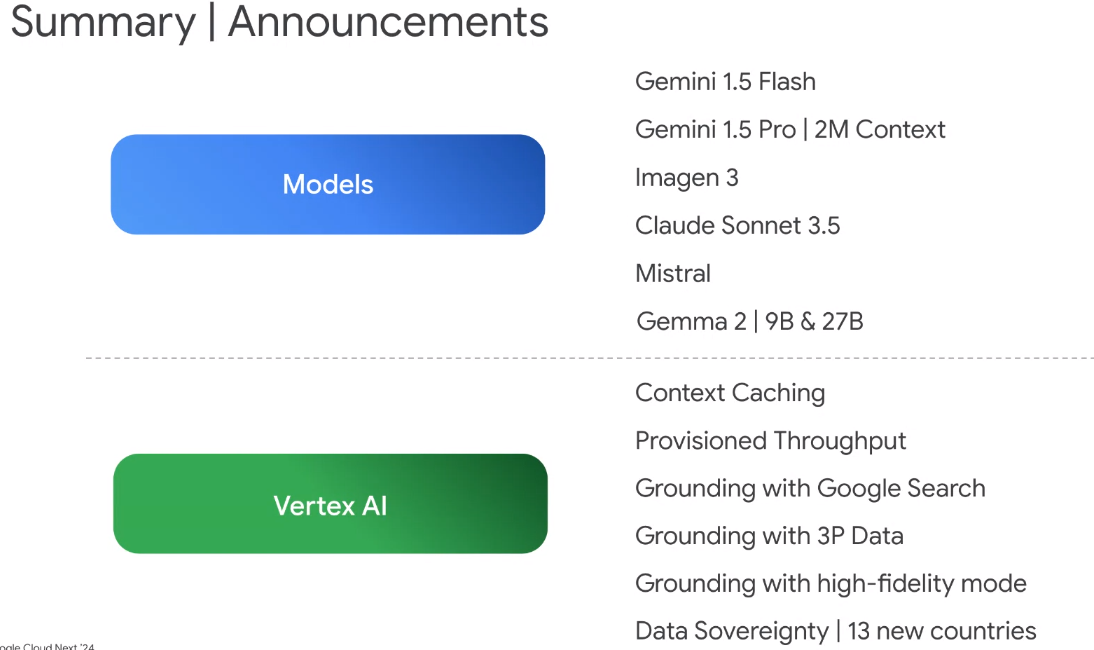
The token arms race. Pichai outlined how 1.5 million developers are using Gemini models to create next-gen AI applications. Gemini 1.5 Pro will now have a 2 million token context window and aggressive pricing. Gemini 1.5 Pro will be available today in Workspace Labs and be capable of synthesizing meetings, documents and your Gmail quickly.

Trillium, a new TPU that will be available on Google Cloud for machine learning and AI workloads. "Trillium delivers a 4.7x improvement in compute performance per chip. Over the previous generation. So most efficient, and performant TPU today will make Trillium available to our cloud customers in late 2024," said Pichai, who noted that Google Cloud will offer Nvidia Blackwell GPUs too. Pichai's message was that Google has the scale to keep building out infrastructure for the AI arms race whether it's in liquid cooling advances, custom processors and fiber cables around the world. 

Gemini 1.5 Flash is a model that's expected to be as powerful as Gemini 1.5 Pro, but be faster. Gemini 1.5 Flash is designed for low latency tasks as well as the small, but fast model trend. Gemini 1.5 Flash, available for public preview, is built for speed and real-time answers such as customer service responses even with an up to 1 million token window.

Search will have planning capabilities. Google pitched a vision where search can answer complex questions and plan. When looking for ideas, Google will give you an AI-generated answer powered by Gemini. These answers and suggestions will likely be monetized. AI-organized search results will appear when you're looking for inspiration. Don't be surprised if these planning capabilities turn up in Google Cloud services. Would business and process planning be much of a leap?

Meet your AI teammate. Workspace's Gemini-powered side panel will be available this month. These features across Workspace apps--Gmail, Meet, Docs--were announced at Google Cloud Next. Google demonstrated AI Teammate, an agent that has a Workspace account and participates in tasks and projects. The demo featured "Chip" configured by the business. The timeline? Stay tuned. Google is also rolling out Gems, which is a personalized Gemini assistant.

Gemini Nano will be multi-modal on Android devices. This AI on device announcement front runs Apple WWDC, but the move highlights how smartphones and edge devices will run models with low latency and create new experiences. Android 15 will feature "Gemini at the core."

Data to Decisions Digital Safety, Privacy & Cybersecurity Innovation & Product-led Growth Tech Optimization Future of Work Next-Generation Customer Experience Google Cloud Google SaaS PaaS IaaS Cloud Digital Transformation Disruptive Technology Enterprise IT Enterprise Acceleration Enterprise Software Next Gen Apps IoT Blockchain CRM ERP CCaaS UCaaS Collaboration Enterprise Service AI GenerativeAI ML Machine Learning LLMs Agentic AI Analytics Automation Chief Information Officer Chief Technology Officer Chief Information Security Officer Chief Data Officer Chief Executive Officer Chief AI Officer Chief Analytics Officer Chief Product Officer

AWS names Garman CEO effective June 3

Matt Garman will become the new CEO of Amazon Web Services as Adam Selipsky is stepping down. Garman takes over June 3.

The Verge first published the memo from Jassy to AWS. Sources confirmed the report is accurate with more to come from the company shortly.

Amazon published the memos from Jassy, Selipsky and Garman.

Garman currently is Senior Vice President of AWS Sales, Marketing and Global Services. Previously, he was Vice President of AWS Compute Services.

Selipsky was one of the first vice presidents at AWS in 2005, spent 11 years there and then left to become CEO of Tableau. When Andy Jassy took over as CEO of Amazon, Selipsky returned to run AWS.

In his staff email, Jassy said when Selipsky returned it was expected that he'd lead for a few years and develop the bench of executive talent.

AWS has seen customers optimize their cloud spending and manage through generative AI. With the launch of Amazon Q and the uptake of Amazon Bedrock, AWS is on a good trajectory and $100 billion revenue run rate.

AWS annual revenue run rate hits $100 billion as growth accelerates | Constellation ShortList™ Global IaaS for Next-Gen Applications | Constellation ShortList™ Artificial Intelligence and Machine Learning Cloud Platforms

Constellation Research CEO Ray Wang said:

"Adam played a key role in Andy Jassy’s transition to CEO of overall Amazon.  The current morale has not been the best, and customers’ expectations remain high as we enter an Age of AI. This sets Matt Garman up to be in a good place to take AWS to the next level."

More:

Data to Decisions amazon Chief Information Officer

Alibaba's cloud unit growth anemic in Q4 with AI green shoots ahead

Alibaba's Cloud Intelligence group posted revenue growth of 3% for the quarter ending March 31, well below global cloud providers.

In the company's fourth quarter earnings report, Alibaba--China's largest e-commerce company--said its Cloud Intelligence Group reported revenue of $3.54 billion, up 3% from a year ago. Adjusted EIBTA for Alibaba's Cloud Intelligence Group was $198 million.

According to Alibaba, revenue growth for the cloud unit was driven by the company's other businesses. Excluding Alibaba-consolidated subsidiaries revenue fell slightly. Alibaba had planned to spin off its cloud unit, but shelved plans citing uncertainty over trade restrictions.

Compared to other cloud vendors, Alibaba's cloud unit is sputtering. AWS grew revenue 13% in the first quarter and hit a $100 billion run rate. Microsoft Azure revenue growth in its most recent quarter was 31% and Google Cloud's first quarter revenue growth was 28%.

Constellation ShortListâ„¢ Global IaaS for Next-Gen Applications | Constellation ShortListâ„¢ Artificial Intelligence and Machine Learning Cloud Platforms

Alibaba said it has been focusing on high-quality cloud revenue and transitioning away from "low-margin project-based revenues." "We expect the strong revenue growth in public cloud and AI-related products will offset the impact of the roll-off of project-based revenues," the company said.

According to Alibaba, cloud revenue related to AI is surging with strength from foundational model companies, financial services and automotive.

For fiscal 2024, Alibaba Cloud Intelligence Group reported revenue of $14.73 billion, up 3% from a year ago, with EIBTA of $848 million.

Alibaba reported fiscal 2024 net income of $11.04 billion on revenue of $130.35 billion, up 7% from a year ago. Alibaba also announced a bevy of executive appointments in various units. Fourth quarter revenue growth for Alibaba was 7%. 

Data to Decisions Tech Optimization SaaS PaaS IaaS Cloud Digital Transformation Disruptive Technology Enterprise IT Enterprise Acceleration Enterprise Software Next Gen Apps IoT Blockchain CRM ERP CCaaS UCaaS Collaboration Enterprise Service Chief Information Officer Chief Technology Officer Chief Information Security Officer Chief Data Officer Chief Executive Officer

OpenAI's GPT-4o: A look at short-term, mid-term and long-term implications

OpenAI's launch of GPT-4o appears to have upped the large language model (LLM) ante with a real-time conversational chat interface that recognizes audio and video and detect emotions. Here's a look at the implications to the enterprise, the short-term impact and the long run.

First, the details. OpenAI's GPT4o enables you to do a lot more than traditional models. In fact, GPT-4o is more in line with what you'd see in a science fiction movie. It's cool, odd and scary at the same time. For what it's worth, the "o" stand for omni and GPT-4o can respond to audio on an average of 320 milliseconds to match a human. It's also more efficient and cheaper.

Here's a look at the benchmarks.

And in a blog post, OpenAI CEO Sam Altman said: "the new voice (and video) mode is the best computer interface I’ve ever used. It feels like AI from the movies; and it’s still a bit surprising to me that it’s real. Getting to human-level response times and expressiveness turns out to be a big change."
Meanwhile, OpenAI aims to make its new model affordable with a free tier and then access via ChatGPT Plus and Teams with a rollout to enterprises on deck.

Here are a few thoughts about what this all means.

  • Short-term: This launch is almost comical in how it falls ahead of Apple's WWDC. Apple has been widely reported to be in negotiations with OpenAI about embedding models into iOS. And in case you haven't noticed (and who hasn't?) Siri has needed a new brain for years. OpenAI's GPT-4o basically seals the Apple deal and a massive revenue stream.
  • Mid-term: OpenAI has a close relationship with Microsoft and that's been mutually beneficial. The problem for OpenAI is that Microsoft is more likely to own that customer relationship than OpenAI. It's obvious GPT-4o can help build more direct enterprise relationships. Moderna and OpenAI may just be a start as enterprises will want more direct access to GPT-4o.
  • Mid-term: Enterprise use cases with GPT-4o are going to surge. Assuming OpenAI's latest and greatest model can replicate a human closely customer experiences are likely to go even more human.
  • Short-term: GPT-4o is interesting because OpenAI is so good at big bang AI. You can expect the competition to heat up even more from LLM rivals, who may not be so far behind.
  • Short-term: The enterprise pendulum has swung to more model choices, but key platforms like Amazon Bedrock feature a bevy of choices that usually don't include OpenAI. OpenAI with GPT-4o may be able to carve out relationships with hyperscalers not named Microsoft Azure. Enterprises are going to want to swap out models as needed, but OpenAI's latest LLM may be too good to ignore. Despite what enterprises say about being vendor neutral, they usually gravitate to one provider and lock-in (and complain about it later).
  • Long-term: GPT-4o appears to be a big leap and enough to trigger an even larger white-collar recession in the future. There are also a bevy of other cultural issues to ponder. As the LLM race accelerates, these issues are only going to become larger.
  • Long-term: OpenAI has already made ChatGPT a verb to some degree. Broad access at a reasonable price may seal the deal. The company said:

"GPT-4o's text and image capabilities are starting to roll out today in ChatGPT. We are making GPT-4o available in the free tier, and to Plus users with up to 5x higher message limits. We'll roll out a new version of Voice Mode with GPT-4o in alpha within ChatGPT Plus in the coming weeks.

Developers can also now access GPT-4o in the API as a text and vision model. GPT-4o is 2x faster, half the price, and has 5x higher rate limits compared to GPT-4 Turbo. We plan to launch support for GPT-4o's new audio and video capabilities to a small group of trusted partners in the API in the coming weeks."

See more:


Data to Decisions Innovation & Product-led Growth Future of Work Tech Optimization Next-Generation Customer Experience Digital Safety, Privacy & Cybersecurity openai ML Machine Learning LLMs Agentic AI Generative AI Robotics AI Analytics Automation Quantum Computing Cloud Digital Transformation Disruptive Technology Enterprise IT Enterprise Acceleration Enterprise Software Next Gen Apps IoT Blockchain Leadership VR GenerativeAI Chief Information Officer Chief Executive Officer Chief Technology Officer Chief AI Officer Chief Data Officer Chief Analytics Officer Chief Information Security Officer Chief Product Officer