


AWS re:Invent 2025: This one was different
"Iterative." "Where's the big bang?" "Practical."
Those are a few of the words I've heard when analysts are summing up AWS re:Invent 2025. As usual, there was a firehose of news announcements and talks about strategy today and going forward.
What has emerged is that AWS is becoming a different company. Yes, AWS is firmly committed to developers and dedicated to creating building blocks needed to scale agentic AI. But AWS is clearly more than an infrastructure company now. It's not quite a software company either. When AWS CEO Matt Garman goes through announcements like AWS S3 Vectors in 30 seconds you know the company is a bit more curated.
Here's all the infrastructure stuff AWS announced. In previous years, this slide would take up the whole keynote. In 2025, it's a 10-minute fast break bit.
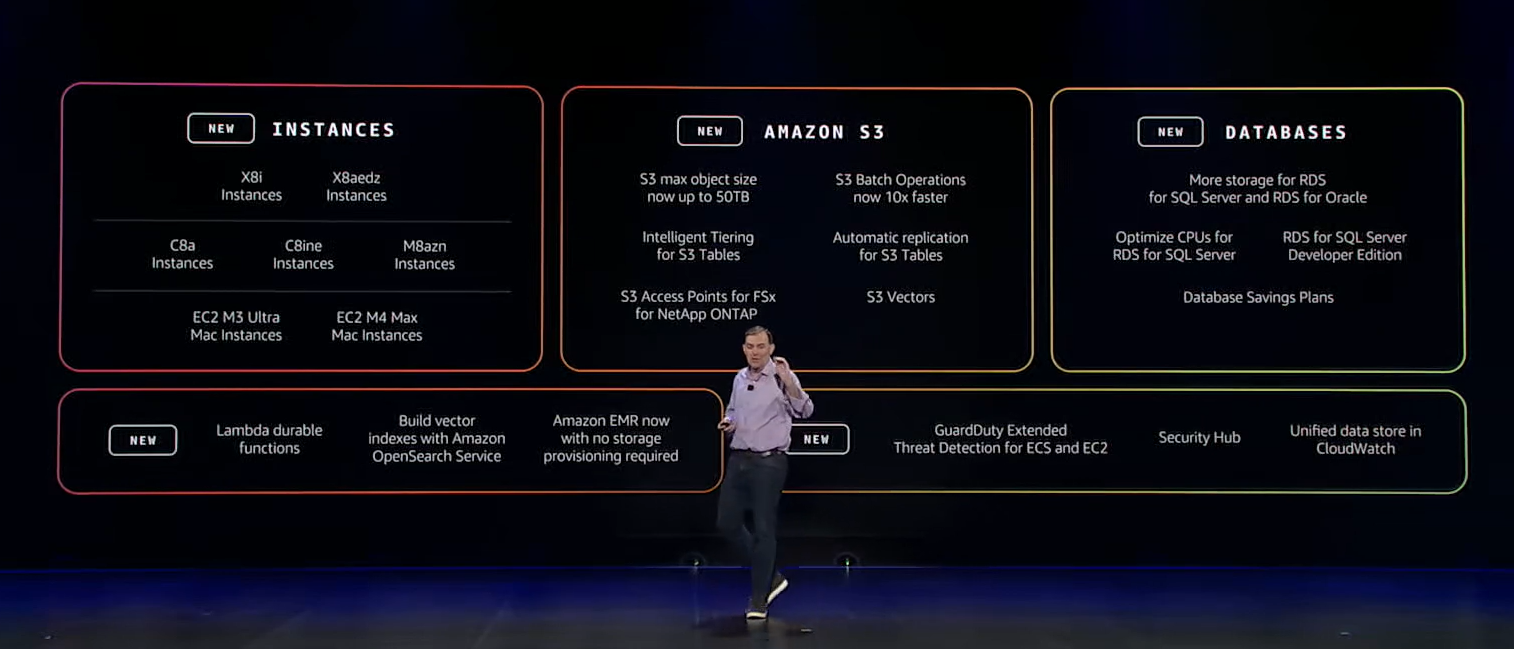
Like its customers, AWS is on a journey that's being reshaped by AI agents. The AWS picture is never complete. The other thing to realize about AWS is that there's now a 6-month cadence for big rollouts. AWS Summit New York, where the company first took its practical approach to AI for a spin, is now a mini re:Invent. AgentCore, AWS' most important launch of 2025, launched at AWS Summit New York.
See: The AWS AI Strategy: Playing the Long Game Infrastructure-Style | AWS re:Inforce 2025 Event Report: A Deep Dive on What You Need to Know
Here’s the link stack from re:Invent 2025:
- AWS launches Graviton5 as custom silicon march continues
- Amazon Connect gets its due at AWS re:Invent 2025
- AWS CEO Garman on hardware ambitions, Trainium demand, AI and jobs
- AWS adds doubles down on customizing, fine tuning AI models, agents
- AWS' Kiro launches autonomous agents for individual developers
- AWS adds AI agent policy, evaluation tools to Amazon Bedrock AgentCore
- AWS launches Amazon Nova Forge, Nova 2 Omni
- AWS launches AI factory service, Trainium 4 with Trainium 4 on deck
- AWS Transform aims for custom code, enterprise tech debt
- AWS, Google Cloud engineer interconnect between their clouds
- AWS Marketplace adds solutions-based offers, Agent Mode
With that backdrop here's a look at my takeaways.
Frontier agents are about the future of work than a category.
Garman during his keynote introduced the term with a trio of software development tools. This concept of a frontier agent revolves around having an AI teammate. My hunch is that the term will likely be renamed.
Garman outlined that frontier agents are a new class of agents that are autonomous, scalable and work over time without human intervention. In other words, they're more like teammates.
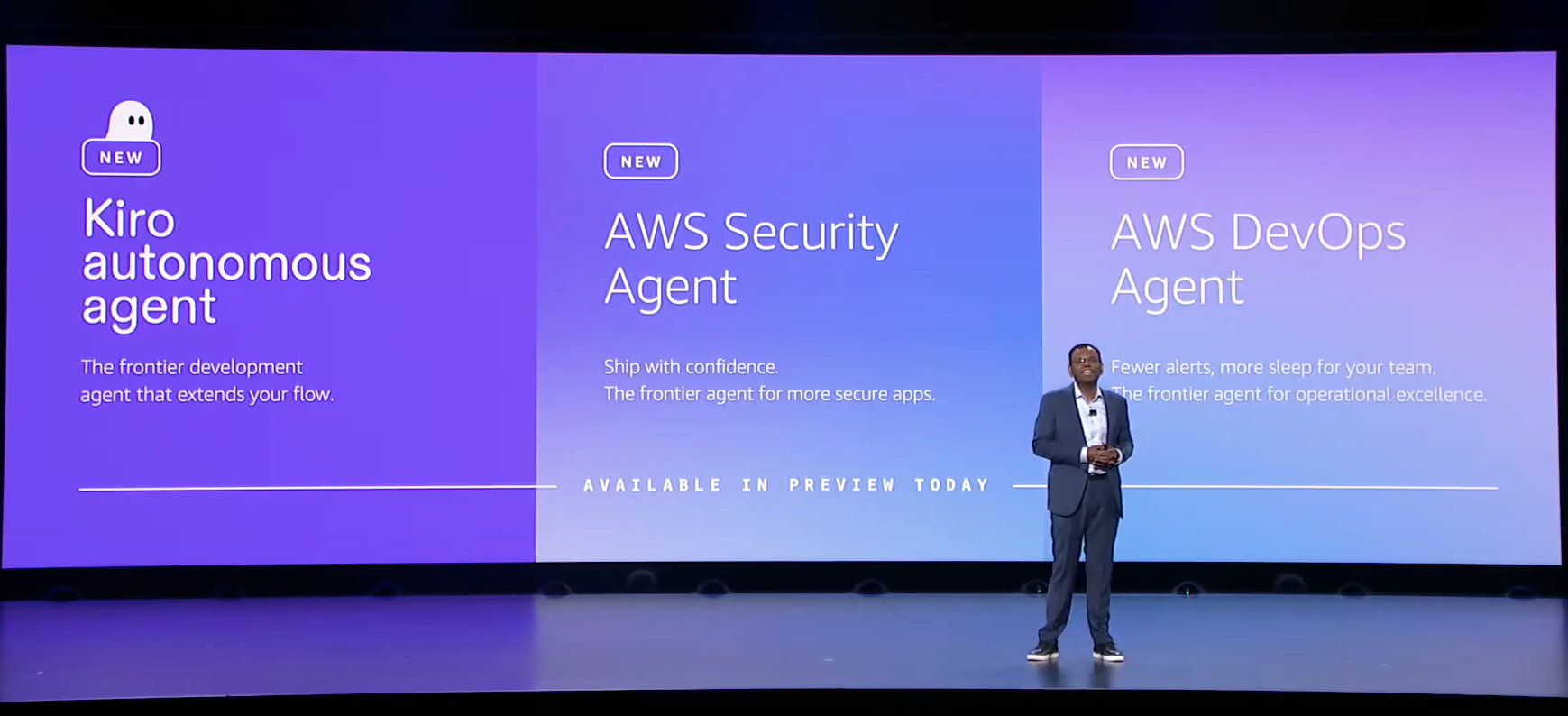
The frontier agent riff is a concept that's far from fully baked, but you can see AWS focusing on expansion beyond the software development lifecycle. "We think we're only at the beginning of frontier agents," said Garman.
A few observations about where frontier agents may lead:
- The concept moves AI agents beyond tools and into collaborators.
- AI will ultimately just have to work. The current AI user interface, which will break down software and data silos, isn't human centric. You shouldn't need to learn how to work with an AI agent.
- Change management and trust will be critical to move forward with this teammate concept.
- Systems of work that have been around for decades will need to be revamped.
- However, multiple enterprises and vendors are coalescing around the same vision.
"I believe that over the next few years, agentic teammates will be essential to every team as essential as the people sitting right next to you, they will fundamentally transform how companies build and deliver for their customers," said Colleen Aubrey, SVP of Applied AI Solutions at AWS, during a keynote.
Blue Origin's William Brennan, Vice President of Technology Transformation, highlighted how the space company has deployed more than 2,700 agents into production to assist engineering, manufacturing, software and supply chain teams.
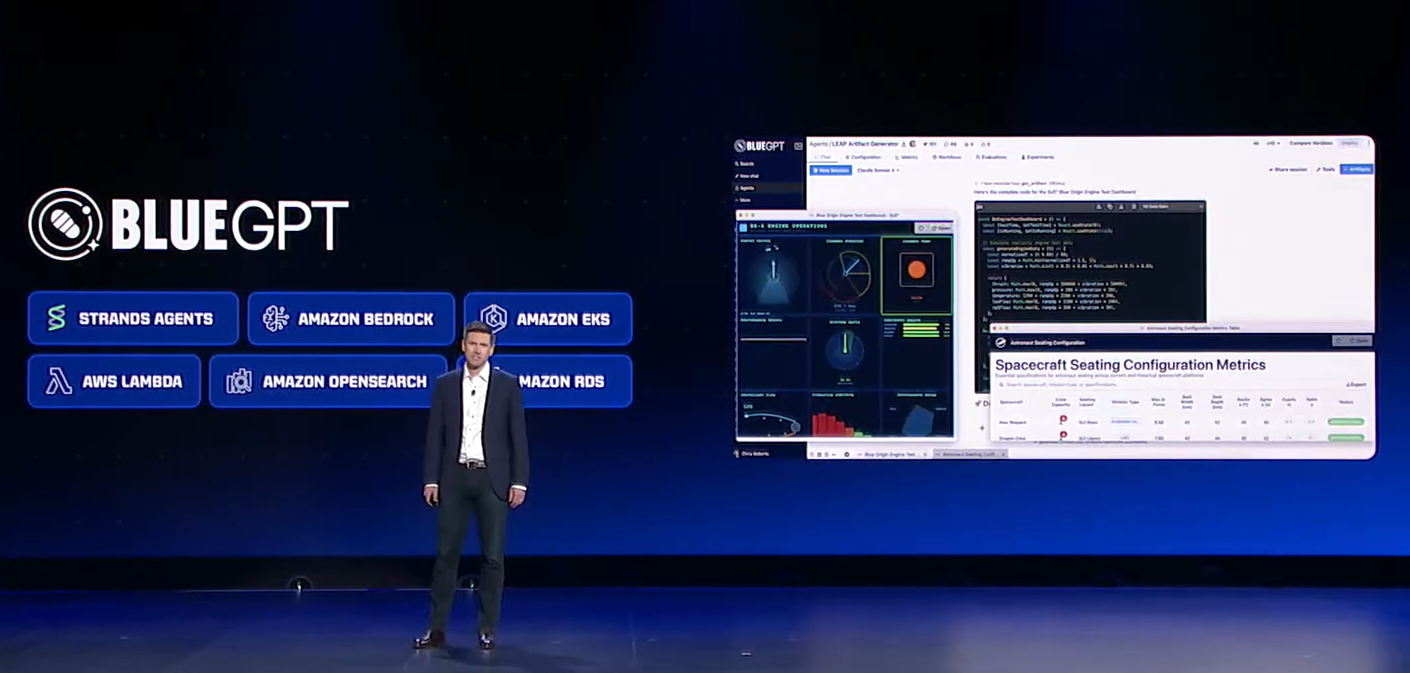
"Everyone at Blue Origin is expected to build and collaborate with AI agents to make their work better and faster," said Brennan, who said the company built its multi-agent orchestration system on AWS. "By equipping our teams with knowledgeable and capable agents, we were able to dramatically accelerate the product life cycle, increase production rate, and, most importantly, reduce the cost of access to space."
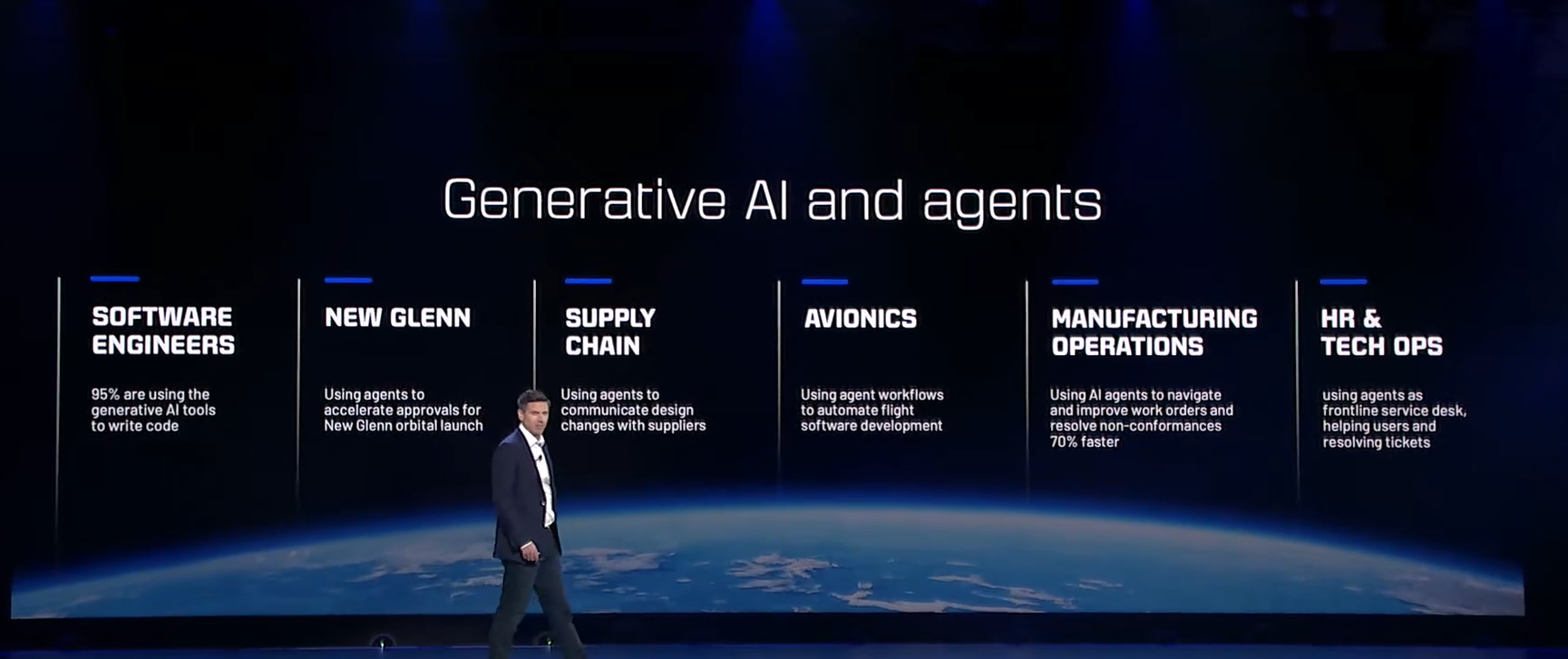
It's not surprising that Blue Origin, owned by Jeff Bezos, is an AWS customer, but the use cases were notable.
AI is still far too complicated.
AWS is doing what it does--launch building blocks, combine them into services and solve problems. Yes, AWS made strides in abstracting the creations of AI agents and customizing models, but it's still very early.
There. Isn't. An. AI. Easy. Button.
Garman said AWS is focusing on offering building blocks as well as applications like AgentCore. Large enterprises want building blocks to build agents. Smaller firms will look for a complete package. "AWS has always been giving small customers the capabilities that only the largest companies used to have," said Garman.
- AWS adds AI agent policy, evaluation tools to Amazon Bedrock AgentCore
- AWS launches Amazon Nova Forge, Nova 2 Omni
Dr. Swami Sivasubramanian, Vice President of Agentic AI, said the aim is to reduce cost and complexity so you don't need an army of PhDs to implement AI. Ironically, many of the speakers this week at re:Invent 2025 had PhDs.
AWS has a software strategy and it's likely to revolve around use cases.
Yes, AWS had its Amazon Bedrock and AgentCore announcements, but the software to watch is Amazon Connect, which has more than $1 billion in annual recurring revenue and is likely to be the starter kit for what Aubrey highlighted about the future of work.
Amazon Connect got some play at re:Invent and largely flies under the radar. Amazon Connect added agentic AI features and the package of applications and building blocks isn't about contact centers as much as it is customer service use cases.
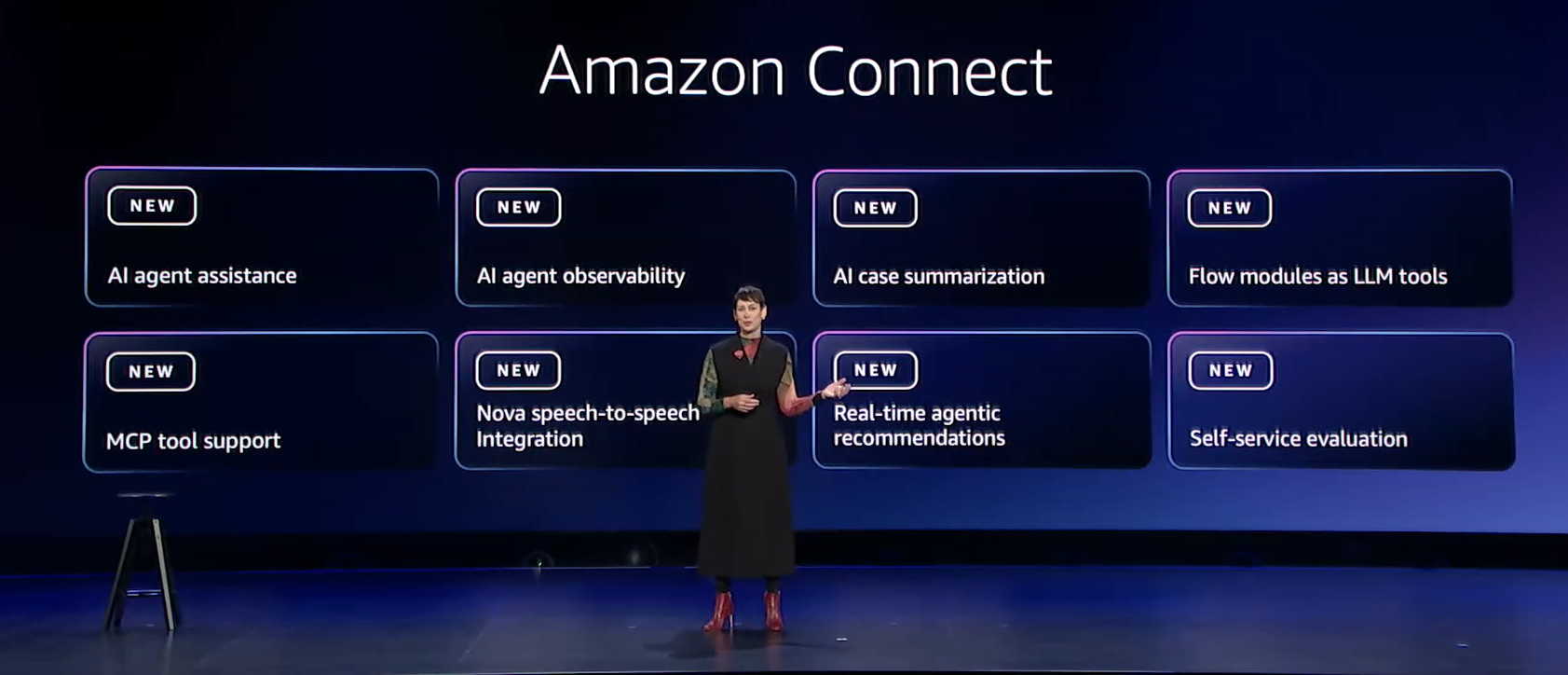
Simply put, Amazon Connect is more in line with where AWS is headed.
In addition, AWS is tackling other use cases including software development and now model customization. Is AWS a SaaS player. Not really, says Garman: "We don't have a concerted plan around SaaS, and we wouldn't go into it just because we want to go into it. And I think it's more there's an area where we think we have a differentiated idea that we can offer some interesting value to customers. We would always consider it. But it's more around that for us, we love leaning into our partners."
Margin is AWS' opportunity.
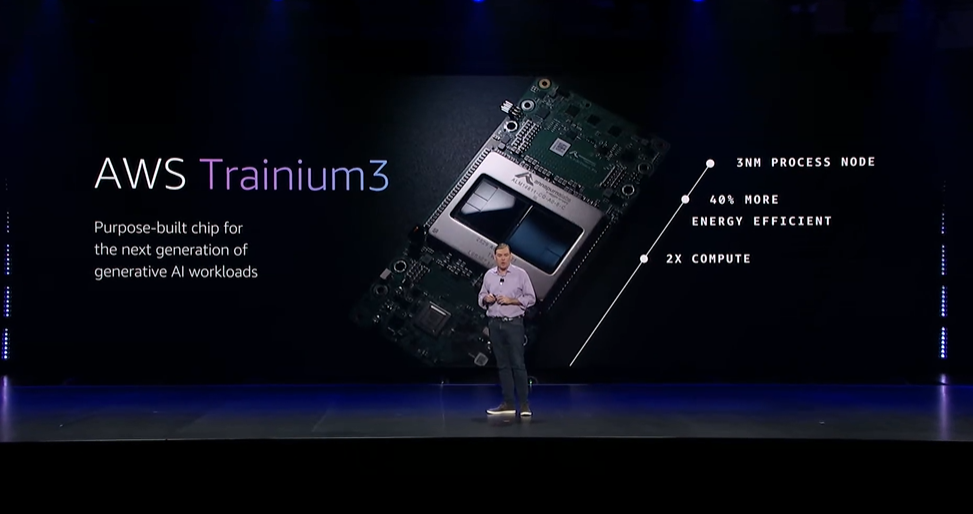
Amazon has said for years that fat margins are its opportunity. That approach comes from Amazon's retail DNA where margins in the best of times are single digits. AWS grew up taking margin away from enterprise incumbents. It still is if you just look at AWS Transform. I thought about this margin mantra repeatedly as AWS talked about its Trainium 3 and Trainium 4 launches. Like Google Cloud and its TPUs, AWS can rake in dough by just acquiring some of those workloads that support Nvidia's fat margins. For now, there are AI bottlenecks everywhere, but Trainium 3 is going to see strong demand and likely crib AI inference workloads.
"The response to Trainium 3 has been much stronger than Trainium 2," said Garman.
AI is forcing multi-cloud approaches and hyperscale cloud cooperation.
AWS and Google Cloud announced an interconnect deal and Microsoft Azure will be in the mix too. If it weren't for Oracle's partnership with all three hyperscalers, there's be some surprise. AI is forcing the clouds to collaborate. If you're keeping score at home hell has frozen over a few times already.
AWS Marketplace is a juggernaut.
Given Amazon's commerce roots this takeaway shouldn't be that surprising. However, AWS is removing friction from buying enterprise software at a steady pace. The ability to buy "solutions" is going to be a win for AWS and buyers. When AWS Marketplace is combined with the partner network, it's clear that AWS has its ground game going well.
The $1 billion AWS Marketplace club is also growing. Snowflake said this week that its AWS Marketplace sales have doubled to $2 billion.
Analyst takeaways from re:Invent 2025
R "Ray" Wang:
- "AWS has figured out the AI game that they're going to play. It's about builders. It's how builders interface with marketplaces, how builders interface with ISVs, and how builders interface with corporate teams. Everything AWS is doing right now is focused on helping people get there. They were behind on that story, and we're starting to see something different. AWS realizes it has to give everybody the tools they need."
- "AWS is moving up the stack and that's the important thing. Amazon is almost an apps company, but we can't say that because it's AI. AWS is going to crank out as many agents as it can. Customers are going to take them and get stuff one. The AI agents AWS uses internally will be the stuff you get to use internally too."
- "I think the partners are really excited, and that's the most important piece. They've been selling so much for Amazon. I mean, it's night and day from three years ago."
- "This is the first Amazon re:Invent where there wasn't a lot of talk about the future. Something was missing. What about Leo? What about quantum? People think quantum is far away. I think quantum is the one thing that will pull Amazon in a direction it may not expect."
Holger Mueller:
- “AWS re:Invent was different in that AWS is moving up the stack and infrastructure as a service was underplayed. “
- "The big miss from AWS side, they didn't talk enough about the data side of things. How do you start with lots of framework talk without the data talk."
- "I talked to a lot of customers who believed in Athena and were wondering where it was in the keynote. You have to at least show consistency in that you're building stuff."
- "Amazon was teeing up something. It was saying we understand the problem here, our abstractions and the outcomes needed."
Mike Ni:
- "AI and data clearly go together, and it goes with the brand promise of, you know, best components better together."
- “AgentCore delivering on policy and evaluations was important since those pieces are needed to deliver agentic AI.”
- "With Nova Forge, you're talking about leveraging your first party data. It's fundamental now to actually go beyond the generic with increased accuracy."
Chirag Mehta:
- "Kiro got disproportionate focus in terms of the keynote and attention."
- "Partner-ed solution sales exceeded direct sales so we're seeing a new wave of builders where companies are building solutions on top of existing products. Partners are driving adoption."
- "Frontier agents are the most murky of terms, but the general idea is that AWS is putting a stake in the ground and saying we're going to build the best DevOps agent anyone can ever have."
Liz Miller:
- "This was the first AWS re:Invent, where things like Amazon Connect and applied AI solutions took center stage and a deserved spot in the keynote. You're seeing customers take the building blocks and putting them into action and seeing business results."
- "With the Nova suite, AWS has intentionally created very durable, usable and price performant foundation models that can be used to build frontier agents. Nova Sonic is one of the best when it comes to delivering speech to speech."
- “I'm going to be watching those customers in 2026. There's a collision between what you're buying between Amazon and what you're buying through AWS. Amazon is a commercially ready package like Amazon Ads and Amazon Connect. AWS is the Lego blocks. When does the Amazon customer look at what they're doing with Amazon and AWS holistically?"
Larry Dignan is Editor in Chief of Constellation Insights at Constellation Research, where he leads editorial coverage focused on enterprise technology, digital transformation, and emerging trends shaping the future of business. He oversees research-driven news, analysis, interviews, and event coverage designed to help technology buyers and vendors navigate complex markets with clarity and context. ...
Read morePublished
Author
