


AWS launches Graviton5 as custom silicon march continues
AWS launched new Graviton5 based instances with 192 core per chip and a 5x larger cache as the company continues its custom processor cadence.
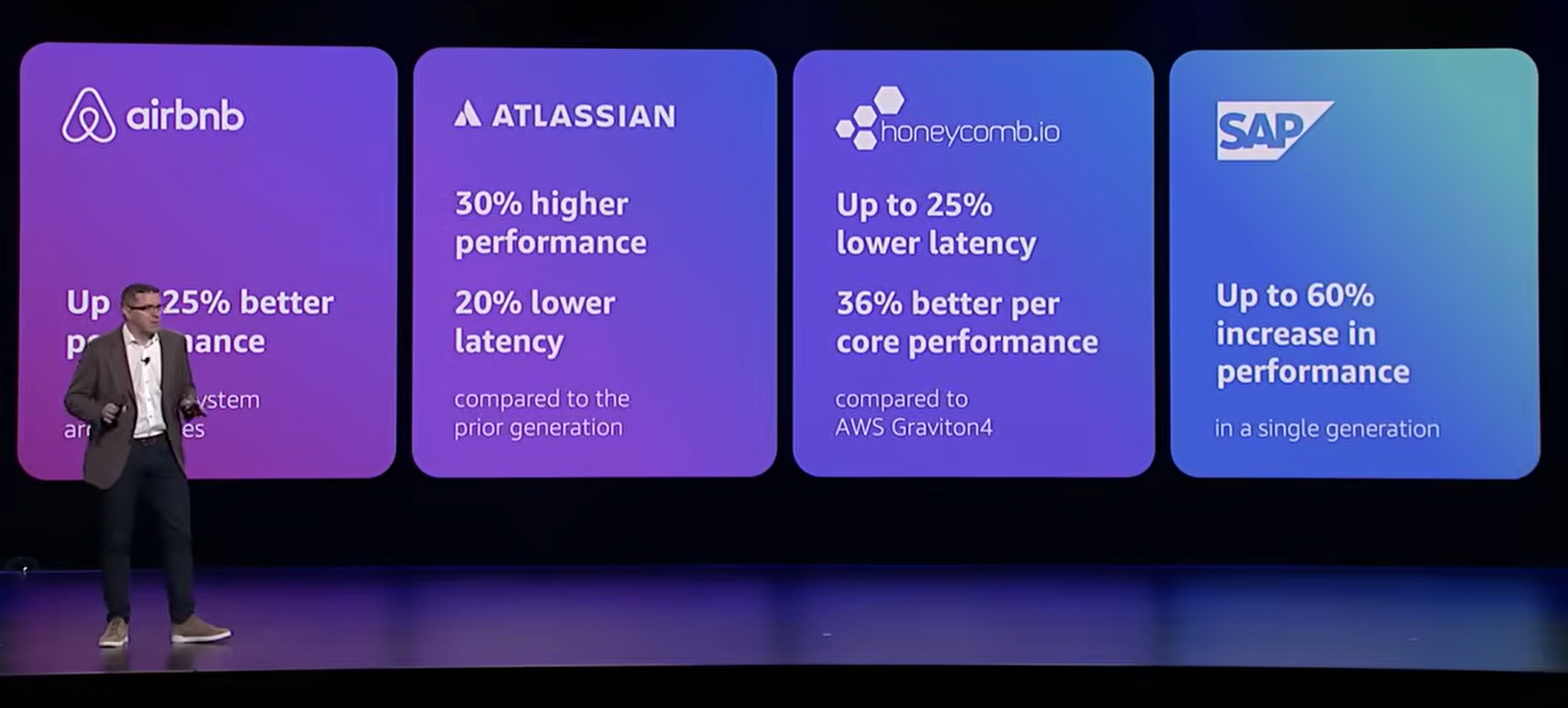
Graviton continues to power more than half of the new CPU capacity for AWS for the third year in a row. AWS said that 98% of its top 1,000 EC2 customers have used Graviton.
Although Trainium is getting most of the attention at AWS re:Invent 2025, Graviton is part of the mix as well as Inferentia. AWS cited Adobe, Pinterest, SAP, Snowflake and a bevy of others as Graviton customers.
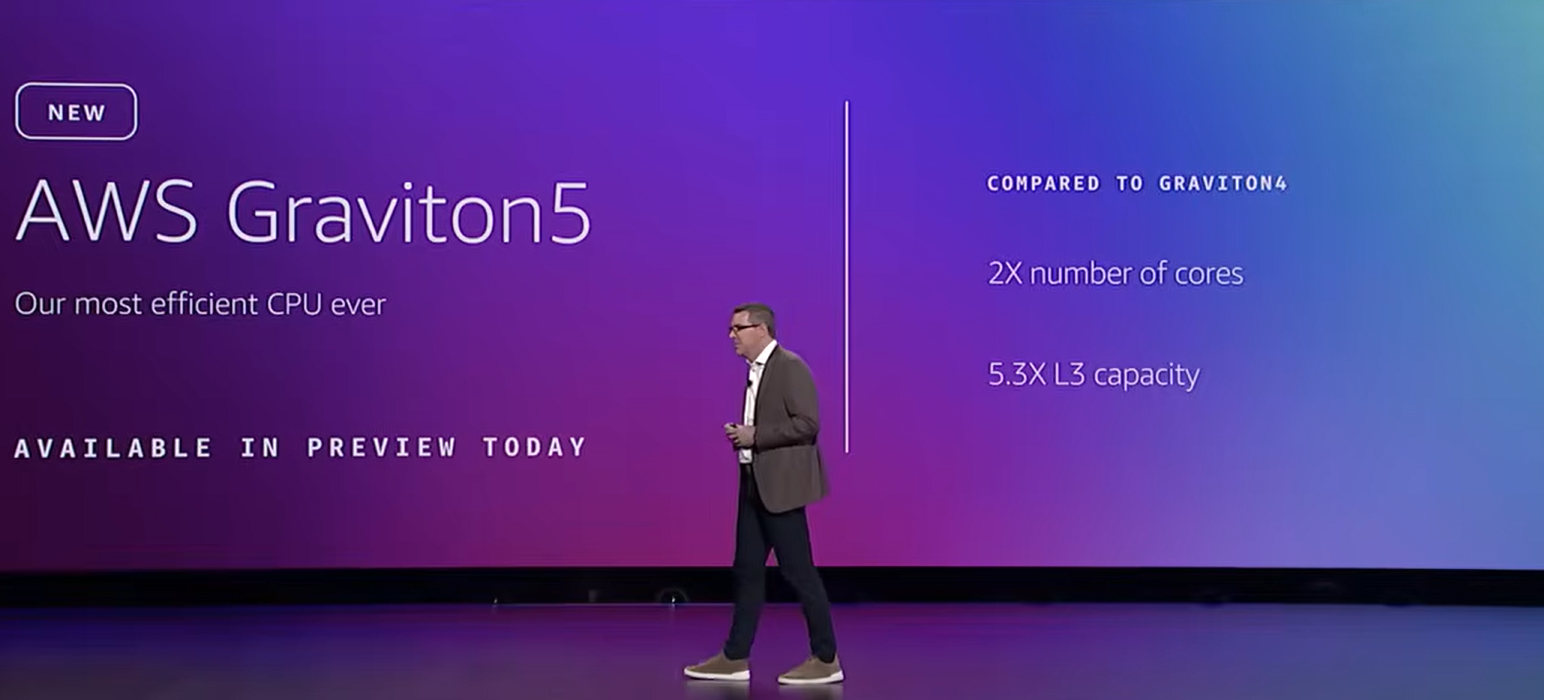
"The Graviton processor came from a brand new design based on delivering the best price performance for workloads that customers run every day in the cloud," said Dave Brown, VP of Compute and Machine Learning Services at AWS.
In a keynote, Brown and AWS SVP Peter DeSantis noted the following about AWS' custom silicon strategy.
- AI is expensive to run.
- AWS is investing heavily in lowering the costs of running workloads.
- With custom processors, AWS can leverage its Nitro virtualization layer and reduce jitter.
- Cloud workloads need to continually optimized for price-performance benefits.
- By controlling the entire stack from processor to server, AWS could implement innovations like direct-to-silicon cooling, which reduced fan power consumption by 33%.
- Custom processors allow AWS to iterate and optimize performance with greater control over the hardware and innovation cadence.
Another way to put it is that everybody's margin is an opportunity for AWS. Whether you look at Trainium, Nova models or Graviton, AWS is looking to commoditize.
Key items about Graviton:
- Graviton5-based EC2 M9g instances have 192 cores in a single package.
- Latency is improved by up to 33%.
- Graviton5 has a 5x larger L3 cache, 2.6x more than Graviton4.
- The processor has up to 15% higher network bandwidth and 20% higher Amazon Elastic Block Store (EBS) bandwidth across instance sizes.
- Graviton5 is built on AWS's 3nm technology.
Graviton5 instances leverage sixth-generation Nitro Cards to offload virtualization, storage and networking functions to dedicated hardware.
More re:Invent 2025:
- Amazon Connect gets its due at AWS re:Invent 2025
- AWS CEO Garman on hardware ambitions, Trainium demand, AI and jobs
- AWS adds doubles down on customizing, fine tuning AI models, agents
- AWS' Kiro launches autonomous agents for individual developers
- AWS adds AI agent policy, evaluation tools to Amazon Bedrock AgentCore
- AWS launches Amazon Nova Forge, Nova 2 Omni
- AWS Transform aims for custom code, enterprise tech debt
- AWS, Google Cloud engineer interconnect between their clouds
- AWS Marketplace adds solutions-based offers, Agent Mode
Larry Dignan is Editor in Chief of Constellation Insights at Constellation Research, where he leads editorial coverage focused on enterprise technology, digital transformation, and emerging trends shaping the future of business. He oversees research-driven news, analysis, interviews, and event coverage designed to help technology buyers and vendors navigate complex markets with clarity and context. ...
Read morePublished
Author
