


AWS Marketplace adds solutions-based offers, Agent Mode
AWS Marketplace is moving beyond apps to offer multiple products bundled into one package, faster private offers and agent mode. AWS Marketplace is also accelerating processes post purchase.
With the move, AWS Marketplace is evolving to enable partners, software providers and integrators to combine components to address complex enterprise use cases, offer flexible pricing and utilize one procurement flow. Customers have better transparency for each component, simplified negotiation and purchasing and one seller of record.
The news outlined ahead of AWS re:Invent 2025 is the latest iteration in how AWS is as much of an enterprise technology marketplace as it is a cloud provider. AWS Marketplaces has more than 3 million subscriptions enabled and more than 99% of the top 1,000 AWS customers have at least one AWS Marketplace subscription.
Speaking on a briefing, Matt Yanchyshyn, Vice President of AWS Marketplace and Partner Services, said the club of vendors that have sold more than $1 billion on AWS Marketplace is growing. Salesforce, Databricks and CrowdStrike are in the club but partners such as Presidio are also conducting transactions at scale.
Yanchyshyn added that the July launch of AI agents in AWS Marketplace is scaling. AWS is also using its own AI agents and generative AI tools on the marketplace. "We have a new suite of AI powered capabilities that are facilitating both discovery, product comparisons, but also purchase through the marketplace," he said.
- Scaling AI Innovation Globally: DataMasque's Journey with Synthetic Data and AWS Marketplace
- AWS Marketplace: A Strategic Hub for Cloud, AI, and Partner-Led Innovation
For AWS Marketplace, which has more than 30,000 public listings, 3,500 channel partners, 10,000 professional services providers and 6,000 sellers in 70 categories, the vision is to remove friction from buying services and software from partners. AWS Marketplace is looking to offer automated deployment experiences as well as built-in integration. For instance, CrowdStrike, one of AWS Marketplace's biggest partners, now has CrowdStrike Falcon Next-Gen SIEM for AWS with pay-as-you-go pricing, self-service procurement, an automated deployment experience and built-in integration with AWS CloudTrail, Security Hub and Guard Duty.
The flow consists of subscription, service selection, 1 click launch resources for integration and deployment.
Here's what AWS Marketplace added.
Solution-based buying where customers can purchase multiple products and services in one flow. The seller of record sends a consolidated offer that includes private offers from all components in a stack. The customer reviews terms and pricing, costs for each component and total contract sets and accepts or denies.
AWS Marketplace's move to support a stack in one purchasing flow reflects that reality that most enterprise purchases aren't done in isolation. Customers in theory would remove the hassle of compiling software and services themselves.
Yanchyshyn said the solution approach on AWS Marketplace should enable more industry- and use-case focused sales. "We're starting to see more industry vertical type solutions come to the marketplace as well," he said. "We need to cater to the needs of the sellers, and, more importantly, our joint customers as well. They're looking for solutions that solve their specific use cases, not always point products."
- AWS Marketplace adds 'Buy with AWS' as it expands reach, woos procurement departments
- Big software deals closing on AWS Marketplace, rival efforts
Independent software vendors can use AWS Marketplace to combine software with implementation services, package complementary products or team up with channel partners and integrators. Systems integrators and channel partners can package services with software their authorized to resell, align with outcomes and simplify procurement for enterprise wide deployments.
Here's a look at some representative solutions.
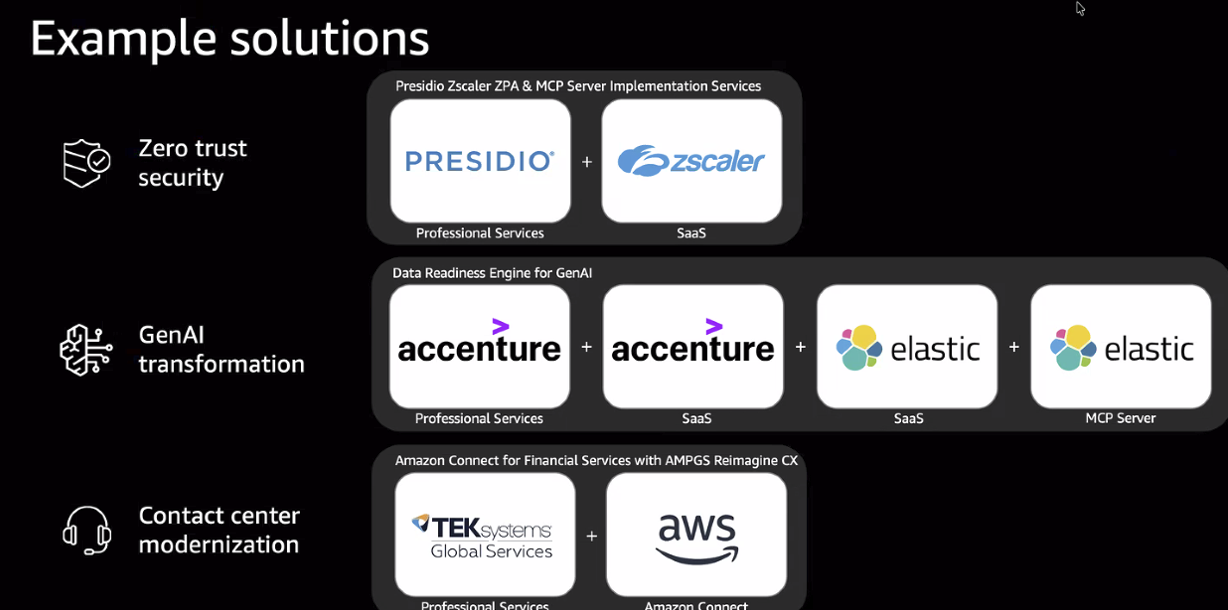
Since anyone can put solutions together, Yanchyshyn said he expects some interesting packages to emerge. He noted that GitLab and MongoDB often sell services along with their software. "The lines between resellers and professional services and ISVs have definitely started to blur over the last few years," he said. "I think we're going to start to see some interesting models evolve with people reselling other people's stuff."
AWS Marketplace also added the following.
Agent Mode, a conversational interface that guides buyers through research and analysis, uploads requirements documentation and provides in-depth comparisons.
From there, Agent Mode generates downloadable proposals. Agent Mode also features a Model Context Protocol server for accessing AI tools and building discovery experiences.
AI-enhanced search for better precision on searches by use cases. Buyers can narrow down results with smart category filters, product grouping and specializations at a glance.
Express private offers where AI on AWS Marketplace evaluates customer needs and aligns them with seller-defined parameters. In other words, offers can be instantly generated. "It allows the seller to essentially expose their private rate card, their discount sheet, and allow us to issue private offers on behalf of the seller to customers, said Yanchyshyn.
Buyers qualify for offers, skip pricing negotiations and procure software at discounted rates. Sellers get flexible pricing at scale, streamline private offers for standard deals and can refocus sales teams.
Variable payments for professional services. AWS Marketplace is supporting flexible services engagement with contract pricing with variable payment, upfront payment and installment plans. Embedded into private offers, services firms can bill customers as work is delivered, based on outcomes or milestone or how time and materials are consumed.
In the variable payment for professional services model, customers get transparency and control and can review and approve requests manually or automate them.
AWS Marketplace added automation features in AWS Partner Central in the AWS Console. Features include API automation, streamlined access to Partner Central and Marketplace Management Portal features, connections to other AWS partners, a personalized Partner assistant powered by Amazon Q, and enhanced user management tools.
New Partner Central APIs, which connect business tools to Partner Central to automate co-selling processes. AWS Marketplace added Opportunity API, Leads API, Account API, Solution API, Benefits API and Connections API.
The AWS Marketplace additions complement new features announced Nov. 19. Leading into re:Invent, AWS Marketplace added billing transfer, which gives customers that ability to retain access to their management account while AWS invoicing and cost data is transferred to channel partner accounts.
AWS Marketplace had also streamlined processes behind post-purchase setup. AWS added identity access management tools that allow partners to request time limited access to customer AWS accounts and streamlined product setup and ongoing maintenance.
Larry Dignan is Editor in Chief of Constellation Insights at Constellation Research, where he leads editorial coverage focused on enterprise technology, digital transformation, and emerging trends shaping the future of business. He oversees research-driven news, analysis, interviews, and event coverage designed to help technology buyers and vendors navigate complex markets with clarity and context. ...
Read morePublished
Author
