



Executive Summary
Contact center solutions have largely stayed the course in terms of functionality, enabling organizations to route, address, and resolve inbound customer interactions and engagements. Contact center as a service (CCaaS) shifted this critical frontline of customer experience (CX) to the cloud, with the promise of scalable infrastructure and a flexible toolset to modernize a contact center that has become more complex. But in the age of AI, experienced teams expect more: more engagement, more channels, more connections, and more cost savings to materially impact the bottom line. What has emerged is a new breed of CCaaS tools that can offer traditional inbound engagement interactions with fully integrated outbound dialing and multi-channel digital communications, predictive dialers, proactive cross-channel messaging and engagement, and more robust collaboration and workforce management tools.
While 2025 saw a boom in generative AI tools, 2026 will be the year of the autonomous enterprise with workflows and agentic capabilities that automate common operations. Agents and supervisors now expect smart co-pilots at the ready to help guide customers to positive outcomes. AI-powered tools, including smart routing, intelligent workforce planning, agent assist, sentiment analysis, chatbots, Interactive Virtual Agents (IVA), data management, conversational intelligence, and process automation, have become core considerations in provider selection. Customers now expect smarter self-service experiences, allowing them to manage more of their own self-determined experiences in the moments and channels of their choice. And increasingly, everyone expects voice to be an interface, not just a channel.
2026 will bring more AI-driven change, with more robust analytics, experience augmentation through real-time, personalized content creation, and the reality of cross-functional CX operations coming into view. But the AI proof-of-concept experiments initiated years earlier continue to struggle, often failing to become fully operationalized projects, adding pressure on COOs and Chief Experience Officers to advance their AI initiatives and budgets in the contact center. While CX leaders initially laid blame for this lack of AI scalability on an enterprise and agent aversion to change or a lack of AI readiness, it has become clear that legacy systems and a lack of meaningful, renewable data are central culprits in the lag in adoption and acceleration. This is especially true of buyers still pushing their cloud shift agendas who are now being asked by the Board to showcase how AI will be deployed as a business transformation and differentiation tool. The pressure to perform will be intense, and AI will increase scrutiny of the value being delivered. Contact center leaders, once convinced that AI and the cloud could eliminate headcount, are reinvesting in people who expect more robust, usable AI-powered tools. This will add pressure to CCaaS vendors to deliver AI capabilities focused on new key performance indicators and business outcomes as strategies shift away from the days of containment and deflection and more earnestly into AI empowered continuous relationship building.
Constellation Research has excluded solutions where communications channels like voice and telephony are delivered via partnership, leading to worthy solutions like Google Cloud CCAI Platform (partnering with UJET) and Zendesk CCaaS (built on Amazon Connect) just outside of this year’s consideration
Threshold Criteria
Constellation considers the following criteria for these offerings:
- Comprehensive communications capabilities, including call management, call provisioning, and routing, and omnichannel communications across phone, email, live chat, social media, messaging, and SMS
- Native telephony and voice capabilities
- Workflow management for process and engagement orchestration
- Flexible delivery models for private, public, and multicloud environments
- Cross-channel workflow and architected journeys to deliver comprehensive service, including always-on self-service content, chatbots, and interactive voice response (IVR) experiences
- Rich library of resources and agent engagement and support tools to boost performance
- Global infrastructure and network footprint for global reach and coverage
- Deep knowledge base and community resource center for users
- Application of AI and ML models for data analytics, smart routing, next-best agent action, virtual agents (text and voice), and chatbot engagement
- Advanced AI application for voice and sentiment scanning via natural-language processing
- Scalable pricing and service models with understandable, consistent, and predictable costs
- Drag & drop designer and studios for self-service tools, including chatbots and intelligentvirtual agent (IVA)
- Collaboration workspaces for agent resources and problem-solving across internal experts
- Security and privacy controls, and rule-based/role-based data and account governance
- Documented uptime and network reliability for large-scale remote agent deployments
- Robust analytics and reporting on agent and platform performance
- Capacity to integrate video engagement and cross-channel handoff in communications
- Outbound dialing systems
- Advanced AI and conversational intelligence capabilities to use LLMs and natural language understanding (NLU) to better understand, summarize and generate relevant, personalized, and contextual conversations
- App marketplace or libraries to extend platform capabilities
- Integrations and connectors to business tools such as CRM, customer data platforms (CDPs), and core customer service operations and help desk solution
The Constellation ShortList
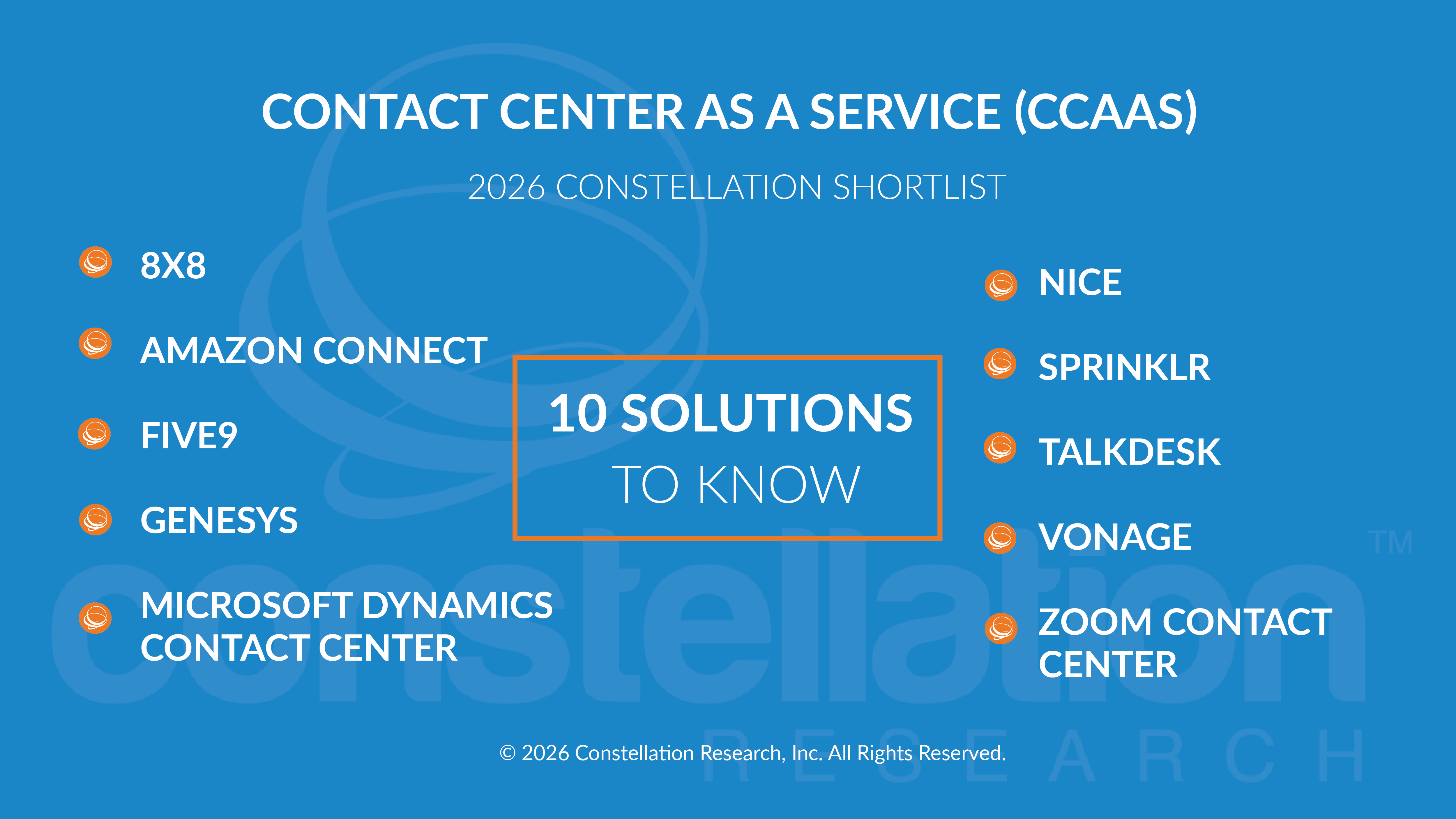
Constellation evaluates 21 solutions categorized in this market. This Constellation ShortLists determined by client inquiries, partner conversations, customer references, vendor selection projects, market share, and internal research.
- 8x8
- Amazon Connect
- Five9
- Genesys
- Microsoft Dynamics Contact Center
- NiCE
- Sprinklr
- TalkDesk
- Vonage
- Zoom Contact Center
Frequency of Evaluation
Each Constellation ShortList is updated at least once per year. Updates may occur after six months if deemed necessary.
Evaluation Services
Constellation clients can work with the analyst and the research team to conduct a more thorough discussion of this ShortList. Constellation can also provide guidance in vendor selection and contract negotiation.