Editor in Chief of Constellation Insights
Constellation Research
Larry Dignan is Editor in Chief of Constellation Insights at Constellation Research, where he leads editorial coverage focused on enterprise technology, digital transformation, and emerging trends shaping the future of business. He oversees research-driven news, analysis, interviews, and event coverage designed to help technology buyers and vendors navigate complex markets with clarity and context. ...
Apple reported better-than-expected first quarter results with revenue growth of 2%.
The company reported first quarter earnings of $2.18 a share on revenue of $119.6 billion. Wall Street was expecting Apple to report earnings of $2.10 a share on revenue of $117.9 billion.
Apple CEO Tim Cook said the company saw record services revenue in the quarter powered by iPhone sales. Cook added that "our installed base of active devices has now surpassed 2.2 billion, reaching an all-time high across all products and geographic segments."
The company will launch its Apple Vision Pro Feb. 2.
On a conference call with analysts, Cook talked up the Apple Vision Pro launch and said Apple will continue to invest in new technologies. He said:
"We're so focused on pushing technology to its limits as we work to enrich the lives of our users. As we look ahead, we will continue to invest in these and other technologies that will shape the future. That includes artificial intelligence, where we continue to spend a tremendous amount of time and effort and we're excited to share the details of our ongoing work in that space later this year."
Here's the breakdown by product line:
iPhone sales in the first quarter were $69.7 billion, up from $65.77 billion a year ago.
Mac sales were $7.78 billion, roughly flat from a year ago.
iPad sales were $7 billion, well below $9.4 billion a year ago.
Wearable revenue was $11.95 billion, down from $13.5 billion a year ago.
Servies revenue was $23.1 billion, up from $20.77 billion a year ago.
Other than the iPhone, Apple's product lines were on par with expectations or below the mark. Apple did have 13 weeks in the first quarter of fiscal 2024 compared to 14 weeks a year ago.
By geography, Apple's China sales were $20.82 billion, down from $23.9 bilion a year ago. Other geographies showed revenue gains.
Editor in Chief of Constellation Insights
Constellation Research
Larry Dignan is Editor in Chief of Constellation Insights at Constellation Research, where he leads editorial coverage focused on enterprise technology, digital transformation, and emerging trends shaping the future of business. He oversees research-driven news, analysis, interviews, and event coverage designed to help technology buyers and vendors navigate complex markets with clarity and context. ...
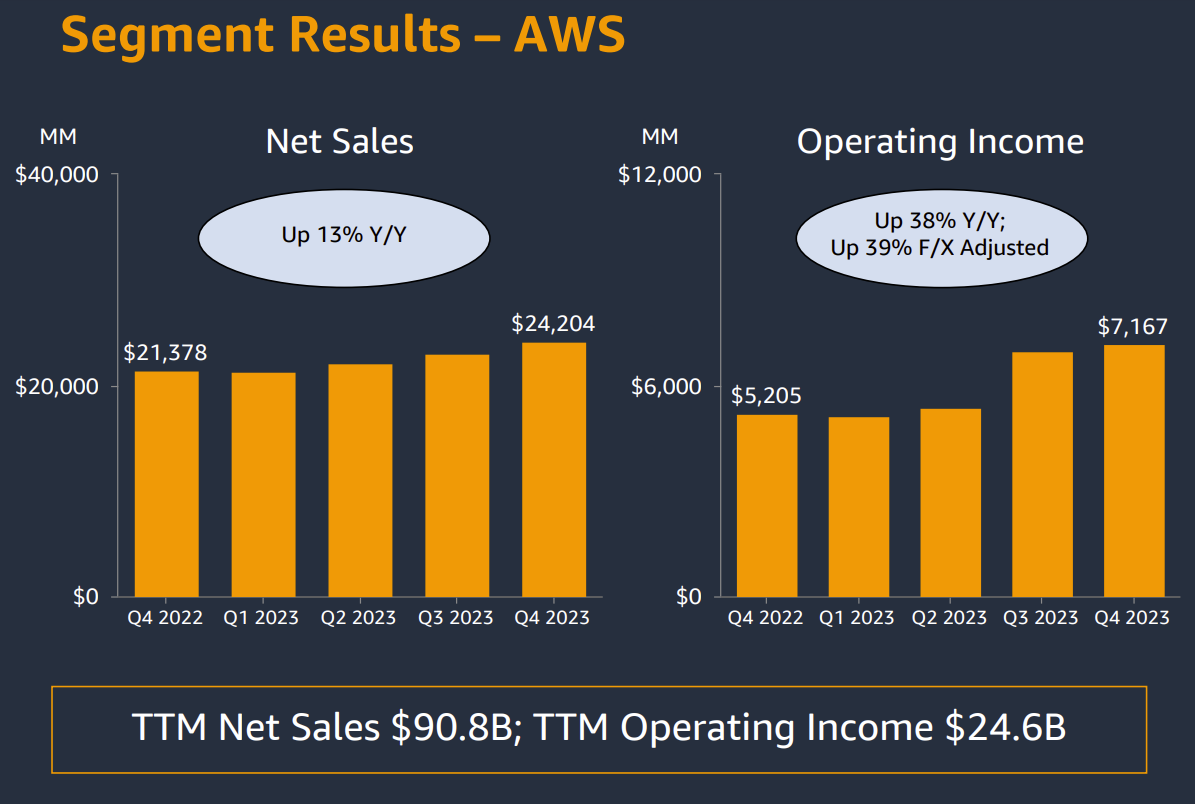
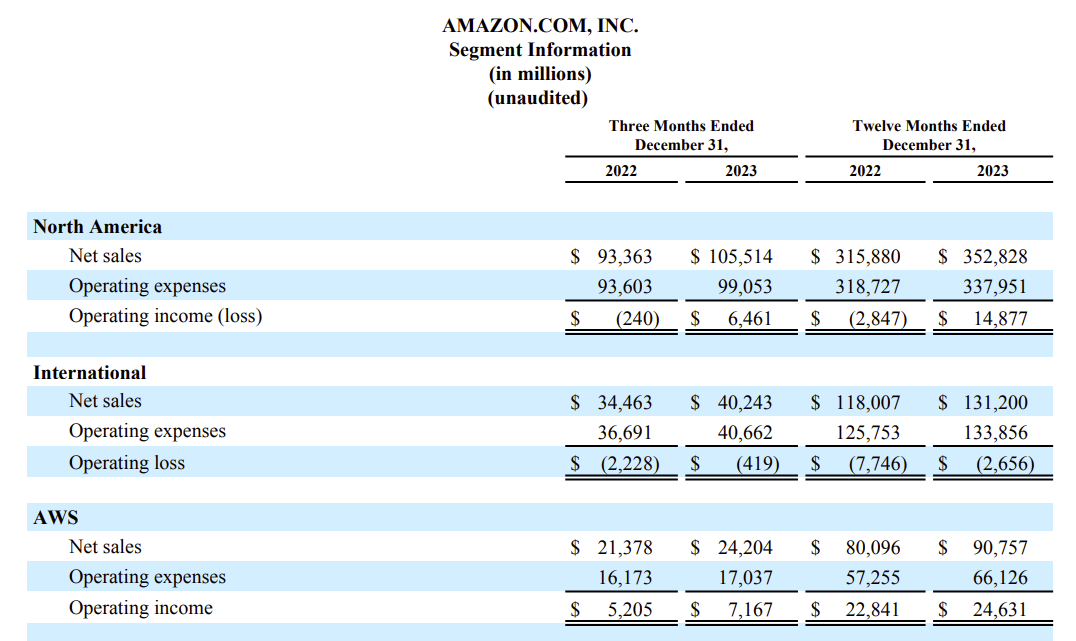
Amazon Web Services' fourth quarter revenue was $24.2 billion, up 13% from a year ago, and below the 30% and 26% growth rates put up by Microsoft Azure and Google Cloud, respectively.
AWS revenue was in line with expectations and fourth quarter operating income of $7.2 billion was well ahead of the $5.2 billion a year ago. AWS's operating income also outpaced the $6.5 billion for Amazon's North America e-commerce business. Amazon's AWS report comes days after both Microsoft and Google reported fourth quarter earnings.
For the fourth quarter, Amazon reported net income of $10.6 billion, or $1 a share, on revenue of $170 billion, up 14% from a year ago. Wall Street was expecting fourth quarter earnings of 80 cents a share on revenue of $166.2 billion.
Amazon reported 2023 net income of $30.4 billion, or $2.90 a share, on revenue of $574.8 billion.
"The regionalization of our U.S. fulfillment network led to our fastest-ever delivery speeds for Prime members while also lowering our cost to serve; AWS’s continued long-term focus on customers and feature delivery, coupled with new genAI capabilities like Bedrock, Q, and Trainium have resonated with customers and are starting to be reflected in our overall results; our Advertising services continue to improve and drive positive results; our newer businesses are progressing nicely."
For the first quarter, Amazon projected revenue of $138 billion and $143.5 billion, or 8% to 13% growth from a year ago. Operating income will be between $8 billion and $12 billion.
Jassy said AWS is also seeing indicators of strong demand ahead. Jassy said AWS is seeing more migration as enterprises start spending on cloud again. He said:
"The lion's share of cost optimization has happened. It's not that there won't be any more that we don't see any more but it just attenuated very significantly. Migrations have started to pick up again.
If you go to the generic GenAI revenue in absolute numbers, it's a pretty big number, but in the scheme of $100 billion annual revenue run rate it's still relatively small. We really believe we're going to drive 10s of billions of dollars of revenue over the next several years (with GenAI). It's encouraging how fast it's growing and our offerings really resonate with customers."
Speaking on a conference call, Jassy made the following points:
North America profit margins have approved because Amazon has retooled its network to bring goods closer to customers. This move has lowered costs to serve. "We reduced our cost to serve on a per unit basis globally. In the US cost to serve was down by more than 45 cents per unit compared to the prior year," said Jassy. "Lowering cost to serve allows us not only to invest in speed improvements, but also afford adding more selection at lower average selling prices or ASP and profitably. We have a saying it's not hard to lower prices. It's hard to be able to afford lower prices."
Advertising revenue was up 26% largely due to sponsored ads across the Amazon network.
AWS added more than $1.1 billion in incremental sequential revenue. "Our customer pipeline remains strong as existing customers are renewing it larger commitments over longer periods and migrations are growing," said Jassy.
AWS' generative AI strategy revolves around options and choices for enterprises. "We've launched Bedrock, which is off to a very strong start with many 1,000s of customers using the service after just a few months," said Jassy. "what customers have learned at this early stage of GenAI is that there's meaningful iteration required. Customers don't want only one model. They want different models for different types of applications and different size models for different applications. Customers want a service that makes this experimenting and iterating simple."
"We're building dozens of Gen AI apps across Amazon's businesses, several of which have launched and others of which are in development," he said. "GenAI is and will continue to be an area of pervasive focus and investment across Amazon primarily because there are few initiatives if any, that give us the chance to reinvent so many of our customer experiences and processes. We believe it'll ultimately drive 10s of billions of dollars of revenue for Amazon over the next several years."
Editor in Chief of Constellation Insights
Constellation Research
Larry Dignan is Editor in Chief of Constellation Insights at Constellation Research, where he leads editorial coverage focused on enterprise technology, digital transformation, and emerging trends shaping the future of business. He oversees research-driven news, analysis, interviews, and event coverage designed to help technology buyers and vendors navigate complex markets with clarity and context. ...
Commercial generative AI use cases are promising, but CXOs at the Hitachi Vantara Exchange in New York note there's a lot of work ahead--data management, privacy and training models--to scale.
Data management and architecture are the base of generative AI efforts. Mark Katz, CTO of Financial Services at Hitachi Vantara, said the explosion of data, most of it unstructured, means that businesses have to be able to manage data, protect personal identifiable information with segmentation and track lineage. "It's not enough to simply store the data and retrieve it," said Katz. "You need a set of data management tools across enormously complex cloud and hybrid cloud environments."
Debika Bhattacharya, Chief Product Officer, Verizon Business, said enterprises will have to harmonize data to get the most out of generative AI. Bhattacharya said Verizon Business customers are focusing on harmonizing data that's housed in separate towers.
Bharti Patel, SVP, Product Engineering, Hitachi Vantara, said a semantic data plane can be used to bridge these data silos. "The reality is that the data is not going to be static. You have to do it in a metadata way, so the processing is closer to the data," said Patel. "How do you feed LLMs with only the data that makes sense?"
Cyber resilience and privacy are being driven by regulations globally. Part of the data management layer has to be security, so you know exactly what's happening to protect data and recover it at scale, said Katz.
Enterprise use cases for generative AI are just starting. "The thing to keep in mind with generative AI is that it's really early days for commercial use," said Katz. Virtual assistants are a primary use case and consumers are already used to it. Artificial intelligence and machine learning have been used in the enterprise for a while, but generative AI use cases are more experimental.
Katz said credit card companies are an area to watch for generative AI use cases. "More advanced models are coming for new use cases," he said. Indeed, Mastercard launched a generative AI initiative to battle fraud. Jeb Horton, SVP, Global Services, Hitachi Vantara, said enterprises have "varying degrees of embedding AI into what they do."
Bhattacharya said more advanced generative AI use cases are promising. She said personalized healthcare is a fascinating area "as long as the risks are studied and handled the right way."
Santhosh Keshavan, CIO of Voya Financial, said generative AI provides an opportunity to enable investors to make smart decisions from an early age to retirement.
Other use cases that are evolving with generative AI include security, sustainability, customer experience. CXOs noted that use cases for generative AI are almost endless as any process can benefit from a copilot.
Responsible AI frameworks are critical for enterprise adoption. Multiple CXOs at Hitachi Vantara Exchange New York noted that generative AI adoption will depend on trust and responsible use.
Katz said there needs to be traceability into how models were trained and on what datasets. Models should also be explainable.
Smaller models will trump large language models (LLMs) in the enterprise. Katz said enterprises are likely to use models that are use case specific for a host of reasons, including lower compute costs, data safety and more predictive behaviors. In addition, limited training data sets, say a corporate knowledge base, will inherently minimize the risk of errors.
Patel added that one large language model to address multiple use cases isn't efficient. "You'll have fine-tuned smaller models that can delegate tasks when they don't know about certain things," said Patel.
"Train the model on corporate offerings, company financials and recommendations designed for a specific use case," said Katz. CXOs at Hitachi Vantara agreed that commercial use of generative AI will initially be very targeted.
Lan Guan, Chief AI Officer at Accenture, said "your propriety data is your biggest advantage” and success is more about the quality of data.
Traditional AI and machine learning technologies can be turbocharged and advanced with generative AI. "AI is not new, but the recent events have shined the light on AI-based applications that have been developed for years," said Bhattacharya. Verizon has been using machine learning and deep learning for networks for insights on the past and predicting the future. "Now we are tying traditional AI to generative AI to create new content," said Bhattacharya.
Keshavan said generative AI can take lessons from traditional AI and data sets and make companies more productive. Voya is looking to generative AI for efficiency gains as well as improving customer service.
Previous AI, data science and machine learning investments are building blocks for generative AI. Andrew Chin, Head of Investment Solutions and Sciences, AllianceBernstein, convinced his company to build out its data science office 7 years ago and today those investments apply to generative AI.
"The lowest hanging fruit was natural language processing so our analysts can gather data faster," he said. "Now we can apply techniques to read documents and make recommendations and summarize for analysts. Humans still have ownership for the final decision."
Take a crawl, walk, run approach with generative AI. Keshavan said his CIO role is part evangelizing generative AI with the business, aggregating use cases and then going from pilot to production.
Bhattacharya said Verizon Business is taking a cross-functional approach that includes security, product, IT and legal to make sure the right policies are in place. "The foundational building block of AI is data," she said. "We prioritize use cases within Verizon and from a product standpoint we look to embed generative AI for new experiences."
Efficiency and cost savings are the table stakes, but enterprises need to eye broader transformation. Accenture's Guan said, "cost efficiency is the table stakes for generative AI, but how do we transform ourselves?"
CXOs at Hitachi Vantara Exchange said one challenge is getting companies to think more in terms of generative AI transformation over productivity.
Dave Malik, Cisco Fellow and CTO, Customer Experience, said the broader transformation due to generative AI will come as more use cases are adopted. "Once there's trust in the system and adoption people will be willing to take more calculated risk with new use cases," said Malik.
Editor in Chief of Constellation Insights
Constellation Research
Larry Dignan is Editor in Chief of Constellation Insights at Constellation Research, where he leads editorial coverage focused on enterprise technology, digital transformation, and emerging trends shaping the future of business. He oversees research-driven news, analysis, interviews, and event coverage designed to help technology buyers and vendors navigate complex markets with clarity and context. ...
Match wants to bring dating into the generative AI age and plans to invest to bring AI-driven experiences to its two largest brands, Tinder and Hinge.
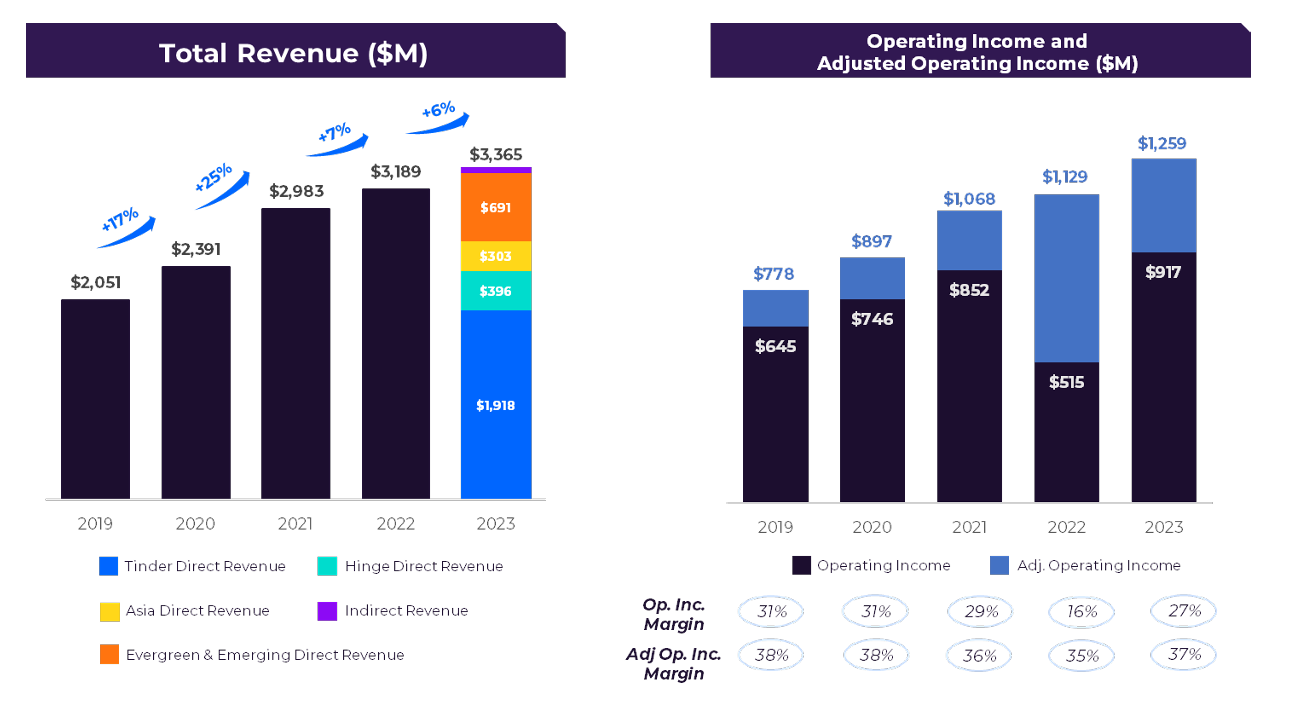
Speaking on Match's fourth quarter earnings call, CEO Bernard Kim outlined the company's generative AI efforts. Match delivered fourth quarter revenue of $866 million, up 10% from a year ago, with annual sales of $3.4 billion. Tinder revenue is more than half of Match's sales.
Kim said:
"We believe that AI is existential to the future of Match Group and our business. AI will help us create improved user experiences and will truly make our products better. And that puts us in a different category from other companies that are just looking at optimizing through AI and slight improvements.
This technology is revolutionary for dating, and we're bringing it to life across our entire portfolio. I envision AI to be felt through the entire experience, influencing everything from profile creation to matching and connecting for dates, literally everything."
Here's a look at Match's generative AI plans and how it will drive engagement.
Tinder will adopt a "fast-fail mentality" that will inform moves across the Match properties. "In 2024, Tinder is adopting a fast-fail mentality, a strategy that prioritizes rapid experimentation and testing. This approach is all about agility. If a new idea or feature doesn't yield the anticipated results, the team is prepared to quickly pivot, absorbing valuable insights and move forward. We recognize that not every innovation will be a groundbreaking success," said Kim.
AI will enable Tinder to appeal to a broader audience. "This new generation of singles is digital-first and expect platforms like ours to allow daters to showcase their unique personalities in an engaging setting and be shown highly curated matches," said Kim. "Leveraging AI, Tinder will focus on creating a more inclusive experience beginning with improving the Gen Z and women's experiences, while solving for key user pain points across the dating journey."
Hinge will use AI and aim to "truly understand you and what you're looking for in order to introduce you to the right person sooner." This use case will leverage data from profiles, interactions and "great dates that Hinge has collected over several years," said Kim.
A central innovation team will begin to launch new brands to grow the dating category and bring in new users.
Internal systems will aim to coordinate with the central innovation team to improve the company’s effectiveness. "While AI brings with it cost efficiencies and a potent optimization tool, we view it as far more than just that," said Kim. "AI has played an important strategic role at Match Group for years from trust and safety efforts to our matching algorithms, and I believe it will play an even larger role moving forward."
Kim's bet is that Match's AI investment in Tinder will generate momentum among Gen Z and women with growth in the second half of the year.
"We believe AI can help improve our users' experience and bring resistors into the category, as well as potentially expand our TAM. We have a long list of product features being rolled out at Tinder and Hinge, as well as plans to test new and different products that leverage AI throughout 2024. Our current expectations for incremental 2024 AI-related spend of $20 million to $30 million across Match Group."
Editor in Chief of Constellation Insights
Constellation Research
Larry Dignan is Editor in Chief of Constellation Insights at Constellation Research, where he leads editorial coverage focused on enterprise technology, digital transformation, and emerging trends shaping the future of business. He oversees research-driven news, analysis, interviews, and event coverage designed to help technology buyers and vendors navigate complex markets with clarity and context. ...
Qualcomm reported strong first quarter results as its Snapdragon platform saw traction across smartphones, automotive, PCs and Internet of things devices.
The company reported first quarter net income of $2.77 billion, or $2.46 a share, on revenue of $9.93 billion, up 5% from a year ago. Wall Street was expecting Qualcomm to report first quarter earnings of $2.37 a share on revenue of $9.52 billion.
As for the outlook, Qualcomm projected second-quarter revenue of $8.9 billion to $97 billion with earnings of $1.73 a share to $1.93 a share. Non-GAAP earnings will be $2.20 a share to $2.40 a share.
For the second quarter, analysts were expecting Qualcomm to report earnings of $2.25 a share on revenue of $9.28 billion.
Qualcomm is betting that on-device generative AI processing and features will drive demand. Qualcomm is embedded in AI-heavy smartphones from Samsung and others and is looking toward more generative AI workloads moving to edge devices.
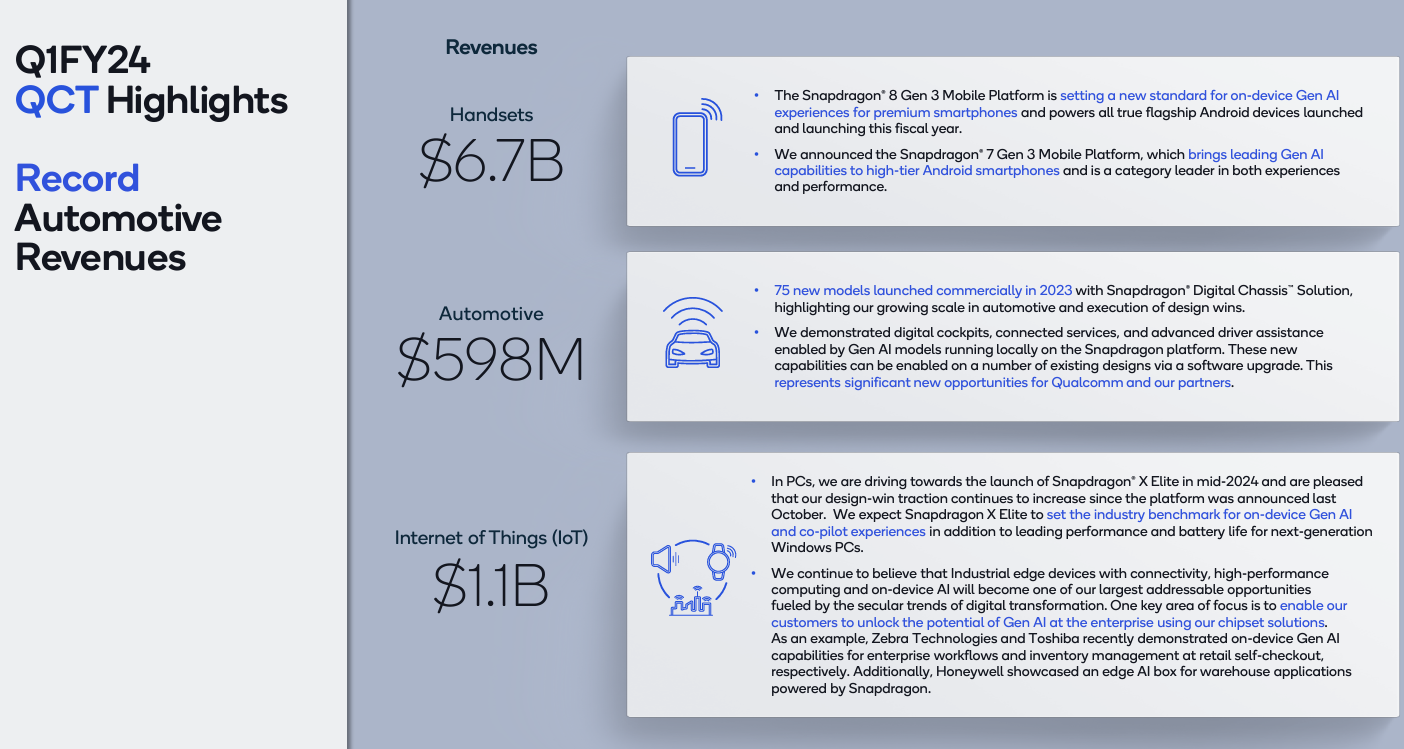
By device, Qualcomm said handset revenue in the first quarter was $6.69 billion, up 16% from a year ago. Automotive revenue was $598 million, up 31%. IoT sales were $1.14 billion, down 32% from a year ago.
Cristiano Amon, CEO of Qualcomm, said on the earnings conference call that generative AI processing on the edge will move well beyond smartphones into enterprise use cases. Amon said:
"We continue to believe that industrial edge devices with connectivity, high-performance computing and on device AI will become one of our largest addressable opportunities fueled by the secular trends of digital transformation. As such, we're accelerating our investments in solutions, ecosystem and broad channel enablement to position ourselves for growth while we navigate the industry-wide inventory draw down."
Vice President and Principal Analyst
Constellation Research
Title: About Dion Hinchcliffe
Dion Hinchcliffe is an internationally recognized business strategist, bestselling author, enterprise architect, industry analyst, and noted keynote speaker. He is widely regarded as one of the most influential figures in digital strategy, the future of work, and enterprise IT. He works with the leadership teams of large enterprises as well as software vendors to raise the bar for the art-of-the-possible in their digital capabilities.
He is currently Vice President and Principal Analyst at Constellation Research. Dion is also currently an executive fellow at the Tuck School of Business Center for Digital Strategies. He is a globally recognized industry expert on the topics of digital transformation, digital workplace, enterprise collaboration, API…...
The rise of hybrid work has thrown open a pandora's box of possibilities, but also unleashed a tangle of challenges for IT departments struggling to keep remote, in-office, and flexible employees seamlessly connected. In the scenario unfolding today, next-generation 5G wireless Internet access has emerged as a genuine enabler, promising to redefine hybrid work flexibility, efficiency, and security.
The traditional office network, tethered to physical desks and legacy wireless connections, now feels archaic in the face of today's dynamic workforce. Imagine attending a crucial client meeting from a comfortable local co-working space, collaborating on real-time documents from home, or seamlessly transitioning between remote office and central office without missing a beat. 5G's fast bandwidth, ultra-low latency, and vast capacity make such scenarios not just feasible, but highly performant and smooth.
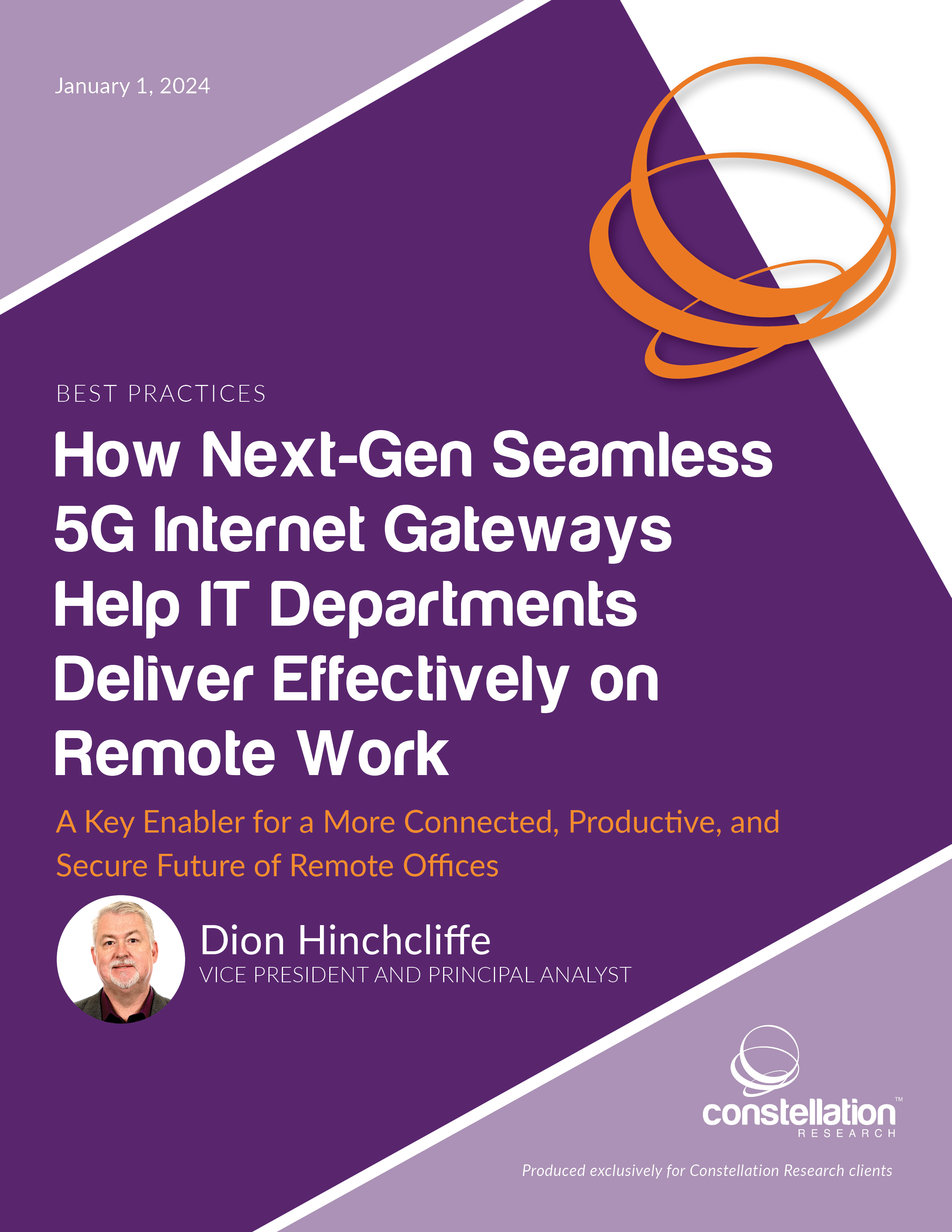
But the benefits of 5G go beyond mere connectivity. In my latest research report on delivering on hybrid work, I explore how next-gen 5G internet gateways -- an example being the widely-used Verizon 5G Business Internet Gateway -- can equip IT departments to tackle the unique challenges of hybrid work.
The crux is success in such hybrid work scenarios is making sure the worker has the capabilities and that it's well supported by the IT department. In my research, supporting the IT department in delivering a high quality hybrid work experience with 5G is a critical succes factor. Imagine a portal that provides real-time visibility into network performance across all hybrid work locations. No more scrambling to diagnose connectivity issues across a scattered patchwork of Wi-Fi hotspots and poorly provisioned regional offices. The such a support portal simplifies network management, security operations, and governance, allowing IT to proactively identify and resolve problems before they disrupt a remote employee's workflow.
But it doesn't stop there. Security concerns abound in the hybrid landscape, with company data potentially accessible from countless public networks. In my exploration of using 5G to unleash hybrid work, I found that solutions like Verizon's VBI Portal can empoower IT to enforce granular security policies across all devices and locations, ensuring every connection adheres to the highest standards, regardless of where the employee is working.
The Data Says: It's a Hybrid Work Future
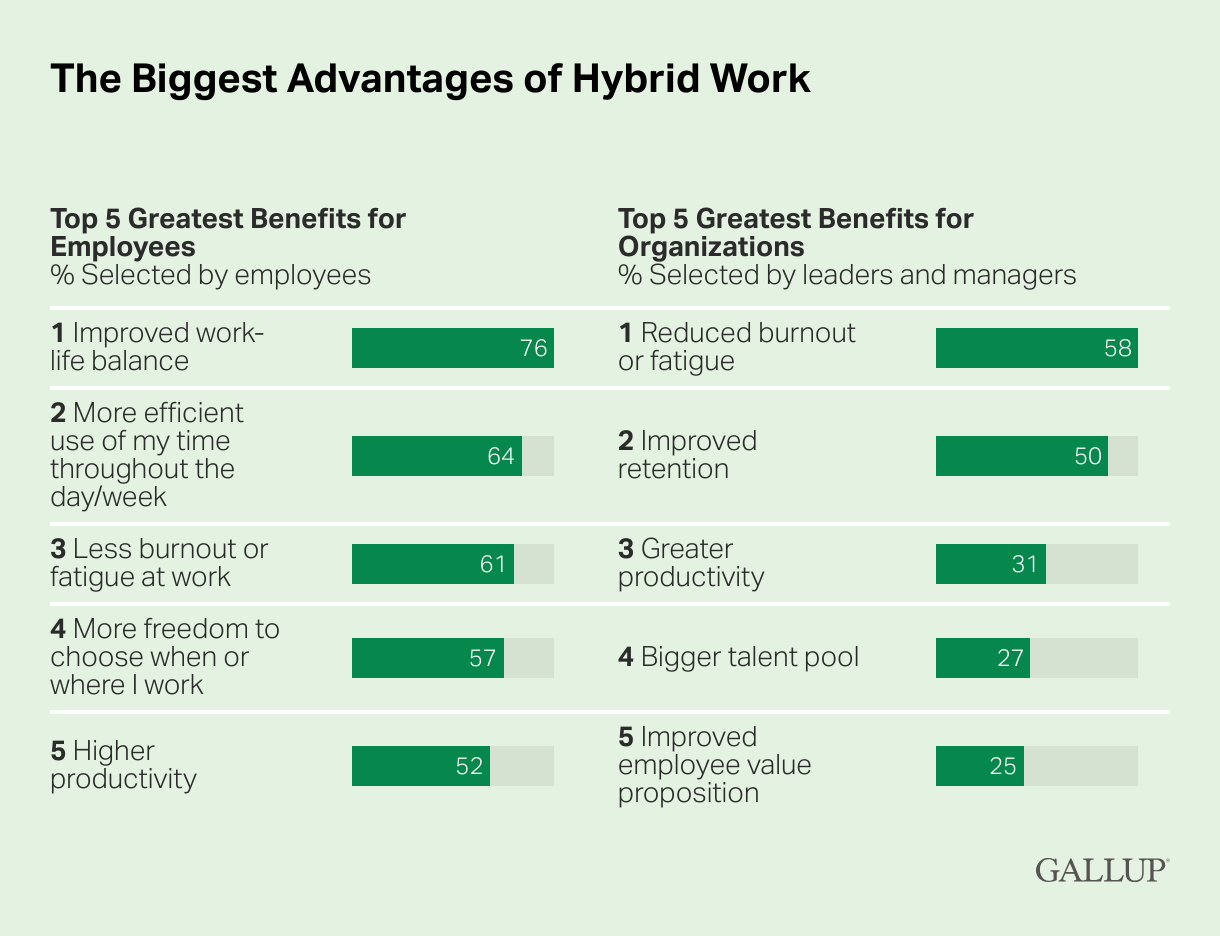
Industry data speaks volumes. A recent study by Upwork revealed that 64 million Americans performed freelance work in the past year, an all-time high, highlighting the growing number of independent professionals who contribute to hybrid teams. Add to that the vast majority of workers, namely 79% of employees who report they crave more flexible work arrangements in a large Cisco survey. It's clear that hybrid work is not just a trend, it's the future. A new Gallup study found that the top five benefits of hybrid work to both employers and workers is productivity:
And 5G, fully unleashed with enabling management support tools for the IT dpeartment, such as Verizon's VBI Portal, holds the key to unlocking its full potential. Imagine a world where employees can sustainablly work seamlessly from anywhere, unburdened by connectivity troubles, secure in the knowledge that their data is fully protected. It's a world where productivity soars, collaboration transcends boundaries, and workers can focus innovation, which is specifically unleashed by the agility and flexibility of 5G networks.
Robust 5G Infrastructure A Vital Enabler of Hybrid Work
Yes, infrastructure challenges remain. But with continued investments in 5G networks and IT-friendly management tools, hybrid work scenarios once deemed futuristic are now within reach. End-user computing teams and digital employee experience leads are now in a position to embrace the flexibility and efficiency that 5G enables, and empower IT departments with the tools they need to support it all. My finding: The future of work is wireless everywhere, and it's more readily achievable than ever before with today's enabling capabilities.
Benefits of 5G management capabilities for IT departments, like the VBI Portal:
Real-time network visibility and performance insights across all hybrid work locations.
Centralized management and troubleshooting of devices and connections.
Granular security policy enforcement to protect company data.
Simplified deployment and support of hybrid work technologies.
As I conclude in the report, "5G unlocks a future where collaboration and productivity defy physical boundaries." And it's not just about speed – the report sheds light on another vital revelation: 5G gateways can unleash virtual networking and resource sharing in real-time, effectively merging disparate physical spaces into a single, dynamic work environment, but only if the right infrastructure is provided.
This research, soon to be publicly available, is a clarion call for IT departments to step up and become champions of hybrid work. By embracing 5G and its empowering tools, they can shed the shackles of traditional network management and orchestrate a symphony of productivity across continents. It's time to rewrite the rules of work, ditch the limitations of the physical office, and unleash the boundless potential of a truly connected, global workforce. The future is wireless, and the future is here today. I urge IT departments to be at the forefront, guiding the way to this high-potential future of work.
Editor in Chief of Constellation Insights
Constellation Research
Larry Dignan is Editor in Chief of Constellation Insights at Constellation Research, where he leads editorial coverage focused on enterprise technology, digital transformation, and emerging trends shaping the future of business. He oversees research-driven news, analysis, interviews, and event coverage designed to help technology buyers and vendors navigate complex markets with clarity and context. ...
Workday said Carl Eschenbach will become CEO of the company Feb. 1. Eschenbach had been co-CEO with Aneel Bhusri since 2022.
Bhusri will become executive chair of Workday's Board of Directors and be a strategic advisor with a focus on innovation and Workday's technology platform.
In a statement, Eschenbach said "working alongside Aneel for the last year has been a highlight of my career, and has solidified my belief in the opportunities ahead for Workday."
Eschenbach is taking over Workday as sole CEO in a strong spot. The company has been integrating AI and generative AI into its platform without going the add-on charge route. Workday has more than 65 million users under contract and more than 10,000 global customers.
Editor in Chief of Constellation Insights
Constellation Research
Larry Dignan is Editor in Chief of Constellation Insights at Constellation Research, where he leads editorial coverage focused on enterprise technology, digital transformation, and emerging trends shaping the future of business. He oversees research-driven news, analysis, interviews, and event coverage designed to help technology buyers and vendors navigate complex markets with clarity and context. ...
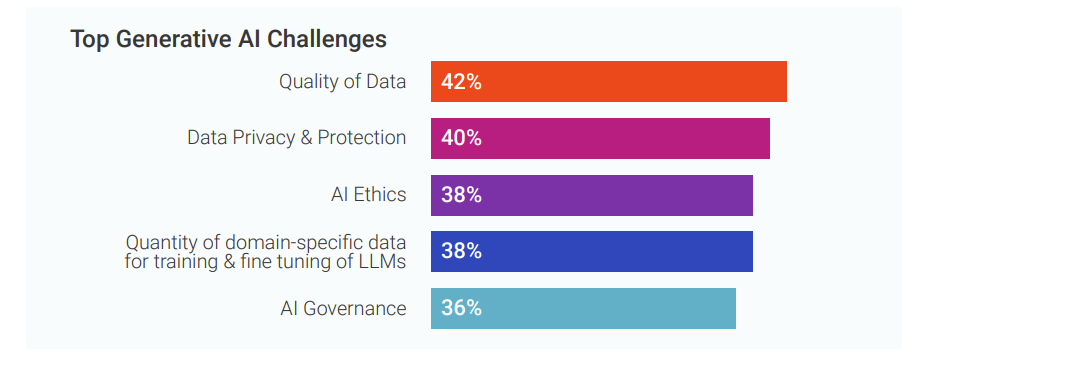
Enterprises are racing to incorporate generative AI into business processes and 45% of chief digital officers say they already have, according to an Informatica survey. However, quality of data was the biggest obstacle for 42% of respondents.
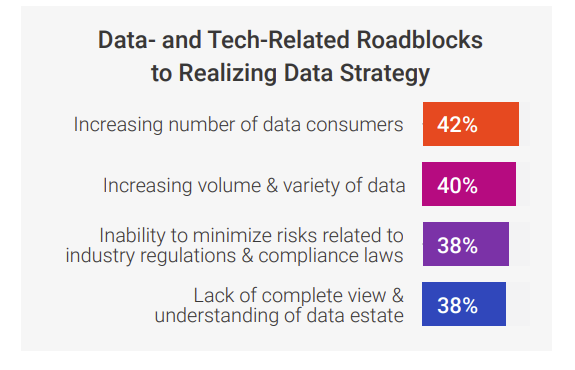
The Informatica survey, based on 600 data leaders from companies with more than $500 million in revenue, revealed that 78% of data leaders expect their enterprises to increase budgets for data management. Informatica noted that 33% of respondents expect significant investments in data management.
These finding align with Constellation Research's take that enterprises will have to invest in data management, architecture and quality to drive generative AI return on investment. There's also the reality that companies may not have enough data to make generative AI work. What remains to be seen is what data drives the most returns with generative AI.
Indeed, Informatica's survey said 41% of respondents already struggle with more than 1,000 sources of data.
From the report:
"As a result, AI, its challenges and data quality are all rising on data leaders' list of priorities for the year ahead.
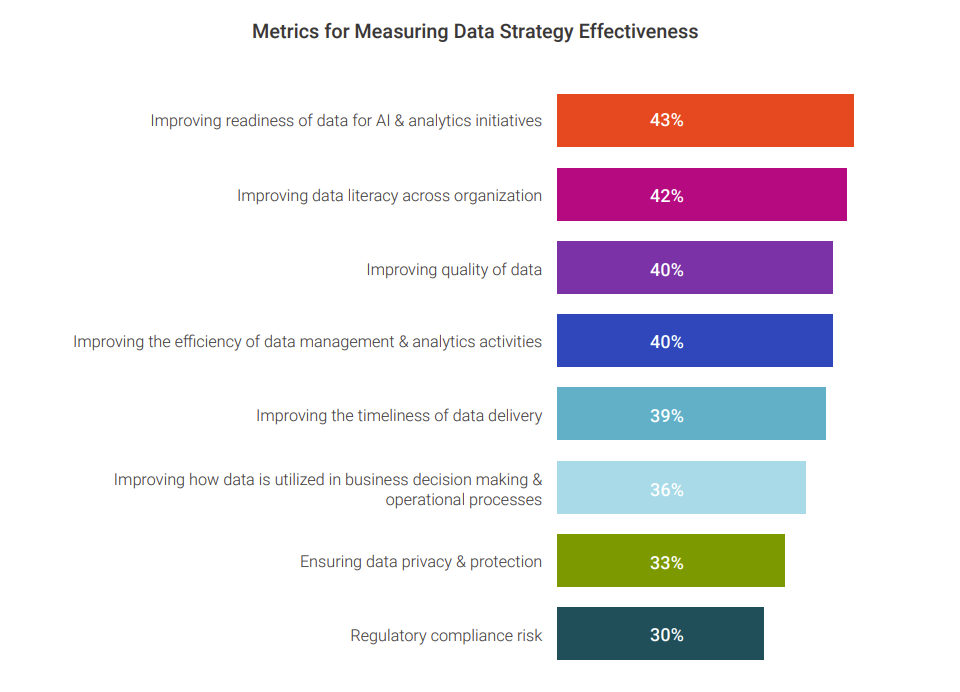
Top data strategy priorities for 2024 include delivering reliable and consistent data fit for generative AI (39%), improving data-driven culture and data literacy (39%), and improving governance over data and data processes (38%). These priorities all highlight the need to push beyond implementing and toward maximizing AI’s efficacy and making the most of their investments—a point made even more clear by the 43% using AI readiness as a top metric for measuring their data strategy effectiveness."
The report had a series of notable findings. Here's a look:
51% are evaluating or planning to evaluate open-source LLMs and 48% are planning to implement retrieval-augmented generation (RAG) with LLMs.
44% of data leaders are considering fine-tuning public LLMs and 43% are planning on customizing them.
99% of respondents adopting or planning to adopt generative AI have encountered challenges.
73% of those implementing or planning to implement generative AI plan to use the technology to deliver faster insights to data.
66% are looking to generative AI to drive productivity with automation and augmentation.
48% of data leaders said AI and machine learning were key areas for reskilling and upskilling. 44% said data analytics and visualization was an opportunity for reskilling.
Editor in Chief of Constellation Insights
Constellation Research
Larry Dignan is Editor in Chief of Constellation Insights at Constellation Research, where he leads editorial coverage focused on enterprise technology, digital transformation, and emerging trends shaping the future of business. He oversees research-driven news, analysis, interviews, and event coverage designed to help technology buyers and vendors navigate complex markets with clarity and context. ...
Dell Technologies is exiting its commercial agreement with VMware now that it has been acquired by Broadcom.
The company said in a regulatory filing that it will terminate its commercial agreement with VMware due to a change in control. With the move Dell Technologies won't be a distributor of VMware products--unless there's a new agreement.
In the filing, Dell said the terminated agreement "provides a framework for various commercial activities between the two parties, including how the Company will act as a distributor of VMware products and services as well as how the parties collaborate on certain solutions and go-to-market activities."
In a recent CXO meeting of BT150 members, VMware was a hot topic. Here are some of the takeaways from that meeting.
CIOs were actively looking at alternatives with many looking to move off VMware. Nutanix appears to be the biggest beneficiary.
CIOs weren't surprised by Broadcom's move and one exec noted that peers are seeing price hikes of 100%. Broadcom made similar moves when it acquired CA and Symantec, CXOs said.
Without a major change in strategy, it's hard to rip and replace VMware, but many companies are looking at jumping. One catch is that VMware still owns a lot of EMC's old big data portfolio and it's difficult to migrate.
Enterprises took the time to plan a move off VMWare while the Broadcom purchase was delayed by regulatory issues. It will take a few years to move off VMware completely.
Nutanix was gaining share and some CXOs were looking at open-source options for their Linux stacks.
CXOs are expecting VMware's innovation, support and service to all decline--especially for enterprises that fall out of the top 100 or 200 clients.
Editor in Chief of Constellation Insights
Constellation Research
Larry Dignan is Editor in Chief of Constellation Insights at Constellation Research, where he leads editorial coverage focused on enterprise technology, digital transformation, and emerging trends shaping the future of business. He oversees research-driven news, analysis, interviews, and event coverage designed to help technology buyers and vendors navigate complex markets with clarity and context. ...
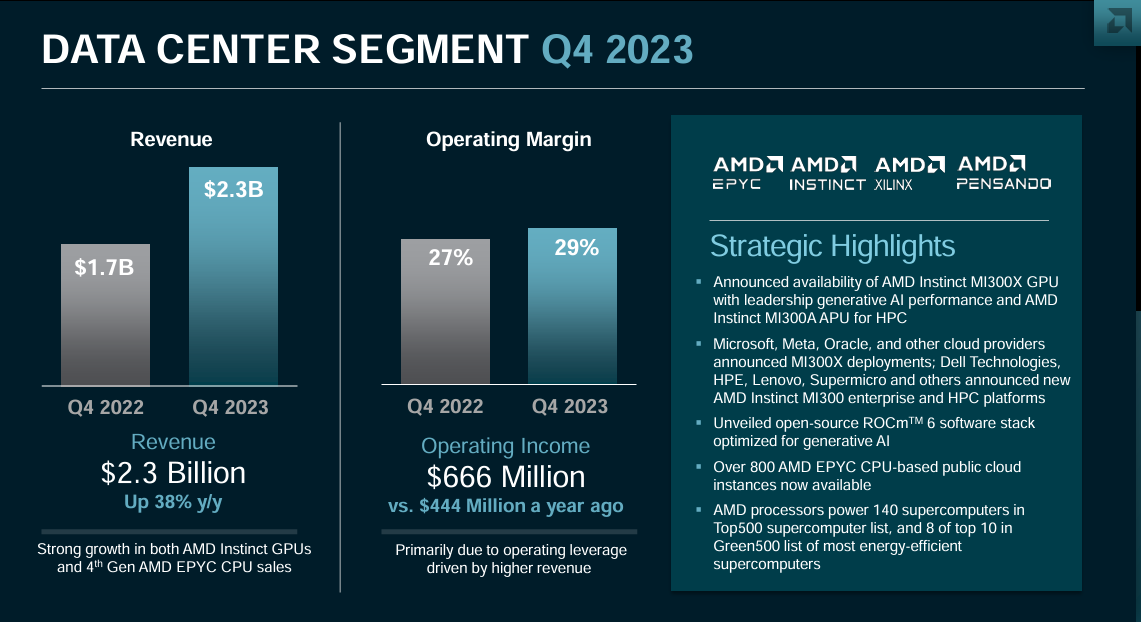
AMD's fourth quarter results were solid, but the outlook for the first quarter missed expectations.
The chipmaker projected first quarter revenue of about $5.4 billion, give or take $300 million. Wall Street was expecting $5.7 billion. AMD's guidance comes a week after Intel's disappointing outlook. AMD also said that its first quarter data center revenue will be flat with the fourth quarter due to a seasonal decline in server sales offset by ramping GPU sales.
For the fourth quarter, AMD reported net income of $667 million, or 41 cents a share. Non-GAAP earnings were 77 cents a share. Revenue for the fourth quarter was $6.2 billion.
Wall Street was expecting AMD to report earnings of 77 cents a share on revenue of $6.14 billion.
For 2023, AMD reported net income of $854 million, or 53 cents a share, on revenue of $22.7 billion. AMD is ramping up its AI-optimized processes as it chases Nvidia.
AMD CEO Lisa Su said, "demand for our high-performance data center product portfolio continues to accelerate, positioning us well to deliver strong annual growth."
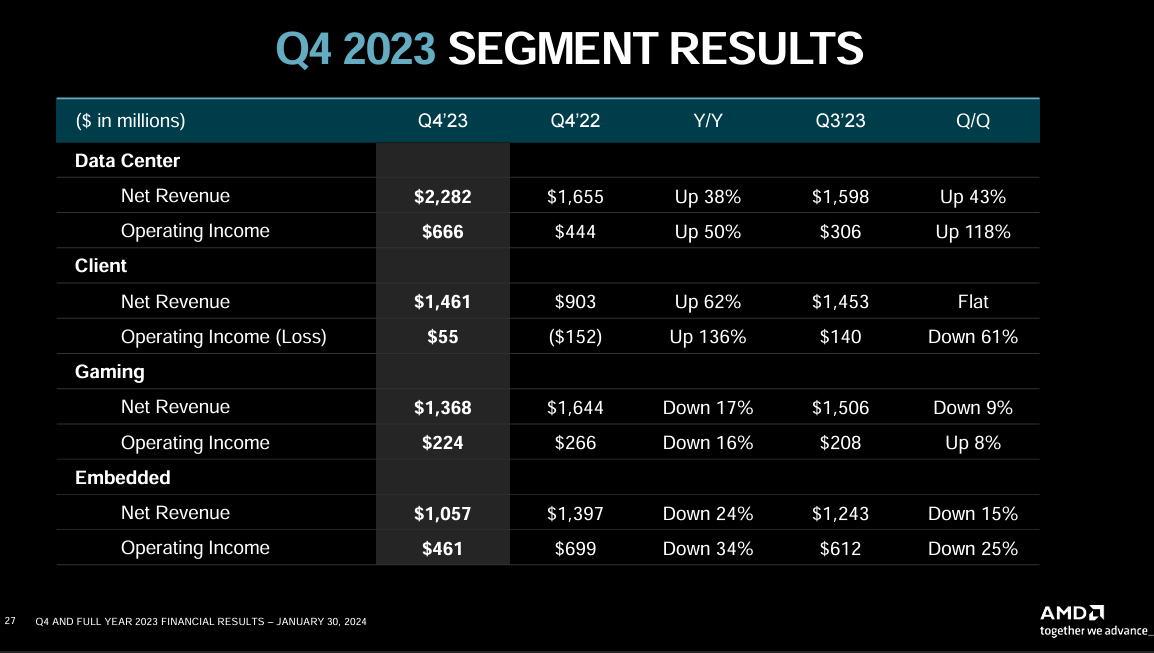
Data center revenue in the fourth quarter was $2.3 billion, up 38% from a year ago. Sales were driven by EPYC CPUs and AMD Instinct GPUs.
AMD's PC group delivered revenue of $1.5 billion, up 62% from a year ago. Those gains weren't enough to reverse a rough 2023 as annual revenue fell 25%. Gaming revenue was $1.4 billion, down 17% from a year ago. Embedded revenue in the fourth quarter was down 24% from a year ago.
Speaking on a conference call, Su said:
"Based on a strong customer pool and expanded engagements, we now expect datacenter GPU revenue to grow sequentially in the first quarter and exceed $3.5 billion in 2024."
Other comments of note:
AMD sees AI PCs driving an upgrade cycle. "Looking at 2024 we are planning for the PC total addressable market to grow modestly year on year weighted towards the second half as AI PCs ramp," said Su.
"We believe AI is a once in a generation transition that will reshape virtually every portion of the computing market starting in the data center and then expanding into PCs and across multiple embedded markets," she said.
One point worth noting is what Su said about AI workloads beyond the hyperscalers. When asked about the MI300 demand, she said:
"On the MI300 trajectory. I think you would expect that revenue should increase every quarter from now through sort of the end of the year, but it will be a bit more second half weighted and part of that is just customers as they're finishing up their qualifications as our supply chain is ramping. We are engaged with all of sort of the large customers. These are all folks that know us really well, given our deep relationships in EPYC. I think people just have different adoption cycles as they consider what they're trying to do in their roadmap. This is very, very early innings for us in this space. This is not just about MI300 conversation, but our long-term multi-generational roadmap. There's a lot of demand coming from folks that are more AI centric and not necessarily typical cloud customers, but more enterprise or let's call it AI-specific companies that we're also very well engaged with."



 51% are evaluating or planning to evaluate open-source LLMs and 48% are planning to implement retrieval-augmented generation (RAG) with LLMs.