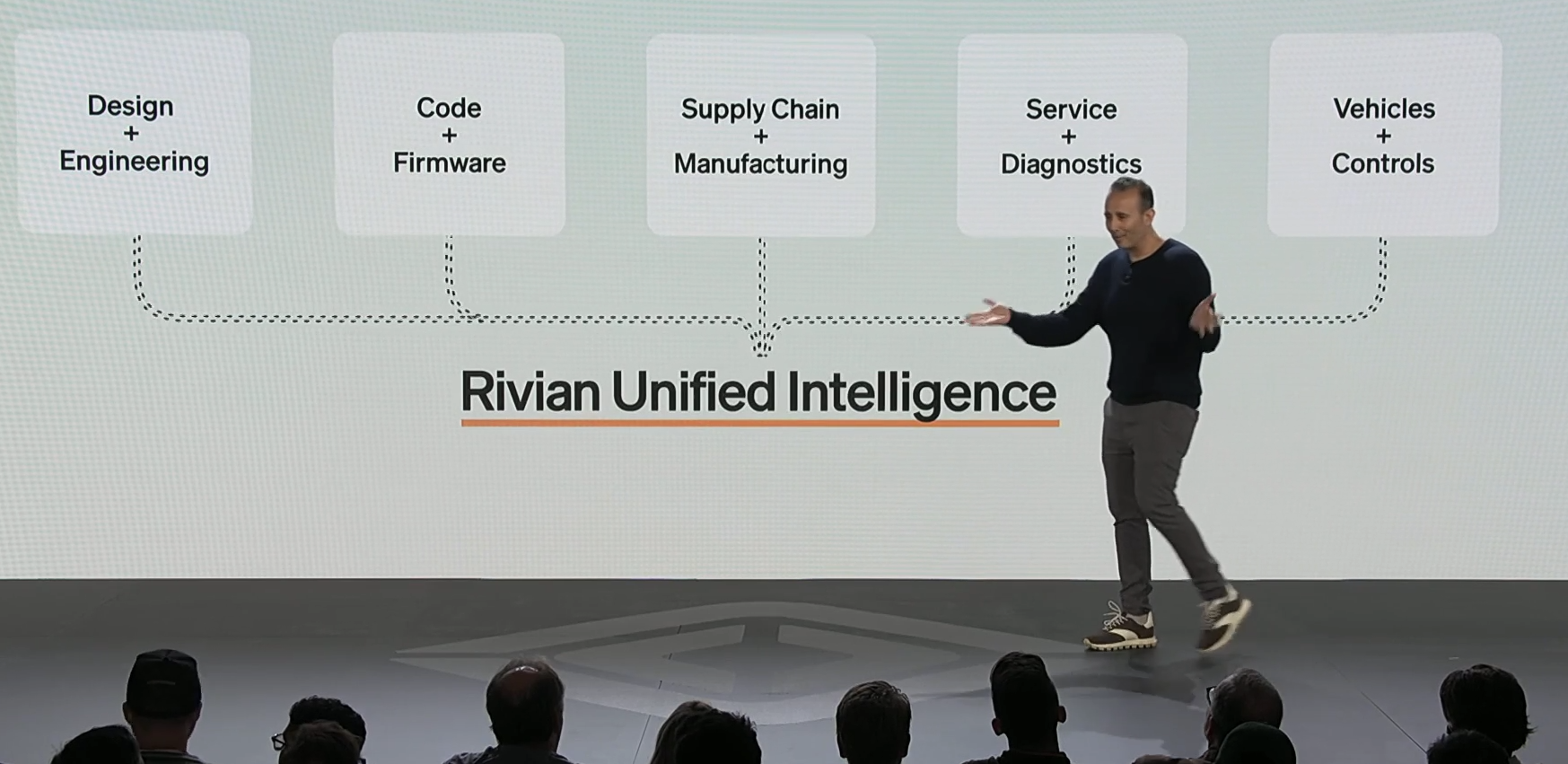
Rivian's vertically integrated approach to autonomous driving and AI is enabled by its data flywheel that it uses to train its models and optimize.
The automaker held its first Autonomy & AI Day and perhaps the biggest lesson is that Rivian is an example of a company using its first-party data to develop new opportunities.
Rivian CEO RJ Scaringe highlighted the company's strategy, which revolves around owning its AI stack. That stack includes purpose-built silicon and a platform that used ingest data and train models. Rivian is looking to get into the AI and autonomy game, which includes the likes of Tesla as well as Alphabet unit Waymo.
"Directly controlling our network architecture and our software platforms in our vehicles has, of course, created an opportunity for us to deliver amazingly rich software. But perhaps even more importantly, this is the foundation of enabling AI across our vehicles and our business," said Scaringe.
Key news items from Rivian's investor meeting:
- Rivian unveiled its Rivian Autonomy Processor (RAP1), a custom 5nm processor that integrates processing and memory on a single multi-chip module.
- RAP1 features RivLink, which is a low latency interconnect technology that networks chips for more processing power.
- The company outlined its third-gen Autonomy computer, or Autonomy Compute Module 3 (ACM3). ACM3 can process 5 billion pixels per second.
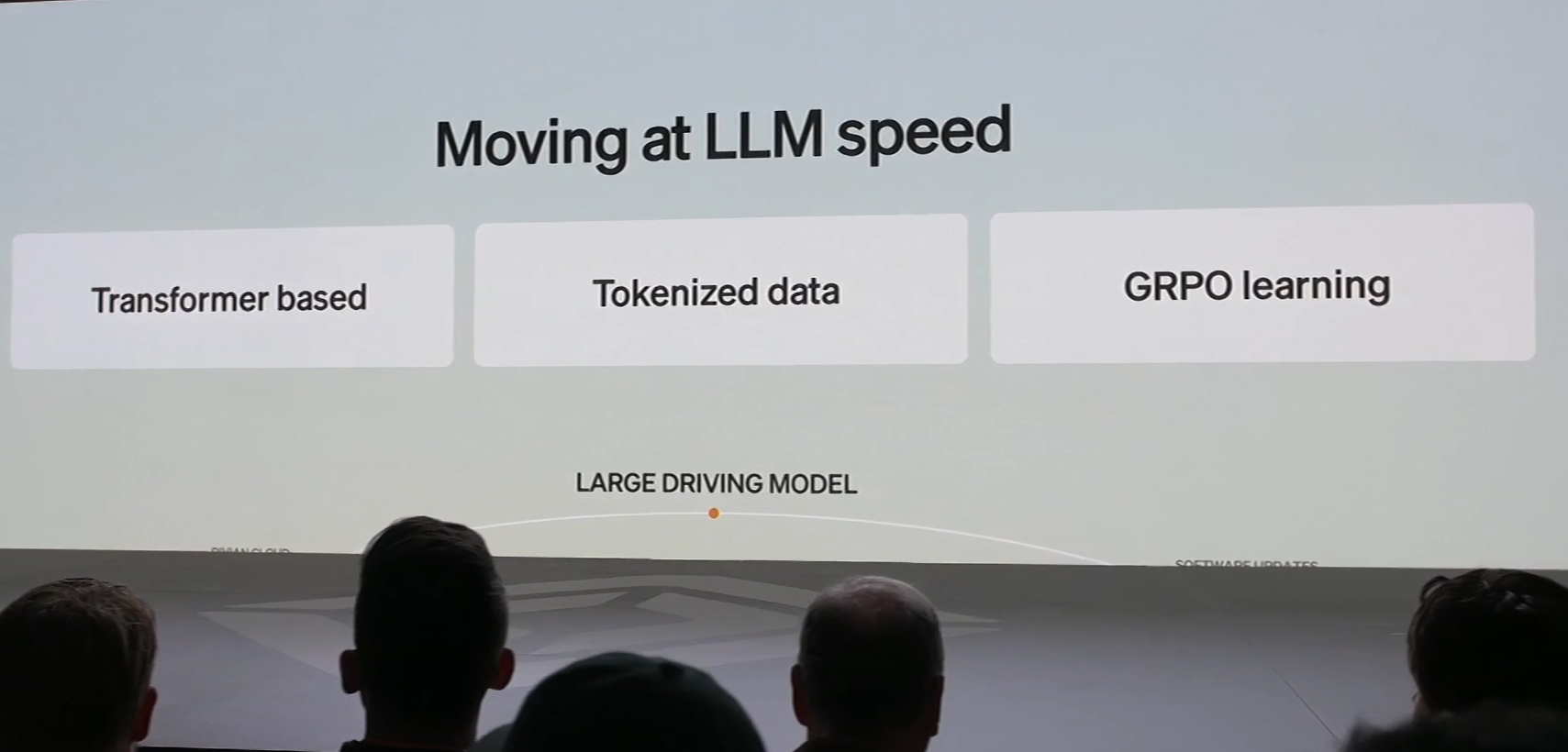
- Rivian has an in-house developed AI compiler and platform. The platform, the Rivian Autonomy Platform, features an end-to-end data loop and its Large Driving Model (LDM), which is an LLM for driving. The LDM will distill strategies from Rivian's datasets.
Going forward, Rivian plans to integrate LiDAR into its upcoming R2 models at the end of 2026. LiDAR augments Rivian's multi-sensor strategy. Rivian also said it will add Universal Hands-Free driving features to its second-gen R1 vehicles. The system will be available on 3.5 million miles of roads in the US and Canada.
Rivian's AI strategy beyond autonomy includes Rivian Unified Intelligence, a foundation of multi-modal and multi-LLMs and data. The platform is designed to enable Rivian to roll out features, improve service and offer predictive maintenance. Rivian is also launching a next-gen voice interface in early 2026 that uses its edge models, third party integrations, and reasoning LLMs.
Beyond the news barrage from Rivian, there are multiple takeaways from the company's strategy meeting. Here are a few:
Rate of change only increasing. Rivian has created an architecture that can adapt to the pace of change. Enterprises will need to work under the assumption that the rate of change over the next five years will be much faster than the last five years.
"If we look forward 3 or 4 years into the future, the rate of change is an order of magnitude greater than what we've experienced in the last 3 or 4 years," said Scaringe.
Also: Uber outlines its autonomous vehicle plan | GM to integrate Google Gemini, delivered unified software defined vehicle architecture
First party data is everything. "Our approach to building self-driving is really designed around this data flywheel. We're a deployed fleet, has a carefully designed data policy that allows us to identify important and interesting events that we can use to train our large model offline, before distilling the model back down into the vehicle," said Scaringe.
AI will touch every process. Rivian is leveraging its AI backbone for its vehicles and autonomous efforts. But Rivian's AI backbone also runs through the enterprise. Scaringe said its AI strategy will impact its sales and service model, supply chain and manufacturing infrastructure.
You may need to build your own. Vidya Rajagopalan, Senior Vice President of Electrical Hardware at Rivian, explained why the company had to develop its own processors. She said:
"It's important to address why we chose to build in-house silicon. The reason for doing it is velocity, performance and cost.
With our in-house silicon development, we're able to start our software development almost a year ahead of what we can do with supplier silicon. We actually had software running on our in-house hardware prototyping platform well ahead of getting first silicon. Our hardware and software teams are actually co-located and they're able to develop at a rapid pace that is just simply not possible with supplier silicon."
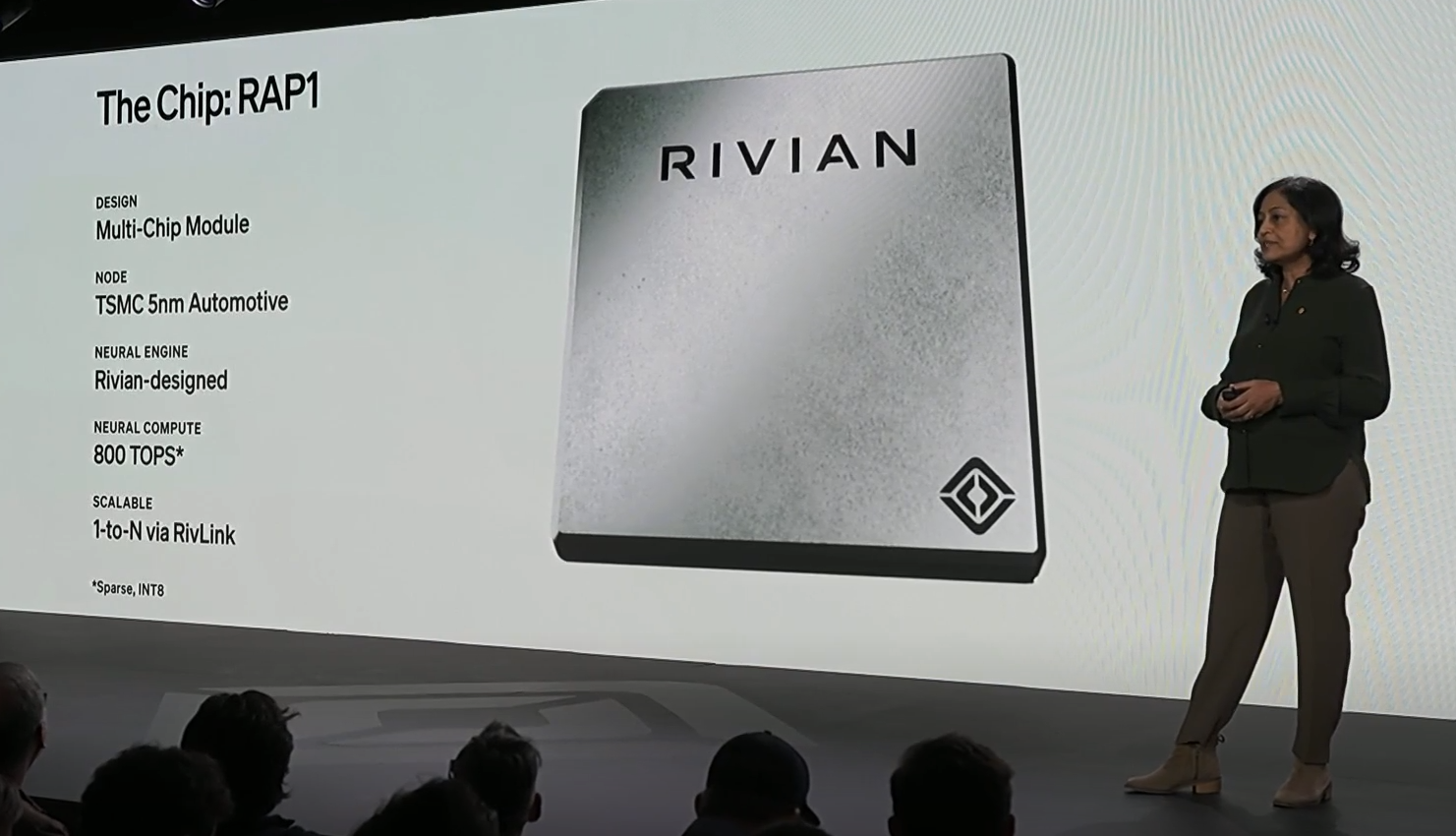
Rajagopalan said the ability to customize is also critical for designing for current use cases and the future. In addition, Rivian can optimize to save money.
Think multiple models. Wassym Bensaid, Chief Software Officer at Rivian, said the company has developed its own model for driving, but has a "suite of specialized agents."
"Every Rivian system from manufacturing, diagnostics, EVR planning, navigation becomes an intelligent node through MCP. And the beauty here is we can integrate third-party agents. And this is completely redefining how apps in the future will integrate in our cars," said Bensaid. "We orchestrate multiple foundation models in real time, choosing the right model for each task. And we support memory and context, allowing us to offer advanced levels of personalized experience."
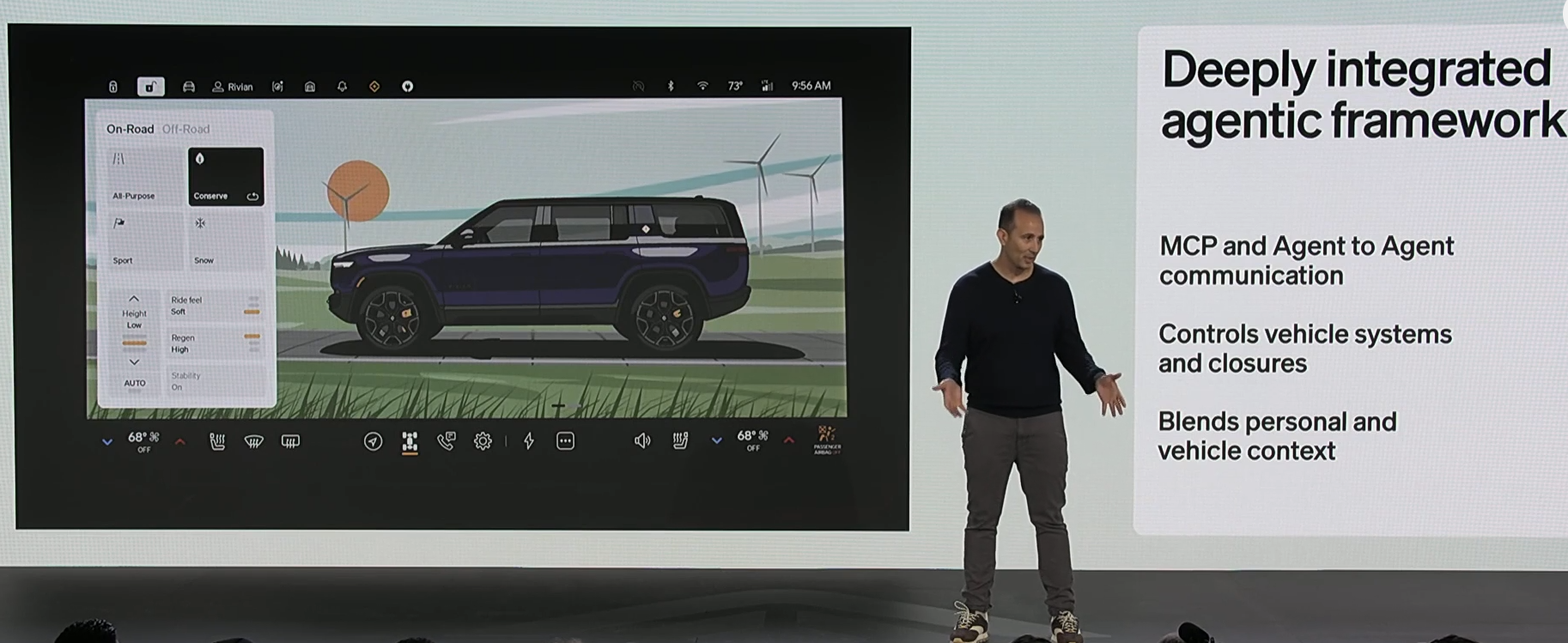
Bensaid said the use of multiple models and Rivian's architecture is designed to move workloads from the cloud to the edge. Rivian Unified Intelligence is the connective tissue.