
OpenAI and Microsoft put out a joint statement that they've reached a detente and may have raised more questions than they answered. Simply put, the OpenAI and Microsoft relationship is a little more clear but not by much. I'm sure it'll all work out great.
In a joint statement, the companies said:
"OpenAI and Microsoft have signed a non-binding memorandum of understanding (MOU) for the next phase of our partnership. We are actively working to finalize contractual terms in a definitive agreement. Together, we remain focused on delivering the best AI tools for everyone, grounded in our shared commitment to safety."
Welcome to the week of things that may happen...or not. OpenAI and Microsoft's statement will get a lot of play, but it's not much different than Oracle's massive remaining performance obligation figures which reportedly revolve around OpenAI buying $300 billion in AI compute in 2027. It's an I. O. U. since OpenAI doesn’t have the money...yet. I may buy that compute once I win the Powerball. I already signed the non-binding contract of things that may happen should I become obscenely wealthy in two years.
So now, OpenAI, which apparently is the master of projections for a perfect world, has an understanding that'll it'll reach an understanding with Microsoft.
But seriously, this OpenAI and Microsoft thing is great news. What we do know from another statement is that OpenAI will remain a non-profit that will have funding of more than $100 billion. Yes, these figures are starting to look like their priced in Japanese Yen at this point.
I just feel better that OpenAI and Microsoft are getting along.
- OpenAI vs. Microsoft: Why a breakup could be good
- OpenAI and Microsoft: Symbiotic or future frenemies?
The Public Benefit Corporation (PBC) will continue to oversee the for-profit OpenAI and have an equity stake. The stake tops $100 billion and makes PBC "one of the most well-resourced philanthropic organizations in the world."
To put this PBC funding in perspective, it's worth a Gates Foundation comparison. Bill Gates and Melinda Gates through 2024 have given $60.2 billion to the Gates Foundation, which has paid out $83.3 billion in grants since inception. Warren Buffet has given $43.3 billion to the Gates Foundation from 2006 to 2024. The Gates Foundation has a trust endowment of $77.2 billion exiting 2024.
OpenAI's PBC will have a larger endowment than the Gates Foundation with a key caveat: PBC's funding will be based on OpenAI's valuation and a future business that'll revolve around AGI and domination of the competition. Hmm.
In any case, this non-binding understanding with Microsoft makes the software giant more of an investor. The PBC would theoretically get to do more good as all parties benefit.
A cynic (can you see me raising my hand looking perplexed and possibly jumping up and down) would call this MOU a bit of vapor, but I’m sure glad OpenAI and Microsoft don't have to go nuclear since it's arguably the most lucrative technology partnership in history.
I mean just look at the happiness between these two.
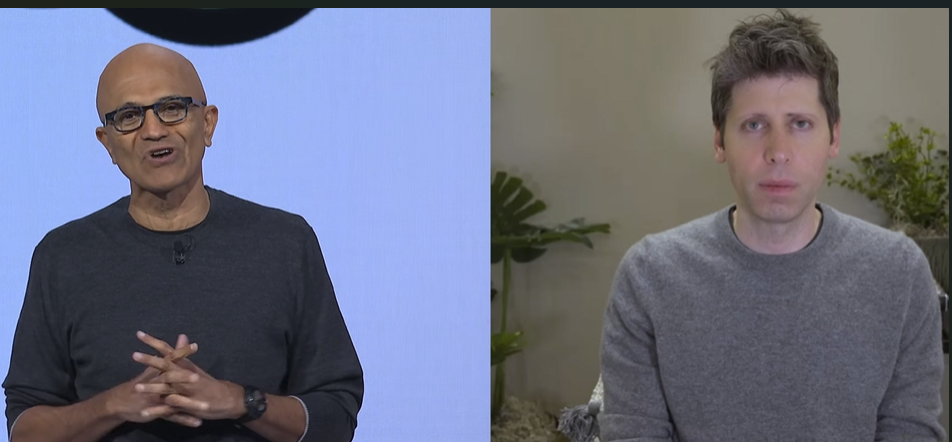
Now Microsoft looks like it will officially be an investor under the new structure even though no details have been provided. The details will be critical:
- How much power will PBC really have?
- What happens when safety and mission collide with profits?
- How will market pressures trade off with what the PBC wants?
- Who will be on the board of the PBC overseeing the push to AGI?
- How transparent is the oversight and governance of OpenAI?
- PBC has a stake of more than $100 billion in OpenAI, but what’s the dilution to existing investors?
- What rights will Microsoft have with its investment?
- Will OpenAI spin off units that won't be under PBC control in the future?
For giggles, I asked ChatGPT to clarify this new OpenAI-Microsoft detente and think through scenarios. After all, since we're playing with a made up understanding with made up numbers, we might as well break out the crystal ball too.
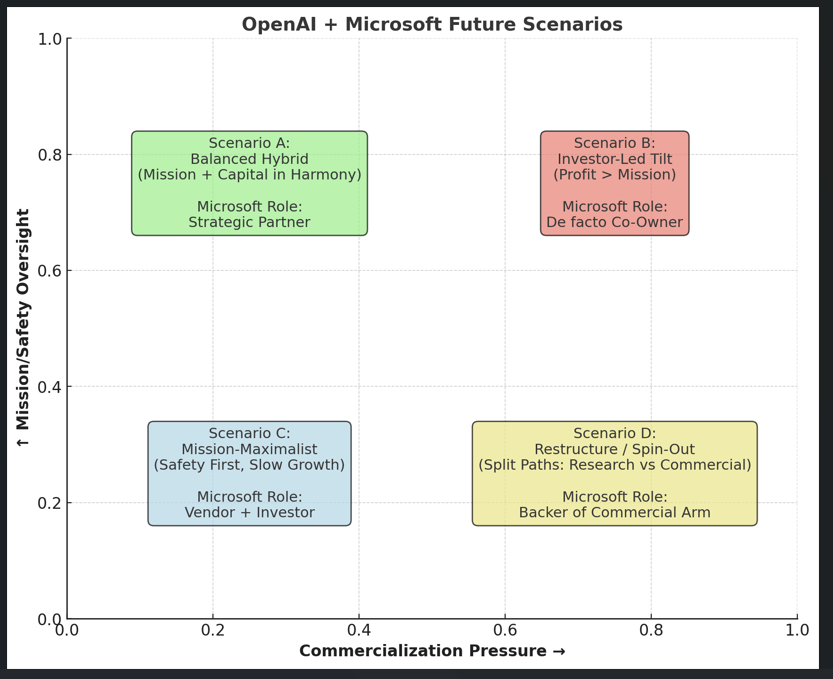
The scenarios boil down to this:
- Mission and capital will be in harmony under this structure. PBC has real veto power over safety, direction and deployment of frontier models. Microsoft has preferred rights, but doesn't dictate roadmap. All is well. I couldn't stop laughing about the odds of this one playing out.
- Investors gain influence and profits trump mission. Microsoft and other investors wind up influencing the PBC. Microsoft is essentially a co-owner. OpenAI benefits from faster commercialization and revenue growth, but has to hear "sell-out" from critics. I can see a PBC board of Larry Ellison, Elon Musk, Sam Altman, Satya Nadella and some token AI ethics professor from Stanford any day now.
- PBC has a lot of authority and OpenAI grows slow. Tensions boil over as OpenAI rivals move faster. It's the good for drama, bad for market capitalization scenario.
- OpenAI starts spinning out parts to focus more on investor-led initiatives. Think OpenAI Labs, OpenAI Enterprise and OpenAI Consumer as a trio of companies.
I’m sure we’ll get to the harmony scenario because in the age of RPO, IOUs and valuations based on SPAC-like made up future revenue figures what could go wrong?


