Results

7 takeaways on enterprise AI projects from Infosys, Wipro Q2 results

7 takeaways on enterprise AI projects from Infosys, Wipro Q2 results

Infosys and Wipro executives said that enterprises are starting to operationalize artificial intelligence projects, scale agentic AI and build a new software stack as pilots move to production with industries such as banking and financial services leading the way.

Those were the highlights from a pair of earnings reports from the Indian services firms that landed within minutes of each other. Infosys reported second quarter earnings of $839 million on revenue of $5.08 billion, up 2.9% from a year ago. Wipro reported second quarter earnings of $368 million on revenue of $2.56 billion, up nearly 2% from a year ago.

Earnings results from services firms are a handy way to get a high level view of what's happening with AI efforts. Both Infosys and Wipro provided color on AI implementations, but the former delivered named references including ABN Amro, Mastercard, Telstra, HanesBrands and Agco Corp.

Here's a look at the takeaways from the Infosys and Wipro results.

Enterprise AI is being scaled by customers.

Infosys CEO Salil Parekh said that "client interactions show strong focus on deploying AI across the enterprise for growth and on cost efficiency programs." He said clients are leveraging Infosys' platforms for AI agents and AI overall.

Wipro CEO Srinivas Pallia said customers are prioritizing cost optimization, vendor consolidation, modernization and scaling AI agents.

On the delivery side, both companies said they are leveraging AI agents more.

AI-driven productivity pays the bills, but growth matters too.

Across industries, AI investments are justified based on cost savings, but customer experience and growth is becoming a bigger part of the ROI mix. Infosys CFO Jayesh Sanghrajka said:

"Clients are actively planning modernization and AI-driven initiatives with a clear focus on cost efficiency, enhanced customer experience and strategic transformation."

Pallia said Wipro's customers are "clearly looking for cost optimization."

The broader theme for both companies is that enterprises aren't into AI pilots as much as they are business outcomes.

Can you monetize trust?

Questions from analysts around agentic AI and automation frameworks often revolved around accuracy and hallucinations. What happens if an AI agent goes rogue?

Both companies highlighted guardrails, years of experience automating processes and industry knowhow. Wipro's Hari Shetty, chief strategist, said Wipro Intelligence is a layer for responsible AI guardrails built into the platform.

Meanwhile, Infosys Chief Delivery Officer Satish H.C. said: "Our Responsible AI office ensures clients have the defense and technical guardrails to address AI-related risks. We are among the first certified on ISO 42001:2023."

The questions were notable since they raised more queries. Can Indian IT giants monetize trust in AI? And are vendors on the hook if AI agents wind up hurting a client's business?

Banking, financial services and insurance lead AI spending.

The fact that financial companies lead the way on AI spending isn't surprising to anyone keeping tabs on earnings reports. The financial sector is one of the most mature industries for AI adoption. Both Infosys and Wipro noted that financial firms are scaling AI pilots.

Sanghrajka said:

"In financial services, clients are actively planning modernization and AI-driven initiatives with a clear focus on cost efficiency, enhance customer experience and strategic business transformation. We see strong momentum in mortgages, capital markets commercial banking and wealth management areas. Banks have spent significantly to build AI infrastructure. Many initiatives are progressing from proof of concepts to full-scale projects with notable traction in Agentic AI."

Healthcare transformation

Healthcare was cited as a strong vertical. Infosys cited strength in healthcare with clients deploying AI and automation. Wipro's Pallia cited a mega deal with a healthcare client. Palia noted:

  • Healthcare is going through structural changes and companies are navigating various policy changes.
  • Payers are trying to accelerate and transform contact centers.
  • Wipro healthcare clients are looking for real-time claim processing, efficiencies in pre-authorization and enhanced transparency.

Healthcare was Wipro's best vertical in the second quarter with revenue growth of 3.9%.

Manufacturing and energy mixed.

Infosys' Sanghrajka said manufacturing "continues to face trade and macro uncertainties, which is creating pressure on discretionary spend specifically in the automotive sector."

However, Sanghrajka said manufacturers are spending on the following:

  • Application and infrastructure rationalization.
  • Leveraging AI for automation.
  • Predictive maintenance.
  • Resolving supply chain bottlenecks.

As for energy, Sanghrajka said utilities are trying to leverage new technologies to meet data center demand. "Utility companies are looking for partners to meet the accelerating electricity demand, creating opportunities in areas like renewable integration, grid modernization, AI-driven optimization, et cetera," he said.

Industries are aiming AI spend at specific issues. Telecom, technology and communication are focused on using AI for customer experience, but cost optimization remains critical. Retailers are also mixed as they wrestle with tariffs and consumer demand.

The new AI stack

Other nuggets worth noting include:

  • Infosys and Wipro both said that big deals are signed due to vendor consolidation plans. Enterprises are looking for end-to-end services and horizontal plays.
  • That vendor consolidation is leading to large scale generative AI and agentic AI deployments.
  • Forward deployed engineers are being used for AI transformation deals.
  • Indian IT services firms are increasingly developing AI stacks for enterprises instead of deploying packaged applications. Infosys' Satish HC said:

"The opportunity with AI is that we are developing a new breed of services stack or software stack for our clients, which wasn't done before. This is a reimagining how we run business or how we even deliver services. The onus is on co-creation with our clients, which is why I think there is a sharper pivot to the leverage of forward-deployed engineers. As we move from POCs to enterprise scale adoption, we see that there will be a lot more need for forward-deployed engineers to work with our clients to drive this co-creation of the new breed of software stack."


Data to Decisions Chief Information Officer
Zoho details Indian government migration, expands roster of AI agents

Zoho details Indian government migration, expands roster of AI agents

Zoho has moved 1.1 million Government of India users to Zoho Workplace in a move that highlights how the vendor, known for its disruptive pricing and reach with smaller enterprises, can scale.

In addition, Zoho, which has more than 130 million users, rolled out a series of AI agents for its collaboration, human resources and customer experience apps across its platform.

Regarding the India government migration, Zoho Chief Evangelist Raju Vegesna said during a briefing that the 1.1 million users is just the first installment of the migration. "There are a few other million users coming," said Vegesna. "It's an ongoing process."

Zoho said India's National Informatics Center (NIC) asked for proposals in 2023 to shift collaboration services to a dedicated, secure environment. Zoho was selected to manage and migrate official email and office suite services.

The custom rebranded version of Zoho Workspace will be available for government departments for email, files, documents and communications. India's government is specifically using Zoho Mail, WorkDrive, Meeting, Cliq, Mobile Device Management, Writer, Sheet and Show, OneAuth and Contacts.

Zoho's apps are hosted in a secure data center under NIC's control and includes a complete cybersecurity stack.

As for the agentic AI additions, Zoho said its latest AI agents will be available at no charge across Zoho Collaboration, Customer Experience and Human Resources.

The AI agents from Zoho are a fast follow from the launch of Zia Hubs and Zia LLM, its proprietary B2B model.

Among the agents launching:

  • Lead Generation Agent works across Zoho Mail and CRM to go through unread messages, identify sales queries and converts them into a lead in Zoho CRM.
  • AI Base Creation enables customers to create a use case with a prompt. Zia will create a base with relevant tables, sample data and linked fields. The agent works within Zoho Tables.
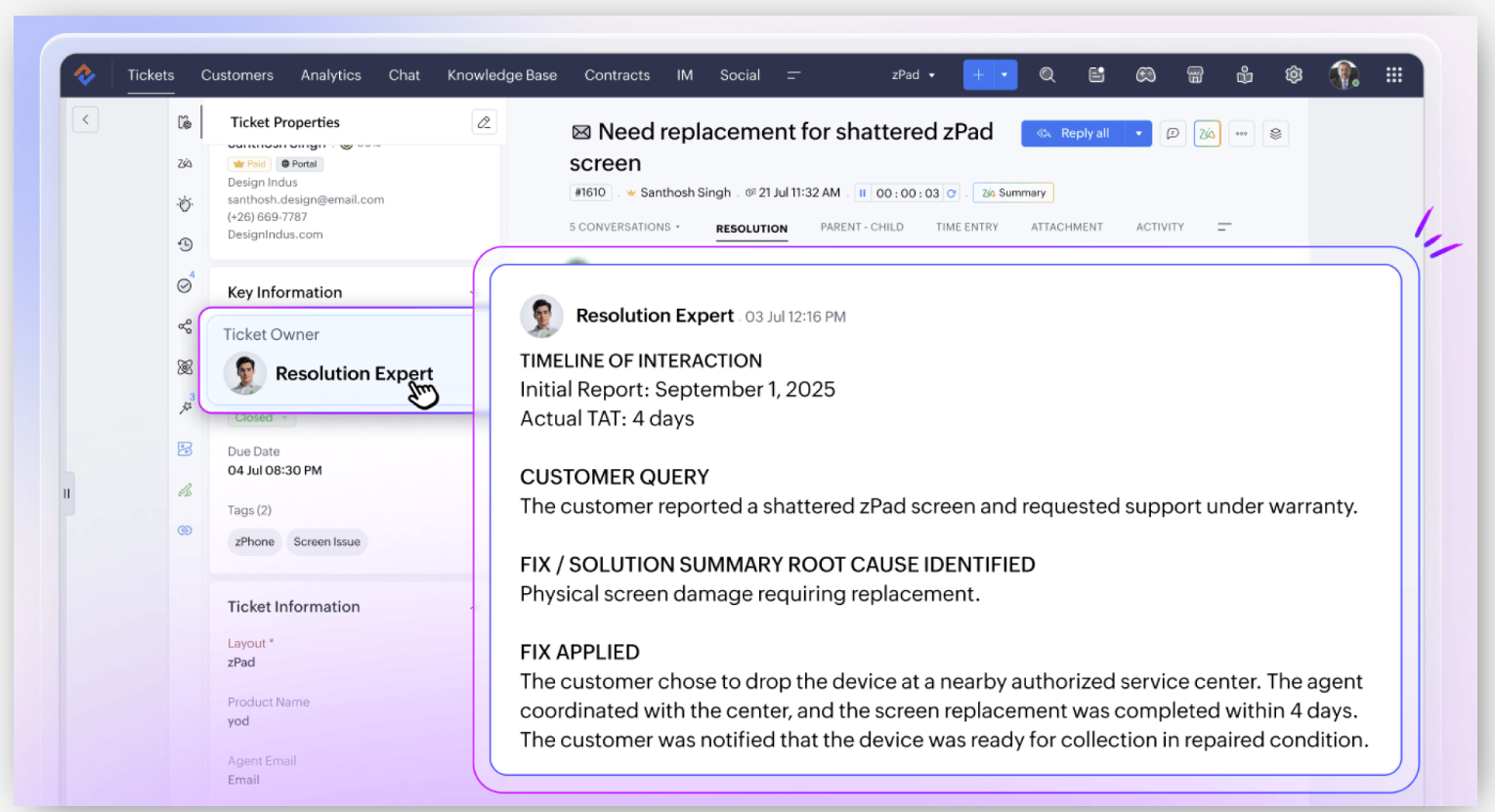
  • Resolution Expert, which works within Zoho Desk, documents ticket resolutions for other agents to resolve similar issues.

  • Agreement Intelligence, which is used in Zoho Sign, generates drafts of contracts, agreements and documents.
  • HR agents in Zoho Recruit include Candidate Matches, Job Matches and AI-Assisted Assessment Generation.

Philip Edey, Business Analyst at Arctic Spas Inc., said in a briefing that Zoho's AI tools are enabling the company to scale and manage nearly 1,000 leads a week, up from 300 leads. Edey said:

"Integrating AI and agentic systems into our workflow is key for the next six months to the year and going forward. With 14 corporate stores and a huge network of dealers, we want to try to make these tools work for us and work for our staff to make it a better user experience. Zoho's AI driven suite can help us get there."

Vegesna said Zoho is rolling out agents and new Zia capabilities. The approach is "to open it up to a limited set of people, and as we gain feedback, refine it," said Vegesna, who noted cybersecurity is a key area.

Data to Decisions Future of Work Next-Generation Customer Experience Innovation & Product-led Growth Tech Optimization Digital Safety, Privacy & Cybersecurity New C-Suite Marketing Transformation I am Team Leader at the Nominee Organization (no vendor self nominations) Distillation Aftershots zoho ML Machine Learning LLMs Agentic AI Generative AI Robotics AI Analytics Automation Quantum Computing Cloud Digital Transformation Disruptive Technology Enterprise IT Enterprise Acceleration Enterprise Software Next Gen Apps IoT Blockchain Leadership VR Chief Information Officer Chief Executive Officer Chief Technology Officer Chief AI Officer Chief Data Officer Chief Analytics Officer Chief Information Security Officer Chief Product Officer
Salesforce, Google comingle Agentforce 360, Gemini models

Salesforce, Google comingle Agentforce 360, Gemini models

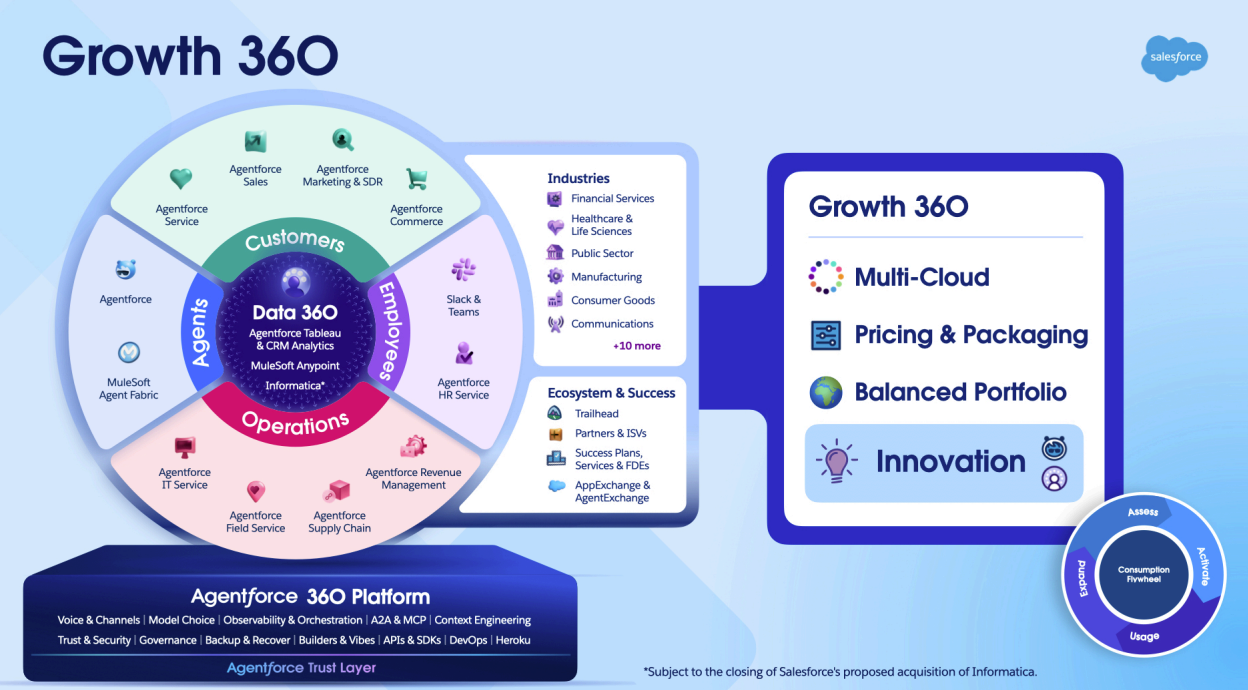
Salesforce and Google expanded their existing partnership in a move that brings Google Gemini models to Agentforce 360, integrates Agentforce into Google Workspace for sales and IT service and brings Gemini Enterprise to Slack.

The addition of Gemini to Salesforce's Agentforce 360's Atlas Reasoning Engine goes along with support for models from OpenAI and Anthropic.

Google Cloud announced Gemini Enterprise ahead of Dreamforce and joint customers are likely to endorse the connections between Agentforce 360 as they stitch together AI agents.

Dreamforce 2025

Key parts of the Salesforce-Google expanded partnership include:

  • Gemini users can deploy AI agents in Salesforce for multistep enterprise workflows.
  • Salesforce and Google will expand capabilities in large action models, which automate processes, with fine-tuned Gemini models.
  • The AI agents on the respective platforms will be tied together via Model Context Protocol (MCP) and Agent2Agent (A2A).
  • Users can access Salesforce Customer 360 apps like Agentforce Sales and Agentforce Service from Google Workspace apps like Gmail and Meet.
  • Salesforce customers can access and view data and insights across the Gemini app and Workplace tools such as Sheets, Docs, Drive and Meet.
  • Agentforce IT Service will have integrations with Google products including Workspace, ChromeOS and Looker.
  • Gemini Enterprise will be integrated into Slack's Real-Time Search API. Gemini Enterprise users will be able to ground responses within the most current conversational data and files.
  • Gemini Enterprise agents can be used directly within Slack.
Data to Decisions Future of Work Next-Generation Customer Experience Innovation & Product-led Growth Tech Optimization Digital Safety, Privacy & Cybersecurity Google salesforce ML Machine Learning LLMs Agentic AI Generative AI Robotics AI Analytics Automation Quantum Computing Cloud Digital Transformation Disruptive Technology Enterprise IT Enterprise Acceleration Enterprise Software Next Gen Apps IoT Blockchain Leadership VR Chief Information Officer Chief Executive Officer Chief Technology Officer Chief AI Officer Chief Data Officer Chief Analytics Officer Chief Information Security Officer Chief Product Officer
Salesforce sets $60B revenue target: Will unlimited Agentforce plans drive growth?

Salesforce sets $60B revenue target: Will unlimited Agentforce plans drive growth?

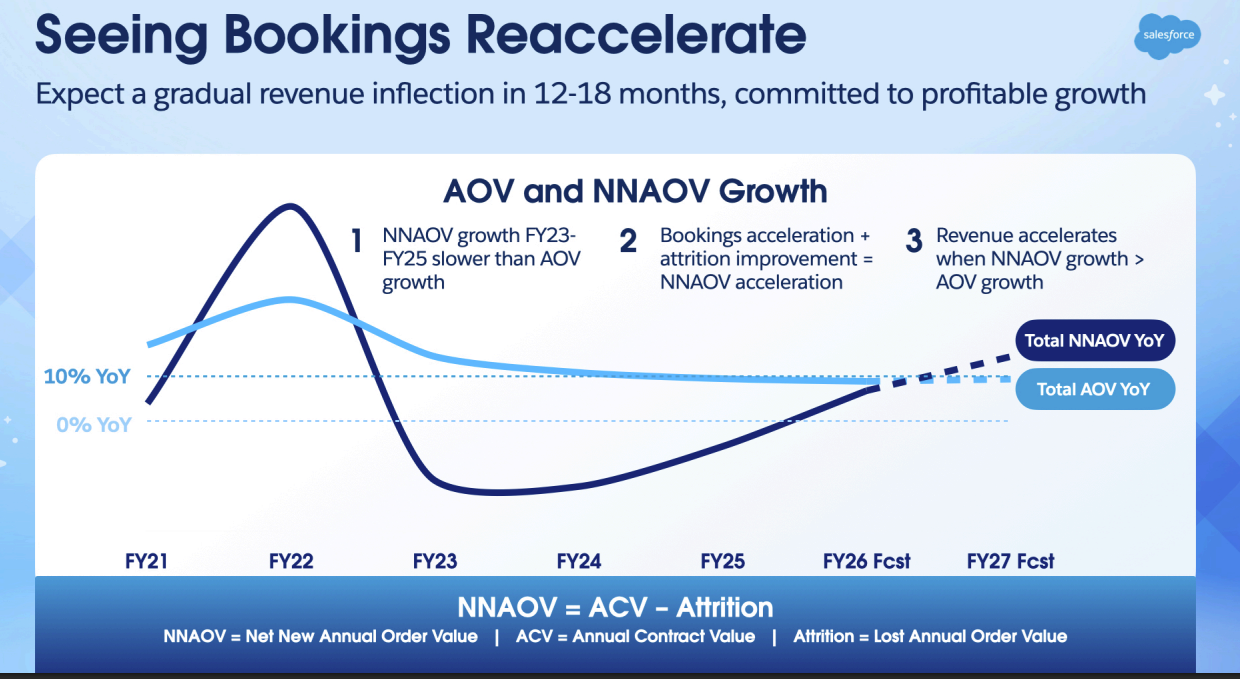
Salesforce executives said that growth is reaccelerating due to Agentforce deployments and it is projecting a long-term revenue target of $60 billion by fiscal 2030 excluding the Informatica purchase. The big question is whether new pricing plans designed to meet customers where they are will drive the growth.

The revenue target assumes more than 10% of organic compound annual revenue growth from fiscal 2026 to fiscal 2030. Salesforce also said it aims to have the sum of subscription and support constant currency growth rate and non-GAAP operating margin total 50 by the end of fiscal 2030. Software vendors have typically made the "Rule of 40" as a key metric.

"We are confident in our ability to reach $60-plus billion by FY '30. In addition to that, as you know, we are very focused on profitable growth. One of my key goals as CFO is to deliver Salesforce is not only an agentic enterprise, but a lean agentic enterprise," said Salesforce CFO Robin Washington.

During the Wall Street analyst session, Salesforce executives, notably Chief Revenue Officer Miquel Milano, walked through the pricing and packaging of Agentforce. "We are meeting customers where they are," said Washington, who noted Salesforce is focusing on industries and segments as well as geographies.

Salesforce CEO Marc Benioff said "what we've seen in the last 3 years is that the speed of innovation has outpaced the speed of customer adoption." That situation is changing though.

Benioff said:

"There's only two things that we do. One is building that product. The second thing is now selling it. So now on a global stage, across every geography, every language and across all six of those segments, we have to deliver the goods, and we have to deliver the growth. And we have to get to those -- the numbers are off the screen, but then we're trying to get to these very high numbers."

Pricing matters

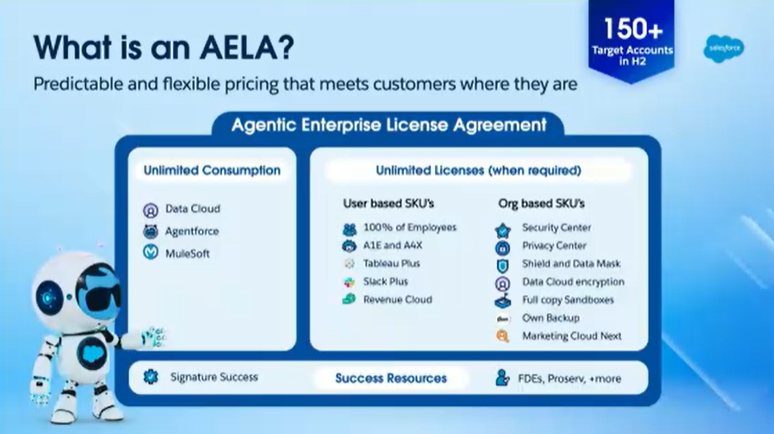
Milano outlined an Agentforce pricing strategy that appears to be more flexible to entice enterprises to bet on Agentforce 360 as a platform play. The unlimited plans for Agentforce and Data 360 may give CFOs and CIOs more predictable costs. 

“Customers don’t want to count tokens. They want predictability. The Agentic ELA gives them unlimited use for two or three years,” said Milano.

New monetization models to “meet customers where they are” include:

  • Seat-based editions (e.g., Agentforce for Service/Sales): upgrades existing licenses.
  • Consumption-based credits for flexible AI use.
  • Flex Agreements: reallocate seat spend toward AI consumption.
  • Agentic Enterprise License Agreements (ELAs): flat-fee, unlimited use of Data 360 and Agentforce for predictable costs — already a dozen signed and more than 150 accounts in negotiation.

Milano said:

“CEOs for the most part, they're tired. They're saying I just want to transform. I just want to use AI everywhere. We are clear that there are very few technology vendors that can do this for us. We want Salesforce to do it, but we are worried about the pricing. Predictability of cost was very important for CEOs. So we put together something very simple: Flat fee, unlimited usage of Data Cloud and Agentforce for our customers. They can deploy any use case they want for 2, 3 years. They can ingest as much data as they need for those Agentic use cases.”

Data to Decisions Future of Work Next-Generation Customer Experience Innovation & Product-led Growth Tech Optimization Digital Safety, Privacy & Cybersecurity salesforce ML Machine Learning LLMs Agentic AI Generative AI Robotics AI Analytics Automation Quantum Computing Cloud Digital Transformation Disruptive Technology Enterprise IT Enterprise Acceleration Enterprise Software Next Gen Apps IoT Blockchain Leadership VR Chief Executive Officer Chief Financial Officer Chief Information Officer Chief Technology Officer Chief AI Officer Chief Data Officer Chief Analytics Officer Chief Information Security Officer Chief Product Officer
Snowflake, Palantir forge data integration partnership

Snowflake, Palantir forge data integration partnership

Snowflake and Palantir said they will integrate Snowflake AI Data Cloud with Palantir Foundry and Palantir Artificial Intelligence Platform (AIP).

The two companies said the partnership will enable joint customers to build data pipelines, analytics and AI applications faster. Eaton, which is a power management company, is an early customer of the integration.

For Palantir, the company has been rapidly building its ecosystem and partnerships. Systems integrators have also been betting on Palantir's AIP platform. For instance, Accenture acquired Decho, an AI consulting firm focused on scaling Palantir across health and public sector. In July, Deloitte and Palantir announced a partnership.

Snowflake and Palantir said the integration between Foundry and Snowflake Iceberg Tables will lead to bidirectional zero-copy interoperability.

Using Eaton as the example, the customers said the partnership:

  • Will improve customer experience.
  • Connect engineering to manufacturing with supply chain orchestration with agentic AI. That connection should improve inventory, on time delivery and quality.
  • Enhance visibility across Eaton's technical landscape.

Constellation Research analyst Michael Ni said:

"This partnership is a win-win: Palantir gets a scalable data backbone, and Snowflake gains a front-row seat in some of the world’s most mission-critical AI deployments. It’s not just about data storage, but increasingly operationalizing data to decisions, as well as ensuring insights are available across the enterprise.

This announcement isn’t just about helping existing customers. For both, this deal is a land and expand play. Snowflake gains an AI decisioning layer solution partner it didn’t have, and Palantir can now offer unified data, governance, and AI workflows without data duplication. That’s a major productivity and compliance gain that both can offer their customers."

Related:

Data to Decisions snowflake Chief Information Officer

HPE has big AI infrastructure plans that are 'going to take a little bit of time'

HPE has big AI infrastructure plans that are 'going to take a little bit of time'

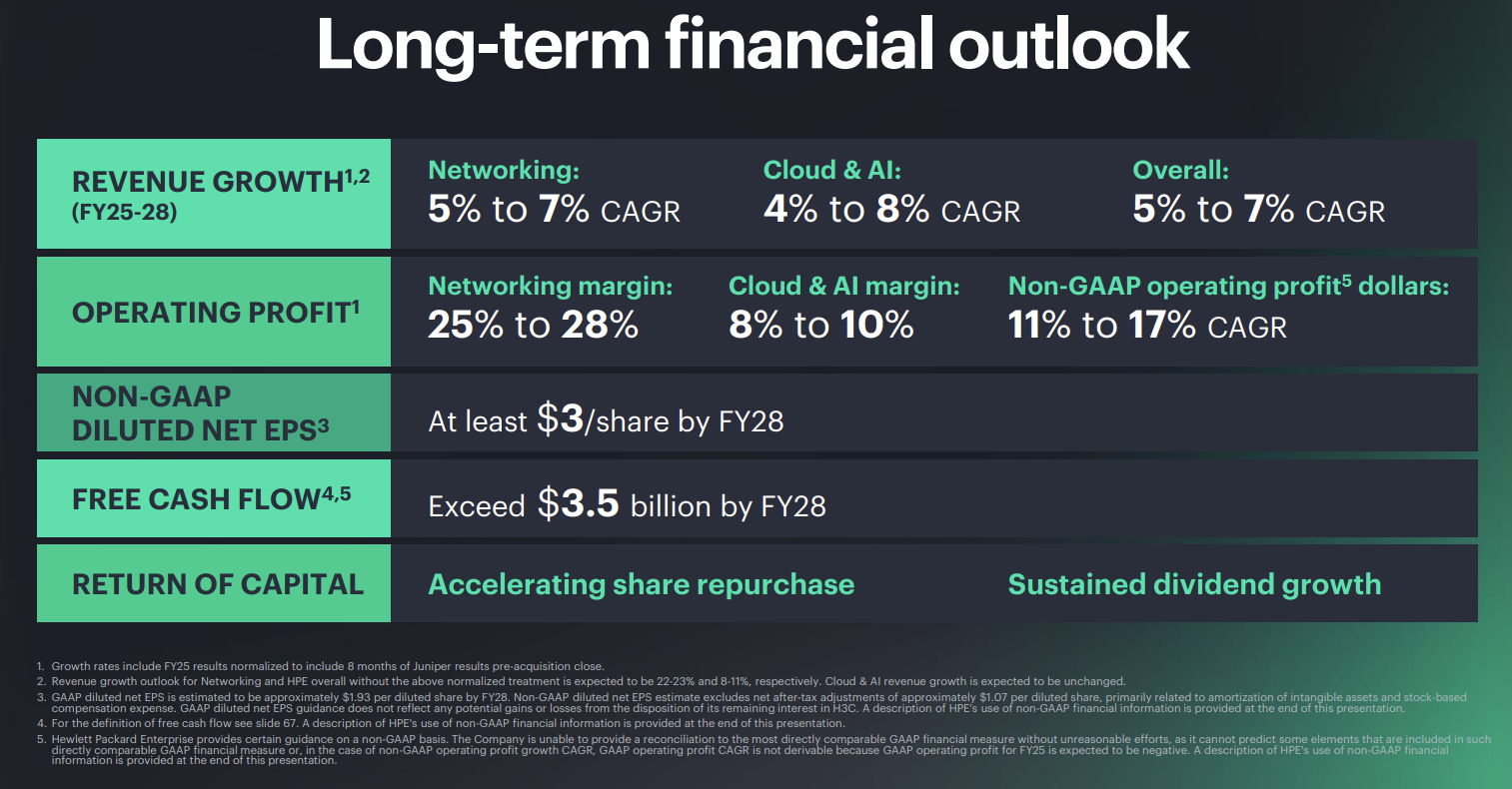
Hewlett Packard Enterprise gave an upbeat presentation on taking networking share and capitalizing on the AI infrastructure buildout, but its fiscal 2026 revenue growth forecast was lower than expected.

At its Security Analyst Meeting, HPE projected fiscal 2026 revenue growth of 5% to 10% and analysts were expecting about 17%. HPE projected adjusted earnings for fiscal 2026 of $2.20 a share to $2.40 a share compared to estimates of $2.42 a share.

HPE also projected a 5% to 7% compound annual revenue growth rate with non-GAAP earnings of at least $3 a share for fiscal 2028. HPE did raise its dividend 10% and announce a $3 billion share repurchase plan.

CEO Antonio Neri emphasized that HPE was focusing on its operating margins and capturing profitable share of AI infrastructure. Neri was joined by Rami Rahim, who gave an overview of the networking plan.

"HPE strategic priorities over the next 3 years are clear. We will build a new networking industry leader, capture AI infrastructure growth profitably, with a focus on sovereign and enterprise customers, accelerate our high-margin software and services growth through our HPE GreenLake Cloud, capitalize on unstructured data market growth with our own IP through Alletra MP Storage and drive customer transition to next-generation server platforms," said Neri.

Neri said the company will deliver annual run rate savings by 2028 of at least $600 million through the Juniper integration and another $350 million from its efforts to optimize efficiency under a program called Catalyst.

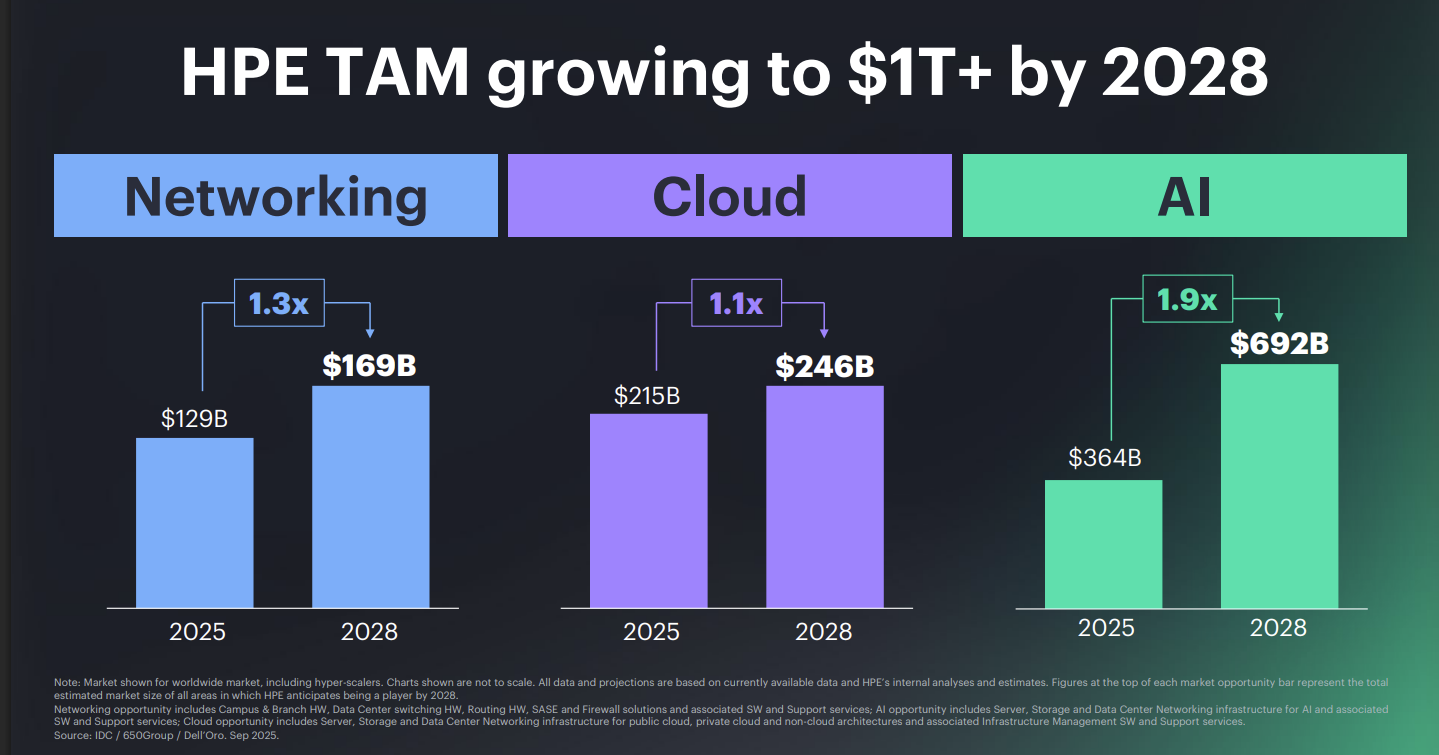
"HPE is playing to win in 3 strategic IT markets: networking, cloud and AI, each one serves as an essential building block for modern IT. These markets are all growing at an accelerated pace, driven by advancement in AI and the swift expansion in data center build-outs," said Neri. "We anticipate the overall total addressable market across our portfolio will increase to over $1.1 trillion by fiscal year 2028."

Rahim added that networking will be a critical part of HPE's growth engine for AI infrastructure. "In this new AI era, networking has become mission critical. And as a result, we expect to capture market share in key network product segments that are both large and growing," said Rahim.

Rahim added that HPE's networking business will focus on data center needs for industries, locations, enterprise and AI factories. He said data centers will become more diverse and the era of one-size-fits-all is over.

HPE's presentation was bullish, but the guidance from CFO Marie Myers didn't line up with the expansion plans. Myers explained that HPE is looking to lower its debt load, invest in its products and increase capital returns.

Wall Street analysts weren't thrilled about the outlook, but Neri and Rahim explained that the sales cycles for networking are longer, neo cloud providers are a new market and reference accounts take time.

"We did not bake revenue synergies into 2026 for a specific reason. I have a lot of work in 2026 to integrate 2 businesses together without disrupting any customers. I think I can do that. So we were a bit cautious about expecting too much in that time frame. I think over time, through both commercial and technical integrations, we can see revenue synergies, but that's just going to take a little bit of time," said Rahim.

Data to Decisions Tech Optimization Big Data Chief Information Officer Chief Technology Officer Chief Information Security Officer Chief Data Officer

Oracle CTO Larry Ellison on AI use cases for healthcare, agriculture, climate change

Oracle CTO Larry Ellison on AI use cases for healthcare, agriculture, climate change

Oracle CTO Larry Ellison is never short of words. In his annual keynote at Oracle's AI World conference (previously Cloud World), Ellison held court for nearly two hours and riffed on a bevy of big AI ideas.

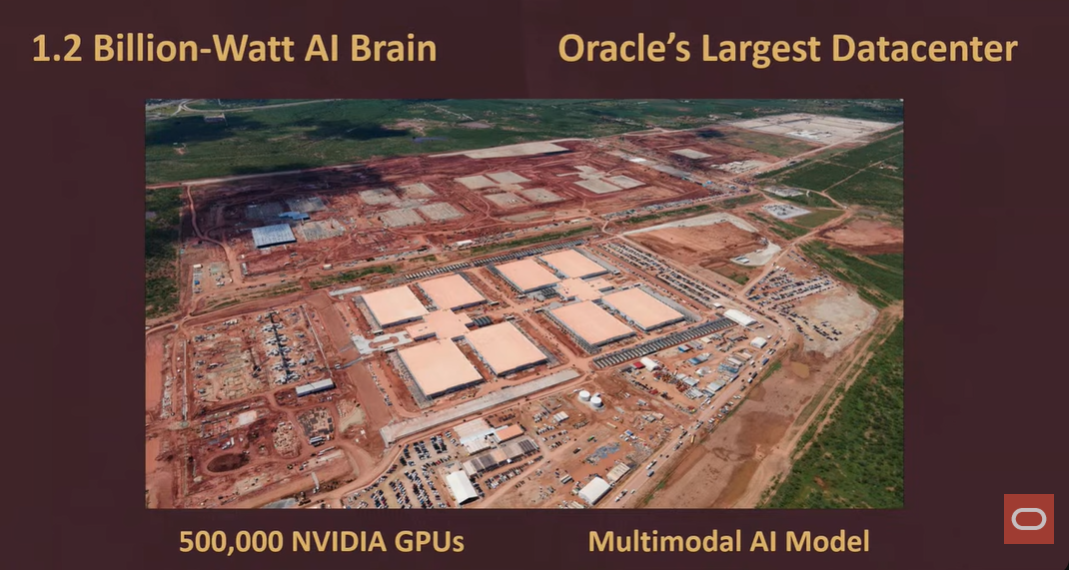
A good chunk of Ellison's talk revolved around talking up Oracle Cloud Infrastructure's plans for a 1.2 billion-Watt AI Brain, which would be Oracle's largest data center with 500,000 Nvidia GPUs. Ellison also touted Oracle AI Data Platform, which will reason on public and private data.

Ellison said Oracle's two biggest opportunities are AI training and AI Reasoning. Private data will enable more valuable models and data will stay private. He added that Oracle databases already contain most of the world's high-value private data.

"The big opportunity in AI training is upon us, and Oracle is a major participant in building data centers to do AI training. But the much, much larger opportunity, the one that will truly change the world, isn't the creation of the models themselves, the training of the models," said Ellison. "What will change the world is when we start using these remarkable electronic brains, and that's what they are. These are remarkable electronic brains to solve humanity's most difficult and enduring problems."

Ellison also noted that AI will also build out its perception game in addition to reasoning. "It's called artificial intelligence as opposed to artificial perception, but it does perceive. It hears it smells. Think about smelling. I mean the idea that you can pick up chemicals that are just drifting around in the atmosphere and figure out what those chemicals are. Dogs can smell cancer in patients," said Ellison. "We should be able to do that with AI, we should be able to. In fact, there's a project I know of called the dog's nose that I'm actually a part of, and we're building sensors. We're building sensors that can smell cancer or other or other illnesses."

According to Ellison, AI players are focusing on two flavors of models. The ones that are most familiar are the reasoning models, but real-time models will be as important. He noted how Google Cloud has Gemini, but physical AI models too. Elon Musk's xAI has Grok, which is a reasoning model, but Tesla represents a real-time model.

Here's a roundup of those problems that AI can solve. Some of these problems are aligned with the Ellison Institute of Technology at Oxford, which is expanding following another £890 million investment from the CTO.

Healthcare

Ellison, which counts Cerner as part of Oracle, is passionate about healthcare. Cerner has leveraged AI to rewrite its code base, but Ellson noted the rebuild also includes retooling accounting and HR systems designed for hospitals. "Hospitals are very unusual," he said.

AI-driven use cases for healthcare include:

AI-powered precision surgery. Ellison described AI robots that surpass human surgical capabilities through superior vision and coordination. For something like cancer removal, AI robots could eliminate some key steps where surgeons remove tissue layers and examine them under a microscope. "AI robots just don't play fair. Their vision is the AI, the vision on the robot and it is microscopic. They don't need a microscope to see individual cells and they can cut between a layer of healthy cells and a layer of cancer cells."

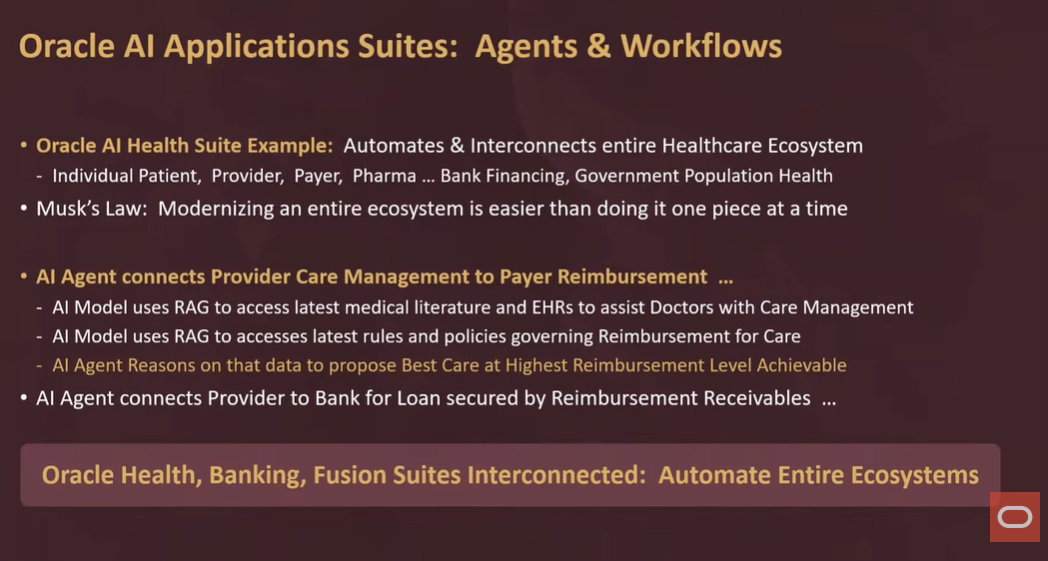
Integrated healthcare workflows. Ellison said there's a big opportunity to automate healthcare workflows. With retrieval-augmented generation (RAG) models can access the latest medical literature, patient test results, and clinical trial information. The AI can identify optimal care while ensuring full insurance reimbursement. That final point is key since you can use AI to predict whether insurance will pay.

Smoothing out hospital cash flow. With better predictions for insurance reimbursement, hospitals will be able to get loans against receivables with a 95% to 99% chance to be reimbursed. Ellison said there could be specialized banks focused on hospitals. "An AI agent can bank all of the information about a particular collection of reimbursements, assuring the bank that those that reimbursements will be adhere to all of the rules," said Ellison. "The clinic and the hospital will be reimbursed. You can discount a little bit, and the bank will then loan on those receivables."

Automating healthcare ecosystems. "If we really want to be successful in health care, we can't just automate hospitals and clinics. We have to automate the entire ecosystem," said Ellison. "You have to automate the pay the patient, the provider, the payer, the regulator, the pharma, companies, banks who finance the hospitals, and governments who regulate the hospitals and collect information from the hospitals. You have to automate the entire ecosystem. You do that and then you will get a truly modern, efficient healthcare system. And that's what we were after when we bought Cerner as a first step."

Ellison said one of the most interesting AI agents built by Oracle connects providers to payers. The agent comes up with the best possible quality of care that is fully reimbursable if the patient can't pay. "The AI model will provide information to doctors as the doctor tries to figure out the best possible care for the patient, then the AI model is also trained on the latest rules and policies. What's the best care and what's fully reimbursable? I have to train the model on all of the insurance rules," said Ellison.

The subtext here is that Ellison could use healthcare automation as a way to talk about layering AI agents throughout its Fusion apps. At Oracle AI World, Oracle outlined the agentic AI efforts in its applications including a marketplace and AI agent studio.

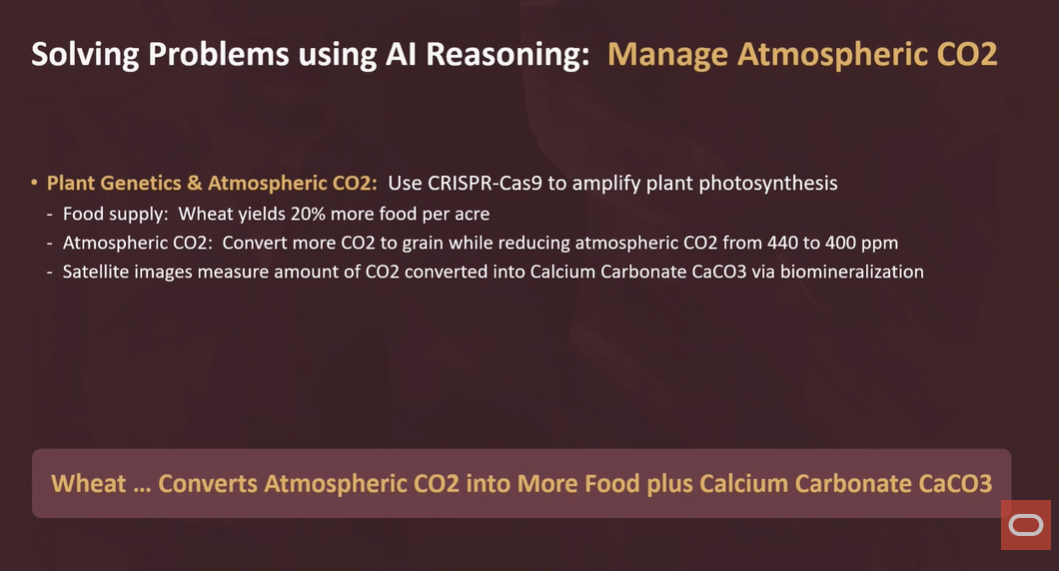
Agriculture, carbon capture and sustainable farming

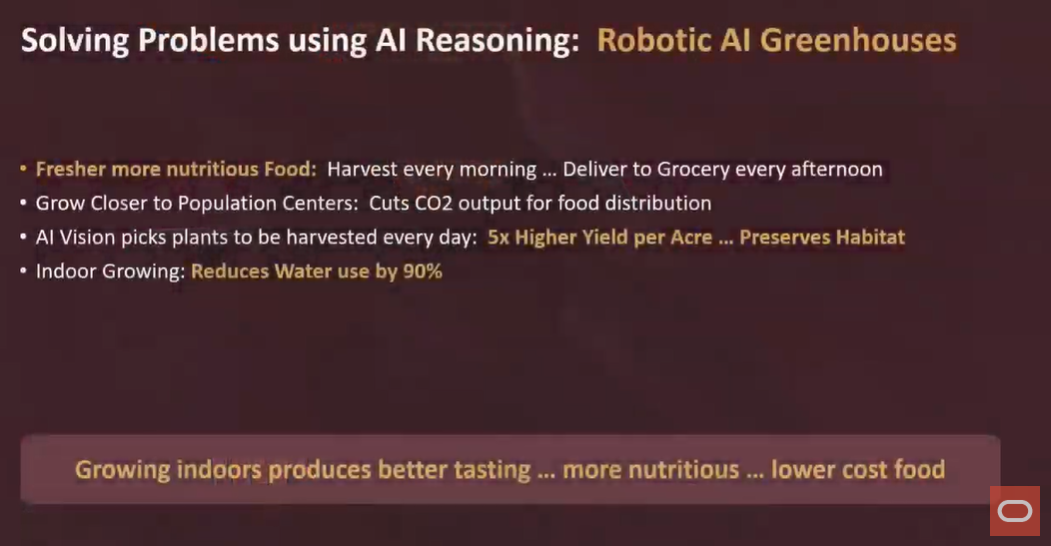
Ellison said there's a need for "robotic greenhouse systems" and AI driven farming. "We need to produce much more fruit and food than we currently do. We're going to run out of water. We're going to run out of arable land. We can't keep taking habitat and converting it to farmland. We have to be much more efficient," said Ellison. "By growing and by growing in greenhouses and moving plants around, plants only need a lot of room for the few weeks before they're harvested."

Robotic greenhouses will use less water and space. The CO2 footprint would be lower. Ellison said two robotic greenhouses are being built in California and Texas. The building includes a rail system that moves plants from one location to another. No humans are allowed since people contaminate the growing area. The structure is an air pressure building.

"You snap the steel cables onto the footing, and then you turn the fan on, and you inflate the building. You fold the building up. The building is fabric with steel cables. You fold it up and nice, nice, nice packages, and you transport it to where you're building it, or you transport it to Mars on one of those big rockets," said Ellison.

The company behind the robotic greenhouses is Wild Bio, which is part of Ellison's institute at Oxford.

AI-assisted engineering of crops. Ellison said crops can be engineered to remove CO2 from the atmosphere while increasing food production. "We could use our food crops, we could actually increase the food yield while lowering CO2 through a natural process called bio-mineralization," said Ellison. The general idea is to engineer crops to extract nitrogen from the atmosphere via an enzyme called Nitrogenase, naturally found in soybeans.

"Rather than using fertilizer to nourish the plant, the atmosphere has got a huge amount of nitrogen in it. Why don't you simply engineer the plant to take the nitrogen directly out of the atmosphere?" said Ellison.

The engineering of crops would face multiple regulatory and technology challenges as well as the impact on biological systems. Farmers would need new practices and techniques as well as training.

Drones

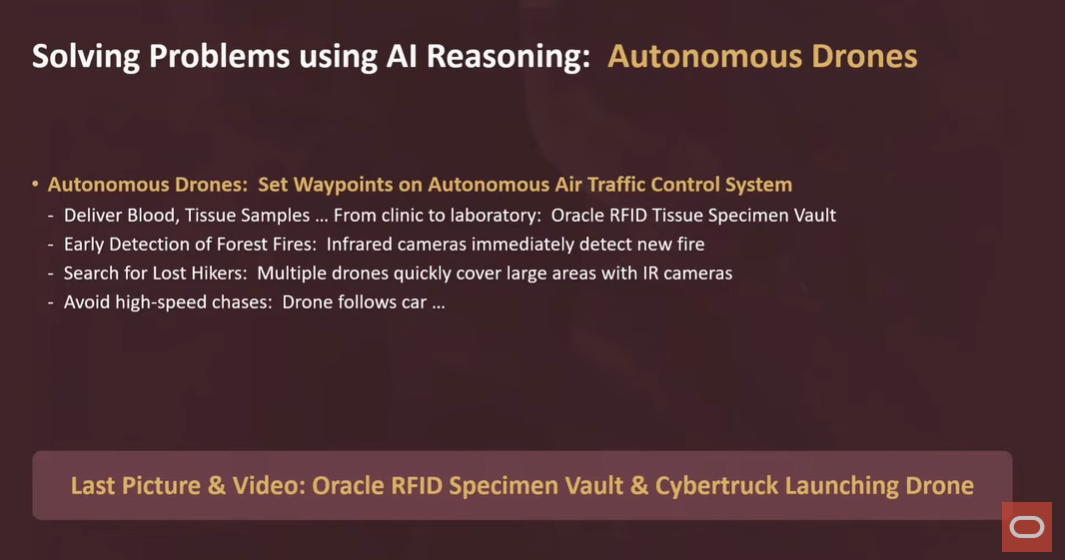
Forest fire detection and response. Ellison demonstrated autonomous drones equipped with infrared cameras that can "detect forest fires immediately" and even determine if fires were deliberately set.

Medical sample transport. The system includes RFID-tagged specimen vaults that maintain chain of custody while protecting patient privacy. Drones transport blood samples from clinics to testing laboratories, solving logistics challenges while maintaining security. "No one knows this is Larry Ellison's blood. They just know there's an RFID tag on it," said Ellison.


Data to Decisions Innovation & Product-led Growth Next-Generation Customer Experience Tech Optimization Future of Work Digital Safety, Privacy & Cybersecurity Oracle ML Machine Learning LLMs Agentic AI Generative AI Robotics AI Analytics Automation Quantum Computing Cloud Digital Transformation Disruptive Technology Enterprise IT Enterprise Acceleration Enterprise Software Next Gen Apps IoT Blockchain Leadership VR Chief Information Officer Chief Executive Officer Chief Technology Officer Chief AI Officer Chief Data Officer Chief Analytics Officer Chief Information Security Officer Chief Product Officer

IBM acquires SAP S/4 HANA services firm Cognitus

IBM acquires SAP S/4 HANA services firm Cognitus

IBM said it will acquire SAP S/4 HANA services specialist Cognitus in a deal that will expand its SAP AI-driven industry services.

Terms of the deal weren't disclosed.

According to IBM, Cognitus will bring SAP skills in deploying the RISE and GROW programs with SAP as well as software assets. Cognitus, founded in 2002, offers SAP S/4HANA implementation services as well as application maintenance.

Cognitus, based in Dallas, also has a suite of SAP-endorsed software assets including Cognitus CIS-GovCon to support government contracting, Cognitus CLM for contract management for government, and Cognitus Data Migration, which moves data from legacy systems to SAP S/4HANA. The company also offers Cognitus Real-Time Billing.

SAP customers have picked up the pace with SAP S/4 HANA migrations so they can leverage AI. Cognitus is focused on the SAP transformation project lifecycle with a focus on regulated industries.

Cognitus is focused on the following industries:

  • Aerospace & Defense
  • Engineering, Construction & Operations (EC&O)
  • Utilities
  • Professional Services
  • Manufacturing
  • Consumer Products
  • Wholesale Distribution

IBM said Cognitus will bring deep industry expertise and add to its SAP practice and IBM Consulting Advantage, an AI-driven delivery platform.


Data to Decisions IBM Chief Information Officer

Citigroup AI agent pilot underway for 5,000 workers

Citigroup AI agent pilot underway for 5,000 workers

Citigroup CEO Jane Frasier said the bank has launched a pilot of AI agents for 5,000 employees. The agentic AI pilot is designed to complete multi-step tasks with a single prompt.

Frasier, speaking on the company's third quarter earnings call, said the pilot launched in September. In September, Citigroup announced that Citi Stylus Workspaces, a proprietary AI platform now uses agentic AI and is integrated with various systems. Citigroup leverages Google Cloud and its Gemini models, Vertex AI and Anthropic's Claude models. Citigroup and Google Cloud announced a strategic partnership a year ago and the banking giant presented at Google Cloud Next earlier this year.

"The early results are very promising and we'll expand access to this in the months ahead," said Fraser. "We have launched a firm-wide effort to systematically embed AI in our processes end-to-end to drive further efficiencies, reduce risk and improve client experience."

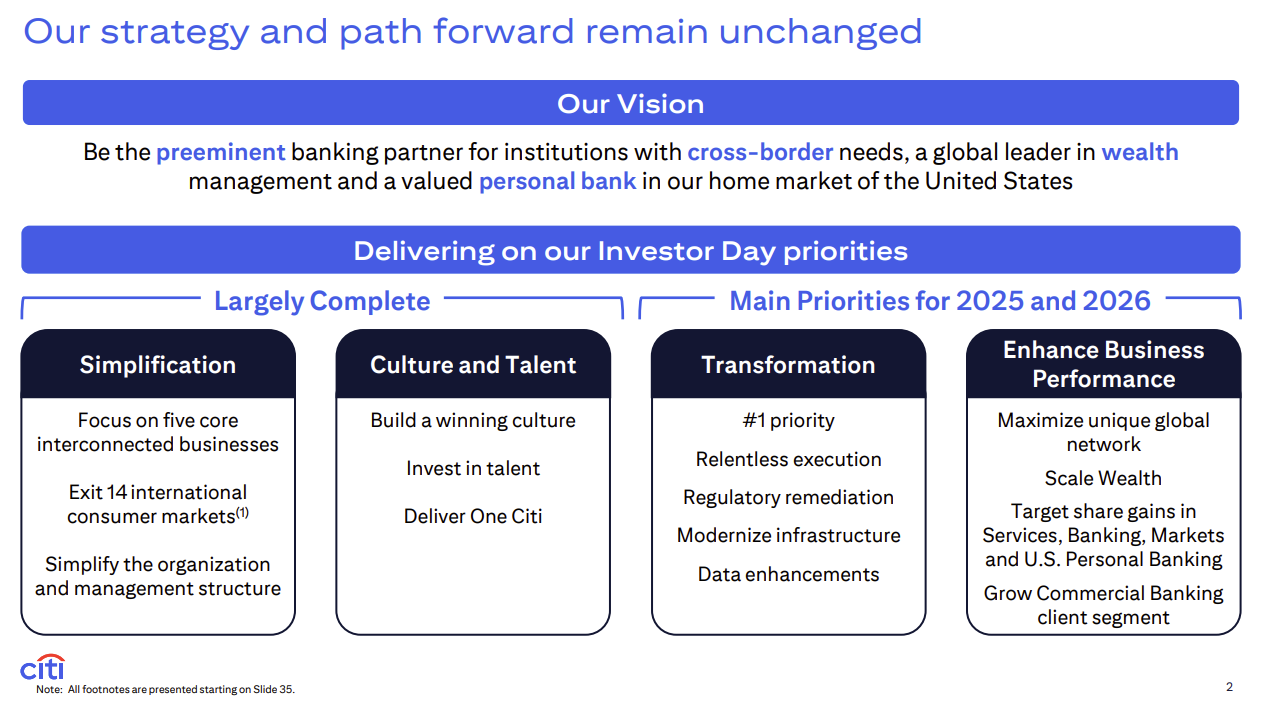
Citigroup will outline the next phase of its technology and AI transformation at an investor day in 2026, but Fraser said two-thirds of the company has been revamped.

"As we simplify, we continue to invest in technology to catalyze our transformation and become a more agile and modern bank. We have been relentless in our execution, and it is creating results. Over two-thirds of our transformation programs are at or are close to our target stage, and we're making very good progress in the remaining areas," said Fraser.

Citigroup is using its productivity gains and technology returns to self-fund investments in transformation, AI and technology.

A few examples of the transformation and AI usage include:

  • Nearly 180,000 employees in 83 countries have access to Citigroup's proprietary AI tools and have used them 7 million times this year. "These tools save hours each day by automating routine work, analyzing data and creating materials in minutes instead of hours," said Fraser.
  • Citigroup is using AI to resolve client queries faster. In the wealth group, advisers are receiving AI-driven insights to deliver personalized advice.
  • AI-driven automated code reviews have been used more than 1 million times this year to improve developer productivity. Fraser said the automated code reviews have created 100,000 hours of weekly developer capacity.
  • Citigroup has retired or replaced 384 applications so far in 2025.

The other takeaway is that the AI transformation is never complete. Fraser added that "there is still so much upside left for us to capture."

Data to Decisions Future of Work Next-Generation Customer Experience Innovation & Product-led Growth Tech Optimization Digital Safety, Privacy & Cybersecurity ML Machine Learning LLMs Agentic AI Generative AI Robotics AI Analytics Automation Quantum Computing Cloud Digital Transformation Disruptive Technology Enterprise IT Enterprise Acceleration Enterprise Software Next Gen Apps IoT Blockchain Leadership VR Chief Executive Officer Chief Information Officer Chief Technology Officer Chief AI Officer Chief Data Officer Chief Analytics Officer Chief Information Security Officer Chief Product Officer

Goldman Sachs eyes next AI transformation from position of strength

Goldman Sachs eyes next AI transformation from position of strength

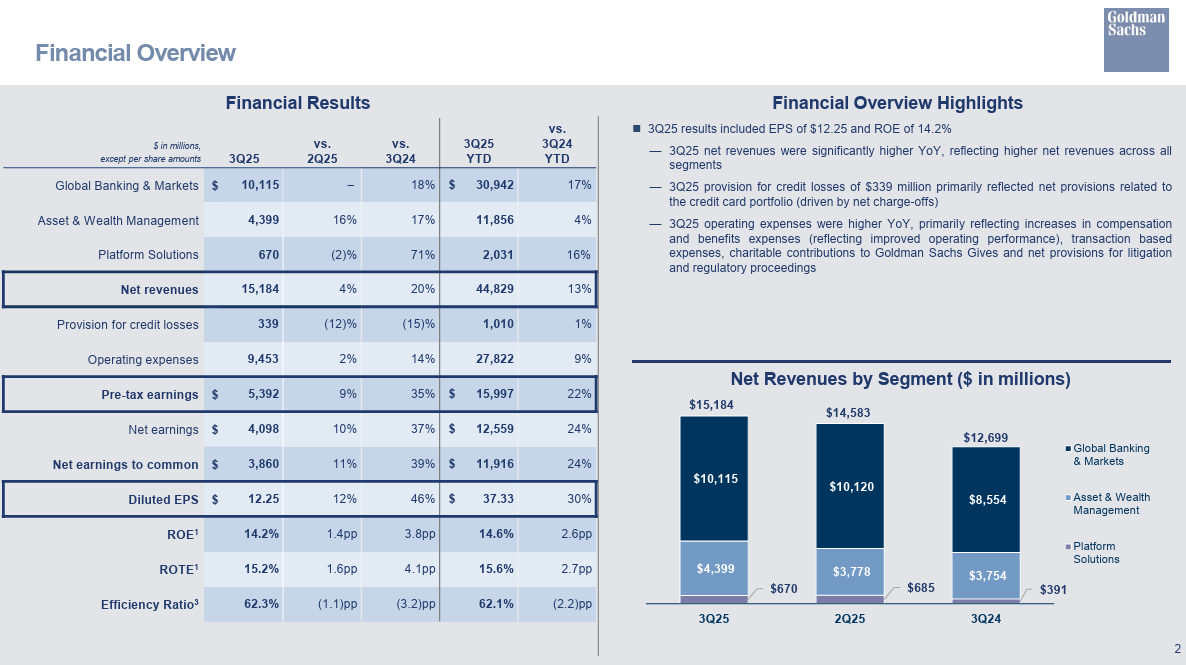
Goldman Sachs CEO David Solomon said the company has launched an initiative dubbed One Goldman Sachs 3.0, which will leverage AI to create a centralized operating model that's more efficient and drive growth.

Speaking on Goldman Sachs fiscal third quarter results, Solomon said:

"This is a multiyear effort that we will build over time, and we plan to measure our progress across 6 goals: enhancing client experience, improving profitability, driving productivity and efficiency, strengthening resilience and capacity to scale, enriching the employee experience and bolstering risk management."

To start the effort, Solomon said the company is looking at a handful of "front-to-back work streams that can significantly benefit from AI-driven process reengineering and will help inform our longer-term approach."

Use case priorities will revolve around sales enablement and client onboarding that directly impact the client experience, lending processes, regulatory reporting and vendor management.

Solomon said the company will provide a deeper update in January.

CFO Denis Coleman said the company has a nice tailwind with a rebound in IPOs and a better regulatory environment. "We are focused on efficiency and leveraging AI to meaningfully transform the firm. And this is all in the context of an improving regulatory backdrop, which should allow us to be on offense as we deploy resources and service of our clients," said Coleman.

Solomon said Goldman Sachs would rather take on more AI transformation efforts as it is operating from a position of strength. "I'm talking to CEOs all over the world and businesses are focused on this because the technology actually allows you to take a fresh look front to back at certain operating processes and really reimagine," said Solomon. "Obviously, the firm is performing. The firm is growing. We feel very good about the execution, but we see this as an opportunity to use technology to automate, drive scale, create efficiency and actually give us the capacity to invest more in the growth of our business."

According to Solomon, AI transformation from a position of strength could become a common refrain from enterprises. He said:

"I think you're going to hear this from lots of companies and lots of industries that people are very focused on taking advantage of this acceleration in technology to really allow automation, efficiency and therefore, investment. This is one of the reasons why we're optimistic about the forward, the productivity gains in the economy from enterprises are going to be very meaningful over the next few years, and that creates a good tailwind that will balance other macro factors that may or may not come into play."

Data to Decisions Next-Generation Customer Experience Innovation & Product-led Growth Chief Executive Officer Chief Information Officer