


Salesforce makes its Agentforce 360 case to be your AI agent platform
Salesforce announced a series of product updates, a process intelligence acquisition and an Agentforce 360 architecture designed to make the case that it should orchestrate first and third party AI agents.
At Dreamforce 2025, Salesforce looked to differentiate itself from what's becoming a crowded agentic AI platform space. The cloud giants are looking to go horizontal with stacks to build, deploy and optimize AI agents. SaaS vendors are expanding into managing AI agents beyond their verticals. There's a set of neutral platforms such as Boomi and UiPath. And everyone is trying to layer process intelligence into the agentic AI stack via tuck-in acquisitions.
- Salesforce's acquisition of Apromore highlights how process intelligence, agentic AI converging
- Salesforce heads into Dreamforce 2025: A look at the big themes
- Is Salesforce ripe for Serious Disruption? And if so, from Whom?
- Salesforce raises prices across multiple products including Slack
- Salesforce revamps Agentforce pricing with Flex Credits: What you need to know
If Dreamforce 2024 was that coming out proof-of-concept party for Agentforce, Dreamforce 2025 is about production and scale with Agentforce 360. The challenge for customers is piecing together the barrage of news announcements and product updates and sorting through the keynote flash to understand the big picture. The Agentforce pacing is brisk with four iterations in 12 months.
"What we want to see is that all companies become agentic enterprises," said Parker Harris, co-founder of Salesforce and CTO of Slack. "We're entering a world where it's going to be humans and AI working together. It's the biggest transition in technology I've ever experienced."
Harris, who sets the technical vision for Salesforce, would know. He helped start the SaaS transition and has been through the mobile and social shifts.
- Enterprise AI: It's all about the proprietary data
- The big AI, SaaS, transformation themes to watch in 2025’s home stretch
- AI agents, automation, process mining starting to converge
- LLM giants need to build apps, ecosystems to go with the models
- Pondering the future of enterprise software
Here are some of the big Salesforce themes to note.
Agentforce 360 expands Salesforce's reach from CRM
Salesforce announced a unified agentic AI stack that is now called Agentforce 360, which includes Agentforce Platform, Data 360, Customer 360 Apps and Slack. The general idea is to connect humans, AI agents, apps and data across the entire enterprise.
Srini Tallapragada, President and Chief Engineering and Customer Success Officer, said the goal with Agentforce is to ensure that AI isn't disconnected from context. "Agentforce 360 is a deeply unified platform," he said. "We don't want customers stuck in what I call the pilot bucket. What we had to solve is to ensure that AI is not disconnected from context."
If this approach sounds familiar, it's because multiple vendors are trying it. Salesforce and ServiceNow appear to be on a collision course. You don't have to look farther than ServiceNow's foray into CRM and Agentforce IT Service to realize the two vendors are rivals. The main thing to note is that the Salesforce and ServiceNow have plenty of joint customers and CRM and ITSM both remain fragmented enough for both to grow while talking smack.
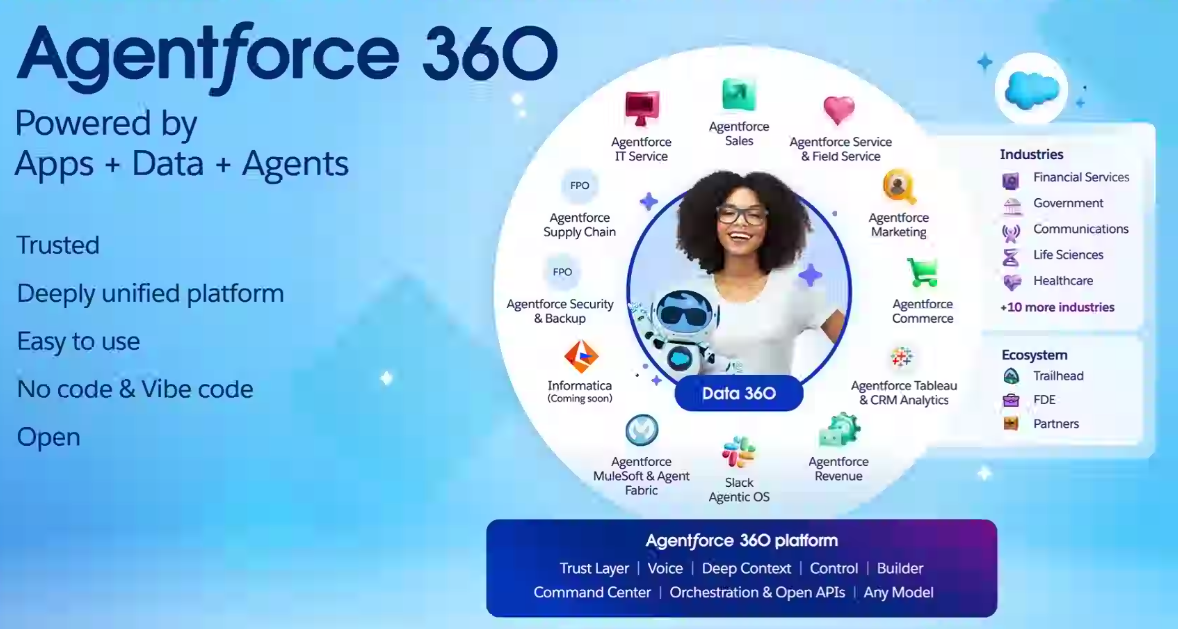
Agentforce 360 includes the following:
- Hybrid Reasoning Engine. Within Atlas, Salesforce is providing a deterministic control system called Agent Script. The goal here is to provide predictable agent behavior while keeping the creativity. The Hybrid Reasoning Engine will be in beta in November and provide customers the ability to build via natural language or code.
- A revamped Agentforce Builder, which will be in beta in November. Agentforce Builder will provide predictable logic, a conversational build and test loop and a natural language approach.
- Agentforce Studio and Agent Observability close the loop to create what Salesforce hopes is a continuous agent improvement flywheel.
- Voice integration. Agentforce 360 includes seamless voice capabilities to hand off calls between AI agents and humans.
- Context engineering with the ability to process unstructured data as well as structured.
- Multi-agent orchestration. MuleSoft becomes the Agent Fabric that can govern and coordinate multiple agents including those from third parties.
- Apps for multiple verticals and use cases.
- Informatica will fit into this mix on the data front when Salesforce's acquisition closes. Informatica's role in the Agentforce stack: Turn enterprise data into a searchable catalog as Data Cloud activates data, MuleSoft connects any system and Tableau is an insights engine.
Of those news items, it's worth noting that Salesforce is trying to thread the needle between predictability, which is an enterprise must-have, and creativity, a customer must have. By controlling AI agent behavior, Salesforce is trying to give enterprises the ability to provide a unified brand voice and customer experience as AI agents and humans run a CX relay race.
Perhaps the biggest takeaway is that Salesforce has noted that its platform can be headless across channels and run in the background.
Holger Mueller, an analyst at Constellation Research, said:
"While it's competitors are working on single products and second versions, Salesforce has a suite of AI offerings available for customers with it's typical 360 brand. All of this is another data point on how Salesforce has a lead of one or two years over its key competitors."
Real returns and value
Salesforce highlighted a series of customers deploying Agentforce, provided returns and walked through the production process.
Yes, Salesforce spent a good amount of time detailing its success as its first customer. Salesforce internally handles 4.8 million customer conversations across multiple channels.
Salesforce also has a year's worth of deployments under its belt. The company has developed blueprints for enterprises deploying AI agents to move to production faster. Salesforce said it has more than 200 agentic industry workflows across 15 industries such as automotive, communications, consumer goods, manufacturing, public sector and retail.
- For AI agents to work, focus on business outcomes, ROI not technology
- BT150 zeitgeist: Consumption-based pricing angst abounds
CIOs will be more interested in hearing from the parade of customers. DirecTV saved 300,000 hours through Agentforce, Under Armour doubled case deflection rates, Williams Sonoma uses AI agents for personalized interior design and Heathrow Airport deployed an AI agent to improve customer experiences.
Salesforce also noted that Agentforce can work across multiple verticals including manufacturing where Eaton saw a 71% reduction in cost per service call.
Salesforce also noted that it has landed enterprises that are standardizing on Agentforce. For instance, Salesforce said Vonage is using Agentforce for its platform as is Statista and Reddit.
Here are a few customer vignettes from a Dreamforce briefing call:
- Indeed's Lisa West, Vice President of Automation at the job listing site, said the company went with Agentforce because it was heavily invested in the Salesforce platform. "We have so much rich context inside of the Salesforce ecosystem so it was quite natural to add agents to that," said West.
- Peter Burns, Director of Marketing, Digital and E-commerce at Heathrow Airport, used Agentforce to create Hallie, a personal customer agent. Heathrow uses Salesforce's platform for its customer contact center. Burns said Heathrow uses Agentforce to provide a simple interface to a complicated technical ecosystem. "We think about creating experiences in the front and back of house. In the back of house, Agentforce and Salesforce power our customer center. Agentforce helps answer and manage those conversations," said Burns. "Hallie was launched as a customer-facing agent that answers questions and manages more of your bookings. We have more than 80 million passengers and as much as we want to individually hold their hands through Heathrow, it's not practically possible. Hallie and Agentforce allow us to effectively scale personalized customer experience."
- Sameer Hassan, Chief Technology and Digital Officer at Williams Sonoma, said the retailer is homing in on using Agentforce to create personalized agents focused on interior decorating and design. Hassan said AI agents were initially seen as a productivity play, but evolved into tools that could drive growth. "Yes, we're seeing the efficiency gains, and yes, we are automating the repetitive task, but AI is actually amplifying that creative and strategic work that our people are doing," said Hassan. "When you equip brilliant minds with this kind of technology, we are actually seeing better strategic and creative outcomes from folks whether it's product development, supply chain, merchandising, photography and visualization or technology. It's also about amplifying your people."
Slack as an "agentic OS"
One of Salesforce's unique approaches to Agentforce and AI agents is that it is betting Slack can be the front end to all Salesforce applications.
"Slack is not only becoming the front-end of Salesforce and Work 360, but it's becoming your agentic OS where you can search, collaborate and act across all the people in your organization, data and connect with agents," said Parker. "We're reimagining Salesforce and Slack. Maybe you don't log in to Salesforce or even see it, but it's there. It's coming to you in Slack because that's where you're getting your work done with native AI and enterprise AI search. Then you can unify your entire enterprise in one agentic OS and bring in other AI agents."
This strategic bet on Slack comes as OpenAI is betting ChatGPT can be the front end of all applications, ServiceNow is using its AIx approach with a similar conversational UI and Workday bought Sana to do something similar.
Add it up and there's an industry-wide bet that the ChatGPT interface and multi-model LLM approach will be the entry point into all applications.
If Slack winds up being that agentic OS to enterprise AI, Salesforce will be differentiated. Perhaps OpenAI will be that OS for consumers and Salesforce will happily take the enterprise AI agent OS turf.
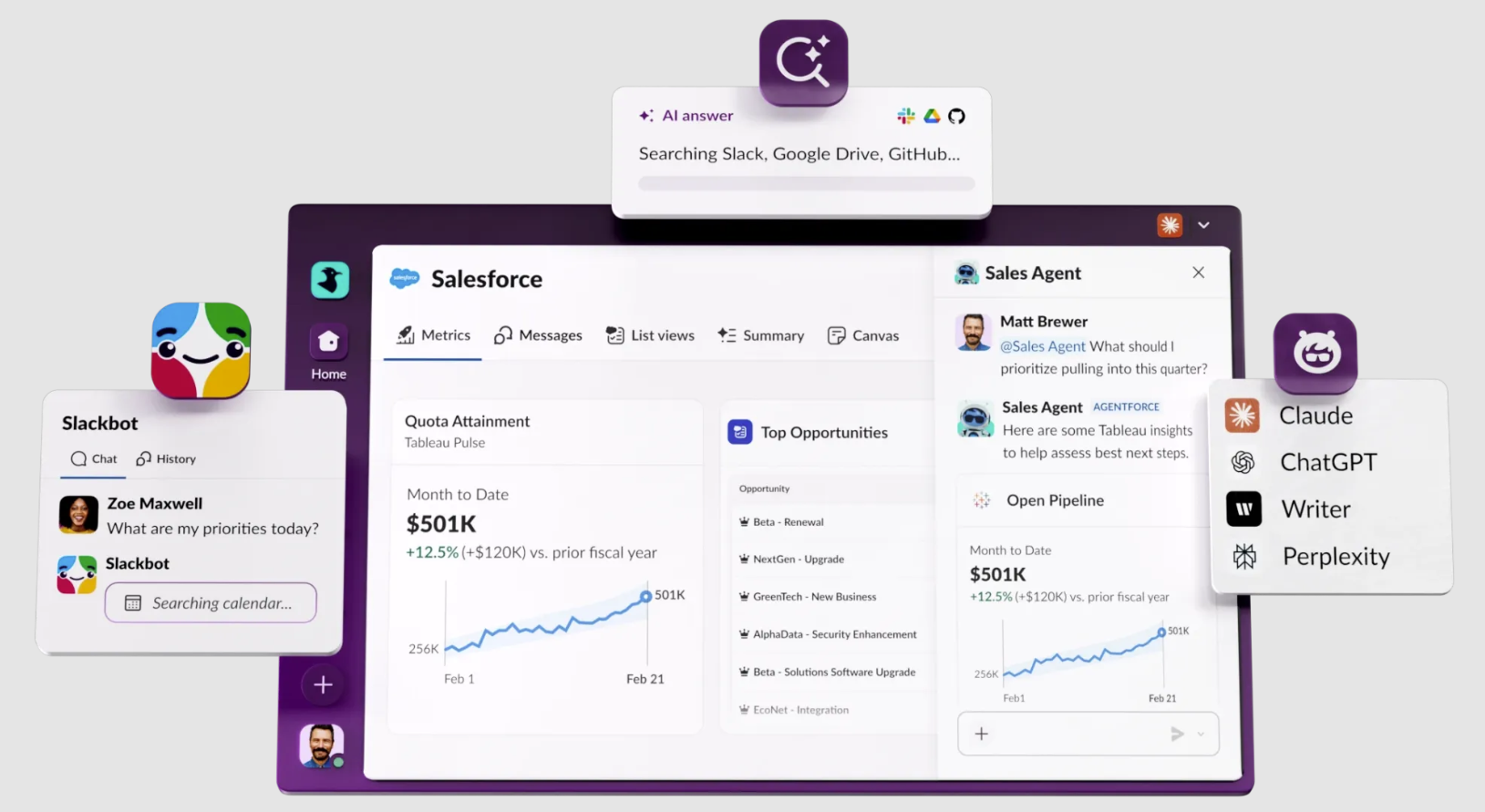
Parker said that Slack will connect easily with OpenAI, Google and multiple partners via Model Context Protocol (MCP). Slack AgentExchange will be available in the fourth quarter with Slack personal agent landing in the first quarter and agentic search will be in pilot in January.
Slack will get:
- Slack-first Apps such as Agentforce sales, service, ITSM and HR.
- An agent with always-on expertise.
- Enterprise search.
- A reimagined Slackbot that’s context aware.
- Multiple integrations via MCP.
Larry Dignan is Editor in Chief of Constellation Insights at Constellation Research, where he leads editorial coverage focused on enterprise technology, digital transformation, and emerging trends shaping the future of business. He oversees research-driven news, analysis, interviews, and event coverage designed to help technology buyers and vendors navigate complex markets with clarity and context. ...
Read morePublished
Author
