


Palantir's software revolution: Forget sales people, let value do the talking
Palantir CEO Alex Karp is a bit opinionated and garners his share of haters. But the returns on Palantir are attracting enterprises to the point where word of mouth among customers scales.
In a stellar second quarter, Palantir gave investors a little bit of everything. Palantir delivered revenue growth of 48% in the second quarter as US commercial and government sales surged. The company also raised its outlook.
Palantir reported second quarter earnings of $327 million, or 13 cents a share, on revenue of $1.004 billion, up 14% from a year ago. Wall Street was looking for non-GAAP earnings of 14 cents a share on revenue of $939.5 million.
In a shareholder letter, Karp quoted himself and C.S. Lewis and argued that his company "will become the dominant software company of the future."
Palantir reported second quarter US revenue of $733 million, up 68% from a year ago. US commercial revenue was $306 million, up 93% from a year ago. US government revenue was up 53% from a year ago to $426 million. The company closed 157 deals of at least $1 million and 66 of at least $5 million. Palantir landed 42 deals worth more than $10 million.
As for the outlook, Palantir projected third quarter revenue of $1.083 billion and $1.087 billion with adjusted income from operations of $493 million to $497 million. For 2025, Palantir projected revenue between $4.142 billion to $4.15 billion. US commercial revenue for 2025 will top $1.302 billion, up about 85% from a year ago. Adjusted income from operations will be $1.912 billion and $1.92 billion.
While the numbers shined, Palantir’s conference call with analysts featured a bevy of insights. Here’s a look:
AIP and enterprise traction
Ryan Taylor, Chief Revenue and Legal Officer, said enterprises are using the company's software to make LLMs work as they should. "LLMs simply don't work in the real world without Palantir. This is the reality fueling our growth," said Taylor.
He cited customers such as Fannie Mae, Citibank, Nebraska Medicine and Lear as customers that are seeing strong returns. Taylor also noted Palantir's AIP is gaining traction at a rapid clip. This commercial momentum started to bubble up in late 2023 with Palantir's boot camps for AIP.
"Lear Corporation recently signed a 5-year extension. Over the past 2.5 years, they have leveraged foundry and AIP to support over 11,000 users and more than 175 use cases, including proactively managing their tariff exposure, automating multiple administrative workflows and dynamically balancing their manufacturing lines," said Taylor.
- Palantir's Q2: Growth in US commercial, government accelerates
- Databricks, Palantir forge integration pact
- Palantir CTO: Engineering on DeepSeek 'is exquisite'
- Palantir to deploy platforms on Microsoft Azure
Ontology and AI FDE
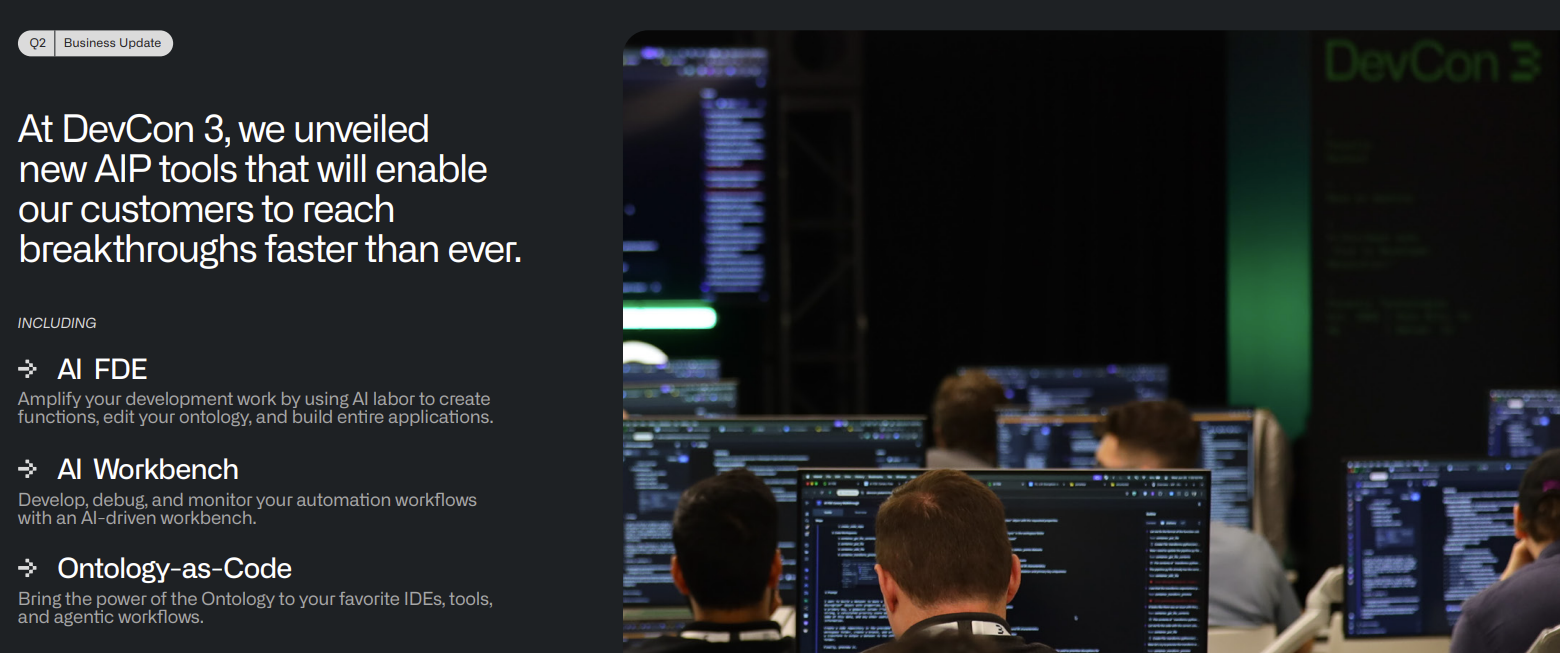
Shyam Sankar outlined enterprises that have replatformed on Palantir, but was largely referring to moving to the company's data ontology with enterprises using the company's AI FDE (Forward Deployed Engineer). A FDE is an engineered focused on deploying Palantir and moving customers to value quickly. AI FDE, launched last month at DevCon 3, is an autonomous agent that will run Palantir's AIP platform delegate tasks and optimize as needed.
Sankar said:
"A substantial development over the last couple of quarters is the realization and acceleration of our vision of Ontology web services as an architectural concept for our customers. AIP isn't just software our customers use, it's software, our customers are building their software on. Software companies are re-platforming away from the highly unopinionated services and building blocks of the hyperscaler stack onto AIP with its highly opinionated building blocks that get you to value 10x faster."
Yes, Palantir's argument is that building blocks in your tech stack need to be opinioned and decisive.
Sankar also noted that Palantir's investment in AI FDE is driving time to value.
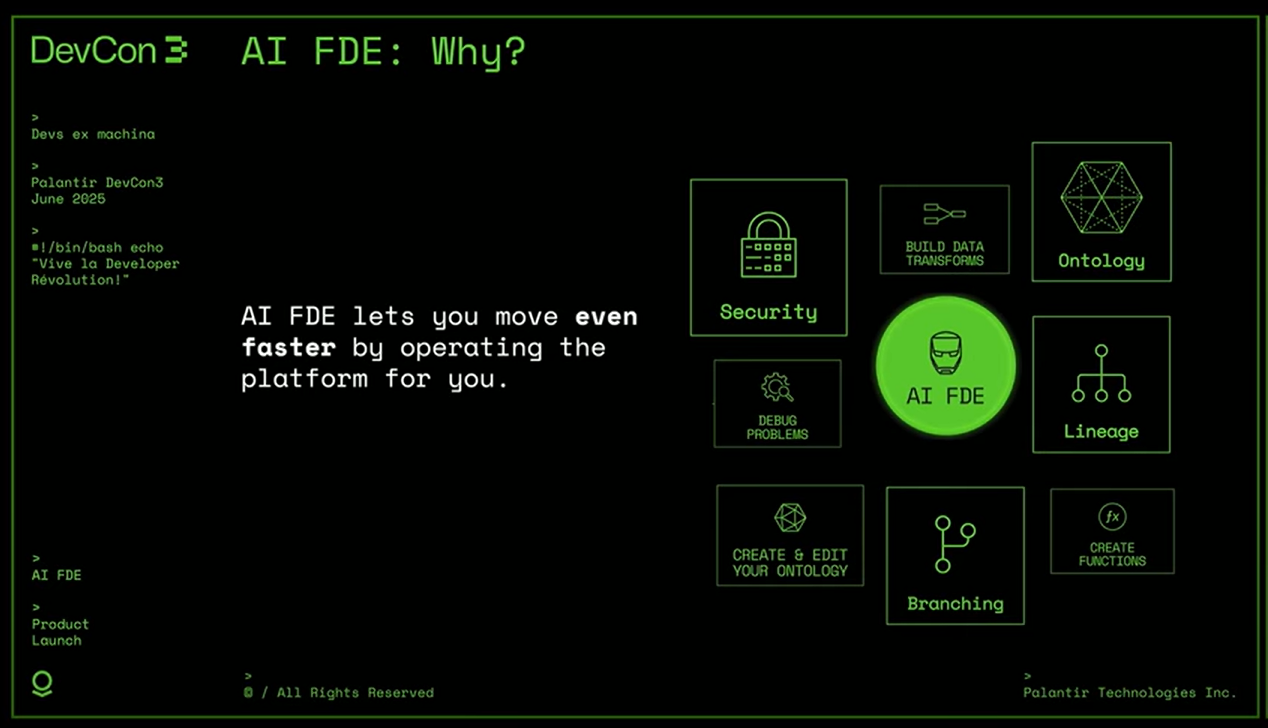
"AI FDE is designed to enable autonomous execution across a wide array of tasks, including creating and editing ontology, building data transforms, creating functions, debugging issues and building applications. With its own closed-loop error handling, AI FDE can identify and correct issues and notify human users if needed, and it's been designed for seamless collaboration with humans in the loop through integration with AIPs branching," said Sankar.
The end of software sales?
Karp was asked whether Palantir could continue to grow without a direct sales force.
His answer was clear: Palantir isn't going to load up on sales people. No fancy dinners. No effort to "convince you to buy something."
Karp added:
"Our primary sales force now, and I think likely in the future, are going to be current customers telling other customers."
A sales army would just diminish Palantir's credibility. "Yes, you don't have 10,000 people roaming around selling something they don't understand. But the advantage is we go from once we come in the door, we come in with enormous credibility," said Karp. "The person we're selling to believes we will make them a lot of money, save them expenses or we will make their soldiers safer and more lethal."
Because the word of mouth around Palantir's value is good, the company can come in with higher level discussions with CxOs, said Karp, who said the game is about value creation more than software. Karp indirectly took jabs at SAP on the earnings call.
While Palantir isn't going all-in on direct salespeople, it is building out its network with systems integrators including Deloitte, Accenture, Booz Allen and a bevy of others.
Time to value and outright cockiness
To say Karp and Palantir are lightning rods would be an understatement.
Karp, never one shy about an opinion or two, said the ROI generated with Palantir will do the talking. "I've been cautioned to be a little modest about our bombastic numbers, but honestly, there's no authentic way to be anything, but have enormous pride and gratefulness about these extraordinary numbers," said Karp.
Karp noted that Palantir's ability to push the Rule of 40 score to 94% shows the company is firing on all cylinders.
"There are almost no parasitic elements to this company. We have a small sales force. We have very little BS internally. We have a flat hierarchy. We have the most qualified interesting people heterodox on their beliefs," said Karp.
Karp said Palantir has earned the right to say what it wants. The company is teaching its customers how to attain its unit economics and telling CxOs: "If you want to have your first amendment rights to an opinion again, get our unit economics and then you too can say things that are true in public like we do."
Larry Dignan is Editor in Chief of Constellation Insights at Constellation Research, where he leads editorial coverage focused on enterprise technology, digital transformation, and emerging trends shaping the future of business. He oversees research-driven news, analysis, interviews, and event coverage designed to help technology buyers and vendors navigate complex markets with clarity and context. ...
Read morePublished
Author
