Results

Salesforce's acquisition of Apromore highlights how process intelligence, agentic AI converging

Salesforce's acquisition of Apromore highlights how process intelligence, agentic AI converging

Salesforce said it has acquired Apromore, a process intelligence software provider, as it aims to bring process optimization to its Agentforce platform.

As previously noted, agentic AI will require a hefty dose of process mining, task mining and intelligence to really benefit enterprises. Without process knowhow, there's a risk you'll simply automate less than optimal processes. Agentic AI could mean you actually scale faulty processes.

Apromore, founded in 2009, had raised $30 million in funding and Salesforce is already an investor in the company. Other vendors have been touting process expertise with agentic AI platforms. ServiceNow in its latest platform release integrated process and task mining into its AI agent workflows. Microsoft previously acquired Minit, a process mining company. Workday talked process for financials and HCM. And UiPath is pure play process automation companies that has evolved to be an AI agent orchestration platform.

Terms of Salesforce's acquisition of Apromore weren't disclosed. The purchase, announced just before Salesforce's Dreamforce conference, is expected to close in the fourth quarter.

In a statement, Salesforce said Apromore will bring "deep domain expertise in process intelligence and optimization directly into the Salesforce platform." Salesforce added that Apromore will be able to provide a real-time view in how processes run across enterprise systems.

Specifically, Salesforce said Apromore will provide:

  • Visibility across all business processes, systems and applications.
  • A foundation to target optimal automation use cases using process intelligence. Agentic AI, like process mining, is a game of finding use cases, such as accounts payable, order-to-cash and procurement, which drive the most returns for early wins.
  • Ongoing optimization using Apromore's process and task mining, digital twin and simulation, root cause analysis and compliance tools.
  • Apromore has a system neutral no-code approach that already leverages MuleSoft and has connectors to multiple systems including SAP, ServiceNow, Oracle and others.

Here's a look at Apromore's software.
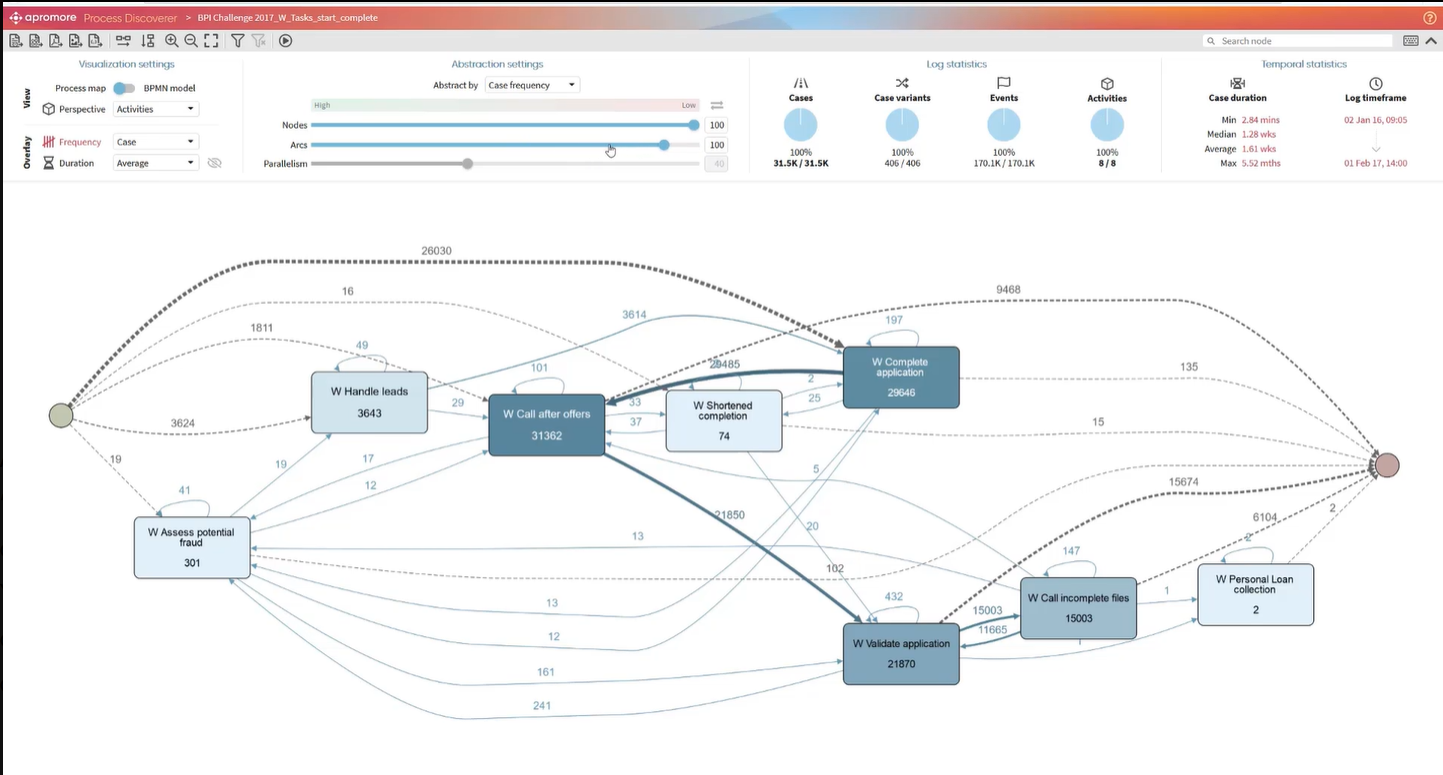
Apromore CEO Marcello La Rosa said joining Salesforce accelerates the company's plan to democratize process intelligence. He noted that "the majority of our customers already deploy our technology on Salesforce."

Steve Fisher, President and Chief Product Officer at Salesforce, said Apromore's integration into the company's platform will bring the ability "to unlock opportunities to measure, optimize, and automate through agentic process automation."

Constellation Research analyst Holger Mueller said:

"Salesforce keeps bolstering its PaaS layer for Agentforce and the acquisition of Apromore highlights the trend. Process intelligence graphs are a proven and successful approach to make sure agentic AI does not hallucinate and it's usually more reliable than data based RAG. Now the question is how fast it will be able to make process intelligence capabilities to show up in Agentforce."

More on process optimization:

Data to Decisions Future of Work Next-Generation Customer Experience Tech Optimization Innovation & Product-led Growth Revenue & Growth Effectiveness Digital Safety, Privacy & Cybersecurity salesforce ML Machine Learning LLMs Agentic AI Generative AI Robotics AI Analytics Automation Quantum Computing Cloud Digital Transformation Disruptive Technology Enterprise IT Enterprise Acceleration Enterprise Software Next Gen Apps IoT Blockchain Leadership VR Chief Information Officer Chief Executive Officer Chief Technology Officer Chief AI Officer Chief Data Officer Chief Analytics Officer Chief Information Security Officer Chief Product Officer

AI Trends, Industry Shakeups, and the Power of LLMs | CRTV Episode 115

AI Trends, Industry Shakeups, and the Power of LLMs | CRTV Episode 115

ConstellationTV episode 115 covers AI Forum Washington DC highlights, the latest #enterprise M&A (Thoma Bravo), a field report on #Sprinklr’s platform shift and #CX outcomes, and a pragmatic look at #LLMs vs. small models—performance, cost, and where edge deployments change the equation. If you own AI strategy, CX, apps, or data platforms, this one’s for you.

What you’ll learn
How to turn “Responsible AI” into governed workflows and measurable productivity
Why consolidation in martech/AI keeps accelerating—and how to evaluate vendors post-M&A
A CX playbook: instrument for outcomes, not activity; use social + first-party data to lift retention
Model selection 101: when LLMs win (quality/coverage) and when smaller models make sense (latency, cost, edge)

Chapters:
00:00 - Intro
00:35 - AI Forum DC takeaways
05:40 - Thoma Bravo and the consolidation curve
09:20 - Sprinklr: outcomes over outputs
14:05 - LLMs vs. small models
18:30 - Actions for 2025

On ConstellationTV <iframe width="560" height="315" src="https://www.youtube.com/embed/czeOPEaNp1Q?si=13rF-dsk1XtV-L5j" title="YouTube video player" frameborder="0" allow="accelerometer; autoplay; clipboard-write; encrypted-media; gyroscope; picture-in-picture; web-share" referrerpolicy="strict-origin-when-cross-origin" allowfullscreen></iframe>

5 AI Trends Every Tech Leader Should Know | ConstellationTV Episode 115

5 AI Trends Every Tech Leader Should Know | ConstellationTV Episode 115

Navigating AI Evolution: Takeaways from ConstellationTV Enterprise News

Artificial intelligence is not simply another technology wave—it’s a structural force reshaping how enterprises build, compete, and govern. In ConstellationTV episode 115, Constellation Research analysts Holger Mueller and Liz Miller explored the most urgent dynamics shaping enterprise strategy in the age of AI.

Here are five strategic shifts that should be on every technology leader’s radar.

1. AI Is Rewriting the Rules of Enterprise Architecture

The AI era looks different from past innovation cycles. Unlike previous disruptive technologies, agentic AI tools can integrate with both legacy and modern systems with far less friction. That’s accelerating transformation timelines across CRM, CX, and operational functions.

For CIOs and CTOs, this means AI adoption isn’t about bolting on another layer of technology—it’s about re-architecting the enterprise to be more adaptable and intelligent.

“This isn’t about layering tools. It’s about re-architecting the way enterprises innovate.” — Holger Mueller

2. Productivity Acceleration Comes With New Responsibilities

AI-assisted coding and workflow automation are redefining speed-to-value. SAP projects 4–5× productivity gains from AI-assisted development, while Deloitte has embedded local language models across 200,000 employee workflows.

This surge is transformative—but it also introduces new risk vectors. Liz Miller highlights how AI hallucinations in critical business contexts have already led to operational missteps. Responsible AI isn’t a checkbox—it’s the foundation for scale.

Key takeaway: Acceleration without governance is fragile. Reskilling, transparency, and guardrails must evolve in tandem with deployment.

3. Competing Through Differentiation, Not Imitation

In the CRM market, Salesforce remains the incumbent—and simplifying products alone won’t unseat a giant. As Mueller notes, the future belongs to companies that lead with differentiation: vertical specialization, data strategy, or integrated ecosystems.

Liz Miller underscores the same principle in partnerships: innovation flourishes when alliances solve real, overlooked pain points, not just when they check integration boxes.

Key takeaway: True competitive advantage comes from clarity of purpose—not mimicry of market leaders.

4. Rethinking Vendor Strategy in the AI Gold Rush

AI’s rapid growth is tethering many enterprises to hyperscalers. Partnerships like OpenAI and Oracle highlight how cloud providers are capturing disproportionate value from AI workloads.

Mueller raises the question: Why should enterprises tie themselves to proprietary ecosystems without equitable upside?

Key takeaway: Vendor strategy is becoming as critical as technology strategy. Build flexibility into your stack to avoid lock-in and retain control over value creation.

5. From Metrics to Outcomes: Redefining CX

Sprinklr’s evolution offers a glimpse into the future of customer engagement. Caesars Entertainment moved beyond contact-center metrics to identify and retain their most valuable customers through social insights.

This shift reflects a broader reality: AI is most powerful when it helps leaders understand the “why” behind the numbers, not just the numbers themselves.

Key takeaway: Modern CX strategies must focus on outcomes—like retention and loyalty—not just activity metrics.

Final Thoughts: Leadership at the Inflection Point

The age of agentic AI is accelerating enterprise transformation. But speed alone isn’t strategy. The most successful technology leaders will:

  • Architect flexible, AI-enabled enterprise foundations
  • Pair acceleration with governance
  • Differentiate rather than imitate
  • Revisit vendor strategies with intention
  • Redefine success through meaningful outcomes

This is a moment that demands clarity, not noise. Tech leaders who navigate this inflection point with discipline and vision will define the next era of enterprise technology.

Want more analysis? Watch the full discussion with Holger Mueller and Liz Miller on ConstellationTV epsiode 115.

Data to Decisions Digital Safety, Privacy & Cybersecurity Future of Work Innovation & Product-led Growth Marketing Transformation Matrix Commerce New C-Suite Next-Generation Customer Experience Tech Optimization salesforce ML Machine Learning LLMs Agentic AI Generative AI AI Analytics Automation business Marketing SaaS PaaS IaaS Digital Transformation Disruptive Technology Enterprise IT Enterprise Acceleration Enterprise Software Next Gen Apps IoT Blockchain CRM ERP finance Healthcare Customer Service Content Management Collaboration Chief Analytics Officer Chief Customer Officer Chief Data Officer Chief Digital Officer Chief Executive Officer Chief Financial Officer Chief Information Officer Chief Information Security Officer Chief Marketing Officer Chief People Officer Chief Privacy Officer Chief Procurement Officer Chief Product Officer Chief Revenue Officer Chief Supply Chain Officer Chief Sustainability Officer Chief Technology Officer Chief AI Officer

AWS launches Amazon Quick Suite, aims to automate business workflows

AWS launches Amazon Quick Suite, aims to automate business workflows

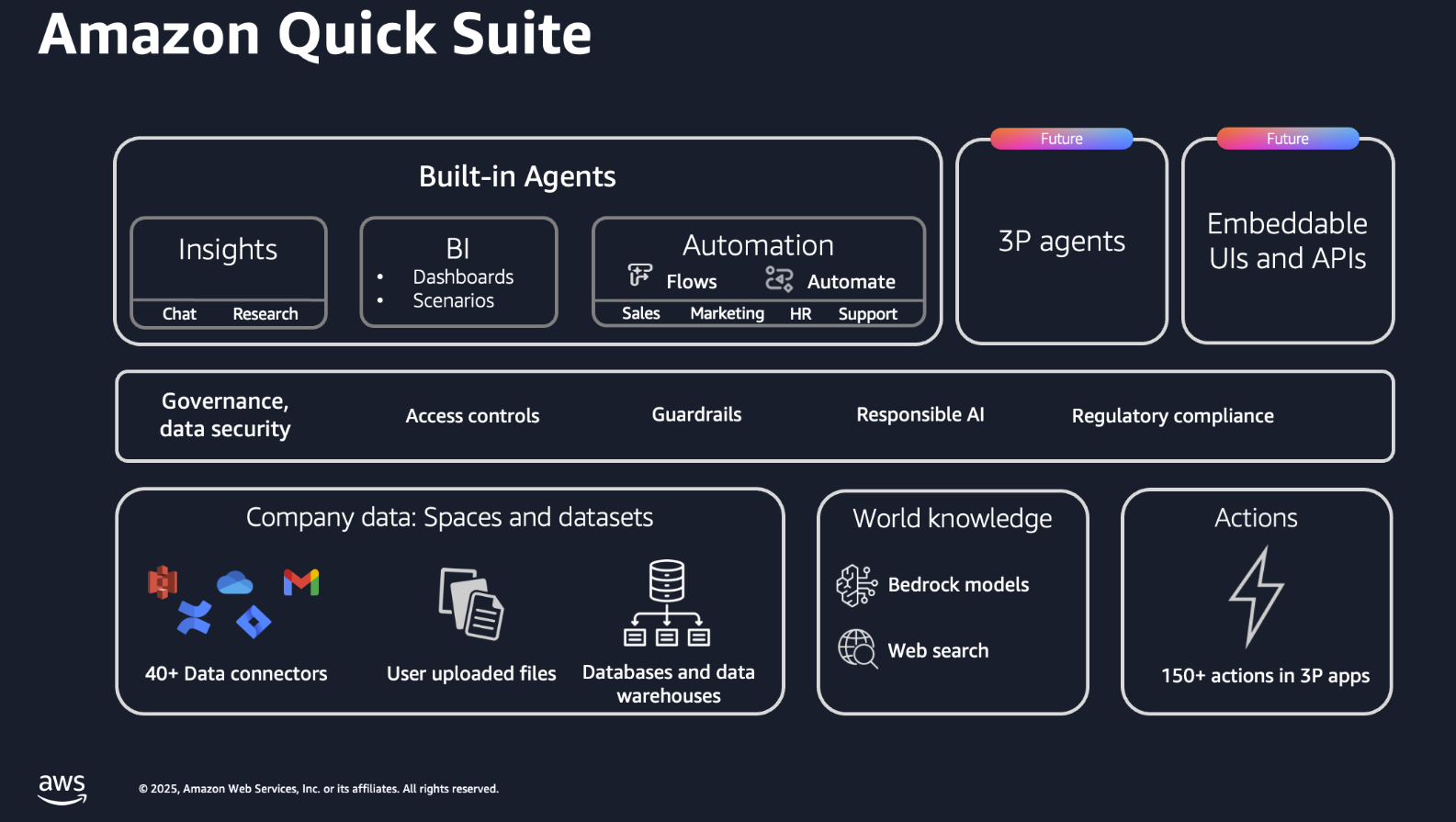
Amazon Web Services launched Amazon Quick Suite, which combines Amazon Q Business features with Amazon Quick Sight as well as new capabilities for automation and research in a move to bolster business user and AI agent collaboration.

The platform is designed to bridge the gap between AI proof-of-concepts and production deployments. In many ways, Amazon Quick Suite reflects the current playbook for AWS. AWS has been combining building blocks into suites and unified platforms that are easier to consume.

See: The AWS AI Strategy: Playing the Long Game Infrastructure-Style

Amazon Quick Suite includes these primary functions and features:

  • Information gathering from multiple enterprise unstructured data stores with connectors to Amazon S3, SharePoint, Exchange, Google Drive and others. Data is shared via APIs and Model Context Protocol (MCP). Amazon Quick Suite also leverages structured data from CRM, ticketing systems and other enterprise systems.
  • Hypothesis testing with specialized data sets.
  • Decision automation via repeatable workflows, or what AWS calls Flows, which is aimed at business users to automate routine tasks. Amazon Quick Suite also includes Quick Automate, which enables technical teams to handle complex, multi-agent, mission-critical processes.
  • A user interface agent to help business users stitch together agents and orchestrate them. UI Agent is a part of Quick Automate and Flows and can be used to interact across websites and business apps.
  • A built-in research agent that can produce comprehensive reports with verified sources and analytics on business strategy, pricing and market analysis across any industry.
  • All of the business intelligence capabilities of Quick Sight including dashboards and reports that can be created and queried with natural language.
  • Monitoring, logging and observability so admins have visibility into workflows and AI agents.
  • The ability to use multiple models via Amazon Bedrock. For default tools like built-in agent and chat agent, AWS steers users to models based on high quality responses. Model flexibility is available in Flows, where users can adjust settings for speed, comprehensive responses and deep reasoning. In Quick Automate, customers have full control and can set up their own Bedrock connector and select any model. API connectors can connect to non-Bedrock models and agents on and off AWS with MCP servers.

In a demo, Amazon Quick Suite was able to pull insights and recommend workflows across five to six enterprise systems in about 5 minutes. That output generally saved 30 minutes to 45 minutes to complete without Amazon Quick Suite or manual operations.

According to AWS, Amazon Quick Suite is designed specifically for business users with the ability to create workflows with natural language, pre-built integrations and a browser extension to meet customers where they work. Amazon Quick Suite is a horizontal approach to AI agents as AWS leverages its hyperscale cloud footprint to work across various enterprise applications and data stores.

"At a high level, we're empowering every business user regardless of technical skill and experience with generative AI to make better decisions faster," said John Brock, Head of Product, Apps and Automation AWS Agentic AI. "We also want to enable them to take action directly where they are working without having to switch between different tools."

Some of the prebuilt integrations include:

  • Atlassian.
  • Asana.
  • SAP.
  • ServiceNow.
  • Salesforce.
  • Microsoft Outlook, Teams.
  • HubSpot.
  • Marketo.
  • Microsoft SharePoint, OneDrive, Google Drive and Amazon S3 storage and collaboration.
  • OpenAI Specification.
  • Amazon Athena, Redshift and DynamoDB.
  • Slack and email.

Amazon Quick Suite supports API actions, MCP connectors, integration with existing enterprise systems and connections to agents.

With pricing of $20 per business user a month at professional scale, Amazon Quick Suite is priced on par with plans for large language model chat tools and brings together structured and unstructured data with context. Amazon Quick Suite will run $40 per user per month for a power user who would conduct a lot of research volume and build complex dashboards and technical automations.

Data to Decisions Future of Work Innovation & Product-led Growth Tech Optimization Next-Generation Customer Experience Digital Safety, Privacy & Cybersecurity amazon ML Machine Learning LLMs Agentic AI Generative AI Robotics AI Analytics Automation Quantum Computing Cloud Digital Transformation Disruptive Technology Enterprise IT Enterprise Acceleration Enterprise Software Next Gen Apps IoT Blockchain Leadership VR Chief Information Officer Chief Executive Officer Chief Technology Officer Chief AI Officer Chief Data Officer Chief Analytics Officer Chief Information Security Officer Chief Product Officer

Google Cloud launches Gemini Enterprise, eyes agentic AI orchestration

Google Cloud launches Gemini Enterprise, eyes agentic AI orchestration

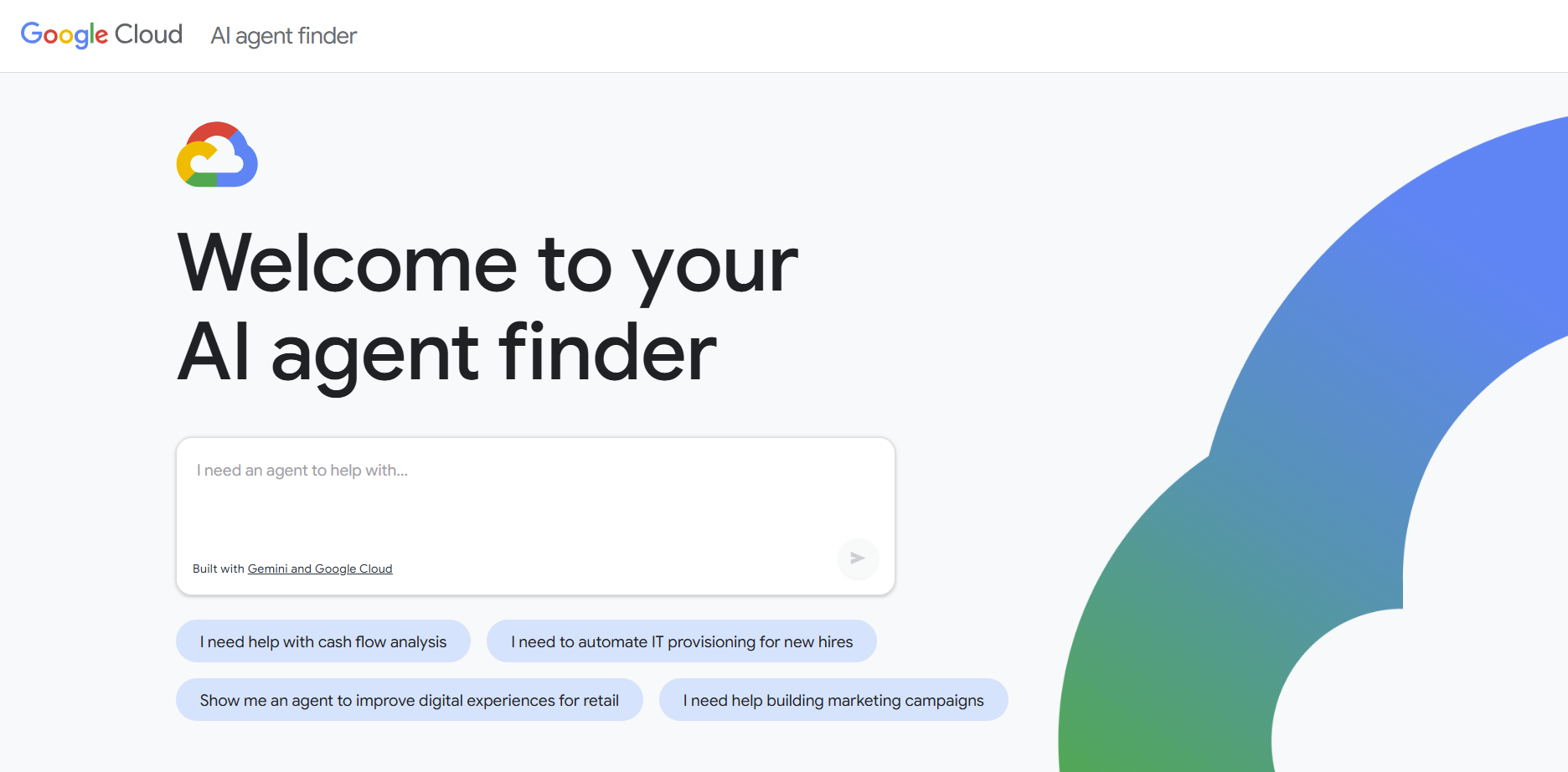
Google Cloud launched Gemini Enterprise, an agentic AI platform that includes Gemini models, first and third party agents and orchestration technology that was previously known as Agentspace.

The goal of Gemini Enterprise is to create one platform that can create multi-step and process AI agents coupled with the latest models and an enterprise's data. The agents within Gemini Enterprise can leverage data from internal systems and Google AI tools in one workflow.

Gemini Enterprise lands as enterprise vendors are scrambling to provide platforms that can address agentic AI workflows. Salesforce will make its case for Agentforce as a multi-agent enterprise platform. ServiceNow has a similar argument. AWS has AgentCore. Meanwhile, Boomi, UiPath and others are positioned as AI agent orchestrators.

Google Cloud said Gemini Enterprise use cases include marketing, sales and account intelligence, automated testing and code generation, HR and financial process optimization.

In a blog post, Google Cloud CEO Thomas Kurian said that the first generation of AI deployments was hampered by silos that limited orchestration. Google Enterprise provides an integrated stack that can work across processes, workflows and enterprise systems.

"Gemini Enterprise moves beyond simple tasks to automate entire workflows and drive smarter business outcomes," said Kurian, who said that enterprises need a single interface instead of a series of AI models and toolkits that have to be stitched together.

Gemini Enterprise starts at $30 per seat per month. The platform comes in Standard and Plus editions. Google Cloud also has Gemini Business, which starts at $21 per seat per month, and is designed for smaller businesses and teams. 

Components of Gemini Enterprise include:

  • Google's most advanced Gemini models and DeepMind research.
  • A no-code workbench that can be used by multiple corporate functions to orchestrate agents and automate processes.
  • A series of pre-built Google agents for specialized jobs.
  • Connectors to corporate data that resides in Google Workspace, Microsoft 365, Salesforce and SAP among others.
  • A central governance framework to audit agents.
  • An ecosystem of more than 100,000 partners.

Google Cloud cited Banco BV, Harvey, Macquarie Bank and Virgin Voyages as Google Enterprise customers. Virgin Voyages has plans to build more than 50 AI agents on Gemini Enterprise.

The strategy

Google Cloud said Gemini Enterprise has an open strategy with built-in multimodal agents designed to work within Google Workspace.

This playbook has been followed by most vendors looking to be your agent orchestration platform. The general theme for vendors is creating a platform that can work horizontally yet provide benefits if you stay with the integrated approach.

Gemini Enterprise with Google Workspace will include multi-modal agents powered by Gemini to understand text, image, video and speech. For instance, Google Enterprise is launching a Data Science Agent in preview to automate data wrangling and ingestion. Google Enterprise will be able to deliver conversational agents used in Google Cloud's Customer Engagement Suite.

In addition, Gemini Enterprise will include Gemini CLI as well as Agent2Agent Protocol, Model Context Protocol and Agent Payments Protocol to use Gemini models directly into products.

By offering seamless integration points with Google Cloud offerings, Gemini Enterprise can be differentiated.

The other side of the effort is being open enough to be a broad horizontal tool. Kurian touted Google Cloud's agentic AI ecosystem including cross-platform workflows with Box, OpenText, ServiceNow and Workday and the ability to scale with partners such as BCG, Capgemini, Infosys, Accenture, Cognizant and others.

Many of those partners are also using Google Enterprise internally.

Gemini Enterprise said the following partners will announce agents built with Gemini Enterprise: Box, Dun & Bradstreet, Manhattan Associates, OpenText, Salesforce, S&P Global, ServiceNow and Workday. Other vendors including Elastic, HubSpot and UiPath have plans to integrate agents with Gemini Enterprise.

Data to Decisions Future of Work Innovation & Product-led Growth Tech Optimization Next-Generation Customer Experience Digital Safety, Privacy & Cybersecurity Google ML Machine Learning LLMs Agentic AI Generative AI Robotics AI Analytics Automation Quantum Computing Cloud Digital Transformation Disruptive Technology Enterprise IT Enterprise Acceleration Enterprise Software Next Gen Apps IoT Blockchain Leadership VR Chief Information Officer Chief Executive Officer Chief Technology Officer Chief AI Officer Chief Data Officer Chief Analytics Officer Chief Information Security Officer Chief Product Officer

SoftBank's ABB robotics purchase boosts physical AI plans

SoftBank's ABB robotics purchase boosts physical AI plans

SoftBank is acquiring the robotics division of ABB Group in a deal worth $5.375 billion. Softbank's plan is to combine ABB Robotics with its physical AI assets.

With the move, SoftBank has a base of robotics customers and manufactures to expand its physical AI ambitions. ABB will complement SoftBank’s robotics stable of companies: SoftBank Robotics Group Corp., Berkshire Grey, Inc., AutoStore Holdings Ltd., Agile Robots SE, and Skild AI.

SoftBank said that it will create a new holding company focused on its robotics businesses.

ABB was planning to spin off its robotics division. The deal is expected to close in mid- to late-2026.

SoftBank Group CEO Masayoshi Son said ABB Robotics will speed up its physical AI ambitions. "SoftBank’s next frontier is Physical AI. Together with ABB Robotics, we will unite world-class technology and talent under our shared vision to fuse Artificial Super Intelligence and robotics —driving a groundbreaking evolution that will propel humanity forward," said Son.

ABB Robotics has 7,000 workers and 2024 revenue of $2.3 billion, or 7% of ABB Group's total revenue.

In a statement, SoftBank said its mission is "actively investing and expanding its businesses in four essential areas: (i) AI chips, (ii) AI robots, (iii) AI data centers, and (iv) energy, as well as investing in companies at the forefront of generative AI."


Data to Decisions Future of Work Chief Information Officer

DeepSeek's launch set off China's AI boom

DeepSeek's launch set off China's AI boom

DeepSeek created an AI boom in China and has more than doubled usage as it attracts new users and then holds them, according to a research report from Microsoft Research.

In a paper, Microsoft Research took anonymized telemetry data on how people are using AI globally. The data complements other use case data from LLM providers like OpenAI and Anthropic.

First, it's worth noting that Microsoft's telemetry data has its own biases, but is a solid data set on usage. Microsoft's telemetry data is skewed toward desktop usage and the company's demographic.

In a paper, which was used in a Financial Times visual story, Microsoft researchers wrote:

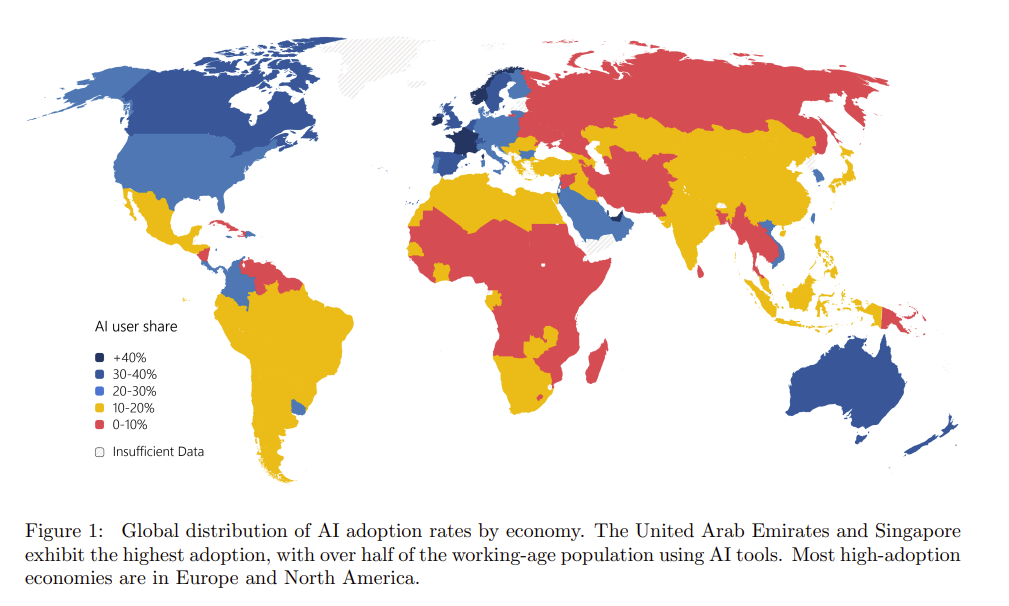
"We introduce AI User Share, a novel indicator that estimates the share of each country’s working-age population actively using AI tools. Built from anonymized Microsoft telemetry and adjusted for device access and mobile scaling, this metric spans 148 economies and provides consistent, real-time insight into global AI diffusion. We find wide variation in adoption, with a strong correlation between AI User Share and GDP. High uptake is concentrated in developed economies, though usage among internet-connected populations in lower-income countries reveals substantial latent demand."

From a market share perspective, Microsoft telemetry doesn't give you any real surprises. The countries leveraging AI the most tend to be the richest.

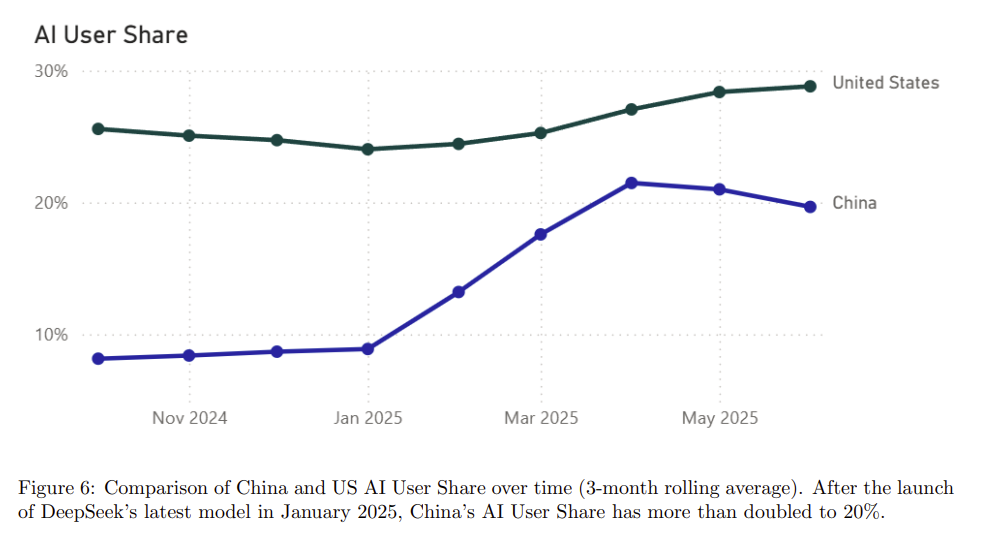
But what really sticks out is the DeepSeek launch in January. When DeepSeek initially launched, the big takeaway is that the model from China offered a contrast to the brute force compute approach offered by the US.

After a few months, the importance of DeepSeek really revolves around putting China into the AI race. China is now the largest AI market.

Microsoft noted:

"China’s AI user share has more than doubled from 8% to 20%, making it the world’s largest AI market, with an estimated AI user base exceeding 195 million. The growth in China’s AI user population also appears to be sustained, suggesting that DeepSeek is not only attracting new users, but also keeping them engaged."

Data to Decisions Future of Work Chief Information Officer

IBM TechXChange 2025: Big blue connects agentic AI, mainframe dots, partners with Anthropic

IBM TechXChange 2025: Big blue connects agentic AI, mainframe dots, partners with Anthropic

IBM said its Spyre AI accelerator and Telum II processor are generally available, outlined a partnership with Anthropic and layered agentic AI tools throughout its offerings.

The news outlined at IBM's Tech Xchange 2025 in Orlando revolved around operationalizing AI in the enterprise. Here's a look at the notable news.

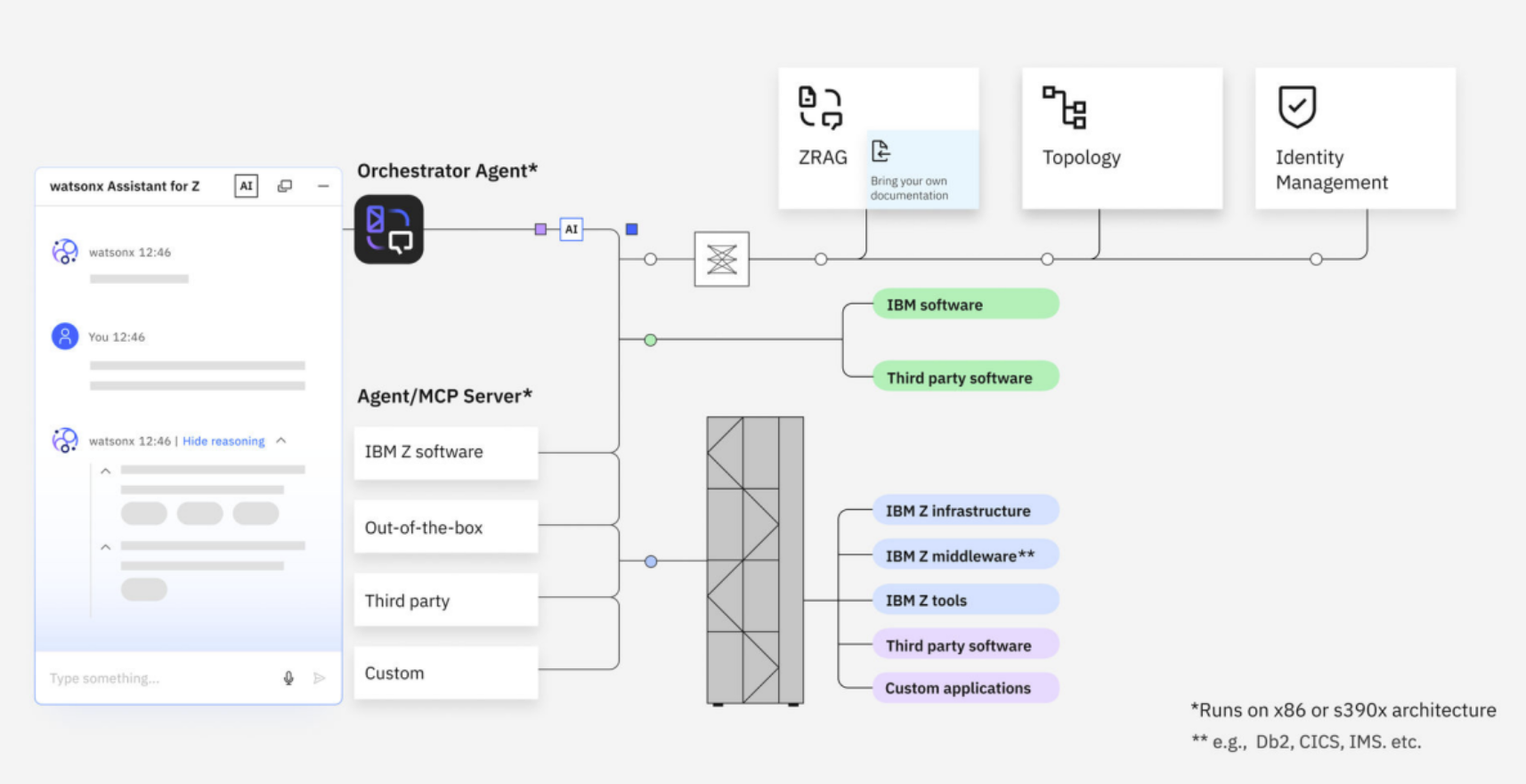
IBM Spyre Accelerator became generally available for IBM z17 will bring LLMs to IBM Z mainframe environment. IBM also said its software products including  IBM watsonx Assistant for Z, AI Toolkit for IBM Z and IBM LinuxONE, and Machine Learning for IBM z/OS will use Spyre for on-prem deployments.

The Spyre Accelerator has 32 AI-optimized processing cores to support LLMs on the mainframe. Combined with IBM's Telum II processor, the company said its Z platform can process up to 450 million inference operations using multiple AI models for credit card fraud detection.

IBM said it will layer Anthropic's Claude LLMs into its software portfolio starting with its latest integrated development environment (IDE). The two companies are aiming to use Claude throughout the enterprise software development lifecycle. IBM said more than 6,000 early adopters in the company are using the new IDE, which is in preview with IBM customers.

The IDE, called Project Bob, includes tools for application modernization, code generation and review and security embedded into workflows.

IBM watsonx Orchestrate gets new tools for agentic AI including workflows that are reusable and sequence multiple AI agents, Langflow integration, a catalog of prebuilt agents for procurement, HR, finance, supply chain and sales and prebuilt customer service agents.

Watsonx Orchestrate also includes agent observability, governance and production monitoring.

IBM delivered a new release of watsonx Assistant for Z to improve the mainframe user experience with a AI chatbot grounded on Z expertise.


Data to Decisions Next-Generation Customer Experience Tech Optimization IBM Chief Information Officer

Dell Technologies ups revenue outlook due to AI infrastructure

Dell Technologies ups revenue outlook due to AI infrastructure

Dell Technologies raised its annual revenue growth target to 7% to 9% as it ramps its AI infrastructure business.

The company outlined its guidance at its security analyst meeting. Dell maintained its third quarter guidance delivered when it reported second quarter earnings.

Dell said its updated annual revenue growth will be in the 7% to 9% range, up from 3% to 4%. The company also said it will raise its dividend 10% or more annually through 2030. Annual non-GAAP earnings growth will be 15% or better.

CEO Michael Dell said, "customers are hungry for AI and the compute, storage and networking we provide to deploy intelligence at scale." He added that the AI "opportunity ahead is massive."

The company argued that it is well positioned for AI data center infrastructure as well as PCs.

In a presentation, Dell laid out the following points:

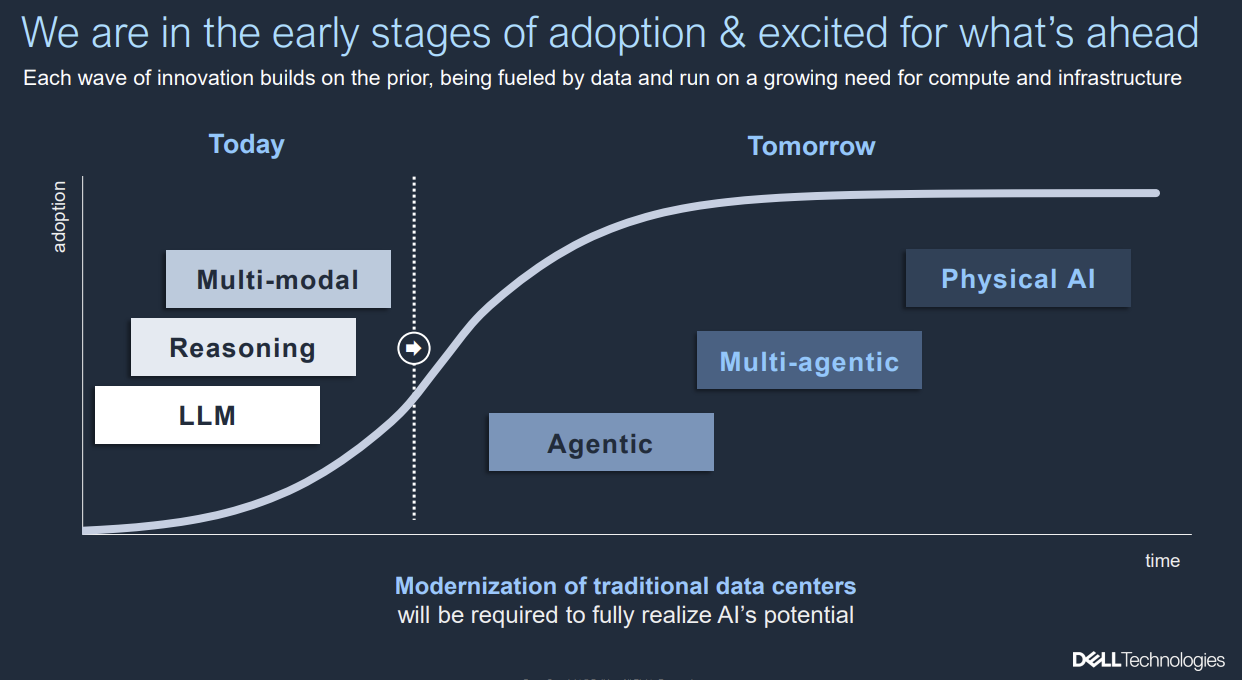
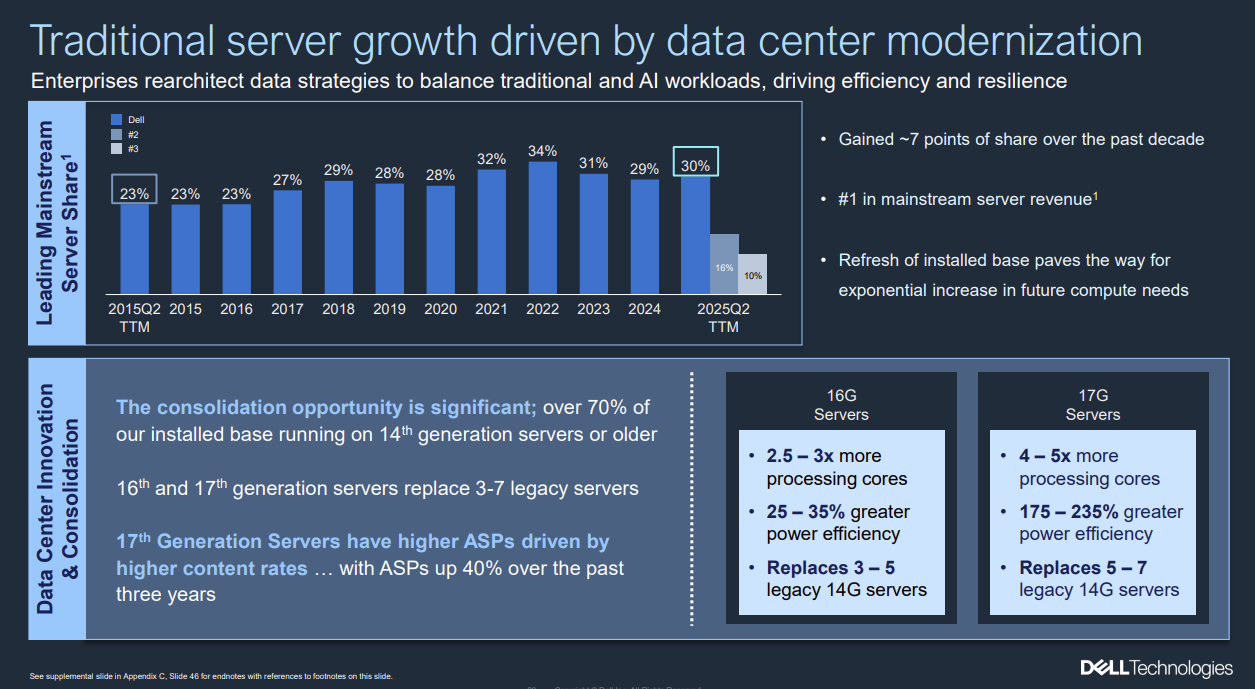
  • AI is in the early stages of adoption and traditional data centers will be key to AI deployments.

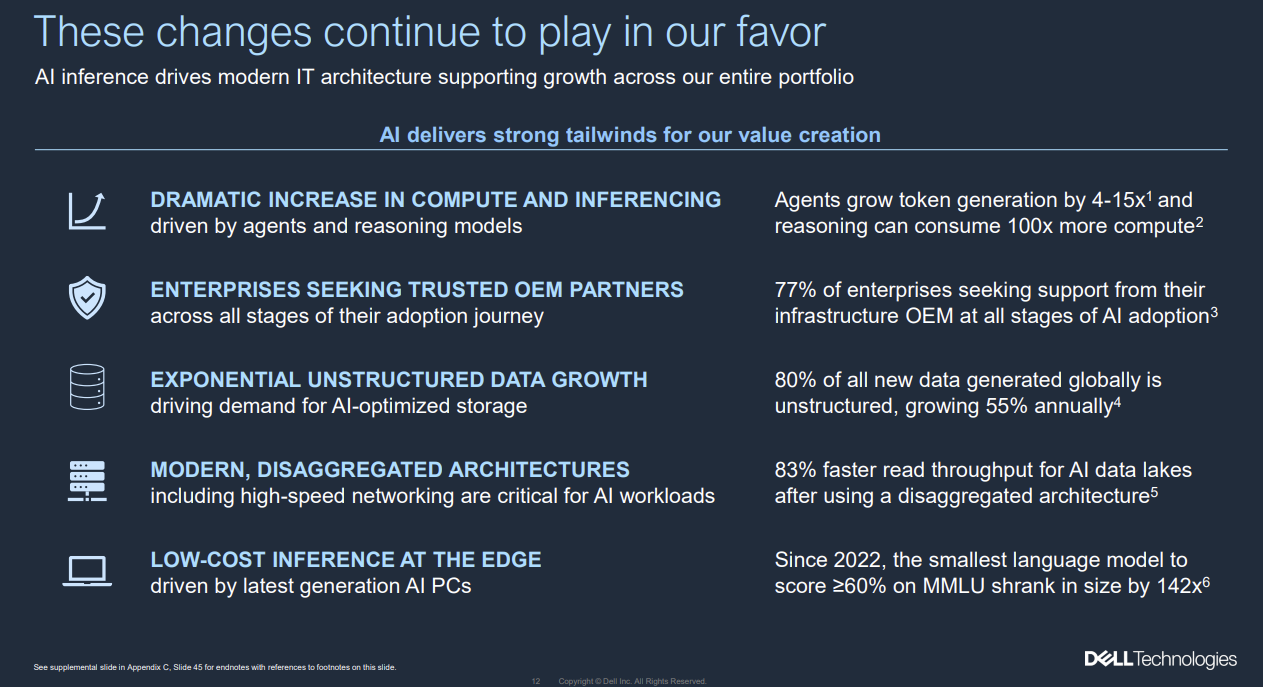
  • AI inference will support growth going forward and enterprises will increasingly go with low-cost inference at the edge and disaggregated architectures. PCs will also play a role in edge AI.

  • Traditional server and storage growth will be driven by AI workloads.

Data to Decisions Tech Optimization dell Big Data Chief Information Officer Chief Technology Officer Chief Information Security Officer Chief Data Officer

CoreWeave acquires Monolith, eyes industrial AI use cases

CoreWeave acquires Monolith, eyes industrial AI use cases

CoreWeave said it will acquire Monolith AI Limited, which specializes in AI for engineering in industrial and manufacturing companies.

Terms of the deal weren't disclosed, but the purchase is notable because CoreWeave is looking to take its broader AI infrastructure workloads vertical where the customer base is stickier.

Indeed, Monolith has a strong customer base including BMW, Mercedes-Benz, Honda, Nissan and Siemens to name a few. Monolith's platform is used for simulation and testing for physics and engineering solutions. CoreWeave has been rounding out its business with acquisitions including OpenPipe and Weights & Biases.

With CoreWeave, Monolith will get access to an AI stack for its customers. According to CoreWeave, the combined company will give customers the ability to speed up R&D, product development and design. CoreWeave Chief Strategy Officer Brian Venturo said AI can transform manufacturing.

"Monolith was founded to put AI directly into the hands of engineers, enabling them to create breakthrough technologies. Joining CoreWeave will allow us to scale that mission dramatically," said Dr. Richard Ahlfeld, CEO of Monolith, in a statement.

Holger Mueller, an analyst at Constellation Research, said:

"This is CoreWeave's first entry into the AI applications space, and it may highlight a potential future concern on workloads. The higher in-house, organic workloads are for CoreWeave relative to volatile AI provider workloads, the more stable CoreWeave's utilization of data center capacity."

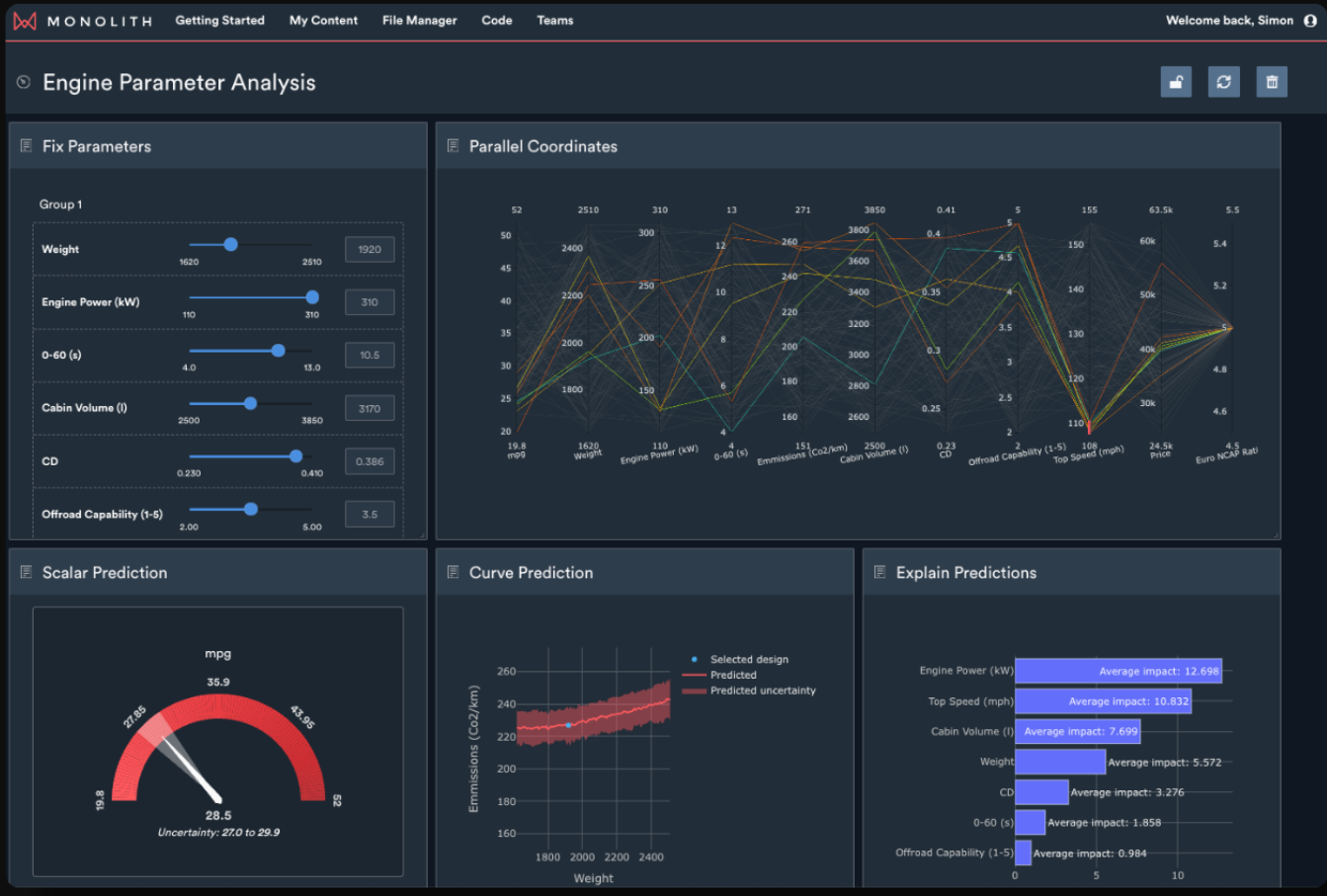
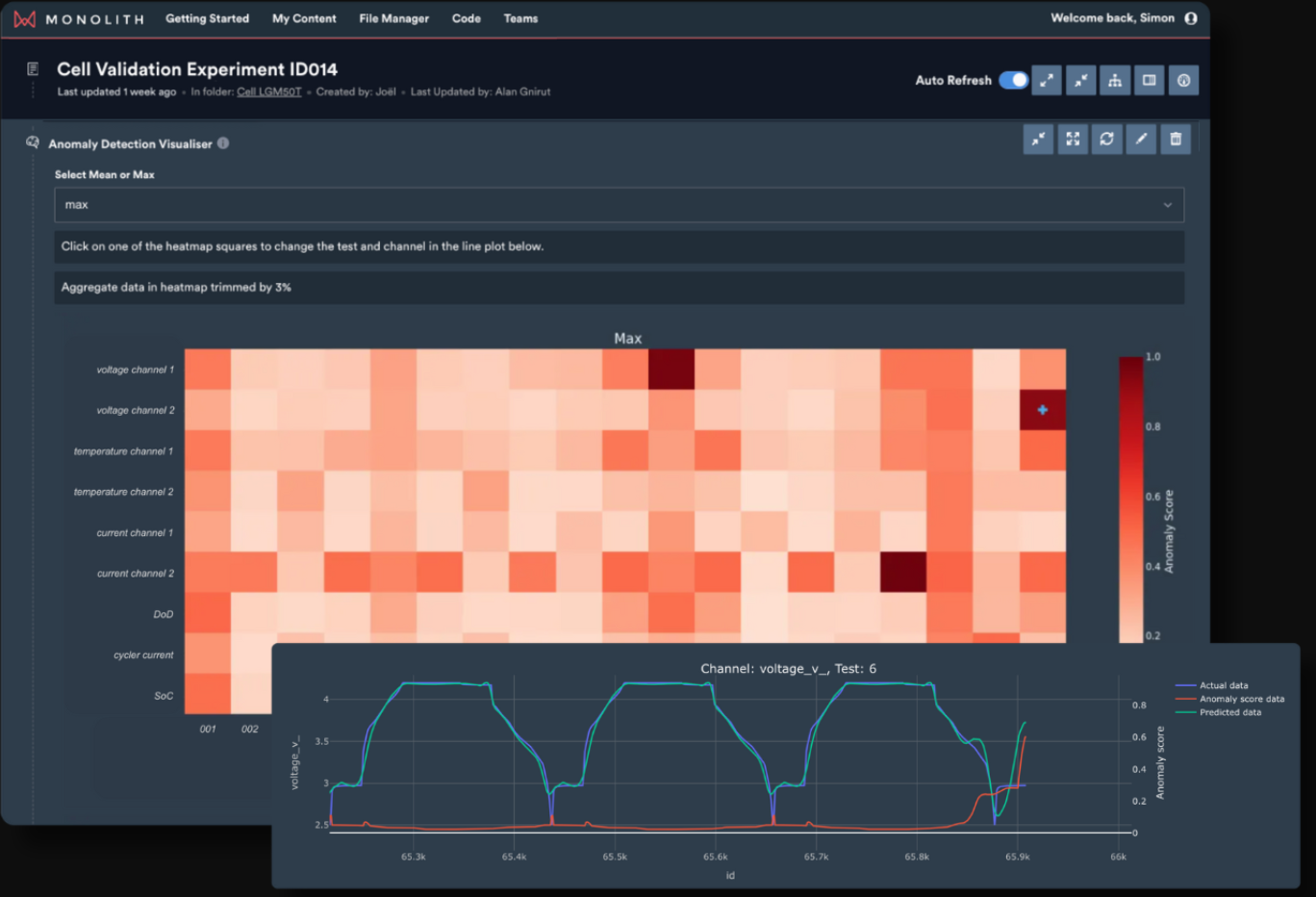
Monolith's platform embeds AI and machine learning directly into engineering workloads and reduces the need for physical testing. Here are a few screenshots of Monolith’s platform.

Data to Decisions Future of Work Innovation & Product-led Growth Big Data Chief Information Officer Chief Technology Officer Chief Information Security Officer Chief Data Officer