


Snowflake Q2 earnings strong with revenue growth of 32%
Snowflake delivered strong second quarter earnings as its AI Data Cloud gains traction.
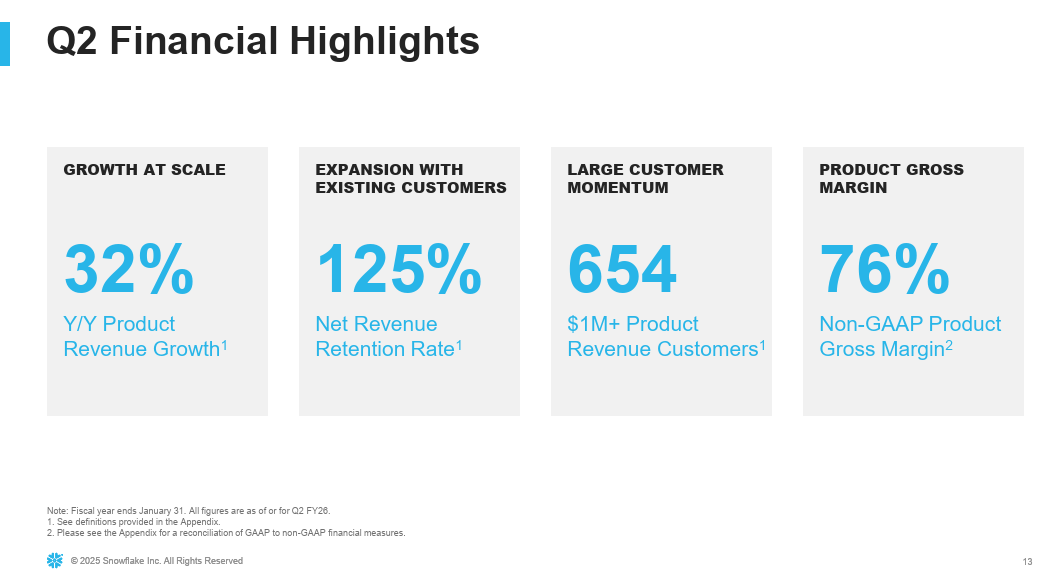
The company reported a GAAP second quarter net loss of $298 million, or 89 cents a share, on revenue of $1.144 billion, up 32% from a year ago. Snowflake reported second quarter non-GAAP earnings of 35 cents a share.
Wall Street was expecting Snowflake to report second quarter non-GAAP earnings of 27 cents a share on revenue of $1.09 billion.
- Snowflake Summit 2025: Everything you need to know
- Snowflake makes its Postgres move, acquires Crunchy Data
Snowflake said it has 654 customers with trailing 12-month product revenue greater than $1 million. Product revenue in the second quarter was $1.09 billion.
Sridhar Ramaswamy, CEO of Snowflake, said the company is executing well and “thousands of customers are betting their business on Snowflake and more than 6,100 accounts are using Snowflake’s AI every week.“
Nevertheless, Snowflake is valued at about $65 billion by the public markets compared to Databricks' $100 billion private market valuation.
As for the outlook, Snowflake projected product revenue in the third quarter of $1.125 billion and $1.13 billion, up 25% to 26%. Operating income margin will be 9% on a non-GAAP basis.
For fiscal 2026, Snowflake projected product revenue of $4.395 billion, up 27% from a year ago.
On an earnings call, Snowflake cited BlackRock, Cambia Medicare, Thomson Reuters and Duck Creek Technologies as customers.
Ramaswamy said the following on the earnings call:
- "In the first half of the year alone, we launched approximately 250 capabilities to general availability, demonstrating both the pace of our innovation and the breadth of our platform expansion. But we aren't stopping there. As we innovate, we are continuing to strengthen our platform and help our customers do more with their data to deliver great business outcomes."
- "We are continuing to see strong adoption of open data formats, especially truly open modern table formats like Apache Iceberg. We now have over 1,200 accounts using Iceberg."
- "There is more and more recognition that the AI components of our data platform can deliver enormous value. And we are seeing budgets get allocated from large customers for AI projects."
- "I think there is honestly years of work ahead in terms of the value that we can get from AI. The models have advanced so much that I think just effectively using them in all of the workflows that matter to enterprises is going to create enormous value for all of us."
Larry Dignan is Editor in Chief of Constellation Insights at Constellation Research, where he leads editorial coverage focused on enterprise technology, digital transformation, and emerging trends shaping the future of business. He oversees research-driven news, analysis, interviews, and event coverage designed to help technology buyers and vendors navigate complex markets with clarity and context. ...
Read morePublished
Author
