Executive Summary
Privileged Access Management (PAM) has become a foundational security control as identity-driven attacks continue to rise across enterprise environments. Attackers increasingly target privileged credentials to bypass controls, move laterally, and gain persistent access to critical systems and data. The growing use of automation and AI by attackers further increases the speed and scale at which privileged access can be exploited once initial compromise occurs.
Modern PAM platforms focus on controlling, monitoring, and governing access to high-risk accounts, including administrators, service accounts, and machine identities. Core capabilities such as credential vaulting, session monitoring, and least-privilege enforcement remain essential. At the same time, PAM is evolving to address more dynamic environments where privileges are short-lived, distributed across cloud and SaaS platforms, and closely tied to identity and access workflows.
As organizations adopt Zero Trust strategies, PAM plays a critical role in enforcing least-privilege access and reducing blast radius when identities are compromised. The category is also evolving to incorporate analytics and AI-assisted controls that help detect abnormal privileged behavior, assess risk in real time, and automate response actions. This ShortList reflects PAM’s transition from static credential control to an adaptive security layer designed to counter modern identity-centric and AI-enabled attacks.
Threshold Criteria
Constellation considers the following criteria for these solutions:
Core Capabilities
Privileged credential vaulting and management
Securely stores, rotates, and manages privileged credentials for users, applications, and services.Least-privilege access enforcement
Limits privileged access to the minimum level required, reducing standing privileges and attack surface.Session monitoring and recording
Monitors and records privileged sessions to support visibility, auditing, and forensic investigation.Privilege elevation and delegation management
Controls and logs temporary privilege elevation with approval workflows and policy enforcement.Strong authentication and access controls
Enforces multi-factor authentication and contextual access policies for privileged users.Integration with identity and security platforms
Integrates with IAM, directory services, security operations, and cloud platforms.
Differentiated Capabilities
Behavioral and risk-based privilege analysis
Uses analytics to assess privileged activity patterns and identify high-risk or abnormal behavior.Adaptive access controls for dynamic environments
Adjusts privilege enforcement based on context such as workload, location, and risk level.Support for cloud, SaaS, and machine identities
Extends PAM controls beyond traditional admins to cloud-native, API, and service accounts.Automation of privileged access workflows
Reduces operational friction through automated provisioning, approval, and deprovisioning of privileges.Alignment with Zero Trust and identity security strategies
Supports least-privilege enforcement and continuous verification as part of broader identity and Zero Trust initiatives.
The Constellation ShortList
Constellation evaluates more than 34 solutions categorized in this market. This Constellation ShortList is determined by client inquiries, partner conversations, customer references, vendor selection projects, market share, and internal research.
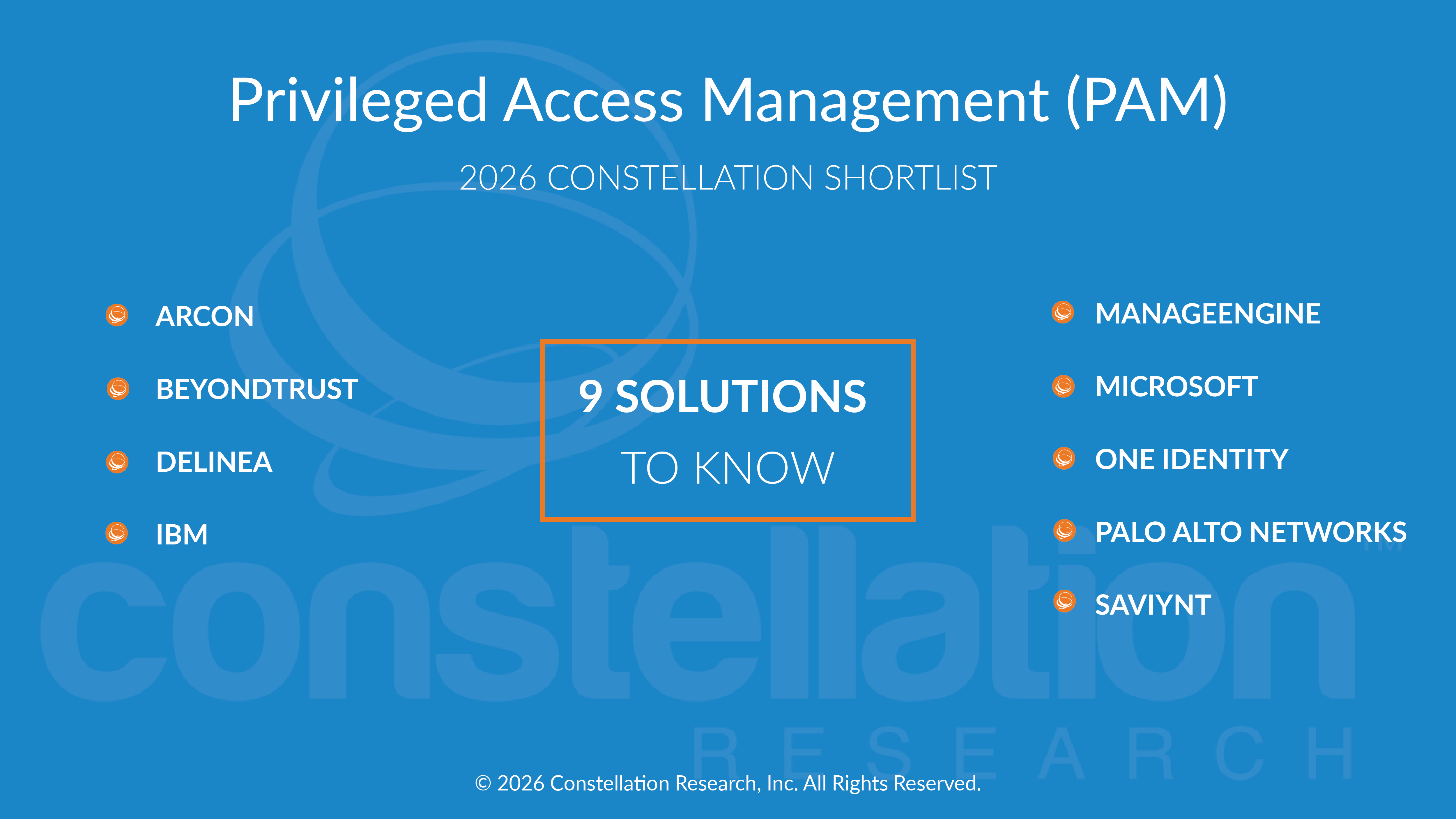
- ARCON
- BeyondTrust
- Delinea
- IBM
- ManageEngine
- Microsoft
- One Identity
- Palo Alto Networks
- Saviynt
Frequency of Evaluation
Each Constellation ShortList is updated at least once per year. Updates may occur after six months if deemed necessary.
Evaluation Services
Constellation clients can work with the analyst and research team to conduct a more thorough discussion of this Constellation ShortList. Constellation can also provide guidance in vendor selection and contract negotiation.