Editor in Chief of Constellation Insights
Constellation Research
Larry Dignan is Editor in Chief of Constellation Insights at Constellation Research, where he leads editorial coverage focused on enterprise technology, digital transformation, and emerging trends shaping the future of business. He oversees research-driven news, analysis, interviews, and event coverage designed to help technology buyers and vendors navigate complex markets with clarity and context. ...
Bank of America's second quarter was strong, the banking giant captured deposits and the company saw good operating leverage. Bank of America CEO Brian Moynihan said digital superiority is a big reason.
Speaking on the company's second quarter earnings conference call, Moynihan said:
"Digital superiority is key to our operating dynamics. First, it produces a great customer experience resulting in strong customer retention and strong customer scores. Second, it ensures our position as a lead transactional bank for our customers, whether they are consumers, companies, or investors. Third, it preserves a strong deposit balance. And last, but importantly not least, efficiency."
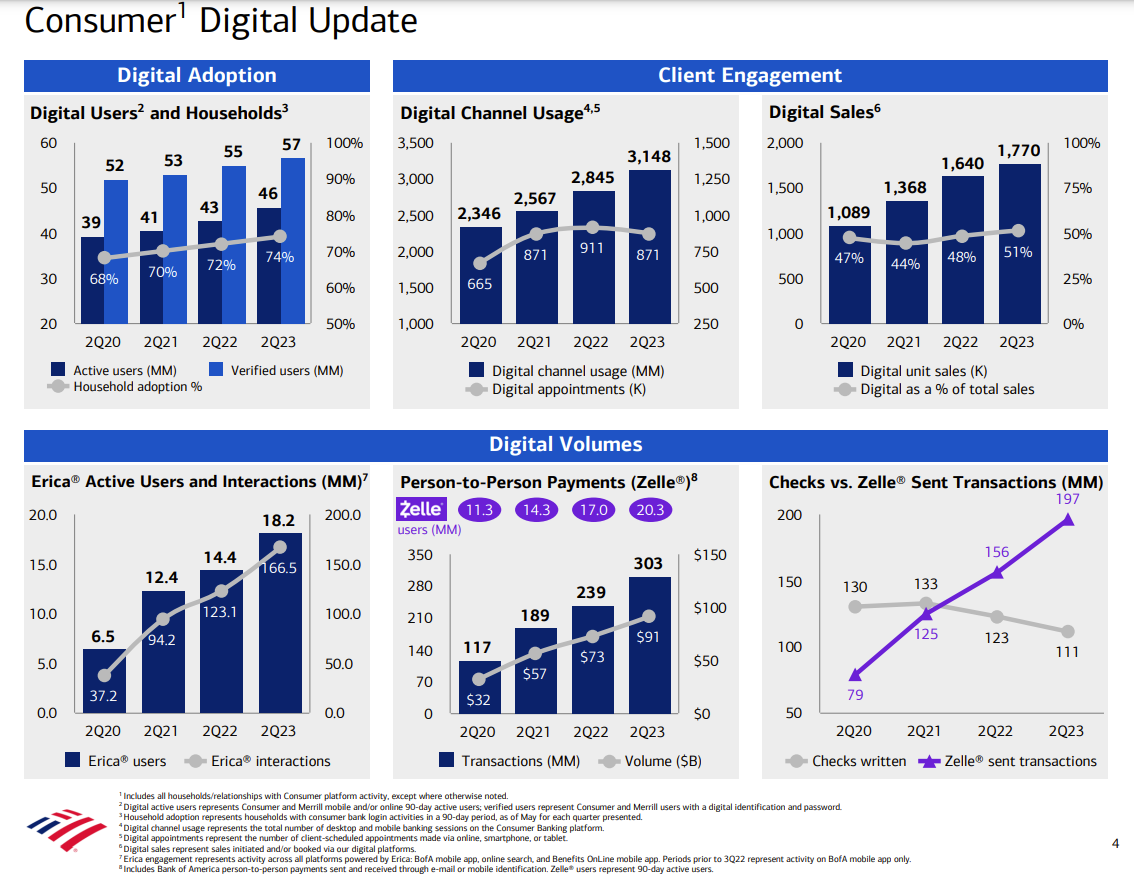
46 million active consumer users digitally engaged and logged on 1 billion times a month.
Interactions with Erica, the bank's natural language processing and AI bot, has now had more than 1.5 billion client interactions in its first five years. Erica interactions rose 35% in the past year.
Zelle usage has grown 19% over the past year.
Erica and Zelle have generated 20,000 digital leads for 7,000 advisors.
Bank of America also saw digital engagement gains in global wealth and investment management and global banking.
Alastair Borthwick, CFO at Bank of America, said digital superiority also means operating leverage and efficiency gains.
Borthwick said:
"You should expect us to continue to engineer by applying massive amounts of technology. Erica saves a lot of transactional activity, Zelle saves a lot of transactional activity deposits by mobile phone saves a lot of activity."
Those digital efforts save money and drive revenue.
Moynihan said digital prowess has enabled Bank of America to keep headcount flat to down and invest those savings back into developers.
Editor in Chief of Constellation Insights
Constellation Research
Larry Dignan is Editor in Chief of Constellation Insights at Constellation Research, where he leads editorial coverage focused on enterprise technology, digital transformation, and emerging trends shaping the future of business. He oversees research-driven news, analysis, interviews, and event coverage designed to help technology buyers and vendors navigate complex markets with clarity and context. ...
Microsoft is officially entering the process mining and process automation ring with Power Automate Process Mining availability August 1.
Power Automate Process Mining general availability was announced at Microsoft's Inspire conference in Las Vegas. Microsoft beefed up its process mining and task mining capabilities with the acquisition of Minit in March 2022.
With process mining integration with Power Automate, Microsoft is looking to leverage its installed base of its Power platform to automate processes. Power Automate Process Mining has been in public preview since November 2022.
As previously detailed, the process automation platform scrum is going to be intense. In addition to process mining giant Celonis, UIPath, SAP and others are positioning to be automation platforms from different directions. The goal of these vendors is clear: Find process improvements with data from systems of record such as SAP, fix them and then automate them so businesses can continually improve.
Microsoft's Power Automate Process Mining includes the following:
Templates to leverage corporate data, systems of record and flows from Azure, Power Automate, Power Apps and Power Virtual Agents and Azure to visualize processes as they actually happen.
Tools for root cause analysis, drilldowns and recommended KPIs to identify inefficiencies and automation possibilities.
Process templates for horizontal processes such as order-to-cash, peer-to-peer pay and supply chain.
Low code automation tools to optimize processes across the Power Platform.
Notifications in Microsoft Teams and Outlook when KPIs are at risk or not met.
Ongoing monitoring of processes with the ability to create new goals and continually improve.
With the rollout of Power Automate Process Mining, Microsoft revamped its licensing for the Power Platform.
Along with the Aug. 1 general availability, Microsoft is adding a Power Automate Premium option for $15 per user per month. The license will provide unlimited cloud flows, digital process automation, robotic process automation and Power Automate Process Mining. Power Automate Premium replaces Power Automate Attended RPA per user.
In addition, Microsoft is adding a Power Automate Process license with access to an automation bot that can be used for unattended RPA or cloud-flow process that can be accessed by unlimited users at a company.
Power Automation Process Mining can also be available as an add-on for additional capacity at $5,000 per tenant per month with 100 GB Process Mining data storage.
For enterprises, the big question is whether process mining and automation is a separate category or something that is seen as an integration within a broader platform. Like analytics, there's a point where embedded features become good enough as part of a broader platform purchase.
Editor in Chief of Constellation Insights
Constellation Research
Larry Dignan is Editor in Chief of Constellation Insights at Constellation Research, where he leads editorial coverage focused on enterprise technology, digital transformation, and emerging trends shaping the future of business. He oversees research-driven news, analysis, interviews, and event coverage designed to help technology buyers and vendors navigate complex markets with clarity and context. ...
Microsoft 365 Copilot will run you $30 per user per month for Microsoft 365 E3, E5, Business Standard and Business Premium customers.
The news, announced at Microsoft Inspire in Las Vegas, fleshes out the price tag for generative AI capabilities embedded into Microsoft's portfolio. Microsoft said Microsoft 365 Copilot will be embedded throughout Microsoft’s portfolio including Word, Excel and PowerPoint and inherits existing Microsoft 365 security, privacy, identity and compliance policies. Data will be isolated.
Microsoft has 600 enterprise customers in the Microsoft 365 Copilot paid Early Access Program. Enterprises have been cutting licensing costs and it'll be interesting to see whether CXOs give Microsoft 365 Copilot to every employee with access to Office or pick and choose roles. It also remains to be seen how enterprises pick and choose vendors for generative AI.
Constellation Research analyst Holger Mueller said:
"Microsoft keeps rolling out generative AI capabilities across it is products and now it's the turn of the enterprise offerings, as part of the Office franchise. To have an AI powered assistant can be very helpful to the knowledge worker and positively changes the future of work. And we finally have a price tag for or the service at $30 per month. That is not much for an assistant that delivers productivity gains, when it delivers 2-3 hours of time savings a month. The interesting aspect: This is going to be more than the office license after 3-5 months. This plan shows both the commoditization of Office, how expensive generative AI is and how important it is for revenue growth at Microsoft."
Inspire is Microsoft's partner conference. Here's a rundown of what was announced.
Microsoft rolled out Bing Chat Enterprise, which aims to keep enterprise data segmented while providing generative AI insights via Web data with citations to workers. Bing Chat Enterprise is in preview and included at no cost for Microsoft 365 E3, E5, Business Standard and Business Premium. in the future, Bing Chat Enterprise will be $5 per user per month.
The software giant added Visual Search in Chat to Bing Chat using OpenAI's GPT-4 model. Users can upload images and search the web for related content.
Microsoft Sales Copilot gets new features within Dynamics 365 Sales. Features include opportunity summaries, email drafts and meeting prep.
Power Automate Process Mining is now generally available with low-code tools, process mining, automation suggestions and task mining within the platform.
Meta and Microsoft forged a partnership that will support the Llama family of large language models on Azure and Windows. Microsoft will be Meta's preferred partner when Llama 2 is released to commercial customers.
Azure OpenAI Service adoption has been expanded to 4,500 customers with more availability in North America and Western Europe. The service is also available in Asia now.
Microsoft and healthcare software giant Epic have expanded their partnership. Epic has integrated Azure OpenAI Service into its electronic health record platform. Microsoft will also embed its clinical documentation tools via Nuance into Epic. Epic customers are also using Azure Large Instances. The Microsoft and Epic partnership is notable given Oracle's healthcare expansion plans via the Cerner acquisition.
And finally, Microsoft launched its Microsoft AI Cloud Partner Program, which includes incentives and co-selling opportunities as well as training content.
The list of companies leveraging generative AI is expanding:
Editor in Chief of Constellation Insights
Constellation Research
Larry Dignan is Editor in Chief of Constellation Insights at Constellation Research, where he leads editorial coverage focused on enterprise technology, digital transformation, and emerging trends shaping the future of business. He oversees research-driven news, analysis, interviews, and event coverage designed to help technology buyers and vendors navigate complex markets with clarity and context. ...
Splunk launched Splunk AI Assistant, which will use generative AI and a domain specific large language model (LLM) built on its security and observability data.
The generative AI effort is part of Splunk AI, a portfolio of AI offerings announced at Splunk's .conf23 conference in Las Vegas.
According to Splunk, its AI Assistant will provide chat experiences to help users leverage Splunk Processing Language using natural language. Customers can use Splunk AI Assistant to write or explain custom queries. The big theme is that Splunk is looking to make its data more accessible to enterprises.
Constellation Research analyst Andy Thurai said:
"Splunk AI optimizes domain-specific large language models and machine learning algorithms specifically built on security and observability data. This means rather than having generic LLM models, their offering will have a domain specific knowledge trained on their data set. Splunk is helping customers train their own LLMs on their domain specific data, which can be powerful in unearthing tribal knowledge that is hidden in many corners of the enterprise.
Splunk AI Assistant and Splunk Processing Language (SPL) can be a good tool to help support personnel, SREs, SecOps folks and even DevOps teams, to find information faster for incident management whether it is security or service incidents."
While Splunk AI Assistant, which is in preview, was the headliner the company Splunk AI portfolio is aiming to free up various operations and engineering teams to do more strategic work and be more productive. Splunk said its AI efforts will be open and extend into its AI models as well as third party and proprietary tools.
Other Splunk AI and machine learning announcements include:
Splunk App for Anomaly Detection provides AIOps related teams to automate anomaly detection and streamline operation workflows.
IT Service Intelligence 4.17 improves detection accuracy with Outlier Exclusion for Adaptive Thresholding, which detects and omits outliers to provide more precise insights. ML Assisted Thresholding will use historical data and patterns to provide more accurate alerting with one click.
Splunk Machine Learning Toolkit 5.4 offers guided access to machines learning technology. Security and IT operations teams can garner machine learning insights and bring external models into Splunk.
Splunk App for Data Science and Deep Learning 5.1 will extend the Machine Learning Toolkit to bring together data science, machine learning and deep learning systems.
The Splunk Threat Research Team has added 6 machine learning detections to Splunk Enterprise Security to keep up with new threats and attacks.
Editor in Chief of Constellation Insights
Constellation Research
Larry Dignan is Editor in Chief of Constellation Insights at Constellation Research, where he leads editorial coverage focused on enterprise technology, digital transformation, and emerging trends shaping the future of business. He oversees research-driven news, analysis, interviews, and event coverage designed to help technology buyers and vendors navigate complex markets with clarity and context. ...
Don't look now, but CXOs are becoming more optimistic, favoring revenue growth opportunities and planning technology pilots that will optimize and automate processes to partly pay for innovation.
Simply put, CXOs are expecting a better business climate in 2023. Fifty eight percent of respondents said they expected a better business climate in 2023. In the fourth quarter 2022 survey, 67% of respondents predicted a worse business climate for 2023.
The themes in the Constellation Research 2023 H1 "CxO Business Confidence Survey" revolve around leveraging technologies such as generative AI, analytics and automation to solve for revenue growth, profit growth via efficiency and labor constraints. From the report:
“Constellation predicts that enterprises that neglect to build a generative AI strategy will progressively fall behind. Early adopters have an opportunity to deliver on exponential growth across revenue operations, customer and employee experiences, and enterprise growth.”
Here's a look at a few of the findings from the report and my take:
The top 3 most important business issues facing CXOs is labor availability, operational challenges, and innovation. Worries about inflation, interest rates and consumer demand have receded along with recession fears. My take: Labor availability is a pain point that my also dovetail with interest in generative AI.
32% of the IT budget is going to investments that add to top-line growth and 28% is going to efficiency. My take: That balance makes a lot of sense given one can fund the other. Large enterprises can continually optimize processes at scale and fund innovation efforts.
57% of respondents plant to initiate a proof of concept this year for ChatGPT. Analytics and cloud remain top of mind for nearly half of CXOs. My take: Pilots for generative AI will abound as corporate FOMO kicks in and vendors roll out integrations. Stay tuned for the all-too-predictable generative AI disillusionment. Generative AI will be swell for companies with strong data strategies. The rest will gripe that generative AI wasn't a magic elixir.
22% of CXOs say they will initiate a proof of concept for metaverse in 2023. My take: That's a big percentage considering that metaverse has largely been a punchline for a year. Maybe it's not so mehtaverse after all.
The go-to vendors for CXOs are Microsoft, AWS, Salesforce, Google Cloud and Adobe. My take: Microsoft was cited as a top-of-mind software vendor by 69% of respondents. The big get bigger. More interesting is that "other" was cited by 25% of respondents, tied with Workday. The fact that "other" beat Apple, SAP, Cisco and Oracle tell me that not all CXOs are on the vendor consolidation bandwagon.
Editor in Chief of Constellation Insights
Constellation Research
Larry Dignan is Editor in Chief of Constellation Insights at Constellation Research, where he leads editorial coverage focused on enterprise technology, digital transformation, and emerging trends shaping the future of business. He oversees research-driven news, analysis, interviews, and event coverage designed to help technology buyers and vendors navigate complex markets with clarity and context. ...
A Constellation Research DisrupTV panel riffed on generative AI use cases, regulation, ethics and how technology can build resilience.
Here are some of the big themes that emerged from the DisrupTV discussion:
Dr. Anthony Scriffignano, Global award-winning Chief Data Scientist
Sharron McPherson, CEO of The Green Jobs Machine, Adjunct Senior Lecturer at the University of Cape Town Graduate School of Business, and Faculty at Singularity University
Natalie Barrett, Senior Fellow at Atlantic Council
Regulation. Barrett said her biggest concern is that legislation hasn't caught up with AI and will be perpetually behind if "something happens where you'd want someone to be accountable."
McPherson agreed: "AI and other kinds of technologies can influence global thinking with ideas. Power is shifting from government to companies and from companies to people. AI is shifting power in our society, and I think about voice and agency. We're going to have lots of changes in policy around AI because of the concerns people are starting to have. It's too early to imagine what the impact might be or whether it's not enough. We are not jumping in early enough with the right policies. How am I as a legislator going to legislate something that doesn't have transparency."
Scriffignano added that regulation can prevent bad things from happen as well as the good. "The challenge put on these regulators is that innovation is always going to outpace regulation," he explained.
AI is a tool, but... McPherson noted that AI is a tool that can be used for both good and bad.
Scriffignano said there's a risk that large language models are ingesting everything that's being said and create misinformation and disinformation.
"It's very easy to confuse them (LLMs)," he said. "When we say generative AI what we mean is it is outputting or summarizing what is read or consumed, but that can also be digital hearsay from sources that are no invisible to us. We invented a new hammer so let's be careful about how we use that hammer."
On the positive side, Scriffignano said generative AI can summarize data and text well. "There's no way you could read everything that's being published in any field of medicine right now so AI can give me a summary of what's being said so I can be a physician and not a researcher," he said.
Scriffignano added that AI can also be used to track behavior and ultimately prevent bad things from happening.
Resilience technology. McPherson said she spends a lot of time thinking about using technologies like AI to shift capital into places that need it, notably marginalized communities at the intersection of climate and technology.
"How do you leverage technologies like Earth observation technologies to get data and build resilience technologies," said McPherson. "We have been in stealth mode trying to build an index that measures the resilience and vulnerability of a place or physical asset and provide recommendations that are actionable to save lives and livelihoods."
McPherson said her group has focused on digging deep into how we use data and AI to "begin to solve for climate resilience." "We are going to have millions of people leaving their homes and migrate (due to climate)," she said. "Think about the implications for our global economy and everything you care about. There's no silver bullet to this, but it really is about matching and making sure that we understand what resilience is and you need data for that."
Defining AI use cases. Barrett said there are multiple AI use cases to ponder including medical assessments, or a "doctor in a box" that can be sent to disadvantaged areas.
She said:
"We have validated data sets where we do have protocols and processes that we need to use whether it's for financial market, climate security, medical treatment and personalized medicine."
Human intelligence vs. artificial intelligence. Barnett said that human intelligence (HI) will be more valuable than AI due to authenticity.
Barnett said:
"An artist or someone who writes a poem for some reason leaves a part of the soul, but we just get a photocopy of that poem (with AI). No matter what HI will always be more valuable. AI should augment a human to be valuable."
Responsible AI. Barnett said equity in AI in the US should focus on the equality of the data used as well as the quality of results. "AI if used properly can be a democratic tool that pulls the power back to the people but only if used in the right use cases," she said. "It also has to be traceable, which means I need to know where the data came from and what the algorithm did. I need to be able to test it in some way and it has to be governable."
Scriffignano said that transparency in AI is easier said than done.
"We can't necessarily explain why we reach certain decisions as humans. We can think after the fact or rationalize how we made a decision, but the reality is a lot more complicated than we think. We're constantly simplifying the world around us."
Scriffignano ran through multiple ethical quandaries with algorithms including privacy when using data for commercial purposes vs. a crisis where "the needs of many outweigh the needs of one." "I'm glad I don't have to be an ethicist because it's really hard to make these decisions and there isn't a black and white answer. And that answer changes depending on where you are in the world and what your country values," he said.
Editor in Chief of Constellation Insights
Constellation Research
Larry Dignan is Editor in Chief of Constellation Insights at Constellation Research, where he leads editorial coverage focused on enterprise technology, digital transformation, and emerging trends shaping the future of business. He oversees research-driven news, analysis, interviews, and event coverage designed to help technology buyers and vendors navigate complex markets with clarity and context. ...
Earnings season is on deck, and we are going to see a parade of technology vendors with second quarter reports. Last quarter was sluggish but better than feared since most folks were waiting for a recession. When Armageddon didn't come the stock market rejoiced. It did not hurt that generative AI euphoria drove tech stock prices too.
Now that the stock market has had a nice run it’s possible a lot of optimism is priced in. Simply put, we have a different setup for tech companies this quarter. It's unlikely that tech giants will post massive sales gains--excluding Nvidia of course--since enterprises are still wary. Yes, the cost cutting may be over, but tech buyers aren't going to be giddy right away.
To cut through all the noise, I'm looking for the following signals from earnings season.
In the second quarter, every demand signal from cloud providers will be overanalyzed by Wall Street. Meanwhile, cloud providers are buying gear to support generative AI workloads that are still largely experimental for enterprises. AI will drive cloud computing demand, but the timing is debatable.
Software price increases. Salesforce launched a series of AI services, became more efficient and raised list prices about 9% on average across clouds. Salesforce's increases are effective Aug. 1, but the CRM giant won’t be the only company raising prices. Watch software company earnings to see how much growth has been fueled by price increases.
Generative AI buzz. In the first quarter, generative AI was the hot topic. The second quarter will likely feature a lot more generative AI talk. I'll be looking at the earnings calls from enterprise buyers to see what they say about generative AI, concerns, efficiency and production implementations. The first quarter earnings transcripts turned up a decent amount of generative AI comments from multiple industries.
Data revenue streams. While enterprises are training large language models and looking for competitive advantage, new revenue streams are going to appear in surprising places. My hunch is that Shutterstock's move to license its IP so OpenAI can train models is just the beginning. There are multiple companies in various industries that can license data to train models. Simply put, I think we're going to see every company try to monetize its data.
IT spending. Hardware is hot given how AI is reshaping data center demand. I cannot recall talking this much about semiconductors in years. AI is going to drive a hardware upgrade cycle at some point. I'll be looking to see if hardware demand expands beyond Nvidia and semiconductors and into networking gear and servers.
Editor in Chief of Constellation Insights
Constellation Research
Larry Dignan is Editor in Chief of Constellation Insights at Constellation Research, where he leads editorial coverage focused on enterprise technology, digital transformation, and emerging trends shaping the future of business. He oversees research-driven news, analysis, interviews, and event coverage designed to help technology buyers and vendors navigate complex markets with clarity and context. ...
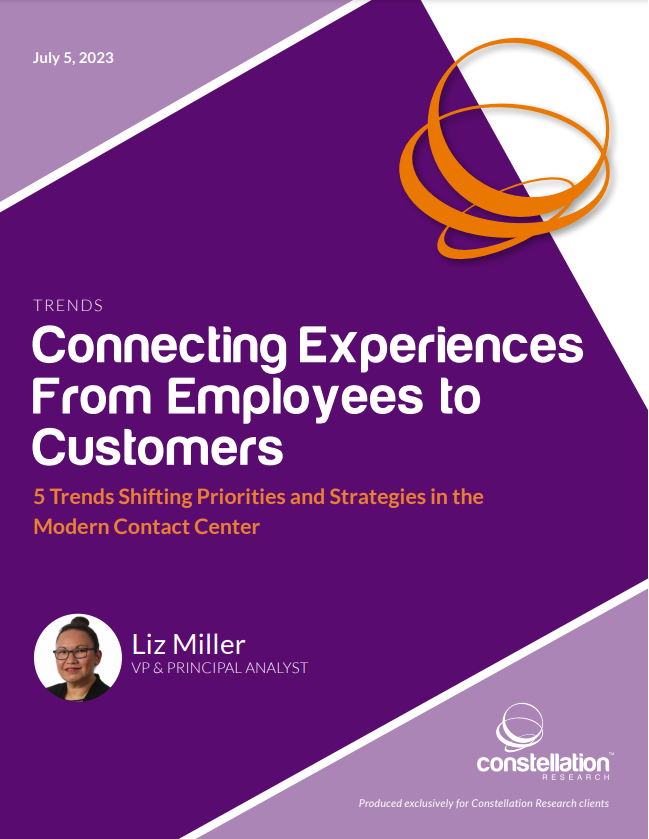
Customer experience teams--marketing, commerce, customer service, support and contact center--are pressured to become a unified growth engine driving engagement and revenue opportunities and that's going to force contact center evolution.
Miller wrote about the shift to becoming an Experience Enterprise:
"It is a shift that has been a long time coming as individual teams have evolved from operational deployment teams into centers of functional excellence within an experience-driven enterprise. Sales’ role becomes that of revenue-optimization engine, whereas Marketing helms growth identification and amplification. Service becomes a key communication channel, proactively resolving issues and scaling one-to-one engagements that derive value for customers. Across all functions runs a common call for AI-powered, data-driven solutions to guide customers as well as employees through processes. Guided selling, self-service support, and focused hyperpersonalization to drive brand loyalty and advocacy begin to feel like shared services rather than individual, independent, disconnected functions or teams.
This shift has most acutely impacted the contact center, pushing Service as a whole out of the shadow of being an “operational cost center” and into the light of being a hub for profitable relationship-driving via purpose-built connected experiences. This move, where all three skill sets of CX delivery—selling, servicing, and marketing—must be executed by agents and supervisors, turns the contact center into a strategic growth hub for the experience-driven enterprise."
The upshot: Contact center agents will need to serve as brand ambassadors, storytellers, and sales problem solvers. Enterprises will have to enable those agents.
Many companies aren't there yet due to cloud computing maturity and the expertise needed to leverage AI and functional silos. Miller provides the questions to ask as well as takeaways about where the contact center fits in. Among the takeaways:
Contact centers are adopting new CX metrics. These metrics include quality of issue resolution, impact on customer lifetime value and revenue outcomes.
Contact centers are a data goldmine that can be leveraged for AI and new workflows. Customer records with agent notes, history, attitude, preferences, sentiment and other information can provide real insights into product development, marketing and sales.
Customers make no distinction about functional CX silos within an enterprise.
Enterprises will need to clearly articulate AI strategies in contact center and credit answers when they are generated by AI.
The technology behind the contact center isn't always easy to modernize and transform and enterprises may choose to keep on-premises systems.
Editor in Chief of Constellation Insights
Constellation Research
Larry Dignan is Editor in Chief of Constellation Insights at Constellation Research, where he leads editorial coverage focused on enterprise technology, digital transformation, and emerging trends shaping the future of business. He oversees research-driven news, analysis, interviews, and event coverage designed to help technology buyers and vendors navigate complex markets with clarity and context. ...
Wipro said it will invest $1 billion over the next three years to advance artificial intelligence via Wipro ai360, a unit focused on end-to-end AI innovation.
According to the services and consulting giant, Wipro ai360 will build on the company's existing investments and integrate AI into every platform and tool used internally and offered to clients.
Wipro added that responsible AI will be at the core of Wipro ai360's efforts. Thierry Delaporte, CEO of Wipro Limited, said in a statement that Wipro ai360 will target multiple industries, business models and challenges. Wipro ai360 will have 20 innovation centers and digital pods, more than 300 patents and experience via 2,000 AI engagements.
If you zoom out, Wipro ai360 highlights how technology vendors are embedding generative AI and related tools everywhere. However, enterprise buyers are wary of AI and its implications for compliance, first party data and security even as boardrooms push for rapid adoption.
In other words, there's a lot to figure out when it comes to integrating AI everywhere. Here's a sampling of how enterprise buyers are thinking through AI.
Wipro said it plans to train its 250,000 employees on AI fundamentals and responsible use over the next 12 months with more customized training available.
Wipro ai360 includes:
30,000 Wipro experts in analytics and AI across multiple businesses.
New AI capabilities across cloud, analytics, design, consulting, security, and engineering as well as new processes and practices.
Wipro's innovation hub Lab45 will be part of Wipro ai360 to speed up research and co-innovation for AI.
R&D efforts to improve AI, data and platform capabilities.
In addition, Wipro said it will accelerate startup investments via its Wipro Ventures arm. The company will also launch a GenAI Seed Accelerator.
Editor in Chief of Constellation Insights
Constellation Research
Larry Dignan is Editor in Chief of Constellation Insights at Constellation Research, where he leads editorial coverage focused on enterprise technology, digital transformation, and emerging trends shaping the future of business. He oversees research-driven news, analysis, interviews, and event coverage designed to help technology buyers and vendors navigate complex markets with clarity and context. ...
Is Shutterstock mapping the way forward for IP owners in the generative AI age or making an epic business model mistake?
Check back in a few years.
Shutterstock, which has more than 615 million images enriched with metadata and 2.2 million global customers, will provide training data for OpenAI models. Shutterstock and OpenAI launched a partnership in January, but the expanded deal will give OpenAI a license to access Shutterstock training data for image, video and music libraries and metadata.
Last week, Shutterstock said that it will indemnify enterprise customers following a similar move by Adobe.
The takeaway is that Shutterstock sees generative AI as a way to expand its total addressable market. Shutterstock will use generative AI tools to drive subscriptions and licenses and improve its products. What remains to be seen is whether granting OpenAI access to Shutterstock's first party data will be a business risk.
A historical comparison would be Starz, which licensed its catalog to Netflix in 2008. Netflix then used the Starz catalog to build its streaming business. Starz pulled its content from Netflix in 2011.
Other companies with extensive media catalogs have waffled between taking money upfront and licensing content to digital platforms and keeping it exclusive.
Whether Shutterstock regrets granting OpenAI access to training data remains to be seen. Shutterstock's e-commerce channel is self-serve and is 60% of the company's business. Those subscribers could ultimately choose OpenAI in the future. However, Shutterstock has its own generative AI offerings too.
Shutterstock CEO Paul Hennessy said on the company's first quarter earnings call that generative AI requires "experimentation at scale so we understand this new market."
Hennessy said generative AI drives engagement for its platform and enables other companies to create products by licensing its data. He said:
"We are aggressively investing in bringing generative AI to our customers. After launching our AI image generation platform in partnership with OpenAI in January, we had last reported that users had created 3 million assets in the two weeks immediately following the launch. From the three months since inception, almost 1 million users have created more than 20 million assets on our platform. To put that in context, Shutterstock averaged 10 million new images every quarter since 2020, and so the pace thus far in generative images created far exceeds the growth we’ve seen historically in our content engine.
Although it’s too early to provide any definitive statements on generative AI’s revenue potential, I’m excited to report some early indicators that speak to high engagement and the exciting potential of this new technology across the entire user journey."
To Hennessy there's no conflict between building generative AI products with Shutterstock's first party data and licensing it to others to grow its total contract value.
"In addition to the major investments we’re making in developing and delivering generative AI for our customers, we continue to be highly encouraged by our pipeline of data partnerships to help large tech companies train their models to develop their own generative AI products and solutions. The need to use meta data for generative AI model training is expanding, and we are seeing new companies invest with urgency to build commercial products within their core area of focus. We are also seeing our pipeline expand for existing customers across multiple asset types: customers who started with images looking at video, and customers looking at music and 3D content for model training. The use cases for training data are also expanding and we are seeing opportunities that are increasingly industry-specific and for specific commercial products."