Results

At Google I/O 2023, Google Cloud launches Duet AI, Vertex AI enhancements

Google Cloud is launching Duet AI, which takes Google's foundational generative AI models to make building and deploying cloud applications easier. Developers can also optimize code with Generative AI Support in Vertex AI with three new foundation models.

The launch of Duet AI was announced at Google I/O. Google Cloud was a headliner during CEO Sundar Pichai's keynote, which focused on generative AI as well as examples of where the company was using AI across Google Workspace, Gmail, Docs, Slides and Meet. Google Cloud CEO Thomas Kurian's appearance at Google I/O highlights the unit's maturity. Google Cloud was profitable in the first quarter.

"All of these generative AI advancements are coming to business," said Kurian. He added that Google Cloud's AI technologies for business are secure and rightsized based on the compute needed. 

Google Cloud's announcements land as Google outlined its Transformer architecture as well as its next-generation language model called PaLM 2. PaLM 2 has improved multilingual, reasoning, and coding capabilities. Competitively, Google Cloud’s Duet AI and Generative AI Support in Vertex AI will face off with Microsoft’s numerous OpenAI ChatGPT integrations, notably CoPilot.

AWS, Microsoft Azure, Google Cloud themes: Optimization, generative AI and the long game

Duet AI, which is available today for early adopters via Google Cloud's AI Trusted Tester Program, is designed to make developing cloud applications less complicated by offering the following across multiple services:

  • Code assistance with AI provides recommendations, generates functions and code blocks while flagging errors and security risks. Code assistance will be available across Google Cloud including services such as Cloud Workstations, Cloud Shell Editor and Cloud Code IDE. Code assistance will support multiple languages including Go, Java, JavaScript, Python and SQL.
  • Chat assistance that uses natural language to deliver answers on development and cloud-related questions. Users can engage with chat assistance, learn how to use services, and get implementation plans while providing architecture and coding best practices.
  • Duet AI for AppSheet, which will allow Google Cloud users to create business applications, connect data and build workflows into Google Workspace in a natural language no-code format. Users will be able to describe an app guided by prompts.

Generative AI support in Vertex AI

Google Cloud also outlined Generative AI support in Vertex AI, which enables enterprises to fine-tune Codey models using their own code base. Codey models will be available directly in Vertex AI and ultimately connect to Duet AI. In March, Google Cloud outlined Gen App Builder to enable generative chat and search apps, Generative AI support in Vertex AI, Model Garden and Generative AI Studio.

MARKET OVERVIEW: Analytics and Business Intelligence Evolve for Cloud, Embedding, and Generative AI

At Google I/O, Google Cloud outlined three new foundation models including:

  • Codey, a text-to-code foundation model to improve code generation and completion and quality. Codey suggests the next few lines based on the code entered, generates code based on natural language prompts, and features a bot to help with documentation and questions.
  • Imagen, a text-to-image foundation model to generate and customize studio-grade images.
  • Chirp, a speech-to-text foundation model to provide native language captioning and voice assistant. Chirp is a version of Google Cloud's 2 billion parameter speech model that supports more than 100 languages.

The company also added embedding API for text and images so developers can more easily build classifiers, question and answering systems and other applications and reinforcement learning with human feedback to extend Vertex AI's tuning. Human feedback is handy to generate accurate models for industries like healthcare.

Google Cloud also said Generative AI Studio, Model Garden, and PaLM 2 for Text and Chat are moving from trusted tester availability to preview. Google Cloud also announced A3 instances to run AI workloads. 

Generative AI guide: ChatGPT: Hype or the Future of Customer Experience

Media Name: kurian ai workloads.png
Data to Decisions Digital Safety, Privacy & Cybersecurity Innovation & Product-led Growth Tech Optimization Future of Work Next-Generation Customer Experience Google Cloud Google SaaS PaaS IaaS Cloud Digital Transformation Disruptive Technology Enterprise IT Enterprise Acceleration Enterprise Software Next Gen Apps IoT Blockchain CRM ERP CCaaS UCaaS Collaboration Enterprise Service AI GenerativeAI ML Machine Learning LLMs Agentic AI Analytics Automation Chief Information Officer Chief Digital Officer Chief Data Officer Chief Technology Officer Chief Information Security Officer Chief Executive Officer Chief AI Officer Chief Analytics Officer Chief Product Officer

IBM launches Quantum Safe security portfolio

IBM launched a portfolio of security tools designed to protect data from quantum computing attacks.

The portfolio, IBM Quantum Safe technology, aims to address quantum computing security risks. While quantum computing can address multiple problems, it can break most of the security systems in place today.

Announced at IBM Think, Big Blue outlined the following:

  • IBM Quantum Safe Explorer, which can find cryptographic assets, dependencies and vulnerabilities to view potential risks.
  • IBM Quantum Safe Advisor, which tracks cryptographic inventory and provide guides to remediation and compliance.
  • IBM Quantum Safe Remediator, which tests best practices and quantum-safe remediation patterns.

The company also published its IBM Quantum Safe Roadmap that outlines milestones on the way to quantum-safe technology.

IBM's Quantum Safe push comes as U.S. agencies are developing quantum resistant security measures. The National Institute of Standards and Technology (NIST) selected four quantum-resistant algorithms for standardization including three by IBM. The National Security Agency (NSA) also outlined requirements for national security systems to transition to quantum-safe algorithms by 2025.

Constellation Research Shortlists:

Quantum Computing Platforms
Quantum Computing Software Platforms
Quantum Full Stack Players

Digital Safety, Privacy & Cybersecurity Data to Decisions Innovation & Product-led Growth Tech Optimization Quantum Computing Chief Information Security Officer

Tableau Pulse aims to bring analytics, insights to business users

Tableau launched a series of updates to its platform including Tableau Pulse, which aims to bring analytics and insights directly to business users.

The move to provide automated insights and personalized analytics via Tableau Pulse recognizes a key issue: Many data consumers track dashboards sporadically. Constellation Research analyst Doug Henschen said Tableau Pulse can make the analytics platform more prescriptive.

"In addition to pattern analysis against the graph of user and data interactions, Pulse also enables individuals and subject matter experts to clearly define what’s important to specific users and groups and to deliver alerts, driver analyses and recommendations to those users so they can take action proactively to get performance back on track or do more of what’s working well."

The news, delivered at Tableau Conference, comes as Salesforce, owner of Tableau, integrates more of its technology. For instance, Tableau will incorporate Salesforce's Einstein generative AI with the launch of Tableau GPT. Salesforce Data Cloud for Tableau also adds more customer data integration.

Here's a look at the key items and Henschen's take:

Tableau GPT can generate visualizations based on natural language prompts with progress and recommendations. Tableau GPT is a "reimagining of Tableau" using natural language.

Henschen: "Tableau and Salesforce acquired Narrative Science, one of the industry’s leading NLP vendors, a couple of years ago. I expect that the technology and expertise gained through that acquisition will help give Salesforce and Tableau a leg up in exploiting generative AI capabilities, but we’ll have to wait to see the proof in generally available functionality."

Tableau Pulse will feature tight integrations with Slack and email so people can collaborate on insights.

Henschen: "Pulse is not available yet, but the promise is that it will spot what data and metrics are important to specific users and groups and when those metrics are changing and why. Alerts and explanations can go a long way toward driving action. Assuming Pulse delivers as promised, it could be a tremendous boon to personal and group productivity and proactive responses to changing conditions."

Tableau Data Cloud will unify corporate data across interactions into one view with Instant Analytics.

Henschen: "The Tableau Data Cloud is a lakehouse architecture that’s bringing all the advantages of such platforms to Salesforce customers, including those using Tableau. Advantages include bringing together all your disparate data, separating compute and storage decisions, and enabling many types of analysis and many different use cases against the data cloud without replication and redundant copies of data. There are many business benefits, but it’s the data engineers, analysts and Salesforce administrators who will be the ones that implement it." 

Data to Decisions Innovation & Product-led Growth Future of Work Tech Optimization Next-Generation Customer Experience Digital Safety, Privacy & Cybersecurity tableau AI GenerativeAI ML Machine Learning LLMs Agentic AI Analytics Automation Disruptive Technology Chief Analytics Officer Chief Data Officer Chief Executive Officer Chief Information Officer Chief Technology Officer Chief AI Officer Chief Information Security Officer Chief Product Officer

IBM launches Watsonx, an AI platform with open source models, governance

IBM launched Watsonx, a platform for artificial intelligence models and generative AI, in a move that revives the Watson brand. IBM also announced a partnership with Hugging Face to bring open source AI models to the enterprise.

Last week, ServiceNow and Hugging Face announced a partnership on open source AI models.

For IBM, the Watsonx launch is a way to bring together foundational models for code, AIOps, digital labor, security and sustainability. IBM is looking to capitalize on the generative AI boom as well as its various use cases.

IBM announced the news at its Think conference. IBM said it is looking to provide a full enterprise stack to train, tune and deploy AI models. In addition, IBM is outlining GPU-as-a-service to support AI workloads.

Watsonx includes the following:

  • An AI development studio to access curated and trained open source models. The AI studio will also enable enterprises to manage the data and AI lifecycle.
  • The ability to build models on language as well as code, time-series and tabular data, geospatial data and IT events.
  • Access to a data store to train and cleanse data via IBM Watsonx.data, which is built on an open data lakehouse architecture. It will be generally available in July and manage workloads on-premise and in multi-cloud environments.
  • A set of governance tools via IBM Watsonx.governance, which aims to govern customer privacy, model bias and drift as well as provide transparency.
  • Hugging Face will contribute open-source libraries, models and datasets. IBM is looking to use the open source approach it has used historically for AI applications.

IBM will also include a Watson Code Assistant, AIOps Insights, Watson Assistant and Orchestrate and Environmental Intelligence Suite as part of the Watsonx foundation.

Here's Constellation Research analyst Andy Thurai's take:

As with many announcements lately, IBM has YAGAIA (Yet another generative ai announcement). It is sad to say this time it is the granddaddy of AI, IBM.

Among the WatsonX announcements, AI studio and datastore won't move the needle much. There are other vendors who are offering better AI data stores data lakes for many years. However, the governance toolkit is an interesting option. This allows companies to build trusted AI workflows and help with building explainable and transparent AI workflows. Though it is not available currently, slated to be released late this year, IBM can be differentiated in the crowded AI market.

As far as the Hugging Face relationship is concerned, it is more of a win for Hugging Face than for IBM. Hugging Face has become the de facto standard for public model repositories. They have partnerships with many recently among the same lines - AWS, ServiceNow, and even Azure. Most of these companies don't want to compete in the LLM arms race instead they want to enable enterprises to train their own models by providing the necessary components and providing a way those models can be easily created, shared, and monetized across the marketplace.

IBM’s GPU as a service is very late to the market. Many Cloud and HPC vendors have been offering this for years. While it is not a game changer, it is good to see that IBM is catching up in this area. This is a much similar story to IBM entering the cloud market very late when the other players had already established and matured their services. Their AI-optimized infrastructure is still not available, yet, which is scheduled for a full release later this year. While the efficiency in itself needs to be proven, it is going to be hard to win against other players in this area.

IBM’s Center of Excellence of AI experts is a brilliant idea. This is one of the areas where most of the other AI companies struggle - to create an army of practitioners to help customers. IBM Consulting has been in front of customers helping major enterprises with digital transformation for decades. This practice, with over 1,000 experts, who are focused on WatsonX-practices can be developer advocates in creating traction for the technology with the customers. While this is still just in the announcement stage, the move can put IBM in the right AI direction.

The Environmental Intelligence Suite, which helps calculate environmental risks and provides a carbon calculator can be a unique offering for companies that care about the environment. However, no one in the AI space is worried too much about emissions, carbon footprint, or even efficiency. Fast to market and AI washing everything at a faster pace than others seem to be the norm now.

Overall, IBM had a good set of announcements, mostly catching up with others. I still need to see the execution to believe this is all real.

Data to Decisions Innovation & Product-led Growth Future of Work Tech Optimization Next-Generation Customer Experience Digital Safety, Privacy & Cybersecurity ML Machine Learning LLMs Agentic AI Generative AI AI Analytics Automation business Marketing SaaS PaaS IaaS Digital Transformation Disruptive Technology Enterprise IT Enterprise Acceleration Enterprise Software Next Gen Apps IoT Blockchain CRM ERP finance Healthcare Customer Service Content Management Collaboration GenerativeAI Chief Information Officer Chief Data Officer Chief Technology Officer Chief Executive Officer Chief AI Officer Chief Analytics Officer Chief Information Security Officer Chief Product Officer

7 future of work themes to know now

The future of work is being rewritten as we speak as technologies such as generative AI and collaboration change the game in real-time.

DisrupTV Episode 321 brought together Paul Sheard, Author of The Power of Money and former Vice Chairman of S&P Global, Sue Watts, President at Sapience Analytics and Phil Simon, Author of The Nine: The Tectonic Forces Reshaping the Workplace.

Sheard got everyone thinking about the value of money and where fiscal policy and digital currency is headed. That backdrop provided a handy segue into the future of work. Here are 7 themes worth pondering from the episode.

Generative AI: Empowering or replacing workers? Maybe both. Simon acknowledged that there's a lot of uncertainty. "I'm not hearing a lot about generative AI empowerment, but you can go back and look at the arrival of the commercial Web, which destroyed jobs and created new ones," said Simon. "There is a lot of uncertainty that's justifiable."

The pendulum has shifted back to employers, but not much. Simon said generative AI has swung the pendulum back to employees a bit more after two years of paying up due to labor shortages. But let's not get carried away. "Has the dynamic completely changed for employers. Absolutely not. I'd say the pendulum swung back a little bit, but if you look at the data employees feel empowered too," said Simon. "Labor union approval is up, and you have employees who will quit en masse if forced to go back to the office Monday through Friday. I detailed a few examples in my book."

Simon also noted that unemployment is low, the economy is adding jobs in the US and there still is a lack of workers so it's hard to say we have reverted to a pro-employer environment.

Employer, employee leverage varies by industry. Simon said historically blue-collar workers have taken the hit from automation, but now tech workers and white-collar workers are taking the hit.

Data and transparency into how work gets done will be critical--especially for contingent workforces. Watts' company Sapience Analytics is looking to help customers save and better track their contingent workforce.

In the contingent workforce environment, your company is bringing on resources that they source through other channels. Typically, these resources are billed on time. Timecards show up to be approved and then the supplier gets paid for the services rendered.

"What we've found at Sapience is companies don't know what's truly happening. If everyone agrees with the premise that the workplace is very complicated and it is hard to know what people are doing you know no one in the business has figured it out if you're entrusting part of your workforce to a supplier," explained Watts. "The supplier is telling you through a timecard what should be invoiced and paid. But that's a difficult place for companies. If I'm struggling to know what my people are doing imagine how hard it is with a contingent workforce. "

"What's the likelihood my supplier knows what its people are doing and what's the likelihood that invoice and timecard is going to be accurate?" asked Watts.

DisrupTV Episode 321, Paul Sheard, Sue Watts, Phil Simon - Hosted by Vala Afshar & R "Ray" Wang from Constellation Research on Vimeo.

Sapience collects metadata of what people are doing and then it is turned into structured data, so companies know what's exactly happening down the individual level. Sapience has found that 30% to 50% of the time billed hasn't actually been worked. "You're discovering not only overpayment but the reality you probably don't need as much headcount as before," said Watts.

Geographic freedom has had a big impact on work. With workers going remote, that labor market has dispersed. "With tools like Slack, Microsoft Teams, Zoom etc., remote work has become a lot more plausible. I don't have to relocate my family to take a new job," said Simon.

The hybrid work approach is being sorted out--in real time. Simon said that it is clear that employees have been as productive if not more so working at home so it's tough to say everyone should be back in the office. "But it's not unreasonable to want people back in the office," he said. "Work in the office needs to be more purposeful." For younger workers, it's also important to have in-person mentors and develop social capital.

One thing is certain: The right mix of hybrid work will be found. "There are massive benefits to hybrid including the ability to attract the best employees and retain them," said Simon. "I don't see how we're going back to the way it was before."

"Almost every other company is seeing that it is very difficult to know what's happening in the workplace,” said Watts. "There is a high percentage of the workforce that's still working from home. There's no company that has figured it out in terms of what is the right combination of work from home and work from office. How much flexibility should exist?"

Future work models will emerge. Simon noted there are massive financial advantages to being remote so there will be co-working arrangements as well as new ways to work. "If companies pooh pooh remote and hybrid and pretend that they don't matter, I'm betting your company won't be around in five years," said Simon.

"There's a tremendous amount of uncertainty for both the workers as well as the company," said Watts. "There's a need to know the data in regard to what's truly happening in the workplace in a way to create the transparency and clarity so both the employee and employer can exist in the new modern workplace."

What do you tell someone entering the workforce today? Given the rate of change in technologies such as generative AI, recent graduates entering the workforce should assume everything they've learned is going to change in two years. "People will have to get comfortable with ambiguity. With AI tools taking the world by storm it would be foolish to not know how to use them, but you will also need to roll up your sleeves," said Simon. For instance, a computer science major that can only use ChatGPT for coding will be exposed if she doesn't understand the core concepts and think critically.

"You'll need to lean into the uncertainty and steer into the skid," said Simon.

Data to Decisions Future of Work Innovation & Product-led Growth New C-Suite Tech Optimization Chief Executive Officer Chief Financial Officer Chief People Officer Chief Information Officer Chief Experience Officer

Breaking News: FinancialForce Rebrand to Certinia

This just in! 📣 FinancialForce announces its rebrand to Certinia to better reflect its evolution around delivering Services as a Business.

In the following interview, Chief Product and Strategy Officer Dan Brown explains to R "Ray" Wang why Certinia outgrew the "FinancialForce" name in its shift towards #customercentricity and #customersuccess.

Certinia's strategies are enabling enterprises like Hewlett Packard Enterprise and DocuSign to achieve successful #GTM strategies, improved operations, and better customer outcomes.

Keep an eye on Certinia as it keeps rolling out new and exciting projects in the coming months! #ServicesAsABusiness #PSA #CloudERPc

On ConstellationTV <iframe width="560" height="315" src="https://www.youtube.com/embed/VGw4kuCPgIM" title="YouTube video player" frameborder="0" allow="accelerometer; autoplay; clipboard-write; encrypted-media; gyroscope; picture-in-picture; web-share" allowfullscreen></iframe>

Business process automation platform debate about to heat up

The debate over process and business automation platforms is about to heat up as enterprises look to optimize their technology spending.

This bake-off between best-of-breed process automation offerings and the "suite or platform always wins" will likely become more evident as ServiceNow and SAP both hold their big customer conferences, Knowledge and Sapphire, next week.

Here's a look at some of the recent and upcoming process automation moves:

  • UIPath is broadening its focus from robotic process automation to its business automation platform.
  • SAP launched SAP Datasphere, which collects and federates business data across SAP and non-SAP data sources.
  • SAP has partnered with UIPath to couple the UIPath automation platform with SAP's process automation efforts. SAP has also partnered with Collibra, Confluent, Databricks and DataRobot on the data layer.
  • ServiceNow's Utah release includes process mining, RPA and other new features to fuel enterprise automation efforts. "ServiceNow has AI, process mining, RPA, low-code and many other technologies built natively into a single workflow automation platform," said ServiceNow CEO Bill McDermott on the company's first quarter earnings conference call.
  • Appian last week updated its platform to AI tools for process automation and launched a fixed-fee program for process mining.
  • Celonis has its Execution Management System (EMS) with its World Tour conferences coming up. Disclosure: I used to work for Celonis.
  • And Microsoft is fusing its generative AI push with its automation platform plans. "From customer experience and service to finance and supply chain, we continue to take share across all categories we serve as organizations like Asahi, C.H. Robinson, E.ON, Franklin Templeton, choose our AI-powered business applications to automate, simulate and predict every business process and function," said Microsoft CEO Satya Nadella on the company's fiscal third quarter earnings conference call.

Simply put, you're going to hear a lot about process and business automation platforms. Toss in generative AI and it won't be hard to play a tech conference drinking game or two. You can also expect more vendors to enter the process automation mix. Is it much of a reach to see Salesforce taking Mulesoft, which already has connectors to enterprise applications, becoming an automation platform?

The big picture

Anyone who has been in the enterprise tech industry knows that all of these aforementioned vendors see themselves in the middle of the process automation ecosystem and then expanding into new industries and verticals.

Until recently, enterprises were fine with using multiple vendors and platforms for process automation. Today, companies are looking to optimize and be more efficient. Not all vendors are going to win.

As noted in Constellation Research's report on analytics and business intelligence software, there's an argument for using built-in tools for analytics from your strategic vendors. Process automation won't be much different.

What the process automation argument in the US will come down to is whether enterprises think more best of breed or go with the discounts associated with consolidating vendors.

This debate has been bubbling up for months. In January, UIPath CEO Rob Enslin said at an investor conference:

"At certain point, best-of-breed solutions become complex to manage because there's too many pieces to it. So, if you look at our UiPath platform, business platform, you could probably plug in 20, 30 different product vendors into that platform.

And if you go to many of these Global 2000 companies, they've got 10, 15, 20 vendors running on process modeling, process mining, another one for task mining, something else for testing, right, somebody else for document understanding and so on. You can go through the whole process. And then, they have logs going to Splunk to manage the thing. And it's just very complex for them to manage, and it's very complex for them to bring in a systems integrator, because they don't have somebody that has that kind of skill set. They don't have -- they don't want to bring in 10 people, it's just not cost effective."

Enslin's point is that large enterprises will take good enough process mining for the overall automation play.

The scrum ahead

The battle to be the business process automation platform of choice will likely heat up with SAP, ServiceNow and Microsoft making cases at their big conferences in the weeks ahead. Consider:

SAP systems already hold most critical data from operations. Via the acquisition of Signavio, SAP added process modeling and mining tools. Datasphere aims to go beyond SAP data stores. SAP CEO Christian Klein said SAP will outline how AI fits into the mix at its Sapphire conference May 16 and May 17.

"Our AI is built for business, with AI capabilities built in to deliver strong business outcomes for our customers' most critical business functions. And with Datasphere, we laid the strongest data foundation in business. We are in the advanced stages to apply generative AI across our portfolio, and we are working as an early release partner of OpenAI and together with other vendors. We are planning to announce new disruptive AI use cases. Stay tuned for Sapphire."

ServiceNow CEO McDermott is looking at process automation through a workflow lens. ServiceNow is betting its platform can be extended throughout business processes. He said:

"The ServiceNow Utah release was engineered to drive faster business outcomes for our customers. The release includes AI-powered process mining, with robotic process automation capabilities, additional search enhancements, expanded workforce optimization and health and safety incident management. These are all designed to help increase automation, simplify experiences and offer greater organizational agility.

It bears repeating that while customers are aware of market excitement for individual technologies like generative AI, they expect a platform strategy to integrate the various tools. ServiceNow has AI, process mining, RPA, low-code and many other technologies built natively into a single workflow automation platform. Of course, we will have much more to say about all of this at our Knowledge event in Las Vegas on May 16."

Microsoft's Build 2023, which kicks off May 23, is heavy on the generative AI and ChatGPT, but there are multiple sessions on automation. Celonis holds its first World Tour 2023 stop in Munich May 23. 

Learn more about Doug's latest report on analytics and BI markets:

Data to Decisions Tech Optimization Innovation & Product-led Growth Future of Work Next-Generation Customer Experience Revenue & Growth Effectiveness Chief Financial Officer Chief Information Officer Chief Analytics Officer Chief Data Officer Chief Technology Officer

From Clash of Clans to DNA Sequencing: The MarTech Landscape Grows to 11,000+

Every year, ChiefMarTech…helmed by the ever-brilliant Scott Brinker…puts on the magnifying glasses, throws on the digital muck boots and wades through the swamp of Marketing Technology to compile the annual extravaganza called the MarTech Landscape Supergraphic. You can check it out as an interactive experience at Martechmap.com thanks to the teams at ChiefMartech and the Martech Tribe.

In April 2020, when I was still a “rookie” here at Constellation Research, I wrote in wonder and exhaustion that the landscape had ballooned to include 8,000-plus solutions. At that time, I called the graphic a representation of a beast chasing down marketers…a manifestation of the Frankenstack that was lumbering about promising engagement while delivering confusion and complexity. I called it a Clash of Clans map where you could imagine the rebel land of CDP was poised to devour the kingdom of DMP.

Had you told me that 3 years and 1 pandemic later I would be talking about 11,000+ solutions arranged into something that looked like a DNA sequencing map, I would have laughed. I would have also hoped it was a lie. But here we are. 11,038 solutions categorized, organized and searchable depicting the chaos known as the marketing stack.

Let’s dig in with a couple highlights:

  • The landscape is split into 6 primary categories across 49 individual segments but take a closer look…the column that once dominated the marketing landscape, namely advertising and promotion, has shrunk, much like the DMP section within the Data column. The reality here is that many of those DMP players have escaped, some seeking asylum within the Audience Data category, others masquerading as CDPs.
  • 689 companies were removed from the landscape between 2022 and 2023 (7% churn), some thanks to acquisition, but others because of business closure.
  • The growth rate of the space has slowed to 10% year over year. By comparison, in 2020, the growth rate for new market entries was 24.5% with a churn rate of 8.7%. While the slowdown has provided a bit of respite for weary marketers exhausted by the endless sales pitches, don’t expect the slowdown to remain. Afterall, AI hasn’t earned its own segment yet.

11,038 products are included but there are a couple omissions which is bound to happen. For example, Oracle Unity is a CDP not included in the category. Salesforce CDP or even mention of Genie or Data Cloud is missing. Brightspot is listed as a DAM, but not a CMS. HCL has a DAM offering that is included with their DX solution…should it be listed, or not because it isn’t sold as a standalone? On and on it goes. I mean Constellation Research isn’t included in the Vendor Analysis & Management section…not that I’m feeling left out or anything. Let’s just agree the actual number of solutions is actually higher 11,038.

While a by-the-numbers view of the sprawling landscape can feel overwhelming, the continued growth is also totally understandable. Customer engagement and more specifically the ways our most profitable customers want to engage with brands has become increasingly complex. While we need the data to power ambient experiences, we also need the traditional investments in events and moments that are indelibly etched into a customer’s lifetime of experiences.

We need to accept that any collapse or consolidation of the market will happen in small corners…like adtech or DMPs…for now. The moral of this year’s landscape is that this is not getting easier. We haven’t hit a point of mandatory and potentially cataclysmic consolidation. For every logo that disappears, 8 more emerge like an angry Gremlin confronted with water.

There is still the AI factor that could shift this landscape in any number of ways. Instead of disconnected point tools, AI could be the great consolidator, pulling data across these segmented systems and driving new efficiency in intelligence operations in new ways. The connection between AI’s capacity to analyze data at machine scale and empower work at human scale is undeniable. Joining AI’s intelligence output with automated workflows promises to herald in a new age of near real time customer journey optimization. Instead of collaboration tools to connect people around conversations, expect to see AI empowered work and collaboration tools that start to manage how humans collaborate with AI and, eventually, how machines collaborate with other AI managed machines.

Perhaps the very section I lament not being included in is the very section that could save us. I’m not suggesting that we analysts will save the stack…rather that 2023 might be the year of the vendor catalogs and technology management tools. We have officially hit the phase of operations where we must step back and admit that we can’t know what we don’t know.

So, use the stack builder page on the MarTechMap site. I myself have the urge to build out a stack using nothing but icons in the form of animals. Take the time to build a bill of materials for experience on a solution like CabinetM…start with MarTech but expand out beyond marketing’s walls to include any and all solutions that touch the customer or deliver experiences. Even if you think you took a single vendor approach…I guarantee you have a rogue implementation of something hiding in a corner.

If there is a single call to action I land upon after analyzing this landscape it is this: get on those muck boots and wade through the known and unknown of all the engagement stacks out there. Drag it all out into the light. Get your CIO colleagues involved. Let it be a bonding exercise in radical tech and data transparency. But do it now. Choice drives innovation and transformation. It also sows chaos. Time to go tame the chaos.

Marketing Transformation Next-Generation Customer Experience Chief Marketing Officer Chief Digital Officer

Apple Q2 earnings powered by iPhone revenue: 7 takeaways

Apple's fiscal second quarter revenue fell as expected, but the drop was less than feared. The results highlight how Apple has been able to weather a weakening economy.

The company reported second-quarter revenue of $94.8 billion, down 3% from a year ago. Apple reported second quarter earnings of $1.52 a share.

Wall Street was expecting second quarter earnings of $1.43 a share on revenue of $92.96 billion. For the June quarter, Apple is expected to deliver earnings of $1.21 a share and revenue of $84.5 billion.

Constellation Research analyst Holger Mueller's take:

"Apple’s product and service portfolio is not recession proof. CEO Tim Cook and team managed to keep selling, general and administrative costs constant year over year, while R&D investment is up by $1B. 

Once more Apple is becoming even more the iPhone company, with the iPhone the only product category growing. After 6 months into the fiscal year, we see that Apples is more the iPhone company than ever. The pressure on strong iPhone launch in 2023 is rising."

Here's a look at the key takeaways:

Apple is a cash cow.

Apple is a cash machine and its dividend and stock buyback reinforce the company's image as a safe haven for investors in what Cook called a "challenging macroeconomic environment." Apple generated operating cash flow of $26.8 billion in the March quarter and authorized $90 billion to repurchase common stock.

Apple is a cash cow because it's increasingly a services company.

For the three months ended April 1, Apple services revenue was $20.9 billion, up from $19.8 billion. Apple's installed base enables the company to sell you more services.

Apple CFO Luca Maestri said:

"The continued growth in Services is the reflection of our ecosystem strength and the positive momentum we are seeing across several key metrics. First, our growing installed base of over 2 billion active devices represents a great foundation for future expansion of our ecosystem."  

Hardware has taken a hit.

Product revenue for Apple checked in at $73.93 billion, down from $77.46 billion. Apple's revenue decline isn't completely unexpected given that IDC said first quarter global smartphone shipments fell 14.6% from a year ago. However, Apple's first quarter shipments were down 2.3% from a year ago, according to IDC. That tally was better than Samsung's first quarter decline of 18.9%.

PC sales fell 29% in the first quarter compared to a year ago, said IDC. Apple's shipments fell 40.5% in the first quarter compared to a year ago. That decline was worse than other global vendors such as Lenovo, HP and Dell, which saw declines between 24% to 31%.

But it's still all about the iPhone.

Apple's iPhone sales were $51.33 billion in the second quarter, up from $50.6 billion a year ago. 

Mac sales tanked and iPad didn't do much better.

Apple's second quarter Mac revenue was $7.17 billion, down from $10.43 billion a year ago. Like most PC vendors, Apple has a hangover from pandemic era laptop purchases.

Cook said:

"Mac faced a very difficult compare because of the incredibly successful rollout of our M1 chip throughout the Mac lineup last year. And like our other product lines, Mac is facing some macroeconomic and foreign exchange headwinds as well."

Ditto for the iPad, which saw sales of $6.67 billion, down from $7.65 billion a year ago.

Apple Watch keeps wearables and accessories steady.

Apple's wearables business held the revenue line with second quarter sales of $8.76 billion, down from $8.8 billion a year ago.

Apple sales steady in Europe.

Apple's regional results are worth noting. Americas second quarter revenue was $37.78 billion, down from $40.9 billion a year ago. Europe had a slight gain with sales of $23.94 billion. China sales in the second quarter were $17.8 billion, down from $18.34 billion.

Japan second quarter revenue was $7.2 billion, down from $7.72 billion a year ago. Rest of Asia Pacific sales were $8.12 billion, up from $7.04 billion a year ago.  

Bonus: Is Apple an enterprise company?

Cook was asked whether Apple's enterprise sales were large enough to worry about IT spending trends. Apple doesn't break out corporate vs. consumer sales. He said:

"Internally, we have our estimates for how much is enterprise versus consumer. And the enterprise business is growing. We have been focusing a lot on BYOD programs and there's more and more companies that are leaning into those and given employees the ability to select which is plays to our benefit, I believe, because I think a lot of people want to use a Mac at work or an iPad at work."

But we're certainly primarily a consumer company in terms of our revenues, obviously.

Future of Work apple Chief Information Officer

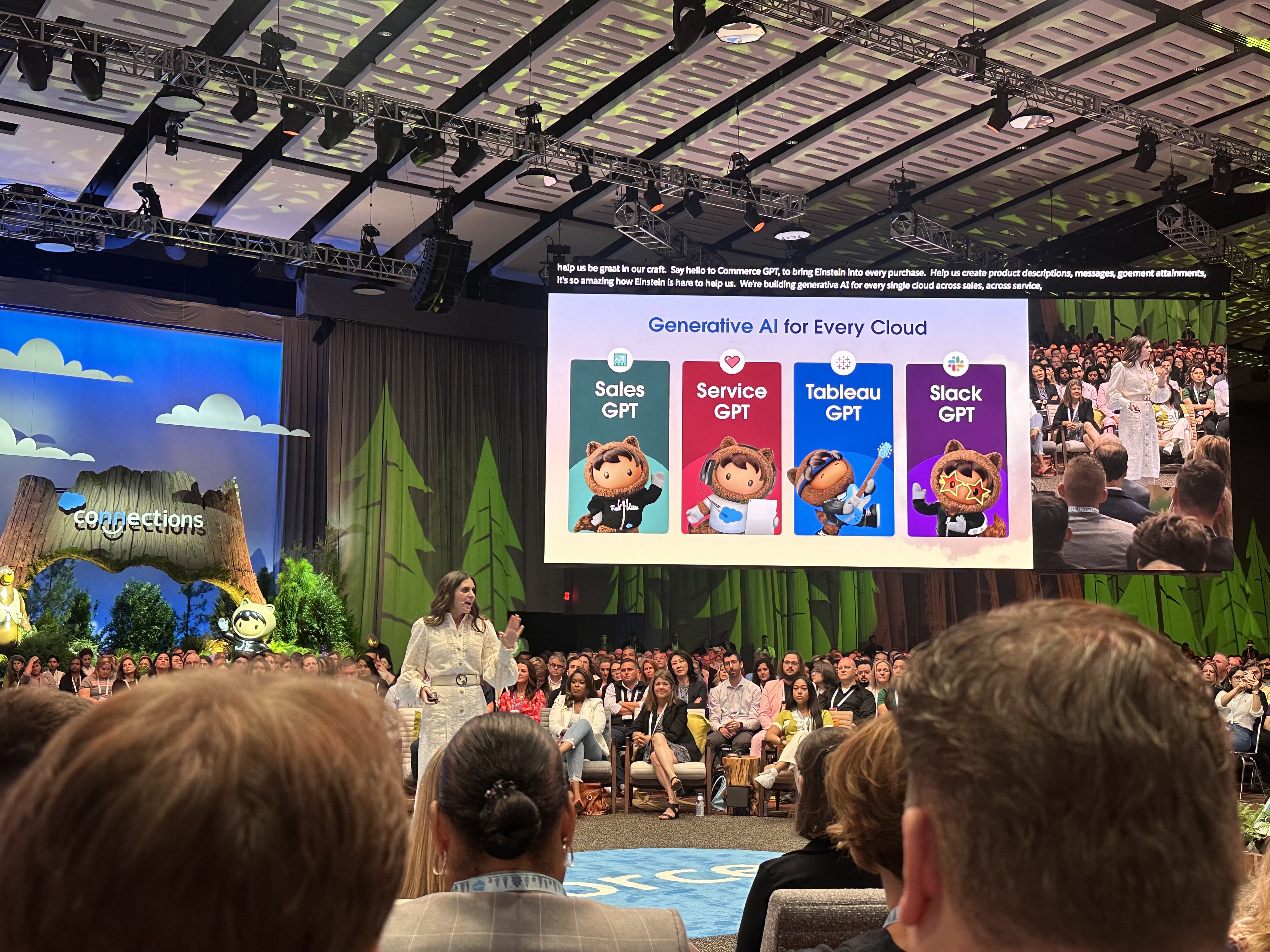
Slack GPT plans to integrate language models, summarize conversations, offer writing tips

Salesforce's Slack launched SlackGPT, its generative AI technology, that will enable customers to use the language model of choice, summarize conversations and offer writing tips.

According to Slack, Slack GPT will be able to use a series of models. For instance, Slack will be able to leverage OpenAI's ChatGPT or other partner apps, feature native AI and tap into Salesforce data via a new Einstein GPT app.

Generative AI guide: ChatGPT: Hype or the Future of Customer Experience

This approach reflects the reality that enterprises are likely to use multiple AI services as well as bots. While OpenAI ChatGPT has captured mindshare, there are a bevy of services for enterprises to consider as well as legacy investments.

Salesforce and Slack announced the news ahead of its New York World Tour stop.

Slack said:

“As the ecosystem of generative AI tools expands, flexibility will only become more important. Whether you build with clicks, code, or a bit of both, our open, extensible platform lets you decide when and how you bring AI into Slack.”

According to the company, generative AI should be incorporated into the way people work today. The Slack vision, which rhymes with what Microsoft is planning with its Co-Pilot initiative, is that generative AI will be built into your existing applications.

Slack said that Slack GPT can offer assistance to tweak drafts, adjust tone and distill content.

Future of Work Data to Decisions Innovation & Product-led Growth New C-Suite Sales Marketing Next-Generation Customer Experience Digital Safety, Privacy & Cybersecurity Tech Optimization AI GenerativeAI ML Machine Learning LLMs Agentic AI Analytics Automation Disruptive Technology Chief Information Officer Chief Executive Officer Chief Technology Officer Chief AI Officer Chief Data Officer Chief Analytics Officer Chief Information Security Officer Chief Product Officer