
Meta raised its capital spending outlook for 2025 as it throws money at AI researchers as it chases superintelligence.
The good news for Meta is that it can afford the spending spree.
CEO Mark Zuckerberg riffed on superintelligence and barely defined the term. One thing is clear: Meta has the resources to make a big bet on superintelligence.
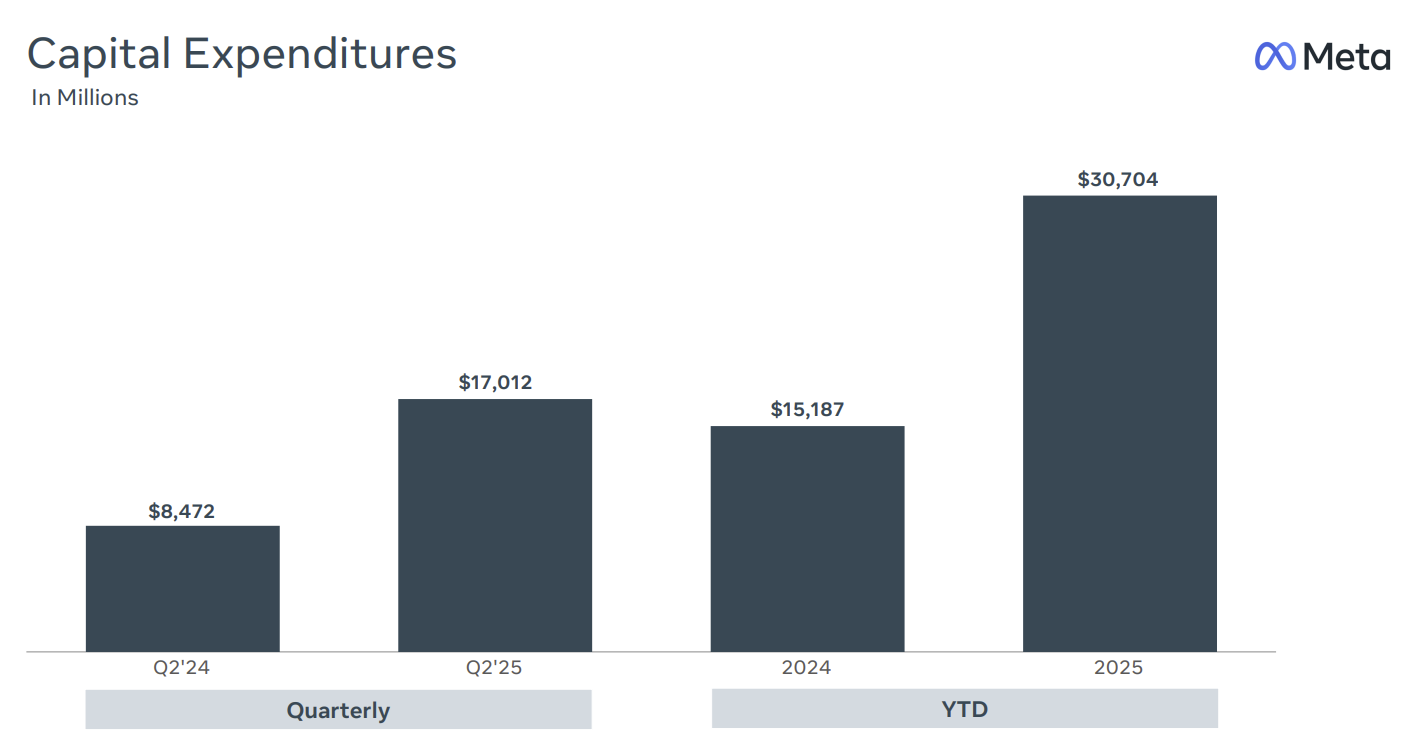
Meta said its 2025 capital expenses will be $66 billion to $72 billion. That range is narrowed down from the previous $64 billion to $72 billion range. At the midpoint, capital expenditures in 2025 will be $30 billion higher than a year ago.
The Meta second quarter earnings report landed as Zuckerberg outlined a vision for superintelligence that is personal to individuals, likely powered by smart glasses and definitely not open source.
- Meta ups its 2025 spending on AI, data centers
- Here's why Meta is spending $35 billion to $40 billion on AI infrastructure, roadmap
- Meta Superintelligence Labs: A look of the challenges ahead
- The problem with Meta chasing superintelligence
Zuckerberg said:
"Personal devices like glasses that understand our context because they can see what we see, hear what we hear, and interact with us throughout the day will become our primary computing devices.
We believe the benefits of superintelligence should be shared with the world as broadly as possible. That said, superintelligence will raise novel safety concerns. We'll need to be rigorous about mitigating these risks and careful about what we choose to open source. Still, we believe that building a free society requires that we aim to empower people as much as possible."
Zuckerberg also noted that Meta has the resources to deliver on superintelligence. And you can't argue that point.
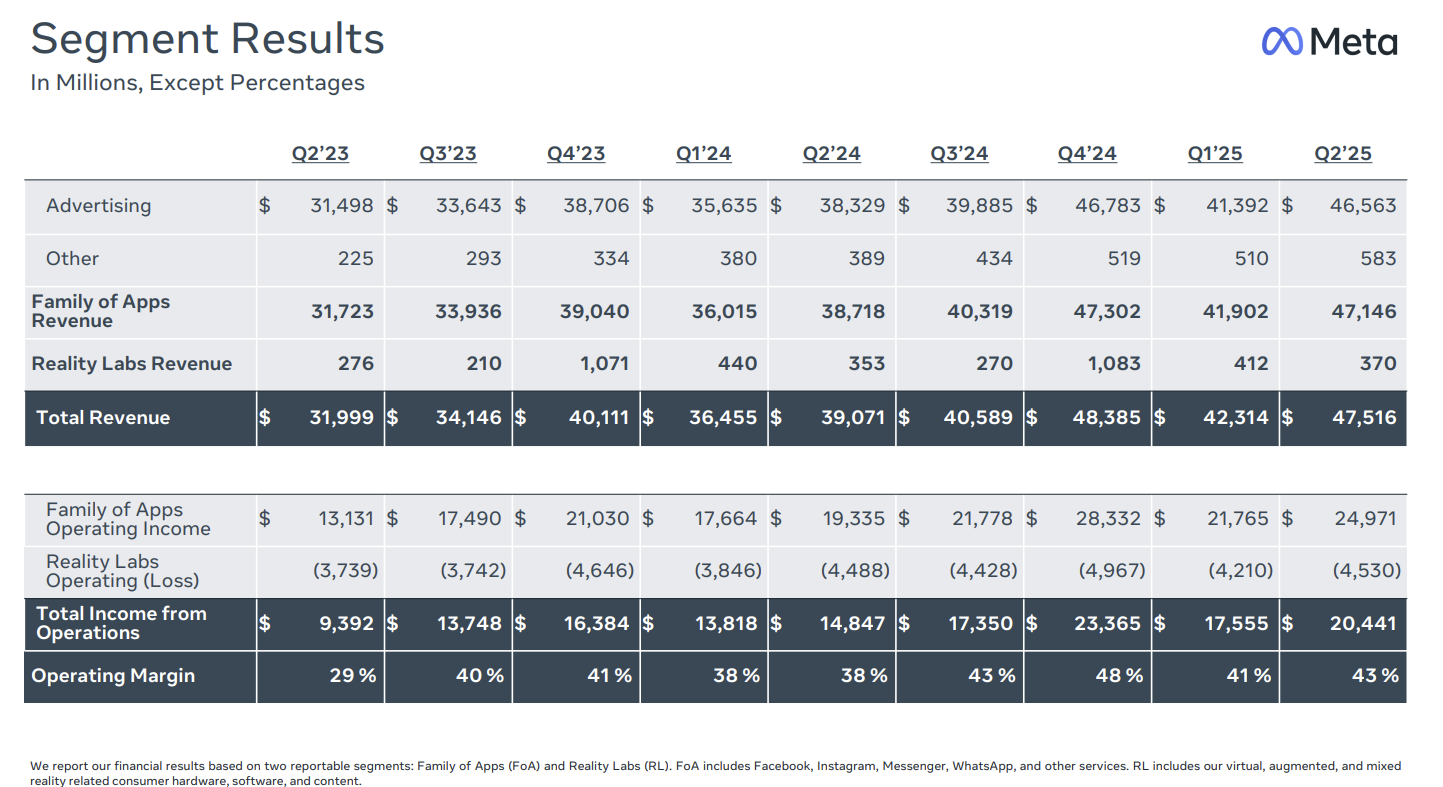
In the second quarter, Meta delivered net income of $18.34 billion, or $7.14 a share, on revenue of $47.52 billion, up 22% a year ago. Wall Street was looking for second quarter earnings of $5.92 a share on revenue of $44.8 billion.
The key numbers:
- Daily active people across Meta properties were 3.48 billion on average for June, up 6% from a year ago.
- Average price per ad was up 9%.
- Meta had 75,945 employees as of June 30.
- Reality Labs lost $4.53 billion in the second quarter.
As for the outlook, Meta is projecting third quarter revenue of $47.5 billion to $50.5 billion. The company said it is early in the planning process for 2026, but expenses will be higher due to infrastructure costs. The second biggest expense driver will be employee compensation for technical talent.
Constellation Research analyst Holger Mueller said:
"Meta is growing nicely and funding what Zuckerberg' superintelligence" efforts. While the previous focus on metaverse was a defensive move. What is clear is that AI has not hurt Meta - with ad impressions and average price per ad growing up. The question will be: How many Zuckerberg ambitions can the Meta business find? We will know soon."
Zuckerberg said the following on Meta's earnings conference call:
- "I've spent a lot of time building this team this quarter. And the reason that so many people are excited to join is because Meta has all of the ingredients that are required to build leading models and deliver them to billions of people. The people who are joining us are going to have access to unparalleled compute as we build out several multi-gigawatt clusters. Our Prometheus cluster is coming online next year, and we think it's going to be the world's first gigawatt-plus cluster. We're also building out Hyperion, which will be able to scale up to 5 gigawatts over several years, and we have multiple more titan clusters in development as well. We are making all these investments because we have conviction that superintelligence is going to improve every aspect of what we do."
- "AI is significantly improving our ability to show people content that they're going to find interesting and useful. Advancements in our recommendation systems have improved quality so much that it has led to a 5% increase in time spent on Facebook and 6% on Instagram, just this quarter."
- "For developing superintelligence, you're not just going to be learning from people because you're trying to build something that is fundamentally smarter than people. So it's going to need to learn how to -- or you're going to need to develop a way for it to be able to improve itself."
- "For the leading research on superintelligence, you really want the smallest group that can hold the whole thing in their head."


