


Google's Gemini models reportedly hacked three companies in a test, but the incident wasn't disclosed since the LLMs stopped when they were hacking real companies. Here's The Wall Street Journal story.
September 20, 2026 4:28:37 AM




Google's Gemini models reportedly hacked three companies in a test, but the incident wasn't disclosed since the LLMs stopped when they were hacking real companies. Here's The Wall Street Journal story.
CoreWeave said it has established an at-the-market (ATM) offering program that'll enable it to sell up to 35 million shares to raise money. The ATM program "is being established to provide ongoing financing flexibility and to support CoreWeave’s objective of migrating its enterprise credit profile toward investment grade."
In addition, CoreWeave said it will seek to raise $3 billion in convertible bonds due 2033.
Along with the fundraising, CoreWeave said compute capacity prices are moving higher. The company said it has signed short-term customer contracts ranging from three to six months at a price of $40 million per megawatt.
More:
Generac said it has inked a deal with Amazon for backup power at its data centers. Under the deal, Amazon will have the option to acquire nearly 1.7 million shares of Generac at $200.9266. Generac will provide up to $8 billion in backup power generators. Initial deliveries of backup generators are expected to total $2.4 billion in 2027 and 2028.
Anthropic merged Claude chat and Cowork and added new tools for making presentations and documents. The company rolled out Claude Docs and Claude Slides and Claude Design now works inside conversations. The company said it will roll the updates to Pro and Max plans first and then other accounts.
Cohere and Aleph Alpha signed their merger agreement officially and said they will remain deeply rooted in Canada and Germany. The new company is focused on sovereign AI and being a transatlantic counterweight to US frontier AI labs. The company will operate globally as Cohere.
According to The Information, Apple has been working on plans for an enterprise server using its own chips that could incorporate networking equipment from Nvidia. The move makes some sense given Apple's popularity with AI developers.
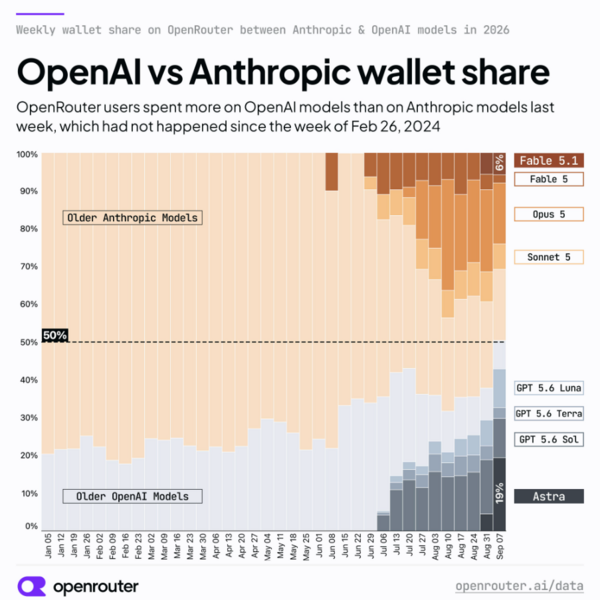
OpenRouter said its users spent more on OpenAI models over Anthropic's models. OpenAI hasn't led Anthropic on OpenRouter for 2.5 years.
Meta CEO Mark Zuckerberg penned a missive on AI regulation that boiled down to this: Frontier labs need to get it together. In an X post that rhymed with the take from Nvidia CEO Jensen Huang, Zuckerberg said:
"Meta delayed shipping Muse for several months to focus on safety and security. We didn't call for everyone else to do this before we would. We just did it as part of our day-to-day work because it was clearly the right thing for people and for us. I'm proud of the security foundations we've built."
I'll suspend disbelief that this is coming from a guy who made all of his money addicting people to social media, but he has a point.
See: Anthropic CEO Amodei: Think of AI safety like car safety
Amazon Web Services said it can't restore services to its cloud facilities in Bahrain and parts of the UAE. The data centers were hit in the US-Iran war in March. The company posted the update on its Health Dashboard in the first comments since April.
Mayo Clinic and Thermo Fisher Scientific launched Precure LLC to create a leading biomedical rsearch dataset to idenfify early biological signals of disease. The dataset will integrate proteomic, genomic and longitudinal clinical data.
The goal is to use the dataset to develop treatments for diseases well before they are diagnosed. Mayo Clinic will be the majority shareholder.
Google launched Gemini 3.8 Live and 3.8 Live Extended Thinking, which represent the company's most advanced live dialogue models. The upgrades are designed to make it easier to collaborate and carry out advanced tasks with voice.
An EY survey found that 47% of enterprises have not applied its AI governance processes for urgent deployments even though 98% of them have policies in place. In addition, EYU found that agentic AI is creating new governance challenges with 26% of respondents saying they can't detect unauthorized agents operating internally.