


Google Cloud Next 2026: A look at the big themes
Agentic AI is shifting from experimental to production in enterprises and Google Cloud is touting its integrated AI stack including next-gen TPUs, data platform and agent layer. To go along with those moves, Google Cloud is building its ecosystem and ground game to target industries and use cases.
With Google Cloud Next 2026 in the books, here’s a look at the big themes.
Google Cloud wants to be the Apple of enterprise AI
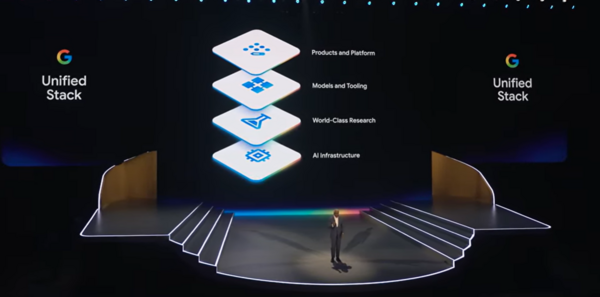
Google Cloud's big message was that its integrated AI stack can drive results. Sure, the latest TPUs are at the core, but there's the networking, the data cloud, the AI agent engine and apps and services. What Apple is to the consumer stack, Google wants to be for the enterprise AI stack and multiple talks revolved around the one Google approach and the flywheel between Google DeepMind, Google Cloud and other units.
- Google Cloud presses full-stack AI edge with new TPUs, Agentic Data Cloud, Gemini Enterprise Agent Platform
- Google Cloud CEO Kurian on AI model evolution, CPUs importance and being open
Think vertically integrated and optimized. The only twist is that Google Cloud is more open than Apple's walled garden.
Google Cloud is going after the likes of Snowflake and Databricks
The standardization of data on Apache Iceberg is putting the data layer in play. Google Cloud already has a bunch of parts--AlloyDB, BigQuery, Managed Service for Apache Spark and Spanner--but now has stacked them into its Agentic Data Cloud that includes a cross-cloud lakehouse and knowledge catalog. For good measure, Google Cloud has a set of migration tools aimed at Snowflake and Databricks.
In an analyst talk, Yasmeen Ahmad, Managing Director of Data Cloud at Google Cloud, said the company is positioning itself as a destination for doing AI and data together instead of separate stacks. AI agents require a rethinking of the data platform. "We don't see migration journeys being multiyear anymore," she said. "On average, we see a typical migration maybe takes about nine months or so. If you look at the average, especially cloud to cloud, much simpler, easier, faster."
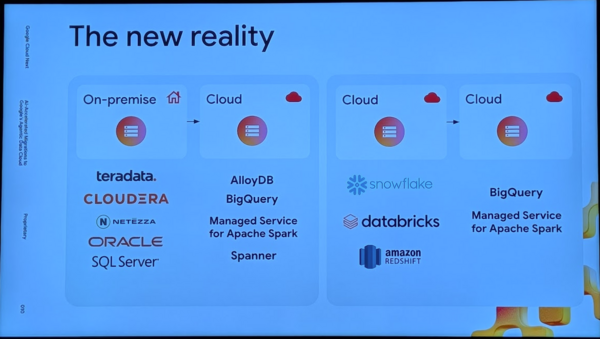
The launch of Google's Agentic Data Cloud serves as the first volley of a war of words, features and customers. Stay tuned since Snowflake and Databricks have conferences on deck.
The agentic AI customer base is more mature
The talk this year about agentic AI was way more meat and potatoes than the big dreams and pilots of 2025. There are still multiple gaps to fill in, but it wasn't hard to find real world customer stories. The core industries deploying agentic AI for Google Cloud are financial services, retail, healthcare and media and telco. That said it's notable that Google Cloud had some solid manufacturing references with GE Appliances and Tata Steel.
Google Cloud appears to be most dominant in retail, which isn't surprising given Gemini's ability to serve as a commerce agent and then close the marketing loop. Another factor: No retailer is going to be into AWS.
- Citigroup's wealth unit launches Citi Sky, a Google-powered wealth advisor
- The big picture behind Ask Macy’s, a Gemini powered AI agent
- Merck inks Google Cloud agentic AI deal worth up to $1 billion
Thomas Kurian, CEO of Google Cloud, featured customer quick hits throughout his Google Cloud Next 2026 keynote. A few highlights include:
- Honeywell uses Google Cloud and Gemini to generate millions of insights for building management and leverages digital twins and large product‑specification graphs.
- Walmart uses Gemini Enterprise and Google Cloud data to connect store and supply chain data to all enterprise data.
- Citadel partnered with Google Cloud to build a scalable research environment with TPUs. Workloads now run 2x to 4x faster at 30% lower cost. Citadel sees TPUs as a competitive edge for its quantitative research and model training.
- Virgin Media uses Knowledge Catalog and Gemini to activate more than 20,000 data assets that were previously dark.
- Costco uses BigQuery to accelerate member insights and helps associates optimize experiences.
- Home Depot uses Gemini Enterprise for Customer Experience to power "Magic Apron," a digital agent helps customers across the inspiration to research to shopping to doing continuum and increases conversion.
Add it up and Google Cloud Next 2024 introduced AI agents as a concept. Google Next 2025 featured experimentation and a more sandbox only approach. Google Cloud Next was more about production even though there’s a lot more development to be done.
Google’s Gemini Agent Platform creates a suite with multiple Google Cloud parts
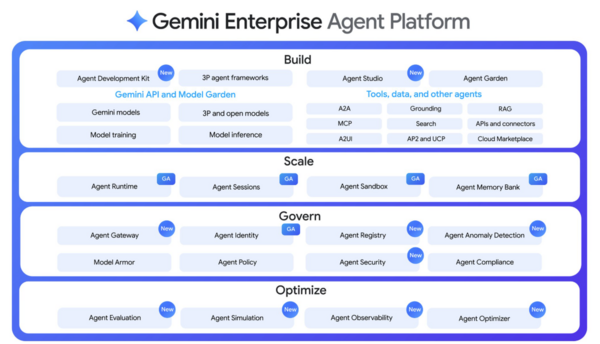
With last year's launch of Gemini Enterprise, Google Cloud was early in its efforts to become a platform to build, orchestrate and govern agents. At Google Cloud Next 2026, Gemini Enterprise Agent Platform has gone with more of a full-stack approach that includes systems connectivity, registries for skills, tools and agents, universal context, agent engine runtime, governance and marketplace.
Google Cloud is building its ground game
AI agents require forward deployed engineers, partners and integrators. Google Cloud is spending $750 million to develop its partner network for agentic AI as it announced a bevy of partnerships with integrators as well as enterprise software giants such as Salesforce and SAP.
The bottom line is Google Cloud is building out its ground game for AI agent deployment. Key announcements at Google Cloud Next include:
- Google Cloud will spend $750 million to accelerate customer deployments, AI prototyping and using Google FDEs.
- Deloitte launched a Google Cloud Agentic Transformation practice and Accenture expanded its Google Cloud efforts on agentic AI. BCG and Google Cloud also expanded a partnership as did McKinsey.
- Salesforce and Google Cloud said their agents will be able to collaborate with context and end-to-end workflows across their platforms. ServiceNow announced a similar deal and joint industry offerings with Google Cloud.
- SAP said Google Cloud outlined a multi-agent integration pact with Gemini Enterprise and SAP’s Joule agents. Customers can deploy Joule Agents in SAP CX Solutions to build, launch and optimize marketing campaigns. Gemini Enterprise acts as a central hub for agents to take action across SAP and Google Cloud platforms.
Google Cloud CEO Thomas Kurian said you can expect more industry-focused efforts with partners. "We started with customer experience and commerce," said Kurian. "You will see us operating in many more industries and domains. We continue to work with an open approach and not just at the product level, but also the new ecosystem. We will be massively expanding our field organization, our core technology engineering capability, and our forward deployed engineering."
Larry Dignan is Editor in Chief of Constellation Insights at Constellation Research, where he leads editorial coverage focused on enterprise technology, digital transformation, and emerging trends shaping the future of business. He oversees research-driven news, analysis, interviews, and event coverage designed to help technology buyers and vendors navigate complex markets with clarity and context. ...
Read morePublished
Author
