


AWS launches Amazon Quick, Connect family of business apps, OpenAI managed agents
Amazon Web Services moved into the business application market via its Amazon Quick AI agents and outlined plans to build Amazon Connect customer contact platform. AWS is planning to move into new applications markets including talent, supply chain and healthcare.
The company also launched Amazon Bedrock Managed Agents powered by OpenAI.
At the "What's Next with AWS" event in San Francisco, AWS CEO Matt Garman laid out a plan that moves the company up the stack with business applications. AWS has the infrastructure and multiple building blocks for enterprises, but to date has been light on business applications.
"What you see today is how people are thinking about AI and agents. Teams are thinking differently about workflows, applications, data, access patterns and how the UI changes," said Garman. "Customers are changing what is possible, iterating quickly and then inventing new processes. They're inventing every application and workflow out there."
Now Amazon is looking to solve for "the last mile of AI agents." What does AWS mean? In a nutshell, AWS is arguing the model is just a starting point and needs to be packaged and deployed as an agent. However, agents also need to be folded into applications for "last mile" usefulness. Amazon is diving into the business application and productivity market, but framing the effort as agent-first instead of suite first.
In recent years, Amazon has moved to put its services and building blocks together into suites such as Amazon Bedrock AgentCore, Amazon Quick Suite, AWS Security Hub and Amazon Connect, which is AWS' most successful offering. Simply put, the breadcrumbs for AWS' applications plans have been visible for roughly two years as part of a practical return driven approach to agentic AI.
AWS said it offers applications in areas where it can add value. At the core of its business applications efforts is Amazon Quick, which is generally available. Amazon Quick connects with enterprise applications, tools and data to move questions to outcomes.
Amazon Quick is a desktop companion that leverages multiple agents and a context graph based on various enterprise systems. Amazon Quick rhymes with Anthropic's Claude Cowork, but aims to be more proactive.
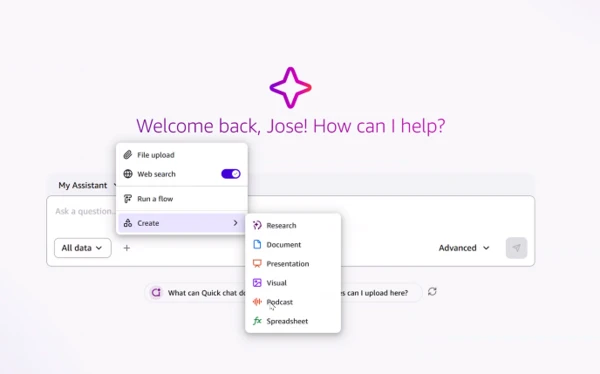
In addition, Amazon Quick has social sign-in and now integration with Google Workspace as well as Microsoft, native file formats, new application extensions, and more data connectors. Amazon Quick is a spin on what Anthropic Claude Cowork tries to do--connect applications and data with a natural language and abstract various enterprise systems.
During a briefing, AWS executives said Amazon Quick, which can be used by individuals and teams, is deployed by more than 500,000 users within Amazon. Amazon Quick is seen as an endpoint for Amazon Bedrock and Amazon AgentCore agents.
The company said Amazon Quick is deployed at enterprises such as AstraZeneca, NFL, Jabil, 3M, BMW and S&P Global. Amazon Quick is an AI assistant that can do research, uncover insights, chat with customizable agents, build a knowledge center, create workflows and automate end-to-end processes.
Amazon Quick is a component of a much broader portfolio of agentic applications. AWS rebranded Amazon Connect as a family of agentic AI applications focused on Customer AI, Decisions (supply chain), Talent (hiring) and Health.
The design approach to the Amazon Connect portfolio falls under humorphism, a philosophy that revolves around creating an interface that leans into the strength of AI agents and humans.
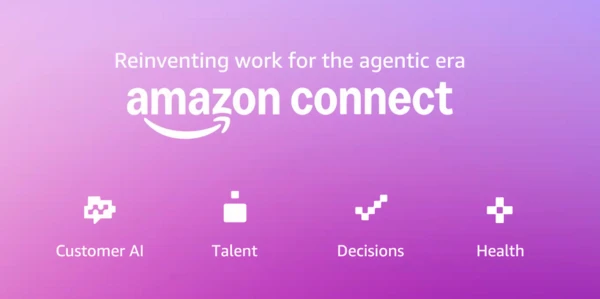
Colleen Aubrey SVP, Applied AI Solutions, said the Connect family interfaces were designed to be a helpful teammate. Aubrey said:
"No one needs a difficult teammate. So we don't need to do that. I need a teammate which is easy to work with. It's intuitive, it's trustworthy, and an agentic team that is always learning. And I need to be able to take this agentic capability and get the transformation in my business without the change management. No one needs to go on a two or three year change management sort of process."
AWS is designing its business apps to be intuitive and redesign work without requiring employees to learn something different. "It's a journey and we're just getting started," Aubrey said.
AWS launched the following:
Amazon Connect Customer, which is for contact centers and customer service orchestration. Amazon Connect Customer AI is the rebrand of Amazon Connect, which handles 20 million daily interaction and 12 billion minutes of customer conversations with AI in 2025.
Amazon Connect Talent, which leverages Amazon's core processes and knowhow in hiring employees at scale. Amazon's core business depends on scaling employees quickly in travel, contact centers, retail, hospitality and logistics and Amazon Connect Talent is focused on job requisition creation, voice interviews, assessments, evaluation and candidate scoring. The platform will also include AI-based interviews that can be schedule when a candidate is ready, something that Amazon said offers a more level playing field.
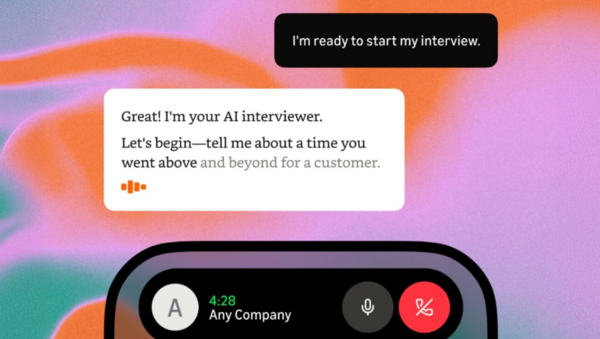
"It's good to see AWS entering the HCM market - as the other offerings - built on its in-house experience. Hiring 250,000 seasonal workers is not a bad reference and will attract attention from CHROs. Amazon Connect Talent is also the first offering that states that agents will autonomously schedule, call and interview candidates. The Talent Acquisition market just got a little more competitive," said Constellation Research analyst Holger Mueller.
Amazon Connect Decisions, an application focused on supply chain optimization and modeling that abstracts legacy systems.
AWS said Connect Decisions provides an agentic intelligence layer that integrates with existing systems and allows you to define what metrics to optimize and recommend ways to hit those goals. Connect Decisions is powered some of the models used in Amazon's own supply chain management systems and augments predictions with proprietary global data signals.
Amazon Connect Health, which leverages Amazon One Medical and Amazon Pharmacy processes and operational knowhow. Amazon Connect Health is an agentic AI platform for healthcare admin tasks such as patient scheduling and documentation and includes patient verification, medical coding, patient insights, and after-visit summaries.
Key points about Amazon Connect Health:
- Amazon Connect Health embeds AI agents into the electronic health record workflow to reduce clinician documentation.
- Documentation is a big use case since the average primary care physician spends two hours on documentation for every hour of patient care.
- By embedding AI agents inside of existing systems, clinicians won't have to change workflows.
- Amazon Connect Health has been used at One Medical for more than 1 million visits with regular weekly usage.
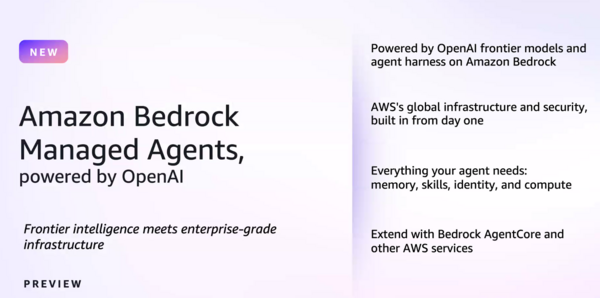
To round out the business application push, AWS also outlined Amazon Bedrock Managed Agents powered by OpenAI, which is in preview. Amazon Bedrock Managed Agents powered by OpenAI landed a day after OpenAI retooled its partnership with Microsoft so it can expand to more clouds.
- OpenAI inks $38 billion deal with AWS, starts renting GPUs immediately
- Amazon, OpenAI forge multi-faceted partnership: Dissecting the deal
"Customers have asked us, 'how can we get OpenAI models inside of AWS?' That's really what they want. And so this partnership is bringing those two together," said Garman. "It's not just bringing the OpenAI models, but it's innovating together and building new capabilities."
Key points about Amazon Bedrock Managed Agents include:
- The system is powered by OpenAI frontier models and agent harness on Amazon Bedrock built on AWS infrastructure.
- Amazon Bedrock Managed Agents has memory, skills, identity, and compute to power AI agents.
- The platform can be extended with Bedrock AgentCore and other AWS services.
- Amazon Bedrock Managed Agents has three steps to configure agentic applications: Create environment with compute, storage network policies, identity and tools with MCP servers; create runtime with instruction, skills and memory; and submit a task that leverages an application AI to get results, chain responses and stream real-time data.
How does Amazon Bedrock Managed Agents powered by OpenAI compare to Amazon AgentCore? The former is a way to get OpenAI-powered agents to market and the latter is model and framework agnostic. AWS said OpenAI models will be included in Amazon Bedrock following the AI lab's new deal with Microsoft.
Constellation Research’s point of view
Constellation Research analyst Liz Miller said:
“These announcements are two things all at once: Amazon sharing its own hard won best practices in managing its own business from how service is delivered in the contact center to how to digitally manage the madness supply chains. Amazon Connect as a portfolio is evolving and showcasing how Amazon the business has leveraged AWS.
What I find most intriguing about the initial core areas where Amazon Connect has grown is that in each case, these complex operations are all being connected and aligned thanks to an end-to-end communications and engagement layer that almost feels like a Communications Platform as a Service (CPaaS) that is inextricably tied to data and AI.
These moves are more about stepping away from traditional solutions that have looked at the assets, the products, the people or the old processes and tried to resolve key issues by random acts of automation across functional units. The Amazon Connect approach shifts attention away from those traditional functionally focused strategies and instead looks at where and how communication, engagement and automation connect and accelerate operations. It is less focused on how to get people in and out of the way. It is far more focused on automating those points of engagement that often get lost on the path to optimization and instead of looking as if it was a problem in need of a solution.”
Larry Dignan is Editor in Chief of Constellation Insights at Constellation Research, where he leads editorial coverage focused on enterprise technology, digital transformation, and emerging trends shaping the future of business. He oversees research-driven news, analysis, interviews, and event coverage designed to help technology buyers and vendors navigate complex markets with clarity and context. ...
Read morePublished
Author
