


OpenAI goes multi-cloud in amended deal with Microsoft
OpenAI said it has reworked its partnership with Microsoft so it can "now serve all of its products to customers across any cloud provider."
In other words, OpenAI's models and services will be coming to an AWS Trainium chip or Google Cloud TPU near you. OpenAI said in a blog post that Microsoft remains its primary cloud provider and its products will ship on Azure first unless Microsoft doesn't support them.
OpenAI also said that Microsoft will continue to have a license to its IP for models and products through 2032. Now Microsoft's license will be non-exclusive and the software and cloud giant won't pay a revenue share.
The latest amendment on the OpenAI-Microsoft is the latest chapter in what at the very least will be an interesting business school case study. Perhaps the partnership becomes a movie.
- Microsoft owns 27% of OpenAI worth $135 billion
- OpenAI, Microsoft reach an understanding of something as AI harmony awaits
- OpenAI vs. Microsoft: Why a breakup could be good
- OpenAI and Microsoft: Symbiotic or future frenemies?
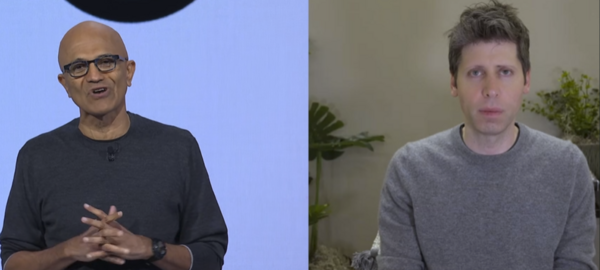
According to OpenAI, the company will continue to pay a revenue share to Microsoft through 2030 independent of how the AI lab progresses toward AGI. Microsoft will remain a shareholder. OpenAI said:
"While this amendment simplifies the partnership, the work we’re doing together remains ambitious. From scaling gigawatts of new datacenter capacity, to collaborating on next- generation silicon, to applying AI to advance cybersecurity, and more, we’re excited to keep partnering to advance and scale AI for people and organizations around the world."
In the end, OpenAI and Microsoft are unraveling a partnership that gave both companies a running start in generative AI, but is starting to limit both. Simply put, the OpenAI-Microsoft symbiotic partnership has run its course and now is more limiting to both sides. OpenAI won't be able to effectively compete with Anthropic if it has its models mostly available on one cloud. Anthropic has all three clouds in play and runs on Nvidia and custom silicon and now OpenAI will.
- OpenAI inks $38 billion deal with AWS, starts renting GPUs immediately
- Amazon, OpenAI forge multi-faceted partnership: Dissecting the deal
Constellation Research analyst Holger Mueller said:
"Microsoft and OpenAI separate each other to a point, which gives both partners more flexibility. The capped revenue share may hurt OpenAI down the road, and gives Microsoft a way to not overpay for OpenAI after all of its investments. For OpenAI, the revised deal also signals a potential loss of support from Microsoft and more enterprise exposure--something that Microsoft is uniquely positioned to provide."
Larry Dignan is Editor in Chief of Constellation Insights at Constellation Research, where he leads editorial coverage focused on enterprise technology, digital transformation, and emerging trends shaping the future of business. He oversees research-driven news, analysis, interviews, and event coverage designed to help technology buyers and vendors navigate complex markets with clarity and context. ...
Read morePublished
Author
