
Anthropic released research that aims to be an early warning job loss detection system for AI-related job losses. The company is looking to close the gap between perceived job losses and what's actually happening with AI usage. It's worth a read.
Anthropic CEO Dario Amodei posted an update on where things stand with the Department of War. In a nutshell:
"Our most important priority right now is making sure that our warfighters and national security experts are not deprived of important tools in the middle of major combat operations. Anthropic will provide our models to the Department of War and national security community, at nominal cost and with continuing support from our engineers, for as long as is necessary to make that transition, and for as long as we are permitted to do so."
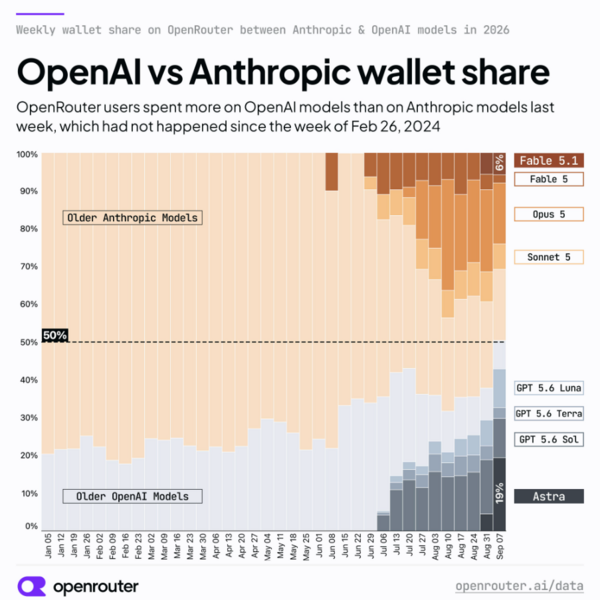
OpenAi releases GPT-5.4 with improvements designed for professional work, better reasoning and computer use built in. Details are here but big picture is OpenAi wants to steal some Anthropic buzz back.
The big AI infrastructure spenders including Google, Microsoft, Meta, Amazon, OpenAI and others signed a pledge at the White House to pick up the tab for new data center electric bills. The catch? Bloomberg reports that local utilities and states will enforce the pledge, but there aren't penalties if AI giants don't comply.
Apple launched MacBook Neo, a budget MacBook that comes in four colors and starts at $599. With the move, Apple is taking aim at Chromebook and low-priced Microsoft Windows PCs. Apple is departing from its usual approach but the logic behind Neo is solid. Apple can get people to eventually trade up to more expensive MacBooks and now it has a MacBook to ride along with the iPhone 17e. After all, the goal for Apple is to get you in the ecosystem and keep you there.
MacBook Neo has two USB-C ports, 256GB of storage to start and is powered by A18 Pro chip used in the iPhone.
Perplexity will run its AI inference workloads on CoreWeave Cloud. The companies have a multi-year partnership to pilot new services.
Under the agreement, Perplexity will use CoreWeave's platform and Nvidia GB200 NVL72-powered clusters. CoreWeave will use Perplexity Enterprise Max across its org for knowledge sharing, research and analysis.
GitLab reported a better-than-expected fourth quarter, mixed outlook and said it sees "multi-year growth drivers with GitLab Duo Agent Platform and hybrid pricing."
The company reported a fourth quarter net loss of $2.6 million, or 2 cents a share, on revenue of $260.4 million, up 23% from a year ago. Non-GAAP earnings were 31 cents a share. GitLab's annual recurring revenue now tops $1 billion.
As for the outlook, GitLab projected first quarter revenue of $253 million to $255 million with non-GAAP earnings of 20 cents a share to 21 cents a share, slightly above estimates.
For fiscal 2027, GitLab projected revenue of $1.1 billion to $1.12 billion with non-GAAP earnings of 76 cents a share to 80 cents a share, well below the $1.03 expected.
CEO William Staples said:
"Investor uncertainty is understandably high. When every developer has access to the same models, code generation becomes a commodity. The bottleneck shifts to everything after the code, reviews, security, pipelines, compliance, deployment. That's precisely where we live. And that position gets harder to replicate as AI proliferates. Some of our customers already carry decades of technical debt, thousands of repositories and compliance obligations tied to policies written years ago.
GitLab holds all of that context, history, ownership, risk, intent, it's all getting indexed and connected across the software life cycle. In the world of autonomous agents, context is the difference between useful action and a potentially catastrophic one."
GitLab is on the following Shortlists:
OpenAI released GPT 5.3-Instant, which is designed to respond faster and offer more context when searching the web. GPT Instant is OpenAI's most used model.
Akamai said it has acquired thousands of Nvidia Blackwell GPUs as it builds out its AI inference network. Akamai recently launched its Akamai Inference Cloud.
Google launched Gemini 3.1 Flash-Lite, which is built for high-volume workloads that need to be cost efficient. The new model will roll out in preview via the Gemini API in Google AI Studio and Vertex AI. Last week, Google launched Gemini 3.1 Pro. These models are the warm-up act for whatever LLM news is announced at Google Cloud Next in April and Google I/O in May.
Apple's week of product refreshes continues. The company refreshed its MacBook Pro line with its M5 Pro and M5 Max processors. Apple said the systems have four times faster prompt processing, twice the SSD speeds and 1TB to 2TB storage.
The 14-inch MacBook Pro with M5 Pro will start at $2,199 and the 16-inch MacBook Pro with M5 Pro starts at $2,699.
Accenture said it will buy Ookla from Ziff Davis for $1.2 billion. It's not often that a media company and a consulting firm swap properties. Ookla, which for now is part of Ziff Davis' connectivity unit, includes Speedtest, Downdetector, Ekahau and RootMetrics. Accenture's plan is to leverage the data and technology from those brands to "help Communications Service Providers (CSPs), hyperscalers, and enterprises optimize the mission-critical Wi-Fi and 5G networks that power their digital core."
In a statement, Accenture said the insights from the network, device and applications are critical in the AI era. "Without the ability to measure performance, organizations cannot optimize experience, revenue, or security. By acquiring Ookla, we will help our clients across business and government scale AI safely and build the trusted data foundations they need to deliver the reliable, seamless connectivity that creates value," said Accenture CEO Julie Sweet.
Ookla had $231 million in revenue in 2025, according to Ziff Davis.