


Google Cloud CEO Kurian on AI model evolution, CPUs importance and being open
Google Cloud CEO Thomas Kurian riffed on being open, enterprise AI adoption, measuring success and why CPUs matter. He also teased the next evolution of Google Gemini models at Google I/O.
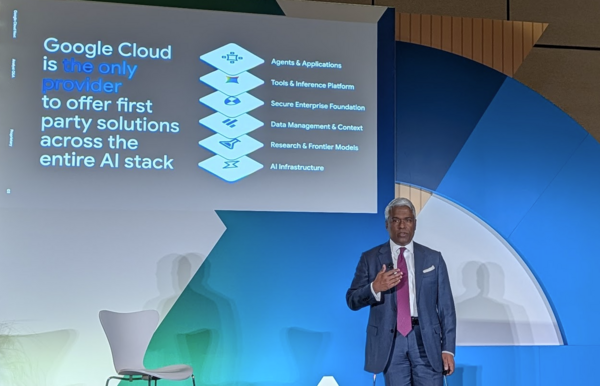
Speaking at an industry analyst Q&A at Google Cloud Next 2026, Kurian outlined the following on Google Cloud’s strategy and the broader industry.
Google Cloud Next 2026:
- Google Cloud presses full-stack AI edge with new TPUs, Agentic Data Cloud, Gemini Enterprise Agent Platform
- Citigroup's wealth unit launches Citi Sky, a Google-powered wealth advisor
- The big picture behind Ask Macy’s, a Gemini powered AI agent
- Merck inks Google Cloud agentic AI deal worth up to $1 billion
What's success for Google Cloud? "We look at the long-term technical problems we're solving customer by customer," said Kurian. "We always measure the input. In December we were at 10 billion tokens a minute just for enterprise customers. Now we're at 16 billion as of the end of March."
He added:
"We always look at fundamental long-term problems. Our long-term approach is to completely solve the problem operating in the cloud. We always measure success so we're not always looking at the horizon, but also measuring practical adoption and success. We're also trying to balance the short term and long term."
AI's impact on the enterprise. "We believe industries and companies will adopt AI to solve problems. Can you take a capability that was restricted and now serve a broader market and serve the long tail," said Kurian. "Can I differentiate with time to market? Can I change the cost curve in my industry? We give them the infrastructure and ability to differentiate."
Co-opetiton. Kurian was asked about whether Anthropic is a partner or foe. Kurian said:
"As a platform company, you choose where you compete and where you collaborate and you'll see us continue to do that. The one thing that's for sure is for the long term, you want to continue to invest at scale with models and create infrastructure to generate sufficient revenue to fund that investment and do that with the maximum diversity of revenue. At Google we can sell chips, we can sell models, we can sell an agent platform. We can sell subscription services. We can sell identity tools, security, and advertising all based on the use of these models. We're very confident in our strategy."
What does Google Cloud mean when it says it is open? Kurian said customers can use TPUs or Nvidia and there are model choices and there are multiple forms of being open.
"We have choices on the model layer. There's a whole range of open. We don't expect the customer to say, I'm taking everything from Google," said Kurian. "We proactively integrate our technology deeply into the ecosystem, and so we provide connectors out of the box. There's a variety of things that we're doing to enable you to connect our platform with the complexity that enterprises typically have. We do work with software companies so agents can be exposed in Gemini Enterprise Agent Platform. These platforms are moving extremely quickly, so we're investing continuously for us only us only means all of these different elements."
Kurian said CPUs are critical to inference workloads. He outlined why Google Cloud has eighth generation TPUs for inference as well as training and said CPUs will play a big role. "We continue to work super closely on the evolution of CPUs," he said. "The mass CPU becomes a very important part of the inference equation. We are working on our own ARM processor."
Google I/O will feature "a lot more on the evolution of models." Kurian said models are evolving due to AI agents and stay tuned.
Apache Iceberg is enabling zero-copy data sharing across all of the clouds. Kurian outlined Google Agentic Data Cloud and said zero copy is enabling new use cases and use Google Cloud as the compute engine. "You can analyze all the information no matter where it is stored because of the zero copy that allows the customer to use Google and look up anything that supports Iceberg," he said.
Expect more domains and industry efforts from Google Cloud. "We started with customer experience and commerce," said Kurian. "You will see us operating in many more industries and domains. We continue to work with an open approach and not just at the product level, but also the new ecosystem. We will be massively expanding our field organization, our core technology engineering capability, and our forward deployed engineering."
Larry Dignan is Editor in Chief of Constellation Insights at Constellation Research, where he leads editorial coverage focused on enterprise technology, digital transformation, and emerging trends shaping the future of business. He oversees research-driven news, analysis, interviews, and event coverage designed to help technology buyers and vendors navigate complex markets with clarity and context. ...
Read morePublished
Author
