


For AI agents to work, focus on business outcomes, ROI not technology
The IT department is where agentic AI goes to die--or at least never make it out of proof of concept. Agentic AI needs to be driven by outcomes, returns and benefits to the business instead of technology.
 That's a big takeaway from Boomi's Chris Hallenbeck, SVP and GM of AI & Platform
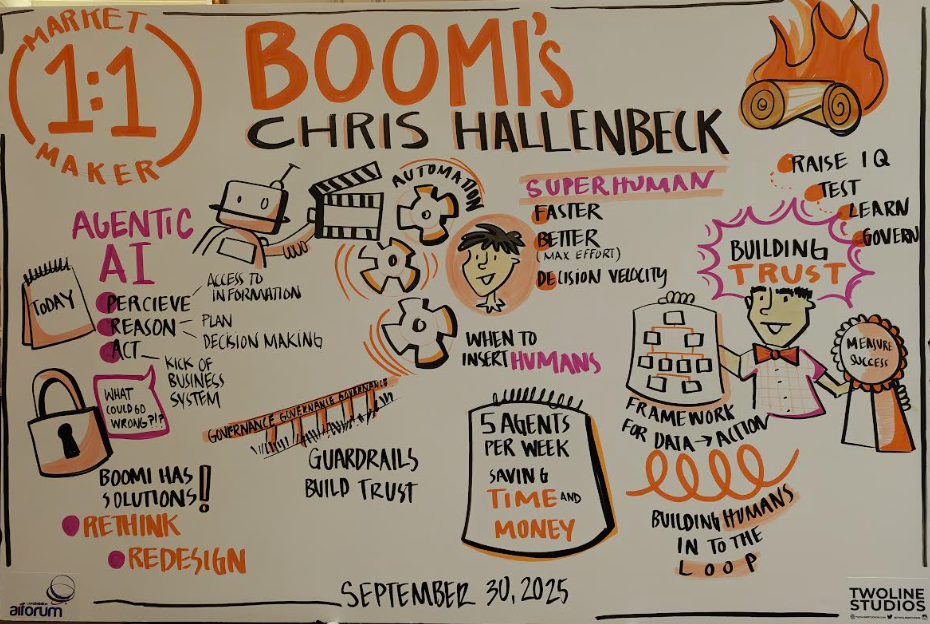
Boomi. Hallenbeck (right), speaking at Constellation Research's AI Forum in Washington DC, said that enterprise agentic AI is a work in progress and enterprises are still wrestling with defining the technology.
"Less than 5% of companies know what agentic AI is," said Hallenbeck, who said an AI agent is one that can perceive, reason and act. "Agents are more than conversations and within a corporate sense, they need access to my data, CRM, financial systems, HR and databases to proceed. To reason you have to give it oerating procedures."
- Boomi World 2025: Lessons From Early AI Agent Efforts So Far
- Boomi acquires Thru, makes case for AI orchestration, automation platform
- Boomi World 2025: Agentstudio, AWS pact, 33,000 AI agents deployed
- Boomi launches AI Studio, makes its move on AI agent orchestration
In other words, process matters as does frameworks for governance, observability and security as well as audit trails. "Without those systems and guardrails nothing gets out of POC to production," said Hallenbeck.
Too often, the business impact is getting lost in agentic AI use cases as enterprises focus on technology over outcomes.
"If AI is being pushed into IT with a focus on code and libraries, those systems don't go live," said Hallenbeck. "You can get to POC, but it's not going to scale up to enterprise class. Folks are having a lot of fun, but if they're not dead focused on business impact it's not going live. How can I deploy a project from idea to actual positive business impact is important. It's completely doable, but you just can push it down to a CoE (center of excellence)."
That CoE approach raises the costs and leads to scope creep where enterprises are trying a big bang approach to AI agents, said Hallenbeck. "If you keep going after bigger and bigger projects the business is going to say it doesn't want to pay for it because the hurdle rate is huge," he said.
What's the approach that works for AI agents?
Hallenbeck cited one customer that took two days and built an agent to save $50,000. That's $50,000 saved in two days’ work. You scale and learn by saving one problem at a time.
"Enterprises are going after reducing costs and reducing risk and looking where they can have a higher impact on revenue and other places," said Hallenbeck, who cited one customer that used agents to insource a process and saved 27,000 hours.
Other takeaways from Hallenbeck:
- Processes. Enterprises are automating processes with AI agents, but then need to think through the overall process. "What if you rethought the entire process looking at it from an agentic perspective. Redesign it," said Hallenbeck.
- Raising the AI IQ. To drive business impact enterprises need to focus on raising the AI IQ across the workforce.
- The next phase for agentic AI in 2026 is going to be verticalized use cases.
- Agentic AI is still in early innings due to tooling, the need for situational awareness and standards.
More on AI agents:
- Anthropic, Microsoft, OpenAI build out AI agent use cases
- Accenture: Enterprise AI deployments hit inflection point
- AI agents, automation, process mining starting to converge
- Cognizant CEO Kumar: Agentic AI will create a reinforcing flywheel of ROI
- Pondering the future of enterprise software
- Lessons from early AI agent efforts so far
- Every vendor wants to be your AI agent orchestrator: Here's how you pick
Larry Dignan is Editor in Chief of Constellation Insights at Constellation Research, where he leads editorial coverage focused on enterprise technology, digital transformation, and emerging trends shaping the future of business. He oversees research-driven news, analysis, interviews, and event coverage designed to help technology buyers and vendors navigate complex markets with clarity and context. ...
Read morePublished
Author
