Results

Apple WWDC 2023: Can Vision Pro headset jump start AR, VR, metaverse for business?

Apple WWDC 2023: Can Vision Pro headset jump start AR, VR, metaverse for business?

Media Name: visionpro price.png

Apple launched its $3,499 Vision Pro extended reality headset with its VisionOS software, its first new software platform since watchOS launched with the Apple Watch in 2015. The core pitch: Vision Pro can be a hybrid work and collaboration tool. Vision Pro is available early next year. 

"This is a day that has been years in the making. Augmented reality is a profound technology," said Apple CEO Tim Cook. "It's the first Apple product you look through, not at."

Vision Pro will include immersive media consumption, MacOS integration, and outward-facing cameras so users can see people around them. Apple's Vision Pro will also have its own App Store to enable gaming, watching sports and media and fitness and meditation. 

A toggle similar to the Digital Crown will enable users to switch between AR and VR modes. Enterprise use cases may revolve around FaceTime, which will have a VR version, and productivity features for Apple's Keynote, Pages and Numbers software.

As for the hardware, Apple Vision Pro has Apple's M2 chip, but further specifications weren't disclosed during the WWDC keynote or on Apple's product page. Vision Pro has a sleek design, but there are a bevy of compromises including an external battery pack, which provides about 2 hours of power similar to HTC's Vive Pro. When plugged in, Vision Pro can run all day. Among the takeaways from Apple's WWDC keynote:

  • Cook said Vision Pro will usher in the era of spatial computing. 
  • One of the first use cases shown for Vision Pro was for work. Apple showed office, remote and collaboration use cases. 
  • Microsoft productivity apps will be ready for Vision Pro as will Zoom and Cisco WebEx.

  • Unity apps will also work with Apple Vision Pro.
  • Developers can use Reality Composer Pro, which works with existing Apple frameworks in iOS and MacOS. 
  • Of course, there were consumer use cases as Disney outlined a few sports, movie and entertainment scenarios. Think Disney World and Marvel via Vision Pro.  Disney+ will be available at launch. 
  • When you open Vision Pro you see your apps in your physical space to create presence. 
  • There are no hand controllers because Vision Pro has eye tracking and hand tracking. 
  • Iris scanner can be used for security via Optic ID. Vision Pro will also mask where you look from apps. Camera data is processed at a system level. 
  • Apple said it focused on a glass device with wearability via a modular design for a precise fit and included flexible straps. 
  • Vision Pro can connect to Apple Watch, iPhone and iPad.
  • In addition to an M2 chip, Apple included R1, a processor to eliminate lag and process real-time data from sensors and 12 cameras. M2 offers performance. R1 ensures experience quality. 
  • Siri is the voice interface. 

Like Apple's other product lines, you can expect new Vision Pro units at lower price points as well as one that's business-friendly.

“This is the next generation of computing and how developers respond to the launch will determine how robust the ecosystem will be for Apple,” said R “Ray” Wang, CEO of Constellation Research.

What's unknown is whether Apple's ecosystem leverage can make AR, VR and the metaverse more of an enterprise staple. The metaverse was a big theme in 2022 but has taken an enterprise back seat to generative AI, optimization efforts and automation.

The competition for enterprise use cases

Apple's vertically integrated approach with hardware and software has gained enterprise traction with its Mac, iPhone and iPad lineup and the software that powers it. Augmented and virtual reality, which is often pitched for mainstream consumers, has more enterprise use cases including training, collaboration and remote maintenance.

Cook usually gives Apple’s enterprise traction a mention on earnings conference calls even though the company doesn’t break out sales to consumers vs. businesses. On Apple’s most recent earnings call, Cook noted: “We see business customers continuing to invest in the Apple platform to drive higher employee productivity and satisfaction.”

Cook added:

“We have our estimates for how much is enterprise versus consumer. And the enterprise business is growing. We have been focusing a lot on BYOD programs and there's more and more companies that are leaning into those and given employees the ability to select which is plays to our benefit, I believe, because I think a lot of people want to use a Mac at work or an iPad at work.

And so, but we're certainly primarily a consumer company in terms of our revenues, obviously.”

When Meta launched its Quest 3 headset last week, it noted that Quest Pro is optimized for work use cases. With Quest 3's increased performance, Quest 2 and Quest Pro will also see better performance via an upcoming software update.

Meta now has three headsets at different price points and use cases. Quest 3 starts at $499.99, and Quest 2 starts at $299.99. Quest Pro starts at $999.99.

Lenovo also launched its ThinkReality VRX headset, which will start at $1,299.

In comparison, Apple's Vision Pro headset is going to be too pricey for wide enterprise adoption. However, Apple can leverage its ecosystem of apps and developers to jump-start enterprise use cases. It's unlikely that Apple will talk up business for the Vision Pro, but the odds are good that it'll garner enterprise attention over time.

After all, Apple's iPhone pulled the iPad and Mac into the enterprise.


Future of Work Next-Generation Customer Experience Innovation & Product-led Growth Marketing Transformation apple Metaverse Chief Information Officer

Goldman Sachs CIO Marco Argenti on AI, data, mental models for disruption

Goldman Sachs CIO Marco Argenti on AI, data, mental models for disruption

Goldman Sachs CIO Marco Argenti said his firm is betting on generative AI and technology that won't replace human workers but make them superhuman and prioritize the customer.

Speaking during the keynote at the Domino Data Lab Rev 4 conference, Argenti outlined a bevy of thoughts on digital transformation and staying ahead of the AI curve. Among the key takeaways from the Rev 4 keynote:

Being a fully digital company. Goldman Sachs has roughly 45,000 employees and 12,000 are in technology. "We are a fully digital company. We've determined technology is the lifeblood of the organization. It was always tech that started in the back office, but it has worked its way up, so you notice it," said Argenti (check). "Technology has been disruptive in every sector and you have to put software at the center of what you do."

The beauty of being an outsider. Argenti, who was Vice President of Technology at Amazon's AWS before joining Goldman Sachs in 2019, figured he needed some sort of financial background. After an interview with Goldman Sachs CEO David Solomon, it became clear that being an outsider was a plus. "If you want to disrupt you need an external viewpoint of some kind," he said.

AI's importance. Goldman Sachs has plenty of AI and machine learning technology and generative AI will be another wrinkle over time. "There's a realization from the very top of Goldman Sachs that you cannot be a leader in your industry without technology. It's even more so with AI. The leaders in any industry will be leaders in AI," said Argenti.

The mental model for AI management and prioritizing. Argenti said the scaling of AI can rattle humans. "It's hard to say you're an expert in anything with AI," said Argenti. "It comes down to how you think about the future."

He said his mental model revolves around using AI to augment humans by prioritizing what makes Goldman Sachs special. To Argenti technology comes down to saving money and making money. "There's a bias toward saving money you have to fight. You can over index for productivity, but being fit doesn't make you a champion," said Argenti. 

Argenti's approach is to use AI to "assure the synergy between human and machine and be something superhuman." His focus areas for AI revolve around impact and quantity.

Developer productivity is a big area since productivity improvement can boost returns on high impact, high-cost workers. Bankers are another area where AI can help by making meetings more valuable for clients and the firm.

Education and training are also areas where AI can be a force multiplier. "There is a lot of knowledge in people's heads and generative AI can provide summarization and learning content," explained Argenti. "What can we do to shorten the apprenticeship?"

He also said that ultimately every major persona within Goldman Sachs will have an AI copilot.

Generative AI. "When you talk about generative AI, the first question to ask is 'what is it good at?'" he said. Indeed, Argenti said more traditional AI and machine learning are better at certain tasks. Generative AI can take large amounts of unstructured data and summarize it and it's good at connecting dots. This ability could mean generative AI can connect dots to ultimately drive investment returns.

AI architecture. Argenti said Goldman Sachs is internally trying to get consensus over the AI strategy, but it's likely there will be humans, large language learning models and a "swarm of small models to create a constellation of specialists." "Humans will focus on relationships, intuition, wisdom and instruction," he said.

Whether this effort is successful will depend on the following:

  • Quality of data.
  • Access to clients.
  • A set of people to provide a flywheel of feedback that creates something unique to Goldman Sachs.

Data strategy. Argenti said Goldman Sachs has been investing in its data platform to have one single version of the truth, transparency to lineage and easy discovery. "The data is the foundation of any AI effort," he said.

The future of engineers. Engineers will move from focusing on how something gets done to what and why, he said. "You'll have to understand the customer and customer benefit," said Argenti. "We're all becoming prompt engineers. With generative AI it will be more about writing instructions than code. It will be all about the mental model."

Argenti likened the change in the computer science profession to when compilers were abstracted. "Engineers will have to conceptualize and understand why they are doing something," he said.

Changing a culture with data. Argenti said he wants his team to move from a vertical approach to one that's more horizontal and distributed. To change culture, you need trust, he said. Data transparency will be key. "Data creates transparency. Transparency creates trust. Trust shifts culture," said Argenti. 

More:

Data to Decisions Next-Generation Customer Experience Innovation & Product-led Growth Tech Optimization Future of Work New C-Suite Digital Safety, Privacy & Cybersecurity ML Machine Learning LLMs Agentic AI Generative AI AI Analytics Automation business Marketing SaaS PaaS IaaS Digital Transformation Disruptive Technology Enterprise IT Enterprise Acceleration Enterprise Software Next Gen Apps IoT Blockchain CRM ERP finance Healthcare Customer Service Content Management Collaboration GenerativeAI Chief Information Officer Chief Executive Officer Chief Technology Officer Chief AI Officer Chief Data Officer Chief Analytics Officer Chief Information Security Officer Chief Product Officer

How AI workloads will reshape data center demand

How AI workloads will reshape data center demand

Data center infrastructure companies say there will be a spike in demand for AI-optimized hardware, but it'll take time to develop as many customers are working on their generative AI plans and determining what workloads will be on-premises, edge, or cloud.

Earnings conference calls from NetApp, Pure Storage, HPE and Dell Technologies provided insights into AI workloads and how they are shaping data centers. Here are some key themes across those companies.

Enterprises are tightening budgets, but spending on hardware enables transformation and drives productivity. NetApp CEO George Kurian said:

"Even as customers are tightening their budgets in response to the macro, they are not stopping investments in applications and technologies that drive business productivity and growth. Digital transformation projects involving business analytics, AI, data security, and application modernization, both on premises and in the cloud remain top priorities for IT organizations."

HPE CEO Antonio Neri added:

"In our HPC & AI’s business, we saw a significant sequential increase in orders this quarter, with a noteworthy uptick across customer segments from Fortune 500 companies including a large cloud provider to digital native start-ups looking for optimized AI supercomputing solutions."

Data centers will move to flash storage since there will be no such thing as cold data when training AI models. Charlie Giancarlo, CEO of Pure Storage, said:

"The days of hard disks are coming to an end. We predict that there will be no new hard disks sold in 5 years...We expect our leading role in AI to continue to expand, but we are equally excited that the requirements for Big Data will drive even more use of high-performance flash for traditional bulk data."

Giancarlo added that Pure Storage's FlashBlade//E enables it to compete for secondary tier storage as well as low-tier storage, which has been dominated by hard drives.

Hardware is likely to be upgraded for generative AI, but customers are just figuring out their strategies. Yes, Nvidia is busy selling chips to hyperscalers, but enterprises are evaluating plans. Giancarlo said:

"Every company is looking at large language models, ChatGPT, et cetera, trying to determine exactly what it means for them. We've seen some interest in that area, but it still remains a minority. The majority being traditional, much -- if I can use that word, with AI traditional AI projects. But we're most excited by is both the opportunity for a high-performance FlashBlade systems."

Kurian said:

"Today's environments are not the advanced LLM model, the majority of the business we see today are really around re-platforming from Hadoop to more modern environments as well as the use of advanced neural networks.

We see the impending onslaught of ChatGPT and tools like that, where customers will take the OpenAI or open-source generative AI model, but then build it on top of their own data sets, which require the storage that we have."

Those comments were echoed by Dell Technologies co-Chief Operating Officer Jeff Clarke. He said:

"What customers are trying to do is to figure out how to use their data with their business context to get better business outcomes and greater insight to their customers and to their business.

And while there's a lot of discussion around these large, generalized AI models, we think the more specific opportunity is around domain-specific and process-specific generative AI, where customers can use their own data. The datasets tend to be smaller. Those datasets then can be trained more quickly, and they can use their business context to help them inform and run their businesses better."

AI workloads and systems are greenfields for new architectures. Giancarlo said:

“AI systems are typically greenfield. So, we're not generally replacing. What we are competing with are solely all-flash systems. Hard systems just can't provide the kind of performance necessary for a sophisticated AI environment.

Of course, you still have hard disk systems in there for some analytics environments, where the performance is not generally as required. But for anything that's machine learning or real-time AI-oriented, it's only all-flash systems."

AI will mean more inference on the edge. HPE has seen strong growth for its intelligent edge unit, which was bulked up the acquisition of Aruba in 2015. Neri said:

"I consider AI a massive inflection point, no different than Web 1.0 or mobile in different decades. But obviously, the potential to disrupt every industry, to advance many of the challenges we all face every day through data insights, it's just astonishing. And HPE has a unique opportunity in that market because ultimately, you need a what I call a hybrid AI strategy.

You need strong inference at the edge. And that really comped by being able to connect and process data, whatever is created with very efficient and low carbon footprint, meaning sustainable solutions with lower power consumption. And then on the other side, you need a training environment where you take some part of the data, where you can train for different needs, different models for different type of used cases."

Dell Technologies co-Chief Operating Officer Chuck Whitten said on the company's first quarter earnings conference call:

"Customers, enterprises, are broadly pursuing and experimenting with AI efforts right now. They're doing it on premises and at the edge. Demand for our XE9680, that's our 16G and first-to-market purpose-built AI server with eight NVIDIA H100 or A100 GPUs has been very good, but we're also seeing demand across our portfolio. It's not simply the specialized eight-way GPU servers that can run AI, not everything needs billions of parameters."

Whitten added that "excitement for AI applications is ahead of GPU supply" and AI-optimized servers are a small part of the overall mix. In other words, the interest in AI-optimized infrastructure is there, but it will take time to flow to the bottom line.

Generative AI guide: ChatGPT: Hype or the Future of Customer Experience

Data to Decisions Tech Optimization Innovation & Product-led Growth Future of Work Next-Generation Customer Experience Digital Safety, Privacy & Cybersecurity Big Data ML Machine Learning LLMs Agentic AI Generative AI AI Analytics Automation business Marketing SaaS PaaS IaaS Digital Transformation Disruptive Technology Enterprise IT Enterprise Acceleration Enterprise Software Next Gen Apps IoT Blockchain CRM ERP finance Healthcare Customer Service Content Management Collaboration GenerativeAI Chief Information Officer Chief Technology Officer Chief Information Security Officer Chief Data Officer Chief Executive Officer Chief AI Officer Chief Analytics Officer Chief Product Officer

Enterprise tech buyers wary of generative AI hype, security

Enterprise tech buyers wary of generative AI hype, security

Generative AI is the topic du jour on earnings conference calls and technology press releases, but enterprise customers are wary of data security, compliance and hype. There's a generative AI rocket ship ahead, but the timing of lift off is debatable.

Speaking at Domino Data Lab's Rev 4 conference in New York City, Jan Zirnstein, Director of Data Science at Honeywell Connected Enterprise, said the company has been looking at generative AI use cases but questions remain.

"Generative AI has tipped the public perception of what AI is, but tipped it a little too far," said Zirnstein. "There's nothing in the actual training model and architecture that's tied to truth and factual correctness. We're looking at use cases tied to where factualness isn't imperative like saving time on the creative side. There are also use cases on the summarization side."

Zirnstein said generative AI can speed up software development, but there's also a chance that the technology can simply scale poor code.

Neil Constable, head of quantitative research and investments at Fidelity, said at Rev 4 that there are multiple data safety issues to consider with generative AI. "If you use ChatGPT and think what you put in won't show up in some future version you're sadly mistaken," said Constable. Nevertheless, Constable said enterprises should explore generative AI, but "a lot of work should go into looking at what you should and shouldn't do."

He said it's worth bringing in smaller models and learning how to find tune them. "There's a lot of proprietary data I'd like to throw into it," said Constable. "When trained properly there's the ability to use generative AI across the organization but only internally. The data security issue is no joke."

These concerns were echoed by CEOs speaking on earnings conference calls in recent weeks. The big issue is transparency into how large learning models and transformer architecture work.

Those security concerns are why vendors like Salesforce are pushing a trust layer. "Large customers must maintain data compliance as a critical part of their governance, while using generative AI and LLMs. This is not true in the consumer environment, but it is true for our customers, our enterprise customers who demand the highest levels of this capability," said Salesforce CEO Marc Benioff on the company's earnings conference call.

He added:

"Where customers who for years have used relational databases as the secure mechanism of their trusted data, they already have that high level of security to the row and cell level. We all understand that. And that is why we have built our GPT trust layer into Einstein GPT. The GPT trust layer gives connected LLM secure real time access to data without the need to move all of your data into the LLM itself."

Beyond Nvidia, however, no tech vendor has meaningfully raised guidance based on generative AI demand. Yes, hyperscale cloud providers are ramping up generative AI infrastructure, but the other layers in the tech stack aren't benefiting just yet.

C3 AI CEO Tom Siebel said there are inbound calls about AI. He said:

"I do not believe that it's an overstatement to say that there is no technology leader, no business leader and no government leader, who is not thinking about AI daily. AI chipmakers like NVIDIA are accelerating production to try to keep up with the very real demand that's out there. And all of this is being accelerated by the advent of generative AI.

The interest in AI and in applying AI to business and government processes has never been greater. Business inquiries are increasing, the opportunity pipeline is growing, demand is increasing."

But Siebel also noted that enterprise customers' interest won't translate into revenue right away. "In terms of applying AI to enterprise we're in first half of the first inning. This is an embryotic market," he said. "We're going to see where this goes in the next few years."

Generative AI guide: ChatGPT: Hype or the Future of Customer Experience

Data to Decisions Digital Safety, Privacy & Cybersecurity Innovation & Product-led Growth Future of Work Tech Optimization Next-Generation Customer Experience AI GenerativeAI ML Machine Learning LLMs Agentic AI Analytics Automation Disruptive Technology Chief Executive Officer Chief Financial Officer Chief Information Officer Chief Technology Officer Chief AI Officer Chief Data Officer Chief Analytics Officer Chief Information Security Officer Chief Product Officer

Dell Technologies Q1 better than expected, but sales fell 20% from a year ago

Dell Technologies Q1 better than expected, but sales fell 20% from a year ago

Dell Technologies saw its revenue fall 20% in the first quarter, but lower operating expenses enabled it to handily beat expectations.

The company reported first quarter earnings of 79 cents a share on revenue of $20.9 billion, down 20% from a year ago. Non-GAAP earnings in the first quarter were $1.31 a share.

Wall Street was expecting Dell Technologies to report first quarter non-GAAP earnings of 85 cents a share on revenue of $20.27 billion.

Also see: 

The company said it maintained pricing discipline, cut operating expenses and benefited from a normalized supply chain. 

In prepared remarks, Chuck Whitten, co-Chief Operating Officer at Dell Technologies, said:

"We continued to see demand softness across our major lines of business, all regions, all customer sizes, and most verticals. In what was a challenging demand backdrop, we executed extremely well and stayed focused on what we could control. Looking ahead, we expect the cautious IT spending environment to continue in Q2."

Whitten said he expects demand to be muted for infrastructure and PCs with some pockets of stabilization. 

Even with better-than-expected results, Dell Technologies' core units saw revenue declines. By the numbers:

  • The Infrastructure Solutions Group had revenue of $7.6 billion, down 18%. Storage revenue was $3.8 billion, and servers and networking sales were $3.8 billion. Operating income for the unit was $740 million.
  • Client Solutions Group had revenue of $12 billion, down 23%. Commercial revenue was $9.9 billion of that sum. Operating income was $892 million. Commercial revenue was down 18% and consumer revenue fell 41%.
Tech Optimization Data to Decisions dell Big Data Chief Information Officer Chief Technology Officer Chief Information Security Officer Chief Data Officer

Salesforce Q1 better than expected, margins improve

Salesforce Q1 better than expected, margins improve

Salesforce reported better-than-expected first quarter earnings and CEO Marc Benioff said the company will infuse "trusted, secure generative AI across our entire product portfolio."

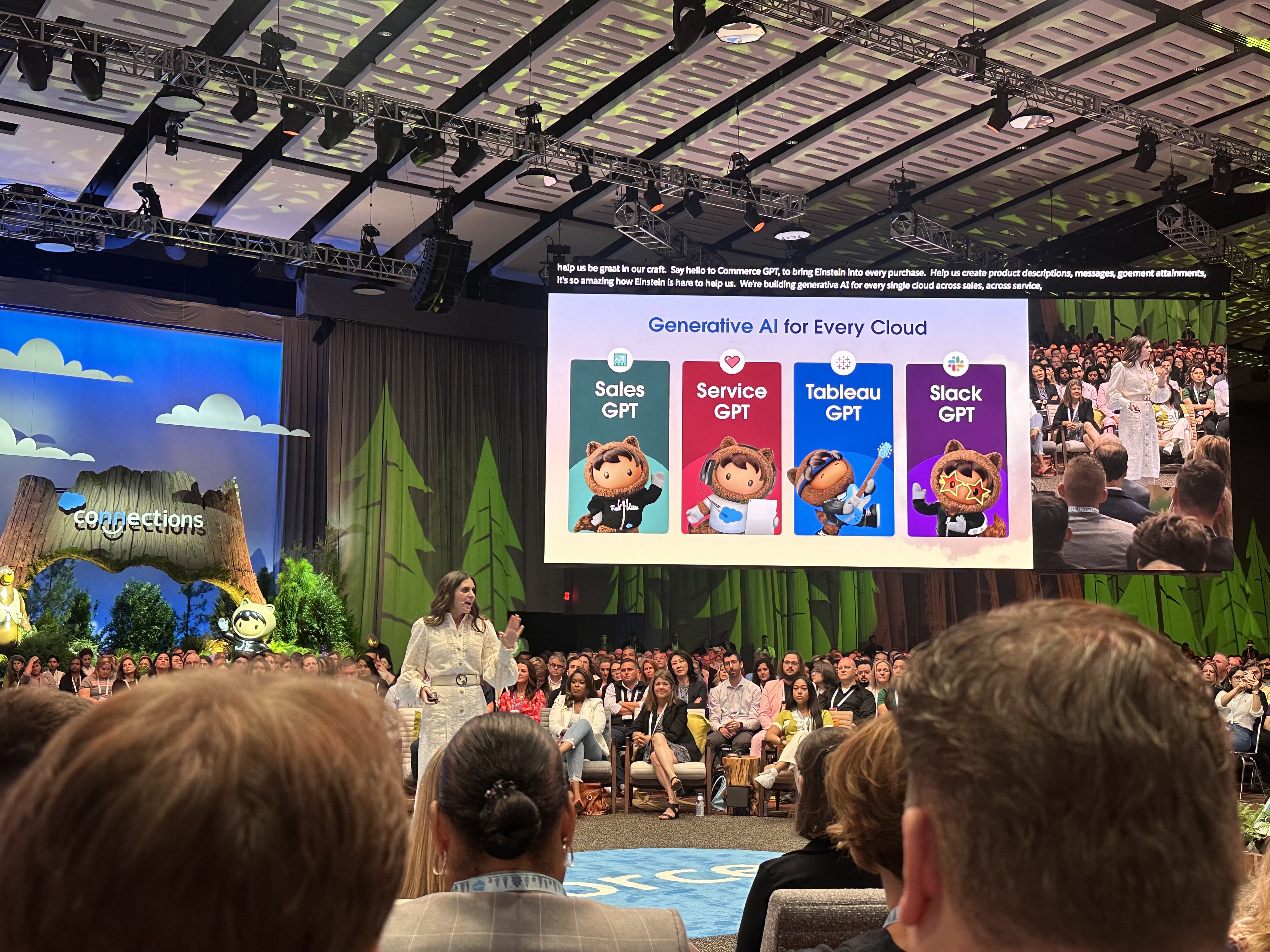
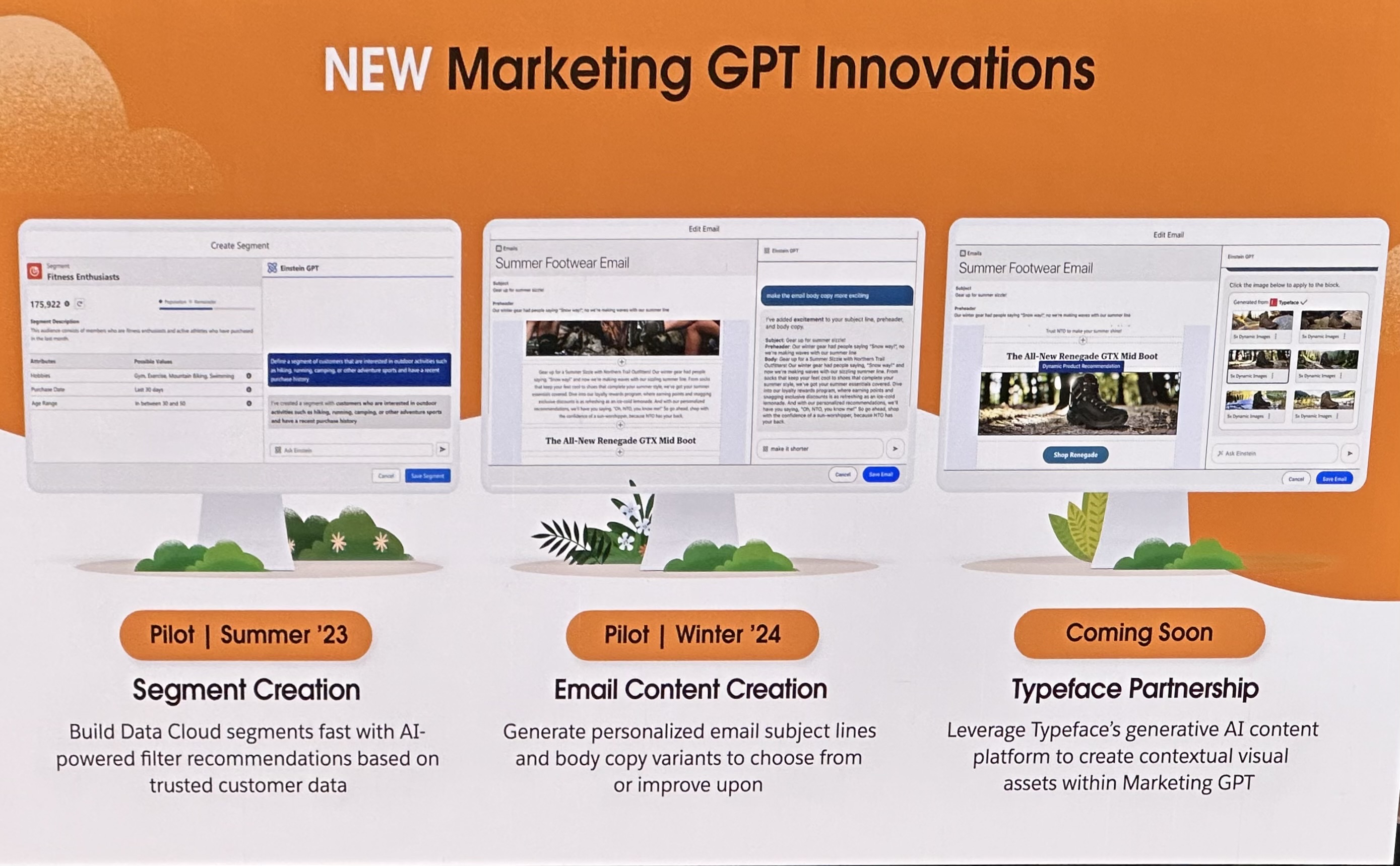
Not surprisingly, Salesforce was talking about generative AI. After all, what vendor isn't talking about generative AI? Benioff, however, noted Salesforce has a portfolio of generative AI brands including Einstein GPT, Slack GPT and Tableau GPT. The company also said its Salesforce GPT Trust Layer is designed to deploy generative AI in a way that secures enterprise data.

As previously reported, enterprises are currently working on how to leverage generative AI and tune using corporate data sets securely.

Speaking on an earnings conference call, Benioff said every CEO realizes that it must invest in generative AI. "Every CEO wants more productivity, automation and intelligence by using AI," he said. 

Customers also need to understand where their data is going while keeping compliance, said Benioff. Enterprise customers will have to worry about compliance, security and regulation more than consumer industries will, he added. "This AI revolution is just getting started," said Benioff, who said AI will lead to a new super cycle. He said he was in a customer meeting and all anyone wanted to talk about was generative AI. 

Salesforce is planning an AI event in New York in June.

Salesforce reported first quarter earnings of 20 cents a share on revenue of $8.25 billion, up 11% from a year ago. Non-GAAP earnings were $1.69 a share. Wall Street analysts were expecting Salesforce to report first quarter earnings of $1.61 a share on revenue of $8.17 billion.

Benioff also added that Salesforce has become more efficient by improving its non-GAAP margin by 1,000 basis points from a year ago. Salesforce reiterated its revenue outlook for fiscal 2024 and updated its earnings outlook.

"We are transforming every corner of our company," said Benioff, who said Salesforce is improving profitability as well as efficiency. "While the economy isn't in our control our margins are."

For the second quarter, Salesforce is projecting revenue of $8.51 billion to $8.53 billion, up about 10% from a year ago. Non-GAAP earnings for the quarter will be $1.89 a share to $1.90 a share.

For fiscal 2024, Salesforce is projecting sales of $34.5 billion to $34.7 billion with non-GAAP earnings of $7.41 a share to $7.43 a share.

By cloud, Salesforce's Sales Cloud had first quarter revenue of $1.81 billion, up from $1.63 billion a year ago.

  • Service Cloud had revenue of $1.96 billion, up from $1.76 billion a year ago.
  • Platform and Other had revenue of $1.57 billion, up from $1.42 billion a year ago.
  • Marketing and Commerce had revenue of $1.17 billion, up from $1.09 billion a year ago.
  • And Data Cloud had revenue of $1.13 billion, up from $955 million a year ago.

Also:

Marketing Transformation Innovation & Product-led Growth Next-Generation Customer Experience Tech Optimization Future of Work Data to Decisions New C-Suite Digital Safety, Privacy & Cybersecurity AI ML Machine Learning Generative AI Analytics Automation B2B B2C CX EX Employee Experience business Marketing SaaS PaaS Growth Cloud Digital Transformation eCommerce Enterprise Software CRM ERP Leadership Social Customer Service Content Management Collaboration GenerativeAI LLMs Agentic AI Disruptive Technology Chief Marketing Officer Chief Executive Officer Chief Information Officer Chief Technology Officer Chief AI Officer Chief Data Officer Chief Analytics Officer Chief Information Security Officer Chief Product Officer

Box CEO Levie on generative AI, productivity and platform neutrality

Box CEO Levie on generative AI, productivity and platform neutrality

Box CEO Aaron Levie outlined his take on generative AI, software table stakes, productivity and the importance of being neutral as enterprises race to integrate the technology.

The comments from Levie came on Box's first quarter earnings conference call. The company reported first quarter earnings of 2 cents a share on revenue of

$251.9 million, up 5.6% from a year ago. For the second quarter, Box projected revenue of $260 million to $262 million with non-GAAP earnings of 34 cents a share to 35 cents a share. The results and outlook were better than expected.

Here's a look at what Levie had to say about large language learning models and generative AI in the enterprise.

LLMs can bring visibility into unstructured corporate data. Levie said:

"For years we've been able to ask questions about our structured data, like the information that's in a database, ERP system, or CRM system. You can ask those systems for financial forecasts, sales pipeline results, inventory levels, supply chain details, and more. But we’ve had limited ability to ask questions of our unstructured data, like content, which is 80% of corporate data. And now we can. By safely bringing leading AI models to enterprise data, enterprises can truly unlock the value that lies in their content.

To do this, we need a way to connect these models safely, securely, and compliantly to our enterprise content.

Imagine being able to instantly ask things like how many days of parental leave can I take? on an HR document or please summarize this report and provide five key takeaways on a quarterly earnings document or how would you pitch this product to a customer in the automotive industry when looking at a product overview document."

Neutrality on AI will matter to enterprise customers. Levie noted:

"As a platform-neutral vendor, we will also be AI-neutral, which means as new AI breakthroughs emerge from more vendors over time, we’ll be in a position to bring the full power of their technology to Box and our customers. In addition to our collaboration with OpenAI, we recently announced that we are building on our strategic partnership with Google Cloud to integrate Google’s advanced AI models into Box AI to create new ways for joint customers to work smarter and more productively with generative AI."

OpenAI collaboration will likely lead to more Microsoft integration for Box.

He said:

"One, we're partnering with OpenAI which by virtue leads you to partnering more broadly over time with Microsoft as well, given the OpenAI models generally running on Azure. So, there's, I think, a lot of exciting potential in that collaboration and an area that we're going to cooperate with them, we think, pretty meaningfully. And so, customers will be able to basically leverage the exact same AI that they would be seeing in any Microsoft products, but within Box as well. So that kind of adds a bit of a bit of benefit to our relationship there with CoPilot."

New uses cases, table stakes and new models. From a product standpoint, Levie said some generative AI capabilities will simply be table stakes. Think about generating AI with content, asking questions about content and workflows. Incremental monetization could come through platform APIs or multiproduct suites. "We've already shown and done are very kind of public about now is we are going to be building this technology full force, and we think it's transformational in how we can work with our unstructured data and our content," said Levie.

Levie said:

"I think everybody is trying to figure out their strategy of how they bring generative AI to their enterprise use cases, which is going to -- which requires a substantial amount of work in kind of the abstraction layer between AI models, customer data and cloud infrastructure, and that's exactly what we're building out."

Productivity gains. Levie said:

"With AI, I think you have such a rapid alignment of customers on testing new use cases, trying out new products and capabilities. Obviously, things like ChatGPT have been front and center. Some companies are fully banning that. Some customers are -- some companies are enabling that. And what I think companies are trying to figure out is where is the productivity gain going to most come from? Is it going to come from going into an AI interface and just like a ChatGPT and asking a question and getting an answer back? Or is it going to come from AI reasoning over existing data and existing workflows in an enterprise and then becoming a productivity boost for those kinds of use cases."

He added that his personal opinion was that generative AI is going to boost productivity by taking on a variety of subtasks a knowledge worker has to handle.

"I strongly believe that this is going to have a net positive impact to just knowledge worker productivity as opposed to a net replacement to kind of large swaps of knowledge work. If you look at the actual tasks that any one of us do in any of our jobs kind of across our roughly 2,500 employees or kind of anybody that we interact with, the vast majority of work that we're actually doing is sort of a collection of many subtasks; hundreds, thousands of subtasks that require us to have a large degree of context that we kind of maintain.

And I think AI is going after those individual subtasks and in some cases, collections of subtasks, but really in a way that will just make us more productive overall. Maybe some roles will be 5% more productive, some roles may be 50% more productive. But I think the net result of that is that we just accelerate into the future faster as opposed to we kind of like do less work.

Instead of having maybe a sales rep or an engineer waste time trying to search or find information, they can be doing the more fun productive parts of their job of working with a customer or getting code released and building a feature. And so, I think that's the kind of impact on the total knowledge worker population.

So, I'm firmly in the optimist camp on this one in terms of what it does to jobs."

Future of Work Tech Optimization Marketing Transformation Data to Decisions Innovation & Product-led Growth Next-Generation Customer Experience Digital Safety, Privacy & Cybersecurity box Marketing B2B B2C CX Customer Experience EX Employee Experience AI ML Generative AI Analytics Automation Cloud Digital Transformation Disruptive Technology Growth eCommerce Enterprise Software Next Gen Apps Social Customer Service Content Management Collaboration GenerativeAI Machine Learning LLMs Agentic AI Chief Marketing Officer Chief Executive Officer Chief Information Officer Chief Technology Officer Chief AI Officer Chief Data Officer Chief Analytics Officer Chief Information Security Officer Chief Product Officer

HP: AI can change the role of PCs

HP: AI can change the role of PCs

HP's PC business in the second quarter was down 29% from a year ago a consumer and commercial units fell. HP's second quarter earnings were better than expected.

The company's results highlight the pandemic PC hangover that tech vendors are facing. HP reported second-quarter earnings of $1.07 a share on revenue of $12.9 billion, down nearly 22% from a year ago. Non-GAAP earnings in the second quarter were 80 cents a share.

Wall Street was expecting non-GAAP second quarter earnings of 76 cents a share.

Enrique Lores, CEO of HP, said the company is focused on "disciplined execution and strong innovation in a tough macro environment." Lores said on a conference call that it’ll move to lower channel inventory.

On a conference call, Lores said:

"Like last quarter, we estimate that the sell-out to customers exceeded sell-in to the channel, which means that end-user demand was stronger than revenue shipments.

This helped us further reduce our channel inventory. There are still pockets where we need to improve, but we are making good progress as per our plan." 

By unit, HP's personal systems unit delivered second quarter revenue of $8.2 billion, down 39% from a year ago. Commercial PC units were down 23% and consumer units fell 28%. The printing division had second-quarter revenue of $4.7 billion, down 5%.

Lores said generative AI has the potential to boost PC sales as customers look for new architectures and designs.He argued that the personal systems unit remains a strong long-term growth driver. "AI will transform the role PCs play in our lives," he said.  

For the third quarter, HP projected non-GAAP earnings of 81 cents a share to 91 cents a share. For fiscal 2023, HP projected non-GAAP earnings between $3.30 a share to $3.50 a share. Lores said that the PC unit is expected to improve due to lower channel inventory and seasonality along with its cost savings efforts. 

According to HP, 46% of its second quarter revenue was commercial PC sales with 17% consumer PCs. Printing supplies were 23% of revenue with commercial printing at 9% and consumer printing 5%.

Future of Work Data to Decisions Innovation & Product-led Growth New C-Suite Tech Optimization HP Chief Information Officer Chief Experience Officer

HPE rides edge computing, HPC growth in fiscal Q2

HPE rides edge computing, HPC growth in fiscal Q2

Hewlett Packard Enterprise saw strong fiscal second quarter growth from its intelligent edge and high performance computing and AI units as its earnings were better than expected.

HPE reported second quarter earnings of 32 cents a share on revenue of $7 billion, up 4% from a year ago. Non-GAAP earnings were 52 cents a share. Wall Street analysts were expecting HPE to report non-GAAP earnings of 48 cents a share on revenue of $7.31 billion.

As for the outlook, HPE said its third quarter revenue will be between $6.7 billion to $7.2 billion with non-GAAP earnings between 44 cents a share to 48 cents a share. For fiscal 2023, HPE sees revenue growth of 4% to 6% in constant currency with non-GAAP earnings of $2.06 a share to $2.14 a share.

Constellation ShortList™ Digital Transformation Target Platforms

HPE has been pivoting to more of an as-a-service company for software as well as hardware. The company's HPE Greenlake platform now has annual recurring revenue of $1.1 billion and total as-a-service total contract value topping $10 billion.

Antonio Neri, CEO of HPE, said the company's shift to higher margin products is paying off. Indeed, HPE's intelligent edge unit delivered second quarter revenue of $1.3 billion, up 50% from a year ago. The HPC and AI unit had revenue of $840 million, up 18% from a year ago. Compute revenue in the second quarter was $2.8 billion, down 8% from a year ago, and storage sales fell 3% from a year ago to $1 billion.

HPE's growth by business unit highlight technology investment trends. For instance, AI is driving HPC systems. HPE's HPC and AI unit delivers standard and custom hardware, software and data management systems for data-intensive workloads. The intelligent edge unit features platforms and services such as wireless local area networks, switching and software defined networking.

Speaking on a conference call, Neri said:

"In the second quarter, we saw some decline in the health of microeconomic conditions, causing unevenness in customer demand, particularly in general purpose compute. We also see unevenness when comparing customer size, industry, or geography. European, Asian, and mid-sized company deals are holding up better than expected, while large enterprise businesses and customers in certain sectors such as financial services manufactured in North America have been more conservative with our spend.

In the last few months, sales cycles have elongated because customers are more reluctant to quickly commit to large projects or some will seek additional internal approvals at the time of the order. We continue to focus on our soft processes to accelerate closing deals wherever possible."

Constellation Research analyst Holger Mueller said:

"HPE had a solid quarter, doing better than a year ago (4% up), but worse than last quarter (11%) revenue wise. Double digit less revenue in Compute, HPC & AI as well as Storage did not help Antonio Neri and team. But with good cost control, and even a reduction in cost of sales as well as total costs and expenses, both ToT and QoQ, show a better earnings per share  than a year ago – now all eyes are on Q3."

Among the takeaways:

  • Intelligent edge and HPC and AI units are now 30% of revenue.
  • Compute is 39% of HPE's revenue.
  • 87% of HPE's second quarter operating profits were via the intelligent edge and compute units.
  • HPC and AI's order book is topping $2 billion in awarded contracts. HPE has four of the global top 10 supercomputers and three of the top 5.
Tech Optimization Innovation & Product-led Growth Data to Decisions Next-Generation Customer Experience Future of Work Digital Safety, Privacy & Cybersecurity HPE greenlake SaaS PaaS IaaS Cloud Digital Transformation Disruptive Technology Enterprise IT Enterprise Acceleration Enterprise Software Next Gen Apps IoT Blockchain CRM ERP CCaaS UCaaS Collaboration Enterprise Service ML Machine Learning LLMs Agentic AI Generative AI AI Analytics Automation business Marketing finance Healthcare Customer Service Content Management Chief Executive Officer Chief Information Officer Chief Technology Officer Chief AI Officer Chief Data Officer Chief Analytics Officer Chief Information Security Officer Chief Product Officer

CrowdStrike launches Charlotte AI, generative AI to uplevel, democratize cybersecurity analysis

CrowdStrike launches Charlotte AI, generative AI to uplevel, democratize cybersecurity analysis

CrowdStrike is using generative AI to tap into its Falcon platform and deliver natural language answers and recommendations on cybersecurity.

According to CrowdStrike, the generative AI rollout called Charlotte AI, is designed to turn everyone into a cybersecurity power user. The company said Charlotte AI can also close cybersecurity skills gaps and speed response time.

The broader takeaway is that companies with vibrant data sets can leverage large language models (LLMs) for competitive advantage. CrowdStrike's Charlotte AI taps into a platform that captures trillions of data points on cybersecurity incidents via its CrowdStrike Threat Graph.

CrowdStrike added that Charlotte AI will also tap into human-validated content to create a human feedback loop in addition to threat intelligence. In a blog post, CrowdStrike noted:

"Generative AI opens up a new world of possibilities by creating net-new outputs based on the patterns and structures inherent to the training data. But the limiting factor will always be the quality, context and completeness of the underlying data."

Palo Alto Research CEO Nikesh Arora had a similar take when the company reported earnings.

Use cases outlined by CrowdStrike include:

  • Answering CXO and business user questions about risks related to a recent vulnerability.
  • Empowering lower-level security analysts to perform more high-level analysis.
  • Automate repetitive tasks including data collection, extraction and threat searches and detection.

Charlotte AI is in private preview.

Related:

Digital Safety, Privacy & Cybersecurity Data to Decisions Innovation & Product-led Growth Future of Work Tech Optimization Next-Generation Customer Experience AI GenerativeAI ML Machine Learning LLMs Agentic AI Analytics Automation Disruptive Technology Chief Executive Officer Chief Information Officer Chief Technology Officer Chief AI Officer Chief Data Officer Chief Analytics Officer Chief Information Security Officer Chief Product Officer