


SAP rolls out developer tools for Joule, ecosystem connections
SAP advanced its plans for developer tools, SAP Build, the Joule roadmap and connecting to a broader ecosystem including a partnership with Snowflake.
At SAP TechEd 2025 in Berlin, the company outlined a series of AI-driven tools in SAP Build as well as a set of Joule Agents designed to enable developers to move faster.
Muhammad Alam, a member of the Executive Board at SP, said the innovations at SAP TechEd create a "unique flywheel of applications, data and AI put developers in the driver’s seat."
Specifically, SAP outlined the following:
- Developers who use agentic AI platforms such as Cursor, Claude Code, Cline and Windsurf can now use SAP frameworks via SAP Build local Model Context Protocol (MCP) servers.
- Visual Studio Code users will be able to use SAP Build via extensions.
- The extension will be available later on the Open VSX Registry.
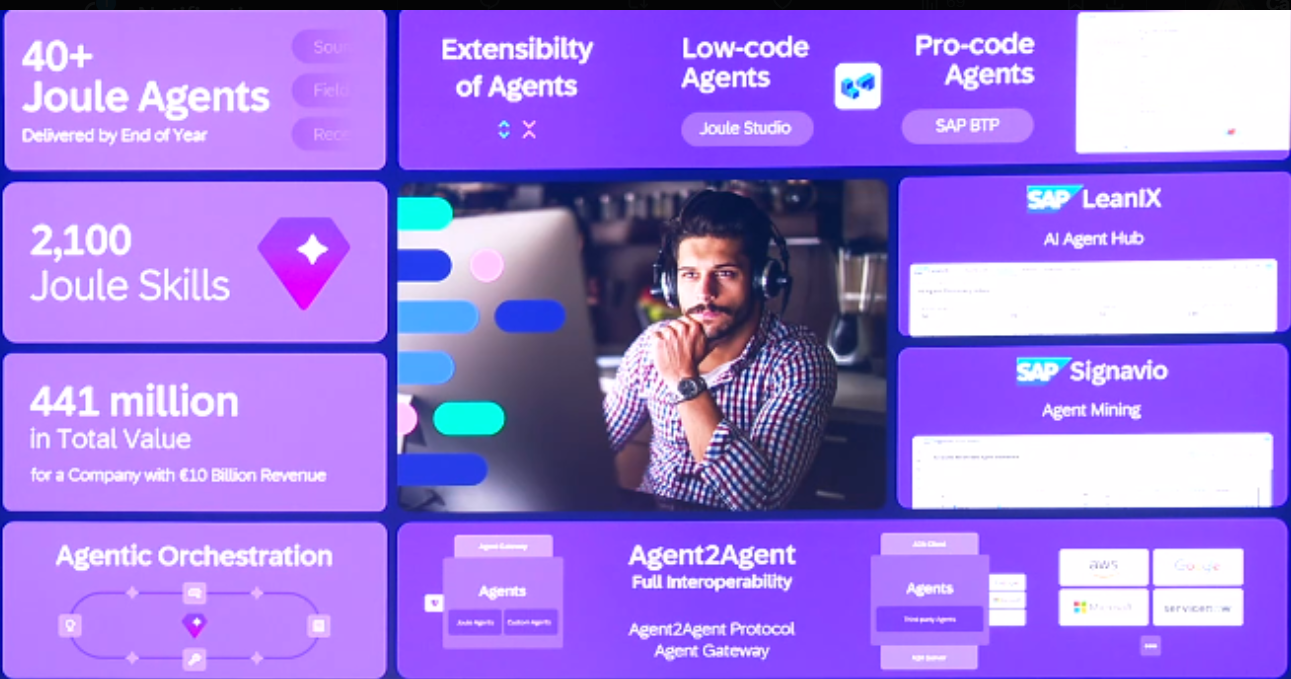
- Joule Studio will get new tools to customize SAP ready-to-use agents as well as build new ones grounded in SAP business data.
- SAP rolled out new Joule AI assistants to coordinate multiple agents across workflows, departments and applications for finance, supply chain and HR.
- The company partnered with Snowflake on a new SAP Snowflake extension for SAP Business Data Cloud. The partnership gives joint customers the ability to move data bidirectionally.
- SAP HANA Cloud knowledge graph ending can now automatically generate knowledge graphs.
- SAP launched its first enterprise relational foundation model, which is focused on business outcomes. SAP-RPT-1, short for the first-generation Relational Pre-trained Transformer, can make predictions for common business scenarios including delivery delays and payment risk.
Constellation Research analyst Holger Mueller said the SAP TechEd lineup was compelling. He said:
"SAP delivered a compelling keynote, showing how the SAP product teams work together for customer success on AI, application development and more - which was not always the case and good to see. With innovations on the Joule, SAP's agentic framework, advances on SAP Business Data Cloud, language driven and vibe code based development, ABAP models coming to on premises customers, SAP has shown significant innovation dynamic for its customer base. The question now is will it help SAP customers to tackle the task at hand - the upgrade to S/4HANA Cloud."
Here are the key points from Alam at SAP TechEd.
App–Data–AI Flywheel & ROI
- SAP’s thesis: Real ROI comes from the seamless integration of applications, data, and AI, rather than isolated AI experiments.
- SAP’s business suite spans finance, supply chain, HR, CRM, and more, giving it an advantage in creating a “global maximum” of value versus “local optimizations” seen in siloed systems.
- Embedded AI in unified applications enables automation and insight across end-to-end business processes.
Assistants, Agents, and Human Productivity
- SAP envisions AI as an assistive layer first—to make people smarter, faster, and more efficient—before evolving toward autonomous execution once trust is built.
- Example: demand-planning and supply-planning agents collaborating autonomously across functions.
- The “assistant” concept begins with human-in-the-loop confidence building, leading later to autonomous operations when maturity allows.
AI Hype vs. Real ROI
- AI hype has inflated expectations. Many companies now realize value only comes from simplifying and structuring the equation—embedding AI in core workflows, not generating random apps.
- 95% of firms once reported no ROI (MIT study), but a newer study found 74% now see positive ROI—mainly those that adapt workflows and culture rather than just bolt on AI.
- ROI perception varies: executives tend to report success, managers often don’t see it yet.
SAP’s Approach to AI Value Creation
- SAP focuses on incremental AI adoption—enhancing existing roles and processes rather than replacing them.
- Companies should start by making core roles (like AR clerks or billing agents) more efficient, then progress toward autonomous execution.
- AI maturity follows a staged “value journey”: assistive → semi-autonomous → autonomous → deep research.
Developers, Product Managers & the AI Workforce
- SAP employs ~40,000 developers but sees enough backlog for 200,000 developers’ worth of work—AI helps scale output, not replace people.
- AI agents are multiplying productivity (7x–12x) in some teams by automating code generation, testing, and design.
- SAP Build and Joule Studio Agent Builder will let developers and customers create AI agents in low-code/no-code environments.
- Roles like product manager, QA, UX, designer will evolve but not disappear—AI will change team ratios and workflows.
Data Ecosystem & Partnerships
- Business Data Cloud (BDC) launched in 2025 integrates with Snowflake and Databricks, allowing zero-copy data sharing.
- SAP aims for open, governed, interoperable data management, letting customers combine SAP and non-SAP data seamlessly.
Organizational Design & Industry Collaboration
- SAP is experimenting with “Dev Games of the Future” to rethink team structures and collaboration models for AI-augmented development.
- Emphasis on evolving from people upward, not top-down reorganization.
- SAP collaborates with large customers and institutions (e.g., Linux Foundation) on defining future role structures and standards.
ROI Beyond Headcount Reduction
- SAP stresses AI ROI doesn’t equate to layoffs—it’s about growth, productivity, and redeployment of talent.
- Customers view AI as a tool to expand capacity, not shrink the workforce.
Accountability & Measurement for AI
- ROI and accountability come from embedding AI in structured business processes where performance can be measured (e.g., sourcing contracts closed, savings achieved).
- SAP’s new Agent Topology Index maps and tracks agents (SAP and non-SAP) to measure outcomes and performance signals.
Quantum Computing Outlook
- SAP is experimenting with quantum computing but sees it as post-2030 for commercial rollout.
- Quantum will serve different use cases than AI, likely focusing on performance and optimization problems.
Larry Dignan is Editor in Chief of Constellation Insights at Constellation Research, where he leads editorial coverage focused on enterprise technology, digital transformation, and emerging trends shaping the future of business. He oversees research-driven news, analysis, interviews, and event coverage designed to help technology buyers and vendors navigate complex markets with clarity and context. ...
Read morePublished
Author
