Editor in Chief of Constellation Insights
Constellation Research
Larry Dignan is Editor in Chief of Constellation Insights at Constellation Research, where he leads editorial coverage focused on enterprise technology, digital transformation, and emerging trends shaping the future of business. He oversees research-driven news, analysis, interviews, and event coverage designed to help technology buyers and vendors navigate complex markets with clarity and context. ...
Lowe's has laid the groundwork and is starting to leverage artificial intelligence throughout its operations including store experiences across multiple channels and backend supply chain processes. The plan is to invest in an uncertain market to reap the awards when the home improvement market improves.
The home improvement retailer's focus on its enterprise architecture, data, artificial intelligence and optimization comes amid a rocky real estate market. With fewer homes being sold and inflation concerns, home improvement projects are being put off. Lowe's CEO Marvin Ellison said that Lowe's is seeing customers put off big-ticket purchases such as appliances and a "greater than expected pullback in DIY discretionary spending."
"At this point, we're expecting a phased recovery, beginning with homeowners re engaging in smaller refresh and repair projects. Then over time, we expect them to engage in more complex remodels," said Ellison, speaking on an investor meeting in December. Ellison added that Lowe's is looking to win share among Millennials with homes and kids and baby boomers. "These two generations make up the largest share of the home improvement market, and by meeting their needs, we're in position to win across all generations," he said.
Lowe's strategy revolves around the following:
Grow its revenue by appealing to professional contractors.
Redesign its loyalty program and step up digital marketing efforts.
Grow its online sales and omnichannel capabilities to target Gen Z.
Offer more services with design tools and an online marketplace.
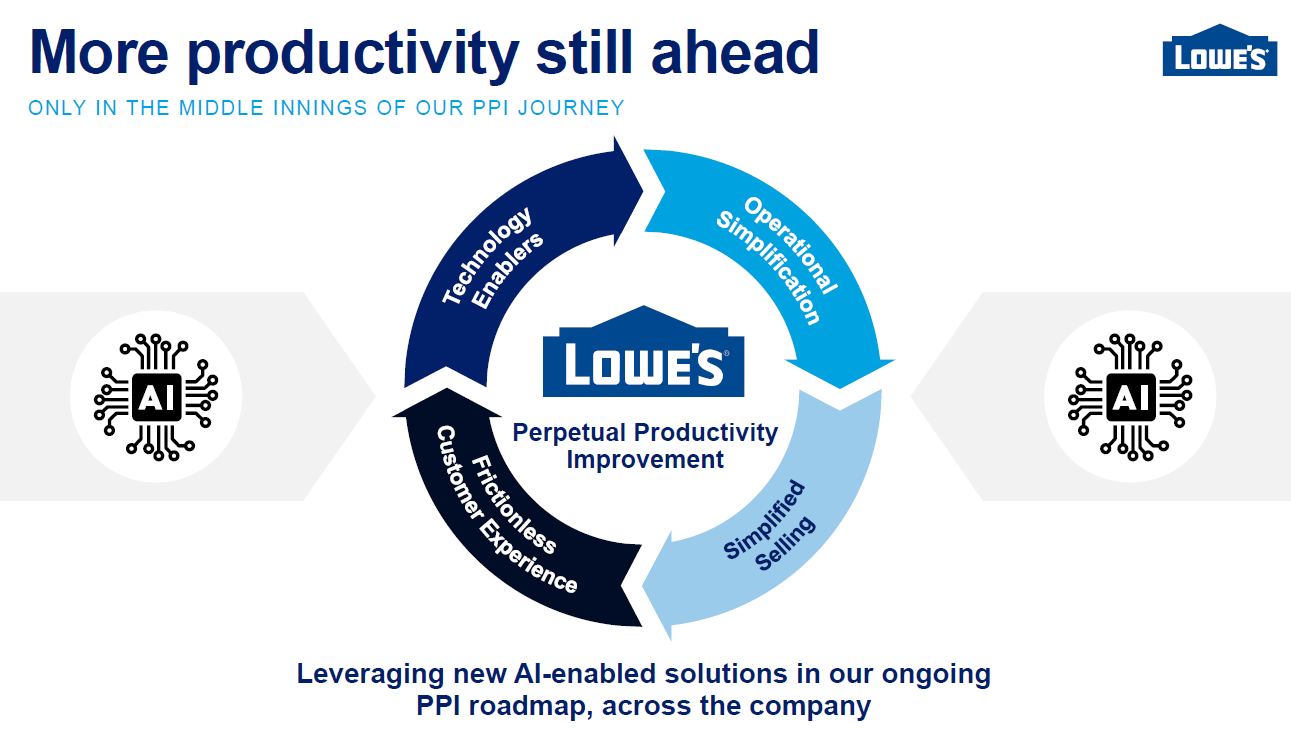
Continue productivity efforts and leverage generative AI.
The modernization effort
All of those initiatives have a heavy dose of data, AI and enterprise technology. Speaking at Lowe's investor meeting Seemantini Godbole, Chief Digital and Information Officer at Lowe's, said:
"We are using technology to improve our operating efficiency, not only in our stores, but across the organization, and we are looking to leverage the exciting capabilities unlocked by generative AI to enhance our customers and associate experience driving traffic and sales."
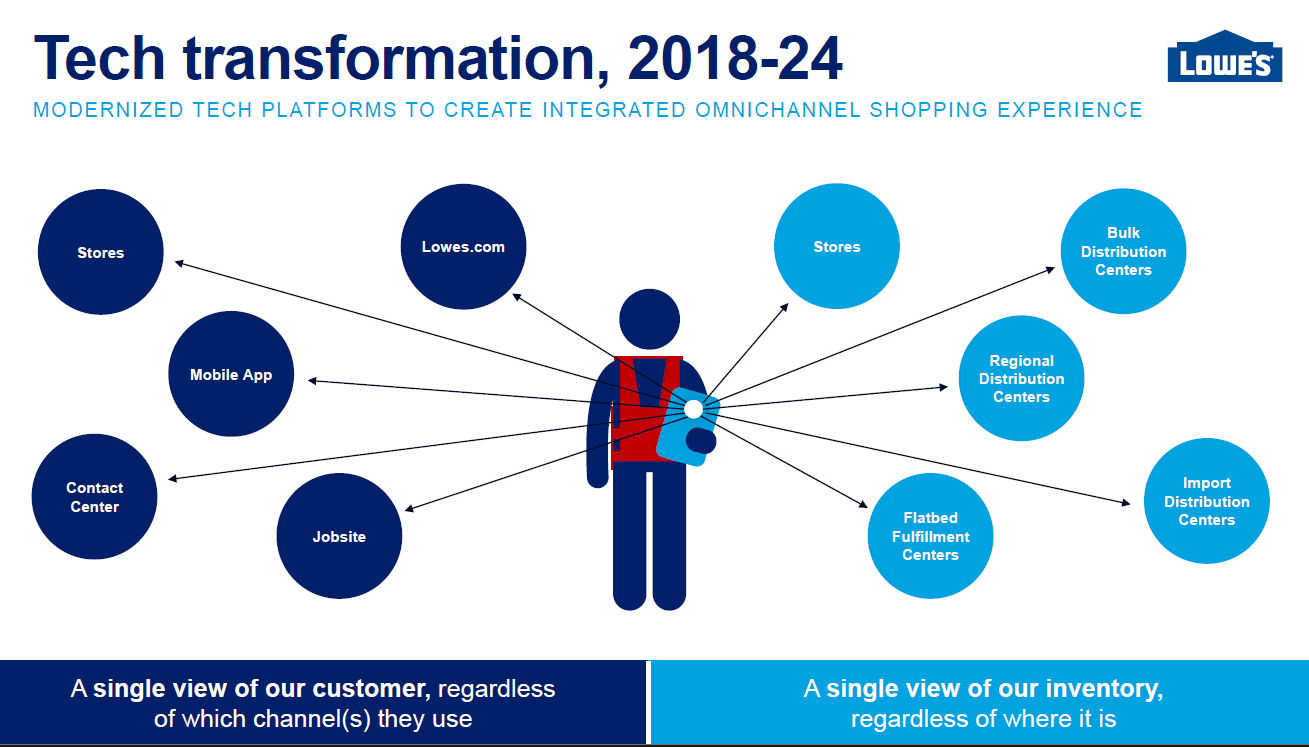
Godbole joined Lowe's in 2018 and started an effort to rebuild the retailer's technology strategy, architecture and processes. Lowe's stores were run by systems designed in the 1990s and had merchandising systems from the early 2000s. The company modernized those systems with a focus on omnichannel customer experiences.
Lowe's then set out to build systems to deliver consistent experiences, said Godbole. Key points about the infrastructure updates:
The company focused on a unified system that provided one view of the customer across multiple channels.
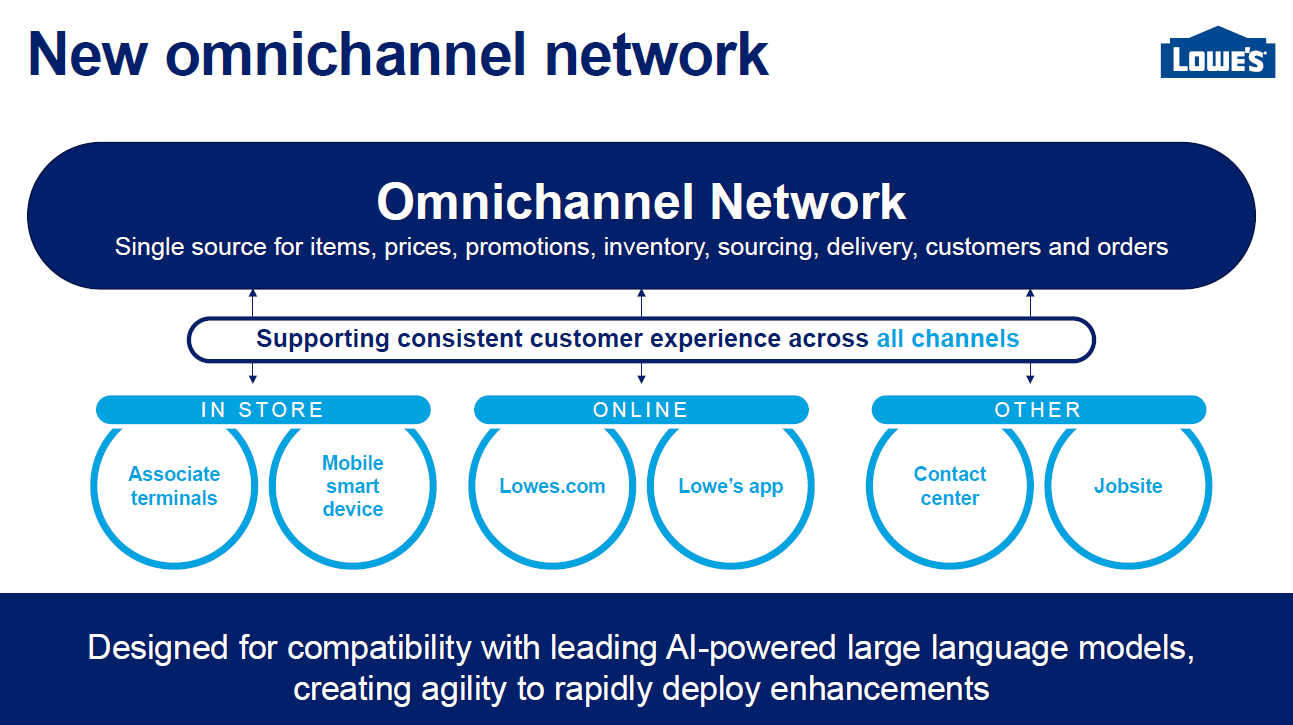
Associates can access everything needed to serve a customer across multiple channels instead of navigating green screens. "Associates have one intuitive touch screen they can use for everything, even complex sales," said Godbole. "They can look up inventory across the network and even sell products that just arrived at our distribution centers and are yet to be unloaded."
The omnichannel system includes "all product information, inventory, locations, pricing and promotions and customer orders across every channel."
The data architecture at Lowe's was built "with AI in mind" and organized so it can be "easily understood and analyzed by AI," said Godbole. "This allows us to easily work across leading AI, large language models, so we can use the right platform depending on the use case," she said.
Lowe's provides a look at how companies leveraging AI have made transformation investments years in advance. There are no overnight AI hits for enterprises.
Godbole said:
"We are now putting in place a framework to help us harness the new power of generative AI for our business to enhance how we sell, how we shop and how we work. This framework helps us standardize the development process so we are using a consistent set of criteria to establish where we use AI regardless of the project. We have built an AI platform that allows us to reuse components and gives us agility to create innovative solutions alongside many of the leading platforms like Nvidia, OpenAI and Palantir."
According to Godbole, Lowe's has "roughly 50 AI models in place" that are used for search, product recommendations, sourcing, demand and planning tools and pricing.
"Now we are using the experience we gained from these first AI models to help us create leading edge solutions that leverage generative AI," said Godbole.
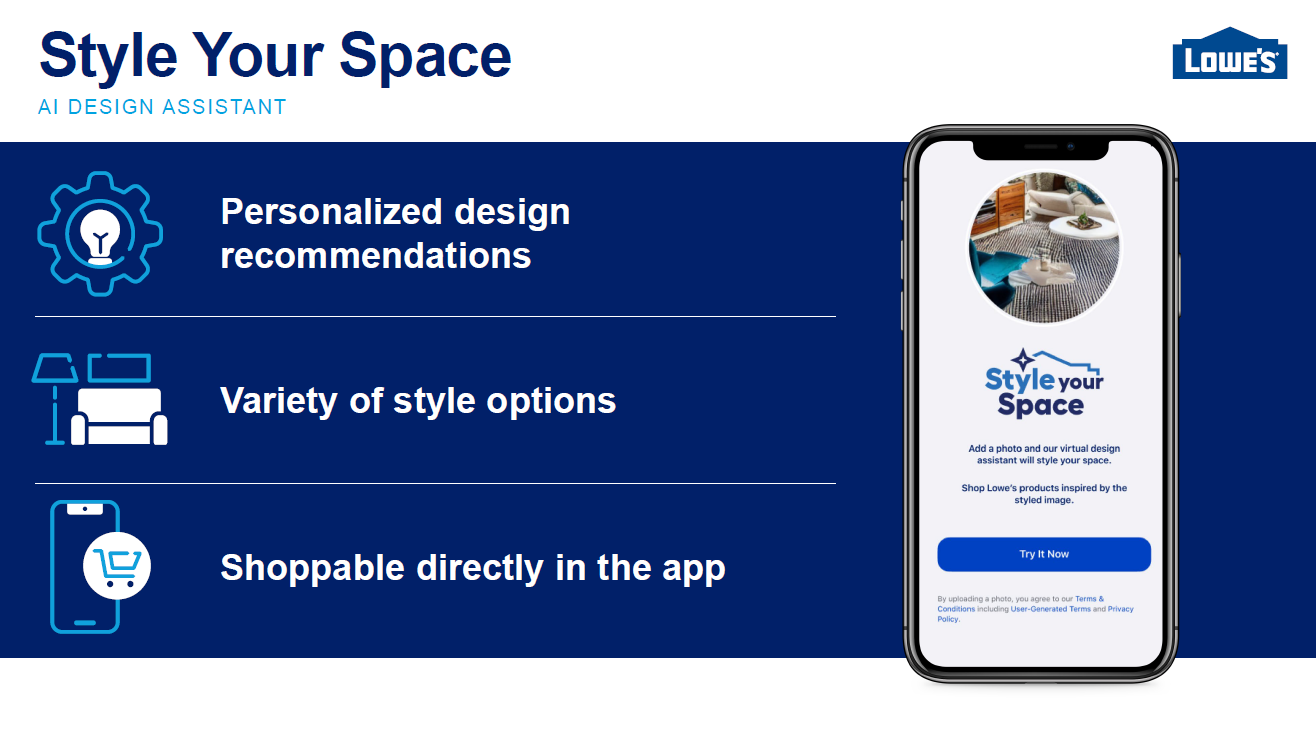
Many of these edge use cases will be used to accelerate online sales with enhanced user experience, customer acquisition and digital commerce. Lowe's app has a style your space feature that is powered by genAI.
Other Lowe's efforts where AI and its data platform are playing a role include:
Localization of assortment. Bill Boltz, executive vice president of merchandising at Lowe's, said the company is expanding private label goods and assortment depending on local market needs. The company is also expanding its efforts in rural areas.
"We're driving space productivity through localization, where we're tailoring our assortments based on demographics, housing sizes, building codes, climate, geography and community preferences, all with the goal of making each Lowe's store feel like your Hometown Store," said Bortz. "We're leveraging AI driven planning tools and insights from our customers and from our field merchants who serve as our boots on the ground to help us understand those local market needs and preferences."
Supply chain optimization. Boltz said the company has been analyzing product components, transportation and raw material costs to verify that supplier charges are warranted. "Leveraging these capabilities, we've worked with our suppliers to claw back some of the costs that we've absorbed due to exceptionally high inflation triggered by the pandemic, and we've worked to then reinvest these savings to drive traffic and sales," said Boltz.
Reducing manual work. Boltz said that Lowe's is focused on reducing manual work, accelerating pricing decisions and optimizing promotions with AI.
Customer data feedback loop. Jen Wilson, chief marketing officer at Lowe's, said the company is using its loyalty program for consumers and contractors to drive a data and consumer insights flywheel. "We built a robust customer data platform, which is transforming our ability to understand our customers and how we market to them," said Wilson. "The more we know about them, the more we can put them at the center of everything that we do, and we can connect with them in more sophisticated ways by offering them a more relevant and personalized experience in anticipating what they need next."
Wilson said the data includes first party data such as purchase behavior and activity on the Lowe's site as well as third party data. "Zero party data," which is information collected through the loyalty program, is also critical because it tells Lowe's whether a customer has a pet, likes to garden and what trades are favored by contractors. Wilson said Lowe's is also adding perks such as digital warranty information attached to appliance purchases.
Efforts to expand professional market share. Lowe's Quonta Vance, executive vice president of pro and home services, said the company has launched a new CRM system to optimize the sales process and personalize offers. Lowe's has also connected directly to suppliers with inventory, pricing and services data. Vance said Lowe's is piloting new fulfillment capabilities for large deliveries.
Services digital payment system. Lowe's is also looking to expand its home services with the ability to make it easy to schedule and pay for installation via smart devices. Customers can now digitally sign a contract and submit payment without a special trip. Typically, customers would have to return to a store to pay for installation for things such as windows, flooring and doors. Associates will also be able to process payments in a customer's home.
"We realized we needed to empower our hard-working front-line associates with better technology and simpler processes so they could be freed from outdated manual tasks and shift their attention to serving our customers and driving sales," said Joe McFarland, executive vice president of Lowe's stores.
Customer experience wins with computer vision
With smart devices, self-checkout terminals and omnichannel improvements mostly in place, Lowe's has set out to leverage AI in ways that can move the needle for customer satisfaction yet operate in the background.
McFarland said the company has been focusing on both associate and customer experiences since it has created "meaningful gains in labor productivity and our operating margin."
According to McFarland, Lowe's proprietary self-checkout registers, improved buy online and pickup in store experiences and optimized front-end selling spaces are just the beginning.
Via a partnership with Nvidia, Lowe's has installed a self-checkout system that uses an AI computer vision tool called Nudge. Nudge detects discrepancies such as a customer that has missed scanning something. Nudge can prod the customer to scan the missing item or alert cashiers to resolve the mismatch.
"Nudge helps us maintain our strong track record managing shrink, and with this assisted self-checkout, we can shift associate time to the sales floor so they can spend more time driving sales and serving customers," said McFarland.
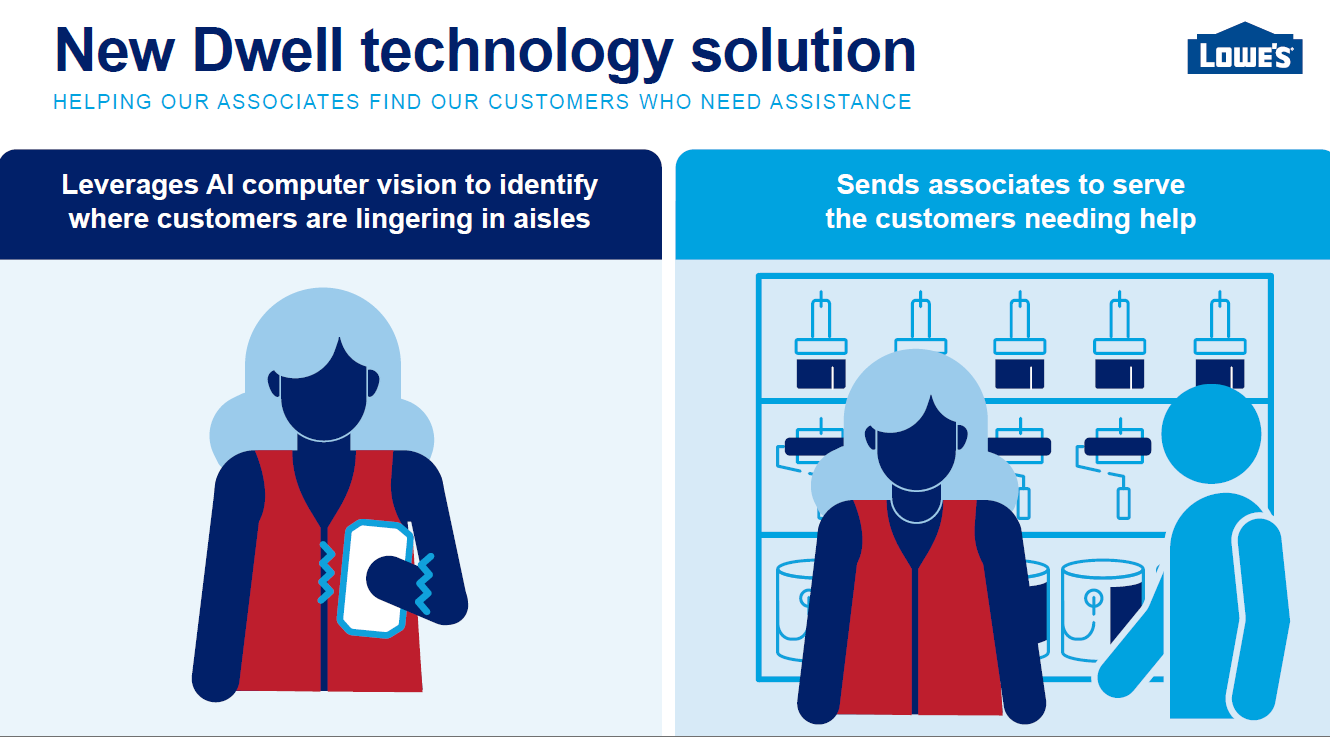
Another interesting customer experience use case is an effort Lowe's calls Dwell. Dwell uses AI vision and algorithms to estimate sales and traffic patterns inside a store. McFarland explained:
"Dwell uses an AI vision algorithm to estimate sales and traffic patterns and see the trends inside of our stores. It uses real time heat maps to see where customers stop in our aisles to look at products and sends associates directly to them to ask if they need help. This new technology will help us staff our stores correctly to maximize sales."
Another use of AI will be embedded into Lowe's companion app for associates. McFarland said the store companion app includes "our very own version of ChatGPT that helps our associates understand what's involved in projects."
The core metrics for these efforts are customer and associate satisfaction scores, operating margin, lower shrink and sales velocity. McFarland said these improvements will also lead to better return on invested capital as Lowe's opens 10 to 15 new stores per year. Lowe's has transformed about a third of its store footprint with new front-end systems and processes.
Supply chain as insights engine
Lowe's has been transforming its supply chain since 2018 to optimize its more than 130 facilities with more than 65 million square feet. The Lowe's supply chain network includes regional, bulk, import and flatbed distribution centers as well as a system of fulfillment facilities.
Margi Vagell, executive vice president of supply chain at Lowe's, said:
"We've transformed our supply chain from a traditional hub and spoke model centered around replenishing stores to one that's more agile, centered around supporting omnichannel fulfillment needs. This multiyear transformation has helped us increase our network capacity, our capabilities to deliver big and bulky items and our flow of product through our distribution centers to our stores. This in turn improves our in stocks and our customer shopping experience and our ability to meet the ever-increasing demand from our DIY and pro customers for fast and flexible delivery options."
Vagell also said Lowe's has deployed a market delivery model for big and bulky products such as appliances. AS a result, bulky products flow from the supply chain to customer homes and job sites instead of stores. Lowe's has been able to double the number of next-day deliveries and improved customer satisfaction by 20 percentage points.
Lowe's said that the company's plan is to further optimize its supply chain and ultimately "make it a proactive sales enabler that drives greater inventory productivity and operational efficiency."
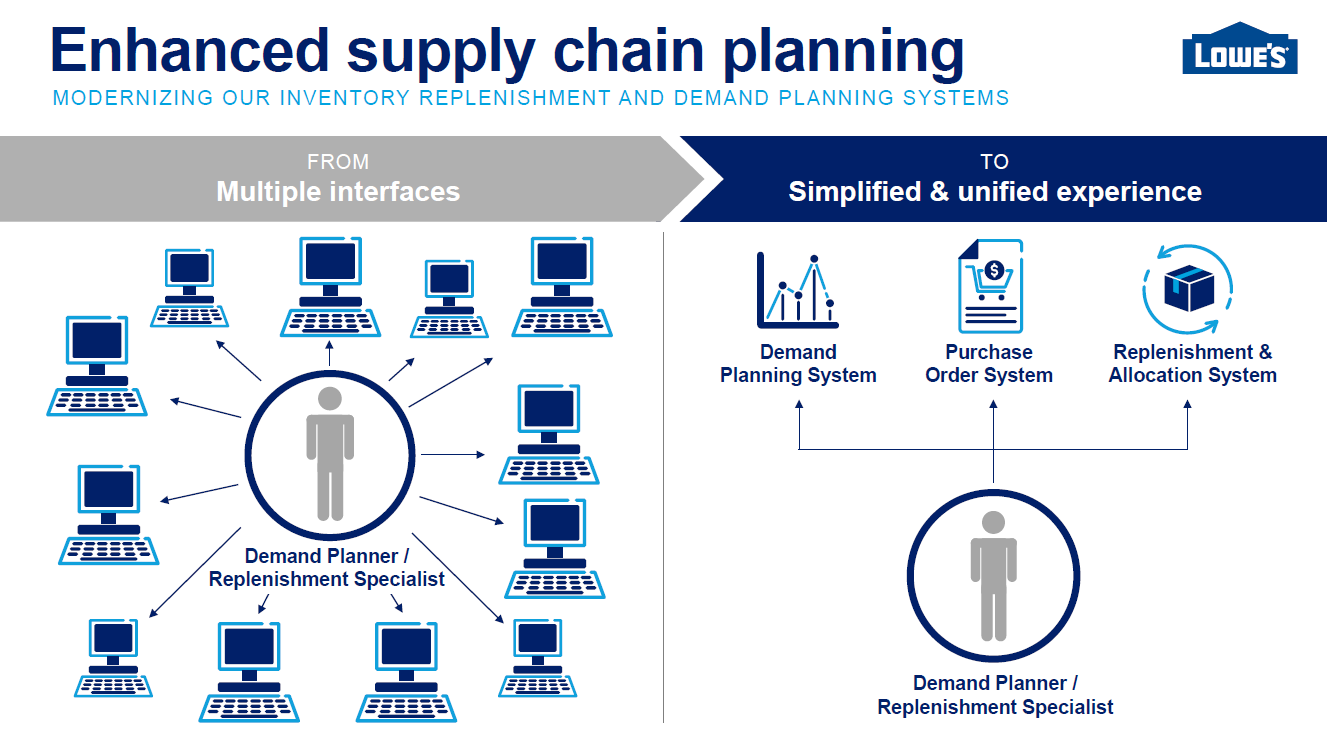
Vagell added that Lowe's has started a three-year project to redesign and modernize its inventory replenishment and demand planning systems. AI will also play a big role in planning for rural locations, rapid store responses and driving insights. Vagell said:
"This new technology ecosystem merges custom and third-party applications that will create a vastly simplified and cohesive experience, resulting in improved forecast accuracy and increased inventory productivity. With these enhancements to our tools and analytics, we will proactively simulate the business and simulate scenarios instead of simply reacting to them."
Lowe's is expecting its merchandising and supply chain efforts to have an impact of $500 million a year in savings and sales and its store operations optimizations to generate another $500 million annually.
Editor in Chief of Constellation Insights
Constellation Research
Larry Dignan is Editor in Chief of Constellation Insights at Constellation Research, where he leads editorial coverage focused on enterprise technology, digital transformation, and emerging trends shaping the future of business. He oversees research-driven news, analysis, interviews, and event coverage designed to help technology buyers and vendors navigate complex markets with clarity and context. ...
GenAI and agentic AI were key themes in 2024, but there was plenty of nuance to note as well as common best practices that provide enterprise value.
Here's a look at some of the key takeaways in 2024 from the CXOs in the BT150 based on our numerous interviews and monthly calls.
Sort through the hype vs. reality with genAI and agentic AI. Generative AI and AI agents can drive projects, reshape performance management and impact culture. The problem is cutting through the hype vs. reality of AI adoption. Scaling remains a big issue.
Wanted: Real-world value. BT150 members emphasized the need to translate AI innovations into real-world operational value. Process automation was a critical component of genAI efforts and CxOs said there are plenty of returns available with traditional AI approaches.
Frustration with vendors. BT150 members frequently said they were frustrated with their SaaS vendors for a lack of customer focus, rising costs and questionable ROI. CxOs were also weary of SaaS models that ate up the operating expense budget and wanted tangible business value.
Enterprise buyers ware also struggling with complexity in systems as well as new methodologies.
Wariness of trending technologies. CxOs said throughout the year that the focus should be on proven results over the latest and greatest in foundational models and data platforms.
Change management matters. CxOs said successful AI projects typically were due to change management as much as the actual technology or vendors.
Use AI projects to drive organizational change. Yes, genAI can drive productivity, but the real win is using those technologies to drive organizational change.
Processes matter. Using AI to scale inefficient business processes will only create headaches. CxOs said that enterprises need to emphasize human-centric approaches and human oversight. Where to put humans in AI-driven processes is the key question.
Editor in Chief of Constellation Insights
Constellation Research
Larry Dignan is Editor in Chief of Constellation Insights at Constellation Research, where he leads editorial coverage focused on enterprise technology, digital transformation, and emerging trends shaping the future of business. He oversees research-driven news, analysis, interviews, and event coverage designed to help technology buyers and vendors navigate complex markets with clarity and context. ...
With 2025 days away, it’s worth soaking in various outlooks and technology themes that may play out in the year ahead. Here’s a list of reads from Constellation Research and around the web.
Enterprise software will be volatile in 2025 as customers increasingly question value, complain about upsells and added charges and assess whether agentic AI provides an abstraction layer to their existing applications.
The gap between generative AI's "build it and they will come" folks and the enterprises looking for actual business value may be widening. The next year will be interesting for generative AI trickledown economics.
Artificial intelligence budgets will surge again in 2025, but good luck tracking expenditures with any precision as generative AI spending is lumped into other categories and driven by multiple departments.
In 2025, you'll have to get ready for "knowledge," AI governance will move to the forefront, enterprise software models will be revamped, decision automation will depend on humans in the loop and data strategies will be a pain point.
Artificial intelligence and generative AI will tax leadership, but ultimately raise the bar for decision making. Those were some of the takeaways from Cassie Kozyrkov, Founder Kozyr LLC, who delivered the keynote at Constellation Research's Connected Enterprise.
Editor in Chief of Constellation Insights
Constellation Research
Larry Dignan is Editor in Chief of Constellation Insights at Constellation Research, where he leads editorial coverage focused on enterprise technology, digital transformation, and emerging trends shaping the future of business. He oversees research-driven news, analysis, interviews, and event coverage designed to help technology buyers and vendors navigate complex markets with clarity and context. ...
With 2024 ending it’s worth checking in on everything we’ve learned from the CxOs, buyers and sellers of enterprise technology.
Here's everything we learned in 2024:
Some predictions don't quite work out. Yes, I went back into the archive to look at the trends to watch for 2024 published in January. Here's the breakdown:
Enterprises did refocus on data strategy to make generative AI work and there was a bit of disillusionment with genAI. Not that generative AI was a complete dud, but the reality is that it was a building block on the road to agentic AI. And transformation projects, which included a lot of AI, faced more scrutiny.
On the flip side of 2024 predictions, that hybrid model for genAI is still on the drawing board, but may appear in 2025. Customers were miffed about enterprise technology price increases, but few did anything about it. I also noted that the economy would be volatile in 2024, but the stock market and leading indicators chugged along for a goldilocks scenario. Tech mergers and IPO remained no shows even though I bet otherwise.My biggest flop was this one: "Enterprises embrace hybrid and remote work and start unloading commercial real estate." You can stop laughing as you read your return to office memos.
Enterprise software is at a crossroads. Enterprise software disruption was a theme we returned to repeatedly in 2024. The seat-based business model isn’t going to fly when AI starts replacing people. Vendors are navigating the rise of marketplaces, models that can keep revenue growth going and balancing margins since genAI isn’t cheap. Most vendors want to be a platform, but we all know there are only a few. Enterprise buyers are pushing back on price increases because software vendors can’t keep gobbling up all the operating expenses.
What remains to be seen is whether enterprises buyers have any leverage. Broadcom’s acquisition of VMware caused a lot of complaints, but it’s hard to argue that the deal wasn’t a financial success.
Hyperscale cloud providers are only growing more powerful. Yes, cloud providers give enterprises more agility and save them money. But these hyperscalers hold a lot of power. AWS, Google Cloud and Microsoft Azure had banner years with annual run rates of $110 billion, $45.6 billion, and $156 billion, respectively* . Oracle Cloud Infrastructure did too. What remains to be seen is whether a new breed of cloud providers focused on AI—or even hybrid approaches—can check the market power. AI is a cloud workload—especially since the technology is developing so fast—and looking down the road quantum will be a cloud-first workload too. Whether you standardize on one cloud provider or mix and match infrastructure will be your most important enterprise decision.
*Microsoft doesn’t break out Azure revenue so the run rate is calculated on commercial cloud revenue.
AI has impacted industries well beyond technology. AI has become a hot topic on earnings calls beyond the technology sector. GenAI and automation have fueled expanding profit margins at companies such as Lowe’s, Exxon, Rocket and Equifax. Those examples are just a few. The productivity boom from AI has expanded to multiple sectors.
Agentic AI has staying power. Agentic AI pushed generative AI aside for buzzword of the year, but the idea goes beyond vendor marketing. GenAI was a start, but being able to string together models into a flow that automates and executes work is a game changer. There’s a lot of work ahead, but agentic AI is off to a good start.
However, the spoils of the AI revolution largely stayed with the infrastructure layer. While AI is promising for multiple industries, the market cap expansion went to infrastructure players. We’re still in the picks and shovels stage of the AI revolution and that means Nvidia has been raking in cash. The big question is when the AI spoils will spread beyond infrastructure.
Business transformation is alive and well. The Constellation Research community of CxOs continually outlined projects that transform their businesses away from the fanfare. Business transformation is about continual improvement, change management and process. It’s difficult to synthesize all the conversations we’ve had, but here are a few.
Editor in Chief of Constellation Insights
Constellation Research
Larry Dignan is Editor in Chief of Constellation Insights at Constellation Research, where he leads editorial coverage focused on enterprise technology, digital transformation, and emerging trends shaping the future of business. He oversees research-driven news, analysis, interviews, and event coverage designed to help technology buyers and vendors navigate complex markets with clarity and context. ...
Omar Jacques Omran said innovation is a team sport built on relationships and win-win scenarios that can even bring fierce competitors together to co-innovate.
Omran, a BT150 member, is an entrepreneur and former CTO of Six Flags where he led a transformation that resulted in a $100 million net profit increase over two years. Before joining Six Flags, Omran was the Vice President of Digital Transformation at Welbilt and the Managing Director of Welbilt’s KitchenConnect brand. Under his leadership, KitchenConnect grew into the largest cloud platform in the foodservice industry, enabling seamless connectivity for smart equipment in restaurants. He also initiated the largest digital alliance in the food service industry.
These industry alliances are notable because ultimately enterprises in various verticals will need to form value chains with co-innovation at the forefront.
Here are some of the takeaways from my chat with Omran:
The mindset for innovation. Omran said that "innovation doesn't start with technology." He said the first part of innovation is being optimistic and believing the best is yet to come and there are opportunities to improve. Perhaps the biggest mindset shift is "having empathy and generosity to knowing you get a multiplier effect by bringing people together."
Bringing teams together means partners, vendors and even competitors when there's a win-win. "By bringing partners together you can go big and faster even if you don't have the biggest budget," said Omran. "And make sure that everybody's going to win, not only you."
Six Flags as an innovation experiment. Omran said in many ways Six Flags and theme parks are small cities with food, services, retail, parking, digital maps and other common services. However, budgets are limited and the goal was to "leverage technology to create a better value for our consumers," he said.
Omran noted that Six Flags roadmap was ambitious and the only way to do it was to create a team and ally with similar companies. With the likes of HCL, Snowflake and Google Cloud, Six Flags was able to deliver cloud and data services, integrate systems and come together to leverage technology across theme park areas including point-of-sale.
Ideation. Omran said Six Flags brought together partners and vendors to come up with ideas to transform the company. These workshops led to kiosks, a new mobile app for parking, maps and theme park services and new point-of-sale systems and AI on the back end.
Relationships. Bringing vendors together revolved around relationships and values that all of the partners were on equal footing and driving wins within their expertise, said Omran. When working with competitors, Omran said it's about co-innovation and driving ideas that will benefit the entire industry and increase the total addressable market. "If you can combine budgets you'll be stronger together and go to market in a bigger way," said Omran. "But first you need trust because everybody is going to be afraid to lose a share of the pie. If you're able to trust then you can get a bigger share of the pie."
Editor in Chief of Constellation Insights
Constellation Research
Larry Dignan is Editor in Chief of Constellation Insights at Constellation Research, where he leads editorial coverage focused on enterprise technology, digital transformation, and emerging trends shaping the future of business. He oversees research-driven news, analysis, interviews, and event coverage designed to help technology buyers and vendors navigate complex markets with clarity and context. ...
In the latest BT150 Spotlight interview, Larry Dignan sat down with Omar Jacques Omran, who says innovation is a team sport built on relationships and win-win scenarios that can even bring fierce competitors together to co-innovate.
Omran, a BT150 member, is an entrepreneur and former CTO of Six Flags where he led a transformation that resulted in a $100 million net profit increase over two years. Omran was former VP of Digital Transformation at Welbilt and the Managing Director of Welbilt’s KitchenConnect brand. Under his leadership, KitchenConnect grew into the largest cloud platform in the food service industry, enabling seamless connectivity for smart restaurant equipment. He also initiated the largest digital alliance in the food service industry.
These industry alliances are notable because enterprises in various verticals will ultimately need to form value chains with co-innovation at the forefront. Here are some of the takeaways from my chat with Omran:
📌 The mindset for innovation. Omran said that "innovation doesn't start with technology." He said the first part of innovation is being optimistic and believing the best is yet to come and there are opportunities to improve. Perhaps the biggest mindset shift is "having empathy and generosity to knowing you get a multiplier effect by bringing people together."
📌 Bringing teams together means partners, vendors and even competitors when there's a win-win. "By bringing partners together you can go big and faster even if you don't have the biggest budget," said Omran. "And make sure that everybody's going to win, not only you."
📌 Six Flags as an innovation experiment. Omran said in many ways Six Flags and theme parks are small cities with food, services, retail, parking, digital maps and other common services. However, budgets are limited and the goal was to "leverage technology to create a better value for our consumers," he said.
📌 Ideation. Omran said Six Flags brought together partners and vendors to come up with ideas to transform the company. These workshops led to kiosks, a new mobile app for parking, maps and theme park services and new point-of-sale systems and AI on the back end.
📌 Relationships. Bringing vendors together revolved around relationships and values that all of the partners were on equal footing and driving wins within their expertise, said Omran. When working with competitors, Omran said it's about co-innovation and driving ideas that will benefit the entire industry and increase the total addressable market. "If you can combine budgets you'll be stronger together and go to market in a bigger way," said Omran. "But first you need trust because everybody is going to be afraid to lose a share of the pie. If you're able to trust then you can get a bigger share of the pie."
Editor in Chief of Constellation Insights
Constellation Research
Larry Dignan is Editor in Chief of Constellation Insights at Constellation Research, where he leads editorial coverage focused on enterprise technology, digital transformation, and emerging trends shaping the future of business. He oversees research-driven news, analysis, interviews, and event coverage designed to help technology buyers and vendors navigate complex markets with clarity and context. ...
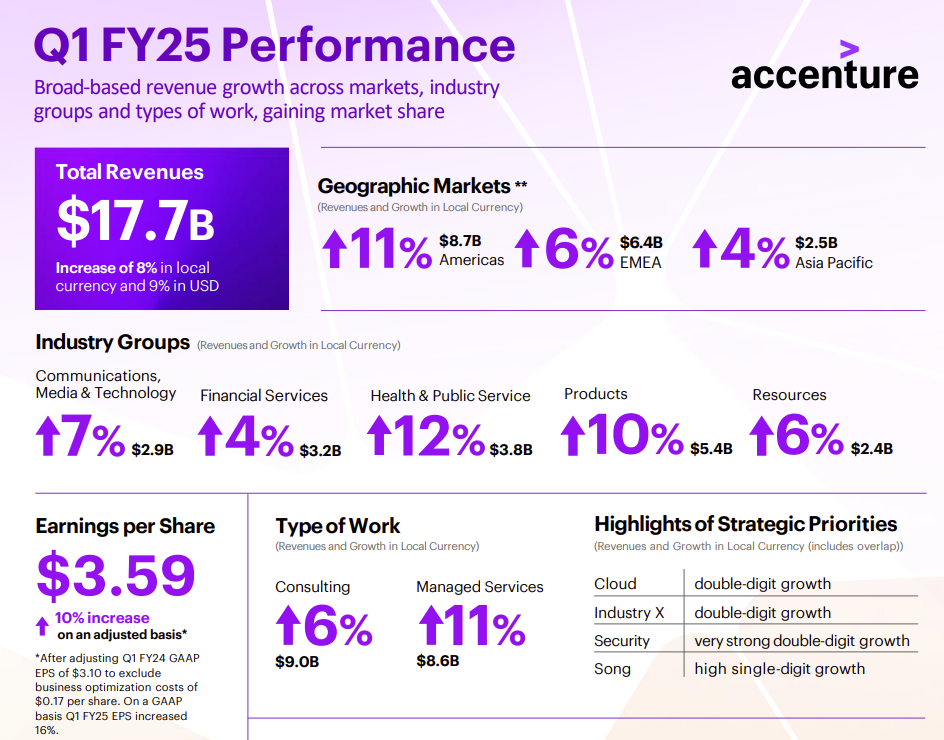
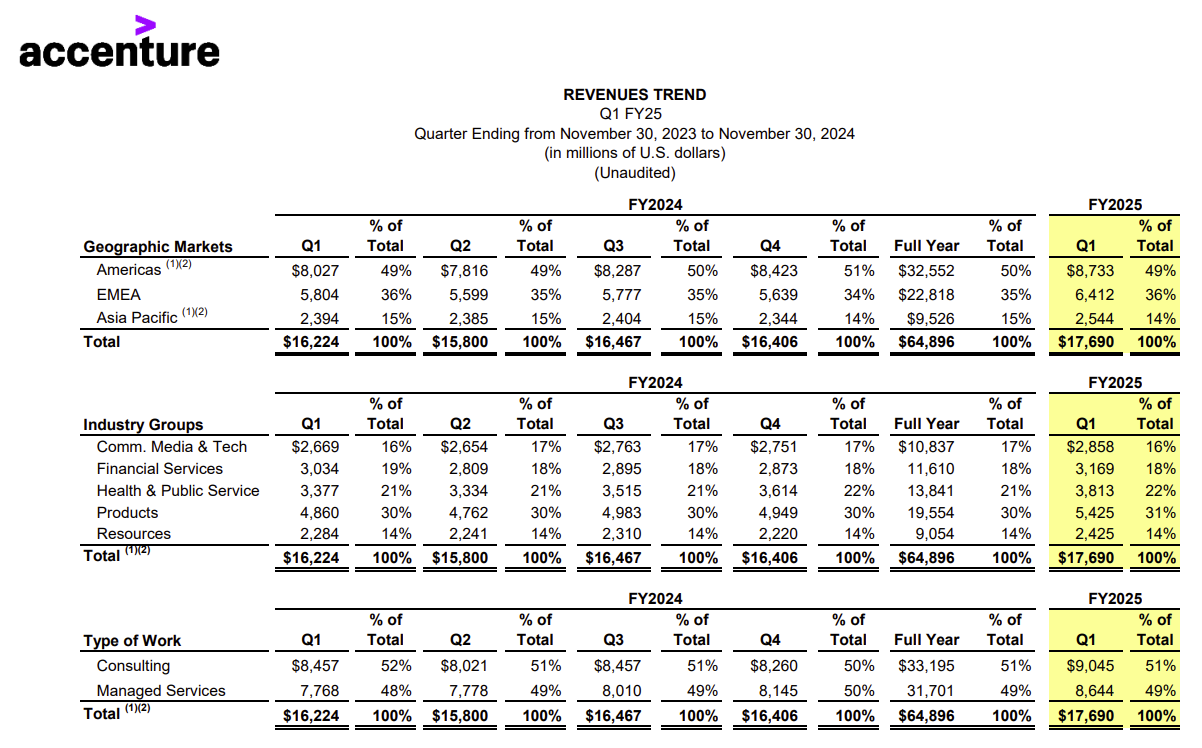
That outlook was better than expected. Accenture also topped estimates for the first quarter with earnings of $3.59 a share on revenue of $17.7 billion, up 9.3% from a year ago. Earnings were 20 cents a share better than estimates and revenue was $570 million above targets.
Accenture has been able to land new bookings for generative AI projects even as new booking overall are flat. Generative AI bookings in the first quarter were $1.2 billion. Overall, Accenture landed first quarter bookings of $18.7 billion, up 1% from a year ago.
Julie Sweet, Accenture's CEO, said the company saw revenue growth in consulting and managed services across industries. In the first quarter, Accenture had 30 bookings of more than $100 million. "We continued to lead in helping our clients realize value with generative AI," she said.
By industry group, Accenture reported first quarter revenue growth between 4% and 13%. Health and public service industry drove the strongest growth.
On the earnings call, Sweet said:
"Starting with the demand environment, we saw more of the same. Our clients are focused on reinvention, which means large-scale transformations. We do not currently see an improvement in overall spending by our clients, particularly on smaller deals. When those market conditions improve, we will be well-positioned to capitalize on them, as we continue to meet the demand for the critical programs our clients are prioritizing."
GenAI continues to be a catalyst for reinvention across the enterprise and building out the data foundation necessary to capitalize on AI, as an increasing part of that growth. Themes around achieving both cost efficiencies and growth continue across the demand we're seeing."
Constellation Research analyst Holger Mueller said:
"Accenture had a good quarter, considering that the services business is affected by the AI trend both in a positive and a challenging way. In a positive way: enterprises need help to leverage AI. The negative is that AI makes many tasks easier to implement, thus requiring less of consultant help. Accenture's managed services business on the other side is doing well, with new bookings in managed services for the first time surpassing the (traditional) consulting business. A relatively stronger performance in Europe was a positive surprise as well. Now it is all about how Accenture can further leverage the AI era."
Vice President and Principal Analyst
Constellation Research
Chirag Mehta is Vice President and Principal Analyst focusing on cybersecurity, next-gen application development, and product-led growth.
With over 25 years of experience, he has built, shipped, marketed, and sold successful enterprise SaaS products and solutions across startups, mid-size, and large companies. As a product leader overseeing engineering, product management, and design, he has consistently driven revenue growth and product innovation. He also held key leadership roles in product marketing, corporate strategy, ecosystem partnerships, and business development, leveraging his expertise to make a significant impact on various aspects of product success.
His holistic research approach on cybersecurity is grounded in the reality that as sophisticated AI-led attacks become…...
Former Vice President and Principal Analyst
Constellation Research
Doug Henschen is former Vice President and Principal Analyst where he focused on data-driven decision making. Henschen’s Data-to-Decisions research examines how organizations employ data analysis to reimagine their business models and gain a deeper understanding of their customers. Henschen's research acknowledges the fact that innovative applications of data analysis requires a multi-disciplinary approach starting with information and orchestration technologies, continuing through business intelligence, data-visualization, and analytics, and moving into NoSQL and big-data analysis, third-party data enrichment, and decision-management technologies.
Insight-driven business models are of interest to the entire C-suite, but most particularly chief executive officers, chief digital officers,…...
Vice President and Principal Analyst
Constellation Research
Holger Mueller is VP and Principal Analyst for Constellation Research for the fundamental enablers of the cloud, IaaS, PaaS and next generation Applications, with forays up the tech stack into BigData and Analytics, HR Tech, and sometimes SaaS. Holger provides strategy and counsel to key clients, including Chief Information Officers, Chief Technology Officers, Chief Product Officers, Chief HR Officers, investment analysts, venture capitalists, sell-side firms, and technology buyers.
Coverage Areas:
Future of Work
Tech Optimization & Innovation
Background:
Before joining Constellation Research, Mueller was VP of Products for NorthgateArinso, a KKR company. There, he led the transformation of products to the cloud and laid the foundation for new Business Process as a…...
Editor in Chief of Constellation Insights
Constellation Research
Larry Dignan is Editor in Chief of Constellation Insights at Constellation Research, where he leads editorial coverage focused on enterprise technology, digital transformation, and emerging trends shaping the future of business. He oversees research-driven news, analysis, interviews, and event coverage designed to help technology buyers and vendors navigate complex markets with clarity and context. ...
Vice President & Principal Analyst
Constellation Research
About Liz Miller:
Liz Miller is Vice President and Principal Analyst at Constellation, focused on the org-wide team sport known as customer experience. While covering CX as an enterprise strategy, Miller spends time zeroing in on the functional demands of Marketing and Service and the evolving role of the Chief Marketing Officer, the rise of the Chief Experience Officer, the evolution of customer engagement, and the rising requirement for a new security posture that accounts for the threat to brand trust in this age of AI. With over 30 years of marketing experience, Miller offers strategic guidance on the leadership, business transformation, and technology requirements to deliver on today’s CX strategies. She has worked with global marketing organizations to transform everything from…...
Vice President and Principal Analyst
Constellation Research
Martin Schneider has had a unique career that has spanned both analyst and marketing practitioner roles, focused on high technology and related industries. The unifying factor has always been both a keen analysis of go-to-market trends, while also having achieved success as a marketing leader.
Schneider started his career as a journalist covering B2B technologies, and quickly transitioned into a leading analyst covering application software for the 451 Group in NYC, where he specialized in CRM, marketing automation, and business intelligence/analytics technologies. After analyzing various go-to-market strategies of dozens of technology vendors, Schneider made the move to the vendor side, where he led successful go-to-market teams for several startups and established tech providers,…...
Principal Analyst and Founder
Constellation Research
R “Ray” Wang is the CEO of Silicon Valley-based Constellation Research Inc. He co-hosts DisrupTV, a weekly enterprise tech and leadership webcast that averages 50,000 views per episode and blogs at www.raywang.org. His ground-breaking best-selling book on digital transformation, Disrupting Digital Business, was published by Harvard Business Review Press in 2015. Ray's new book about Digital Giants and the future of business, titled, Everybody Wants to Rule The World was released in July 2021. Wang is well-quoted and frequently interviewed by media outlets such as the Wall Street Journal, Fox Business, CNBC, Yahoo Finance, Cheddar, and Bloomberg.
Short Bio
R “Ray” Wang (pronounced WAHNG) is the Founder, Chairman, and Principal Analyst of Silicon Valley-based Constellation Research Inc. He…...
ð‘Šð‘Žð‘›ð‘¡ ð‘¡ð‘œ ?ð‘’ð‘Žð‘Ÿ ð¶ð‘œð‘›ð‘ ð‘¡ð‘’ð‘™ð‘™ð‘Žð‘¡ð‘–ð‘œð‘›'ð‘ ð‘¡ð‘Žð‘˜ð‘’ ð‘œð‘› ð‘¡?ð‘’ "ð‘ð‘’ð‘ ð‘¡" ð‘Žð‘›ð‘‘ "ð‘¤ð‘œð‘Ÿð‘ ð‘¡" ð‘–ð‘› ð‘¡ð‘’ð‘?? Look no further! The 2024 Enterprise Awards are here... 👠??
In many ways, the themes dominating 2024 were a continuation of the hashtag#generativeAI revolution started in 2023. Then the switch flipped from generative AI to hashtag#agenticAI and hashtag#CxOs started to focus on returns and production deployments.
👋 So long proofs of concept and hello returns on investment. 📈 This more practical AI spin featured familiar players, rejuvenated giants, and emerging vendors. The 2024 picks demonstrated the ability to navigate an hashtag#enterprise technology landscape that changed every few months.
Our team debated, horse traded, and bickered to pick this year's Enterprise Award Winners. Enjoy, and let us know if you agree...
Vice President & Principal Analyst
Constellation Research
About Liz Miller:
Liz Miller is Vice President and Principal Analyst at Constellation, focused on the org-wide team sport known as customer experience. While covering CX as an enterprise strategy, Miller spends time zeroing in on the functional demands of Marketing and Service and the evolving role of the Chief Marketing Officer, the rise of the Chief Experience Officer, the evolution of customer engagement, and the rising requirement for a new security posture that accounts for the threat to brand trust in this age of AI. With over 30 years of marketing experience, Miller offers strategic guidance on the leadership, business transformation, and technology requirements to deliver on today’s CX strategies. She has worked with global marketing organizations to transform everything from…...
Vice President and Principal Analyst
Constellation Research
About Andy Thurai
Andy Thurai is an accomplished IT executive, strategist, advisor, enterprise architect and evangelist with more than 25 years of experience in executive, technical, and architectural leadership positions at companies such as IBM, Intel, BMC, Nortel, and Oracle. Andy has written more than 100 articles on emerging technology topics for publications such as Forbes, The New Stack, AI World, VentureBeat, DevOps.com, GigaOm and Wired.
Andy’s fields of interest and expertise include AIOps, ITOps, Observability, Artificial Intelligence, Machine Learning, Cloud, Edge, and other enterprise software. His strength is selling technology to the CxO audience with a value proposition rather than the usual technology sales pitch.
Find more details and samples of Andy’s work on his…...
Former Vice President and Principal Analyst
Constellation Research
Doug Henschen is former Vice President and Principal Analyst where he focused on data-driven decision making. Henschen’s Data-to-Decisions research examines how organizations employ data analysis to reimagine their business models and gain a deeper understanding of their customers. Henschen's research acknowledges the fact that innovative applications of data analysis requires a multi-disciplinary approach starting with information and orchestration technologies, continuing through business intelligence, data-visualization, and analytics, and moving into NoSQL and big-data analysis, third-party data enrichment, and decision-management technologies.
Insight-driven business models are of interest to the entire C-suite, but most particularly chief executive officers, chief digital officers,…...
Editor in Chief of Constellation Insights
Constellation Research
Larry Dignan is Editor in Chief of Constellation Insights at Constellation Research, where he leads editorial coverage focused on enterprise technology, digital transformation, and emerging trends shaping the future of business. He oversees research-driven news, analysis, interviews, and event coverage designed to help technology buyers and vendors navigate complex markets with clarity and context. ...
Principal Analyst and Founder
Constellation Research
R “Ray” Wang is the CEO of Silicon Valley-based Constellation Research Inc. He co-hosts DisrupTV, a weekly enterprise tech and leadership webcast that averages 50,000 views per episode and blogs at www.raywang.org. His ground-breaking best-selling book on digital transformation, Disrupting Digital Business, was published by Harvard Business Review Press in 2015. Ray's new book about Digital Giants and the future of business, titled, Everybody Wants to Rule The World was released in July 2021. Wang is well-quoted and frequently interviewed by media outlets such as the Wall Street Journal, Fox Business, CNBC, Yahoo Finance, Cheddar, and Bloomberg.
Short Bio
R “Ray” Wang (pronounced WAHNG) is the Founder, Chairman, and Principal Analyst of Silicon Valley-based Constellation Research Inc. He…...
Vice President and Principal Analyst
Constellation Research
Holger Mueller is VP and Principal Analyst for Constellation Research for the fundamental enablers of the cloud, IaaS, PaaS and next generation Applications, with forays up the tech stack into BigData and Analytics, HR Tech, and sometimes SaaS. Holger provides strategy and counsel to key clients, including Chief Information Officers, Chief Technology Officers, Chief Product Officers, Chief HR Officers, investment analysts, venture capitalists, sell-side firms, and technology buyers.
Coverage Areas:
Future of Work
Tech Optimization & Innovation
Background:
Before joining Constellation Research, Mueller was VP of Products for NorthgateArinso, a KKR company. There, he led the transformation of products to the cloud and laid the foundation for new Business Process as a…...
Former Vice President and Principal Analyst
Constellation Research
Steve Wilson is former VP and Principal Analyst at Constellation Research, leading the business theme Digital Safety and Privacy. His coverage includes digital identity, data protection, data privacy, cryptography, and trust. His advisory services to CIOs, CISOs, CPOs and IT architects include identity product strategy, security practice benchmarking, Privacy by Design (PbD), privacy engineering and Privacy [or Data Protection] Impact Assessments (PIA, DPIA).
Coverage Areas:
- Identity management, frameworks & governance- Digital identity technologies- Privacy by Design
- Big Data; “Big Privacy”- Identity & privacy innovation
Previous experience:
Wilson has worked in ICT innovation, research, development and analysis for over 25 years. With double…...
Vice President and Principal Analyst
Constellation Research
Chirag Mehta is Vice President and Principal Analyst focusing on cybersecurity, next-gen application development, and product-led growth.
With over 25 years of experience, he has built, shipped, marketed, and sold successful enterprise SaaS products and solutions across startups, mid-size, and large companies. As a product leader overseeing engineering, product management, and design, he has consistently driven revenue growth and product innovation. He also held key leadership roles in product marketing, corporate strategy, ecosystem partnerships, and business development, leveraging his expertise to make a significant impact on various aspects of product success.
His holistic research approach on cybersecurity is grounded in the reality that as sophisticated AI-led attacks become…...
Vice President and Principal Analyst
Constellation Research
Martin Schneider has had a unique career that has spanned both analyst and marketing practitioner roles, focused on high technology and related industries. The unifying factor has always been both a keen analysis of go-to-market trends, while also having achieved success as a marketing leader.
Schneider started his career as a journalist covering B2B technologies, and quickly transitioned into a leading analyst covering application software for the 451 Group in NYC, where he specialized in CRM, marketing automation, and business intelligence/analytics technologies. After analyzing various go-to-market strategies of dozens of technology vendors, Schneider made the move to the vendor side, where he led successful go-to-market teams for several startups and established tech providers,…...
In many ways, the themes that dominated 2024 were a continuation of the generative AI revolution started in 2023. And then the switch flipped from generative AI to agentic AI and CxOs started to focus on returns and production deployments.
So long proofs of concept and hello returns on investment. This more practical AI spin featured familiar players--Nvidia, Microsoft, Amazon Web Services and Google Cloud--with rejuvenated giants such as Salesforce and emerging vendors including Anthropic, Rubrik and Kong.
The technology vendors in this year's Enterprise Awards have shown the ability to navigate an enterprise technology landscape that changes every few months. The Constellation Research team debated, horse traded and bickered to pick this year's 2024 Constellation Enterprise Award Winners. Enjoy.
BEST ENTERPRISE SOFTWARE VENDOR
This category recognizes the enterprise software vendor who improved their customer relevance, market share, customer satisfaction, and brand standing.
Google had a lead in custom algorithms on custom silicon (TensorFlow on TPUs) and started in 2014. Now with Trillium, Google has maintained its lead over its fellow cloud competitors. Google is on its 6th iteration of custom AI silicon and the competition is on its second.
Multimodal lead. Humans are inherently multimodal and for AI to have a shot to be general AI it needs to be multimodal. Google was the first with Gemini at Google Cloud Next, now it is pushing further with native Gemini Flash 2.0, which uses Trillium as its platform. It is the first multimodal model that doesn’t have to call on other models to be multimodal. All modalities are trained together.
Just when we got comfortable with agentic AI, Google has pushed on into autonomous AI. Its coding AI agent Jules identifies what code to write, bug to fix (in JavaScript and Python) and can put it on GitHub. Google is making software development autonomous and moving into the era of Autonomous Software Operations (where software writes itself, delivers and operates itself - more here.)
Google shows a broader leverage of its models which creates 2+2=5 synergies: Project Astra uses Gemini 2.0, has a 10-minute memory window and can use Google Search. Project Mariner also uses Gemini 2.0 in the Chrome browser. Collab provides automatic insights from data in notebooks with language discovery with Gemini 2.0. Finally, Google is going vertical (already) with research and gaming offerings.
CO-WINNER: SALESFORCE
Why did they win?
For the longest time Salesforce seemed to be stuck on its 20+ year old architecture. In 2022 at Dreamforce, Salesforce departed from that architecture with the launch of Genie (now Data.com). That innovation has put Salesforce on a new, innovative platform trajectory.
Fast forward to Dreamforce 2024 and Salesforce has achieved four unique feats that make them the winner of the 2024 best enterprise software vendor award:
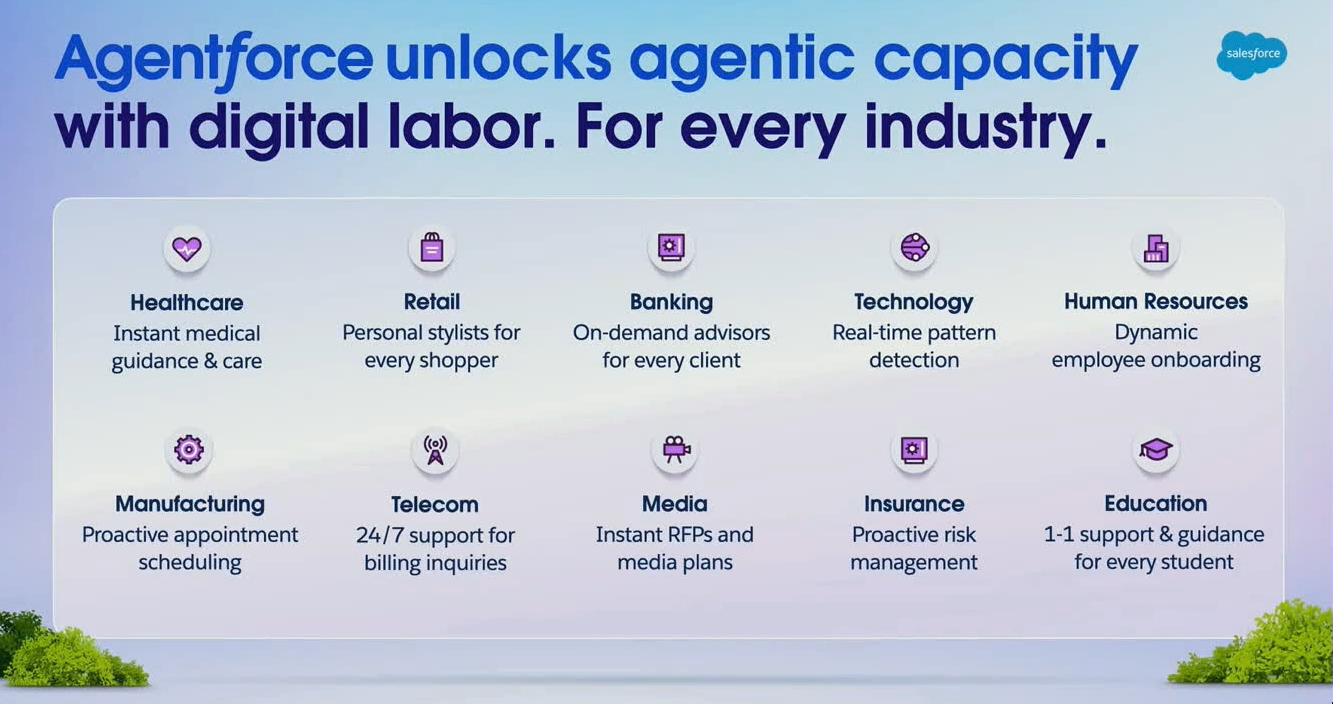
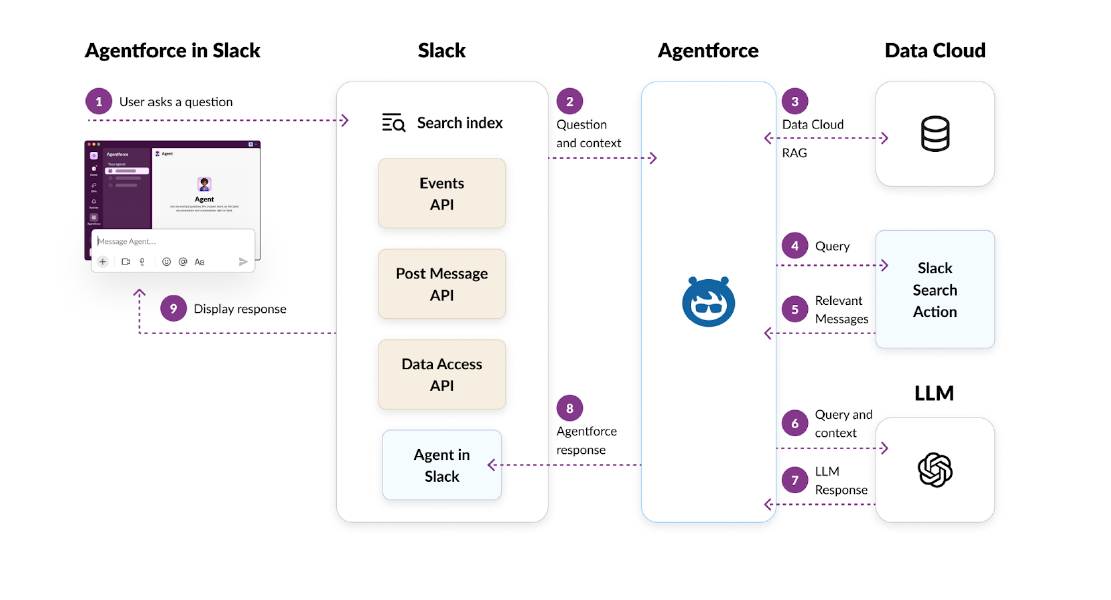
Salesforce was among the first vendors to unleash an agent-based offering with Agentforce, thus ushering the era of agentic AI, not in PowerPoint, but in actual available (and paid for) enterprise software.
Salesforce showed continuous and systematic platform building from the launch of Genie to Einstein to Einstein Copilot and now Agentforce. No other software vendor has a 2+ year platform evolution strategy to serve the enterprise like Salesforce.
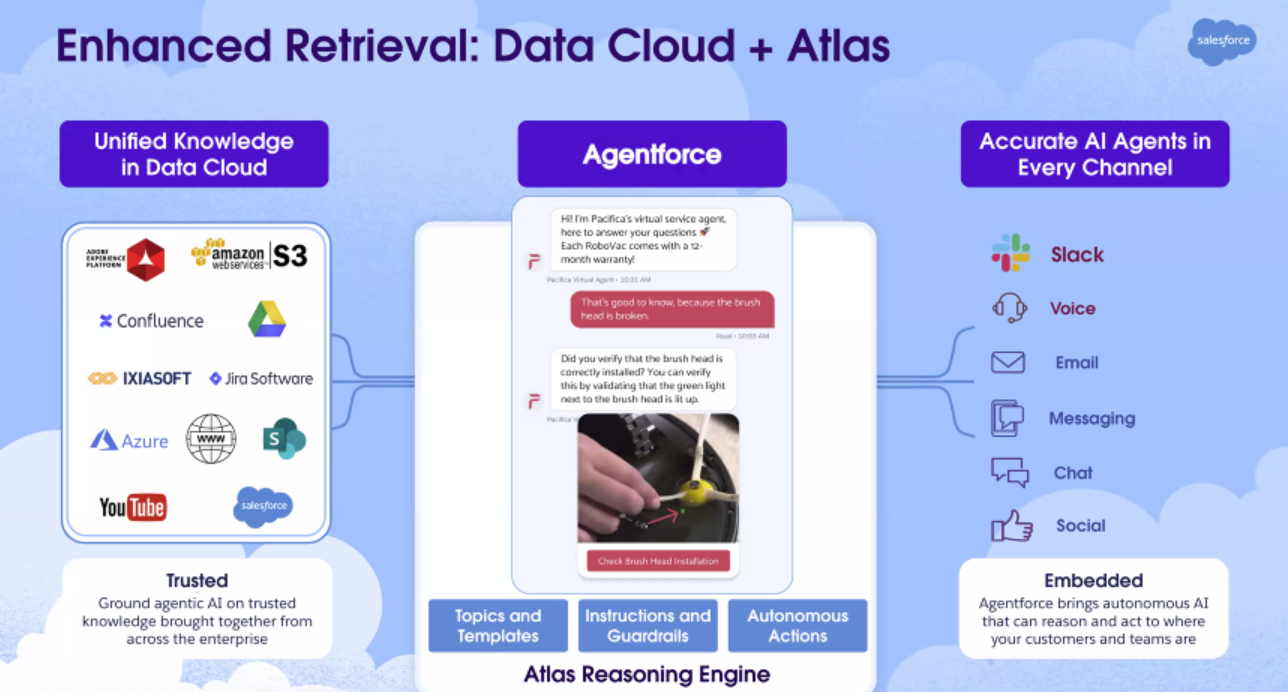
Salesforce was the first enterprise vendor to access the data that matters for enterprises--transactional data--via its Atlas Reasoning Engine. Until Atlas, generative AI was limited to the transformer algorithm-based document centric ingestion and generation. That approach is of course transformative, but enterprises run on data and transactions and Salesforce is the first enterprise vendor to unleash GenAI to both data sets.
Enterprise vendors typically announce their plans at their user conferences and deliver capabilities months later. But Salesforce at Dreamforce 2024 pre-equipped 1,000 customers with Agentforce and had company attendees build agents during Dreamforce. The expectation was one agent per customer, but attendees were so inspired they ended up building 10 agents per customer on average. That proof point highlights how easy Salesforce has enabled the creation and operation of agents.
Congrats to Salesforce, which has shown that we are in the PaaS age and not the DIY era of AI in the enterprise.
RUNNERS UP: ServiceNow
Why were they recognized?
Call ServiceNow an AI platform, an automation and workflow platform or call them a platform of platforms. ServiceNow spent 2024 working to corner the market of putting AI to action and work. From its Workflow Data Fabric to over 150 GenAI applications across its Now Platform, ServiceNow got specific with upgrades to processes with a healthy dose of GenAI governance. On the functional front, ServiceNow focused on partnerships with key functional solutions to bring data and workflows out of functional silos, announcing major initiatives with contact center solutions like Genesys and Five9. ServiceNow CEO Bill McDermott has also issued a promise for business: ServiceNow is here to make business fun again. After years of pushing data, workflow and AI rocks up chaotic hills, businesses are ready for some of that fun.
This category recognizes the best enterprise CEO. Enough said.
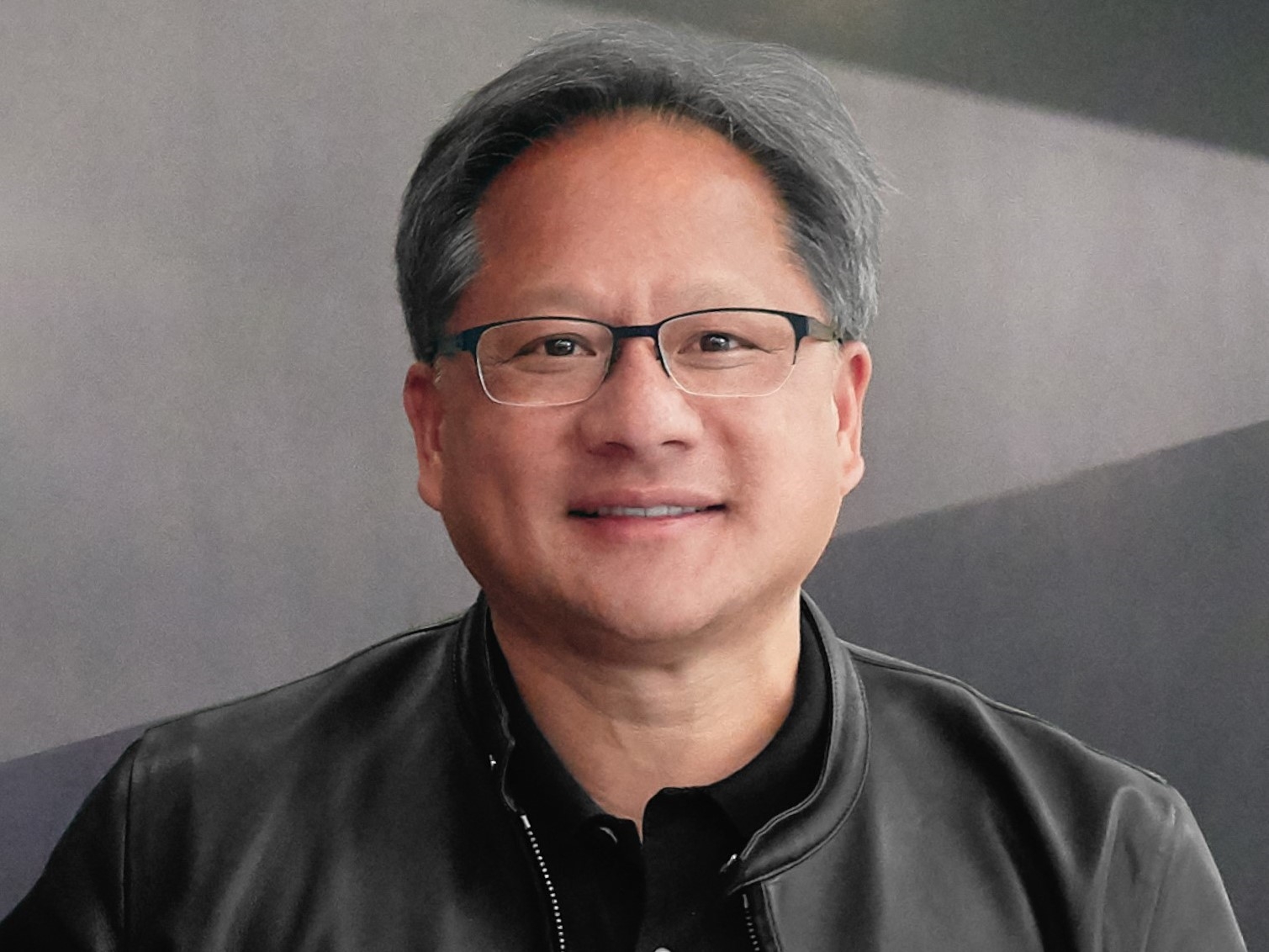
WINNER: JENSEN HUANG, NVIDIA
Why did they win?
If there is one CEO in enterprise tech who has managed a growth curve well, it is Nvidia’s Jensen Huang. Never has a tech vendor managed growth from single digit billions of triple digit billions in such a short time, so successfully. Yes, timing is everything, but if Huang had not seeded Nvidia machines to OpenAI in 2016 it wouldn’t be where it is today.
But credit does not only go to Huang for betting on its own platform, but also for surrounding himself with great talent. Chips can only scale when abundant talent is around: Nvidia’s four company officers have been around since 2003 (longest) to 2017 (shortest). Simply put, Huang hired talent that can scale for the AI era boom.
Working with the same team allowed Huang also to do something that the chip industry has struggled with - growing the supply chain. While Nvidia has recently run into some supply challenges, it has not hurt its growth path. And finally, the semiconductor industry that is accustomed to release major platforms on a two-year cycle, was pushed single handedly into a one-year cycle by Huang. He knows Nvidia will need to more beyond chips and has successfully moved up the technology stack with CUDA and NIMs. An added bonus is Huang is always an insightful, incredibly humble and interesting CEO to see on dozens of tech keynotes.
If you attended or watched Amazon Web Services re:Invent 2024 event, you had to come away impressed by the company’s new CEO, Matt Garman. Had this unflappable straight shooter taken the helm of the company earlier in the year, rather than on June 3, 2024, he would have been our hands-down pick for Best CEO of 2024. Good things happened after Garman took charge, starting with the Oracle-AWS partnership, announced on September 9, and culminating in a powerhouse re:Invent that saw AWS solidify its AI roadmap with significant product announcements and introductions. Garman oozes credibility and in-depth knowledge of all things AWS, having joined the company as an MBA intern in 2005 before becoming one of its first product managers in 2006. More importantly, Garman believes in customer choice and makes their wants and needs the top priority, whether best served by AWS or by third-party partners.
Barak Eilam first joined NICE 25 years ago, taking on the CEO role 10 years ago. In his tenure, total revenue has tripled, and profitability has increased 4x and market value has increased 7x for the now $14 billion dollar contact center company. Through his leadership, NICE is a consistently recognized leader in Contact Center as a Service (CCaaS) and is poised to look beyond the contact center function and into a more expansive service-led customer engagement platform with a solid underpinning of AI. He is also a good person with conviction, humility and a distinct need to help people around him. His upcoming “retirement” will likely see him spearheading both philanthropic and entrepreneurial endeavors.
BEST ENTERPRISE SERVICES VENDOR
This category recognizes the enterprise services vendor that transforms delivery models and crafts new client–centric market approaches.
WINNER: ACCENTURE
Why did they win?
The services market has been brutal with the major players growing in the mid-single digits. Despite no promotions or advancement for employees in this current cycle, Accenture has weathered the AI storm quite well. While other services firms were talking about AI, Accenture took every opportunity to engage clients with live POC’s and demos to help clients quickly adopt to the changing landscape. Accenture has achieved more than $1 billion in AI associated revenue, and that 10X growth from $100 million just last year is quite impressive. The loss of Global CTO Paul Daugherty in September to retirement will be felt by clients for years to come, but the shift to AI will forever change the services landscape. Accenture has taken a first mover advantage and competitors and customers have taken note.
RUNNERS UP: PERSISTENT SYSTEMS
Why were they recognized?
Prior to Sandeep Kalra’s arrival, Persistent had been stagnant in growth at $500 million in revenue, but under Kalra’s leadership, the company grew and crossed the $1 billion mark in 2023. Over the past four years, Persistent has transformed from a specialized technology provider into a trusted digital transformation partner and global brand competing against the Tier 1 global system integrators. In October 2024, the company achieved a $345.5 million quarter, showing an 18.4% YoY growth. Persistent is making a name for itself in BFSI, healthcare, and high tech and emerging industries.
BEST ENTERPRISE SOFTWARE STARTUP
This category recognizes when an enterprise software startup achieves escape velocity in mind share and relevance.
WINNER: WIZ
Why did they win?
Wiz has demonstrated exceptional growth, achieving $500 million in ARR and is aiming for $1 billion ARR by 2025. This trajectory underscores its significant impact in the cloud security sector. In July 2024, Wiz declined a $23 billion acquisition offer from Google, opting to pursue its own path toward an IPO. This decision reflects Wiz’s confidence in its long-term potential, strategy, and commitment to innovation. Wiz has also expanded its capabilities through acquisitions, such as the recent purchase of Gem Security. Wiz is not just executing as the best start-up; it’s executing as one of the best enterprise software companies of any size.
RUNNERS UP: KONG
Why were they recognized?
Kong, a startup focused on cloud API technologies, raised $175 million Series E financing at a valuation of $2 billion. It remains to be seen if Kong can thrive in the cloud API ecosystem. Certainly, demand is there. Kong is looking to capitalize on a surge in API call demand largely due to cloud connections to large language models.
BEST AI LAUNCH
This category recognizes the enterprise partnership that delivered the most impact for customers and the market.
WINNER: ADOBE
Why did they win?
Adobe launched significant upgrades, updates and new models and integrations across its applications and platform in 2024. Simply put: Adobe didn’t have an AI launch, but rather multiple AI solution launches coupled with highly usable and creative and productivity enhancing AI tools. These tools were then launched directly into existing interfaces and applications used by creative, business and marketing users. While the most notable and visible were introductions of upgrades to the Adobe Firefly Family of Models—specifically Image, Vector, Design and Video—Adobe also launched AI services across its Digital Experience (AI Assistant in Adobe Experience Platform, personalization in Journey Optimizer, content analytics and behavior analytics in Adobe Analytics, GenAI enhancements to create personalized content across Adobe Experience Manager) and Document Cloud (Acrobat AI Assistant includes multiple AI and GenAI driven services).
While the individual AI products or services are impressive on their own, it is the totality of AI being infused directly into Adobe’s portfolio of creative and business applications and across their engagement-centric Adobe Experience Platform that matters. The proof of AI’s value to Adobe was revealed in Q4 and 2024 earnings with CEO Shantanu Narayan noting that the company attributes more than $2 billion in Digital Media (which represents the Creative Cloud and Document Cloud business groups) net new ARR. Bottom line: customers are USING AI, not just testing or experimenting. Customers have initiated over 16 billion Firefly powered generations, with new records being set every month.
Specific to a new 2024 AI launch, the Adobe Acrobat AI Assistant saw AI Assistant conversations double quarter-over-quarter. The AI launches in 2024 have kicked off headwinds for all three major business groups moving into 2025, but customers in multiple segments are tapping into the company’s generative AI tools across Adobe’s portfolio.
RUNNERS UP: SALESFORCE AGENTFORCE
Why were they recognized?
Salesforce’s entire Dreamforce event could have just been called Agentforce. The company put on a full court press around its agentic AI play and touted more than 2,000 AI agents created during the event. But more than a no code platform for building agents, Agentforce is including several out of the box AI agents as part of the launch. Highlights were their AI sales development rep, which enabled business development teams to instantly become global, 24-7 lead development engines. Another solid agent was their sales coaching agent, which provides in-line and contextual coaching to sales reps. Salesforce now has several pre-built agents, covering sales, service and marketing campaign building use cases.
RUNNERS UP: MAJOR LLM PROVIDERS
Why were they recognized?
The LLM race used to be more about genAI, which is used to generate things like text, chats, images, video, etc. But they are moving to the next level from seamless multi-modality such as the ability to digest input in NLP, text, image, video, etc., and provide output back in the needed format. Also, expanding the language usage from just English to the most common languages.
Each has its own variation to make this a winner. Meta’s Llama models proved that open source models can compete toe-to-toe against the big boys. OpenAI continues to innovate at a fast pace keeping everyone on their toes. Google is bringing the multi-modality, governance, and trustworthiness to the forefront. Anthropic is making things a lot better and cheaper. So many things that happened so fast.
And LLM vendors can command a premium. OpenAI recently announced the price hike from $20/user/month to $200/user/month.
Overall, generative AI has come a long way in 2024 alone. It is enterprise-ready in many ways. AI is moving from the experimentation state to the production stage.
BEST PARTNERSHIP
This category recognizes the enterprise partnership that delivered the most impact for customers and the market.
WINNER: AWS & ORACLE
Why did they win?
Moving past years of competitive sniping, Oracle and Amazon Web Services forged a pragmatic partnership that’s an overdue acknowledgement of customer requirements. The deal made the leading enterprise-grade database services (Oracle Autonomous Database and the Oracle Exadata Database Service) and the leading open-source database (MySQL/MySQL Heatwave) available with the blessings of both companies (as well as clear licensing terms and support arrangements) on the most popular public cloud. It’s unclear whether the CEO change at AWS or whether the influence of one or more mega customers finally made this partnership possible, but it’s good for all customers, as they are now able to leverage their substantial investments in Oracle tech while still running everything else on their preferred cloud platform.
While still in early days, ServiceNow’s partnership with Five9 is about a massive future opportunity for customers looking to connect more dots between platforms, data, experiences and people. Announced in November and expected to be available in early 2025, this partnership drives well beyond APIs or marketplaces with a turnkey AI-powered solution for unified end-to-end employee and customer experiences. The unified offering will pluck the best of both worlds to offer a single, integrated capability living in a user’s platform of choice. Five9’s TranscriptStream will integrate into ServiceNow’s Interaction Management and into the Now platform. ServiceNow has established multiple functional partnerships, and in earnest, the Five9 partnership expansion is just the latest with others, most notably with Genesys, paving the way. Expect to see this functional expansion continue into 2025.
BEST TECH ACQUISITION
This category recognizes the enterprise tech acquisition that has the most impact for customers, market landscape, and the overall industry direction.
WINNER: SAP + WALKME
Why did they win?
Is software valuable if nobody actually uses it? Are AI Agents worth the effort if nobody ever contributes or leverages them? It was clear from the very first words of SAP CEO Christian Klein Sapphire keynote, use and adoption matter more now than ever. That approach is what makes the acquisition of Digital Adoption Platform darling, WalkMe, interesting. As SAP works to guide workflows across applications, the vision here is for WalkMe to become SAP’s window into adoption and the pace and advancement of business transformation goals.
RUNNERS UP: HPE + JUNIPER
Why were they recognized?
HPE announced the purchase of Juniper Networks for $14 billion in a move that would give it a unified AI stack. That deal is now expected to close in early 2025. HPE CEO Antonio Neri touted the benefits of the deal in December. "Both HPE and Juniper continue to believe the transaction will enable us to provide a complete portfolio of modern, secure networking solutions that offer essential foundations for both Hybrid Cloud and AI," he said. "This transaction will also strengthen U.S. National Security interests by advancing HPE's position as a strong U.S. Innovator among global technology companies."
RUNNERS UP: COHesity + veritas
Why were they recognized?
With the acquisition Veritas closing, Cohesity becomes the fastest company to cross $1.5 billion revenue, "Rule of 40", in just 11 years since their founding - and on a path to $2 billion revenue goal soon. With more than 12,000 customers, the combined company will have more than 85% of the Fortune 100, 70% of the Global 500, the broadest portfolio in the industry and 2x the engineering resources compared to others. Nvidia has also invested in Cohesity.
WORST TECH ACQUISITION
This category recognizes the enterprise tech acquisition that had the least impact for customers, market landscape, and the overall industry direction.
WINNER: ALPHABET AND ANYBODY
Why did they win?
There are only so many times companies can say no to your offers until you wonder, “Was it me?” In the case of Alphabet and their track record of potential mergers and acquisitions in 2024, two power players in two different markets said no at two very different stages of the relationship. Both left egg on the face of a company better known for its business bravado than its acquisition humility.
In fairness to Alphabet and the Google brand, the Hubspot “deal” was more of a rumor. Hubspot could have been another tale of woe in the long history of ‘Google struggles with business applications, but the two parties wisely agreed to part as friends. Wiz similarly declined to push the proposed deal to any substantive stage, publicly choosing to bet on themselves which helped cement their “Best Startup for 2024” status. All in all, Alphabet knocked on a lot of acquisition doors to expand its footing, increase workloads in cloud and secure new lines of revenue to no avail.
RUNNERS UP: Broadcom + vmware
Why were they recognized?
Broadcom's purchase of VMware looked swell in PowerPoint. Broadcom would broaden its revenue base in software, simplify and raise prices and keep an installed base. Unfortunately, VMware customers were irked and the competition is swirling. Nutanix is likely the biggest beneficiary of VMware angst, but how those workloads get moved will be a trend to watch in 2025. Broadcom has turned the VMware deal into a huge financial success, but what’s in it remains to be seen what’s in it for customers.
BEST NEW IPO
This category recognizes the most successful IPO for the year
WINNER: Reddit
Why did they win?
When Reddit went public in 2024, it wasn't hard to find skeptics. In its short life as a public company, Reddit has proved naysayers wrong as the social network has leveraged content provided by real humans for the AI age. In its third quarter, Reddit delivered $29.9 million in profit and revenue of $348.4 million, up 68% from a year ago. Daily active users on Reddit were 97.2 million, up 47% from a year ago. Fourth quarter revenue is projected to be in the range of $385 million to $400 million. Reddit has forged partnerships with OpenAI, Google and is providing training data to models.
Next up: Reddit is aiming to improve its search experience and CEO Steve Huffman said: "We know many users are looking for more than just answers; they are looking for authentic, real-world insights and advice from the communities on Reddit."
RUNNERS UP: rubrik
Why were they recognized?
Rubrik, a data management and cybersecurity company, went public in April at $32 a share and now has more than doubled. However, the company traded below its IPO price after rocky earnings before the big rebound. Rubrik's offerings are resonating with larger enterprises, and the company has surpassed $1 billion in subscription annual recurring revenue, up 38% in the third quarter compared to a year ago. Rubrik's third quarter revenue was $236.2 million, up 43% from a year ago. Yes, Rubrik is still posting losses, but partnerships with AWS, Pure Storage and Okta signal more enterprise traction ahead.
BEST NEW ENTERPRISE CATEGORY
This category recognizes the best new enterprise category that made an impact to the market.
WINNER: agentic ai
Why did it win?
If there was one new technology concept that commandeered both the tech media but also most company roadmaps it would have to be agentic AI. While generative AI owned the cycles in 2023; 2024 quickly became the burgeoning age of autonomous agents. When Salesforce, Oracle, ServiceNow, SAP and Microsoft are stumbling over to scoop each other’s agentic AI announcements, you know it’s a big deal. Nearly every major player in software made some announcement around agentic AI, and those that failed to do so are seen as lagging.
What made agentic AI the hottest new category? Arguably the fact that this is one of the most quickly deployed new technologies both in terms of being embedded in key software portfolios but also being used by enterprise organizations. Also, users have been building both muscle memory and comfort levels with all the generative AI “copilot” announcements and releases over the past two years, so agentic AI was a smooth and natural evolution. These new autonomous agents have been delivered with no code tool sets to speed their uptake, and the results speak for themselves, with companies like Salesforce touting more than 2500 deployed agents to date.
And why is agentic AI a category and not a feature set of AI? Because it changes the game and has implications across every facet of tech. The goal of AI is to aid in decision-making, and optimizing the moments where humans need to make decisions and reducing the number of unnecessary human actions and decisions in any given workflow. That means agentic AI will become prevalent across not just the use of technology, but also the building, testing, configuring, managing and distribution of technology. It will, in short, be an inevitable part of our daily lives across work and personal activities. No other technology has had this large of an impact, this quickly, since the public internet itself.
RUNNERS UP: decision intelligence
Why was it recognized?
Decision Intelligence or Decision Automation is the natural extension of why we have AI. The goal is to achieve decision velocity inside an organization to gain efficiencies and accelerate business. Look for this theme to emerge in 2025 and beyond.
BEST NEW ENTERPRISE SOFTWARE MARKETING OF THE YEAR
This category showcases the best marketing campaign, ad, or perception transformation in the enterprise.
WINNER: atlassian
Why did they win?
Atlassian takes the top spot for bringing a unified marketing message of building better systems of work FOR work. For some time now, Atlassian has struggled to pull some of its acquisitions into a cohesive marketing message for a more cohesive value proposition. 2024 is the year it all clicked, some would say thanks to an advanced AI strategy that pulls functional tools into a more intentional and integrated system of work. Atlassian has brought purposeful marketing language around collaboration and work.
RUNNERS UP: salesforce agentforce
Why were they recognized?
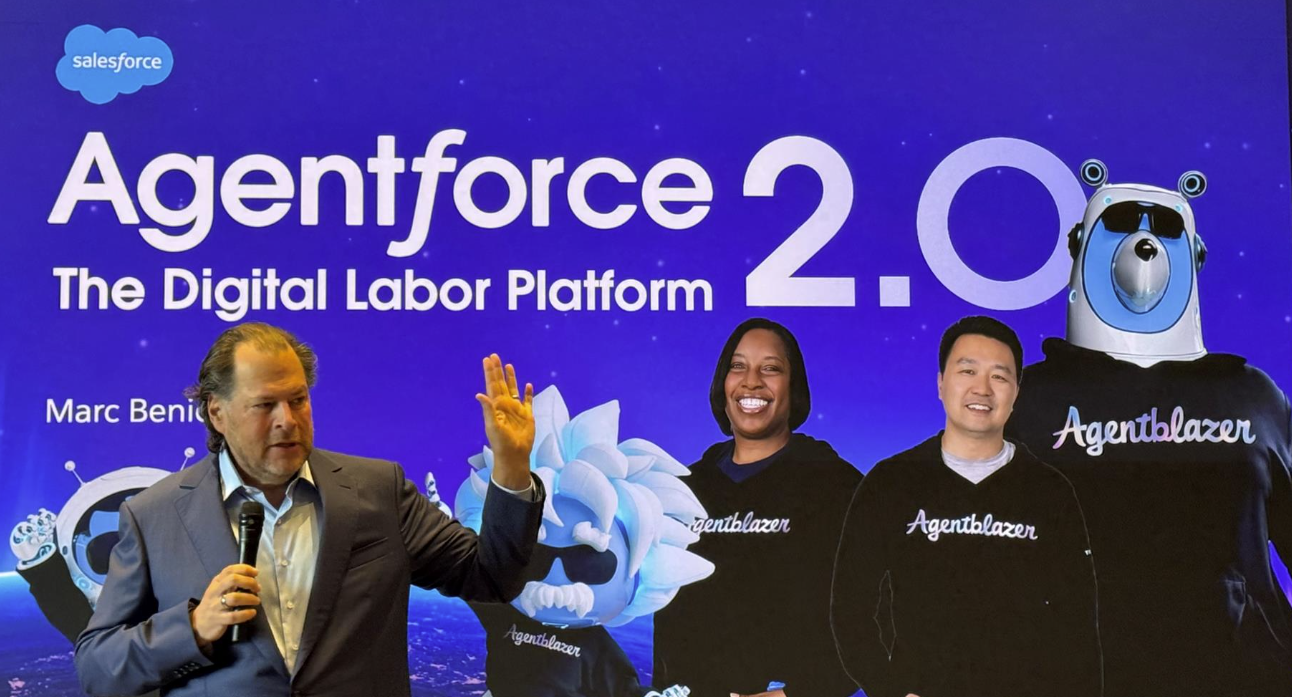
It takes a bold marketing strategy to pivot from a go-to-market live event motion to one that positions another vendor’s copilots as a failure with a new solution where customers can build immediately. It takes a bold strategy…or an even bolder CEO willing to take on the world. When Marc Benioff hit the Dreamforce stage in 2024, the marketing machine had already kicked into high gear with a heavy dose of paid, earned and owned media all screaming the same message: Agentforce had arrived. Salesforce clearly listened to past criticism that noted the scales far more tipped towards long-lead aspirational products as opposed to usable, buildable solutions ready to deploy the moment the keynote concluded. Agents were being built in the campgrounds and customers could get started even before the traditional Hawaiian blessing had been delivered. This excitement and momentum took to the road with a whistle stop tour and a steady drum beat of use case reveals and customer testimonials, allowing Salesforce’s most powerful marketing weapon (aka their Trailblazers) to tell the tale of their own improvements thanks to Agentforce.
BEST NEW ENTERPRISE SOFTWARE AD CAMPAIGN
This category showcases the best ad campaign in the enterprise.
WINNER: jira
Why did they win?
Jira’s ad campaign featuring Zach Woods, an actor known for roles in The Office and Silicon Valley, hit all the notes a video spot should hit, especially the note of insider joke humor. Woods, looking to collaborate on a contract ideal for his “aspiring to be a rich person” agenda and his goals to be on “a sake only diet” of the rich and famous, Woods perfectly highlights why work and how we collaborate for business has changed for the better thanks to workflows, data and AI.
RUNNERS UP: Stych billboards
Why were they recognized?
Stych went back to the whiteboard to create a campaign that would appeal to developers and create bottoms-up influence. The company chose not to go with a typical enterprisey billboards such as “we understand your security” but rather emotionally appealed to developers by showing a play on code or on a technical term. They picked San Francisco to show their ads including some prominent places such as near Moscone during the RSA Conference.
BEST LIVE-EVENT
This category showcases the team that adapted and succeeded in their high-touch in-person event to a full on virtual event experience.
WINNER: google cloud next
Why did they win?
In eight years, from a few hundred attendees at a nondescript location in San Francisco to 30,000+ attendees in one of the largest convention centers in Las Vegas, the Google Cloud Next conference came a long way. And so did Google Cloud. Google Cloud has increased its revenue 5x in the last five years. Google Cloud Next is the moment for the company to share the progress it has made on AI and other fast-growing categories such as cybersecurity. It was a flawless event that left a mark; Google Cloud appeared as enterprisey as Microsoft or AWS.
RUNNERS UP: aws reinvent
Why were they recognized?
The traditional get together of the IT industry used to be VMworld that would be attended by non-VMWare users because all of the CIOs and IT senior leaders were there. AWS took that baton pre-Covid already with 80,000 attendees. Now AWS re:Invent has come back to that position with 60,000 attendees and attractive new services and offerings.
RUNNERS UP: hpe discover
Why were they recognized?
HPE Discover 2024 marked the first-ever live tech keynote in The Sphere in Las Vegas. Clad in his black jacket, Nvidia CEO Jensen Huang joined HPE CEO Antoni Neri and officially declared “Antoni consumed more liquid than anyone known to mankind.” Of course, he was talking about HPE data centers now being liquid-cooled, which was one of the major announcements of the event. HPE also announced its plan to capture the AI market by offering the simplistic “AI OOB,” an out-of-the-box offering of AI models and other optimized components that come ready to deploy. HPE could kill it in the inferencing arena if this concept takes off. HPE also announced Zerto support for KVM. Given the Broadcom/VMware fiasco, HPE could become a landing place for a lot of dissatisfied customers.
BIGGEST TECH FLOP OF THE YEAR
This category simultaneously recognizes the highest potential and largest failure in enterprise tech.
WINNER: apple vision pro
Why did they win?
This late arrival to the already-failed Metaverse market was not only overweight (at more than 20 ounces), and overpriced (at $3,499), it suffered from a short battery life (of only 2 hours) and a paltry selection of augmented reality and mixed reality content. Reports are that Apple will end production of the device in 2024 because it can’t unload the 500,000 to 600,000 units already produced. The simple truth is that the metaverse has failed to gain mass adoption because the vast majority of people don’t want to cut themselves off from reality and other people — all while looking like a dork with a contraption on their heads. If you really want to escape into the Metaverse, you can buy Meta’s MetaQuest 3S for just $299. The Apple Vision Pro is a repeat performance for Apple, having arrived late to the smart speaker category in 2017 with its overpriced Apple HomePod — although at least that product is still selling to Apple fans.
RUNNERS UP: DOE FAFSA Rollout
Why were they recognized?
The Department of Education’s new financial aid system and FAFSA form will be seen as 2024’s worst IT projects. The FAFSA form was revamped with a Dec. 31 soft launch (typically FAFSA opened in October) that barely delivered. Not only was the FAFSA form a headache for parents and students, but it was also an IT disaster. Studentaid.gov couldn’t serve students well. You mean the Department of Education lacks cloud scalability? Pretty much. Along with the FAFSA form changes, the Department of Education launched its new hybrid cloud platform. A June General Accountability Office report highlighted issues with the new systems. In 2021, the Federal Student Aid (FSA) org aimed to modernize and replace a 30-year-old system to process student aid applications. In March 2023, FSA put a new system in a new cloud environment. In December, that system was fully deployed. The system stabilized but was also late for launch for the 2025-2026 school year.
Editor in Chief of Constellation Insights
Constellation Research
Larry Dignan is Editor in Chief of Constellation Insights at Constellation Research, where he leads editorial coverage focused on enterprise technology, digital transformation, and emerging trends shaping the future of business. He oversees research-driven news, analysis, interviews, and event coverage designed to help technology buyers and vendors navigate complex markets with clarity and context. ...
Salesforce launched Agentforce 2.0 in a bid to move its agentic AI platform to more teams, workflows and markets. Agentforce 2.0 includes Slack integration, more workflows across the enterprise and is generally available in February.
Agentforce 2.0's debut also includes a new tagline dubbing the effort a "digital labor platform" that can move beyond Salesforce's core sales, service and CRM borders. To expand Agentforce's reach, Salesforce is relying heavily on MuleSoft, the company's API platform. With MuleSoft, Agentforce will be able to enable actions across 40 enterprise systems via MuleSoft for Flow, surface APIs as actions and add metadata to APIs.MuleSoft for Flow will be in pilot Feb. 25 and surfacing APIs as actions and metadata additions to APIs in Topic Center will be available on the same date. MuleSoft has become critical to Salesforce's plan to expand into new agentic AI use cases.
Salesforce is also adding new pre-built skills that will be released monthly. New pre-built skills in Agentforce will include sales development and coaching, field asset management, commerce merchant, Slack engagement, predictive insights and industry-specific skills. Agentforce 2.0 will also include an expanded roster of third-party skills. Salesforce's Agentforce 2.0 is a fast follow to its Dreamforce launch of its agentic AI platform.
Salesforce CEO Marc Benioff said:
"As a CEO, I'm not just managing human beings, but I'm also managing agents. There is an agentic layer around the support today for Salesforce. It's not some vision fantasy in the future idea, it's what is happening right now."
Benioff said agentic AI is enabling digital labor, robots and voice as a user interface. "We've already crossed this bridge into the new world of digital labor," he said.
Here's how Salesforce sees Agentforce 2.0 expanding into new areas and providing digital labor.
Salesforce's approach with Agentforce 2.0 rhymes with ServiceNow's focus on AI-enabled workflow orchestration. Where ServiceNow started in IT and expanded to other areas including ERP, HR, CRM and any other function, Salesforce is starting with CRM and expanding out into HR, finance and engineering.
Slack search
Salesforce also appears to be leveraging Slack as the collaboration glue for Agentforce 2.0. On Jan. 25, Agentforce will be available in Slack, integrate into Slack enterprise search and feature prebuilt actions. In Slack, Agentforce can take action including creating a Canvas, updates, adding channels and sending direct messages.
Key points about how Slack search is used in Agentforce:
Slack's search system ensures that a message is visible only to the right users by indexing messages based on channel types and applying visibility filters at the time of query. For instance, public channels are visible to all, but private channels only apply to members of that channel. Search queries are indexed to workspace ID in the public channel scenario, but the index avoids listing every member ID in the private channel scenario.
File visibility is also determined by channels and members. Files in public channels will be indexed by workspace ID, but private channels are restricted to channel membership.
Slack's search functions are enhanced by retrieval-augmented generation (RAG) techniques.
Slack search actions are also controlled by visibility access, admin controls and minimized data sharing.
Slack search also has FedRAMP certifications, enterprise key management and custom retention policies.
Atlas Reasoning Engine details
Salesforce also enhanced its Atlas Reasoning Engine with features that will be generally available Feb. 25. These enhancements include:
Advanced Retriever, which can be used to improve answers.
Enriched Indexes that will use advanced RAG and added metadata.
And Inline Citation, which will improve accuracy and transparency to responses.
The company also added some details to how Atlas works. According to Phil Mui, Ph.D., SVP of Technology, Head of Products and Engineering, Salesforce AI Research and Agentforce, Atlas combines models, data, business logic, events and workflows into one compound system. Atlas aims to understand the nuances of user queries and contexts.
Mui argued that DIY assistants that are large language model based are rapid, but are focused on basic tasks (System 1). Atlas is an evolution because it can understand and think through a situation (System 2).
Atlas retrieves the most relevant data based on processes and then refines the query with RAG and additional context and metadata. This step-by-step approach to Atlas' analysis grounds answers and decisions using Data Cloud.
Salesforce noted that Atlas' move to System 2 thinking is a win, but future progress will incorporate agentic AI and coordinating specialized agents.
A faster cadence, bigger market
Salesforce President and Chief Operating Officer said at a recent Barclays investor conference that the company is stepping up its innovation cadence with more frequent releases. Benioff also noted agentic AI is expanding Salesforce's market.
In February, Agentforce 2.0 will feature a bevy of new skills beyond those just outlined including citation support, supervisory LLMs, token streaming, scheduling skills and multilingual support.
"We've prided ourselves on three upgrades a year for 25 years. This (Agentforce) is measured in weeks and so the velocity is really incredible," said Millham. "We feel that urgency by the way. We really feel like we need to be moving quickly at this opportunity."
And the opportunity is large as Google Cloud, AWS and Microsoft Azure all have agentic AI efforts underway.
Millham said Salesforce with Agentforce can expand the company's total addressable market dramatically. He explained:
"We're going to provide digital labor to our customers now. And when you start to look at this through the lens of just software, the size of that measured in billions. When you start to think about what the opportunity is for labor offset, you measure in TAM and in the form of trillions. That is the opportunity that we're contemplating out there.
We talk to CEOs and CFOs, they say, this is great. I can take some cost out of my business in the call center, for example, which is fine.
We also can have it from a growth perspective. Hey, over the next five years, I'm growing at 8% on top line and my cost of people is flat. That's a pretty good proposition and people can do the math very quickly on why they should be investing in Agentforce."
Millham said customers are asking about applying Agentforce to other areas such as HR. At the conference, Millham was asked about how Agentforce will be priced. He said pricing for Agentforce will start to resemble platform plays where you have prices for the platform and then universal credits that will be consumed across workflows. In other words, Salesforce's pricing model will likely rhyme with ServiceNow's approach going forward.
Constellation Research's take
Constellation Research analyst Holger Mueller said:
“Salesforce is demonstrating unseen product velocity with the launch of Agentforce 2.0. Mark Benioff is the Jensen Huang of SaaS by accelerating product innovation cycles. Bringing Agentforce to where work happens -- to Slack is critical. Even more will be the necessary integration into Teams / Outlook (no date so far). Equally critical for CxOs will be - which other SaaS vendors will play along with Salesforce - as Salesforce opens Agentforce to ISVs. Will integration happen on a data level, an API level or even an agent level - will be a key AI success question for 2025 - not just for the industry - but for enterprises.”
Constellation Research analyst Martin Schneider said:
"One of the most interesting facets of the Agentforce 2.0 launch is the apparent rebranding of agentic AI into 'digital labor.' This development seems interesting when you think about the existing ambivalence towards AI from a lot of workers and the fear that it will displace labor rather than augment human capabilities. From the business side, the digital labor platform messaging of course implies cost savings and efficiency, but I think Salesforce needs to be careful in how they put this message across certain audiences.
From a technical side, Salesforce seems to be doing the right things in terms of enabling nontechnical users to get started with agentic AI, not just from putting the work in around Data Cloud to power more effective insights, but also pre-integrating with MuleSoft to power the task management and workflow associated with AI agents taking autonomous action. In addition, the new skills concept gives both technical and non-technical users a lot of components that are preconfigured towards building more effective agents out-of-the-box.
Out-of-the-box agents now run across all Salesforce clouds, giving users some fast and useful proof of concepts as they dip their toe into the water of agentic AI. I expect Salesforce's partner ecosystem to go even further and offer even more AI agents that cover even more complex use cases that touch even more systems than CRM and ERP.
But in the end, the two important factors will be both the quantity and quality of usable data that Salesforce users have on hand to power AI agents. Historically, CRM data can be both incomplete and inaccurate. As AI use cases call for more and more queries into the core Salesforce platform, performance and availability may become an issue as some users are already citing that the more they leverage complex AI use cases, the number of round trips between the Atlas reasoning engine, other data systems, and Salesforce and data cloud are causing some performance issues.
The availability of Agentforce in Slack will be strong bridge between the agentic-to-human handoff, allowing for more seamless workflows, and a better ability for humans to monitor AI agents inside a tool like Slack that is m ore conducive to these actions than a traditional CRM UI."