Editor in Chief of Constellation Insights
Constellation Research
Larry Dignan is Editor in Chief of Constellation Insights at Constellation Research, where he leads editorial coverage focused on enterprise technology, digital transformation, and emerging trends shaping the future of business. He oversees research-driven news, analysis, interviews, and event coverage designed to help technology buyers and vendors navigate complex markets with clarity and context. ...
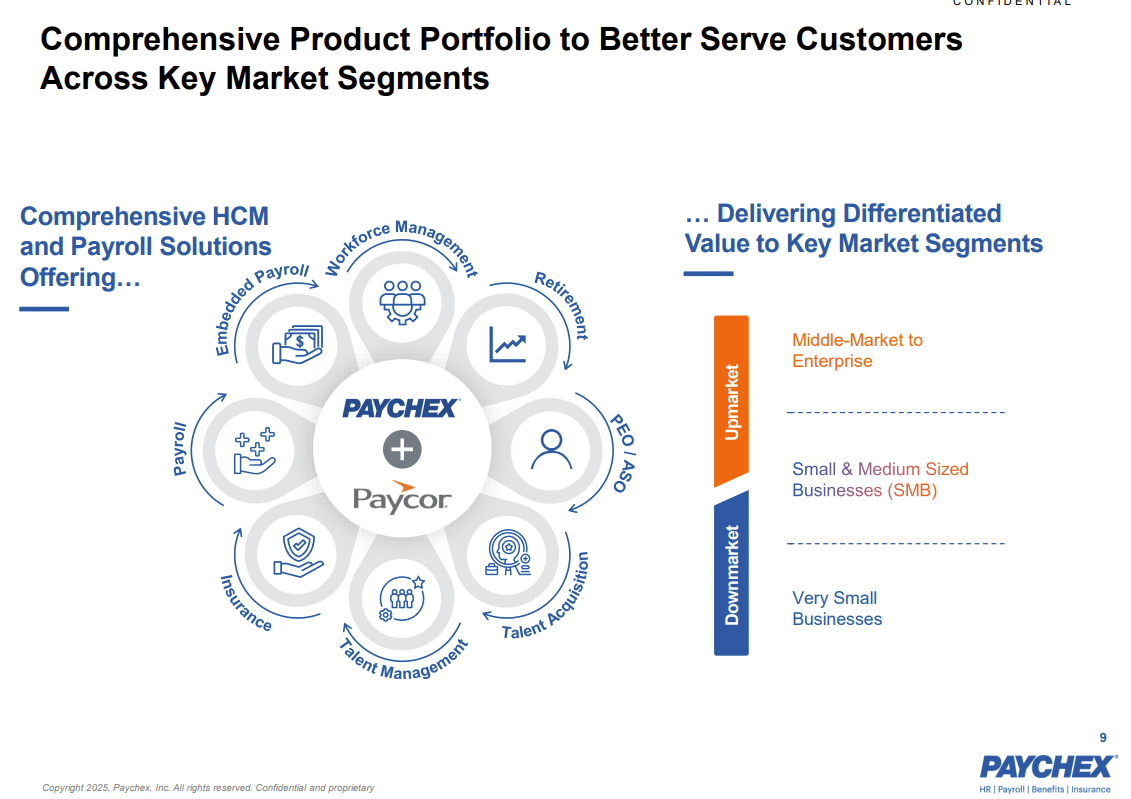
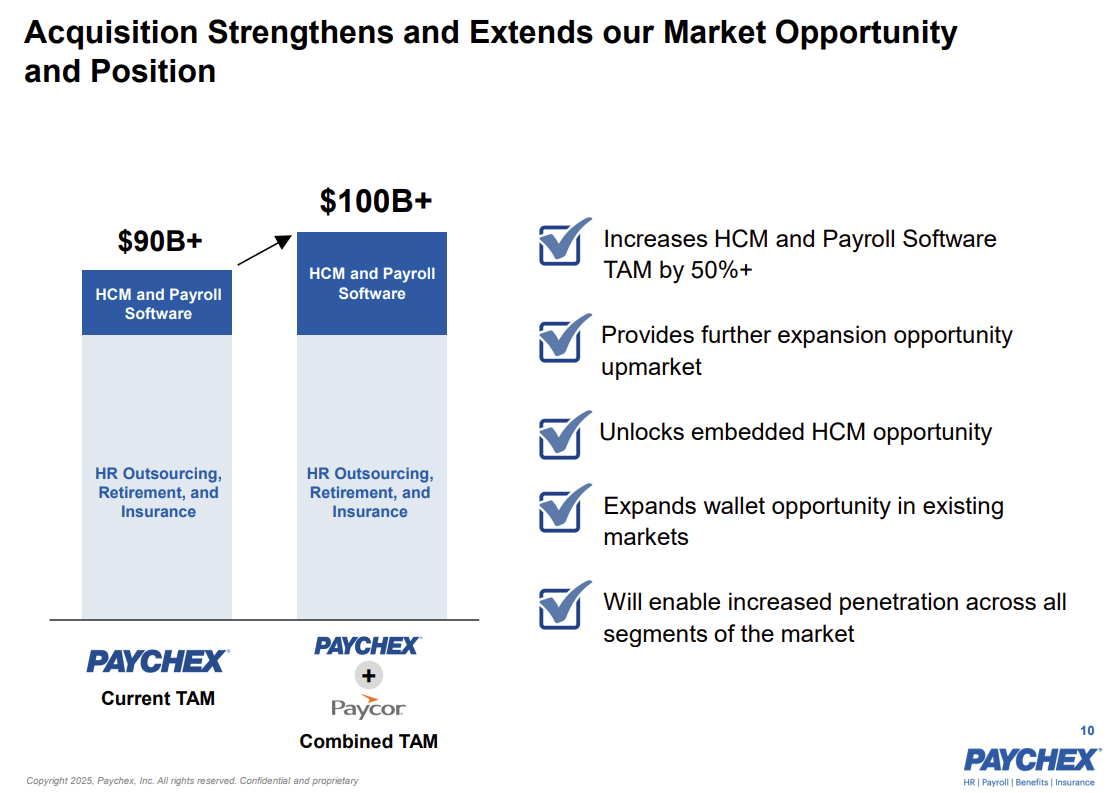
According to Paychex and Paycor, the combined company will boost its total addressable market by offering a suite of technology and services for HR, employee benefits, insurance and payroll.
Paycor has 2,900 employees and more than 49,000 customers. Paycor's HCM, payroll and talent software has typically served small businesses but has been moving toward larger enterprises.
John Gibson, CEO of Paychex, said Paycor "will enhance our capabilities upmarket, broaden our suite of AI-driven HR technology capabilities, and provide new channels for sustained long-term growth."
The combined company is expecting cost savings of more than $80 million in the short term and neutral to accretive to adjusted earnings in the first year post close. Paychex will gain from Paycor's partnerships and sales coverage and HCM features that will round out the HCM suite.
Going forward, Paychex and Paycor will invest in data and AI tools for customers.
Constellation Research analyst Holger Mueller said:
"There always have been consolidation trends in the HCM market – but the acquisition of Paycor by Paychex is a new apex. The SMB player buys the large enterprise player, resulting in a double automation portfolio – that is unrivaled – apart from UKG, which itself is the product of a merger. The acquisition is good news for the higher-end Paychex customer and for Paycor customers who have smaller operations and subsidiaries in Canada. It is now up to the Paychex management team to successfully integrate portfolios, go to market and more."
In a presentation, the focus of the deal was go-to-market efforts. Paychex and Paycor expect to win in more customer segments, sell Paycor's workforce management, talent acquisition and talent management tools to Paychex customers. Paychex's HR advisory and employee solutions will be sold to Paycor customers.
By the numbers:
Paychex has $5.3 billion in annual revenue.
Paychex has more than 2.3 million HR outsourcing worksite employees.
Paychex HCM and payroll software has processed more than $950 billion financial transactions and is the leading 401(k) record keeper in the US.
Paychex has 745,000 payroll clients.
Paycor has $655 million in annual revenue and 90% of it is recurring revenue.
Paycor revenue growth in fiscal 2024 was 19%.
Paycor has 2.7 million active employees on its platform.
Editor in Chief of Constellation Insights
Constellation Research
Larry Dignan is Editor in Chief of Constellation Insights at Constellation Research, where he leads editorial coverage focused on enterprise technology, digital transformation, and emerging trends shaping the future of business. He oversees research-driven news, analysis, interviews, and event coverage designed to help technology buyers and vendors navigate complex markets with clarity and context. ...
The launch of Nvidia's Project Digits, a desktop AI supercomputer starting at $3,000 for data scientists and AI researchers, is just one example of a broader theme: AI training and inferencing is going to be decentralized to some degree.
Nvidia's news--delivered by CEO Jensen Huang at CES 2025--highlights a key use case revolving around offloading AI development with a high-powered system. The general idea is that users can develop and run inference on models on the desktop and then deploy to the cloud or data center.
For enterprises pondering on-premises data centers and wrestling with cloud costs, Nvidia's Project Digits isn't a bad idea--especially when you can network two of those systems together to run up to 405-billion parameter models.
"With Project Digits, developers can harness the power of Llama locally, unlocking new possibilities for innovation and collaboration," said Ahmad Al-Dahle, Head of GenAI at Meta.
Constellation Research analyst Holger Mueller said:
"Digits poses lots of challenges, but if Nvidia overcomes them it has repercussions across the whole AI stack. Bigger has been better for AI and the question has always been this: Is it cost effective and can it be run on remote locations? Digits ends that discussion. It is Blackwell everywhere (and with that the soon to be announced Blackwell successor) as well."
But Nvidia's desktop supercomputer is just part of the mix.
With the move, AMD is putting high-performance computing into thin laptops and looking to capture AI workloads on workstations. Ryzen AI Max Pro Series processors are designed for large engineering and models.
Simply put, there should be enough AI compute in the field that can be networked and leveraged.
Intel also updated its Intel Core lineup with a focus on business AI applications. For good measure, Qualcomm outlined its Snapdragon X series, which will bring AI and Copilot+ PCs to the masses at a price around $600.
These systems at CES could be construed as yet another effort to prod consumers and businesses to upgrade PCs. The AI PC upgrade cycle will happen, but it has clearly been delayed. Instead, look upstream to Project Digits, which will have a real AI workload purpose. Yes, enterprises will be more dependent on Nvidia but being able to develop and tweak models locally and then use data center resources is likely to be cheaper and arguably more sustainable.
With all the cool kids--data scientists and AI wonks--buying supercomputer workstations the rest of us will likely boost specs just to have the horsepower. Of course, the masses won't use that horsepower, but if a savvy enterprise can capture the compute at the edge there's real returns ahead.
There's already signs that enterprises are starting PC upgrades and more future-proof AI friendly systems are likely to seal the deal. For consumers, the AI PC upgrade cycle will be slower, but you can expect Qualcomm to capture some real share.
Editor in Chief of Constellation Insights
Constellation Research
Larry Dignan is Editor in Chief of Constellation Insights at Constellation Research, where he leads editorial coverage focused on enterprise technology, digital transformation, and emerging trends shaping the future of business. He oversees research-driven news, analysis, interviews, and event coverage designed to help technology buyers and vendors navigate complex markets with clarity and context. ...
Nvidia CEO Jensen Huang said the company is aiming to expand use cases for physical AI including next-generation robots and autonomous vehicles with the launch of world foundation models called Cosmos.
Cosmos is a family of world foundation models, or neural networks that can predict and generate physics-aware virtual environments. Speaking at the headline keynote at CES 2025, Huang said Nvidia Cosmos models will be open sourced. "The ChatGPT moment for robotics is coming. Like large language models, world foundation models are fundamental to advancing robot and AV development," said Huang. "We created Cosmos to democratize physical AI and put general robotics in reach of every developer."
Huang added that world foundation models (WFMs) will be as important as large language models, but physical AI developers have been underserved. WFMs will use data, text, images, video and movement to generate and simulate virtual worlds that accurately models environments and physical interactions. Nvidia said 1X, Agility Robotics and XPENG, and autonomous developers Uber, Waabi and Wayve are among the companies using Cosmos.
The Cosmos launch is part of a wide range of models Nvidia outlined to bolster its ecosystem NeMo framework and platforms like Omniverse and AI Enterprise. Nvidia also launched Nvidia Llama Nemotron and Cosmos Nemotron models for developers creating agentic AI applications.
Huang said WFMs are costly to train. The best way to democratize physical AI was to spend upfront on a suite of open diffusion and autoregressive transformer models for physics-aware video generation and then open them so developers can refine. Cosmos models have been trained on 9,000 trillion tokens from 20 million hours of real-world human interactions, environment, industrial, robotics and driving data.
Cosmos can process 20 million hours of data in just 40 days on Nvidia Hopper GPUs, or 14 days on Blackwell GPUs.
Huang showcased Cosmos models capabilities such as video search and understanding, 3D-to-real synthetic data generation, physical AI model development and evaluation, the ability to predict next potential actions and simulations.
Cosmos WFMs are available on Hugging Face and Nvidia's NGC catalog. Cosmos models will soon be optimized for Nvidia NIM microservices.
Key details about Cosmos include:
The models come in three categories. Cosmos Nano is optimized for low-latency inference and edge deployments. Super is for baseline models and Ultra is designed for maximum quality and best for distilling custom models.
Cosmos is designed to be paired with Nvidia Omniverse 3D outputs.
Developers can use Cosmos models for text-to-world and video-to-world generation with versions ranging from 4 billion to 14 billion parameters.
Cosmos WFMs can enable synthetic data generation to augment training datasets and simulate, test and debug physical AI models before being deployed.
Data curation and training of Cosmos used thousands of Nvidia GPUs via Nvidia DGX Cloud.
Cosmos will be supported via Nvidia AI Enterprise.
Nvidia said the Cosmos platform includes data processing and curation for Nvidia NeMo Curator.
Cosmos will include Cosmos Guardrails and will have a built-in watermarking system.
Industrial AI applications
The launch of Cosmos combined with Nvidia Omniverse is designed to accelerate industrial AI applications. These applications--notably factory and manufacturing optimization, robotic digital twins and autonomous applications--are the next era of AI.
To that end, Nvidia is leveraging partners such as Accenture, Altair, Ansys, Cadence, Foretellix, Microsoft and Neural Concept to integrate Omniverse into software and services. Siemens also announced that its Teamcenter Digital Reality Viewer is available and powered by Nvidia Omniverse.
Huang said:
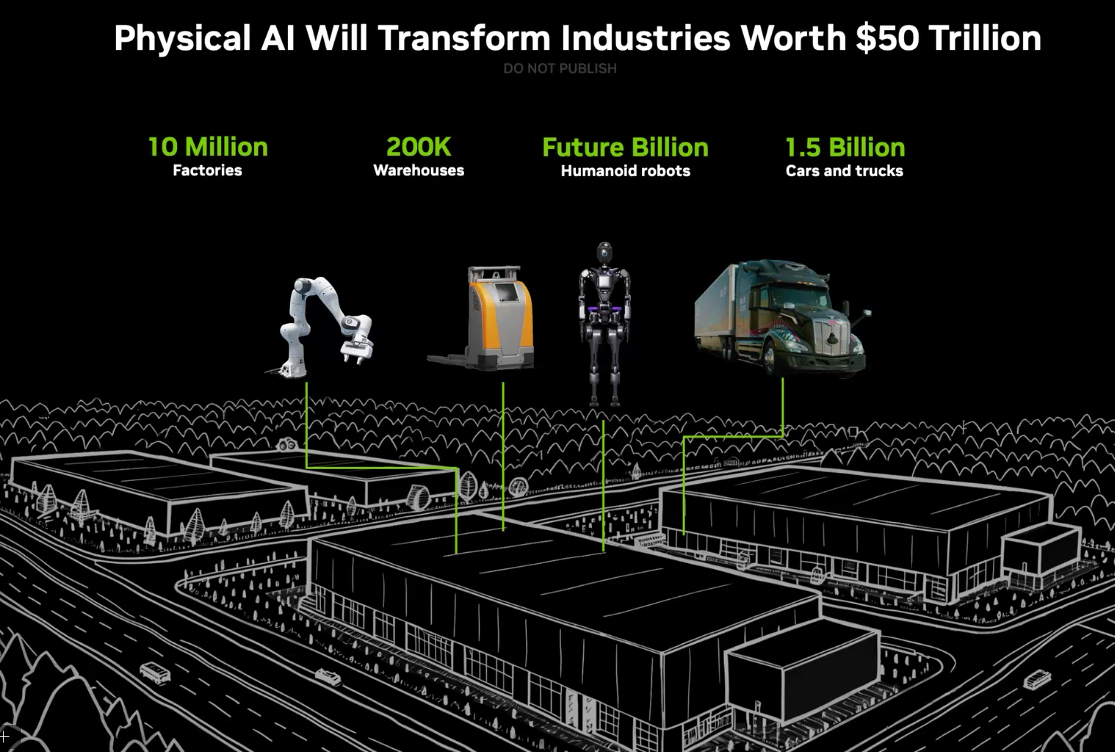
"Physical AI will revolutionize the $50 trillion manufacturing and logistics industries. Everything that moves — from cars and trucks to factories and warehouses — will be robotic and embodied by AI."
Nvidia's plan is to pair Cosmos with Omniverse and its DGX platform to generate synthetic data and then combine it with blueprints and agents.
Nvidia outlined a set of Omniverse Blueprints including;
Mega, which is for developing and testing robot fleets at scale in a factory or warehouse digital twin before real-world deployment.
Autonomous Vehicle simulation for AV developers can replay driving data, generate ground truth data and closed loop testing.
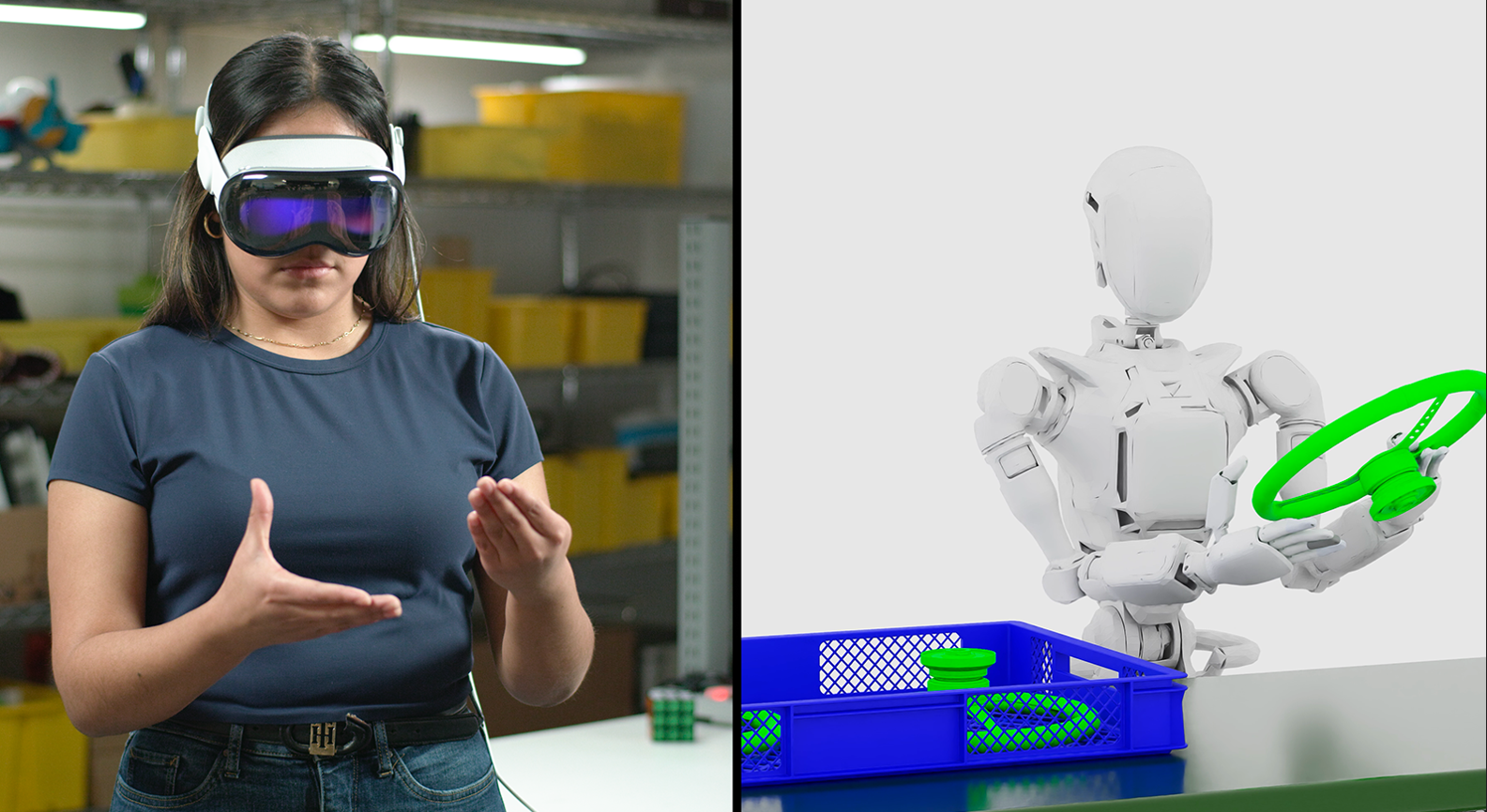
Omniverse Spatial Streaming to Apple Vision Pro for enterprise applications.
Real-Time Digital Twins for Computer Aided Engineering, a reference workflow.
Nvidia also launched the Isaac GR00T Blueprint to accelerate humanoid robotics development. Nvidia Isaac GR00T is designed for synthetic motion generation that can train robots using imitation learning. The workflow captures human data and then multiplies it with synthetic data.
Editor in Chief of Constellation Insights
Constellation Research
Larry Dignan is Editor in Chief of Constellation Insights at Constellation Research, where he leads editorial coverage focused on enterprise technology, digital transformation, and emerging trends shaping the future of business. He oversees research-driven news, analysis, interviews, and event coverage designed to help technology buyers and vendors navigate complex markets with clarity and context. ...
Nvidia launched new models for agentic AI called Nemotron, expanded its set of blueprints and expanded its ecosystem for orchestration.
The news, part of a barrage of items at CES 2025, was announced by Nvidia CEO Jensen Huang. Nvidia's CES news featured Project Digits, a desktop AI supercomputer, and a broad effort to tackle physical AI use cases, but the company continues to build on its AI agent strategy.
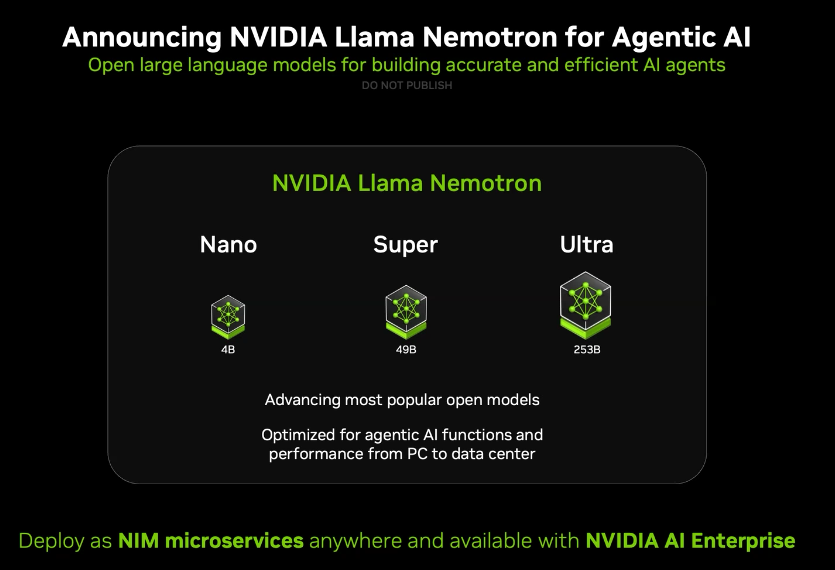
Nvidia launched the Llama Nemotron family of models that are designed to help developers create and deploy agents across use cases including customer support, fraud detection, supply chain and inventory management.
The company also launched the Nvidia Cosmos Nemotron visual language models and Nvidia NIM microservices for video search and summarization. With the Cosmos-Nemotron connection, Nvidia is looking to enable developers to build agents that can analyze and respond to images and video from autonomous machines, hospitals, stores and warehouses.
Key items include:
Nvidia Llama Nemotron models are trained with Nvidia's latest technology, agentic capabilities and quality data sets. These models are designed to excel at following instructions, chat, coding and math. SAP and ServiceNow are early customers of the Llama Nemotron models.
Llama Nemotron models come in three sizes. Nano is 4B parameters, Super is 49B and Ultra is 253B.
The new models are available as hosted APIs from Nvidia and Hugging Face.
Nvidia also outlined new agentic AI blueprints that include NIM microservices, NeMo and agentic AI frameworks from CrewAI, Daily, LangChain, LlamaIndex and Weights & Biases. Those AI frameworks are designed to orchestrate and manage agentic AI and can be used for software development, speech recognition, report generation and research.
Accenture also said it will launch more than 100 AI Refinery agents for industries using Nvidia's stack.
Nvidia also launched a new AI Blueprint for PDF to podcast. Other Nvidia blueprints were focused on Cosmos models and physical AI.
Editor in Chief of Constellation Insights
Constellation Research
Larry Dignan is Editor in Chief of Constellation Insights at Constellation Research, where he leads editorial coverage focused on enterprise technology, digital transformation, and emerging trends shaping the future of business. He oversees research-driven news, analysis, interviews, and event coverage designed to help technology buyers and vendors navigate complex markets with clarity and context. ...
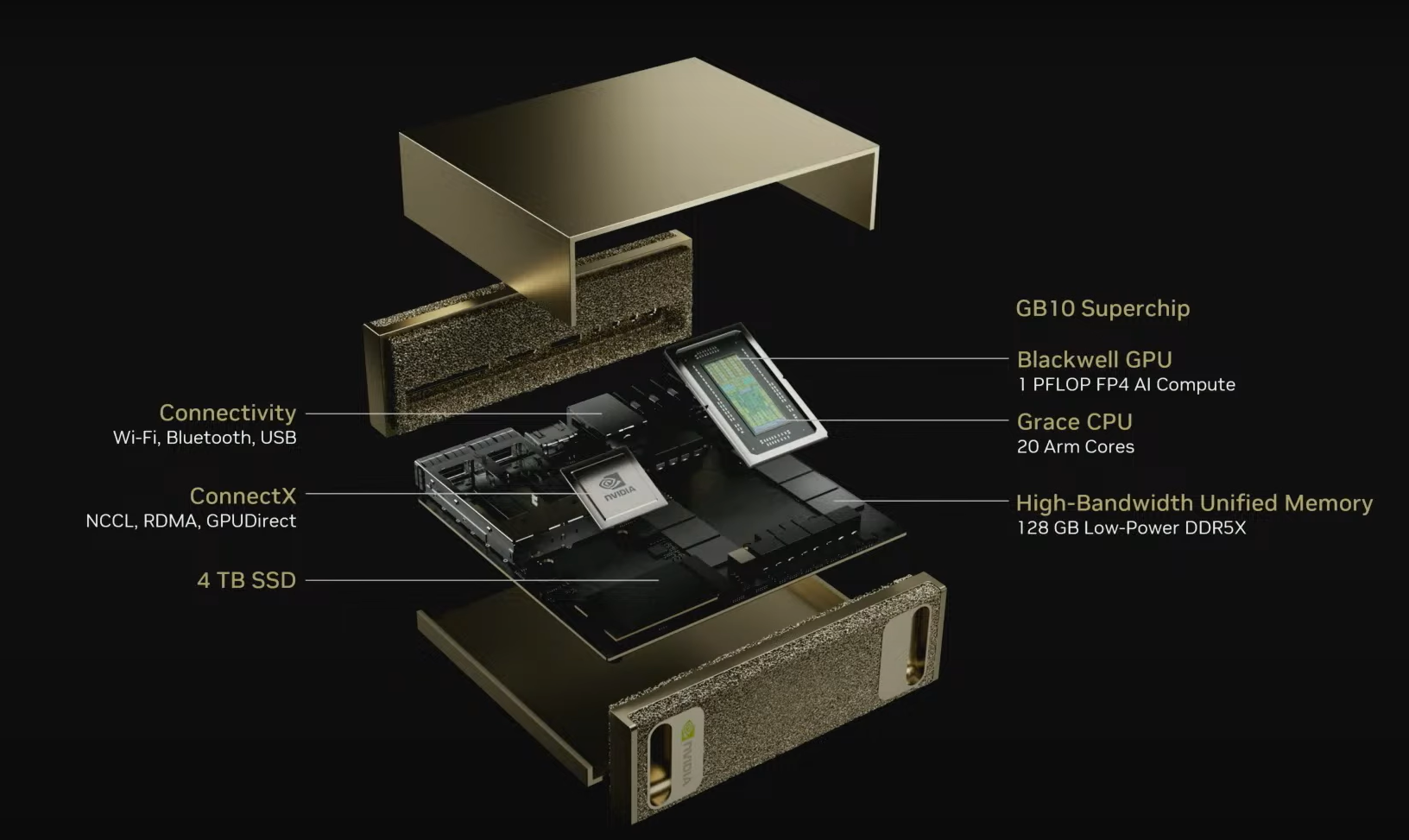
Nvidia is launching a desktop AI supercomputer called Project Digits aimed at AI researchers, data scientists and students. Systems, available in May, will start at $3,000 and include a Nvidia Grace Blackwell Superchip that is capable of running 200B parameter models.
The use case for Digits is to offload compute for AI development from cloud resources as needed. Project Digits will be available from Nvidia and partners with DGX and a Linux operating system. Nvidia is designed for AI development and a complement to laptops for now.
According to Nvidia, the idea is that users can develop and run inference on models on the desktop and then deploy to the cloud or data center. Project Digits has a small form factor that's about as wide as a coffee mug including the end of the handle.
Jensen Huang, CEO of Nvidia, said Digits will democratize access to Grace Blackwell Superchips. "Placing an AI supercomputer on the desks of every data scientist, AI researcher and student empowers them to engage and shape the age of AI," said Huang.
He quipped that Project Digits is a placeholder name and if anyone has a better name to reach out to Nvidia.
Specs for Nvidia Digits include:
Nvidia GB10 Grace Blackwell Superchip, which includes a Nvidia Blackwell GPU, latest generation CUDA cores and fifth-gen Tensor Cores connected via NVLink chip to chip interconnect to a Nvidia Grace CPU.
1 petaflop of AI performance.
128GB unified system memory.
Up to 4TB NVMe storage.
Nvidia's AI software stack including Nvidia Blueprints and NIM microservices.
Compact form factor.
Use cases for digits include prototyping, fine tuning, inference, data science and edge applications including robotics.
Using Nvidia ConnectX, the company said two Project Digits systems can be networked to run up to 405-billion parameter models. If Project Digits is successful, generative AI compute could become more distributed and lower costs.
Constellation Research analyst Holger Mueller said:
"Nvidia is chasing revenue on both ends – the high end and the low end. That is not a unique strategy in the semiconductor space – but it is more stretched out over 5-10 years. Nvidia is trying to do this in under one year that Blackwell. Project Digits marks the second time Nvidia departs from semiconductor industry best practice. The other time was when revving platforms every year – instead of the two year cycle. Digits poses lots of challenges, but if Nvidia overcomes them it has repercussions across the whole AI stack. Bigger has been better for AI and the question has always been this: Is it cost effective and can it be run on remote locations? Digits ends that discussion. It is Blackwell everywhere (and with that the soon to be announced Blackwell successor) as well."
Nvidia executives said that Project Digits doesn't mean it's going into the PC market, but it could be a safe bet in the future.
Editor in Chief of Constellation Insights
Constellation Research
Larry Dignan is Editor in Chief of Constellation Insights at Constellation Research, where he leads editorial coverage focused on enterprise technology, digital transformation, and emerging trends shaping the future of business. He oversees research-driven news, analysis, interviews, and event coverage designed to help technology buyers and vendors navigate complex markets with clarity and context. ...
In this interview, CR Insights editor-in-chief Larry Dignan sits down with Matt Lewis, CEO of LLMental a company on a mission to transform #mentalhealth and wellness through the power of #generativeAI. LLMental has evolved from a venture studio, focused on accelerating AI-driven mental health #innovation to a full-fledged firm with a dual-pronged approach. On the consumer side, their Rhythm Mental platform uses personalized, AI-generated recommendations to guide individuals from diagnosis to recovery, empowering them to build a life worth living.
On the enterprise side, LLMental's Transfer Mental offering tackles the human factors that often hinder successful AI adoption, leveraging AI to improve organizational well-being and enable more effective digital transformations.
In this discussion, Matt shares LLMental's vision, the key challenges it's tackling in mental health, and the underlying #technology powering their innovative solutions. Learn how AI can be a catalyst for enhancing mental wellness, both for individuals and within the modern workplace.
Editor in Chief of Constellation Insights
Constellation Research
Larry Dignan is Editor in Chief of Constellation Insights at Constellation Research, where he leads editorial coverage focused on enterprise technology, digital transformation, and emerging trends shaping the future of business. He oversees research-driven news, analysis, interviews, and event coverage designed to help technology buyers and vendors navigate complex markets with clarity and context. ...
Matt Lewis is on a mission to make mental health more actionable with a big assist from generative artificial intelligence.
AI150 member Lewis is now CEO of LLMental, which was founded to leverage AI to augment mental wellness. LLMental has two businesses, a B2C enterprise, Rhythmental, leveraging AI to address depression and other mental health challenges, and TransforMental, a B2B enterprise focused on prioritizing workplace wellbeing. LLMental started as a venture designed to enable startups to address health and life sciences challenges. Today, LLMental is focused on augmented mental wellness with the aim of operating multiple businesses addressing various challenges.
Here's a look at the takeaways about LLMental and its approach to mental health.
Focus. Lewis said LLMental is taking a future view of the challenges humans will face over the next few years. "We drew up a list of 17 thorny problems that have perennially gone unsolved and are areas that don't really have any real innovation in them and could potentially benefit from AI native consideration for people that struggle with those challenges," said Lewis.
Lewis said that LLMental chose to focus on quality of life and the intersection of mental health. "In serious mental illness, the conversation has really been about harm avoidance, but that's often where the conversation ends," said Lewis. "But how's your actual quality of life? What's your decision-making capability look like? What are your social relationships? Have you gotten back to the person you were before you were first diagnosed with depression?"
"There's been little assistance for the person who is suffering to go from diagnosed to a design for recovery."
As a result, LLMental is looking to use generative AI and machine learning to help people progress from diagnosis to remission and ultimately recovery to build a better life, he added.
The engagement model. Lewis said LLMental's approach revolves arond everyday engagement, but in a way that's not like talking to ChatGPT. The goal is to take a beginner's mind approach to how mental health conditions are treated. LLMental is designed to fill in those moments where you can't get to a therapist or clinician.
Lewis said:
"You'll probably see your psychiatrist, maybe once every three months for about an hour. You'll see a therapist, maybe once every six weeks for an hour. That total time with a clinician adds up to about 24 hours per year, or maybe about one day of every 365 days. On the other 364 days, you're literally left alone, unsupported, with no engagement, no resources and no information. You're just in your head torturing yourself all the time."
LLMental is designed to be a copilot for your mind that can help you architect the life you're meant to live. It's something that helps you scaffold the types of interventions or activities that are helpful, peer reviewed and evidence based to improve your quality of life."
The idea is that patients can get hyper personalized interventions base on various contexts--weather, work, family obligations.
The platform. Lewis said the platform will be gated for people diagnosed for depression and verified with medical records. "That's both a safety and trust consideration so people on the platform know they're only talking to other people like themselves that have their best interests at heart," said Lewis.
LLMental will also offer life plans that are personalized and curated that can contextually adjust based on responsibilities. Think more Spotify than ChatGPT. Lewis said:
"It's not an avatar. It's not a chat bot, per se. It's more of an assistive consideration to help people figure out what they should do and when they should be doing it instead of doom scrolling on social media, which is not helpful. They're doing things that are useful for their mind and for their other relationships that help them progress and build by 10% improvement every day."
LLMental has nearly 2,000 experiences, interventions and activities that have been curated around social interaction, people and roles and purpose. The organizing principles in part revolve around the research of Thomas Insel, who wrote a book Healing about the path from mental illness to mental health. Insel was Director of the National Institute of Mental Health, led the mental health team at Verily and co-founded Mindstrong Health and Vanna Health. "Insel realized what really changes mental illness is this social cure and mix of people, purpose and place," said Lewis.
The tech stack. LLMental is being built on multiple models depending on the use case. "Generative AI does a great job of helping patients come to terms with stages, readiness adoption and meeting them at their level so they can internalize and actually do something," said Lewis. He said LLMental is still being built and later models will have new benefits. "We're evaluating the right path as we go to market and scale up, but it's about summarization and contextualization for a person dealing with a number of challenges," said Lewis. "You need it to be simple, easily understood, annotated and evidence based. If we're doing our job right the user doesn't really see the AI."
Enterprise use cases. While LLMental is focused on serious mental health conditions the company is also homed in on enterprises. The B2B side of the company is TransforMental and that business is focused on companies trying to adopt AI and address transformation; the thesis is that if the leaders of the organization are overly anxious that they won’t have jobs when the transformation is complete, productivity will plummet in the short term and the business will suffer in the long term.. Lewis said:
"Enterprises have the best intentions with trying to adopt AI, but truth be told, it's not going very well in a lot of places. There are some standouts where pilots and POCs do turn into scalable success, but they are exceptions. They're anomalies. There are many more failures than successes. It is our thesis that AI adoption is not succeeding are human factors. This is in the human computer interaction space and the human factor consideration is almost entirely psychological."
Lewis said he has seen organizations where humans were concerned about losing jobs and that fear hampered adoption. When enterprises have a good culture, growth orientation and robust mental health, transformation is adopted faster with better business outcomes. "TransferMental is designed for the mental health wellbeing side of transformation," said Lewis.
Editor in Chief of Constellation Insights
Constellation Research
Larry Dignan is Editor in Chief of Constellation Insights at Constellation Research, where he leads editorial coverage focused on enterprise technology, digital transformation, and emerging trends shaping the future of business. He oversees research-driven news, analysis, interviews, and event coverage designed to help technology buyers and vendors navigate complex markets with clarity and context. ...
OpenAI CEO Sam Altman said "we may see the first AI agents 'join the workforce' and materially change the output of companies in 2025 and that the company's ChatGPT Pro plan, which runs $200 a month, is unprofitable.
Yes, Altman was feeling a bit reflective entering 2025 and provided a few thoughts on OpenAI's evolution in a blog post and on X. Here are some of the key points from Altman.
ChatGPT Pro doesn't make money, but the subscription launched a month ago. On X, Altman noted that ChatGPT Pro doesn't make money at $200 a month because more people are using it than expected. While this disclosure made headlines, it's not really a shocker that a new SKU that launched Dec. 5 isn't profitable. OpenAI is in a weird spot where more usage actually raises prices as ChatGPT processes queries. The company will need more individuals to fork over $200 a month (good luck), upsells to business plans and more efficient compute to make the economics work.
Agentic AI will unfold in 2025--maybe. "We believe that, in 2025, we may see the first AI agents “join the workforce” and materially change the output of companies. We continue to believe that iteratively putting great tools in the hands of people leads to great, broadly-distributed outcomes," said Altman, who is going with that digital labor theme that other tech executives like Salesforce CEO Marc Benioff are using.
AGI is coming, but there's more. Altman said OpenAI is confident it knows how to build AGI, but superintelligence is the goal. He said:
"We love our current products, but we are here for the glorious future. With superintelligence, we can do anything else. Superintelligent tools could massively accelerate scientific discovery and innovation well beyond what we are capable of doing on our own, and in turn massively increase abundance and prosperity.
This sounds like science fiction right now, and somewhat crazy to even talk about it. That’s alright—we’ve been there before and we’re OK with being there again."
OpenAI will need more capital. Not a shocker, but Altman noted the company "had no idea we would need such a crazy amount of capital" when it started. "There are new things we have to go build now that we didn’t understand a few years ago, and there will be new things in the future we can barely imagine now," he said.
Altman feels attacked. Altman said:
"We’ve also seen some colleagues split off and become competitors. Teams tend to turn over as they scale, and OpenAI scales really fast. I think some of this is unavoidable—startups usually see a lot of turnover at each new major level of scale, and at OpenAI numbers go up by orders of magnitude every few months. The last two years have been like a decade at a normal company. When any company grows and evolves so fast, interests naturally diverge. And when any company in an important industry is in the lead, lots of people attack it for all sorts of reasons, especially when they are trying to compete with it."
What was missing from Altman? Talk on compute. How is OpenAI aiming to become more efficient? Should OpenAI use other clouds to train models? Will AI ever be carbon neutral? And the big question: How much money is OpenAI losing per query to ChatGPT?
Editor in Chief of Constellation Insights
Constellation Research
Larry Dignan is Editor in Chief of Constellation Insights at Constellation Research, where he leads editorial coverage focused on enterprise technology, digital transformation, and emerging trends shaping the future of business. He oversees research-driven news, analysis, interviews, and event coverage designed to help technology buyers and vendors navigate complex markets with clarity and context. ...
GenAI will fade in 2025 as a core topic as we get off the treadmill that is large language model innovation and start looking at returns. With agentic AI all the rage going into 2025, it’s safe to say it’ll be a key theme for at least the first half, but like every technology development disillusionment isn’t far behind.
The year ahead will be more volatile than usual. Enterprises will see a lot of market volatility, potential supply chain issues and must ponder more macroeconomic concerns over things like tariffs. While IT budgets look great going into 2025, rest assured budgets and outlooks will fluctuate dramatically. Likelihood of happening: 95%.
2025 will be the year that AI driven productivity gains move outside of the tech sector. Companies like Exxon and Lowe’s will generate billions in savings and revenue opportunities using AI. This move to real enterprise value will barely be noticed given none of the companies benefiting the most from AI will be considered AI pure plays. Nevertheless, the value is there and the companies that use AI for competitive edge will thrive. Likelihood of happening: 90%.
Enterprises will wrestle with vendor consolidation as an M&A boom kicks off in technology. A new administration and regulatory regime will mean a variety of mergers. Some of these deals will be great and many will bomb. Wall Street is sure to cheer, but CIOs are going to have to game plan for another Broadcom-VMware scenario that may not be so great for customers. Likelihood of happening; 70% only because I’m not convinced regulators will stand down.
Microsoft and OpenAI will reach an impasse and that frenemy theory of mine will be evident. Microsoft faces risks from being seen as the OpenAI reseller and will have to go out of its way to highlight its model choice. OpenAI has larger ambitions and will simply compete with Microsoft on multiple fronts. There’s too much money at stake for the Microsoft-OpenAI relationship to totally go haywire, but you can expect things to get frosty in 2025. Likelihood of happening: 95%.
Agentic AI will usher in autonomous processes, but enterprises will again find themselves boxed in by platform specific approaches. Ultimately, enterprises will demand that agents work across platforms, data stores and processes. By mid-year, the agentic disillusionment begins because cross-platform communication and negotiation between agents won’t be in place. Lock-in concerns proliferate as much as agents do. Likelihood of happening: 100%.
The AI data center buildout will stall due to power constraints, land, regulation and NIMBY. It won’t help that large language models will plateau in their development. Let’s get real: Energy needs are the limiting factor toward the proliferation of AI factories. How do I know that LLMs will plateau? Executives get really touchy when asked about the topic. The reality is that LLMs may not have enough available data to make big gains. This reality doesn’t mean that the enterprise returns won’t be there, but we won’t be wowed as much as we were in 2023 and 2024. Given that this call may be early the likelihood of it happening is 50%.
Nvidia growth slows due to tough comparisons, the laws of large numbers and the rise of good enough GPUs from hyperscaler custom silicon. The company remains formidable but there’s a big problem with Wall Street: Is there anyone left to buy Nvidia shares? We all own it somewhere. Nvidia’s financials will continue to look great, but expectations are lofty and all it takes is one real or perceived slip. Likelihood of happening: 70%, but timing is very debatable.
Edge computing will become more critical for AI inference workloads and become as critical as hyperscale infrastructure. Why? Data latency and the need to run inference closer to the source. 2025 will be the year where AI meets edge computing. Hell, even the Internet of things is going to matter again. Physical AI will require edge computing and IoT. Likelihood of happening: 35%.
Enterprises will continue to try new revenue models and customers will scream since the op-ex budget is being eaten up by SaaS. Consumption will win out as a model and ride shotgun with seat-based models. More software vendors will run their sales ops through marketplaces, notably AWS marketplace. Vendors are going to pitch consumption and value-based models and customers may or may not go for it. By the end of 2025, the buy side and sell side will agree on a model that’ll work for the AI-driven years ahead. Likelihood of happening: 50%.
Enterprises will need to think through quantum computing strategies as it increasingly will be needed to push competitive advantage and AI forward. Workloads will be moved through the cloud and marketplaces will be critical given that it’s far too early to predict quantum winners. I’ve been saying the upcoming year will be the year of quantum for the last 18 months. Holger Mueller has made that proclamation over the last 3 years. Eventually, blind squirrels find a nut. Likelihood of happening: 50%. Likelihood of happening if quantum stocks continue to go parabolic: 70% just because boardrooms will start asking questions.
ERP comes under fire from multiple corners. Palantir has developed a manufacturing OS and has talked up customer wins. ServiceNow is seen as a platform to ride above ERP. Salesforce is an agentic AI play and could do the same to ERP. SAP is still trying to get customers to migrate to the cloud. Likelihood of this ERP demise: 25%.
Things that didn’t make the cut:
There will be a massive cyberattack that’ll force enterprises to rethink their recovery best practices. Is that a prediction or just a way of life?
Return to office moves will be delayed. The only companies that are all-in on return to office are the ones with sunk costs and leases in real estate.
The IPO market will surge in 2025. Too easy.
The growth of Google Cloud will overshadow concerns about Google’s core search business being hurt by regulators and OpenAI encroachment.
TikTok will be shut down and global productivity will surge 30%. The shutdown is a coin flip. And that productivity gain is probably conservative.
Editor in Chief of Constellation Insights
Constellation Research
Larry Dignan is Editor in Chief of Constellation Insights at Constellation Research, where he leads editorial coverage focused on enterprise technology, digital transformation, and emerging trends shaping the future of business. He oversees research-driven news, analysis, interviews, and event coverage designed to help technology buyers and vendors navigate complex markets with clarity and context. ...
Microsoft said it will spend $80 billion on AI data centers to train models and deploy applications in what amounts to a concentrated bet on generative and agentic AI. But there are multiple takeaways to note in Microsoft's missive about its AI plans.
In a blog post, Brad Smith, President of Microsoft, outlined the "golden opportunity for American AI" and argued for its role in the AI ecosystem and a foundation for economic success in the US. The missive comes as an opening act for the Consumer Electronics Show (CES) this week where Nvidia CEO Jensen Huang is going to talk up AI factories and other use cases for its GPUs and AI platform.
Here's a read on Microsoft's post beyond the $80 billion being spent on AI data centers.
Is Microsoft playing data center catch up? Yes, $80 billion is a ton of cash being spent on AI and Microsoft and other tech giants will need to break out checkbooks. But that sum may also mean that Azure needs to be built out rapidly to meet OpenAI demand as well as catch up to Google Cloud and Amazon Web Services. Just an open question, but one worth pondering.
Microsoft is clearly wooing a new president in the White House. Tech CEOs are courting President Trump and this Microsoft blog post and its outline for US AI gains is a positioning play. "The country has a unique opportunity to pursue this vision and build on the foundational ideas set for AI policy during President Trump’s first term. Achieving this vision will require a partnership that unites leaders from government, the private sector, and the country’s educational and non-profit institutions," wrote Smith. "At Microsoft, we are excited to take part in this journey."
The software giant hints that Microsoft is more than an OpenAI reseller. Microsoft has noted previously that it's about more than OpenAI models and the company notes Anthropic and Elon Musk’s xAI as rising firms.
Microsoft wants to make sure it doesn't run afoul of antitrust. "Our success, however, depends on a broad and competitive technology ecosystem, much of which is based on open-source development. This includes our longstanding competitors, chip suppliers, applications companies, systems integrators, service providers, and the millions of software developers who use our products to create customized solutions working for our customers," wrote Smith.
Data center buildouts mean blue collar jobs. Microsoft noted that data centers are being built by "construction firms, steel and other manufacturers, and innovative advances in electricity and liquid cooling, all reliant on large numbers of skilled electricians and pipefitters, including members of organized labor unions."
Microsoft dances around job displacement. Microsoft said AI will drive productivity but "disrupt the economy and displace some jobs." Microsoft said it has worked on "skilling initiatives" and is optimistic there will be new economic opportunities.
An export strategy for American AI beyond hardware will be necessary. Microsoft said the race between the US and China for AI dominance will come down to exporting knowhow globally. Smith noted that China has subsidized its telecom industry with Huawei. expanding its reach. "China is starting to offer developing countries subsidized access to scarce chips, and it’s promising to build local AI datacenters. The Chinese wisely recognize that if a country standardizes on China’s AI platform, it likely will continue to rely on that platform in the future," said Smith. "The best response for the United States is not to complain about the competition but to ensure we win the race ahead. This will require that we move quickly and effectively to promote American AI as a superior alternative."
Be wary of regulating too much. "The United States cannot afford to slow its own private sector with heavy-handed regulations. The country instead needs a pragmatic export control policy that balances strong security protection for AI components in trusted datacenters with an ability for U.S. companies to expand rapidly and provide a reliable source of supply to the many countries that are American allies and friends," said Smith. In other words, tariffs and other trade levers may wind up hurting US AI as much as helping.