Results

Constellation Lays Out The Future of Identity in a Seven Point Manifesto

Constellation Lays Out The Future of Identity in a Seven Point Manifesto

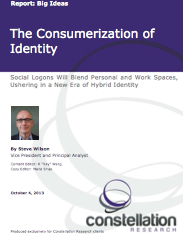
San Francisco, CA – August 28, 2013 Constellation Research, Inc. the research and advisory firm focused how disruptive technologies transform business models announced today the publication of “The Identity Manifesto: Seven Points on the Future of Identity” by Constellation Principal Analyst & CEO, R “Ray” Wang. This research report explores the future of identity and its implications for work, life and society. 

Identity often means many things to many people for good reasons. Traditional definitions of identity for the identity and access management professional have revolved around standards for authentication, access, authorization, and management. Key elements to the manifesto include:

  • B2B and B2C are dead. It’s a P2P and M2M world.
  • Users want identity the way they want it.
  • Identerati must move identity from geek to chic.
  • Context will drive future use cases.
  • Disruptive business requires identity.
  • Privacy isn’t dead.  It’s up to the identerati to guide us out of the morass.
  • New players are battling to orchestrate, manage and own your identity.

With the consumerization of technology, organizations realize that identity must have relevancy.  Why? The world can no longer be defined as business-to-business (B2B) or business-to-consumer (B2C).  In fact, the shift to a people-to-people (P2P) world changes the view on B2B and B2C as roles and relationships adjust with context.  The differences between b2b and b2c are contextual.

“The Future of Identity is a topic that spans across many business themes and must be addressed as we make the shift to a digital business environment,“ noted report author R “Ray” Wang.  “This is an area our clients find fundamental to their success.  Constellation intends to invest research resources in this area soon”

From customer experience to the future of work, Internet of things, matrix commerce and digital marketing, identity plays a key role in unifying people, process, technology and ecosystems.

As the battle for identity continues, commerce vendors, financial service entities, governments, hardware companies, social networks, software companies and telecom concerns seek the trust of users.  The result – a patchwork of trust agents will emerge to provide third-party trusted services.  Trust is the currency that enables identity. Transparency is the requirement.  The reputation economy foreshadows a world of authentic commerce or business.

Constellation recommends that market leaders take a C-A-R-E-based approach when approaching the future of identity.  Consider social logins for the enterprise.  Ask first when dealing with privacy. Raise the identity theft bar. Encourage emergence of independent trust agents.

This “big ideas” research report offers insight into how identity affects five of Constellation’s business oriented research themes: Digital Marketing Transformation, the Future of Work, the Next-Generation Customer Experience, Consumerization of IT, and Matrix Commerce.


THE REPORT
More information about “The Identity Manifesto: Seven Points on the Future of Identity” can be found here: http://constellationr.com/research/identity-manifesto-seven-points-future-identity

ABOUT R “Ray” Wang
R "Ray" Wang is the Principal Analyst and CEO at Constellation Research, Inc.  He's also the author of the popular enterprise software blog "A Software Insider’s Point of View". Ray's a prominent keynote speaker and research analyst working with clients on innovation, business model design, engagement strategies, customer experience, matrix commerce, and big data.  He advises Global 2000 companies on business strategy and technology selection.

COORDINATES
Profile
www.constellationr.com/users/rwang0
Twitter: @rwang0

Press Contacts:
Contact the Media and Influencers relations team at [email protected] for interviews with analysts.

Sales Contacts:
Contact our sales team at [email protected].

Future of Work Marketing Transformation Matrix Commerce New C-Suite Next-Generation Customer Experience Chief Customer Officer Chief Executive Officer Chief People Officer Chief Marketing Officer

Does it Really Matter if Ballmer Retires from Microsoft?

Does it Really Matter if Ballmer Retires from Microsoft?

"The higher a man stands on the social ladder, the more people he is connected with and the more power he has over others, the more evident is the predestination and inevitability of his every action."

-- Tolstoy, War and Peace

After 13 years as the CEO of Microsoft (NASDAQ MSFT), Steve Ballmer will retire in the next 12 months once his successor has been chosen. But will it make any difference? Microsoft has close to 100,000 employees, 1 billion customers, and $78 billion in revenue. The company's direction is pretty much set and its momentum can only be termed historic.

When Balmer joined Microsoft, the company had 30 people and its revenue were $7.5 million. It is conceivable the personality and will of a single individual could have a significant impact on the fortunes of a company of that size, but how can one person have that much influence on one hundred thousand employees, much less a billion customers? Microsoft is not the dominate company it once was not because of one individual but because of deeper historic trends. As Tolstoy points out in his novel War and Peace:

"We are forced to fall back on fatalism as an explanation of irrational events (that is to say, events the reasonableness of which we do not understand). The more we try to explain such events in history reasonably, the more unreasonable and incomprehensible do they become to us."

Why did Windows 8 fail? Was it because customers had all the features they needed in earlier versions, because tablets and smart phones are becoming the preferred platforms over desk tops and lap tops,  or because Balmer made some bad calls? No one today can really say, but Tolstoy provides some perspective:

"In historic events the so-called great men are labels giving names to events, and like labels they have but the smallest connection with the event itself. Every act of theirs, which appears to them an act of their own will, is in an historical sense involuntary and is related to the whole course of history."

Like Napoleon on Elba Island, in his retirement, Ballmer will no doubt ponder his role at Microsoft. If he reaches any conclusions we would be happy to publish them here.

Tech Optimization Chief Customer Officer Chief Executive Officer Chief Information Officer

Five Emerging Customer Service Investments To Consider

Five Emerging Customer Service Investments To Consider

1

Late summer and early fall is often the time for many customer service organizations to develop an investment strategy for the coming year. I find that companies often struggle regarding the best place to invest in innovative applications due to the many options available.  Most customer service decision makers understand the many benefits of emerging technologies supporting their customer needs, but tight budgets often limit their ability to move forward with new investments.  My short list of five key technologies that support new revenues, lower service costs and provide compelling customer experiences include mobile application support, automated chat, real time analytics, big data analytics and video customer support. These customer service investments demonstrate quantifiable business benefits and provide valuable customer insight.

Although emerging applications offer a tremendous potential, the reality is that business decision leaders need to fully appreciate how these applications will transform their business and provide better customer engagement.  To build a business case, you first need to identify the key pain points of the current operations and quantify the cost of not doing anything.    The emerging applications provide savings in the following ways:

· Mobile app integration delivers support directly from the mobile app.  It provides faster response and interacts with the customer at the time of greatest interest.  It also provides a seamless customer experience from their mobile device.

· Real time analytics mines customer structured and unstructured data from customer cases and social interactions.  Analytics provide insights into a customer’s issues to improve service, personalize interactions and identify product problems. It also supports faster problem resolution for customers.

· Automated chat or virtual assistants offer help to online customers with advanced natural language speech solutions.  It lowers the cost for online support services and eliminates unnecessary calls for basic information.

· Big data collects, manages and analyzes customer data from multiple sources with informed decisions and customer insight. It improves customer satisfaction by better understanding a customer’s needs, help brands make educated decisions and sends alerts on trends and issues.

· Video customer service offers visual communications to smartphones and tables. It promotes customer intimacy and encourages real-time collaboration. It also supports remote expert access to facilitate problem solving and shorten problem resolution time.

Next-Generation Customer Experience Chief Customer Officer

Top 12 Sites For Free Cloud Computing & Enterprise Software Research

Top 12 Sites For Free Cloud Computing & Enterprise Software Research

1

campusOne of the most common questions I get from students is where they can find free cloud computing and enterprise software research.

Few if any of my students work for companies who have subscriptions with the top analyst firms however.  A small group of students are working on a start-up on the side and want to absorb as much market data as they can.

Many of my former students are also in IT management roles, and when they become interested in a specific cloud computing or enterprise topic over time, they write me and ask if I have any data on their subject of interest.  I keep the following list updated from them too.   To serve all these students I’ve been adding to the list shown below for a number of years. None of these companies are current or past clients and I hold no equity positions in any of them.

The requests are so prevalent in global competitive strategy courses I distribute this list at the beginning of the semester with the following disclaimers.

  • Many of the cloud computing and enterprise software companies pay to have white papers written and research done.  Writing white papers and doing research for an enterprise software vendor client is a very lucrative business for many industry analyst firms.  Ethical industry analysts will often insist that a disclaimer be included in the white paper and on the website stating that they and their firms were hired to write the paper or do the research and publish the report.
  • The reports are intellectual property of the firms publishing them.  Enterprise software vendors often pay tens of thousands of dollars at a minimum for reprint rights and the right to provide them on their websites.  I advise my students to seek out the copyright and quote policies of the research firm of interest if they plan on re-using the graphics in any published materials or in their blog posts.  One for example, the Gartner Copyright and Quote Policy is shown here.
  • Pay attention to the methodologies used in each report and realize they change over time.  This is especially the case with the  Gartner Magic Quadrant and MarketScopes. Gartner has been very active this year in refining the Magic Quadrant methodology for example.

The following are the list of cloud computing and enterprise software vendor sites that offer free downloads of cloud computing and enterprise software research:

  • Amazon Web Services – Amazon has purchased re-print rights to the Gartner Magic Quadrant for Cloud Infrastructure as a Service written by Lydia Leong, Douglas Toombs, Bob Gill, Gregor Petri, Tiny Haynes published on August, 19, 2013 in addition to the latest reports from Forrester on enterprise public cloud platforms and enterprise cloud databases. Link:    https://aws.amazon.com/resources/analyst-reports/
  • BMC Software – Many free reports from Gartner, Forrester, The 451 Group and other research firms covering advanced performance analytics (APA), cloud computing, IT Service Management and long-term technology trends. Link: http://www.bmc.com/industry-analysts/reports/
  • Computer Associates – An extensive collection of cloud computing and enterprise software research organized into the following categories: cloud; data management; energy and sustainability management; IT automation; IT security; IT service management; mainframe; project and portfolio management; service assurance and virtual organizations.  CA requires opt-in on the latest research as they use this site as part of their lead generation strategy.  Link: http://www.ca.com/us/collateral/industry-analyst-reports.aspx
  • Cisco Systems -  Data Center and Virtualization; includes the latest Current Analysis, Forrester, Gartner, IDC, Lippis and Yankee Group research reports covering Big Data, blade servers, cloud computing, Hadoop, unified data centers and many other topics.  Be sure to click across the Computing, Network, Orchestration/Automation,  and Network Services tabs to find additional research:   Link: http://www.cisco.com/en/US/solutions/ns340/ns857/ns156/ns1094/analyst_reports.html
  • Hewlett-Packard – HP has invested primarily in networking-related analyst research including the latest studies and market frameworks from Forrester, Gartner, IDC and Infonetics Research.  Link: http://h17007.www1.hp.com/us/en/networking/ar/index.aspx#.Uhp-ERufg-J
  • Intel – Organized around the topic of designing a data center for the cloud, Intel is providing a series of research studies, reports, white papers and videos that provide insights into virtualization, networking, mobility and Intel-based servers running cloud architectures.  Link:  http://www.intel.com/content/www/us/en/cloud-computing/cloud-computing-analyst-reports.html
  • Microsoft – Balancing the need to support their enterprise applications today and create demand for cloud-based initiatives now and in the future, Microsoft’s series of analyst reports reflect their evolving business model.  Microsoft has licensed the latest research from Enterprise Strategy Group (ESDG), Forrester, Gartner, IDC, Ovum, Yankee Group and others listed on this site. Link: https://www.microsoft.com/en-us/news/itanalyst/
  • Oracle - The most comprehensive collection of industry analyst research online for any enterprise software vendor, Oracle has hundreds of research reports available for viewing under their reprint licenses for free, and also for download.  The reports are organized into corporate, infrastructure, systems, services, solutions, industries, enterprise applications and regions.     Link: http://www.oracle.com/us/corporate/analystreports/index.html
  • Progress Software – Extensive collection of research from Bloor, Forrester, Gartner, IDC, Tabb Group, Ovum and other research firms are available for download from this site. Link:  http://www.progress.com/en/inthenews/analyst-reports.html
  • SAS – The most extensive and well-organized online collection of analyst research on analytics and business intelligence (BI) available, SAS makes research available from fifteen analyst firms across six industries on this area of their website.  You can find the SAS Analyst Viewpoints section of their website here: http://www.sas.com/news/analysts/
  • Symantec – Provides downloadable analyst reports in the areas of risk and compliance, endpoint security and management, information and identity protection, messaging security, backup and archiving, storage and availability management, services and emerging trends.  ESG, Info-Tech Research Group, Forrester, Gartner and IDC reports are on this page for download. Link: http://www.symantec.com/about/industryanalysts/analystreports.jsp
  • Teradata – Extensive collection of industry analysis and research organized into the sections of Active Data Warehousing, Active Enterprise Intelligence, Enterprise Data Warehousing, Teradata Analytical Ecosystem and Teradata Integration Analytics.  The latest market frameworks from Gartner, Forrester, IDC and other research firms are available for download.  Link:   http://www.teradata.com/analyst-reports/

Filed under: Amazon Web Services, Cloud Computing, Louis Columbus' blog, SaaS Forecasts Tagged: Amazon Web Services, Cisco, Cloud Computing, cloud computing landscape, Enterprise Resource Planning, enterprise software companies, enterprise software vendor, enterprise software vendors, ERP, Forrester Research, HP, IDC SaaS Forecasts, Intel, Louis Columbus' blog, Microsoft, Oracle, Progress Software, SAP, SAS, Selling SaaS Applications, software, Software-as-a-Service, Symantec, technology

New C-Suite Tech Optimization Innovation & Product-led Growth SaaS PaaS IaaS Cloud Digital Transformation Disruptive Technology Enterprise IT Enterprise Acceleration Enterprise Software Next Gen Apps IoT Blockchain CRM ERP CCaaS UCaaS Collaboration Enterprise Service Chief Executive Officer Chief People Officer Chief Information Officer Chief Technology Officer Chief Information Security Officer Chief Data Officer

Microsoft does not need one new CEO - but six

Microsoft does not need one new CEO - but six

After a very long 12 years it looks like Steve Ballmer is calling its quits at the helm of Microsoft. Actually it will be 13 or years when he retires. 

No need to add to the speculation on possible successors - internal, external etc. the question really shareholders should be asking is - can you find an individual to successfully lead the diverse Microsoft businesses? Are they potentially not synergistic to each other? And ultimately - would Microsoft being split into separate businesses not be a better return for shareholders?

To give credit to Steve Ballmer (and Bill Gates who may becoming more prominent these days and coming months in Redmond, after all he is getting into the age where most managers become CEOs...) - they tried to sort this out by focusing on devices and services. But that was too abstract and the devices are too diverse - it's different to sell smartphones vs game consoles - and the service portfolio was too wide, too - provisioning servers in Azure is different than taking orders in Dynamics.

So time to untangle Microsoft - here are the suggestions...

  • Operating systems (Windows in all its flavors)

  • Cloud (Azure)

  • Productivity (Office, outlook.com etc)

  • Business Applications (Dynamics et al)

  • Gaming (XBox & co)

  • Consumer Products (if you like keep venturing with the Surface, maybe a phone etc). 

Now, finding a CEO is never easy - but if you think about it  - it's much easier to find six CEOs for the above entities than for all or Microsoft. And you make keep some in place that are running entities that are similar to the above - like e.g. Nadella for cloud and Tatarinov for Dynamics.

And you could still cross license, subsidize across these entities. But each of them would be able to position themselves with their own marketing, decide where to sell with their own sales force, build their own products, have their unique support experience, select their best partners etc. And you could still have perfect fights over cross charges and bad delivery and partnership - in short keep the press entertained.

Finally - and this is all speculation of course - I think investors will trust more and hence vote with their security purchases - into the six entities - than into Microsoft as a hole. Microsoft running on full steam with six entities as it's offspring - may achieve more for customers, partners, employees and mankind than the behemoth it sometimes is these days.

Now I can only hope Bill Gate reads this...

Missed my takeaways from Build 2013? Read them here

Future of Work Tech Optimization Microsoft Chief Customer Officer Chief Executive Officer

Event Report: CRM Evolution 2013: Seven Trends In The Return To Digital Business And Customer Centricity

Event Report: CRM Evolution 2013: Seven Trends In The Return To Digital Business And Customer Centricity

Market Leaders Refocus On Digital Business and Customer Centricity

The annual gathering of the industry’s top thought leaders, users, and vendors of CRM converged at the Marriott Marquis in New York this past August 19th to 21st.  As with any good conference, the speaker tracks and the corridor conversations provided a glimpse of where market leaders and fast followers planned to make their future investments and provided key insights for 2014.  After speaking with over 100 attendees, the following seven trends emerged from this year’s event:

  1. CRM is dead, well not really. While the term CRM is loosely used to define many things.  Leaders realize that CRM is the technology.  Customer experience is the business process and journey maps.  Customer centricity is a state of mind that’s required of management and leaders.  While customer experience is the new term du jour, all three elements (i.e. technology, business process, and people leadership) are required for success.  Front office is more descriptive than Tom Siebel’s legacy term of CRM.
  2. Customers seek outcomes not products or services. Customers no longer buy products.  Customers expect products to be bundled with services.  Services providers now seek to sell experiences.  Experience providers now sell access to outcomes.  This evolution of what customer’s want and what’s delivered continues to accelerate.  With hipsters and millennials short on cash, access, experiences, and outcomes have emerged as one market category to deliver for in this growing sharing economy.  However, not all customers seek just access. A movement to move too far, will result in a backlash from a majority of customers who seek ownership without the shackles of renting.
  3. Transformation projects now rally behind the shift from social back to digital business. The social business and social crm era focused on a key aspect of CRM – the relationship.  In the past, CRM excelled at management, poorly accomplished customer, and failed at relationship.  Looking back three years,  the rise of social ties back to the need to address relationships.  Now that social moves to the mainstream, market leaders refocus to digital transformation of customer centric initiatives.
  4. Funnels make no sense in an asynchronous world. Classic sales, marketing, and service funnels force fit customers into unrealistic models.  Entry points will ebb and flow as channels and context drive demand into a variety of use cases.  Design must account for this constant state of change.
  5. Big data provides relevancy and context. All the hype on big data continues to miss the point.  Customer centricity requires context.  Context creates relevancy based on a customer’s roles, relationships, products, services, location, time, sentiment, and intent.  Without relevancy, acquisition, targeting, and personalization will fail.
  6. Front office still needs back office integration. Integration with back office is required for customer experience.  A customer who makes an order for a product or service that’s out of stock and billed twice for something they did not receive will most likely be upset.  Customer centricity is both a front office and back office exercise.
  7. Identity plays a key role. Identity plays a multi-faceted role for each individual. The business implications of identity after authentication, authorization, access, and availability touch on commerce, work lives, personal lives, and engagement with each other.  Identity is a unifying factor in the current transformation to a digital world and required for customer centricity.

The Bottom Line: Business Leaders Must Embrace Customer Centricity In Order to Differentiate In A Digital World

A digital world requires organizations to practice what they preach.  Customer centricity is a state of mind that requires leadership at the top.  Most data on customer experience highlights a need for authenticity and relevancy in dealing with a brand or enterprise.  With trust and transparency an increasing requirement for authentic business, leaders who fail to lead from the top, deliver great customer journeys, and apply the right CRM technologies will continue to fall behind as the digital business divide widens.  Customer centricity is now a strategic imperative and requires first rate orchestration, company wide commitment, and leadership.

Your POV.

What’s your plan to achieve customer centricity? Are you embarking on a digital business transformation?  Let us know how it’s going!  Add your comments to the blog or reach me via email: R (at) ConstellationR (dot) com or R (at) SoftwareInsider (dot) com.

Please let us know if you need help with your Customer Centricity and Digital Business transformation efforts.  Here’s how we can assist:

  • Assessing customer centricty readiness
  • Developing your digital business strategy
  • Vendor selection
  • Implementation partner selection
  • Connecting with other pioneers
  • Sharing best practices
  • Designing a next gen apps strategy
  • Providing contract negotiations and software licensing support
  • Demystifying software licensing

Related Research:

Reprints

Reprints can be purchased through Constellation Research, Inc. To request official reprints in PDF format, please contact Sales .

Disclosure

Although we work closely with many mega software vendors, we want you to trust us. For the full disclosure policy, stay tuned for the full client list on the Constellation Research website.

* Not responsible for any factual errors or omissions.  However, happy to correct any errors upon email receipt.

Copyright © 2001 – 2013 R Wang and Insider Associates, LLC All rights reserved.
Contact the Sales team to purchase this report on a a la carte basis or join the Constellation Customer Experience!


Marketing Transformation Matrix Commerce New C-Suite Next-Generation Customer Experience Data to Decisions Future of Work Innovation & Product-led Growth Tech Optimization Revenue & Growth Effectiveness Digital Safety, Privacy & Cybersecurity Event Report SoftwareInsider B2C CX Next Gen Apps Customer Experience ML Machine Learning LLMs Agentic AI Generative AI Robotics AI Analytics Automation B2B EX Employee Experience HR HCM business Marketing Metaverse developer SaaS PaaS IaaS Supply Chain Quantum Computing Growth Cloud Digital Transformation Disruptive Technology eCommerce Enterprise IT Enterprise Acceleration Enterprise Software IoT Blockchain CRM ERP Leadership finance Social Healthcare VR CCaaS UCaaS Customer Service Content Management Collaboration M&A Enterprise Service Security Zero Trust Executive Events Chief Customer Officer Chief Executive Officer Chief Information Officer Chief Marketing Officer Chief Technology Officer Chief Data Officer Chief Digital Officer Chief Analytics Officer Chief Financial Officer Chief Operating Officer Chief Revenue Officer Chief People Officer Chief Information Security Officer Chief Privacy Officer Chief Human Resources Officer Chief Experience Officer

Birst Closes $38 Million Funding Round

Birst Closes $38 Million Funding Round

Birst
Birst Inc, a Cloud BI company has completed a $38 million investment led by Sequoia Capital. Founded by Siebel alumni Brad Peters and Paul Staelin (where they developed the Siebel analytics product lines) Birst is headquartered in San Francisco. In addition to gaining new customers, Birst is expanding into Europe, Asia and the Middle East and growing its partner and technology alliances.

New customers include American Express, Build.com, Cisco, CSC, InterContinental Hotels Group, Ingram Medical, Johnson Controls, Leapfrog, NCC Media, New South Wales Government, Nippon Life, Reckitt Benckiser, Samsung, Schneider Electric, Sunny Delight, and Virgin HealthMiles. Birst also continues to expand its indirect embedded business, adding FICO, Navis, OpenText, Trimble and Valen to the list of software providers who use Birst analytics within their products.

New partnerships include Acumen, Analytics8, Audaxium, CorSource, Eagle Creek, The Pedowitz Group, Projectline, TeleTech and 3Coast. In addition new strategic alliances were formed with Amazon, NetSuite, and Marketo.

“This investment furthers our ability to strengthen our solution and will allow us to offer it around the world.” said Brad Peters, CEO and Co-founder of Birst.

The new funding will be used to further expand internationally, grow sales and marketing and invest in new product capabilities.

New C-Suite Tech Optimization Chief Information Officer

Oracle Releases Mobile Apps Designer Product

Oracle Releases Mobile Apps Designer Product

Oracle-logo

Oracle Corporation (NYSE: ORCL) has released the BI Mobile App Designer, a design tool to create analytical applications for use on multiple mobile devices. With this product, Oracle extends the capabilities of the Oracle BI Mobile solution to provide with real-time insights to users while on the go.

The tool has a browser-based, drag-and-drop design interface which enables business users to combine data, text, images, visual graphs, and tables from multiple sources to create mobile analytical apps. Without installing anything, developers can create mobile analytical applications.

The tool has a web-based mobile simulator, and can scan a QR code to run an application. Multiple users can also collaborate and share apps via an App Library where users can subscribe and receive automatic updates.

The apps created using the tool run using HTML5 on iOS, Android, and Windows Mobile smartphones and tablets. Automatic rendering for differing screen sizes allow users to follow a write once, run anywhere model.

"Purpose-built mobile analytical apps greatly expand the opportunities for companies to deploy analytics broadly to everyone," said Paul Rodwick, vice president of product management, Oracle.

Tech Optimization Chief Customer Officer

Accenture Wins Asia Oracle Partner of the Year

Accenture Wins Asia Oracle Partner of the Year

Accenture
 

Accenture was awarded the 2013 Oracle Excellence Awards for Specialized Partner of the Year: Applications - APAC  at Oracle OpenWorld in Shanghai. The award recognizes Accenture for the firm's commitment to services based on Oracle products. The award is determined by such criteria as the size and nature of joint client engagements, successful implementations, and Accenture's ability to enhance Oracle products to deliver tailored solutions.

"We are thrilled to be recognized for our technology capability and success in helping clients get the most out of their Oracle solutions," said Jane Livesey, Accenture's Oracle practice lead in APAC. 

"We congratulate Accenture in achieving the 2013 Oracle Excellence Award for Specialized Alliance Partner of the Year: Applications - APAC." said Andy Bailey, senior vice president, Strategic Alliances, Oracle.

Accenture has more than 52,000 consultants working on Oracle solutions out of 266,000 employees who in total generated revenues of $28 billion last year.

New C-Suite Tech Optimization Chief Information Officer

2013 SuperNova Award (#SNA2013) Finalists Announced

2013 SuperNova Award (#SNA2013) Finalists Announced

Constellation Research celebrates champions of disruptive technology for third year

SAN FRANCISCO, CA, August 22, 2013— Constellation Research, Inc. the research and advisory firm focused on helping organizations apply emerging technologies to disrupt business models today announced the finalists of the third annual SuperNova awards for innovators in disruptive technology. The finalists were selected from a pool of over 220 applicants, and recognized by the SuperNova Award Judges as exceptional examples of those who embody the SuperNova Award spirit to innovate and overcome the odds in successfully applying emerging and disruptive technologies within their organizations. The winners of the SuperNova Awards will be announced at the SuperNova Awards gala dinner on October 30, 2013 in Half Moon Bay, California. The gala dinner will take place on the first night of Constellation’s Connected Enterprise innovation summit.

Selecting Finalists

The Constellation SuperNova Awards celebrate the explorers, the pioneers, and champions of technology that battle the odds to effect change in their organizations, and create disruptions in their market.

An all-star cast of judges have selected applicants who embody the SuperNova spirit to innovate, overcome adversity, and successfully deliver market-changing approaches. Applicants were subjected to a vigorous set of criteria that reflect real-world and pragmatic experience. Entrants in 2013 SuperNova Awards are competing in seven categories centered on Constellation's business-focused research themes: Future of Work, Data to Decisions, Digital Marketing Transformation, Technology Optimization and Innovation, Consumerization of IT and the New C-Suite, Matrix Commerce, and Next Generation Customer Experience.

“We’ve been very impressed with the quality of this year’s SuperNova Awards finalists.  The individual and companies who have been selected truly buck the trend and show disruption,” said R “Ray” Wang, principal analyst and CEO of Constellation Research, Inc.


SuperNova Award Finalists

Consumerization of IT and the New C-Suite

 Andrew Knapp, IT Support Specialist, Arizona Beverages
Chris Plescia IT Leader, Collaboration, Nationwide
Jason Thomas, Chief Information Officer, Green Clinic Health System
Lauren Klein, Social Leadership Community Strategist, Hitachi Data Systems
Lina Gallardo, Director, Product Management Group Markets, Blue Cross and Blue Shield of Minnesota
Vijay Kesavan, IS Director, Diageo

Data to Decisions

 Ashish Braganza, Senior Manager of Global Business Intelligence, Lenovo
Brad Donovan, Manager, Agile Analytics and Innovation, GlaxoSmithKline
Bruce Yen, Director of Business Intelligence, Guess?
Dirk Zeller, Head of IT Consulting at Mercedes-AMG GmbH, Mercedes-AMG GmbH
Karen Simmons, Senior Director, Enterprise Data Warehouse, Kelley Blue Book Co., Inc.
Oswaldo Mestre, Director, Division of Citizen Services, Office of the Mayor, City of Buffalo 311 Call and Resolution Center
Lance Henderson, CEO, Zamzee
Roman Coba, Chief Information Officer, McCain Foods Limited
Ronald Baden, VP of Services, Host Analytics
Russ Turner, Site Reliability Engineering - Manager, Domino’s Pizza
Tony Candeloro, Vice President Product Development, ARI

Digital Marketing Transformation

Ashish Braganza, Senior Manager of Global Business Intelligence, Lenovo
Ashleigh Casner, Director of Marketing, Huddle
Brace Rennels, Director, Community Strategy, EMC
Christopher Jowsey, Senior Manager, Web eCommerce, Lenovo Australia
Karen Simmons Senior Director, Enterprise Data Warehouse, Kelley Blue Book Co., Inc.
Pierre Bourbonniere, Head of Marketing, Société de transport de Montréal, La Société de transport de Montréal (STM)
Richard, Milne, Global Director of eCommerce and Digital Marketing    Life Technologies Corporation
Steve Susina, Director, Demand Generation Services, Crain's Business Insurance

Matrix Commerce

 Jacob Jaber, CEO, Philz Coffee
Phillip Kennedy, Director, Information Technology, Pandora Jewelry
Ron Godine, Director of IT, TMW Systems
Sanjib Sahoo, Chief Technology Officer, tradeMONSTER
Trak Lord, Marketing & Media Relations, Metaio
Alan Hilburn, Director – IT Transportation & Operations, PSC, LLC

Technology Optimization and Innovation           

Annalie Killian, Catalyst for Magic, Amplify Festival / AMP Services Limited
Arland Weise, VP Administration, National Oilwell Varco
Dirk Zeller, Head of IT Consulting at Mercedes-AMG GmbH
Don Whittington, Vice president and CIO, Florida Crystals Corporation
Eric Feige, VP Digital Strategy, Prudential
Greg Hicks, Director IT, Social and Collaborative Innovation, UnitedHealth Group
Jacky Saayman, Director, eMarketing and Programs, EMEA, OpenText
Jacob Jaber, CEO, Philz Coffee
Jeffrey Burns, "OPENPediatrics Program Director: Chief, Critical Care Medicine, Boston Children's Hospital", Boston Children's Hospital
Jos Uijterwaal, CFO, Cloud9 IDE
Sanjib Sahoo, Chief Technology Officer, tradeMONSTER
Steve Airton, Information Services (IS) Controller, United Biscuits
Tom Cartledge, Director, Technology & Operations, John Moore Services (JMS)
Trever Scott, Senior Director, Information Technology-North America, Dole Fresh Fruit Company

Future of Work           

Andrew Knapp, IT Support Specialist, AriZona Beverages
Chris Plescia, IT Leader, Collaboration, Nationwide
Dirk Zeller, Head of IT Consulting at Mercedes-AMG GmbH 
Greg Hicks, Director IT, Social and Collaborative Innovation, UnitedHealth Group
Jay Grant, Chief Executive, InterPortPolice
Jeffrey Burns, "OPENPediatrics Program Director: Chief, Critical Care Medicine, Boston Children's Hospital",Boston Children's Hospital
Joan Orr, Vice President, TAGteach International
Kenneth Fonzi, Associate Director of Online Information Systems, Children's Hospital Foundation
Lauren Klein, Social Leadership Community Strategist, Hitachi Data Systems
Margaret Oldham, Director of Innovation and Opportunity, Beck Ag, Inc.
Paul Rumsey, Vice President, Global Learning & Development, Carlson Restaurants (TGI Friday's)
Sebastian Joseph, Chief Technology Officer, DDB Mudra Group
Susie Long, Director, Organizational Development, Dollar General

Next Generation Customer Experience

Carl Stokes, Head of IT, NHBC (National House-Building Council)
Eric McKirdy, Global Customer Care Manager, Ask.com
Fred Kirsch, Vice President, Content, New England Patriots
Jacky Saayman, Director, eMarketing and Programs, EMEA, OpenText
Jeff Sullivan, Senior Marketing Manager – Online Communities, Dell
Jeffrey Burns, "OPENPediatrics Program Director: Chief, Critical Care Medicine, Boston Children's Hospital", Boston Children's Hospital
Krissy Espindola, Director, Knowledge Management and Social Customer Support, T-Mobile
Lauren Klein, Social Leadership Community Strategist, Hitachi Data Systems
Lauri Travis, Community Manager, Tyler Technologies, Inc.
Lina Gallardo, Director, Product Management Group Markets, Blue Cross and Blue Shield of Minnesota
Oswaldo Mestre, Director, Division of Citizen Services, Office of the Mayor, City of Buffalo 311 Call and Resolution Center
Philippe Vayssac, Customer Interaction Project Owner, Groupama Rhône Alpes Auvergne
Pierre Bourbonniere, Head of Marketing, Société de transport de Montréal, La Société de transport de Montréal (STM)
Samuel Creek, Principal Business Analyst, CA Technologies
Sanjib Sahoo, Chief Technology Officer, tradeMONSTER
Wynn Parrish, Vice President, Product Support, B/E Aerospace


SELECTING WINNERS

Winners of the 2013 SuperNova Awards will be determined by a combination of public and judges’ votes.  Public polling will take place on the Constellation website between September 9, 2013 and October 9, 2013. One vote per IP address. Constellation encourages the general public to vote for the finalist they deem most worthy of receiving a SuperNova Award for innovators in disruptive technology. Judges’ votes will be weighted at 70% of the total.


SUPERNOVA AWARD WINNERS

The winners of the SuperNova Awards will be announced live, on stage at the SuperNova Awards gala dinner on October 30, 2013 on the first night of Constellation’s Connected Enterprise innovation summit (#CCE2013). All finalists are invited to attend Constellation’s Connected Enterprise, and are encouraged to attend the gala dinner.


REWARDS INCLUDE ACCESS TO INNOVATION, NETWORKING, AND RESEARCH

All finalists will be awarded one three-month subscription to Constellation’s Quark (short research) library. In addition, finalists will be invited to attend Constellation’s Connected Enterprise 2013 innovation summit (#CCE2013), at the Ritz Carlton, Half Moon Bay, California -- October 30th to November 1st 2013.

#CCE2013 is a three-day executive retreat described as TED for the enterprise that includes mind-expanding keynotes from visionaries, best practices panels, Market Maker 1:1 interviews, The Constellation SuperNova Awards gala dinner, and golf outing.

Winners of the SuperNova Awards will win a one -year subscription to Constellation’s Research Library, advisory with Constellation analysts, and complimentary tickets to Connected Enterprise 2014 –an estimated value of $120,000 per winner.


ABOUT CONSTELLATION RESEARCH

Constellation Research is a research and advisory firm focused on disruptive and emerging technologies. This renowned group of experienced analysts, led by R "Ray" Wang, focuses on business-themed research including Digital Marketing Transformation; Future of Work; Next Generation Customer Experience; Data to Decisions; Matrix Commerce; Technology Optimization and Innovation; and Consumerization of IT and the New C-Suite.

Constellation's collection of prestigious analysts bring real world experience, independence, and objectivity to client solutions that span cross-role, cross-functional, and cross-industry points of view. Clients join Constellation Research for a fresh and business focused perspective.

Unlike the legacy analyst firms, Constellation Research is disrupting how research is accessed, what topics are covered, and how clients can partner with a research firm to achieve success. Over 100 clients have joined from an ecosystem of buyers, partners, solution providers, c-suite, board of directors and vendor clients.

***

Constellation Research, Constellation SuperNova Awards, Constellation Orbit, Connected Enterprise, Constellation Cosmos, and the Constellation Research logo are trademarks of Constellation Research, Org. All other products and services listed herein are trademarks of their respective companies.


Press Contacts:
Contact the Media and Influencers relations team at [email protected] for interviews with analysts.

Sales Contacts:
Contact our sales team at [email protected].


Data to Decisions Future of Work Marketing Transformation Matrix Commerce New C-Suite Next-Generation Customer Experience Tech Optimization Innovation & Product-led Growth Supernova Awards AR Executive Events Chief Customer Officer Chief Executive Officer Chief Financial Officer Chief Information Officer Chief Marketing Officer Chief People Officer Chief Procurement Officer Chief Supply Chain Officer