Results

New Report: Why Artificial Intelligence Will Power the Future of Work

New Report: Why Artificial Intelligence Will Power the Future of Work

During the Fall of 2014 at Salesforce’s annual conference Dreamforce, I gave a presentation titled “From Clippy to JARVIS" where I explained how the next generation of software was going to assist people in getting their work done. Back then, terms like Artificial Intelligence (AI) and machine learning had not reached the massive level of hype that they are currently experiencing today. Instead, my presentation discussed topics like task automation, extracting insights, and providing recommendations. Since that presentation over two years ago, I’ve worked with dozens of enterprise software vendors, innovative new startups, and customers of Constellation on how AI can help their employees get work done. That work formed the foundation for my newest report, Why Artificial Intelligence Will Power the Future of Work.

This new report is intended for C-suite executives and Line of Business managers who want to understand why there is so much talk about AI these days, how it’s important to their businesses, the use-cases and benefits it can provide, and also prepare them for the challenges that the future of AI-enhanced software must overcome.

Below is a glance at what is contained in the report.

Table of Contents

  • Executive Summary
  • Artificial Intelligence Delivers a Game Changer to the Future of Work
  • AI-Enhanced Software Learns while Traditional Software Is Static
  • How Does a Machine Learn?
  • AI Requires Five Core Components for Success
  • AI Will Augment Humanity over Time
  • Expect AI to Rapidly Show Up in Applications
  • Where AI Helps People Get Work Done
  • AI Must Overcome Six Human Challenges
  • Recommendations
  • The Bottom Line


Executive Summary
Artificial intelligence (AI) has emerged as one of the most important trends affecting the future of work.  While the study of AI has been around for decades, advancements in computing power and access to huge data sets now bring AI capabilities closer to reality. Enterprise software vendors are working on new versions of their applications that use AI to help employees be more productive. For instance, these AI-enhanced programs can help bring to light important information, assist in expense reporting, automate content creation, and help connect the right people at the right time. This report serves as a Beginners Guide to AI, explaining some basic concepts and then providing examples of how AI-enhanced software can help employees get work done and augment humanity. Finally, Constellation provides recommendations on how organizations should prepare for artificial intelligence’s role in the future of work.


Constellation Research customers can purchase the full report, Why Artificial Intelligence Will Power the Future of Workby clicking here.   
 

Future of Work

Q2 2016 Future of Work Developments & Trends Shootout

Q2 2016 Future of Work Developments & Trends Shootout

By now you will be familiar with my year end development and trends shootout, this one is about Future of Work trends and developments in Q2 2016. If you missed the Q1 Future of Work post - it can be found here.


Here you go for Q1 2016 - all related to Future of Work - the research area that covers how, when, what and if we work, what and how we get paid, stay motivated and balance the work / life relationship. If you wonder on the process - all laid out in the Q1 post - read here.


[Apologies - time to market forced me to play the bracket right to left.]
 
 
Holger Mueller Enterprise Software Musings Constellation Research Microsoft Cornerstone Oracle SAP
 

Round #1 Dropouts

 
  • NGA HR - unshackled - NGA HR, the former NorthGate Arinso managed to renegotiate and shed itself of substantial debt, expecting a brighter future for the 'All Things HR' specialist - with a focus on Global HR BPO (read more here). Not enough to trump the Microsoft Hololens, but this was a match-up of non equals both in vendor size and announcement category (read here).
     
  • Equifax EFX Forum - Another got event for the compliance specialist, one of the few vendors who can solve one of the top concerns of CxOs, compliance, with a Compliance as a Service (CaaS) offering (more here). But Cornerstone adding to its HCM automaton portfolio with adding HR Core capabilities had more impact (read here).
     
  • SAP SuccessFactors Analyst Summit - SuccessFactors found a way forward, to lift all products with common horizontal and platform plans. Very important to consolidate the mixed acquisition history, and very welcome by customers and prospects (read here). But sparred against one of the biggest acquisitions in enterprise history, a clear win for Microsoft (read here).
     
  • HireVue Digital Disruption - HireVue keeps innovating in the area of video recruiting and Talent Acquisition overall (read here). Good progress and an interesting foray into the (bigger) coaching market - but no competition to the sheer breadth of announcements and progress made by Oracle at HCM World (read here).
 

Round #2 Dropouts

 
  • Microsoft Hololens - Much progress made by Microsoft Hololens in 2016, we had a chance to build a mini applicaiton during the developer conference Build in San Francisco (read here).The mixed reality vision is compelling - now Microsoft needs to convicne developers to build the apps for Hololens. More immediate impact by Cornerstone, and more direct talk of people leaders (read here). 
     
  • Oracle HCM World - A broad push around the core was the key strategy and announcement trail at HCM World, with Helpdesk, Learning and more Work / Life offerings (read here). But more impact happened from the Microsoft and LinkedIn tie in (read here). 


Q1 Finals - Microsoft / LInkedIn wins over Cornerstone

While Cornerstone portfolio enhancement move remains impressive (read here), the acqusition of LinkedIn by Microsoft garnered even more interest. Not a fair match-up - but it all happened in Q2. More questions than answers specifically on the HCM side, but Microsoft probably acquired a Top 3 HCM vendor with LinkedIn - without mentioning it (more here and here). Congrats to Microsoft / LinkedIn to making it to the 2016 finals!
 
How would you have scored the Q1 2016 news? Please comment!
  
 
Here are all blog posts:
  • Progress Report - NGA HR with new HR service offerings - unshackled read here.
  • Event Report - Equifax EFXForum16 Good progress and CaaS looming - read here.
  • Progress Report - SAP SuccessFactors makes good progress - now needs appeal beyond SAP - read here.
  • Event Report - HireVue Digital Disruption 2016 - More Recruiing and now... Coaching - read here.
  • Musings - Will Microsoft's Hololens transform the Future of Work? Read here.
  • Event Report - Oracle HCM World - Innovation around the Core - read here.
  • Progress Report - Cornerstone Convergence - HR Core debut, lot's of product, time to execute! Read here.
  • Market Move - Microsoft acquired Linked - Tons of synergies, start with Cortana, maybe too many - read here.
Other Shootouts for 2016:
  • Q2 Q2 2016 NextGen Apps Developments & Trends Shootout - read here.
  • Q1 2016 NextGen Apps Development & Trends Shootout - read here.
  • Q2 2016 Future of Work Development & Trends Shootout - read here.

Find more coverage on the Constellation Research website here and checkout my magazine on Flipboard and my YouTube channel here.
New C-Suite Data to Decisions Innovation & Product-led Growth Revenue & Growth Effectiveness Future of Work Next-Generation Customer Experience Digital Safety, Privacy & Cybersecurity Tech Optimization SuccessFactors SAP Oracle Microsoft Leadership AR Chief Technology Officer Chief Information Officer Chief Information Security Officer Chief Data Officer

Q2 2016 NextGen Apps Developments & Trends Shootout

Q2 2016 NextGen Apps Developments & Trends Shootout

By now you know the idea I had to square off the top news and developments of each quarter of 2016 in playoff / bracket format...  I started with NextGen Apps for Q1 2016 (won by Microsoft with its Conversation as a Platform (CaaP) launch - take a look here and Future of Work Q1 2016 - won by Ceridian with its overall suite wide push and next generation capabilities, read here


Of course this is a personal exercise - anyone can come to an different result - here is what I did: I picked the top 8 events, news, acquisitions, conferences, analyst events etc. of the quarter, they had to have a blog post published by yours truly. Threw them in a bucket, draw them and then had them 'play' out the bracket... based on what myPOV was in regards of enterprise relevance and impact for our clients, the CxOs, with special weight to people leaders out there. Needless to say - some where easier, some harder. 
 
Here you go for Q2 2016 - all related to NextGen Apps - the research area that covers when enterprises build new software - what are the use cases, the tools, the platforms, the players, the best practises etc. 


[Apologies - time to market forced me to play the bracket right to left.]
 

Round #1 Dropouts

 
  • Unit4 Business World On - A complete, start from scratch, built on next gen capabilities that technology offers, ERP package was launched by Unit4. Runs on IaaS, uses BigData and Machine Learning, includes an assistant etc. (read more here). Unfortunately squared against CloudFoundry, which has seen broad adoption and mind-share amongst CxOs in 2016 (read here).
       
  • AWS in India - Few locations, maybe Germany, have garnered more anticipation and interest for AWS opening up a location for its IaaS services than the one in India (read here). Unfortunately the draw squared it against another big AWS announcement, the joint statement of both Salesforce and AWS of making AWS its production IaaS. Both are important for AWS, but getting load leads to opening locations, so the partnership wins this one (read here).
     
  • OpenStack Summit - What used to be the tangible, widely adopted alternative to public IaaS, OpenStack, showed signs of weakening at OpenStack Summit in Austin (read here), where no commercial company talked about usage in the keynote (ISVs and Telcos where there in force). SAP choosing Azure as the (or one? Not clear yet today.) IaaS partner for production loads eclipses this easily. (see here).
     
  • Infosys Confluence - Infosys laid down its vision on how enterprises will operate in the future, but most impressively laying out its vision on how to disrupt its own business for the better with Mana (read here). But Google I/O was a tough opponent and wins this round (see here).
     

Round #2 Dropouts

 
  • Salesforce and AWS - While an impressive partnership - that will show further announcements in the year (stay tuned, think foliage), it did resonate in the Salesforce ecosystem only (read here), but the CloudFoundry victory lap continued strong in 2016, dominating both CxO conversations and plans as well as IVS and IaaS uptake, read here (read here).
     
  • Google I/O - Google staged its yearly developer conference in Mountain View this time and it was loaded with announcements, mainly in Machine Learning (by now everyone said AI), VR / AR, Assistants and much more (read here). But the SAP / Microsoft partnership garnered more, probably immediate enterprise attention and squares the #1 enterprise load in the direction of the #2 IaaS vendor, read here.


Q2 Finals - CloudFoundry beats Microsoft Azure getting SAP load

Two key evens in Q2 2016, both operating at different levels of the stack. The Microsoft / SAP partnership on attracting load for Azure on the IaaS level, also marking (the not confirmed) end of SAP's in house IaaS ambition (read here). CloudFoundry is squarely on a PaaS level, with load portability across IaaS being one of the major reasons to attract enterprises (read here). Even if they may never move loads across IaaS - they still remain very attracted to the topic, trying to avoid the dreaded lock-in. Apps beat IaaS here, so congrats to CloudFoundry to win the Q2 Finals of 2016 in the NextGen Apps category. See you in the Finals. 
 
How would you have scored the Q2 2016 news? Please comment!
  
 
Here are all blog posts:
  •  
  • News Analysis - Unit4 announces Business World On – A modern ERP offering - read here.
  • News Analysis - Amazon Web Services Cloud now speaks… Hindi - Indian AWS Data Centers available - read here.
  • Event Report - OpenStack Summit 2016 - Austin - OpenStack matures - read here.
  • Event Report - Infosys Confluence - The Future Watch is Software + People - read here.
  • News Analysis - Salesforce selects AWS as preferred Public Cloud Infrastructure Provider - Good move - read here.
  • Event Report - Google I/O 2016 - Android N soon, Google assistant sooner and VR / AR later - read here.
  • News Analysis - SAP and Microsoft usher in new era of partnership to accelerate digital transformation in the cloud - read here.
  • Event Report - Cloud Foundry Cloud Foundry Summit - It's good to be king of PaaS - read here.
 
Other Shootouts for 2016:
  • Q1 2016 NextGen Apps Development & Trends Shootout - read here.
  • Q2 2016 Future of Work Development & Trends Shootout - read here.
 
Find more coverage on the Constellation Research website here and checkout my magazine on Flipboard and my YouTube channel here.
Tech Optimization Innovation & Product-led Growth Data to Decisions Future of Work Digital Safety, Privacy & Cybersecurity New C-Suite unit4 infosys Google salesforce amazon SAP Microsoft SaaS PaaS IaaS Cloud Digital Transformation Disruptive Technology Enterprise IT Enterprise Acceleration Enterprise Software Next Gen Apps IoT Blockchain CRM ERP CCaaS UCaaS Collaboration Enterprise Service AR Chief Information Officer Chief Technology Officer Chief Information Security Officer Chief Data Officer Chief Digital Officer Chief Analytics Officer Chief Executive Officer Chief Operating Officer

Q1 2016 Future of Work Developments & Trends Shootout

Q1 2016 Future of Work Developments & Trends Shootout

There is always time to try something new - and instead of writing one more year review on what happened in my research areas, I thought I make this more entertaining, and provider a 'playoff' of the news in each quarter. I started with NextGen Apps for Q1 2016 - take a look here


Of course this is a personal exercise - anyone can come to an different result - here is what I did: I picked the top 8 events, news, acquisitions, conferences, analyst events etc. of the quarter, they had to have a blog post published by yours truly. Threw them in a bucket, draw them and then had them 'play' out the bracket... based on what myPOV was in regards of enterprise relevance and impact for our clients, the CxOs, with special weight to people leaders out there. Needless to say - some where easier, some harder. 
 
Here you go for Q1 2016 - all related to Future of Work - the research area that covers how, when, what and if we work, what and how we get paid, stay motivated and balance the work / life relationship. 
 
 
[Apologies - time to market forced me to play the bracket right to left.]
 

Round #1 Dropouts

 
  • Unit4 Assistant / Slack Integration - Assistants were the key new functionality talked about in 2016, Unit4 was the first traditional ERP vendor coming out with an across suite assistant. Slack with its instant chat tool never got out of the headlines, and many vendors have jumped on the Slack band wagon - again Unit4 was the first larger ERP vendor to provide an integration (read here). But Ceridian with its broad next generation capabilities wins this round (read more here), capturing more people leaders mind share.
     
  • Workday France Payroll - Announced for over two years, Workday delivered on is France payroll (read here), always good to deliver (read more here). But the impact was mainly with international and French clients, and pales compared to the cross suite innovation unveiled by SAP SuccessFactors. (more here).
     
  • VMware Workspace One - VMware EUC has been on a roll, capturing market share and delivering (finally) for the industry on the long time promise of VDI, which changes fundamentally the Human / Machine relationship, away from the traditional PC (read here). But the progress ADP showed at Meeting of the Minds was more relevant for people leaders across the country (see here).
     
  • Workato Bots - Workato kept innovating around its end user, no code integration platform, which changes the Future of Work as it enables business users to build their own work environment, solving the application integration problem (read here). However, Ultimate at UltiConnect provided more impact for people leaders in Q1 2016 (more here).

Round #2 Dropouts

 
  • SAP SuccessFactors platform innovation - SuccessFactors (finally went back to broad across suite platform enhancements (e.g. Intelligent Services, Machine Learning) and renovation (e.g. new UI), read more here. But Ceridian pushed the envelope even more on all fronts (read here), very close but Ceridian wins. After all the only vendor doing payroll conversion from old to new in the multiple 100s each month.
     
  • Ultimate UltiConnect - A good conference for Ultimate with a ton of innovation, interesting new approaches (e.g. Leadership Action) read more here, but ADP with Meeting of the Minds unwrapped their Data as a Service offering on pay grades and the ADP Data Cloud, a win by a buzzer beater here, too (read more here).

Q1 Finals - Ceridian wins over ADP

Well the semifinals were close, this one was even closer, both vendors pushed across the board, but Ceridian's push was even broader than ADP's (more here). Maybe because Analytics / Data as a Service and Benchmarking are still not the HR leaders best friend, but Ceridian got its user base a little more energized (more here). Congrats to Ceridian to making it to the 2016 finals!
 
How would you have scored the Q1 2016 news? Please comment!
  
 
New C-Suite Data to Decisions Innovation & Product-led Growth Revenue & Growth Effectiveness Future of Work Next-Generation Customer Experience Tech Optimization Digital Safety, Privacy & Cybersecurity unit4 ADP vmware SuccessFactors workday SAP Leadership AR Chief Technology Officer Chief Experience Officer Chief Information Officer Chief Information Security Officer Chief Data Officer

Q1 2016 NextGen Apps Trends - Impact News Bracket

Q1 2016 NextGen Apps Trends - Impact News Bracket

Media Name: 4xv3lqnanyc-joe-gardner.jpg
There is always time to try something new - and instead of writing one more year review on what happened in my research areas, I thought I make this more entertaining, and provider a 'playoff' of the news in each quarter.


Of course this is a personal exercise - anyone can come to an different result - here is what I did: I picked the top 8 events, news, acquisitions, conferences, analyst events etc. of the quarter, they had to have a blog post published by yours truly. Threw them in a bucket, draw them and then had them 'play' out the bracket... based on what myPOV was in regards of enterprise relevance and impact for our clients, the CxOs out there. Needless to say - some where easier, some harder. 
 
Here you go for Q1 2016 - all related to NextGen Apps - the research area that covers when enterprises build new software - what are the use cases, the tools, the platforms, the players, the best practises etc. 
 
Holger Mueller Constellation Research
 
[Apologies - time to market force me to play the bracket right to left.]
 

Round #1 Dropouts

 
  • Atos acquired Unify - This was one of the major surprises in Q1 2016, and by now the Atos strategy is clear - differentiate with more products (hardware - see Bull and software - see Unify). A bold move that made the Top 16, but a challenge from an organizational DNA (read more here). Future will tell more. And the IBM and VMware partnership had more impact on CxOs (read here).
  • Hortonworks Analyst Summit - Well done summit (read more here), compelling vision of bringing data at rest and in motion together. But Microsoft had more impact with Conversation as a Platform (CaaP) (more here).
  • Microsoft acquires Xamarin - A very important acquisition by Microsoft, that makes multi platform native development possible. but compare to Google's announcements at Google Cloud Platform Next (see here) not as relevant, a tough round #1 match up (more here).
  • SAP Vora GA - An important step for SAP, making Vora GA, but not as impactful as Oracle acquiring Ravello (more here) - being able to provide heterogeneous load through a nested hypervisor is key to Oracle's overall cloud strategy (more here).
 

Round #2 Dropouts


  • IBM and VMware partner - Great timing for an originally unlikely partnership, that is working well from what we hear (more here). But Microsoft CaaP captured more forward looking plans of CxOs, both events were Top 10 CxO topics in 2016, but Microsoft wins solid (more here).
  • Oracle acquires Ravello - A key move by Oracle, that will get even more valuable later in the year (more here), when Oracle will unveil its 2nd generation IaaS strategy. But Google Cloud Platform captures the imagination of CxOs worldwide with its analytical and Machine Learning capability (more here).


Q1 Finals - Microsoft CaaP wins with a buzzer beater

 
Tough to call with both impactful announcements but Google (see here) and Microsoft. Microsoft Conversation as a Platform wins as Microsoft is the first one out talking virtual assistants and bots in what will become the year when all vendors needs to have an AI story (more here). Very clear and defined positioning by Nadella at the Build developer conference. Very close to call. Congrats to Microsoft to make it to the 2016 Finals.
 
How would you have scored the Q1 2016 news? Please comment!
  
 
Here are all blog posts:
  • News Analysis - IBM and VMware announce partnership to accelerate enterprise hybrid cloud adoption >> Looking promising - read here
  • Market Move - Atos completes acqusition of Unify - moves more into IP - read here
  • Progress Report - Hortonworks wants to become the next generation data platform for the enterprise - a tall ask - read here
  • Event Report - Microsoft Build 2016 - A platform vision and plenty of tools for next generation applications - read here
  • News Analysis - Welcoming the Xamarin team to Microsoft - read here
  • Event Report - Google Cloud Platform Next - Key offerings for (some of the) enterprise - read here
  • Market Move - Oracle acquires Ravello Sysystems - makes good on nested hypervisor roadmap - read here
  • News Analysis - SAP Vora now GA - a key milestone for SAP - read here


Tech Optimization Data to Decisions Digital Safety, Privacy & Cybersecurity Innovation & Product-led Growth Future of Work Hortonworks Google vmware IBM SAP Oracle Microsoft SaaS PaaS IaaS Cloud Digital Transformation Disruptive Technology Enterprise IT Enterprise Acceleration Enterprise Software Next Gen Apps IoT Blockchain CRM ERP CCaaS UCaaS Collaboration Enterprise Service Chief Information Officer Chief Experience Officer Chief Technology Officer Chief Information Security Officer Chief Data Officer

IoT and Cloud Computing; the killer combination for Services; But not always a well defined relationship!

IoT and Cloud Computing; the killer combination for Services; But not always a well defined relationship!

It has been stated that IoT is the killer App for Cloud Computing, but given that the definition of Cloud Computing itself is often difficult, this seems to add to the difficulty of defining Cloud based IoT Services. Add the fact that just about every IoT offering seems to be called a Platform, even those that are genuine Platforms, and understanding relationship between Clouds and different IoT capabilities becomes even more complex.

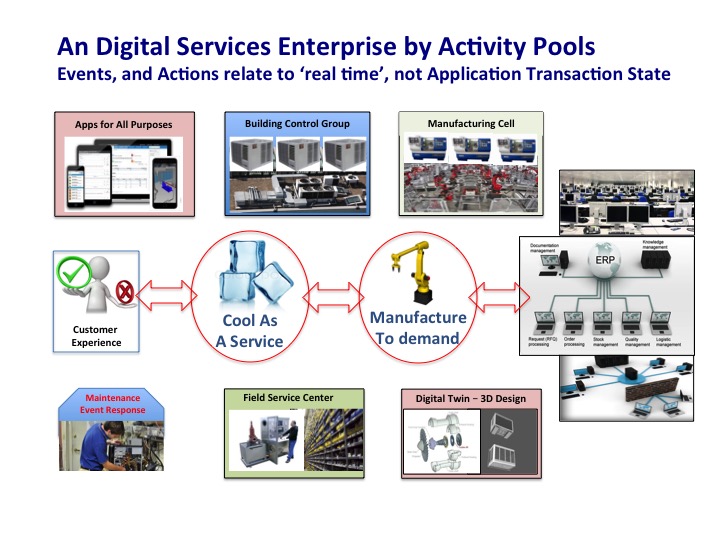
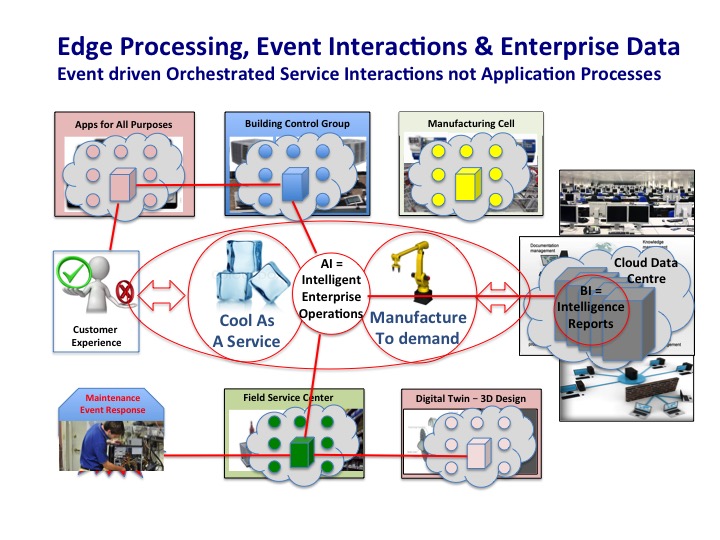
The Internet of ‘Things’, meaning the connection and interaction of intelligent devices, produces a flow of Data triggered by current ‘Events’ as unpredictable activity stream. The unpredictable nature of the computational services requirement relates directly to one of the major benefits of Cloud Computing. In reality Clouds are just further examples of the ‘Things’ that are part of IoT.

The business value doesn’t necessarily directly reside in either Clouds, or IOT, but in the integration to create Services as the Business valuable outcome.

Unsurprisingly the similarities between IoT and Clouds are many, for as the opening paragraph suggests they are inherently part of the same technology environment. Both are part of the same Network Based Architecture that ‘functions’ in response to a particular demand, rather than predicted steady loading of IT style applications. Adding that both are deployed as a mixture of Public, Private, Hybrid and Community Business solutions and the commonality two technologies should be recognizable, even if the exact definitions are less so.

Mixing the diversity of classifications for Cloud Computing deployment Service models with the classification of IoT enabled Business Services offers too so possible combinations to support any simple labeling. But not all, in fact currently perhaps most Cloud based provisioning, is not deployed to support an IoT integrated Business Service. It simplifies classifications to recognize this and remove many Cloud Services from being considered as part of IoT.

Commercial Cloud Service provisioning models were originally designed to be a cost reduction replacement of traditional computing resources in an Enterprise Data Centre, or to run occasional high loads such as Data Rich Analytics. As the advantages offered by Cloud Data Centre models became better understood definable three major hosting, or provisioning, models started to dominate; Infrastructure as a Service (IaaS), Platform as a Service (PaaS) or Software as a Service (SaaS). Each model could be used in a Private, Public or Hybrid deployment.

IoT solutions that are using Clouds don’t fit so readily to these definitions with their more predictable demands and foreseeable operational consumption of Mips.  In contrast IoT solutions which are circumstance, or event driven activities, often a mass of small consumption demands created by evoking specific services to run in different combinations are radically different. So different in fact that it is better to regard them as a fourth hosting model with some Cloud Service providers offering different hosting and charging models.

To understand this in more detail it is necessary to look more closely at the types of IoT and Smart Services being run on Cloud Hosting companies. There are Web Sites that attempt to list all, or at least as many as possible, Cloud Based IoT Service providers, (see appendix for some examples). This blog is focused on noting the impacts of IoT on commercial Cloud hosting.

There is a further clarification necessary to point out that the IoT Cloud Services referred to in this blog all offer capabilities with direct Business value. Unlike the previous blog on large-scale infrastructural IoT connectivity Services Platforms which will interconnect and integrate hundreds of thousands to millions of IoT Devices to various Business Services referred to earlier in this blog.

However it should be noted that current smaller scale, or dedicated single function solutions, IoT Business Services do make direct connections to their dedicated cluster of IoT Devices to collect event data.

So IoT poses an interesting commercial challenge to the providers of the basic Cloud computational capacity. The IoT enabled Services are light, but frequent users of Cloud processing power in a way that doesn’t fit with conventional Cloud hosting tariffs expectation longer usage periods at moderate to heavy computational power usage.

Amazon Web Services, AWS, provides a published tariff as an example, (there are of course similar offers from their competitors), of charging on the basis of events handled, and in what manner.

However AWS, just as other large Cloud Service providers are keen to offer more than just compute power, however they charge for it. Instead they are aiming to re-bundle IoT offerings to merge compute power with direct IoT Business Services with a much higher value Business outcome. These may take the form of  IoT Service Templates, as in this Microsoft Azure example, aimed at particular Industry sectors, or logic templates to simplify defining unique IoT services. Either way the aim is to offer ‘pay as you profit’ simplicity whilst avoiding the complexity/cost for an Enterprise building their own IoT Services.

In line with this shift to new commercial models for IoT a growing number of IoT Cloud Service providers offering sophisticated high value Services charged on the basis numbers of events handled. (Salesforce Thunder Cloud for IoT is an example of approaching IoT from the direction of Business outcomes). As events relate directly to business valuable outcomes and insights this is generally seen as a welcome move by both the customer and the provider, but it does require some care in establishing the exact cost model as few customers have any real experience to negotiate on the expected numbers.

Charging on the basis of the received Business Value outcomes is at an early stage of innovation, as the example of IBM Watson IoT Service working in conjunction with Aerialtronics drones. Equipment installed in inaccessible places, such telecommunication towers, can now have an annual survey by a drone with the results interpreted by IBM Watson visual recognition.  A straight cost substitution of the cost of a manual visit to the lower cost of a drone visit, but notice little to nothing in this is concerned with IoT event driven activities.

More conventional IoT examples around preventative maintenance come from several sources, as an example Software Ag, and allow clearer and more immediate linkage to business beneficial value. Finding and fixing potential failures at a convenient time with the cost saving of expensive failure makes this a particularly popular IoT business target.

The coming together of Cloud Computing and IoT certainly creates a new era of technology capabilities, with genuinely new business value. Add in Augmented Intelligence, AI, and the stage is set to deliver market transformation to the Digital Economy. Combined Clouds and IoT lead a move away from ‘transaction recording’ Enterprise Application IT and into a Business Services driven ‘read and react’ to opportunities capability. The result is a new generation of business models offering new innovative competitive abilities.

However, this new Business environment is still in its early stages, and, as such the commercial terms for outcome value based charging is still emerging. Buyers of IoT Services are buyers of Cloud hosting Services, but that doesn’t mean on the same terms as those for Enterprise Application IT. At this early stage of the IoT enabled Business Services model those responsible for deployment should take a very careful look at the various commercial options being offered.


Appendix; Three sites that list Cloud Based IoT Service Providers

https://iot-analytics.com/product/internet-of-things-company-list-2015/

http://www.iot-directory.com/

http://postscapes.com/internet-of-things-platforms/


Data to Decisions Matrix Commerce Next-Generation Customer Experience Future of Work Innovation & Product-led Growth New C-Suite Tech Optimization Chief Customer Officer Chief Information Officer Chief Digital Officer

Announcing Constellation Research's 2016 Enterprise Awards

Announcing Constellation Research's 2016 Enterprise Awards

Constellation Research hopes you all have a great holiday season this year with friends and family. In the spirit of recognizing memorable achievements in the tech industry, we also want to use this occasion to announce the winners of Constellation’s first annual Enterprise Awards.

The winners were selected through a combination of internal voting and heated debate among Constellation’s analyst team. Each category also includes a number of runner-up winners, as there were so many deserving of recognition. We hope you enjoy reading the results and welcome your comments—approving, dissenting and otherwise.

Best Enterprise Software Startup

Winner: Accompany

Why did it win?: Accompany describes its app as a “digital chief of staff” that pulls together a user’s contacts, email, social channels and other data into one place. The concept has been tried before but Accompany stands out for its excellence of execution.

Runner-Up Winners: General Electric, Coupa, X.ai.

Why did they win?: GE is an enterprise software startup of a different scale, using aggressive acquisitions and partnerships to grow the business fast. Coupa, once labeled a Silicon valley 'unicorn,' may have shed that label for good thanks to a wildly successful IPO. Moreover, its spend management software has become a standard in the Fortune 500. X.ai provides an AI-driven personal assistant that hones in on a key pain point: Scheduling meetings.

Best Enterprise Software Vendor

Winner: Amazon Web Services

Why did it win?: While known for infrastructure and PaaS (platform as a service) rather than applications, AWS had a breakout year, gaining remarkable endorsements from the world’s biggest enterprise customers and attracting application workloads from SAP, Workday and other top vendors. It also rolled out an array of new analytics and AI services that look to be likely winners.

Runner-up winners: Microsoft, Salesforce, Oracle.

Why did they win?: Microsoft continued its steady push into cloud apps and infrastructure, innovated in AI, widened its embrace of open source and made the year’s most daring acquisition with the $26.2 billion purchase of LinkedIn.

Oracle also made moves in cloud across all three layers of the stack while continuing its laser focus on database innovation, industry verticals and aggressive M&A, capped off by its $9.3 billion acquisition of NetSuite.

Salesforce had another high-growth year and is cruising toward its $10 billion in annual revenue goal. While Salesforce lost out to Microsoft in acquiring LinkedIn, it innovated in AI with the launch of Einstein, while the largest-yet Dreamforce event showed customer and partner engagement is at an all-time high.

Best Enterprise Systems Integrator

Winner: Luxoft

Why did it win?: While far from the world’s largest SI, with about 11,500 employees, Luxoft stands out for its recent focus on pursuing innovation-driven projects. It’s not a company looking for growth by simply trying to squeeze more cash out of legacy SI business models.

Runner-up Winners: Accenture, Wipro

Why did they win?: Accenture went on an ambitious acquisition tear in 2016, with deals targeting machine learning, CRM, cybersecurity, boutique SaaS consultancies, creative agencies and more. Wipro continued to mature its Holmes AI platform and is using it to automate mundane coding tasks on fixed-price projects—an idea with value for both Wipro and clients.

Best Enterprise Software Acquisition

Winner: Microsoft-LinkedIn

Why did it win?: Redmond’s move to acquire LinkedIn represents a $26.2 billion bet on the value of curated business social network data in conjunction with Microsoft’s enterprise applications and Office. Constellation sees vast potential in this combination if executed correctly. Microsoft has had plenty of dud acquisitions on its track record—such as Nokia—but Constellation is confident this won’t be the case with LinkedIn.

Runner-up Winners: Dell-EMC, Oracle-NetSuite, Salesforce-Demandware

Why did they win?: While largely a consolidation play, Dell's $67 billion merger with EMC will have ramifications for hundreds of thousands of customers around the world. Oracle's purchase of NetSuite was somewhat controversial given Larry Ellison's stake in the cloud ERP vendor, but gives Oracle needed scale for its cloud business and an entry point with SMBs. Salesforce's Demandware buy gives it the commerce cloud that was sorely lacking from its lineup.

Best Enterprise Partnership

Winner: Amazon-VMware

Why did it win?: This deal, which will see VMWare adopt AWS as its public cloud option, is one with strong benefits for both the vendors involved and the many VMWare-centric enterprises that want to maintain those workloads without having to continually invest in new hardware. VMware shops will also be able to take advantage of the continuous drip of new capabilities that emerges from the AWS machine.

Runner-up Winners: SAP-Microsoft, the Partnership on AI

Why did they win?: SAP’s partnership with Microsoft is one of the software industry’s most venerable, and its continued success and growth are important for thousands of joint customers. This year the vendors made progress on cloud (HANA, SuccessFactors to Azure), Office 365 integration and many other areas.

Amazon, Google, Facebook, IBM and Microsoft came together around the Partnership on AI, an effort that will seek to create best practices and educate the public. While each company stands to gain individually from the effort, the broader public should as well.

Best Enterprise Software Innovation

Winner: Google, for TensorFlow

Why did it win?: TensorFlow is the second generation of Google’s machine learning technology, powering products built by more than 50 teams across the company. In November 2015 Google took the bold step of open-sourcing TensorFlow under the Apache 2.0 license, a highly permissive license that has helped develop a strong community around TensorFlow during 2016.

Runner-up Winners: Workplace by Facebook, SAP’s Digital Boardroom

Why did they win?: This October saw the general availability of Workplace by Facebook, the enterprise social network formerly known as Facebook at Work during its one-year beta program. The application seems off to a very strong start, with more than 1,000 companies using it at launch and more tellingly, with dozens of them having Workplace by Facebook deployments of 10,000 users or more. While enterprise social networks are nothing new, Facebook may have breathed fresh life into the space with a combination of its strong brand and true product innovation.

SAP’s Digital Boardroom provides a real-time analytics portal for the C-suite that leverages line-of-business data from SAP enterprise applications. While it’s still early days for the product, Constellation receives a great deal of interest from clients regarding it.

Best Enterprise CEO

Winner: Satya Nadella, Microsoft

Why did he win?: It’s been going on three years since Nadella was named CEO of Microsoft, succeeding Steve Ballmer. Nadella has consistently put his mark on Microsoft’s culture, such as by his embrace of open source, by bringing the worlds of Dynamics and Office closer together, and aggressive investment in Azure, while continuing to foster Redmond’s vast and crucial developer community.

Runner-up Winners: Jeff Immelt, General Electric; Bill McDermott, SAP; Shantanu Narayen, Adobe

Why did they win?: Immelt is presiding over GE during a time of massive digital transformation at the company. GE is a leading voice for industrial Internet and IoT and that should continue for a very long time.

McDermott overcame the loss of an eye in 2015 and has successfully continued to navigate SAP’s often choppy political waters as its first American sole CEO, while leading the company through a major platform and business model shift.

Under Narayen’s leadership, Adobe has managed to reinvent itself. No more is it just ‘the PDF company’ or a toolmaker for creative workers. In the past several years, Adobe has shifted to a cloud subscription model while greatly expanding its play in marketing and analytics, a move that ties back to its standby creative products in a natural way.

Biggest Tech Flops of 2016

Along with the successes, this year saw quite a few high-profile disasters in the tech industry, so we had to pick winners—er, losers?—here as well.

Winner: Samung’s Galaxy Note 7 mess

Why did it win?: This one was a pretty simple pick. Samsung conducted a global recall of its Galaxy Note 7 phone after it emerged that some units’ batteries were exploding. In October, Samsung discontinued the device entirely and by one estimate, the recall and resulting fallout cost the company $17 billion. However, while the trouble was limited to Samsung, every company with products that use lithium ion batteries was likely both worried and empathetic about the situation.

Runner-up winners: Dyn DDoS attack/Mirai botnet; Massive hacks at Yahoo revealed; Microsoft chatbot Tay develops a potty mouth

Hackers managed to hijack thousands of consumer IoT devices in October to run a massive DDoS (distributed denial of service) attack on Dyn, a company that provides Internet infrastructure services to some of the world’s most popular websites. It later emerged that the attack was executed with a botnet called Mirai, which ended up being released as open source code. Overall, this was the sort of mess that has every sign of happening again in 2017 as broad IoT security best practices remain a distant dream.

Embattled Yahoo thought it had found a buyer in Verizon in July, but recent disclosures that some 1.5 billion users had been hacked in two separate attacks are threatening to spike the deal altogether at this writing.

Finally, Microsoft’s self-learning chatbot Tay ended up getting the wrong kind of lessons from Twitter users after it was plugged into the service in March. Twitter users quickly figured out how to train Tay to spout all manner of profane, insulting and racist remarks. Microsoft ended up pulling Tay off the Internet but recently unveiled a new one named Zo.

Agree with these picks? Disagree? Send me a note at [email protected] and your responses will be included in a follow-up post.


Data to Decisions Future of Work Marketing Transformation New C-Suite Chief Customer Officer Chief Executive Officer Chief Financial Officer Chief Information Officer Chief Digital Officer

MapR has platform ambitions - now it has to deliver

MapR has platform ambitions - now it has to deliver

Media Name: 4xv3lqnanyc-joe-gardner.jpeg
We had the opportunity to attend MapR’s first ever analyst event, held December 12th and 13th in San Jose. The event was well attended for a first analyst event, as to be expected when one of the three key Hadoop distribution vendors wants to update influencers. 
Here is the 1-2 slide condensation (if the slide doesn’t show up, check here):


Want to read on? 

Here you go: Always tough to pick the takeaways – but here are my Top 3:

MapR is an enterprise software company - MapR execs mad it very clear to the analysts present – that MapR is an enterprise software company, meaning the main vehicle of revenue are software licenses – not services. Given the recent addition of Oracle veteran Matt Mills and more – not a surprising direction. And a valid differentiation to the more services oriented 2 other key competitors.


Different product DNA – In the early days someone at MapR made the decision that a distributed storage architecture is the better direction. What MapR calls today the ‘MapR converged platform’ is indeed different from the 2 key competitors in the field. And MapR can address several differentiators here, around scale, high availability, TCO and support of multi-cloud.

Platform for NextGen Apps – MapR sees themselves as an ideal platform for next generation applications. High Performance and the above-mentioned capabilities make MapR an ideal platform to build large, BigData applications. See below Storify for the examples mentioned, of course IoT and self-driving vehicles were part of the what MapR customers are building.


MyPOV

A good event for MapR, always good to formalize the briefings with the analyst community. MapR has several DNA differences to the two other ‘musketeers of Bigdata’ – Cloudera and Hortonworks and made them very clear during the presentations. And enterprise need platforms to build next generation applications. Avoiding IaaS storage lock in is high on the agenda, and when it comes at the price of BigData vendor lock in – may still be the better tradeoff for many enterprises.

On the concern side MapR wants to be an enterprise software vendor, but shared less of a roadmap than the two other players in their field at their respective events. And MapR now needs to execute in go to market and customer adoption. We heard many interesting and light house class customer stories – but they must go live and evangelize the solution more. Investment in more go to market capacity is under way – a good move.

Overall MapR definitively is part of the top 3 independent BigData / Hadoop vendors, it has substantial differentiation at the core product level – now it needs to show the growth and that customers really care. Stay tuned.


Want to learn more? Checkout the Storify collection below (if it doesn’t show up – check here).


Tech Optimization Chief Information Officer

7 Predictions on 2017 Enterprise Technology

7 Predictions on 2017 Enterprise Technology

The growth of enterprise technology continues to fascinate us because of the sheer potential of its scalability and power to transform businesses. When we look at what’s on the horizon with both technology startups and big businesses, the possibilities seem limitless. 

Let us know what you think of our predictions on enterprise tech in 2017. Are we on track or deluding ourselves? Maybe it's too early to tell.  Reach out to any of our Constellation analysts in the Constellation Executive Network app for primers or to discuss the progress that we’re seeing globally in multiple industries, including manufacturing, retail, healthcare, and financial services. 

Hot: AI, microservices, containers, wearables, robotics, virtual/augmented reality and blockchain. 
Not: Social, mobile, cloud, big data. These areas aren't dead, they're simply assumed.

To get caught up on what others are saying about what matters most, here's a reading list of 2017 technology trends that will undoubtedly help to shape, define, and influence the coming years. Which predictions look the most likely to you? Tweet @ChrisKanaracus, our Managing Editor of Constellation Insights with your views, and he'll factor it into his analyses of disruptive technology breaking news.

1) 9 Tech Trends That Will Make Billions of Dollars Starting in 2017 - Business Insider 

2) 8 Tech Startup Trends to Watch in 2017 - CIO

3) 12 Tech Trends That Will Shape Our Lives in 2017 - Fast Co Design

4) 2017 Predictions For AI, Big Data, IoT, Cybersecurity, And Jobs From Senior Tech Executives - Forbes

5) Tech Forecast 2017: 5 Key Technologies to Double Down on NowNetwork World 


Constellation Executive Network

Innovation & Product-led Growth Tech Optimization Data to Decisions Future of Work Digital Safety, Privacy & Cybersecurity Distillation Aftershots Next-Generation Customer Experience Matrix Commerce New C-Suite AI ML Machine Learning LLMs Agentic AI Generative AI Robotics Analytics Automation Cloud SaaS PaaS IaaS Quantum Computing Digital Transformation Disruptive Technology Enterprise IT Enterprise Acceleration Enterprise Software Next Gen Apps IoT Blockchain CRM ERP CCaaS UCaaS Collaboration Enterprise Service developer Metaverse VR Healthcare Supply Chain Leadership B2B B2C CX EX Employee Experience HR HCM business Marketing Growth eCommerce finance Social Customer Service Content Management M&A Chief Information Officer Chief Technology Officer Chief Data Officer Chief Digital Officer Chief Analytics Officer Chief AI Officer Chief Information Security Officer Chief Product Officer Chief Financial Officer Chief Operating Officer Chief Executive Officer Chief Experience Officer Chief Marketing Officer Chief Revenue Officer

MapR Ambition: Next-Generation Application Platform

MapR Ambition: Next-Generation Application Platform

Media Name: 4xv3lqnanyc-joe-gardner.jpeg

MapR promises a more scaleable, reliable, real-time-capable and converged alternative to Hadoop, NoSQL databases and Kafka combined. Are companies buying it?

MapR is frequently mentioned in the same breath with Hadoop vendors Cloudera and Hortonworks, but maybe it’s time to stop thinking of them as competitors. Indeed, over the last eighteen months, MapR has added ambitious NoSQL database and streaming capabilities to what the company now calls its MapR Converged Data Platform.

The differences between MapR and its erstwhile competitors were underscored at MapR’s first ever analyst day, December 13, at its headquarters in San Jose, CA. Executives not only contrasted MapR’s platform with Hadoop, it also detailed advantages verses NoSQL databases Cassandra, HBase and MongoDB, and an open source staple of streaming applications, Apache Kafka. They bemoaned the “complexity” and “chaos” of multi-project open-source deployments, and MapR CEO Matt Mills, a 20-year Oracle veteran, proudly declared MapR to be “a commercial enterprise software company.”

@MapR, #MapR16

MapR presents its Converged Data Platform as a more scalable, reliable and performant
alternative to Hadoop, NoSQL databases and other big data tools.

It’s not that MapR doesn’t exploit open source innovation. The MapR platform includes components of Hadoop and Spark as well as Drill and Myriad, the last two being projects incubated by MapR and contributed to open source. The platform also relies entirely on industry-standard and open source APIs (a choice the company asserts eliminates the possibility of lock-in), even when MapR has replaced the associated components.

MapR chose from its founding to replace the Hadoop Distributed File System (HDFS) with a POSIX/NFS standard file system, for example, yet developers can still use the HDFS API. The POSIX/NFS choice provided read/write capabilities (verse append-only HDFS), better performance, and a “volumes” data construct for higher scalability and easier data organization and governance.

The early POSIX/NFS choice is now paying dividends as MapR goes after database and streaming rolls. The underpinning technology gives the MapR-DB database consistency, reliability and scalability advantages over HBase, Cassandra and MongoDB, says the company, yet developers can still use the HBase API. And given the breadth of capabilities across the platform (including MapR-DB), MapR cites scalability, data persistence, performance and global deployment advantages over Kafka and complex Lambda architectures (yet developers can use the Kafka API).

MapR hasn’t brought together all these capabilities just to check more boxes. Executives said they’re seeing more and more customers building out next-generation applications. The hallmark of such applications is compound requirements spanning the capabilities of file systems, search, databases and streaming systems. Another trait is the embedding of analytics directly into operational applications to support automated, data-driven actions without human intervention. MapR says its converged platform supports all of these demands with better speed, scale and reliability than you can cobble together with multiple open-source point systems.

MapR shared plenty of examples of customers building out next-gen apps. A Paysafe executive was there to talk about how it detects potentially fraudulent payment transactions within milliseconds so it can stop them before they go through. Rubicon runs a real-time, high-scale online ad exchange that handles peak loads of 5 million queries per second with 300 real-time decisions per ad placement. National Oilwell Varco analyzes sensor data from its oil well drills in real time to optimize production output and support predictive maintenance. And Qualcomm monitors sensors in its semiconductor plants in real time to automate actions that improve manufacturing yields.

The typical MapR customer is experienced with big data deployments, and more than 40% are former Cloudera or Hortonworks customers, according to the company. Given MapR’s commercial approach and emphasis on sophisticated requirements, it’s not the right choice for a big data newby or an open-source zealot. Partner Gustavo De Leon of Cognizant described would-be MapR customers as falling into the second of two classes of big data practitioners he’s seeing. First, there are the companies doing lots of big data proof-of-concept (POC) projects and not being terribly productive. Second, there are the companies that are more business focused that a concentrating on specific use cases.

De Leon’s implication was that MapR customers “want to know that they can take POCs into production and that the application will be enterprise ready and capable when they’re done.”

MyPOV on MapR Converged Data Platform

MapR’s foray into NoSQL and steaming opportunities is ambitions but the vision to serve converging requirements and high-performance demands isn’t new to the company. It has been the company’s focus and direction for years. What was new at the analyst day was hearing the vision directly from top brass along with forward-looking statements about the roadmap, investment plans and a possible future initial public offering. What was somewhat surprising was hearing quite the degree of open-source bashing, though I am hearing growing impatience from big data practitioners about the complexity of deploying and managing dozens of separate open source projects.

It was a good first-time analyst event for MapR, but the company was a bit stingy with company measures and plans. The roadmap was more like a set of themes with no precise dates attached. I also would have liked to hear from more customers, including non-OEM customers who don’t have an interest in promoting their own business. MapR has a solid list of high-profile customers, but it’s understandably hard to get an executive from an American Express, Audi, Novartis or United Healthcare to come speak at a tiny insider event in mid December.

Given MapR’s comparatively small size (which it doesn’t disclose but is likely somewhere between $100 million and $200 million), I would have liked to have heard a more nuanced, flexible positioning in the “land-and-expand” or “we can work with incumbent tools or replace them” vein. Instead we heard the hard-sell “we can do it all and do it better than all those other [popular and widely used] tools out there.” I’m guessing that in real-world sales situations there are plenty of developers and influencers predisposed to popular open source choices. I’m also guessing MapR has an easier time making a case for its converged story once it’s established inside a company. And no doubt it gets the nod first as a big data analytics platform, and not as a stand-alone NoSQL database or streaming choice.

I completely agree with MapR that people have to stop thinking of analytics only as reports, data visualizations and other types of human interactions and start thinking more about embedding analytics into transactional applications as automated triggers and actions. At the very least it should be alerts for exception conditions. As companies move toward these sorts of sophisticated, next-gen applications, MapR will have a better and better shot at being part of the conversation.

Related Reading:
Strata + Hadoop World Highlights Long-Term Bets on Cloud
Hadoop Hits 10 Years: Growing Up Fast
Strata + Hadoop World Report: Spark, Real-Time In the Spotlight?


Data to Decisions Tech Optimization AI ML Machine Learning LLMs Agentic AI Generative AI Robotics Analytics Automation Cloud SaaS PaaS IaaS Quantum Computing Digital Transformation Disruptive Technology Enterprise IT Enterprise Acceleration Enterprise Software Next Gen Apps IoT Blockchain CRM ERP CCaaS UCaaS Collaboration Enterprise Service developer Metaverse VR Healthcare Supply Chain Leadership business Marketing finance Customer Service Content Management Chief Customer Officer Chief Information Officer Chief Digital Officer Chief Technology Officer Chief Information Security Officer Chief Data Officer