Results

Scotts Miracle-Gro Tests CX to Optimize for Extraordinary Growth | CR CX Convos

Don't miss the latest CR #CX Convo with Constellation analyst Liz Miller! ☕

Liz sits down with CX leaders Jessica Bailey and Hailey Schraer from The Scotts Miracle-Gro Company 🌱 to unpack how customer experience strategies and partnership with UserTesting drive omnichannel #revenue for the business. 📈

Topics include...

📌 UserTesting techniques (07:41)
📌 Championing the voice of the #customer (10:10)
📌 Balancing education and purchase focus (14:10)
📌 Importance of quick insights (18:45)
📌 Challenges with prioritization and balancing requests (25:22)
📌 Direct-to-consumer efforts and lessons learned (32:05)

For more info, read the full customer story by Larry Dignan ➡ https://www.constellationr.com/research/scotts-miracle-gro-how-cx-and-usertesting-drive-omnichannel-revenue
__

Access the full video transcript: (Disclaimer: This transcript has not been edited and may contain errors)

Music. Hello, everyone. I am here with two amazing, amazing researchers, digital experience architects, CX visionaries. But you know what? More importantly, I am here with two people who know how to put in the work, and so I'm super excited to be joined by Jess and Haley from Scott's Miracle Grow. Should we just go ahead and jump right into it? Should we just go have some fun? Let's do it. I love it. I love it. I first. I want to get into it. Tell me about yourselves, like, what's your background? What's your role at Scott's Miracle Grow? What got you from, like, those first jobs, the job where you're at right now? And what do you do?

Yeah, I'll kick it off. I am coming up on my sixth year anniversary at Scots. Sort of started out pre covid Going into the office every day, but, yeah, it's been a really, really interesting journey. My background is a lot of user experience, more on the evaluative usability research side, but also information architecture design, and I had some really, really amazing experiences early in my career, working in the consulting space, working for big in house organizations. And I think I really found a love for being able to be in house and see the work all the way through, and and to see and well, and to see some of these really long timelines all the way through to and we have several projects that we've been working on that span multiple years. And it's such a blessing to be able to see that, as opposed to having to, you know, fall away after a little bit and hopefully come back, but it's been really great, and I've been able to bring on amazing people like Haley, who have made us just even better. I'll toss it to you. Love that?

Awesome. Yeah, I've been at the company for I just hit my five year in May, so I kind of owe my entire UX career to Jess. UX is where I started UX at Scots, and I've kind of been here ever since leading and building some sort of a team here so we can kind of build empathy across the organization with how our consumers use our digital products, use our physical products, etc. So excited to be here in chat a little bit more.

I love that you just said that you're building empathy across the organization for how people use your digital like, I love that statement. I kind of want to turn it into a t shirt. So I'm not gonna lie, if you somehow see that pop up someplace, just

make sure you send me one. Just send me Yeah, I'm just gonna send you one. There'll be, like, a whole like,

we'll Venmo each other, it's gonna be fine. Okay, so let's talk just a little bit about kind of what's going on and what are some of the big projects, what are some of the big initiatives when you start to think about experience, and especially when you start to think about digital experience, where are some of the directions, and where are some of the key areas that not only you want to see the organization start to go in, but what are those big projects you guys are working on right now that you can share? I don't want to give away the secret sauce, but some good stuff. Yeah, I

think a big thing for us is really honing out on education across all of our platforms. We need to kind of educate our consumers about what they need to do in their lawn, they need to do in their gardens, so that they feel kind of confident and comfortable tackling these projects, and the more confident and comfortable that they feel, the higher likelihood that they're going to purchase from us, so that they're going to revisit our sites, come back and learn more. And so I think that's that's always been a big push for us, and I think we just continue to find and drive ways to really push education, push all of the tips and tricks, so we can teach you how to be the best yarder and gardener that you can I

love, that I love, but that really brings up kind of a very specific need of being able to identify fairly well ahead of time, I would think that kind of earlier in the content and the experience development process, what the burning needs of education are like, what are those things that are top of mind? What are those things that people want to talk about? Like, you know, like me, I like, I want to talk about how to make the fat squirrel in my yard go on a diet. Like, I don't want them to stop eating. But, like, right? But so when we everyone has a different place that they want to start learning. So what are some of the things? What are the tools, the techniques that you guys are using to really, not only get an understanding of that, what maybe a little ahead of time, but then also mapping and under. Understanding if that's really what your audience wanted to experience. Like, is it like? I might sound as I think it's cool, but I might also be navel gazing.

Yeah, I think we're always looking at bringing a lot of cross functional input together. So I know folks on our team, even just last week, had this really amazing conversation with our sales our field sales team to understand like, hey, when you run into folks that when they're in the aisle of a garden center, you know, what are the questions that they're typically asking you, and how can we create a bridge for them? We have folks on the team that focus really deeply on weather and the impacts of weather on our category, and people shopping and trying to just participate in our category overall. And so how did they see weather trends impacting us? And what are some solutions that we can create there? Haley is highly involved, and runs all of our conversion rate optimization and AB testing. And so we're able to get some really clear answers on like, what kind of content is performing better and driving some of those key actions we're focusing on SEO, what are people searching for? The terms that we're looking at. So we really do try to bring a lot of different sources together to get at what are the burning questions that people have, and also, how can we help meet them in the middle? You know, we don't want to come in and be you know, we are the expert, and we know all overlords. Yeah, no, yeah, yeah. Like so your problem? Could your tomatoes be more could you have a bigger bounty or a bigger harvest? Yeah, maybe Squirrel. Squirrel is your big problem right now. So solve that one for you and make it more likely that you're going to put in another, you know, another seedling next year, and maybe two seedlings next year, because you really want to make it happen, then that's a success for us.

I love that. I love that, you know, listen, as a long term marketer, I feel like I should say recovering marketer. I think that's a recovering marketer. And, you know, been at agencies, you know, worked very closely with, you know, art departments, and I've been through that process of, right, like you, you're like, Oh, I gotta build a website, and I'm gonna go and do this, and it's gonna be amazing. And here, here's my, you know, here's my mood board, and here's all of my, like, you know, here's my site maps, and here's all of my research, all this. And then you go and build it, and you kind of forget that all of that research, all of that information that you poured your blood, sweat and tears in, even if you were looking at all the SEO research to make sure all of that foundational search was there, you kind of forget that the testing is to keep going. You know that you kind of have to constantly be working on that care and feeding. I know that you guys do a lot with user testing, so I'm curious. Can you share some of the examples of how you're using these testing tools, right, whether it is something like SEO, whether it is that research on the back end, whether it is AB testing, or whether it is these qualitative panels? Can you share a little bit about what you're doing, and then where that starts to slot in, when you start to think about kind of the life cycle of engagement for each of your brands.

Yeah, user testing has been a great partner for us, I think, for the past three, four years. At this point, we use them in every way that we possibly can. So we do a lot of like, post launch we do a lot of pre launch usability. We'll do some, like, moderated interviews, where we're getting really in depth and nitty gritty about how people are kind of shopping that aisle and what their triggers are for them to go out in their yard, their yards and gardens. I think most recently we we recently ran a study on a new kind of platform that we're looking at going out with and wanting to get some pre launch research with it, to understand what are the pain points that they're having, or what can we expect once we once we release this, or what are some hypothesis that we can pull from this? And then now we can take those and go in and do testing post launch. So now we can say, hey, we're lacking education here. How can we then tackle that post launch and come up with some different testing ideas and different designs where we can really pool and show that quant data of We saw this in qual. These are, this is what we heard from our consumers. And then now we can test against it and say, okay, hey, these two variations smashed it. We really got the consumers what they needed from these lenses. And so we use user testing a lot when it comes to triangulation, and starting to find like our big common themes amongst our participants, and then going out talking to our analytics team or doing AB testing, to really marry that quant, that qual together so we can come up and with the best insights we can

I. I love that. I'm gonna ask like a okay, because you said something, and now my brain went someplace, and so that's where the question's gonna go. But I think part of the problem a lot of times, or at least, I mean, I can remember being at those tables and it sometimes it can feel like the, you know, those data kids came in and told me my baby was ugly. I don't want to listen to them anymore, right? Like it feels like that sometimes. What are some of the things that you guys do like, really, to champion the real voice of the customer by triangulating this quant and the qual. You guys really are sitting at a very interesting intersection of where that true customer, user reaction is coming in. It's not you saying, Well, I think people didn't like this button. It's literally someone being like, I hated that button. You're like, whoa, like, there's the end. But you also get the reason behind that. You get the richness behind that. How you know, how are you guys finding the insights and the information that you're sharing and triangulating move like upstream, so that it's not just I didn't like that button, but it becomes really rich insight for even senior executives and business strategy to say maybe we need to make a different decision, because if education is pushing us here, maybe our product has to shift there too. Or maybe this is a different opportunity. Are you seeing what you guys do take a different stream than kind of just sitting in that digital optimization space.

Yeah, I think there's a few ways that we're seeing that happen. We have a team that is really,

like respectful, I guess,

of data, and not a lot of defensiveness at all. And so I don't know, we're very lucky, I think, but we've not really had a situation where it's like, well, you're just saying that because you don't like it, or that's your personal like, purple, yeah, you know the power of a highlight reel, right? The power of video, the power of having a video of eight people saying, I'm confused. I'm not sure what, like the the cycle on that would be, or I'm confused. I don't know how I would use that. Can't you can't really rebut that at all. So we have teams that are really, really oriented to improving and optimizing and being willing to be wrong and work in a really agile way of if you know, if we can optimize, if we can improve. And it's also the beauty of working in the digital space is that we're working on products that are constantly evolving. Much of the the physical products that we sell in stores and that we sell online, you know, they're always evolving too that time scale is a little bit longer, but our innovation pipeline is super rich, and we're really trying to just sort of help folks that maybe are a little bit more used to that longer time frame. Say, Hey, you know, when it comes to the digital experiences that we have. We're doing that same, you know, product life cycle. We're just sort of squeezing it down a little bit, and the R and D that you're doing to make sure that that product is super, super effective, and that it really does deliver on all of the promises. That's essentially what we're doing to just apply to a different, yeah, I love that. Jess, I'll emphasize

one of your points there too. Of like, highlight reels, we have shown that that like, sticks with our stakeholders the most. Like, there's nothing more important. And I think this is really how we've helped to, like, build empathy. Here is like, let's put this in front of user. We watch videos all day, so let's put this in front of our stakeholders, in front of our cross functional teammates and truly show them what these consumers and these participants are doing, so that they really have a chance to, like, put their put their feet in their shoes, and understand how they're experiencing it, rather than us just saying, hey, the button's ugly, like you can actually truly hear it. And it really does drive us and take us really far with our stakeholders. So that's

amazing. That's amazing, you know, and I think that it's so interesting in your business. I mean, so Scott's Miracle Grow. I think everyone thinks about it from a different entry point, right? Because the portfolio of brands is really expansive across the company. So you have a different mindset of buyer. You have a different skill level of buyer. You, you know, like you got me, like self professed urban farmer here in Los Angeles growing a tomato. I'm pretty proud of myself. But then you have, like, farmer, farmers, like you guys, have this really broad group of customers, but you also, I would imagine, that also translates into a very broad group of stakeholders internally, some of whom are looking for that transaction, right? Like, I need someone to buy that bag of soil. I need someone to be referred to a channel partner. Like, it's going to be very transactional. And Hayley, like you mentioned, you also have that stakeholder that's like, no, no, remember the education part? Like, remember how we lead people into the funnel? So those can often be in most organizations, a pretty. Significant push and pull when you're trying to figure out how to prioritize, whether it's testing, whether it's research, how quickly things get up. I think traditionally, in the world of research, you got to make choices, because things take a while. Can you kind of walk me through how you've developed best practices, whether it is how you prioritize the speed and scale at what you're able to work. But then also, how have you really been able to just, kind of, I guess, balance, like, balance everything. So now that you have the knowledge, how do you are you know? How are you able to then kind of make sure that, like, yeah, we're getting bags and carts, but we're also getting people to think about the next season?

Yeah, yeah. I think focusing on building confidence and motivation and having content that can get people excited to maybe start caring about their lawn for the first time in a while, or to take that very first step, that kind of upper funnel, I guess, like that kind of getting people to just start to care about something that maybe they've lost interest in, or they started a garden during covid, and they're, you know, maybe had one or two seasons of like, oh boy, but putting them back in, you know, if we can do that, then the rest of the pieces are much easier for a lot of our other partners that are in media and marketing and sales, like we've we've really primed them to say, like, you can hit a home run now, like, we've got folks in that right mindset. And so I think having that focus being on the upper funnel, we see that it's paying for things that come later down the road, and that that is the right place for the channels that we're focused on most often, that's the right role for it to play. I think that it can sometimes vary by brand. And there are certain in the portfolio that we have, there are certain brands that say we are exclusively here for education, if you want to compare products, because you're between two or three that have a similar benefit, that's why we're showing up for you in the digital space, or if you want to get inspired to take on a new project, that's why we're there. There are other brands and other sub brands where we see that purchase and that conversion being their top focus. And so we are having to shift a little bit to say, hey, you know you're really focused on moving people through the purchase path, getting that cart to move into checkout, getting that checkout to move into a purchase and so we do have to balance a little bit. And sometimes certain voices are louder than others when it comes to making that balance, we're We're a small team, and so we have choiceful and pretty strategic on how we take those on. But I think truly, in the last couple of years where we've tried to create efficiency in our martech stack and creating efficiencies with the platforms and tools that we're using, we're able to take an insight and apply it more broadly, a little bit easier than we have in the past. And so that rising tide can then benefit all of the brands, and the ways where it's appropriate to benefit all of the brands, and then note those that need, like a more specific focus or a more specific outcome, we can focus our attention really deeply there, while we've also brought everybody up to that same sort of baseline experience that we're able to identify love,

that how important is speed, when you start thinking about these tests, and when you start thinking about kind of how quickly you're able to like, let's look at, let's be honest, I remember back in the day this is, this is going to prove like, how old I am as a marketer. I worked in, you know, skincare, and I also worked in professional sports. And I can remember, like, remember good old, like, focus groups, right, where you were, like, let me get 20 people to sit over there in uncomfortable chairs with bad apple juice and maybe some of the butter cookies that came out of the tan, like, Jess, you come on. Like, we remember this, where you're like, oh, yeah,

I remember

projects. Yeah, I was

right, yeah. Like, can you? Can you? No, no, find the button. No, no, fine, not the real but no, you're not your shirt. But like, we remember those days, right? Like, I still have pain from those days. So how important is it now in this digital space? Well, we are expected to move so quickly, right? Everyone's like, Well, what do you mean? You can't just change it. Well, what do you mean? How important is speed and scale? Just one come before. Like, is it more? How do you start to look at those things? Yeah,

I think not to kind of poke out. These are. Testing again here, but a user thing super much helps us with that. Where our A our ability to test early and often and through the user platform, I think has been super helpful for us. I know we have stats somewhere in our case study of just like we've been able to grow exponentially and pull a lot of those consumer insights in much easier and much quicker, because we can test much faster. And I think that also just speaks to our consumer where we are not that like niche, very, very tiny, tiny business that has that very niche consumer. We want to talk to homeowners. We want to talk to those who are in their lawns and gardens, and so it's a little bit easier for us to then recruit for those folks, to be able to bring them in. So our definitely, our speed to insights has definitely increased. I know I can't speak to some of those kind of long days in a in a focus group room, but fun, Haley,

you don't want to. You don't ever want to. I

went to one, I went to one of my lifetime with Jess, and I will say, we work, we work much more efficiently and faster now. So

I did one on sunscreen, and it's like a day and a half I don't get back in my life just I'm just saying it was not good. Oh my gosh. Well, you know, there's two questions I want to leave us here and share with our audience, because I love these best practices, and I love the things that you guys are sharing, and I think that these are, I mean, you guys look at UX, you guys look at the digital experience, you look at this. But I think that so much of this can be actually applied, even in when we think about decision making for executives, and the velocity and the speed at which we need to make decisions about our businesses, we need to be able to bring in all the data, it bring in all the information, and to bring in that empathy, like you guys said, like, I love thinking about how you can apply that for a business leader and an executive, trying to move that concept of decision velocity forward. What are some of the things that you guys have noticed really make that difference? Like, are there any things that you would share with your colleagues and your peers across the CX ecosystem of if you could take this into your leaders three rungs up, you know, at the very top of the org, these are the types of things that we can and should be delivering specifically to accelerate decision making, anything that you guys would share?

Yeah, I think you talked about speed, and having that speed, we are obviously in a very seasonal business, right? Spring is our Christmas. Of a lot of other CPG and like online retail, like the holidays are, that's our spring, and I love it. Having an answer in spring for spring to impact spring is really important. And so that contrast from the olden days to now, where Haley has and can turn a study around in 24 hours, essentially. And I think that's where too I can take a very specific question that an executive has, a very specific or nuanced hypothesis that someone in leadership has, and we can run it, we can answer it, and we can get that insight back to them to inform it pretty quick, some of the things that we often are doing in the middle of that process that are sort of helping them massage their hypothesis too. Of like, well, you know, I think that people don't care about weather and how it impacts their seeding project, their grass seed project, you know. And so we're saying, Well, is it really about weather, or is it about temperature, or maybe about how long it's going to take to see results, or whether they have to water that much. And so we're trying to help understand, sort of the boundaries of the question that we're trying to solve or identify, at least, like the rough shape of the hypothesis, maybe that somebody has. And then we can come at it really iteratively, and say, we asked that question. Here's the response that we got. And we can ask two, three more questions too, to say, well, actually, hey, you know, they talked mostly about watering. Watering was their real concern. And so we can then spin it into another, spin it into another. There's a great way, I think, that we can help inform some of those leadership decisions that they're having to make, which are often so, so quick, in a way that we probably couldn't before.

I love that. That's I love that so. But then this leads to my net like almost second to last question. I'm going to count this as A, B to that last question I asked. Okay, just be honest, it's just between us girls. I mean, no one else is gonna see this, no one else gonna see this. Has the results of that, has the the ability to bring that research and that insight so quickly also kind of opened the floodgates, though, for folks across. Organization to be like, I too, would like you to test this where now all of a sudden everyone's like, I would like you to test blue versus dark blue, and you're like, that might not be a priority to date.

Oh yeah.

It's ironic to bring that up, because we just had an example of that this week, where, like, we are so dying to kind of get our research in front of people to share what we're finding and the insights that we have and build that empathy. But once you share it like it's not going to stop flooding in. And so I think we're right now trying to trying to figure out that balance a little bit too of and that's where like priority comes in, and seasonality, especially for us, comes into play, of how do we best balance these things within given seasons and within given priorities, because we want to help everyone. We want to bring all the insights and build as much empathy as we possibly can. But it definitely comes with, comes with the flood is coming in, and we got all the intake requests as possible. So everybody wants a new question. Okay, so

most important question I'm going to ask for you guys to share with our audience, like most important question, what should we be growing? Tomatoes, cucumbers, like, what like zucchini and I, we get along, but then when zucchini goes crazy and I now I got, like, 9000 bushels of zucchini and all the little thorns those who knew zucchini and cucumbers were actually painful. I did not know this when they were at just a whole foods. I did not know that I could get wounded by a vegetable. But there I am. Okay. So what are you guys growing? Come on,

I'm growing both tomatoes and cucumbers. There's this gorgeous, cute little variety of Bonnie Plants. It's called The Boston pickling cucumber, they're just little babies. And oh my goodness, do a refrigerator pickle at home. They're adorable. You always gotta, you gotta grow to the cuisine. You have to grow to what you like to cook, right? And so I love to cook Italian, and I love to cook like Mexican. And so

basil, you're like, three organo zone, like, you got a whole like, yeah, Herb era going on in the backyard,

yeah? But only plant what you're going to be excited to cook with. Otherwise, you're just that person that's shoving cucumbers on your neighbors and saying, Please, will you take this?

Yeah, looking alive. That was me.

I was like, I think I can grow bell peppers. I don't like bell peppers, yeah? So, like, I like them in one place, and that's a pizza, and that's it. Like, I don't and I only like one color. So it was just like, This is not Yeah, this is not good. I should not be doing this. Everyone got bell peppers. Like, I apologize now to everyone, pepper, but yeah, so. And then inside play, is it like, is there like, a favorite indoor like, do you guys have any indoor plant, like, preferences, or anything that you're telling us all go, like, Hey, y'all go out and get this, like, little fiddle thing.

I'm more of that indoor girly Jess. Jess takes care of the outdoors. She gets the basil. She makes me pesto. It's perfect. Love. I'm more of the indoor plant girly, where you unfortunately can't see any, but I'm a big window right in front of all the windows, but none behind me. Um, I love a good round tail snake plant. Let's see if I can drag her over real quick. I have one that is thriving. Yes, look at that guy. Yes. I'm a big, round tail snake or just normal snake. I don't discriminate. Love them all.

I'm the idea I got this guy because I read an article that sent me down a rat hole to a NASA study that showed how many allergen particulates this little guy can pull out of my air, and I'm like, every room will have one. Like they're everywhere in our house. It's ridiculous,

yeah, and they're also the easiest. So I'll

take it. I love it. I love it. Oh, my God. Thank you guys. Thank you guys so much. So many best practices, so many great stories. Congratulations, all the stuff you guys are doing.

Thank you. This has been great fun.

I'm gonna pause there, because that's where our editor is gonna go hack up the first 28 minutes of our conversation. I'm gonna ask you guys a couple more questions if you still have a little bit more time here. And I'm sorry, I think we may be going over. So I do apologize if you guys have to run. I totally understand, and I'm happy to send these over to you written. But if you don't mind, I'm going to ask just a couple more of these that Larry has sent over for the customer insights. That'd be okay, yeah, yeah, not terribly far over, but a bit yeah. I'm just going to ask you a couple ofthese important ones, and then maybe if there's a couple that Larry's like, no, I really need this, we might just email them back to you. But I think that the other stuff is awesome when it comes to metrics and how the team is being measured, how your kind of success as a group is being measured. What are your fight what are you finding that those business metrics for CX and for UX are, and how is that getting rolled up into other kind of business driving metrics you. Yeah, engagement is often what we're reporting on, and also brand perception and overall brand health.

We've gotpartners and siblings and cousins in our departments and organizations that are a part of email marketing, social media, and so all of those those channels are coming together to really drive like a personal relationship and engagement with our consumers. Awesome.

Love that. Love that.

So this is what proves that Larry listens to all the calls. Because here's the question, Has when what's interesting about Scott's is how CX directly aligns with the broader corporate strategy. Your CEO in the company's latest conference call cited market share gains and unit point of sale growth. How do you see your digital properties in terms of that direct sale? But also, how do your properties aid that in store buying process? Because, again, for a lot of organizations, they're run by two separate teams, but the insight that feeds the experience also comes from two separate teams. You guys seem very aligned across all of that.

Yeah, and I think when it comes to our websites, it kind of goes back to education and content. So if you are searching for something and you're in that aisle on what grass sheets should I use, or what fertilizer Should I put down now? And we intercept you on our own site. We'll educate the hell out of you, give you all the resources you need. And I don't care if you purchase from us or if we push you over to Home Depot or Lowe's or things to go buy on their websites or to go to their retail stores. It doesn't matter. And so I think that's really where we intercept and we grab them and build the confidence, educate as much as we can, and that's great. And if you go to somewhere else, that's also fine as well. So

I like that confidence seems to be a major currency for the that experience strategy for you guys that it's, you know, how are we making that exchange of content for confidence? And everyone can kind of bring that back into that virtuous cycle. I really like that. That's really well thought out. Okay, so Larry would like to know if you can share, how are those efforts to drive direct to consumer how's that going, and what are some of the lessons maybe, that you guys have learned through, whether it's user testing, whether it is through some of the other ways that you are testing and driving metrics. From that UX perspective, how are things going and where are you guys pushing and heading, let's say in the next year.

Yeah, direct to consumer, I think is so, so interesting. There are certain products for which direct to consumer, either through our own website or through our retailers websites. It feels so natural and such a wonderful fit. There are others where we have to do a little bit of educating on like, Yeah, this is something you can totally get it shipped to your house. And in fact, you want to subscribe to it, and we'll just send it to you every three months so you don't have to worry about it. So when you need to repot that plant and keep it from, you know, growing too far, yeah, that we can help make that really seamless and easier for you. But I think that also we're, we're helping drive to retailers and really smart ways helping, like Haley mentioned, intercepting folks and pushing them to retailers that are a good fit for them, and even if they've come to our site saying, Hey, you have a great store that's just down the road that can deliver this for You to do it today curbside, I think that. And you know, some of those buy online, pick up in store, kinds of solutions that are available are a really, really great match for our category, and with certain retailers being able to just add on those gardening supplies when you get your grocery order or when you're there to pick up the diapers and everything else that you need at the store. That just taking care of the weekends projects and getting all in one stop is a really great way for us to sort of show up for them.

So making it really convenient, making it easy, and giving that perception of ease when taking on those projects, I think is, is good, but yeah, growth and direct to consumer is it's going well. I think that we're leaning in. We have a really amazing omni channel and shopper marketing teams that are doing amazing things with some of these retailers and pushing the boundaries on a lot of stuff. I.

On cx_convos <iframe width="560" height="315" src="https://www.youtube.com/embed/BClBs-OE7bc?si=UkqKUSLi44pDgfOg" title="YouTube video player" frameborder="0" allow="accelerometer; autoplay; clipboard-write; encrypted-media; gyroscope; picture-in-picture; web-share" referrerpolicy="strict-origin-when-cross-origin" allowfullscreen></iframe>

Oracle's cloud, AI plans are a master class in co-opetition

Should Oracle's march toward fiscal 2029 revenue of $104 billion succeed it'll largely because it has managed multi-cloud deployments, co-opetition and triple wins for itself, partners and enterprises.

Oracle's CloudWorld news, led by a key partnership with Amazon Web Services (AWS) laid out a path that gives the database giant a path to expand its total market. Oracle and AWS--for all the cloud trash talk over the years--have multiple joint customers. Those customers really wanted the ability to use their AWS infrastructure and Oracle.

According to the Harvard Business Review, co-opetition arrangements usually start with a simple question: What happens if you don't pursue a cooperative opportunity? HBR: "If a cooperative opportunity is on the table, start by imagining what each party will do if it’s not taken. What alternative agreements might the other side make, and what alternatives might you pursue? If you don’t agree to the deal, will someone else take your place in it? In particular, will the status quo still be an option?"

Looking at AWS and Oracle through that lens makes the partnership a little less shocking. Oracle had already forged Oracle Database deals with Microsoft Azure and Google Cloud. That reality made a co-opetition arrangement between AWS and Oracle more likely. In addition, Oracle could theoretically lose a few cloud deals to AWS, but Oracle Cloud Infrastructure (OCI) is much smaller. If anything, AWS customers may try OCI due to the partnership. Meanwhile, Oracle sees its database business as its identity and a huge revenue stream.

Oracle CTO Larry Ellison explained during a Q&A on the company's Investor Day.

"I think the AWS deal increases the size of the market for us dramatically. I think it's interesting because we debated this a lot internally. What's going to happen when we partner with Microsoft, AWS and Google? Is this going to hurt our business and OCI? I think it's about the customer. Customers are using AWS and also like to use OCI. I'm going to have two cloud providers and one's going to be AWS and the other OCI. I think our OCI business has actually been strengthened. The goal is for us to be a leader in AI, if they can help us be a leader in AI, let's go work with them."

Clay Magouyrk, Executive Vice President, Oracle Cloud Infrastructure, noted: "I have conversations with customers now and they are incredibly encouraged by the fact that it doesn't matter which Cloud they choose. They can maintain their investment in the Oracle database. They can move that into the cloud and still get all of our best and greatest services. Everything that we have available inside OCI is now going to be available in our partner clouds."

Because Oracle missed the first cloud wave, it had to think differently for its database and applications. It focused on networking, file storage and autonomous databases. As a result, OCI turned out to be a handy platform for generative AI training. "It's nice having that late mover advantage sometimes," said Magouyrk.

Ellison also said Oracle had a little bit of luck in that it focused on database automation and innovation as competitors pulled back to chase cloud. Ellison said:

"We had made our name on the technology that we had pioneered relational database technology. I think most people thought we were going to lose that franchise because we only had it at OCI. We had a huge amount on-premises. There was a lot of skepticism whether all information would move to the cloud. In fact, no one else invested in the database during that period of time. Unless you have your data properly organized you can't use AI."

"There's no alternative to the original database. Microsoft SQL isn't a bad product and probably the second-best relational database out there. AWS is an incredible company, but they took open-source databases and moved them to their cloud. Google Cloud has BigQuery but it's not really a database."

Now that database business can play into gaining more OCI workloads, said Ellison.

Indeed, OCI is outlining illustrations that show better price performance vs. its partners, but as long as the AI workload pie is big enough the co-opetition arrangement is just swell. Co-opetition works great...until it doesn't.

Constellation Research analyst Holger Mueller said Oracle's success was built on a series of smart strategic moves. 

"What really delivered for Oracle was to build a cloud infrastructure for its database. It already had the hardware platform with Exadata - and now needed a flexible pod size that could scale to large data centers and the small government data center of a sovereign state of the size of San Marino. At CloudWorld, Oracle showed that the whole stack can run on three 'fridges' which is the smallest footprint of all cloud vendors. Next was to manage all these clouds--even at customer facilities the same way as Oracle Datacenters. That approach reduces Opex and gives CxOs peace of mind of a fully managed cloud stack on premises. Next the design point of a cloud for databases is very similar for a cloud for AI. And Oracle needs to be good at AI or the data from its RDBMS will flow into lakehouses and Oracle could be commoditized. Lastly, Ellison and Catz have spent on CAPEX like never before in Oracle history. And the small footprint works great to move the database to other clouds."

Larry Ellison is quite quotable

There were a bevy of quotes worth highlighting that didn't make the story. Here's a bit of Larry being Larry.

  • "I was just discussing with Safra (Catz) and every 10th sentence I say I feel like we're living in a science fiction movie. Then we get over it and go back and talk a little more about business."
  • "We'll be training robots to be nurses to do a variety of things in the hospital and at home."
  • "We're very involved with automating hospitals. We're connecting robotics in hospitals and connecting all of that data and machines on our IoT framework. We're good at IoT because we build applications."
  • "I went out to dinner with Jensen (Huang) and Elon (Musk) at Nobu in Palo Alto. I would describe the dinner as begging Jensen for GPUs. Please take our money. In fact, take more of it. You're not taking enough of it. It went well. The demand for GPUs and the desire to be first is a big deal."
  • "Another differentiator between us and the competition is that we do applications and infrastructure."
  • "Cerner will be another pillar for growth. You just haven't seen it yet. Healthcare is a multi-trillion-dollar industry and there are two giants: Epic and Cerner. We're used to competing with Microsoft, Amazon and Google. we're trying to automate the entire medical ecosystem with Cerner. If we can do it, we must do it. We have a moral obligation to do it. I can't believe that this industry that is so important and touches all of us doesn't have the very best technology."
  • "We could charge for a new AI module, but I think it misses the point. We're not trying to raise prices. We're trying to increase the volume of sales.
Data to Decisions Tech Optimization Innovation & Product-led Growth Future of Work Next-Generation Customer Experience Digital Safety, Privacy & Cybersecurity Oracle Big Data AI GenerativeAI ML Machine Learning LLMs Agentic AI Analytics Automation Disruptive Technology Chief Information Officer Chief Technology Officer Chief Information Security Officer Chief Data Officer Chief Executive Officer Chief AI Officer Chief Analytics Officer Chief Product Officer

Salesforce Dreamforce 2024: Takeaways on agentic AI, platform, end of copilot era

Salesforce CEO Marc Benioff laid out the company’s AI vision, which revolves around autonomous agents working with humans and the end of the “hit or miss” copilot era. The mission for Benioff: Put the copilot era to bed and focus on agentic AI powered by one platform the Salesforce platforms. Benioff said he wanted his customers to use Agentforce to deploy AI agents at Dreamforce and put an end to do-it-yourself AI.

During his keynote at Dreamforce, Benioff and his executives laid out the case for depending on Salesforce as your AI platform. As telegraphed by Salesforce leading up to the keynote, the talk was heavy on Agentforce.

Benioff said:

“The copilot world has been kind of a hit and miss world. It's been a copilot world where you say, ‘I have these copilots, but they're not exactly performing as we want them to. We don't see how that copilot world is going to get us to the real vision of artificial intelligence, the augmentation of productivity, or better business results. In some ways, copilots are the new Microsoft Clippy. This is the third wave AI. It's agents.”

"Benioff made a pretty compelling case for Data Cloud and the Salesforce platform as the basis of building agents. The approach taps data, metadata and knowledge of app business logic that's all already in Salesforce. Data Cloud adds data federated from third-party data clouds and ingested from external apps. The pitch that everything is in one platform and not a DIY project has attendees here at Dreamforce nodding their heads," said Constellation Research analyst Doug Henschen.

Here are the key takeaways from Dreamforce 2024.

Salesforce is now a platform and less a series of clouds to cross sell. For the last few years, Salesforce has done the heavy lifting to create a series of clouds that run native together. This grunt work is enabling Salesforce to scale Agentforce across Marketing, Commerce, Sales, Revenue and Service Clouds as well as Tableau.

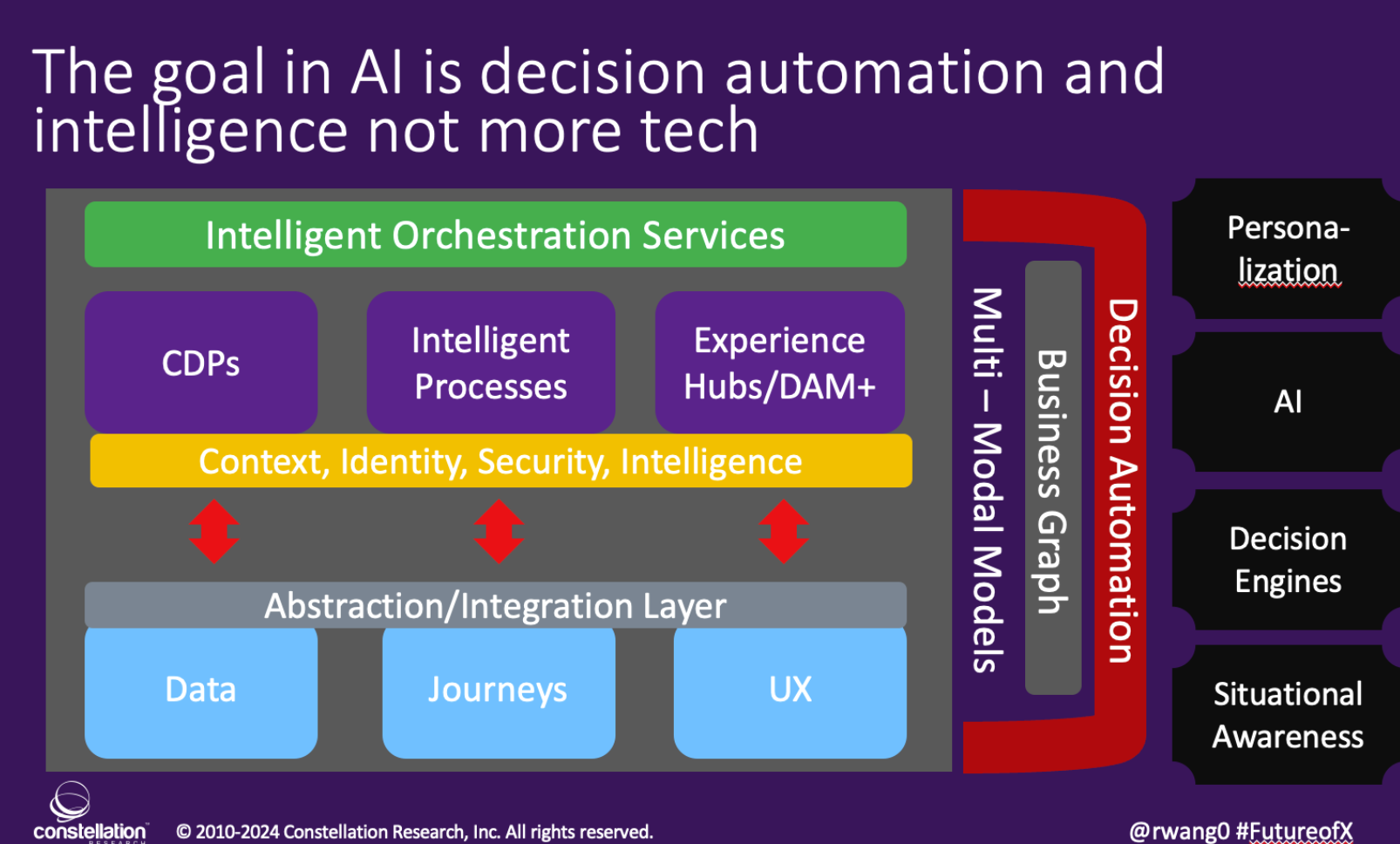
Agentforce wouldn't be possible as envisioned without a unified platform. Salesforce's move to one platform is what enabled it to build out Agentforce using Airkit.ai technology acquired a year ago. With a unified platform, Salesforce is betting it can fend off rivals like ServiceNow, which has the potential to relegate enterprise software to systems of record.

“We are all going to be using agents, but we're going to do it all within our Salesforce platform,” said Benioff. “This platform is the key strategic motion of Salesforce, and now this platform has the best AI in the world.”

Showing Agentforce will sell AI agents to the enterprise, upend the copilot craze and convince companies that new business models like pay per conversation are warranted. Let's face it: Dreamforce 2024 is really one big demo. Agentforce was outlined ahead of Dreamforce with a steady cadence of news. It remains to be seen how this Dreamforce (Agentforce) demo fiesta affects Salesforce's growth.

Accuracy will be the big selling point for Agentforce. Benioff said:

“These agents are going to be some of the lowest hallucination agents who've ever experienced. Why is that? Why would our agents be so low hallucinogenic and so accurate? Well, it has to do with the platform. It's because we have the data and the metadata and the workflow and the business process and the security model and the sharing model.”

Benioff’s goal is to light up Agentforce as fast as possible for customers and highlight it as a way enterprises can scale labor during peak times.

Everything you need to know about Dreamforce 2024:

DIY genAI isn’t worth it. Benioff’s big pitch to enterprises is that the power of platform can drive more value than do-it-yourself efforts. He said:

“DIY means I'm just putting it all together on my own. But I don't think you can DIY this. You want a single, professionally managed, secure, reliable, available platform. You want the ability to deploy this Agentforce capability across all of these people that are so important for your company. We all have struggled in the last two years with this vision of copilots and LLMs. Why are we doing that? We can move from chatbots to copilots to this new Agentforce world, and it's going to know your business, plan, reason and take action on your behalf.

It's about the Salesforce platform, and it's about our core mantra at Salesforce, which is, you don't want to DIY it. This is why we started this company."

To drive the point home, Salesforce is upgrading all customers from Einstein Copilot to Agentforce. Constellation Research analyst Martin Schneider said:

“The upgrade of Copilot to Agentforce might surprise some more casual users who might still be trying to get a foothold in terms of deploying AI into production. In short, Salesforce might be moving too fast here. But the company is doing a solid job of telling an “easy button to Agentforce” story. The emphasis on both security and “trust” as well as a low/no code message in most of the messaging should help even single-cloud users take the plunge.”

"The "Don't DIY your AI... it's too much" message is a pretty effective take down of the prevailing AI proposition. Nonetheless, it's healthy to be skeptical. I think customers will want to experiment for themselves and know more about costs before proceeding at scale," said Henschen.

Data Cloud is the glue of the Salesforce Platform. Data Cloud is seeing 130% growth year over year in paid customers. The company touted customers including FedEx and Wyndham Hotel & Resorts. With Data Cloud, Salesforce is looking to couple Data Cloud, Customer 360 and Agentforce across its platform with the ability to automate actions and workflows.

With its built-in vector database, Salesforce is arguing that Data Cloud is the platform to ingest unstructured and structured data, data lakes and warehouses. Data Cloud is also the conduit to leverage metadata across multiple enterprise functions. At Dreamforce, Salesforce said it is adding support for unstructured audio and video to Data Cloud as well as connectors to multiple partners and more governance features.

The message is clear: Without a data strategy, you don't have an AI strategy. Data Cloud is the core of your data strategy because it grounds Agentforce. Data Cloud One is seen as the glue that can connect silos of Salesforce instances across large enterprises.

Constellation Research's Henschen lays out the Data Cloud evolution.

"Salesforce is extending, maturing and advancing the performance of Data Cloud on multiple fronts. It starts with zero-copy, federated connections now being available for the top five analytical data platforms -- Snowflake, Amazon RedShift, Google BigQuery, Databricks and Microsoft Synapse/Fabric. Prebuilt connectors for data ingestion now extend to more than 200 leading apps. Semi-structured and unstructured data are now supported with the addition of vector embedding/search and retrieval augmented generation (RAG). Finally, both structured and unstructured data can now power agents developed in Agentforce with low-latency, millisecond-speed performance through streaming data pipelines. All leading data platform providers are also pushing on all these fronts, but for Salesforce customers that want to build AI and personalization around customer data, Data Cloud is an option they have to consider.”

Agentforce and AI agents are an ecosystem play. Salesforce realizes that it can't be an AI agent silo so it's creating an ecosystem. Part of that ecosystem revolves around systems integrators (naturally), but the vision also includes a bevy of partners that will build AI agents for the Salesforce platform. Salesforce is also looking to make its agents portable to other applications including Google Workspace and Google Cloud, Amazon Web Services, Box, DocuSign, Workday, IBM, Zoom and other established vendors in the enterprise stack.

The play for Salesforce will be to ensure its AppExchange is loaded with plug and play AI agents.

Atlas details still sparse. Agentforce is driven by the Atlas reasoning engine, but executives didn't divulge much. 

During the keynote, Clara Shih, CEO of Salesforce AI, outlined the following about Atlas:

  • Atlas is the brain of Agentforce. It takes goals, roles, data and creates a plan and then refines it as it executes. Using RAG and Data Cloud it leverages Customer 360 data.
  • “Atlas knows to seamlessly escalate to one of your team members using Sales, Service, Marketing or Commerce Clouds. My favorite thing though about Atlas is that the more you use it, the smarter it gets.”
  • “While everyone else in the industry is talking about reinforcement learning from human feedback, we have pioneered reinforcement learning from customer outcomes in Customer 360, whether it’s marketing conversion rates or sales, deal wins or service resolutions. All of that is used to continuously tune and improve your Agentforce. And because your data isn't in our product, all of your outcome data is proprietary to your company.”

The other argument for Agentforce with Atlas is it trumps DIY genAI efforts. 

A demonstration did highlight how Atlas reasons within Agent Builder. 

Salesforce will have to tell the Agentforce story through its customers. Benioff said that the aim of Dreamforce is to get enterprises up and running quickly with Agentforce. If successful, Salesforce can show business value, the power of the platform and land customer references. Salesforce has been highlighting customer references including Wiley, Disney and Saks. 

Benioff also encouraged enterprises and cusotmers to benchmark Agentforce vs. alternatives such as OpenAI on Microsoft Azure.

Slack is being positioned as a work operating system (again), but the agentic AI era may actually make the vision real. Slack from its inception was viewed as a work operating system. Slack has been more of a collaboration tool. For work OSes, think Smartsheet, Asana and Monday.

But AI agents may make Slack more valuable--perhaps not valuable enough to justify the $27.7 billion Salesforce paid for the company. That Slack acquisition is why Salesforce must think smaller about M&A today. Agentic AI has the potential to transform Slack and its mission.

Constellation Research analyst Liz Miller noted a few swipes at the contact center during the Salesforce keynote. "The contact center zingers were the backbone for all of this Agentforce conversation," said Miller. "The next question is how will Slack allow for real time and asynchronous communication and collaboration across human and AI agents. Slack takes on a very different role. Where and how are you including agents into a swarm? Where and how are agents adding to and improving conversations and actions that come after. This puts much more pressure on the Slack team to quickly innovate.” 


Data to Decisions Future of Work Innovation & Product-led Growth Marketing Transformation Matrix Commerce Next-Generation Customer Experience salesforce Chief Information Officer

Workday Rising 2024: AI Illuminate, AI agents, Evisort acquisition

Workday outlined Workday Illuminate, its next-generation AI systems, AI agents across HR and financial processes and new interfaces. In addition, Workday acquired Evisort.

The news, announced at Workday Rising, highlights how enterprise software vendors are pushing AI agents to automate work. In many ways, generative AI and agents could be the new user interface for many applications.

Workday is using AI to create one experience and Workday Assistant to streamline work on its platform and integrate with other apps. Constellation Research analyst Holger Mueller recently did a deep dive on Workday's AI strategy.

Mueller said:

"Workday realizes it cannot build it all by itself and needs the power of the platform to enable customers and partners to build the necessary automation they need. For customers, this means owning their automation destiny, and not waiting for roadmap, customer councils and more. It also opens a digital disruption strategy that allows to disrupt their makers with software Innovations. For partners, Workday Extend opens new revenue streams, allowing them to achieve better profitability than with traditonal time and labor."

Here's a breakdown of the Workday announcements:

Workday Illuminate

Workday announced its next-gen AI platform, Workday Illuminate. Illuminate models are built on 800 billion transactions across Workday's platform. The aim of Illuminate is to provide context around HR and finance processes.

Carl Eschenbach, CEO of Workday, said the company's AI strategy is aimed at easing enterprise implementation headaches with "tangible business value, responsible innovation, and user-centric design at the forefront."

Workday Illuminate, which is available now, includes:

  • Generative AI tools to create content including job descriptions, talent highlights, messages, articles and contracts in addition to insights.
  • Workday Assistant works across the platform to offer assistance and guidance on routine HR and finance tasks.
  • AI orchestration of processes as well as agents to operate for users.
  • The ability to tap into partners for additional AI applications via Workday AI Gateway.

AI Agents

Workday launched four new AI agents across HR and finance functions. The agents-- Recruiter, Expenses, Succession, and Workday Optimize Agents--are geared to automate workflows.

With Salesforce push, AI Agents, agentic AI overload looms

According to Workday, the new agents are the first in a line of addition from the company and partners like Salesforce and Microsoft.

Here's a look at the agents:

  • Recruiter Agent is built on the acquisition of HiredScore. Recruiter Agent will source passive candidates, automate outreach and recommend talent for open roles with automation for tasks.
  • Expense Agent aims to eliminate manual expense reporting by creating reports, submitting and approving them. The system matches receipts with credit card transactions to create an expense line.
  • Succession Agent is designed to make succession planning continuous with prompts to update plans and automatically recommend future leaders.
  • Workday Optimize identifies bottlenecks in processes on the platform.

Expenses, Succession and Optimize Agents will be available for early access in 2025 and Recruiter Agent will be integrated into Workday in Spring 2025, but is available on HiredScore now.

Evisort

Workday said it will acquire Evisort, an AI document intelligence platform often used for contracts.

Evisort surfaces insights from legal and business documents stored in document management systems.

Workday's plan is to integrate Evisort across its HR and finance platform. With the ability to automate document creation, pull finance and operational details and surface areas, Evisort will give Workday the ability to appeal more to accounting and procurement departments.

Data to Decisions Future of Work Tech Optimization Innovation & Product-led Growth Next-Generation Customer Experience Digital Safety, Privacy & Cybersecurity workday AI Analytics Automation CX EX Employee Experience HCM Machine Learning ML SaaS PaaS Cloud Digital Transformation Enterprise Software Enterprise IT Leadership HR GenerativeAI LLMs Agentic AI Disruptive Technology Chief Financial Officer Chief People Officer Chief Information Officer Chief Customer Officer Chief Human Resources Officer Chief Executive Officer Chief Technology Officer Chief AI Officer Chief Data Officer Chief Analytics Officer Chief Information Security Officer Chief Product Officer

Intel to give Intel Foundry more independence, expands AWS partnership

Intel plans to establish its Foundry business as an independent subsidiary as it aims to cut costs and optimize its business.

The move, outlined in a letter from Intel CEO Pat Gelsinger, came after a day of news aimed at calming fears about the x86 chip giant's future.

Intel also announced an expanded partnership with Amazon Web Services for custom chip designs. Intel Foundry will produce an AI fabric chip for AWS on the Intel 18A architecture as well as a custom Xeon 6 chip for AWS. The two companies will work on other chip designs going forward.

That AWS partnership comes as Intel was awarded $3 billion in direct funding under the CHIPS and Science Act for the U.S. government's Secure Enclave program.

The takeaway from the AWS and CHIPS and Science Act award is that Intel Foundry has a pipeline. For Intel, the issue with Intel Foundry is that manufacturing requires a lot of cash. Intel is trying cut about $10 billion in costs amid competition from AMD and Nvidia.

Gelsinger said that Intel is "more than halfway" through the process of cutting 15,000 jobs by the end of the year. Employees will be notified in mid-October. Intel is also cutting about two-thirds of its real estate footprint by the end of the year.

By making Intel Foundry a subsidiary, Intel stopped short of a complete spin-off, but noted that the structure "provides our external foundry customers and suppliers with clearer separation and independence from the rest of Intel," said Gelsinger. Intel Foundry will also be able to find independent sources of funding and capital structure.

As for Intel the chip design and product company, Gelsinger said the plan is to maximize its x86 architecture for AI across PCs, edge devices and data center. The focus will be on AI inference workloads.

Tech Optimization Data to Decisions Innovation & Product-led Growth Future of Work Next-Generation Customer Experience Digital Safety, Privacy & Cybersecurity Big Data AI GenerativeAI ML Machine Learning LLMs Agentic AI Analytics Automation Disruptive Technology Chief Information Officer Chief Technology Officer Chief Information Security Officer Chief Data Officer Chief Executive Officer Chief AI Officer Chief Analytics Officer Chief Product Officer

Microsoft outlines Copilot agents for enterprises

Microsoft said Copilot agents are generally available in a move that provides enterprises agentic AI to automate business processes while preserving that Copilot brand it's known for.

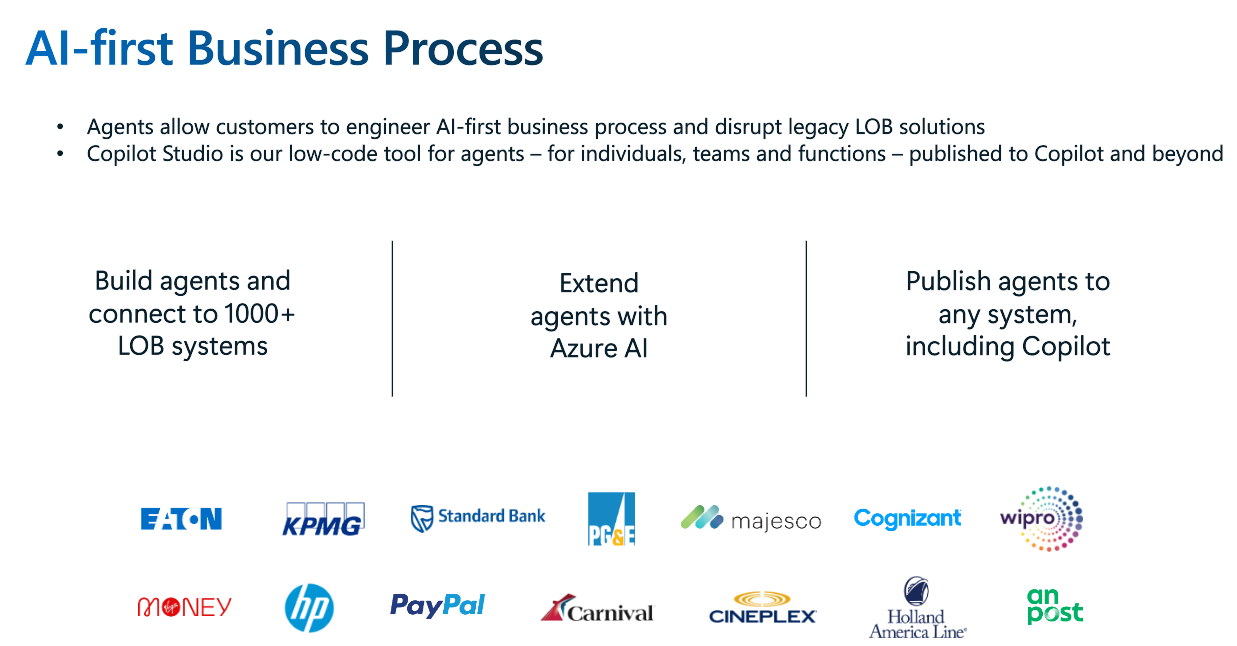
In a blog post aimed at Salesforce's Dreamforce 2024 conference, Microsoft said it will add agent builder to Copilot Studio. Copilot agents are designed to be fully autonomous and run in the background to carry out tasks.

With Salesforce push, AI Agents, agentic AI overload looms

Microsoft said Copilot agents can be created in BizChat or SharePoint and then mentioned in various apps such as Teams or Outlook. Copilot agents and agent builder in BizChat will roll out in the weeks ahead with SharePoint agent builder in preview in October.

Most enterprises vendors have positioned agents to be a different more advanced version of copilots. Salesforce CEO Marc Benioff recently outlined Agentforce and said the platform will be the un-Copilot. "So many customers are so disappointed in what they bought from Microsoft Copilot because they're not getting the accuracy and the response that they want. Microsoft has disappointed so many customers with AI," Benioff said.

Microsoft will beg to differ--especially since it rolled out numerous Copilot enhancements even with its AI agent announcements.

Constellation Research analyst Holger Mueller said Microsoft has an interesting Copilot vs. agents line to walk.

"Microsoft tries to get in its agents before Salesforce.

Microsoft keeps pushing for agents, and interestingly agents are there to help Copilots, which fits the Microsoft vision, but does not address the Copilot inflation that Microsoft users are battling with day in and day out. Microsoft will have to create an uber AI persona. Maybe it will be the comeback of Cortana?"

In the meantime, Microsoft announced a bevy of enhancements for Microsoft 365 Copilot including:

  • Copilot Pages, a collaboration canvas for multiple AI copilots. Microsoft is pitching Copilot Pages as a way to turn genAI artifacts and make them reusable with the ability to edit, add and share AI generated content.
  • Copilot in Excel is generally available and Copilot in Excel with Python is in public preview.
  • Copilot on PowerPoint with Narrative builder is generally available as is Brand manager to ensure presentations are on brand.
  • Copilot in Teams will combine meeting transcripts and chats to provide a complete picture of the meeting.
  • Copilot in Outlook will prioritize emails and messages with a concise summary.
Data to Decisions Future of Work Innovation & Product-led Growth Tech Optimization Next-Generation Customer Experience Digital Safety, Privacy & Cybersecurity Microsoft AI GenerativeAI ML Machine Learning LLMs Agentic AI Analytics Automation Disruptive Technology Chief Information Officer Chief Executive Officer Chief Technology Officer Chief AI Officer Chief Data Officer Chief Analytics Officer Chief Information Security Officer Chief Product Officer

Salesforce adds AI agents to Marketing, Commerce Clouds, Slack at Dreamforce 2024

Salesforce rolled out Agentforce additions across its Marketing and Commerce Clouds as well as Slack as it harmonizes its platform with AI agents. Salesforce's clouds, Marketing Cloud, Commerce Cloud, Service Cloud and Revenue Cloud will also work natively together.

On Friday, Salesforce outlined its Agentforce efforts, agentic AI agents that will work across the company's unified platform. The technology behind Agentforce was acquired in last year's Airkit.ai purchase. Dreamforce 2024 this week will be focused on showing what Agentforce can do.

With Agentforce, Salesforce is hitting an ongoing theme across enterprise software. Simply put, the AI agent bandwagon is about to get crowded.

Here's a look at Saleforce's platform and stack.

And the Dreamforce updates:

Commerce Cloud

Commerce Cloud gets a unified experience as it now runs on one single platform. Salesforce added that it will also add autonomous Agentforce Agents for merchants, buyers and shoppers. The Commerce Cloud updates are designed to appeal for B2C, direct to consumer and B2B commerce.

A look at the Agentforce agents, which are grounded in Data Cloud and can manage product recommendations and order lookups without human intervention:

  • Merchant aims to assist ecommerce merchandisers with promotions, site setup, goal setting, product descriptions and insights.
  • Buyer will help buyers find products, purchase and track orders via chat or portals.
  • Personal Shopper acts as a concierge on ecommerce sites.

Agentforce Merchant will be generally available in October with Personal Shopper and Buyer in beta.

The AI agents are the headliner, but Salesforce also added a series of new features to Commerce Cloud including In-Store Inventory Planning, Buy with Prime, and an enhanced Salesforce Checkout.

Salesforce also said it has expanded its partnership with Stripe to expand Salesforce Payments and express checkout methods. Customers will be able to connect their own Stripe accounts to Salesforce Payments in February.

Marketing Cloud

Salesforce said it will launch a new addition of Marketing Cloud with AI capabilities. Marketing Cloud Advanced will be able to connect marketing efforts across sales, service and commerce workflows.

Marketing Cloud Advanced includes:

  • Agentforce personalization in multiple languages.
  • Automation across teams with Salesforce Flow.
  • Unified SMS conversations across Marketing, Commerce and Service clouds.

Agentforce for Marketing will get Campaign Optimizer automates, analyzes, generates and optimizes marketing campaigns. Agentforce will also personalize engagement by customer.

Einstein Marketing Intelligence will also be a one-stop dashboard to manage and optimize campaign performance with automated data prep, transparency into budgets and integration with Tableau to visualize performance.

Tableau will be able to provide insights for every agent and app with a new Data Cloud semantic layer. Additions will feature unified apps and marketplace, drag and drop VizQL visualization and shareable semantic models and metrics.

Slack

Salesforce launched Agentforce in Slack with a new interface that enables conversations to include insights, data and actions.

In addition, Slack will get integration with third-party AI agents from Adobe, Anthropic, Cohere and Perplexity.

Salesforce is also adding channels so Salesforce CRM can be tied to records in Slack conversations.

Other items include:

  • Slack AI will have huddle notes, and simplified automation experience.
  • Slack will get collections of templates, canvases and workflows for channels.
  • Agentforce will pull in CRM insights directly into Slack.
  • Amazon Q Business will also be integrated with Slack as will Asana, Box and Workday.
Data to Decisions Future of Work Marketing Transformation Matrix Commerce Next-Generation Customer Experience Innovation & Product-led Growth Tech Optimization Digital Safety, Privacy & Cybersecurity salesforce ML Machine Learning LLMs Agentic AI Generative AI Robotics AI Analytics Automation Quantum Computing Cloud Digital Transformation Disruptive Technology Enterprise IT Enterprise Acceleration Enterprise Software Next Gen Apps IoT Blockchain Leadership VR Chief Customer Officer Chief Information Officer Chief Marketing Officer Chief Revenue Officer Chief Data Officer Chief Executive Officer Chief Technology Officer Chief AI Officer Chief Analytics Officer Chief Information Security Officer Chief Product Officer

With Salesforce push, AI Agents, agentic AI overload looms

Generative AI has been the topic du jour for more than 18 months, but now the baton is going to be handed to agentic AI if Salesforce and other enterprise technology giants have their way.

Salesforce’s Dreamforce conference will be all about AI agents—known as Agentforce—and the company has had a steady drumbeat of news leading up to its flagship conference. Salesforce’s plan is to use Dreamforce to show you what Agentforce can do and reinvent the company as a platform that drives value.

The problem: Salesforce had to move early on its Agentforce news because the AI agent bandwagon was filling up so rapidly. Indeed, ServiceNow has been talking AI agents for months and its Xanadu release of its Now Platform puts agents into production this week. Oracle’s CloudWorld conference this week also included a hefty dose of AI agents across its platform, applications and cloud services. Google Cloud CEO Thomas Kurian also talked about how the company is monetizing its agents.

Speaking of monetization, Salesforce said that Agentforce will run $2 per conversation without volume discounts. To Benioff, the $2 per conversation model is a no brainer since the returns on investment are there. We’ll find out if enterprises agree.

This post first appeared in the Constellation Insight newsletter, which features bespoke content weekly and is brought to you by Hitachi Vantara.

"Dreamforce is really becoming Agentforce," said Salesforce CEO Marc Benioff. "I think this is going to be a moment that everyone is going to have to see in person to understand what is going on.” Salesforce’s plan is to outline Agentforce and then outline a bevy of customers using the technology, which was acquired in the tuck-in Airkit.ai purchase a year ago.

In 2024, AI agents came into their own as SaaS providers all worked to make generative AI use cases drive value. Presumably, enterprises will move more genAI pilots to production with the help of agents that can make decisions and automate processes on your behalf. Enter agentic AI.

The term agentic was most likely cribbed by the tech sector from psychologist Albert Bandura, a professor of social science in psychology at Stanford, who died in 2021. In 2001, Bandura wrote Social cognitive theory: An agentic perspective. Annual review of psychology 52. The term agentic has been applied to multiple fields from psychology to education to healthcare to business to portfolio management.

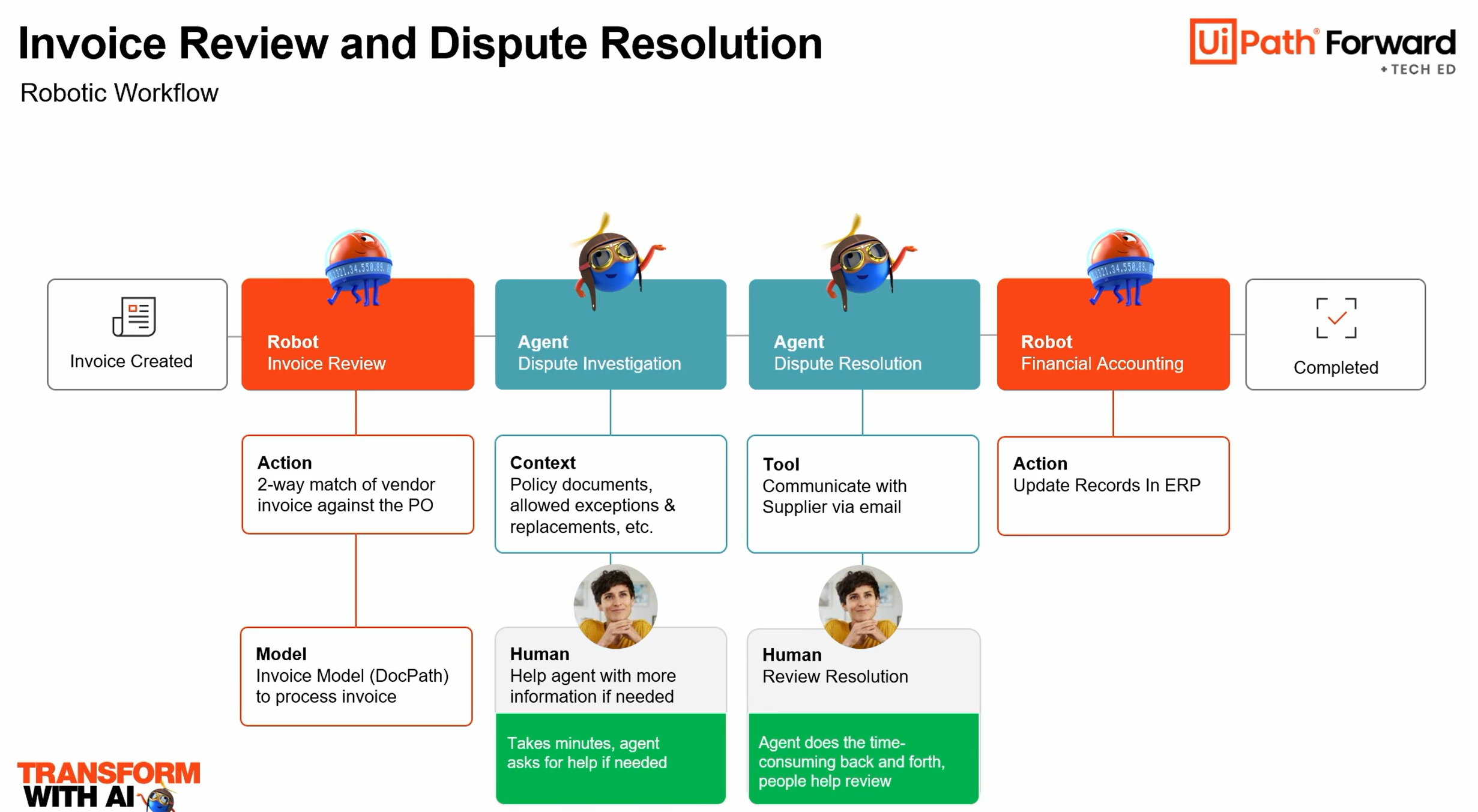
The rough idea behind agentic AI is to create models that can make decisions and act on your behalf. Agents are further along on the genAI progression.

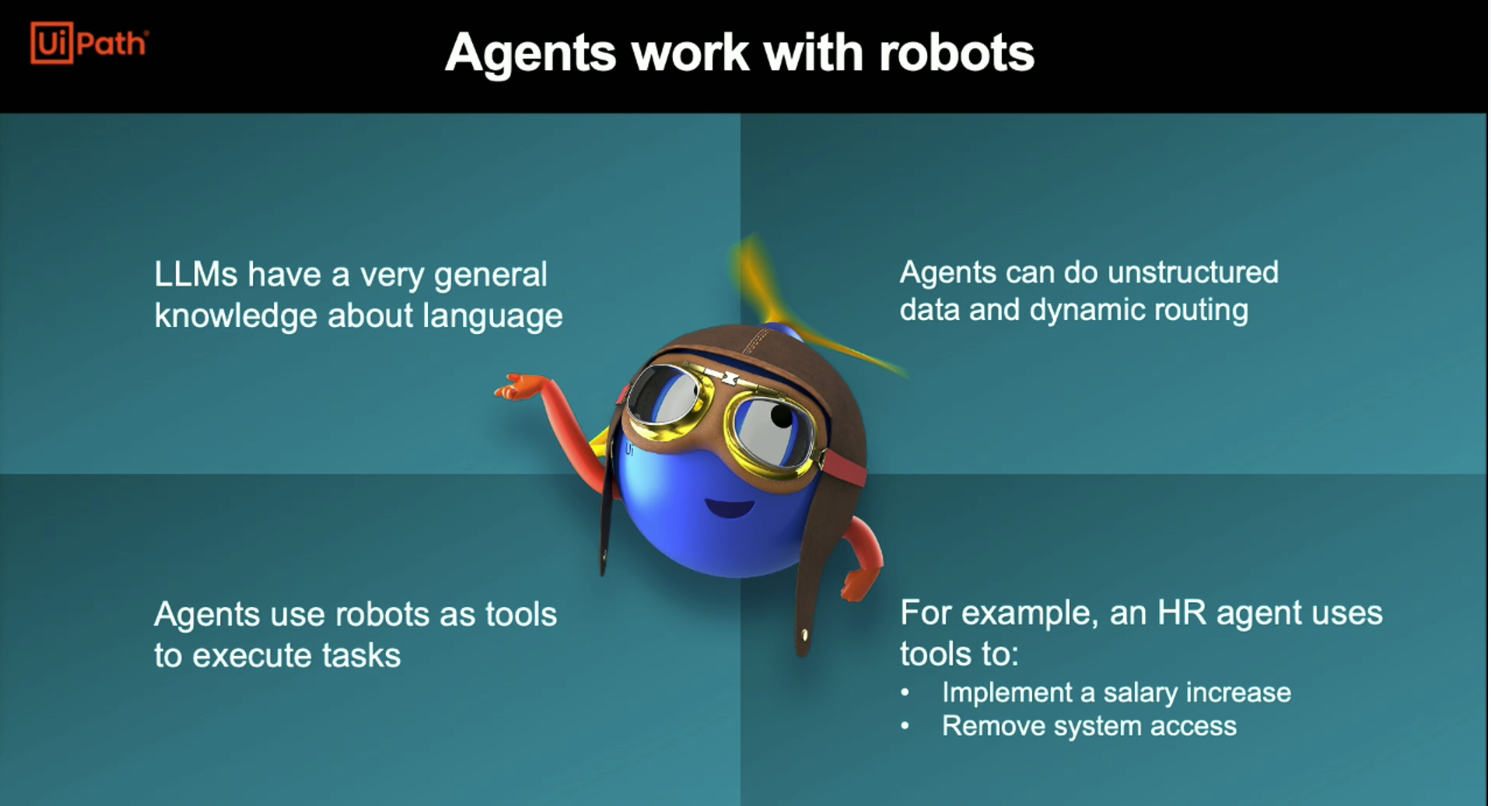
Salesforce is the latest in popularizing agents, but the concept isn’t necessarily in 2024. Enterprise technology companies have been talking up AI agents for most of the year and the term has been floating around for a few years. It’s just now that venture capital will flow into agentic AI in a big way. UIPath CEO Daniel Dines said recent earnings conference call: “To me, an AI agent is basically a robot, if you want, that has some more new skills. And I think there will be multiple type of agents,” said Dines.

In fact, a new category is emerging with purpose-built AI agents for common business use cases. Constellation Research recently published a new ShortList for AI-Powered Virtual SDR Agents – which includes seven startups (and Salesforce) who have emerged with AI agent tools. While big players are getting into the game, smaller players like Qualified are showing promise with their agent roadmaps. Qualified recently added significant email capabilities to its previously chat-only AI SDR this past week.

“You are going to see almost every CRM and CX vendor offering some sort of AI-powered agent tool within the next year or so,” notes Constellation Vice President & Principal Analyst Martin Schneider. “It is the natural evolution from co-pilots; shifting from prompt-based points of insight to semi-autonomous agents that can take action and further along key – yet typically safer or mundane – processes. It is about expanding reach, productivity, and augmenting human capabilities not necessarily replacing them… yet.”

Simply put, the agentic AI bandwagon is already full. Consider some recent headlines:

You could toss Amazon Q into the AI agent mix, but Amazon Web Services refers to it more of an assistant.

The catch is that the agentic AI we’re talking about today will need to improve dramatically to fully understand and make calls in the real world. You know the drill. First comes the buzzword and then the execution.

Speaking earlier this year at Google Cloud Next, Anthropic CEO Dario Amodei said: "One of my guesses is that if you want an agent to act in the world it requires the model to engage in a series of actions. You talk to a chat bot, it only answers and maybe there's a little follow-up. With agents you might need to take a bunch of actions, see what happens in the world or with a human and then take more actions. You need to do a long sequence of things and the error rate on each of the individual things has to be pretty low. There are probably thousands of actions that go into that. Models need to get more reliable because the individual steps need to have very low error rates. Part of that will come from scale. We need another generation or two of scale before the agents will really work."

Since those Anthropic comments, the company has developed its Claude family of large language models nicely.

Technology has never waited for a buzzword to work before talking about it nonstop. Rest assured, “agentic AI,” “AI agents” and the like will be discussed extensively going forward by enterprise software giants. Why?

AI agents are being pitched by enterprise software vendors because the entire category is going to be disrupted. Everything from the cross-selling of clouds, revenue models (seats to consumption and value) and platforms vs. product lines will need to be rethought. GenAI and AI agents are likely to become the primary user interface to software and that’s going to be a big headache for your go-to vendors.

Insights Archive

Data to Decisions Future of Work Innovation & Product-led Growth Matrix Commerce Next-Generation Customer Experience Tech Optimization Digital Safety, Privacy & Cybersecurity ML Machine Learning LLMs Agentic AI Generative AI Robotics AI Analytics Automation Quantum Computing Cloud Digital Transformation Disruptive Technology Enterprise IT Enterprise Acceleration Enterprise Software Next Gen Apps IoT Blockchain Leadership VR GenerativeAI Chief Information Officer Chief Executive Officer Chief Technology Officer Chief AI Officer Chief Data Officer Chief Analytics Officer Chief Information Security Officer Chief Product Officer

OpenAI releases o1-mini, a model optimized STEM reasoning, costs

OpenAI released OpenAI o1-mini, a reasoning model designed to excel at Math and coding. OpenAI o1-mini highlights how models with focus is the next frontier.

The company also said o1-mini's cost is 80% cheaper than OpenAI 01-preview. ChatGPT Plus, Team, Enterprise, and education users can use o1-mini as an alternative to o1-preview to save money.

OpenAI said it trained o1 models without broad knowledge and optimized for STEM reasoning.

In a high school AIME math competition, o1-mini at 70% is competitive with o1 at 74.4%, but with lower costs. Coding had comparison. In other words, enterprises will determine the accuracy needed and optimize costs. The new models from OpenAI deliver much better math performance than GPT-4o.

OpenAI also made the case that slower answers are better for STEM subjects. GPT-4o was fast, but incorrect and the o1 models were correct with slower speeds. The company noted:

"Due to its specialization on STEM reasoning capabilities, o1-mini’s factual knowledge on non-STEM topics such as dates, biographies, and trivia is comparable to small LLMs such as GPT-4o mini. We will improve these limitations in future versions, as well as experiment with extending the model to other modalities and specialties outside of STEM."

OpenAI outlined its views on how LLMs will reason going forward, but there appears to be a bit of a shift away from one-do-it-all model. Humans are also beginning to see models more like a toolkit.

The company concluded:

"o1 significantly advances the state-of-the-art in AI reasoning. We plan to release improved versions of this model as we continue iterating. We expect these new reasoning capabilities will improve our ability to align models to human values and principles. We believe o1 – and its successors – will unlock many new use cases for AI in science, coding, math, and related fields."

Recent:

Data to Decisions Innovation & Product-led Growth Future of Work Tech Optimization Next-Generation Customer Experience Digital Safety, Privacy & Cybersecurity AI GenerativeAI ML Machine Learning LLMs Agentic AI Analytics Automation Disruptive Technology Chief Information Officer Chief Executive Officer Chief Technology Officer Chief AI Officer Chief Data Officer Chief Analytics Officer Chief Information Security Officer Chief Product Officer

Adobe earnings: Solid Q3, but Q4 outlook light

Adobe reported better than expected third quarter earnings as its primary segments delivered double-digit growth from a year ago. However, the fourth quarter outlook was lower than expected.

The company reported third quarter earnings of $3.76 a share on revenue of $5.41 billion, up 11% from a year ago. Non-GAAP earnings were $4.65 a share.

Wall Street was looking for Adobe to report third quarter earnings of $4.54 a share on revenue of $5.37 billion.

As for the outlook, Adobe projected non-GAAP fourth quarter earnings of $4.63 a share to $4.68 a share on revenue of $5.5 billion to $5.55 billion. For the fourth quarter, Wall Street was looking for earnings of $4.67 per share on revenue of $5.6 billion.

In prepared remarks, Adobe CEO Shantanu Narayen said the product advanced launched in the last 18 months "are delighting a huge and growing universe of users and enterprises."

"Our vision revolves around Adobe's deep technology platforms across Creative Cloud, Document Cloud and Experience Cloud which, when integrated, provide significant differentiation and value," said Narayen, who said adoption of Adobe AI features such as Firefly and Acrobat AI Assistant are driving demand. Adobe has surpassed 12 billion Firefly-powered generations across the company's platform.

Speaking on a conference call, Narayen said the fourth quarter is shaping up to be strong. "We saw the typical strength that we would see going into Q4. You're looking at the sequential guide. We're looking at it and saying it's the strongest ever Q4 target that we have put out there for Q4. I think we just continue to focus," said Narayen.

David Wadhwani, President, Digital Media Business at Adobe, added:

"Q3 was a little stronger than you expected, and for a good reason given seasonality. I think a lot of that can be explained by a few deals that would have historically just closed in Q4, closing earlier than expected in Q3, and that changed the dynamic in terms of the linearity that you would typically see between Q3 and Q4."

Wadhwani said Creative Cloud is seeing revenue gains from AI. "We have higher-value, higher-priced offers, thanks to AI innovation that's happening in the base plans that are impacting how the Creative Cloud business is doing," he said. "We also have a broader set of offerings than we've ever had now with web and mobile, including Premium and lower-priced offerings that are driving more proliferation."

By the numbers:

  • Digital Media revenue in the third quarter was $4 billion, up 11% from a year ago. Within that segment, Document Cloud revenue was $807 million, up 18% from a year ago and Creative revenue was $3.19 billion, up 10%.
  • Digital Experience revenue was $1.35 billion, up 10% from a year ago. Digital Experience subscription revenue as $1.23 billion, up 12%.
  • AI interactions within Adobe Acrobat was up 70% in the third quarter compared to the second quarter.

Data to Decisions Future of Work Marketing Transformation Matrix Commerce Next-Generation Customer Experience Innovation & Product-led Growth Tech Optimization Digital Safety, Privacy & Cybersecurity adobe ML Machine Learning LLMs Agentic AI Generative AI AI Analytics Automation business Marketing SaaS PaaS IaaS Digital Transformation Disruptive Technology Enterprise IT Enterprise Acceleration Enterprise Software Next Gen Apps IoT Blockchain CRM ERP finance Healthcare Customer Service Content Management Collaboration Chief Information Officer Chief Marketing Officer Chief Data Officer Chief Executive Officer Chief Technology Officer Chief AI Officer Chief Analytics Officer Chief Information Security Officer Chief Product Officer