Results

Welldoc Chief AI Officer Anand Iyer on AI, data and healthcare transformation

Artificial intelligence in all of its forms--not just generative AI--is going to transform healthcare, but the sector needs to be judicious about how it integrates AI, machine learning, deep learning and generative AI to lower costs and improve patient outcomes.

That broad takeaway was delivered by Anand Iyer, Chief AI Officer at Welldoc, in a DisrupTV interview. Iyer will be a speaker at Constellation Research's AI Forum Sept. 23 in New York.

Here are the takeaways from the Iyer chat with Constellation Research CEO Ray Wang.

Healthcare's intersection with technology and AI. Iyer said rising costs for healthcare and worsening outcomes are driving the need for innovation and technologies that can improve care and lower costs. Iyer said:

"Healthcare is becoming very expensive at the individual level, at the corporate level, and certainly at the macroeconomic level. It's such a large portion of the entire country's GDP. At a high level, healthcare is looking to do two simple things. Innovate. And move the continuum to focus efforts on management and prevention. Can I use data insights? Can I use modeling? Can I use the vast data from sensors to focus the attention on prevention? There are also inefficiencies throughout the healthcare systems. I think AI has the ability to actually have your cake and eat it too."

The noise around AI and machine learning vs. generative AI. Iyer explained:

"There's so much excitement, which is a very positive thing. But with excitement, of course, comes the misunderstanding of AI. AI is oftentimes synonymous with generative AI. AI is actually a much bigger thing. And it starts with what we call the rules-based engine. So, teach a machine to do what a human would otherwise do, and that can be accomplished with a simple set of rules or complex set of rules. There's even the gradation of the complexity of a rules engine. But the pluses of those types of AI approaches, of course, is that they're traceable. For a given rule, the output is known. And by the way, the regulatory agencies love that since they can trace a patient safety all the way back to a set of rules.

The next level of AI is using machine learning so is not fixed anymore. You're feeding data to an algorithm and it is adapting and changing. It's optimizing itself for different conditions, situations and patients. After that it is deep learning and that works well on large data sets, neural network models and then generative AI where it comes back with new content.

I think the reality is all four of these forms of AI, not just generative AI work their way into healthcare."

AI risk assessment in healthcare. Iyer said healthcare organizations need to integrate AI based on risk and intent. There's efficiency and then there's outcomes and risk. There are low risk categories like prevention and education and high-risk areas like mediation dosing. "You have to make sure you have the controls, the safety and the traceability to evidence-based guidelines," said Iyer.

Will AI replace a doctor? Iyer said:

"People ask us all the time, will AI replace a doctor? Hell no, absolutely not. But a doctor who uses AI may very well replace one who doesn't. The analogy that comes to my mind is when you look up in the nighttime sky and you see a point of light, you look up and say, 'oh, it's a star.' The more astute will say it's a planet. But then you look at that same point of light through the Webb telescope, and you see seven galaxies. The Webb telescope is to the astronomer, what AI and digital health is to the doctor. It lets the doctor see things that can't be seen by the naked eye alone. It lets them look deeper than what they can see in a five- or 10-minute office visit."

"There's no blame here. Especially primary care that's the front line for everything. Doctors are being bombarded and in many cases the evidence-based guidelines are changing rapidly and you can't keep up. Patients want the guidance so they don't want AI to be the doctor. But if I could have something that helps my doctor understand what's actually happening with me personally then AI is a transformation agent."

Simply put, Iyer is betting that AI can be like turn-by-turn instructions on Google Maps for physicians.

Personal electronic health records and data sharing. Today, patient records are locked into systems. "At the end of the day if I'm generating all this data as the patient I own the data," said Iyer, who noted that patients will want precise guidance, but also contribute to a larger model.

"I think the future is going to be one where there's going to be more collaboration with sharing data--anonymized of course and protected," he said. "Within those constraints, there's so much we can do by merging data sets."


Data to Decisions Next-Generation Customer Experience Future of Work Innovation & Product-led Growth Tech Optimization Digital Safety, Privacy & Cybersecurity AR ML Machine Learning LLMs Agentic AI Generative AI AI Analytics Automation business Marketing SaaS PaaS IaaS Digital Transformation Disruptive Technology Enterprise IT Enterprise Acceleration Enterprise Software Next Gen Apps IoT Blockchain CRM ERP finance Healthcare Customer Service Content Management Collaboration GenerativeAI Chief Information Officer Chief Analytics Officer Chief Data Officer Chief Technology Officer Chief Executive Officer Chief AI Officer Chief Information Security Officer Chief Product Officer

PC upgrade cycle to be driven by AI, but calling timing has been difficult

Personal computers powered by artificial intelligence haven't surged ahead just yet, but demand appears to be strong enough to spur an upgrade cycle. That's a key takeaway from earnings results from Best Buy, Dell and Hewlett-Packard.

During Best Buy's second quarter earnings call, CEO Corie Barry said the company saw solid growth in tablets, computing and services, but those gains were offset by other categories.

"In Q2, we believe the growth in laptop sales continued to be largely driven by customers’ desire to replace and upgrade their products. The performance of Copilot+ in the quarter was in line with our expectations, but at this early point, a small part of the total revenue," said Barry. "We believe we are just at the beginning of the impact of AI on tech innovation and customer demand. For example, the June introduction of the Copilot+ laptops was one of the first launches with an important AI capability. In addition, Apple Intelligence has been announced with capabilities and features across devices. We believe AI inspired capabilities and innovation will continue to spread across categories and devices over the next few years."

PC industry's big dream: AI enabled PCs spur upgrade cycle

Barry added that Copilot+ PCs have higher price points but create a halo effect for PC upgrades overall. She added that PC upgrades will be driven more by evolution than revolution. "We've been really clear in saying we never expected everyone to be lined up at the door waiting for their AI devices. It's more that this continues to proliferate across screens," she said.

In other words, there is definitely an upgrade cycle looming for PCs bought during the COVID-19 pandemic. It remains to be seen how much AI drives those upgrades.

HP's fiscal third quarter results also featured a heavy dose of Copilot+ PC chatter. HP CEO Enrique Lores said the company saw good demand for its PC unit with a "strong recovery" in commercial PCs.

Lores said:

"In the AI PC category, we are charging ahead. Our next-gen AI PCs are empowering everyone from knowledge workers to data scientists to unlock the power of AI. In May, we launched our first generation using the latest Qualcomm processor. As the world's thinnest next-gen AI PCs with the longest battery life, they are made for mobility. And in July, we introduced a new premium model powered by the latest AMD processor. It is the most powerful AI PC in the industry with up to 55 TOPS of NPU performance. It delivers personalized experiences like real-time translation, personal communication coaching, and quick professional video creation and to help protect against AI-assisted cyber-attacks."

Lores also noted that HP's AI Studio workstation is designed for data scientists and AI developers. Going forward, HP said it expects commercial PC strength with consumer market weakness. "We had said that we expected sales to be around 10% during the second half and we think we're going to be slightly above that number. So, they are performing well. Where we really are also focused on what we call next-generation AI PCs that we have just started to launch," said Lores. "We expect next-generation AI PCs to represent around 50% of shipments in 2027, three years after launch, and they drive an average selling price increase between 5% and 10%."

As for Dell Technologies, the company said its PC unit saw "modest commercial PC demand growth in the quarter with healthy operating profitability."

Dell Technologies said that it expects PC revenue growth in the second half in the year, led by the fourth quarter. Over time, PC upgrades will be driven by the long-term impacts of AI.

Jeff Clarke, Chief Operating Officer of Dell Technologies, said: 

"We remain optimistic about the refresh. I think it's reflected in our guidance that we think the refresh is shifting more towards the end of the year than we thought, maybe at the middle of the year. The refresh is heading towards end of '24 into '25. What's important about that is, as the refresh takes longer it snaps back faster because the Windows 10 end of life date. We have an aging install base of machine bought during the Covid era all mounting to be refreshed with exciting new products built around AI. More AI applications are coming. Calling the timing has been difficult. 

Applications to help productivity with end users is around the corner. And if you think about the extension of AI up to the edge, and what inferencing will be done on the edge on PCs that opportunity is immense as well. When you think about running these small language models with larger memory footprints on the edge your PC will do amazing things."

My take: For the next 12 months, AI PCs will get folks interested in upgrading. I can't necessarily figure out the value proposition for Copilot+ PCs yet, but if you have to upgrade (and many of us do) there is something to be said for future proofing.

Data to Decisions Future of Work Innovation & Product-led Growth New C-Suite Tech Optimization Next-Generation Customer Experience Digital Safety, Privacy & Cybersecurity dell HP AI GenerativeAI ML Machine Learning LLMs Agentic AI Analytics Automation Disruptive Technology Chief Information Officer Chief Experience Officer Chief Executive Officer Chief Technology Officer Chief AI Officer Chief Data Officer Chief Analytics Officer Chief Information Security Officer Chief Product Officer

MongoDB rebounds in Q2 with better-than-expected results

MongoDB rebounded in the second quarter with better-than-expected results due to stronger Atlas consumption levels.

The company reported a second quarter net loss of $54.5 million, or 74 cents a share, on revenue of $478.1 million, up 13% from a year earlier. Non-GAAP earnings were 70 cents a share.

Wall Street was expecting MongoDB to report second quarter non-GAAP earnings of 48 cents a share on revenue of $464.22 million. The company has cut its outlook in the last two quarters and analysts have mostly been cutting estimates for both earnings and revenue.

Dev Ittycheria, CEO of MongoDB, said the company acquired new workloads and saw Atlas consumption go up. “We believe we are incredibly well positioned to help customers incorporate generative AI into their business and modernize their legacy application estate,” he said.

As for the outlook, MongoDB projected third quarter revenue of $493 billion to $497 billion with non-GAAP earnings of 65 cents per share to 68 cents per share. For fiscal 2025, MongoDB projected revenue of $1.92 billion to $1.93 billion with non-GAAP earnings of $2.33 per share to $2.47 per share.

Constellation Research analyst Holger Mueller said:

"MongoDB is a great example that when a vendor does multi-cloud right, it always delivers. For MongoDB, that multi-cloud play is Atlas and it's growing substantially. The problem is that the company cannot control cost despite reasonable growth. The result is more losses and that is not popular with investors these days."

Next-Generation Customer Experience Tech Optimization Innovation & Product-led Growth Data to Decisions Future of Work Digital Safety, Privacy & Cybersecurity mongodb AI GenerativeAI ML Machine Learning LLMs Agentic AI Analytics Automation Disruptive Technology Chief Information Officer Chief Executive Officer Chief Technology Officer Chief AI Officer Chief Data Officer Chief Analytics Officer Chief Information Security Officer Chief Product Officer

Dell Technologies Q2 driven by AI server demand, backlog

Dell Technologies saw a second quarter boom in its infrastructure solutions group (ISG) revenue due to strong server and networking demand. Dell shipped $3.1 billion in AI servers in the second quarter.

The company reported second-quarter earnings of $841 million, or $1.17 a share, on revenue of $25 billion, up 9% from a year ago. Non-GAAP earnings were $1.89 a share.

Wall Street was expecting Dell Technologies to report second quarter earnings of $1.72 a share on revenue of $24.12 billion. Dell’s results are being closely watched to gauge AI infrastructure demand.

AI infrastructure drove the quarter for Dell.

In prepared remarks, Jeff Clarke, Chief Operating Officer, said demand was driven by cloud service providers. “Our unique capability to deliver leading edge air and liquid cooled AI servers, networking and storage — tuned and optimized for maximum performance at the node and rack level — combined with leading ecosystem partners and world class services and support, continues to resonate with customers,” said Clarke. “Encouragingly, we continue to see an increase in the number of enterprise customers buying AI solutions each quarter.”

Servers and networking revenue hit a second quarter record at $7.7 billion, up 80% due to demand for AI servers. Storage revenue was down 5% from a year ago to $4 billion. Operating income was $1.3 billion for ISG in the second quarter.

Clarke said AI server backlog exiting the second quarter was $3.8 billion. The pipeline also expanded beyond cloud service providers to enterprises.

“We are competing in all of the big AI deals and are winning significant deployments at scale,” said Clarke. “Progress will not always be linear in the early stages, but we are winning in the market with strong feedback from repeat customers while acquiring new customers every quarter.”

Dell’s PC unit delivered second quarter operating income of $767 million on revenue of $12.4 billion, down 4% from a year ago. Commercial PC revenue was flat with a year ago as consumer fell 22% in the second quarter.

As for the outlook, Dell Technologies said third quarter revenue will be about $24 billion to $25 billion, up 10% at the midpoint. Non-GAAP earnings for the third quarter will be about $2 a share. For fiscal 2025, Dell Technologies expects revenue to be between $95.5 billion to $98.5 billion. ISG revenue will be up about 30%. 

CFO Yvonne McGill said operating margins will be pressured due to "inflationary input costs, the competitive environment and a higher mix of AI optimized servers." However, Dell Technologies is using generative AI to save money.  

McGill said:

"We are applying artificial intelligence and beginning to realize the benefits across our own business. We're using it to improve customer and team member experiences and sales, software development, services, content management and our supply chain, and in turn, we're using our experiences to help our customers realize benefits of AI for themselves."

Clarke added that Dell Technologies is also improving margins in its AI portfolio. "We are improving margins of our AI portfolio, and we did that with the same sort of price discipline, but more importantly, the engineering value add and the technical value add that we're bringing to our customers, and the expansion from beyond the specific node to the rack level deployment," said Clarke.  

Data to Decisions Tech Optimization Innovation & Product-led Growth Future of Work Next-Generation Customer Experience Digital Safety, Privacy & Cybersecurity dell Big Data AI GenerativeAI ML Machine Learning LLMs Agentic AI Analytics Automation Disruptive Technology Chief Information Officer Chief Technology Officer Chief Information Security Officer Chief Data Officer Chief Executive Officer Chief AI Officer Chief Analytics Officer Chief Product Officer

Nutanix lands larger deals in Q4, ups outlook, plays long game vs. VMware

Nutanix is winning larger enterprise deals and looking to ride hyperconverged infrastructure partnerships with Cisco and Dell as it plays the long game against Broadcom's VMware.

It's difficult to break out Nutanix's direct revenue due to Broadcom's VMware purchase, but it's safe to say the acquisition helped the company land high-level conversations. Nutanix results landed a day after Broadcom CEO Hock Tan made his pitch for VMware Cloud Foundation in Las Vegas.

Nutanix is growing its pipeline with large enterprises, but these deals take longer to play out. For now, Nutanix beats expectations on a quarterly basis with the exception of lumpiness of deals closing. The company reported non-GAAP fourth quarter earnings of 27 cents a share on revenue of $548 million, up 11% from a year ago. Wall Street had expected non-GAAP earnings of 20 cents a share on revenue of $537.3 million. Net loss in the fourth quarter was 51 cents a share.

The outlook for Nutanix was solid and ahead of estimates. For the first quarter, Nutanix projected revenue of $565 million to $575 million and fiscal 2025 revenue of $2.435 billion to $2.465 billion.

Rajiv Ramaswami, CEO of Nutanix, said the company's products and appeal are landing with large enterprises. "We saw good growth in our pipeline of larger deals as we shifted our focus up-market and saw increased engagement from prospects, looking for alternatives to their existing infrastructure solutions," he said.

However, Ramaswami noted that its "land and expand" business fell short of internal projections.

Nutanix is also betting that partnerships Cisco, Dell and Nvidia will expand its market. Dell XC Plus, a turnkey hyperconverged Nutanix offering, is generally available. Nutanix's GPT in-a-box is also gaining traction. "Our most significant wins in the quarter demonstrated the appeal of Nutanix cloud platform to organizations that are looking to modernize their IT footprints and adopt hybrid cloud operating models, as well as those looking for alternatives in the wake of recent industry M&A," said Ramaswami.

Moving up to large enterprises, however, takes time. Nutanix's largest fourth quarter deal was a multimillion-dollar deal that followed a 1.5-year engagement.

In other words, Nutanix is playing the long game vs. VMware as it expands its addressable market.

Ramaswami said:

"We are seeing some of these larger opportunities close. I do expect that we'll continue to see more of these over time. Now in the midsize and smaller customer segments, we're seeing significant increased engagement and opportunity as many of these smaller companies look for alternatives.

Along with our increased leverage from our go-to-market partnerships that we've talked about as well as our programs and incentives that we have in place, this dynamic has also been one of our drivers for our larger -- our stronger new logo performance."


Tech Optimization Data to Decisions vmware Big Data Chief Information Officer Chief Technology Officer Chief Information Security Officer Chief Data Officer

Salesforce's Benioff ponders consumption-based model enabled by Agentforce

Salesforce is known for growing revenue through multi-cloud deals and is still damn good at it since 80% of new business in the second quarter was due to the cross-sell. But it's not hard to see a consumption-based model in the future based on transactions, workflows and Agentforce interactions.

Read between the lines of Salesforce CEO Marc Benioff's second quarter comments and it becomes clear that the company is looking at more of a platform strategy enabled by Agentforce. Dreamforce will be the big debut for Agentforce, which was outlined by Constellation Research analyst Martin Schneider recently.

If successful, Agentforce will move Salesforce's model from one of annoying cross-sells to one based on consumption. Salesforce's plans likely highlight a pivot for an enterprise software industry facing disruption. 

Let's start with Benioff's money quote during the earnings conference call (emphasis mine):

"When you think about apps and you think about humans, because humans use apps, not in all cases. So, for example, the Data Cloud is a consumption product. The Commerce Cloud is a consumption product. Of course, the e-mail product, Marketing Cloud is a consumption product. Heroku is a consumption product. So of course, we've had non-human consumption-based products for quite a long time at Salesforce. But in this idea of agents, when -- I'll just give you my own personal goals. So, I'm not giving any guidance here.

My goal is that by the end of fiscal year '26 that we will have a billion agents. Already in just looking at the number of consumers identified just in the trials that we have going on, we have like 100 million identified or more. Okay. call it, 200 million. But the funny thing is, of course, it's only one agent. But let's just think it's like a manifestation of all these agents talking to all these consumers. And then when we look at pricing, it will be on a consumption basis. And when we think about that, we think about saying to our customers, and we have, it's about $2 per conversation."

Benioff added that agents represent a high margin opportunity. "It's probably a per conversational charge as a good way to look at it or we're selling additional consumption credits like we do with our Data Cloud," he said.

There are multiple themes to ponder here.

  • Can Benioff pivot to a consumption model where it sells its individual apps, but with the platform play they became an ensemble cast in your enterprise? "You have all your agents working, your salespeople are working, your service people are working. You're sending out these e-mails. You're talking commerce on your website and then you hit a button and boom, Tableau visualizes all of it for you and it's all one integrated platform. So that's really our vision of where it's going," said Benioff, who did note that enterprises don't have to buy the entire platform, but it helps accuracy if they do.
  • Will Salesforce avoid a hard landing? It appears that Salesforce is moving more to a hybrid SaaS meets consumption model in the near term. Usually, the pivot to a consumption model takes 18 months.
  • Dreamforce will be the audition for Agentforce and Salesforce has to convince customers to take the leap. ServiceNow may be the biggest competitor to this platform-consumption based pivot for Salesforce. 
  • Salesforce will need to work against the DIY crowd when it comes to AI. Benioff said that he has been disappointed with enterprises trying to build their own AI infrastructure because they are wasting money by not betting on a platform vendor (like Salesforce). I found this initial reference to be a bit chippy, but then noticed the context. Klarna said it was ripping out Salesforce and Workday and using AI to replace them. This news item points to that enterprise software disruption theme I've been highlighting of late. Are all SaaS vendors merely systems of record that can be abstracted away?

It's unclear whether Salesforce can really become more than its disaggregated product lines, but it'll be fun to watch.

Data to Decisions Marketing Transformation Matrix Commerce Next-Generation Customer Experience Innovation & Product-led Growth Future of Work Tech Optimization Digital Safety, Privacy & Cybersecurity salesforce AI GenerativeAI ML Machine Learning LLMs Agentic AI Analytics Automation Disruptive Technology Chief Information Officer Chief Executive Officer Chief Technology Officer Chief AI Officer Chief Data Officer Chief Analytics Officer Chief Information Security Officer Chief Product Officer

Nvidia reports strong Q2, Hopper demand remains strong, Blackwell samples shipping

Nvidia said its Blackwell processor samples are shipping to customers and demand for its Hopper platform remains strong. The company reported better-than-expected second quarter earnings as data center revenue continued to carry the team.

The company reported second quarter net income of $16.6 billion, or 67 cents a share, on revenue of $30.04 billion, up 122% from a year ago. Non-GAAP earnings for the second quarter were 68 cents a share. Wall Street was expecting Nvidia to report second quarter non-GAAP earnings of 64 cents a share on revenue of $28.73 billion.

Data center revenue in the second quarter was $26.3 billion, up 154% from a year ago.

As for the outlook, Nvidia projected third quarter revenue of about $32.5 billion with non-GAAP gross margins about 74.4% to 75%. For the third quarter, analysts were modeling earnings of 71 cents a share on revenue of $31.75 billion.

CEO Jensen Huang said:

"Hopper demand remains strong. Blackwell samples are shipping to our partners and customers. Spectrum-X Ethernet for AI and NVIDIA AI Enterprise software are two new product categories achieving significant scale, demonstrating that NVIDIA is a full-stack and data center-scale platform. Across the entire stack and ecosystem, we are helping frontier model makers to consumer internet services, and now enterprises."

Going into the quarter, Constellation Research CEO Ray Wang noted that Nvidia is the bellwether for AI and the spending on genAI infrastructure is still strong. “This buying cycle will continue for about two more quarters and then we’ll see a pullback,” said Wang. “That said Nvidia is priced for perfection right now”

Key themes from CFO Colette Kress:

  • “Data Center revenue was a record, up 154% from a year ago and up 16% sequentially. The strong sequential and year-on-year growth was driven by demand for our Hopper GPU computing platform for training and inferencing of large language models, recommendation engines, and generative AI applications. Sequential growth was driven by consumer internet and enterprise companies.  Cloud service providers represented roughly 45% of our Data Center revenue, and more than 50% stemmed from consumer internet and enterprise companies.”
  • “Networking revenue was $3.7 billion, up 114% from a year ago driven by InfiniBand and Ethernet for AI revenue, which includes Spectrum-X end-to-end ethernet platform.”
  • “We shipped customer samples of our Blackwell architecture in the second quarter. We executed a change to the Blackwell GPU mask to improve production yield. Blackwell production ramp is scheduled to begin in the fourth quarter and continue into fiscal 2026.  In the fourth quarter, we expect to ship several billion dollars in Blackwell revenue.”
  • “Inventory was $6.7 billion with 81 days sales of inventory (DSI). Purchase commitments and obligations for inventory and manufacturing capacity were $27.8 billion, including new commitments for Blackwell capacity and components. Prepaid supply agreements were $4.7 billion.”
  • The company has authorized another $50 billion to buy back shares.

Speaking on the earnings call, Huang made the following points:

  • Hopper demand remains strong even as Blackwell looms because the upgrade path is simple and companies are moving from traditional data centers. 
  • "Generative AI is a fundamental new form of computer science. It's affecting how every layer of computing is done, from CPU to GPU, from human engineered algorithms to machine learning algorithms, and the type of applications you could now develop and produce."
  • "We have to continue to drive the generational performance up quite significantly so we can drive down the energy consumed and drive down the cost necessary to do it."
  • "A generative AI company spends the vast majority of their invested capital into infrastructure so that they could use an AI to help them create products. And so these companies need it now."

Nvidia’s software game

Nvidia this week outlined a series of announcements that may highlight the company’s real moat: The ability to leverage its software ecosystem to boost performance. In addition, Nvidia is looking to make it easier for enterprises to bring generative AI projects from pilot to production.

Among the key highlights:

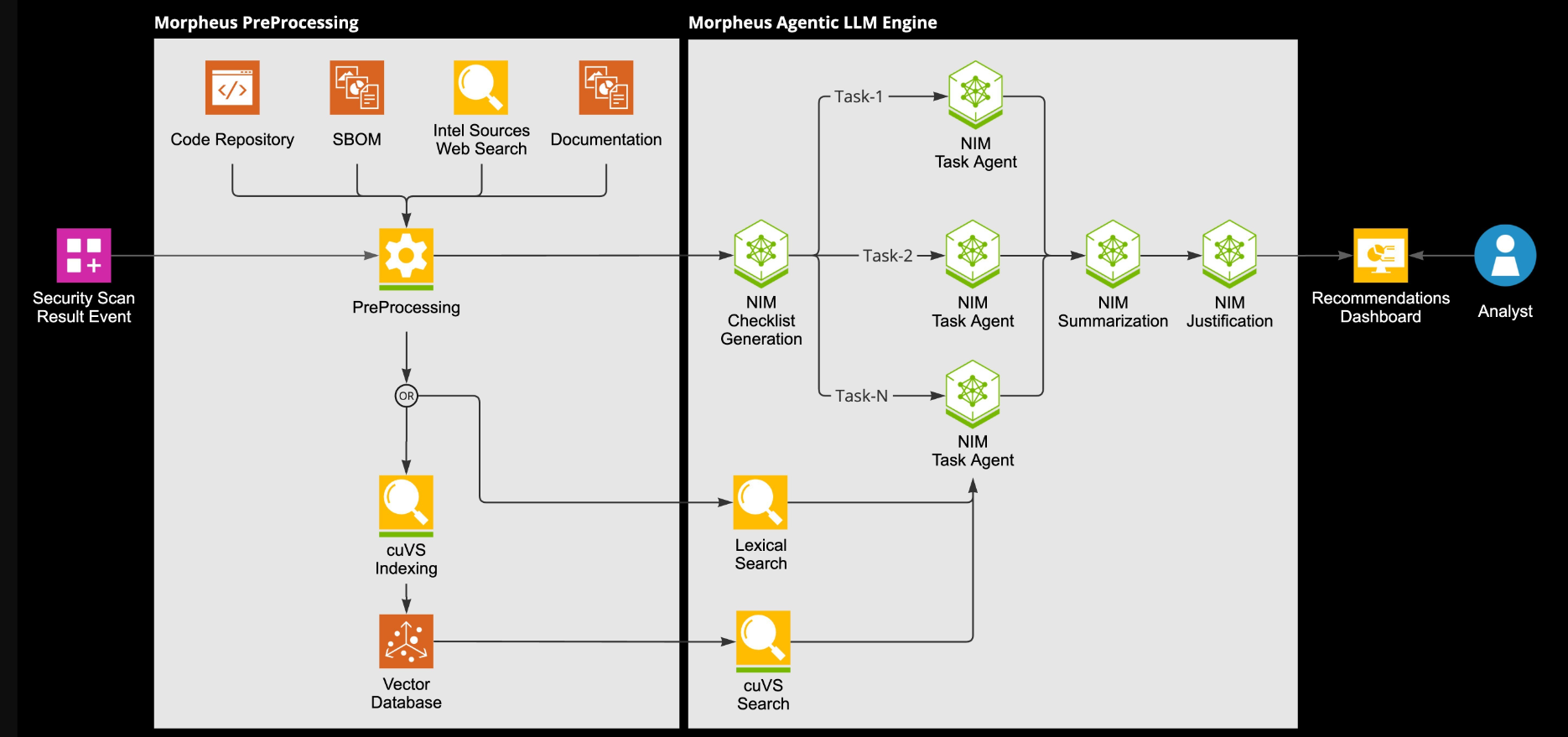
According to Nvidia, NIM Agent Blueprints are a jump start and designed to be modified and enhanced with what the company calls a "data-driven generative AI flywheel." NIM Agent Blueprints are free to download for developers and can be deployed via Nvidia AI Enterprise.

Nvidia's Justin Boitano, vice president of enterprise AI software products, said: "The first wave of generative AI was really the infusion of AI into internet scale services driven by makers of foundation models and expanded into productivity tools. The next wave is really starting now, and it represents a bigger business process transformation that's going to affect how teams work across an enterprise. AI is going to help teams reason through complex business decisions."

Constellation Research analyst Holger Mueller said: "Nvidia's NIM Agent Blueprints offering should enable enterprises to uptake AI faster to power their next generation applications. As expected the AI game is becoming a little more about the software (than the hardware)."

Previously:

Data to Decisions Tech Optimization Innovation & Product-led Growth Future of Work Next-Generation Customer Experience Digital Safety, Privacy & Cybersecurity nvidia Big Data AI GenerativeAI ML Machine Learning LLMs Agentic AI Analytics Automation Disruptive Technology Chief Information Officer Chief Technology Officer Chief Information Security Officer Chief Data Officer Chief Executive Officer Chief AI Officer Chief Analytics Officer Chief Product Officer

CrowdStrike Q2 better-than-expected, sees subscription revenue hit due to outage

CrowdStrike said it will take a $30 million subscription revenue impact for the third quarter and each of the remaining fiscal quarters in the fiscal year due to its recent outage. Fiscal 2025 revenue guidance “includes an estimated impact in the high-single digit millions to professional services revenue in the second half of fiscal year 2025.”

The security vendor said third quarter revenue will be between $979.2 million to $984.7 million with non-GAAP earnings of 80 cents a share to 81 cents a share. Fiscal 2025 revenue will be between $3.89 billion to $3.9 billion with non-GAAP earnings of $3.61 a share to $3.65 a share.

The outlook was the big theme as investors were looking for some quantification due to the outage. For the second quarter, CrowdStrike reported net income of $47 billion, or 19 cents a share, on revenue of $963.9 million, up 32% from a year ago. Non-GAAAP earnings were $1.04 a share in the second quarter.

Wall Street was expecting CrowdStrike to report second quarter non-GAAP earnings of 97 cents a share on revenue of $958.32 million.

Going into the results, all eyes were on CrowdStrike’s orders and potential liability due to its outage. The headlines haven’t been kind to CrowdStrike and rivals Palo Alto Networks and SentinelOne said they have seen a pickup in interest following the outage.

CrowdStrike outage fallout:

In a LinkedIn post, CrowdStrike CEO George Kurtz said:

"Our LogScale Next-Gen SIEM, identity protection, and cloud security hypergrowth businesses together surpassed $1 billion in ending ARR, growing more than 85% YoY. These results showcase CrowdStrike as cybersecurity’s AI-native consolidation platform of choice. Through our Falcon Flex licensing model, customers are adopting more of the Falcon platform than ever before."

That comment speaks to platformization and next-gen SIEM vendors consolidating, said Constellation Research analyst Chirag Mehta. 

The company said that the July 19 outage landed in the last two weeks of the quarter and it delayed deals. Most of those deals remain in CrowdStrike's pipeline. 

Speaking on a conference call, Kurtz said CrowdStrike has implemented new controls to prevent an outage. He apologized to customers and said:

"We've already implemented the following actions to build a more resilient Falcon platform. This ongoing work focuses on enhancing security and resiliency over the short, medium and long term."

Specifically, Kurtz said the company has done the following:

  • Enhance content visibility and controls. The company has released new content control configurations. 
  • Content QA enhancements with a new content validator and interpreter to prevent erroneous content. 
  • Improved content release process to mirror what CrowdStrike does with sensors.

"The July 19 incident starts a new chapter for CrowdStrike," said Kurtz. "We've immediately addressed learnings from the incident, and will continue to apply and evolve these lessons into our future."

Two key quotes from Kurtz on the CrowdStrike earnings call are worth noting because they address durability of the business as well as the Microsoft relationship.

  • "Obviously, there's a lot of noise in the marketplace and we can only control what we can control, and I think the best way for me to articulate that is to just recount some of the conversations. I had two customer calls this morning and most of them start out the same. They talk about our response, how transparent we were, and how we dealt with the problem. We talked about some of the mitigating steps that we've taken and it generally ends with we want to do more with CrowdStrike. I had one this morning, which was a customer that had an impact, we talked through it. They were satisfied with the controls we put in place, and in fact, on the call, they basically said we won the next-gen SIEM project they had, which we won against another next-gen SIEM competitor. So this is what we're seeing."
  • "We'll continue to work with Microsoft as part of the ecosystem as they look to provide further enhancements around kernel access, but just to be clear, there are thousands of software kernel drivers that are out there that go well beyond security, like VPN, virtualization software, IT management software, backup software and a lot more. So we are one part of the ecosystem, and we're certainly a player that's going to help and work with Microsoft as they think about adding other mechanisms to allow the ecosystem to flourish."


Digital Safety, Privacy & Cybersecurity Security Zero Trust Chief Information Security Officer Chief Privacy Officer

Salesforce Q2 revenue growth 8%, touts Agentforce, CFO Weaver to step down

Salesforce reported better than-expected second-quarter results but revenue growth was up 8%. CFO Amy Weaver will also step down.

The company reported second quarter net income of $1.43 billion, or $1.47 a share, on revenue of $9.32 billion. Adjusted earnings were $2.56 a share.

Wall Street was expecting Salesforce to report earnings of $2.36 a share on revenue of $9.23 billion. Wall Street is expecting Salesforce to report single digit revenue growth rates for the foreseeable future.

As for the outlook, Salesforce said third quarter revenue will be $9.31 billion to $9.36 billion, up 7%. Full year revenue will be $37.7 billion to $38 billion.

Salesforce CEO Marc Benioff said the company is operating with discipline and boosting operating margins. “With our new Agentforce AI platform, we’re reimagining enterprise software for a new world where humans with autonomous Agents drive customer success together,” said Benioff.

Weaver will remain CFO of Salesforce until a successor is found, the company said.

By the numbers for the second quarter:

  • Sales Cloud revenue was up 10% from a year ago.
  • Service Cloud revenue was up 11% from a year ago.
  • Platform and other was up 10% from a year ago with marketing and commerce up 7%.
  • Integration and analytics was up 14%.

Key points from Benioff on the conference call:

  • Multi-cloud deals accounted for close to 80% of new business in the quarter.
  • There were 25 trillion Einstein transactions across Salesforce clouds. 
  • AI is top of mind, but customers are overthinking it. 

Benioff elaborated on the do-it-yourself genAI trend. He said:

"I think that there's a lot of misconceptions about AI with my customers. I have been very disappointed with the huge amount of money that so many of these customers have wasted on AI. They are trying to DIY their AI. It's not unlike when we first saw cloud emerge. Customers feel like have to roll their own, build it themselves, get in the weeds, and try to figure to figure it out. This is a moment where every customer is needs to realize you don't need the DIY your AI. You can use a platform like Salesforce to get the highest efficacy of artificial intelligence."

The bet on Agentforce

Speaking on the earnings call, Benioff said genAI is positioning the company for the future and AgentForce is going to drive growth. Benioff said:

"Dreamforce is really becoming Agentforce," said Benioff. "I think this is going to be a moment that everyone is going to have to see in person understand what is going on. We're going to show Agentforce and how we've reimagined enterprise software for this new world of autonomous AI."

Benioff said:

"We're building the agents for Workday, and we're going to be building custom agents for so many of you as well. Agentforce is a development platform, as well as this incredible capability to radically, extend your sales and service organizations. We're all going to have Agentforce and we're going to have them at scale automating the entire workflow on their own."

Constellation Research analyst Martin Schneider said Agentforce represents a new foray for Salesforce. In a blog post, he said:

"The announcement hints at a demarcation point in Salesforce's AI strategy. To reduce it to simple terms, the company has now entered the automated and autonomous phase; as it has evolved from Einstein insights, to generative AI copilots, to these new agents. And to be clear, Salesforce is intently pointing out that these are NOT "bots." These new agents are more outcome oriented, and are designed to handle far more complex and personalized interactions that your typical web chatbot. These agents should, in theory, have far more data points to work with to make this a reality."

Jabs at Microsoft

Benioff said Agentforce can win over enterprises--especially those disappointed with Microsoft Copilots. He said:

"With our new Agentforce platform, we're going to make quantum leap forward in AI. I want you to have your hands on this technology to really understand this. This is not about copilots. So many customers are so disappointed at what they bought from Microsoft with Copilots because they're not getting the accuracy of the response that they want. Microsoft has disappointed so many customers with AI.  These agents are autonomous. They're able to act with accuracy. They're able to come right out of the box.

By the end of the fiscal year, we will have thousands of customers on this platform. The early trials have been remarkable."

Data to Decisions Next-Generation Customer Experience Future of Work Innovation & Product-led Growth New C-Suite Sales Marketing Digital Safety, Privacy & Cybersecurity salesforce Chief Information Officer Chief Marketing Officer

Supermicro's really bad, horrible week

Supermicro said it won't be able to file its annual report on time "without unreasonable effort or expense" because it needs to assess its "internal controls over financial reporting."

That disclosure lands shortly after Hindenberg Research issued a scathing report about Supermicro.

Needless to say, Supermicro's stock hasn't fared well since investors are more likely to sell first and ask accounting questions later. Supermicro shares are trading at $405, down about 25% on the day. Supermicro peaked at $1,229 following earnings surprises due to the generative AI buildout. Simply put, Supermicro looked like one of the few winners of genAI trickledown economics given most of the gains have gone to Nvidia. Supermicro is planning on a 10-for-1 stock split.

The company did say that its fourth quarter results and outlook weren't affected by the annual report delay. Supermicro said its fiscal 2025 revenue will be between $26 billion to $30 billion, up from $15 billion in fiscal 2024.

On Supermicro's fourth quarter conference call, CEO Charles Liang said the company was looking to scale aggressively via direct liquid cooled systems to hyperscalers and enterprise customers. Supermicro wants to be a complete AI data center provider.

"Our Taiwan capacity is getting bigger and Malaysia capacity will be ready. So, we're fully ready for large-scale datacenter customer, but we will be selective. So that's why we foresee only $26 billion to $30 billion. If we try to be more aggressive on a large scale, our growth can be even faster than that. But we try to grow in both ways enterprise and large-scale datacenter kind of try to balance so to maintain our healthy profitability."

Liang did face some skepticism about Supermicro's expansion. One analyst noted that the company doubled revenue in fiscal 2024, but had negative cash flow of $2.6 billion. The question is whether Supermicro has to burn another $2.6 billion or so to double revenue in fiscal 2025.

In response to the cash burn question, Liang said the company may not burn that much cash but could if it chases market share.

What remains to be seen is whether Supermicro's annual report delay is a sign of accounting issues similar to what the company saw in 2018 or just a blip. It's also possible that Supermicro is part of the unraveling of enthusiasm over the genAI infrastructure buildout.

Data to Decisions Tech Optimization Innovation & Product-led Growth Future of Work Next-Generation Customer Experience Digital Safety, Privacy & Cybersecurity Big Data AI GenerativeAI ML Machine Learning LLMs Agentic AI Analytics Automation Disruptive Technology Chief Information Officer Chief Technology Officer Chief Information Security Officer Chief Data Officer Chief Executive Officer Chief AI Officer Chief Analytics Officer Chief Product Officer