Results

Workday aims to be system of record for AI agents, digital labor

Workday is already a hub to manage human capital. Now it wants to manage fleets of digital labor--AI agents from Workday as well as third parties--via Workday Agent System of Record.

The company also outlined Workday Illuminate AI agents for payroll, contracts, financial auditing and policy. Workday's agents ride along with the AI agent management platform and marketplace for AI agents. Workday launched Illuminate at Workday Rising in September.

Workday argued that it is already the system of record for more than 10,500 organizations so managing the deployment and returns on investment from AI agents is a natural extension. CEO Carl Eschenbach said Workday's platform can "manage every part of the workforce – employees, contingent workers, and agents."

Constellation Research CEO Ray Wang said Workday's centralized system to manage AI agents makes sense. "The rise of AI agents in the enterprise has created an urgent need for a centralized system of record to manage and govern this increasingly complex landscape," said Wang.

Amazon, Accenture, Deloitte, Salesforce, PwC and KPMG were among the partners saying Workday's AI agent management platform fills a void. The system gives enterprises the ability to onboard AI agents, define roles and responsibilities, track impact, returns and budget and support compliance.

Research: Workday Extend Writes Its Next Chapter: AI | Constellation ShortList™ Global HCM Suites

Key points about Workday's Agent System of Record include:

  • Centralized management.
  • Agent onboarding, which provides secure access, defines roles and skills.
  • Cost management and optimization of AI agents with budget forecasting and returns.
  • Compliance tools to manage controls and policy enforcement.
  • Real-time identity verification, agent orchestration and cost management.

To go along with that Agent System of Record, Workday also launched the following agents that will be available in Workday Marketplace:

  • Contracts Agent analyzes contracts across the enterprise and surfaces key items buried in unstructured data. This use case was also recently highlighted by airline United.
  • Payroll Agent, which identifies and updates invalid payroll data and automates audit workflows.
  • Financial Auditing Agent to monitor transactions, reconcile balances and review internal controls.
  • Policy Agent, which reads corporate policies and proactively delivers information to employees.

Workday Chief Product Officer David Somers said in a blog post that enterprises have a responsibility to manage its digital workforce alongside humans and control AI agent sprawl.

"We've still got some hurdles to overcome. Accuracy, consistency, bias, speed, and cost are all things we need to consider carefully when implementing agentic AI within organizations. That's why it's so important to set clear boundaries and rules for how they operate. Just like we wouldn't give a new employee free rein over sensitive systems, we need to control what our AI agents can access and do."


Data to Decisions Future of Work Tech Optimization Innovation & Product-led Growth Next-Generation Customer Experience Digital Safety, Privacy & Cybersecurity workday AI Analytics Automation CX EX Employee Experience HCM Machine Learning ML SaaS PaaS Cloud Digital Transformation Enterprise Software Enterprise IT Leadership HR GenerativeAI LLMs Agentic AI Disruptive Technology Chief Customer Officer Chief People Officer Chief Human Resources Officer Chief Executive Officer Chief Information Officer Chief Technology Officer Chief AI Officer Chief Data Officer Chief Analytics Officer Chief Information Security Officer Chief Product Officer

For Shopify's Q4, customer wins, expansion does the talking

Shopify's momentum as a commerce platform continues as the company reported strong fourth quarter results and has become more strategic for customers.

The company reported fourth quarter net income of $1.29 billion on revenue of $2.81 billion, up 31% from $2.14 billion a year ago. Shopify's net income was boosted by equity investments. Excluding those investments, Shopify delivered net income of $458 million.

For 2024, Shopify reported net income of $2.02 billion on revenue of $8.8 billion, up 26% from 2023.

As for the outlook, Shopify projected first quarter revenue growth in the mid-twenty percentage rate. The first quarter is typically Shopify's slowest period.

Last quarter, Shopify broke through as an all-encompassing commerce platform that appealed to both smaller and large enterprises. Harvey Finkelstein, President of Shopify, said the company in 2025 will be committed to "further establishing Shopify as the go-to commerce platform for businesses of all sizes."

While the term "platformization" is typically associated with cybersecurity, it's beginning to apply to commerce platforms. Shopify is consolidating wallet share. Speaking on Shopify’s earnings call, Finkelstein said:

“From top sports teams to major music labels and even one of the largest window covering businesses, Shopify powers them all. This diversity isn't just impressive, it proves that Shopify is the most compelling choice for any business looking to grow quickly, reliably and at scale. In addition to new brands consistently choosing Shopify for its comprehensive enterprise level offerings, the Shop Pay Commerce component has also become a compelling entry point into the Shopify ecosystem for enterprise brands.”

Shopify touted customers such as Everlane, Aldo, Sperry. Crocs, Warner Music and a host of others. “At the high level the enterprise is migrating to Shopify. I think one of the great things we did was we created a bunch of options for them,” said Finkelstein.

But it goes a long way when customers talk up Shopify on their own calls. Commerce customers are citing Shopify as part of their transformation plans.

For instance, Bark CEO Matt Meeker said Shopify replaced a series of legacy systems and boosted its quarterly results. Meeker said:

"In late October, we transitioned all paid media traffic to our new Shopify platform. This is a big deal. While transitions of this nature inherently carry some uncertainty, I'm pleased to report that the early results have been encouraging," said Meeker. "New subscriptions grew 11% year-over-year, and we achieved this at a lower customer acquisition cost."

Meeker added that 43% of checkouts on Bark.com were via Shop Pay. "The new platform modernizes the customer experience, which we expect to continue to drive increased conversion over time," said Meeker. "We plan to migrate our remaining active subscriber cohorts from our legacy sites to the Shopify platform this quarter."

Grove Collaborative Holdings also said Shopify has been a big part of its transformation efforts. "We announced the Shopify migration, but we don't expect to be fully on the platform until early Q1. We are really excited about what that will enable," said Grove Collaborative Holdings CEO Jeff Yurcisin.

Shopify is also gaining on integrations with other commerce players. Roblox cited a Shopify integration in its most recent quarter as did Affirm and Lightspeed Commerce.

For Shopify, those customer endorsements are just the beginning to expanding the company’s footprint. Finkelstein said:

“In 2025, we will continue to invest in our core platform and in key areas like enterprise, offline and international markets as these key growth drivers are helping to fuel our top line growth and laying the groundwork for ongoing success and innovation. We are entering an exciting era of commerce driven by transformative shifts in technology like AI. I think Shopify will very much be one of the major net beneficiaries in this new AI era.”

Data to Decisions Marketing Transformation Matrix Commerce Next-Generation Customer Experience Innovation & Product-led Growth Sales Marketing Revenue & Growth Effectiveness B2B B2C CX Customer Experience EX Employee Experience business Marketing eCommerce Supply Chain Growth Cloud Digital Transformation Disruptive Technology Enterprise IT Enterprise Acceleration Enterprise Software Next Gen Apps IoT Blockchain CRM ERP Leadership finance Social Customer Service Content Management Collaboration M&A Enterprise Service AI Analytics Automation Machine Learning Generative AI Chief Information Officer Chief Customer Officer Chief Data Officer Chief Digital Officer Chief Executive Officer Chief Financial Officer Chief Growth Officer Chief Marketing Officer Chief Product Officer Chief Revenue Officer Chief Technology Officer Chief Supply Chain Officer

How AI Has Changed SAP's Advanced Business Application Programming (ABAP)

#AI is Transforming ABAP Development in the SAP Ecosystem 🚀 A must-watch for any #developer looking to leverage the power of AI to enhance their Advanced Business Application Programming (ABAP) skills and productivity...

Constellation Research VP & principal analyst Holger Mueller shares how AI is changing how developers work with SAP's core programming language...

💡 AI can automate code generation, boosting developer velocity
💡 AI can help understand and migrate legacy ABAP code to new platforms like S/4HANA Cloud
💡 AI-generated unit tests can improve code quality

Watch the full explanation here! ⬇️

On <iframe width="560" height="315" src="https://www.youtube.com/embed/OCnEVAUVYFA?si=5mUuszXumpops3w3" title="YouTube video player" frameborder="0" allow="accelerometer; autoplay; clipboard-write; encrypted-media; gyroscope; picture-in-picture; web-share" referrerpolicy="strict-origin-when-cross-origin" allowfullscreen></iframe>

Why SAP Clean Core Matters For Both Enterprises and Developers

Don't miss Constellation's VP & principal analyst Holger Mueller discussing the importance of SAP's Clean Core and how it impacts #enterprises and #developers.

Holger covers...

📌 The issue of customizations and modifications in #enterprise software that can cause problems during upgrades.
📌 Extensibility options within SAP's clean core approach.
📌 The SAP Business Technology Platform and Integration Suite's role in providing extensibility.
📌 Benefits and challenges of clean core.

Share your experiences and feedback on implementing SAP's clean core in the comments below! 👇

On <iframe width="560" height="315" src="https://www.youtube.com/embed/YxPhcJZ3ppU?si=zOEVV55zTKx5XkVK" title="YouTube video player" frameborder="0" allow="accelerometer; autoplay; clipboard-write; encrypted-media; gyroscope; picture-in-picture; web-share" referrerpolicy="strict-origin-when-cross-origin" allowfullscreen></iframe>

Monday.com rides large enterprise accounts, AI features to move upstream

Monday.com said it is landing more CRM customers and large enterprise accounts as it outlined plans to double-down on its strategy with a consumption model for AI.

The company, which offers work management software and has expanded with MondayDB and CRM, reported strong fourth quarter earnings and said it will continue to invest in AI.

Monday.com's results highlight how work management has become a popular category as the company dukes it out with Smartsheet and Asana. Monday.com's annual recurring revenue surpassed the $1 billion mark. Atlassian is also making a work management play and highlighted gains on its most recent quarter.

Co-CEO Roy Mann said on an earnings conference call:

"We continue to make considerable progress in our multi-product strategy. Monday CRM has exceeded expectations, and we added a record number of net new accounts for both CRM and dev during the year."

Mann also touted AI features including AI capabilities throughout the platform. In the fourth quarter, customers performed about 10 million AI actions. Mann noted that AI agents via Monday.com or third parties can also be a boon to drive consumption.

A move upstream also helped Monday.com. "One of the most significant milestones of 2024 was our strategic expansion into the enterprise market. We successfully grew our largest seat count to 80,000 seats, signaling strong adoption and deepening enterprise customer engagement," said Mann.

Monday.com's AI pricing model revolves around flexible consumption with a baseline level of free usage in all plans. As usage increases, Monday.com customers can buy more AI blocks of capacity.

This AI operating model is starting to gain traction across enterprises including ServiceNow and Salesforce. ServiceNow aims for 'Goldilocks' software model, SaaS industry likely to follow

Eran Zinman, Co-CEO, said Monday.com, said the company will focus on providing AI blocks that can automate tasks and focus on use cases.

Zinman said:

"In 2025, our AI strategy will be focused on three main areas. AI Blocks; Product Power-ups; and Digital Workforce. AI Blocks will be expanded to provide more advanced ways to automate tasks. Through Product Power-ups, AI will be deeply integrated into each product to address specific user needs. And finally, the digital workforce will include AI agents like Monday expert, Deal Facilitator, and Service Analyzer, which will offer actionable insights and streamlined processes for users."

These plans highlight how Monday.com focuses on the art of consumption. The company wants to give you enough of a free tier to gain usage and then leverage workflow automation to drive more consumption.

Monday.com will include 500 free AI Credits per month with the option to purchase more capacity from 2,500 credits to 250,000 credits.

Results and outlook

Monday.com reported fourth quarter earnings of 43 cents a share on revenue of $268 million, up 32% from a year ago. Non-GAAP earnings in the quarter were $1.08 a share.

For 2024, Monday.com reported earnings of 62 cents a share on revenue of $972 million, up 33% from a year ago. As for the outlook, Monday.com projected first quarter revenue between $274 million and $276 million, up 26% to 27%. For 2025, Monday.com expects revenue of $1.208 billion to $1.221 billion.

Zinman noted that demand has been solid across all regions, but 2025 is likely to be unpredictable. He said:

"This year is more unpredictable when you compare it to prior years. The geopolitical situation across the world is to a certain extent, there are something that you can't really predict. So this is also something that we took into account as part of our guidance."

Another wild-card for Monday.com is that its expanding product lineup each has a different go-to-market strategy and sales motion.

Monday.com ended the quarter with 245,000 customers and can do well expanding within its customer base by cross-selling. To that end, Monday.com is ramping its sales capacity and adding people.


Data to Decisions Future of Work Innovation & Product-led Growth New C-Suite Tech Optimization Next-Generation Customer Experience Digital Safety, Privacy & Cybersecurity ML Machine Learning LLMs Agentic AI Generative AI AI Analytics Automation business Marketing SaaS PaaS IaaS Digital Transformation Disruptive Technology Enterprise IT Enterprise Acceleration Enterprise Software Next Gen Apps IoT Blockchain CRM ERP finance Healthcare Customer Service Content Management Collaboration Chief Information Officer Chief Experience Officer Chief Executive Officer Chief Technology Officer Chief AI Officer Chief Data Officer Chief Analytics Officer Chief Information Security Officer Chief Product Officer

Anthropic's Economic Index highlights AI augmenting mid-to-high salary jobs

Usage of generative AI revolves around software development and technical writing tasks and users typically see the technology as way to augment and enhance humans, according to Anthropic's inaugural Economic Index report.

Anthropic anonymized conversations on its Claude large language model (LLM) to highlight trends. High level findings of Anthropic's Economic Index include:

  • About 36% of occupations use AI in at least a quarter of their tasks. About 4% of occupations use it for three quarters of tasks.
  • 57% of AI use is augmentation relative to 43% focused on automation.
  • Mid-to-high wage occupations such as computer programmers and data scientists are using AI for tasks. Lowest and highest paid roles use AI the least.

Perhaps the biggest takeaway from Anthropic's Economic Index is that the middle class of professions is facing the most augmentation. Computer and mathematics, art, design and media, life and physical social science, and education take up the most of Claude conversations.

The dataset on Hugging Face, which Anthropic open sourced, is worth a look.

Data to Decisions Future of Work Innovation & Product-led Growth Tech Optimization Next-Generation Customer Experience Digital Safety, Privacy & Cybersecurity AI GenerativeAI ML Machine Learning LLMs Agentic AI Analytics Automation Disruptive Technology Chief Information Officer Chief Executive Officer Chief Technology Officer Chief AI Officer Chief Data Officer Chief Analytics Officer Chief Information Security Officer Chief Product Officer

DeepSeek's real legacy: Shifting the AI conversation to returns, value, edge

The legacy of DeepSeek will have little to do with the engineering and performance of the model. The real impact of DeepSeek will be that it has shifted the AI workload conversation from hardware and GPUs to efficiency, cost for performance and the application layer.

DeepSeek has turned up during earnings conference calls with questions about whether it makes sense to spend so much on AI infrastructure. It's a valid question that's too early to answer.

DeepSeek: What CxOs and enterprises need to know | GenAI prices to tank: Here’s why

Tech giants did their best justifying the AI spend. After all, more efficient models could mean enterprises spend less on infrastructure. Nevertheless, Alphabet will spend $75 billion in 2025 on capital expenditures. Microsoft said it will spend $80 billion on AI data centers. Meta is planning to spend $60 billion to $65 billion on AI in 2025 and end the year with 1.3 million GPUs. Amazon’s capital expenditures, which are on a run rate of $105 million a year, also include distribution centers, supply chain improvements and technology.

The high-level takeaways from tech giants go like this:

  • DeepSeek is evidence that foundational models are commoditizing. "I think one of the obvious lessons of DeepSeekR1 is something that we've been saying for the last two years, which is that the models are commoditizing. Yes, they're getting better across both closed and open, but they're also getting more similar and the price of inference is dropping like a rock," said Palantir CTO Shyam Sankar.
  • That commoditization doesn't mean that there isn't a need for more infrastructure--at least initially.
  • Hyperscalers are watching cheaper models and how they combine with their custom silicon. It's unclear what model commoditization and a focus away from training does to Nvidia.
  • Cheaper models are moving value toward applications and use cases. AI usage will surge as will edge computing use cases. Enterprises will have a much easier time infusing applications with AI.

The reality is that DeepSeek is an advance and shifted the conversation to optimization and LLM pricing, but the model needs some work relative to other options. We saw DeepSeek put through a rubric on AWS Bedrock and AWS SageMaker compared to other models and the performance was a bit spotty. There were times DeepSeek went into a never-ending loop. DeepSeek may be good enough for some use cases, but in many areas it was meh. Nevertheless, DeepSeek plays into the AWS strategy to offer multiple models.

Sign up for Constellation Insights newsletter

Amazon CEO Andy Jassy said on the company’s fourth quarter earnings call that the AWS launch of Amazon Nova at re:Invent, DeepSeek and LLM choices give enterprises “a plethora of new models and features in Amazon Bedrock that give customers flexibility and cost savings.”

In the end, DeepSeek has been a great way to pivot the conversation on cheaper AI with a dash of a China vs. US AI war.

Jassy continued:

“We were impressed with what DeepSeek has done with some of the training techniques, primarily in flipping the sequencing of reinforcement training, reinforcement learning being earlier and without the human the loop. We thought that was interesting, ahead of the supervised fine tuning. We also thought some of the inference optimizations they did were also quite interesting. Virtually all the big generative AI apps are going to use multiple model types. Different customers going to use different models for different types of workloads. The cost of inference will substantially come down.”

Alphabet CEO Sundar Pichai said AI workloads and the foundational models underneath them will have to adhere to the Pareto frontier, which is a set of optimal solutions that balance multiple objectives of a complex system.

With Google Cloud now capacity constrained due to AI demand, Alphabet has no choice but to spend heavily on infrastructure. Microsoft took the plunge and noted that it can meet future AI demand due to its data center additions.

Nevertheless, it's worth highlighting what Pichai had to say. In a nutshell, scaling AI infrastructure and the commoditization of large language models aren't completely in conflict.

Pichai credited DeepSeek for its advances and said Gemini ranks well on price, performance and latency and all three matters for use cases. He added:

"You can drive a lot of efficiency to serve these models really well. I think a lot of it is our strength of the full stack development into an optimization, our obsession with cost per query, all of that, I think, sets us up well for the workloads ahead, both to serve billions of users across our products and on the cloud side.

If you look at the trajectory over the past 3 years, the proportion of the spend towards inference compared to training has been increasing, which is good because obviously inference is to support businesses with good ROIC. The reasoning models, if anything, accelerates that trend because it's obviously scaling upon inference dimension as well.

The reason we are so excited about the AI opportunity is we know we can drive extraordinary use cases because the cost of actually using it is going to keep coming down, which will make more use cases feasible. And that's the opportunity space. It's as big as it comes. And that's why you're seeing us invest to meet that moment."

Microsoft CEO Satya Nadella had a similar take. He said on Microsoft’s earnings call:

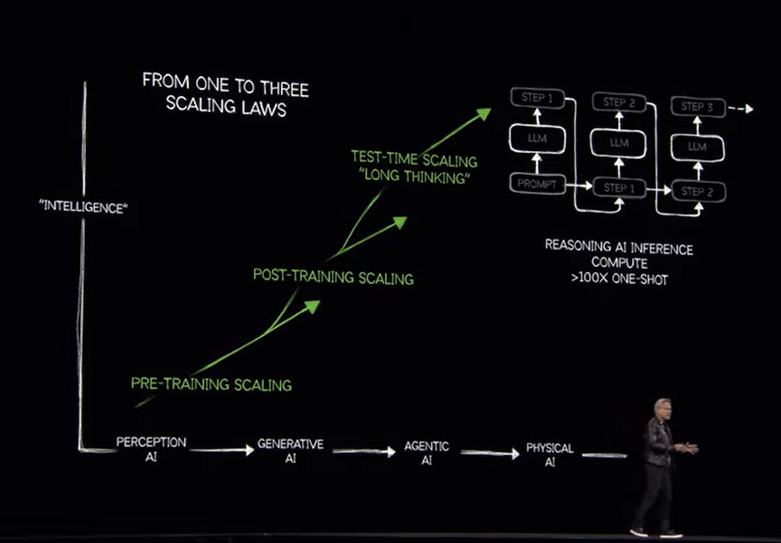
"What's happening with AI is no different than what was happening with the regular compute cycle. It's always about bending the curve and then putting more points up the curve. There are the AI scaling laws, both the pre-training and the inference time compute that compound and that's all software."

Nadella said DeepSeek is one data point that models are being commoditized and broadly used. Software customers will benefit. Given Nadella has Microsoft Azure, DeepSeek is just fine to him.

Meta CEO Mark Zuckerberg said it's too early to know what DeepSeek means for infrastructure spending. "There are a bunch of trends that are happening here all at once. There's already sort of a debate around how much of the compute infrastructure that we're using is going to go towards pretraining versus as you get more of these reasoning time models or reasoning models where you get more of the intelligence by putting more of the compute into inference, whether just will shift how we use our compute infrastructure towards that," said Zuckerberg.

Just because models become less expensive doesn't mean the demand for compute changes, said Zuckerberg. "One of the new properties that's emerged is the ability to apply more compute at inference time in order to generate a higher level of intelligence and a higher quality of service," said Zuckerberg. "I continue to think that investing very heavily in CapEx and infra is going to be a strategic advantage over time. It's possible that we'll learn otherwise at some point, but I just think it's way too early to call that."

And about that edge computing hook…

The DeepSeek-inference-lower cost AI discussion has also highlighted how edge devices--PCs, smartphones, Project Digits and more--are going to be a larger part of the AI inference mix. Here's what Arm CEO Rene Haas said on the company's third quarter earnings call:

"DeepSeek is great for the industry, because it drives efficiency, it lowers the cost. It expands the demand for overall compute. When you think about the application to Arm, given the fact that AI workloads will need to run everywhere and lower-cost inference, a more efficient inference makes it easier to run these applications in areas where power is constrained. As wonderful a product as Grace Blackwell is, you'd never be able to put it in a cell phone, you'd never be able to put it into earbuds, you can't even put it into a car. But Arm is in all those places. I think when you drive down the overall cost of inference, it's great."

Haas also added that the industry will still need some serious compute so the AI buildout will continue. "We're nowhere near the capabilities that could be transformational in terms of what AI can do," he said.

Qualcomm CEO Cristiano Amon said DeepSeek illustrates how AI will play into edge use cases. Amon said:

"We also remain very optimistic about the growing edge AI opportunity across our business, particularly as we see the next cycle of AI innovation and scale. DeepSeek-R1 and other similar models recently demonstrated the AI models are developing faster, becoming smaller, more capable and efficient, and now able to run directly on device. In fact, DeepSeek-R1 distilled models were running on Snapdragon powered smartphones and PCs within just a few days of its release.

As we entered the era of AI inference, we expect that while training will continue in the cloud, inference will run increasingly on-device, making AI more accessible, customizable, and efficient. This will encourage the development of more targeted, purpose-oriented models and applications."

Data to Decisions Future of Work Next-Generation Customer Experience Tech Optimization Innovation & Product-led Growth Digital Safety, Privacy & Cybersecurity AI GenerativeAI ML Machine Learning LLMs Agentic AI Analytics Automation Disruptive Technology Chief Information Officer Chief Executive Officer Chief Technology Officer Chief AI Officer Chief Data Officer Chief Analytics Officer Chief Information Security Officer Chief Product Officer

AWS revenue up 19% in Q4, Amazon results shine

Amazon Web Services revenue growth checked in at 19% in the fourth quarter as parent Amazon handily topped estimates. Amazon's outlook, however, was mixed.

AWS reported operating income of $10.6 billion in the fourth quarter on revenue of $28.8 billion as the annual run rate topped $115 million. AWS in the third quarter also grew at a 19% clip. AWS in the fourth quarter had re:Invent where it outlined its AI strategy. 

Rvals Microsoft Azure and Google Cloud showed revenue growth just above 30% but are working off of a lower base. Microsoft Azure and Google Cloud growth also decelerated sequentially. Amazon CEO Andy Jassy said:

“When we look back on this quarter several years from now, I suspect what we’ll most remember is the remarkable innovation delivered across all of our businesses, none more so than in AWS where we introduced our new Trainium2 AI chip, our own foundation models in Amazon Nova, a plethora of new models and features in Amazon Bedrock that give customers flexibility and cost savings, liberating transformations in Amazon Q to migrate from old platforms, and the next edition of Amazon SageMaker to pull data, analytics, and AI together more concertedly.”

Hyperscale results:

Amazon reported fourth quarter earnings of $20 billion, or $1.86 a share, on revenue of $187.8 billion, up 10% from a year ago. Wall Street was expecting Amazon to report fourth quarter earnings of $1.48 a share on revenue of $187.23 billion.

Here's the breakdown by unit:

  • Amazon North America operating income in the fourth quarter was $9.3 billion on revenue of $115.6 billion, up 10% from a year ago.
  • Amazon international reported operating income of $1.3 billion on revenue of $43.4 billion, up 9%.
  • AWS delivered the most operating income for the company.

For 2024, Amazon reported net income of $59.2 billion, or $5.53 a share, on revenue of $638 billion, up 11%. AWS reported operating income of $39.8 billion on revenue of $107.6 billion.

As for the outlook, Amazon projected first quarter revenue of $151 billion and $155.5 billion, up 5% to 9% from a year ago. Amazon said it will take about a $2.1 billion hit from foreign exchange rates. Operating income will be between $14 billion and $18 billion in the first quarter.

One of the big questions was how much AWS would spend on building it AI infrastructure. It’s also worth noting that Amazon’s capital expenditures, which are on a run rate of more than $105 million a year and $26.3 billion in the fourth quarter, also include distribution centers, supply chain improvements and technology. Hyperscale cloud players’ AI buildout was questioned considering DeepSeek, which was a lower cost model from China. Amazon spent $23.6 billion on technology and infrastructure in the fourth quarter. 

DeepSeek: What CxOs and enterprises need to know | GenAI prices to tank: Here’s why

Nevertheless, cloud providers said they’ll keep spending heavily on AI infrastructure. Alphabet will spend $75 billion in 2025 on capital expenditures. Microsoft said it will spend $80 billion on AI data centers. Meta is planning to spend $60 billion to $65 billion on AI in 2025 and end the year with 1.3 million GPUs. Project Stargate will spend $500 million on US AI infrastructure.

Here's what Jassy had to say on the call:

  • Jassy said the AWS build out needs to continue. "We could be growing faster if not for some of the constraints on capacity," he said. "A lot of that comes from power constraints."
  • "We were impressed with what DeepSeek has done with some of the training techniques, primarily in flipping the sequencing of reinforcement training, reinforcement learning being earlier and without the human the loop. We thought that was interesting, ahead of the supervised fine tuning. We also thought some of the inference optimizations they did were also quite interesting."
  • "Virtually all the big generative AI apps are going to use multiple model types and different customers going to use different models for different types of workloads. You're going to see us provide as many leading frontier models as possible for customers to choose from."
  • "Sometimes people make the assumptions that if you're able to decrease the cost of any type of technology component that it's going to lead to less total spend in technology. In this case, we're really talking about inference. But we've never seen that to be the case." 
  • "The cost of inference will substantially come down. I think it will make it much easier for companies to be able to infuse all their applications with inference and with generative AI."
  • Amazon saw a $700 million headwind from foreign exchange rates, more than anticipated. 
  • Third party sellers were 61% of items sold in 2024.
  • Same day delivery serves 140 metro areas. 
  • "We also remain squarely focused on costs to serve in our fulfillment network, which has been a meaningful driver of our increased operating income. We talked about the regionalization of our US network. We've also recently rolled out our redesigned us inbound network, while still in its early stages, our inbound efforts have improved our placement of inventory so that even more items are closer to end customers."
  • "We've reduced our global cost to serve on a per unit basis for the second year in a row, while at the same time increasing speed, improving safety and adding selection. We see opportunity to reduce costs again, as we further refine inventory placement, grow our same day delivery network, accelerate robotics and automation throughout the network."
  • Amazon ad revenue was $17.3 billion in the fourth quarter, up 18% from a year ago. 
  • AWS will be lumpy over the next few years due to enterprise adoption cycles, capacity and advances, "it's hard to overstate how optimistic we are about what lies ahead for AWS customers and business."
  • Enterprises including Databricks, Adobe and Qualcomm are testing Trainium2 now. Trainium3 will be in preview in late 2025.
  • Thousands of AWS customers are using Amazon Nova models including Palantir, SAP, Fortinet and Robinhood. 
  • "While AI continues to be a compelling new driver in the business, we haven't lost our focus on core modernization of companies' technology infrastructure from on-premises to the cloud."

Data to Decisions Tech Optimization Innovation & Product-led Growth Future of Work Next-Generation Customer Experience Digital Safety, Privacy & Cybersecurity amazon Big Data SaaS PaaS IaaS Cloud Digital Transformation Disruptive Technology Enterprise IT Enterprise Acceleration Enterprise Software Next Gen Apps IoT Blockchain CRM ERP CCaaS UCaaS Collaboration Enterprise Service AI GenerativeAI ML Machine Learning LLMs Agentic AI Analytics Automation Chief Information Officer Chief Technology Officer Chief Information Security Officer Chief Data Officer Chief Executive Officer Chief AI Officer Chief Analytics Officer Chief Product Officer

Qualcomm, Arm cheer cheaper models, AI inference at the edge

CEOs from Qualcomm and Arm say that AI inferencing will increasingly happen at the edge in multiple devices as large language models become more efficient and need less compute.

The buzz around DeepSeek's models and the ensuing discussion about how much AI infrastructure is necessary has given edge computing--where AI inference is likely to happen--more play.

Keep in mind that Qualcomm and Arm have a vested interest in this edge AI game, but the comments from the companies are notable.

The DeepSeek-inference-lower cost AI discussion has also highlighted how edge devices--PCs, smartphones, Project Digits and more--are going to be a larger part of the AI inference mix. Here's what Arm CEO Rene Haas said on the company's third quarter earnings call:

"DeepSeek is great for the industry, because it drives efficiency, it lowers the cost. It expands the demand for overall compute. When you think about the application to Arm, given the fact that AI workloads will need to run everywhere and lower-cost inference, a more efficient inference makes it easier to run these applications in areas where power is constrained. As wonderful a product as Grace Blackwell is, you'd never be able to put it in a cell phone, you'd never be able to put it into earbuds, you can't even put it into a car. But Arm is in all those places. I think when you drive down the overall cost of inference, it's great."

DeepSeek: What CxOs and enterprises need to know | GenAI prices to tank: Here’s why

Haas also added that the industry will still need some serious compute so the AI buildout will continue. "We're nowhere near the capabilities that could be transformational in terms of what AI can do," he said.

Qualcomm CEO Cristiano Amon said DeepSeek illustrates how AI will play into edge use cases. Amon said:

"We also remain very optimistic about the growing edge AI opportunity across our business, particularly as we see the next cycle of AI innovation and scale. DeepSeek-R1 and other similar models recently demonstrated the AI models are developing faster, becoming smaller, more capable and efficient, and now able to run directly on device. In fact, DeepSeek-R1 distilled models were running on Snapdragon powered smartphones and PCs within just a few days of its release.

As we entered the era of AI inference, we expect that while training will continue in the cloud, inference will run increasingly on-device, making AI more accessible, customizable, and efficient. This will encourage the development of more targeted, purpose-oriented models and applications."

The visions of Qualcomm and Arm are very similar when it comes to AI at the edge. Both companies are in data centers, smartphones, PCs, Internet of things endpoints and multiple edge devices such as automobiles. Qualcomm designs processors and markets its dominant Snapdragon platform. Arm licenses its designs to the industry.

Qualcomm's first quarter

Qualcomm's IoT business, which includes PCs, tables, edge networking and extended reality devices, grew at a rapid clip in the first quarter and generated revenue of $1.55 billion, up 36% from a year ago. That business is dwarfed by Qualcomm's handset business, but headed in the right direction.

The company reported strong first quarter results with earnings of $3.18 billion, or $2.83 a share, on revenue of $11.67 billion, up 17% from a year ago. Non-GAAP earnings were $3.41 a share, well ahead of Wall Street estimates.

Amon noted the company is diversifying its business and expanding into industrial IoT, auto and PCs. Qualcomm projected second quarter revenue between $10.3 billion to $11.2 billion with non-GAAP earnings of $2.70 to $2.90 per share.

Qualcomm said it expects strong growth in PCs along with more enterprise traction, auto and industrial IoT. More: AI PCs may decentralize inferencing workloads | Physical AI, world foundation models will move to forefront

Constellation Research analyst Holger Mueller said:

"All Qualcomm segments have been growing nicely. Qualcomm will have to keep executing in the same direction for the quarter, with concerns about its licensing business showing pedestrian growth, close to inflation. Investors care about this revenue stream as it highly profitable for Qualcomm. Credit goes to CEO Amon to have transform Qualcomm into a high tech manufacturer."

Arm's third quarter

Arm reported third quarter net income of $252 million, or 24 cents a share, on revenue of $983 million, up 19% a share. Non-GAAP earnings were 39 cents a share. The results were better than expected.

The outlook from Arm was in line with expectations.

Arm projected fourth quarter revenue between $1.17 billion and $1.27 billion with non-GAAP earnings between 48 cents a share to 56 cents a share. For fiscal 2025, Arm is projecting revenue of $3.94 billion to $4.04 billion with non-GAAP earnings of $1.56 a share to $1.64 a share.

On a conference call, Haas touted Arm's role in Project Stargate and Nvidia's various efforts.

"We strongly believe that the advances in AI, both for training and inference, are going to increase the demand for compute in the AI Cloud," said Haas. "We expect Arm solutions to address the needs from the cloud to the edge to power growth in the world's most popular compute ecosystem for decades to come."

Mueller said:

"All Qualcomm segments have been growing nicely. Qualcomm will have to keep executing in the same direction for the quarter, with concerns about its licensing business showing pedestrian growth, close to inflation. Investors care about this revenue stream as it highly profitable for Qualcomm. Credit goes to CEO Amon to have transform Qualcomm into a high tech manufacturer."

Data to Decisions Tech Optimization Innovation & Product-led Growth Next-Generation Customer Experience Future of Work Digital Safety, Privacy & Cybersecurity AI GenerativeAI ML Machine Learning LLMs Agentic AI Analytics Automation Disruptive Technology Chief Information Officer Chief Executive Officer Chief Technology Officer Chief AI Officer Chief Data Officer Chief Analytics Officer Chief Information Security Officer Chief Product Officer

Project Stargate, Rental Market AI, Conversational Intelligence | ConstellationTV Episode 97

📺 ConstellationTV ep. 97 is here! Co-hosts Liz Miller and Holger Mueller give a #technology news roundup, covering "Project Stargate" announcement, analysis of ServiceNow acquisitions, and the role of #AI in content management and customer service.

Next, Larry Dignan interviews Marcus Räder, CEO of Hostaway, about rental property management software, the unique challenges of the SMB vacation rental market, and the need for AI-powered efficiency.

Finally, Liz highlights her new ShortList, Conversational Intelligence and AI-powered Customer Service Solutions, which will be released Q1 2025 and highlights leading vendors in the CI space.

00:00 - Meet the Hosts
01:19 - #Enterprise Tech News
17:50 - Interview with Marcus Rader, CEO of Hostaway
31:54 - ShortList Highlight
38:27 - Bloopers!

ConstellationTV is a bi-weekly Web series hosted by Constellation analysts, tune in live at 9:00 a.m. PT/ 12:00 p.m. ET every other Wednesday!

On ConstellationTV <iframe width="560" height="315" src="https://www.youtube.com/embed/jMwJUPfapyc?si=NaafNFEPrj1FbpR-" title="YouTube video player" frameborder="0" allow="accelerometer; autoplay; clipboard-write; encrypted-media; gyroscope; picture-in-picture; web-share" referrerpolicy="strict-origin-when-cross-origin" allowfullscreen></iframe>