Results

The Surprising Truth about Transforming the Customer Experience with Digital

The Surprising Truth about Transforming the Customer Experience with Digital

1

Are your employees doing the right thing? Are your teams empowered to make the right decision for your customers? At the Constellation  Research Connected Enterprise conference, moderator, Esteban Kolsky, Board of Advisor, Constellation Research, grilled a panel of customer experience innovators on just how “digital” was transforming the customer experience.

The panel included:

  • Dan Steinman, Chief Customer Officer, Gainsight
  • George Wright, Senior Vice President and General Manager, Thunderhead
  • Howard Tarnoff, Senior Vice President, Ceridian
  • Dave Pennington, Principal, Business Strategy, Microsoft.

It’s a great, short video with a few surprises. Some of my favourite quotes:

  • There’s no such thing as a sales process – there’s only a buying experience
  • It’s time for marketing to shut up
  • What’s the next disruptive thing? It’s engagement
  • The days of the check-in call are over
  • It’s not all about the data
  • Engagement doesn’t mean offer management

The Surprising Truth

But the most interesting thing to me was the focus on culture. We see it over and over again – and it is the most difficult challenge for organisations. While you can buy technology, you can’t buy the hearts, minds and engaged focus of your employees.

And while they may have all the customer data ever needed, without the right focus, support and attitude, you still won’t get the sale.

Need to harmonise your approach? Or bring technology and people together? We can help.

Next-Generation Customer Experience Data to Decisions Future of Work Innovation & Product-led Growth New C-Suite Tech Optimization Connected Enterprise Chief Customer Officer Chief Experience Officer

Three Newsletters for Digital Leaders

Three Newsletters for Digital Leaders

1

As much as we write about the end of this or the end of that, one consistent form of communication that refuses to die, is email. Love it or hate it, newsletters and the like continue to go from strength to strength.

And there is nothing more telling about the role of email than when some of the most innovative digital thinkers start their own newsletters. Over the last few months, newsletters, not blogs or podcasts, have been started by at least three digital leaders that should be on your must-read list (or at least in your “Primary” Gmail tab). These are:

  • Rosie & Faris’ Strands of Genius: Part business diary, part link collection, this newsletter by Rosie Yakob and Faris Yakob has a particular advertising and innovation focus that is hard to find. It is peppered with the dynamic duos’ personal sayings, interesting perspectives, and content that favours insight over statistics (though there are plenty of both).
  • Kris Hoet’s Warped: A weekly curated email featuring the best ideas, trends and awesomeness from the previous seven days. Kris keeps an eye on innovation and trends emanating from Europe.
  • Dave Phillip’s Work Study Dad: Short and sharp – Dave’s Five Things newsletter focuses on social media marketing and culture and contains only five links to items worth reading.
  • Natural Disruption: The newsletter from our Disruptor’s Handbook team keeping you up-tod-ate with disruptive trends, technology and ideas.

And yes, I know that makes four. Make some room in your inbox for all of them ;)

Future of Work Chief Executive Officer Chief Digital Officer

84% Of Enterprises See Big Data Analytics Changing Their Industries’ Competitive Landscapes In The Next Year

84% Of Enterprises See Big Data Analytics Changing Their Industries’ Competitive Landscapes In The Next Year

1

NYC Skyline87% of enterprises believe Big Data analytics will redefine the competitive landscape of their industries within the next three years. 89% believe that companies that do not adopt a Big Data analytics strategy in the next year risk losing market share and momentum.

These and other key findings are from a Accenture and General Electric study published this month on how the combination of Big Data analytics and the Internet of Things (IoT) are redefining the competitive landscape of entire industries. Accenture and GE define the Industrial Internet as the use of sensor, software, machine-to-machine learning and other technologies to gather and analyze data from physical objects or other large data streams, and then use those analyses to manage operations and in some cases to offer new, valued-added services.

Big Data Analytics Now Seen As Essential For Competitive Growth

The Industrial Internet is projected to be worth $500B in worldwide spending by 2020, taking into account hardware, software and services sales according to Wikibon and previously published research from General Electric. This finding and others can be found on the home page of the Accenture and GE study here: How the Industrial Internet is Changing the Competitive Landscape of Industries.

The study also shows that many enterprises are investing the majority of their time in analysis (36%) and just 13% are using Big Data analytics to predict outcomes, and only 16% using their analytics applications to optimize processes and strategies. Moving beyond analysis to predictive analytics and optimization is the upside potential the majority of the C-level respondents see as essential to staying competitive in their industries in the future.

A summary of results and the methodology used are downloadable in PDF form (free, no opt in) from this link: Industrial Internet Insights Report For 2015.

Key take-aways from the study include the following:

  • 73% of companies are already investing more than 20% of their overall technology budget on Big Data analytics, and just over two in ten are investing more than 30%. 76% of executives expect spending levels to increase. The following graphic illustrates these results:

Figure 1 big data investments

  • Big Data analytics has quickly become the highest priority for aviation (61%), wind (45%) and manufacturing (42%) companies.  The following graphic provides insights into the relative level of importance of Big Data analytics relative to other priorities in the enterprises interviewed in the study:

Figure 2 industry overview

  • 74% of enterprises say that their main competitors are already using Big Data analytics to successfully differentiate their competitive strengths with clients, the media, and investors. 93% of enterprises are seeing new competitors in their market using Big Data analytics as a key differentiation strategy.  The single greatest risk enterprises see from not implementing a Big Data strategy is that competitors will gain market share at their expense.  Please see the following graphic for a comparison of the risks of not implementing Big Data strategy.

Figure 3 Unable to Implement

  • 65% of enterprises are focused on monitoring assets to identify operating issues for more proactive maintenance. 58% report having capabilities such as connecting equipment to collect operating data and analyzing the data to produce insights. The following graphic provides an overview of Big Data monitoring survey results:

Figure 4 big data monitoring

  • Increasing profitability (60%), gaining a competitive advantage (57%) and improving environmental safety and emissions compliance (55%) are the three highest industry priorities according to the survey. The following table provides an analysis of the top business priorities by industry for the next three years with the shaded areas indicating the highest-ranked priorities by industry:

Figure 5 industry priorities

  • The top three challenges enterprises face in implementing Big Data initiatives include the following: system barriers between departments prevent collection and correlation of data for maximum impact (36%); security concerns are impacting enterprises’ ability to implement a wide-scale Big Data initiative (35%); and  consolidation of disparate data and being able to use the resulting data store (29%), third. The following graphic provides an overview of the top three challenges organizations face in implementing Big Data initiatives:

Figure 6 challenges for big data analytics


Matrix Commerce Tech Optimization Data to Decisions Future of Work Innovation & Product-led Growth New C-Suite AI ML Machine Learning LLMs Agentic AI Generative AI Robotics Analytics Automation Cloud SaaS PaaS IaaS Quantum Computing Digital Transformation Disruptive Technology Enterprise IT Enterprise Acceleration Enterprise Software Next Gen Apps IoT Blockchain CRM ERP CCaaS UCaaS Collaboration Enterprise Service developer Metaverse VR Healthcare Supply Chain Leadership business Marketing finance Customer Service Content Management Chief Information Officer Chief Technology Officer Chief Information Security Officer Chief Data Officer

Happy 25th Birthday Lotus Notes

Happy 25th Birthday Lotus Notes

My career in technology began in May 1993 when I was a coop student at IBM Canada. My responsibilities there were spilt between AS/400 tasks and setting up this new groupware thing called Lotus Notes. Well today Lotus Notes celebrates its 25th birthday.

Image:Happy 25th Birthday Lotus Notes
Image taken from Mat Newman's blog.

It's amazing how pioneering Notes was in creating the industry that we today call â?ª"social business." I, along with many of my friends and colleagues owe our careers to Lotus Notes.

Let's look back at some of the things Notes did, oh so many years ago:

Applications: Long before Apple made the slogan "There's an app for that" popular, Lotus Notes users spent their days clicking on little square icons each representing a different business application. These applications included CRM tools, inventory control, project management and thousands of other uses.

Security: Long before two-factor authentication sent text messages to your phone to help secure logins, Lotus Notes required not only a password, but that you had an actual ID file on your computer. Notes has built in encryption which still protects data better than many of today's collaboration tools do. Notes has granular access control lists (ACLs) for each application (database) providing a range of user roles ranging from Depositor to Manager. Notes uses execution control lists (ECLs) to control what programs can and can't do on your behalf. (think of it like today's "permissions" in mobile apps) Notes even provides field level security via reader/author name fields on forms. These features are mainly invisible to users, but provide an incredible level of security.

Replication: Long before people starting "synching content to the cloud", Lotus Notes enabled people to "replicate" data between their computer and the server that hosted their applications and mail. This local replication enabled people to use their mail and apps even when disconnected from the network. (i.e. offline)

Mobile: Long before "mobile" was an industry buzzword, Lotus Notes apps ran on phones and PDAs. Yes, it was mainly Palm Pilots and BlackBerry's back then, but it was still amazing for the time.

What do you think Lotus Notes greatest strength was? (is?)


Sadly, I barely use Lotus Notes anymore, but I still respect how ahead of it's time it was, and in some ways still is. I'm constantly hearing pitches from "hot new startups" that are trying to do things Notes did 20+ years ago. I've posted this poster from 1991 several times, but let's review it once more.  Just replace a few words and this could be any collaboration vendor's current marketing campaign.

Notes from Lotus
Until now, most PC software was designed for individuals using individual PCs. But today, more and more people are working in teams on networked PCs that require a new kind of software.  Software that lets them quickly share ideas and information no matter where, when or how they work.

Enter Lotus Notes.

The first software than actually thrives on the fact that people need to work together to be effective.  Lotus Notes creates a new communications environment where users can develop applications - for sales tracking, project management, customer service, and free form discussions of all kinds - and routinely access and share this information from their desktop to anyone, anywhere in the world.  In fact, no other software maximizes your investments in networked PCs like Lotus Notes.

After all, helping people work together is what Lotus does best. 

Image:Happy 25th Birthday Lotus Notes


New C-Suite Future of Work IBM Chief People Officer

Digital Business; Transforming Procurement; Shifting to Purchasing Services

Digital Business; Transforming Procurement; Shifting to Purchasing Services

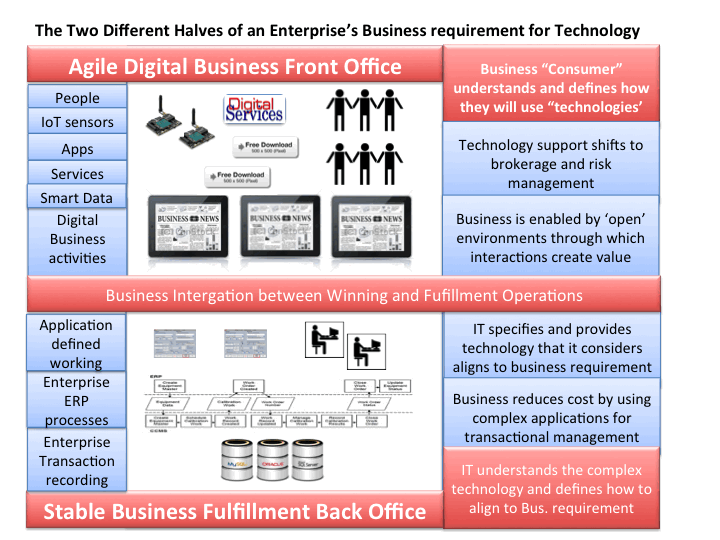
If Digital Business is a transformation of the ‘sell’ side of an Enterprise then it stands to reason that a similar transformation must take place in the ‘buy’ side. After all, your Enterprises buy is another Enterprise’s sell. Yet there is relative little focus on Procurement amongst the great deal of content on Enterprise transformation in terms of  addressing markets and products. There are two distinctive sides to the transformation of Procurement; the alignment of procuring ‘Services’ to match the selling of ‘Services; and the ability to simply buy better with Digital techniques to save money.

Simple logic suggests that the lessons learnt in successful Digital Business procurement techniques should feed a Digital Business sales strategy, and vice versa. Learning to excel at one should lead to excelling at both!

How has procurement become the Cinderella of Digital Business? The probable cause is the structure of the traditional business model around the separation of various Enterprise activities to better focus on functionality excellence. ERP in many ways served to preserve this by offering the necessary data flow between departments to provide an Enterprise wide cohesion. As stage one of any procurement transformation is almost going to be based on the existing department it makes sense to start with using Digital Business capabilities to cut the cost of the overall Enterprise procurement budget. The winner of Constellation Research Connected Enterprise annual award for Technology Optimization and Innovation made the scope for this kind of transformational improvement of procurement very clear.

William Cooper, Associate VP and Chief Procurement Officer, University of California managed to reduce the annual procurement spend by $128million in one year by a real Digital Business transformation of the Universities procurement function and activities.

The achievement was made all the more remarkable by this being achieved in the first year after agreement to proceed with a strategic procurement transformation. The expected ongoing target from year two onward moves this up to an annual $200million of savings. The University of California transformation had a clear well constructed vision, driving a strong organizational and operational transformation program, with equally clearly focused metrics. The full details will be available as a Constellation case study shortly. The focus was rightly on the business model transformation necessary to bring this about, not on the adoption of a single element, or technology product/service. The case study therefore focuses on the operational elements of the transformation, which for this blog are reduced to the following key elements;

Collaboration; transforming ten physically separate campus procurement teams into a single virtual centralized operation organized around virtual teams for particular procurement specialties comprised from those with the most experience to support best practice…everywhere, even if working in different physical locations.

Online Digital Procurement; reduced the cost, time and other factors involved in running individual procurement exercises/bids, which in turn allowed Procurement to address more purchasing requirements. The actual the number of items subjected to continuous competitive procurement rose dramatically from $2bn to $5bn introducing not only cost improvements, but in many cases service level improvements to users as well.

Auctioning; real time competitive online auctioning including the introduction of Reverse Auctioning introduced a game change in time and cost of competitive bidding. The capability to ask Suppliers to bid against your enterprise’s terms and conditions offers important changes in terms of the time, knowledge, and skill required in assessing competitive bids and different commercial terms. This is becoming a key aspect for the ongoing procurement of Services, as detailed in the next paragraphs.

Services; the single most important ongoing change for any procurement department to understand what exactly this will mean to operating managed procurement in an Enterprise that is moving to become a Digital Business on the sales and marketing side.

The procurement of Services is fast becoming a very necessary new skill for an Enterprise to acquire in adopting Digital Business for its go to market operations. What would be the outcome if you could find out how many contracts your Digital Business users have ‘agreed’ online …… without reading the terms and conditions?

There are a variety of Industry estimates on this, if you include personal use of Apps then the number is usually said to be 15 to 20; restricting the count to genuine business process usage suggests around 5 to 10 at a conservative estimate. Whichever one of these estimates is true represents a currently unknown business risk in terms of security, wrongful use, commercial terms, or any other possibility. The need for a Risk Register’ for an Enterprise to recorded, and address, the extent of it’s exposure was defined in a previous blog. The IT department is right to be very worried about the extent of ‘Shadow IT’, but at the same time it has to accept who buys, what, why and on whose budget is a huge game change factor in Digital Business.

Digital Business requires operational managers to consciously make choices using their ongoing operational budgets (OpEx) to acquire capabilities as ‘Services’. The contrast to a yearly centrally administered Enterprise budget (CapEx) supported by Procurement is a genuine Game Change. The traditional IT and Procurement process simply is not going to work on grounds of time, cost, skills in new aspects that have to be mastered, let alone its unsuitability for OpEx versus CapEx business models.

Perhaps this is the moment to refer again to the University of California Procurement transformation that started this blog. Here the first three building blocks listed provided the basis for establishing a new set of methods that are suited to procuring “Services’. Perhaps also rereading a previous blog that introduced the need in Digital Business for Mastering new Financial Controls may also help as well. Fast online procurement by reverse auctioning allows your Enterprise to set its own terms, and if the handfuls of large players don’t want to accept them, then there are an ever-increasing number of competitors in the second tier that probably will. Taking this approach means you know exactly what terms apply to any contract!

But, what if its not IT, or even technology as we understand the term, at all? Most Building Management projects wouldn’t be described as being part of IT, but are equally shifting to ‘services’. As an example the University of California added $3billion to what it described as its ‘addressable procurement’ spend by rethinking all items. In the case of building projects it was not only about buying material better, but to adopt shift ‘services’ such as the power tools required being supplied as a ‘Service’. Extend this line of thinking to include the impact of the Internet of Things on Building Management Outsourcing. Consider who owns the sensors and the data versus who processes and supplies the management of key capabilities ‘as a service’ and the longer-term procurement management of ‘services’ in a Digital Business starts to emerge.

If the pundits are right, and it already looks that way, then the transformation of Procurement and its operations to match/align with Enterprise Digital Business goals, and the market opportunities, is as much a strategic initiative as the transformation of the go to market operations that today receive all of the focus.

Innovation & Product-led Growth Tech Optimization Future of Work AI ML Machine Learning LLMs Agentic AI Generative AI Analytics Automation B2B B2C CX EX Employee Experience HR HCM business Marketing SaaS PaaS IaaS Supply Chain Growth Cloud Digital Transformation Disruptive Technology eCommerce Enterprise IT Enterprise Acceleration Enterprise Software Next Gen Apps IoT Blockchain CRM ERP Leadership finance Customer Service Content Management Collaboration M&A Enterprise Service Chief Information Officer Chief Technology Officer Chief Digital Officer Chief Data Officer Chief Analytics Officer Chief Information Security Officer Chief Executive Officer Chief Operating Officer

Analytics To Guide Our Careers

Analytics To Guide Our Careers

1
It’s time to turn the focus and mechanisms of big data analytics onto the topics of our work tasks, projects, and careers. Organizations continue to apply more and more powerful analytics capabilities to customer identification, customer engagement, and strategic planning. Now it’s time to see what we can learn about how we approach our work and education. (And for those of you who want to know more about business analytics in general, I suggest Jain & Sharma’s new book, Behind Every Good Decision.)

Here is the slide deck from a talk I gave last week (click on the Notes icon within Slideshare for additional links for many of the slides). Predicitive analytics (e.g., analyses that suggest next steps — like Amazon suggesting other books based on your past purchases) offer huge benefits to how we think about the future of work, if we can get to the data. 

From LinkedIn to Elance/oDesk, Coursera, & Watson

I've been studying the benefits of "computer monitoring" since 1984. It wasn't the book, 1984, that triggered my interest at that particular time, but rather being at Carnegie Mellon University where it was, and is, common to intermingle computers, analytics, and work.
 
In the above talk, I extrapolated from the predictive analytics that LinkedIn uses to suggest jobs which might interest us, to a future where some wonderful combination of a variety of platforms could do much more: Interlinked systems that would know the work we can do, how we’ve done at that work in the past, the people who need work, and even predict the skills we need to learn to move ahead in our goals. Such as system could improve on even the best organizational training and development departments. Here are just a few exant systems that might be at the heart of this approach:
  • Elance /oDesk: Hugely successful platforms for linking people who want to do freelance project work with people who have project needs. Preferences and quality ratings from past work steer you to your next projects.
  • Coursera : One of the top platforms for taking massive online open courses. They know what you know and what you are interested in and have talked about offering career services.
  • IBM Watson : The artificial intelligence that won the gameshow Jeopardy! and is now supporting physicians, financial experts, and human resources directors in their daily work. I would love to see Watson become an ally in getting all of our work done. What do we want to do and what do we want to leave to Watson?
It isn’t much of a leap to see how these three platforms could work together to map out our medium term work futures. We know the projects that need to be done, it just takes a bit of prediction to line up the education that we need to be ready for the next projects.
 
The technology is likely there, but more of us need to be thinking about how to leverage more advanced technology systems. While teams of chess players have figured out how to ally with mid range computer programs to beat the best humans and super computers , my colleague Christine Isakson and I haven’t found much work on team configuration where machines are in the hiring pool. As Brynjolfsson & McAfee say, we need to learn to race with the machines, not against them.

Up Soon: How Might Google Help Us Plan Our Day?

The discussion above focused on mid range work goals: What project can I do now and what might I do next? What happens if we turn the lens of analytics onto our daily work? In an upcoming post, I’ll consider the combination of analytics and our daily work decisions. My homework:
If you have thoughts to share about the above ideas, or this upcoming post, please let me know by commenting here. Also, thank you to IBM Almaden for the opportunity to give the November 20th, 2014, IBM Research Distinguished Speaker talk.
Data to Decisions Future of Work Chief Executive Officer

The Collaborative Economy: A Transformative Lens, not a Startup Trend

The Collaborative Economy: A Transformative Lens, not a Startup Trend

Rachel Botsman, Partner, Collaborative Lab and Lauren Capelin, Co-founder Collaborative Lab discuss the virtues and dispels myths about the collaborative economy. Recorded at Constellation's Connected Enterprise. 

Future of Work Marketing Transformation Matrix Commerce New C-Suite Next-Generation Customer Experience Chief Customer Officer Chief Executive Officer Chief Marketing Officer Chief Procurement Officer Chief Supply Chain Officer Chief Digital Officer On <iframe src="//player.vimeo.com/video/111549161" width="500" height="281" frameborder="0" webkitallowfullscreen mozallowfullscreen allowfullscreen></iframe>
Media Name: botsman.jpg

A Conversation with Mark V. Hurd

A Conversation with Mark V. Hurd

R "Ray" Wang interviews Mark V. Hurd, CEO, Oracle, about his vision for Oracle and the future of enterprise software. Recorded at Constellation's Connected Enterprise. 

Marketing Transformation Future of Work Tech Optimization Chief Information Officer On <iframe src="//player.vimeo.com/video/111548757" width="500" height="281" frameborder="0" webkitallowfullscreen mozallowfullscreen allowfullscreen></iframe>
Media Name: hurd.jpg

Constellation Presents David Pogue

Constellation Presents David Pogue

David Pogue presents technology uber trends at Constellation's Connected Enterprise. 

Data to Decisions Digital Safety, Privacy & Cybersecurity Future of Work Marketing Transformation Matrix Commerce New C-Suite Next-Generation Customer Experience Tech Optimization Chief Customer Officer Chief Digital Officer Chief Executive Officer Chief Financial Officer Chief Information Officer Chief Marketing Officer Chief People Officer Chief Procurement Officer Chief Supply Chain Officer On <iframe src="//player.vimeo.com/video/111574328?byline=0&amp;portrait=0" width="500" height="281" frameborder="0" webkitallowfullscreen mozallowfullscreen allowfullscreen></iframe> <p><a href="http://vimeo.com/111574328">Constellation Presents David Pogue</a> from <a href="http://vimeo.com/user5742769">Constellation Research</a> on <a href="https://vimeo.com">Vimeo</a>.</p>
Media Name: david-pogue-cce.png