Results

Survey: Real Forces Disrupting Marketing Effectiveness

Survey: Real Forces Disrupting Marketing Effectiveness

1
 

Disruption Customer Journey Glass

In a 2014 survey conducted by McKinsey & Company and the ANA, B2B and B2C marketers revealed the real forces disrupting marketing effectiveness today. Below is a summary highlighting the results.

1. Complexity and Fragmentation

48% of marketers reported that the fragmentations of the audience, and complexity of solutions and options for audience engagement, are significant disruptions to the success of their marketing efforts. There doesn’t seem to be much hope for a near-term fix; 44% of marketers reported that these factors will remain a challenge in the next 1-3 years.

Customer Journey Survey 1

2. Mobile Tops Budget Allocation

There is a lot of debate on what effect mobile technologies and mobile adoption among consumers have really had on marketing; many of the mobile opportunities and threats once prophesized by analysts have yet to come to fruition here in North America. Yet, B2B and B2C marketers once again point to mobile as both a major obstacle and opportunity – so much so that it tops the 5 areas that are being allocated greater budgets.

Customer Journey Survey 2

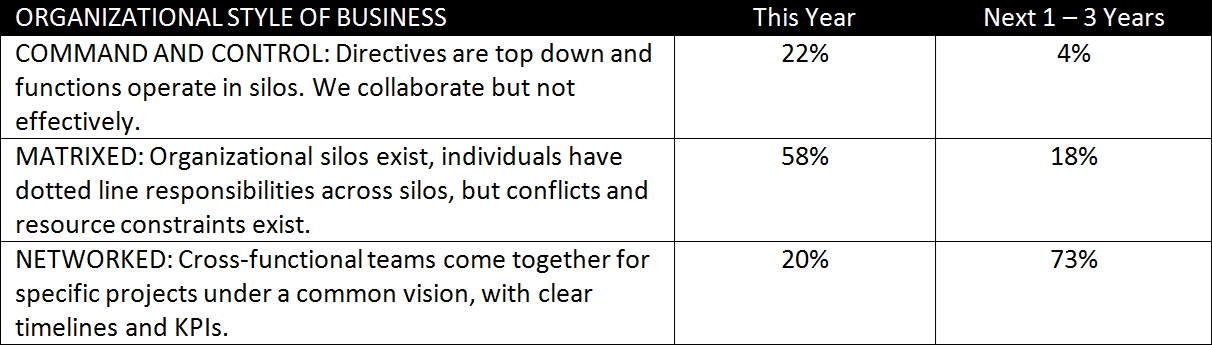
3. Migration to Networked Organizational Structures 

A challenge that is receiving less publicity than technology and social networking is the shift from more traditional organizational structures (where lines of authority are clearly defined and linear) to matrixed organizational structures, which feature multiple reporting lines that see employees reporting to more than one formal boss.

Customer Journey Survey 3

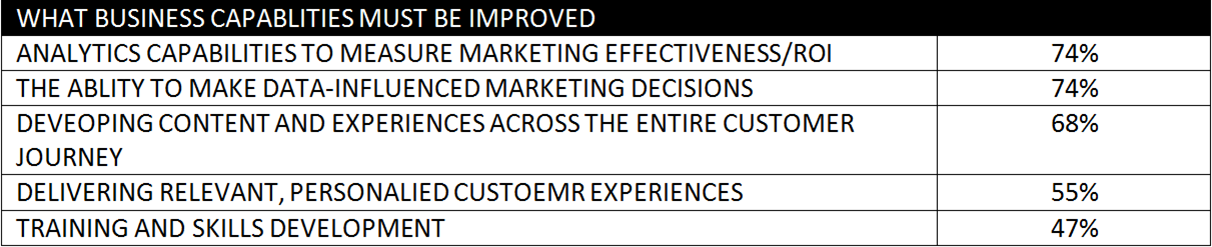
4.  Analytics Capabilities to Understand Customer Behavior

While marketers are keen to report the disruptions their businesses face, they also acknowledge the number of challenges in managing those disruptions. It should not surprise us that decision-making based on big data analysis and ROI measurement still top the list.

Customer Journey Survey 4

5. Poorly Defined “Customer Journey”

What dismayed me the most in reviewing the study’s findings is that only half of the businesses surveyed have a clearly defined “customer journey” mapped out.

Customer Journey Survey 5

That said, with 77% stating that they will have this figured out within the next 3 years, it seems that the importance of this roadmap is understood, if perhaps not how to map it. The customer journey can be defined as the full experience of being the customer of a specific business. In other words, it’s the sum of interactions between an individual and a brand and the net effect that journey has on the business’s bottom line. Those interactions include initial awareness of a product or the brand (lead generation, community, advertising, etc.) to the purchase decision (sales transaction, billing, sales personnel), and from purchase to advocacy (customer service, billing, loyalty programs, etc.).

It’s this customer journey that is at the center of almost every disruption and challenge highlighted by this study. Managing any of these disruptions, be they mobile adoption, data analytics, or changing organizational structures, requires an understanding of the customer journey – and where that journey may be blocked – as a baseline from which to effect change, make improvements, or track progress in the business’s value.

Marketing Transformation Chief Marketing Officer

Where Big Data Jobs Will Be In 2015

Where Big Data Jobs Will Be In 2015

1

Big Data Drives Rapid ChangesDemand for Computer Systems Analysts with big data expertise increased 89.9% in the last twelve months and 85.40% for Computer and Information Research Scientists.

Demand for Python programming expertise increased 96.9% in big-data related positions in the last twelve months.

These and other key insights are from a recent analysis completed of big data hiring trends using WANTED Analytics, the leading provider of data analytics on the workplace.  For purposes of this analysis, the term “big data” is comprised of the four skill sets of data analysis, data acquisition, data mining and data structures. The WANTED Analytics taxonomy references these skill sets when queries are made on the term “big data”.

The company currently maintains a database of more than one billion unique job listings and is collecting hiring trend data from more than 150 countries. WANTED Analytics has never been a client, they provided complimentary access based on my requesting a trial account. Many Forbes readers are interested in staying current on big data hiring trends, which led me to complete this analysis.

Key Take-aways include the following:

  • Demand for big data expertise across a range of occupations saw significant growth over the last twelve months. There was a 123.60% jump in demand for Information Technology Project Managers with big data expertise, and an 89.8% increase for Computer Systems Analysts. The following table provides an overview of the distribution of open positions by occupation and the percentage growth in job demand over time.

job growth matrix

  • The five leading industries with the most job openings requiring big data expertise include Professional, Scientific and Technical Services (27.14%), Information Technologies (18.89%), Manufacturing (12.35%), Retail Trade (9.62%) and Sustainability, Waste Management & Remediation Services (8.20%). The following graphic shows the distribution of open positions between September 1, 2014 to today, December 29, 2014:

top 20 industries hiring

  • The Hiring Scale is 76 for jobs that require big data skills with 12 candidates per job opening as of December 29, 2014.  The higher the Hiring Scale score, the more difficult it is for employers to find the right applicants for open positions. Nationally an average job posting for an IT professional with cloud computing expertise is open just 47 days.

big data hiring scale

  • The median salary for professionals with big data expertise is $103,000 a year. Sample jobs in this category include Big Data Solution Architect, Linux Systems and Big Data Engineer, Big Data Platform Engineer, Lead Software Engineer, Big Data (Java, Hadoop, SQL) and others.  The distribution of median salaries across all industries shown below:

big data market salary

  • San Jose – Sunnyvale – Santa Clara, CA, San Francisco – Oakland – Fremont, CA, and Washington – Arlington – Alexandria, DC are the top three U.S. employment markets for big data related jobs as of today.  Mapping the distribution of job volume, salary range, candidate supply, posting period and hiring scale by Metropolitan Statistical Area (MSA) or states and counties is supported by WANTED Analytics and shown in the following graphic. A summary of the top twenty employment markets is also shown following the map:

US Hiring Map

US Top Markets

  • Cisco (NASDAQ:CSCO), IBM (NYSE:IBM) and Oracle (NYSE:ORCL) have the most open big data-related positions today. Cisco, its supplier, partner and support ecosystem companies have 3,613 related big data positions available.  The following table shows the top ten big data employers today, the distribution of jobs, and the number of new jobs added over the last year.

top ten employers

  • Python programming (96.90%), Linux expertise (76.60%) and Structured Query Language (SQL) (76%) are the three most in-demand skills in positions that mention big data as a requirement.  The following table provides an overview of the top 10 most in-demand skills:

skills

Data to Decisions Tech Optimization AI ML Machine Learning LLMs Agentic AI Generative AI Robotics Analytics Automation Cloud SaaS PaaS IaaS Quantum Computing Digital Transformation Disruptive Technology Enterprise IT Enterprise Acceleration Enterprise Software Next Gen Apps IoT Blockchain CRM ERP CCaaS UCaaS Collaboration Enterprise Service developer Metaverse VR Healthcare Supply Chain Leadership business Marketing finance Customer Service Content Management Chief Information Officer Chief Technology Officer Chief Information Security Officer Chief Data Officer Chief Executive Officer

Why Top Marketers Create Branded Social Networks for Customer Engagement

Why Top Marketers Create Branded Social Networks for Customer Engagement

Branded Social Networks for Customer EngagementMy new report, Why Top Marketers Create Branded Social Networks for Customer Engagement is about how Marketers can create social networks to deliver better engagement and business results with branded online communities. In the business environment that dominated the past few decades, successful marketers helped drive business value by demonstrating proficiency in customer acquisition and lead conversion.

In the digital era, however, top marketers help their brands reap the business value of using branded social networks to drive enhanced customer engagement/experience. The business value of branded social networks comes from the simple idea that forward-looking brands should reimagine their businesses as social networks of customers, fans, partners and many stakeholders who share an enthusiasm for the brand and thus provide the essential elements of a top-performing, revenue-generating brand.

This report explores how smart marketers can apply investments in social networks to drive business results. Constellation provides key criteria for marketing leaders to evaluate when selecting a brand-owned social network technology. In addition, Constellation shares six best practices for successful deployment of brand-owned social networks.

For more information about this report, you con find it here.

Why Top Marketers Create Branded Social Networks for Customer Engagement

Download the report snapshot and table of contents

Download Report Snapshot


Next-Generation Customer Experience Marketing Transformation Innovation & Product-led Growth Tech Optimization Future of Work New C-Suite Digital Safety, Privacy & Cybersecurity Chief Customer Officer Chief Marketing Officer Chief People Officer Chief Human Resources Officer

Constellation Publishes "State of Enterprise Technology" Research

Constellation Publishes "State of Enterprise Technology" Research

Updated March 12, 2015

Constellation recently published our State of Enterprise Technology series of research reports. These reports assess the current state and describe the future direction of several technologies. Use these reports to measure your organization's progress with your enterprise solutions and plan for the future. 

Check our research library often as Constellation will publish reports in our State of Enterprise Technology series throughout Q1. Want to suggest a topic for a report in the "State of Enterprise Technology" series? Drop us a line. 

The State of Marketing 

By Natalie Petouhoff

State of Marketing Customer Experiences and Marketing Further Intertwine  

 Seven measures early adopters must take to prepare for the disruptive forces influencing marketing. Use this report to benchmark and plan for your marketing future.


The State of Manufacturing

By Guy Courtin and R "Ray" Wang

State of Manufacturing Manufacturing Adopts Mass Personalization Ideology

 In 2015 manufacturing will dive into digital transformation as producers take advantage of data insights to create ever-more customized products. 


The State of HCM

By Holger Mueller

State of HCM

Inside the Future of HCM

This report examines seven trends influencing human capital management. Find out how organizations will manage their most valuable resource: their people. 


The State of the Cloud

By Holger Mueller

9 Cloud Trends CXOs Need to Know 2015

Inside the Nine Cloud Trends Every CxO Needs to Know in 2015

As internal and external apps continue to dominate business, the cloud evolves into the responsibility of the entire C-suite. Consequently, all CxOs should be aware of major trends in cloud technology. Prepare yourself for a productive conversation about the future of the cloud in your organization.
 

The State of IT Services

By R "Ray" Wang

State of Digital Transformation Services

Digital Transformation Services Take Center Stage For 2015

The Digital Transformation Services market is set to explode in 2015. Constellation forecasts it to surpass $100.7B in 2020. This report defines the Digital Transformation Services space, identifies seven trends to watch as the market gains traction in 2015, and provides notes on identified services providers.  

The State of Retail in 2015 and Beyond

By Guy Courtin

State_of_Retail_coverDigital Technologies Reshape Retail and Shift Customer-Retailer Relationship

The customer-retailer relationship will become more cooperative in 2015. Learn about the Amazon Trap, visibility, the Internet of Things, network insights, and more trends in the state retail in 2015. 
 

The State of Collaboration in 2015

By Alan Lepofsky

State of Collaboration

The Future of Collaboration Lies at the Intersection of Social Interaction and Data-Driven Insights

Currently collaboration shows maturity in market and user adoption. The future of collaboration must address the human element in Digital Transformation. 


The State of Customer Success Management in 2015

By Natalie Petouhoff

Npetouhoff_state_of_state_custserv

Next-Generation Customer Experience Is Guiding Customer Success Management

Customer service and support evolves into customer success management. Customer success management becomes a top priority for all companies, at all levels.  


The State of Digital Safety and Privacy in 2015

By Steve Wilson

state_of_digital_privacy_cover

Digital Safety and Privacy is about the art and science of maximizing the information assets of a business, including its most important assets – its people. The future of digital safety and privacy requires new awareness of data flows.


The State of Post-Sale Commerce in 2015

By Guy Courtin

SoS_post_sale_commerce_gcourtin_cover

Post-sale commerce is set to be an important revenue driver for many organizations. Organizations moving to post-sale commerce must consider five key elements included in this report.  


The State of Digital Transformation and Digital Leadership

By Andy Mulholland

SOS_Digital_Leadership_BoardroomThe State of the Digital Boardroom and CxO in 2015

Digital transformation remains an important initiative for businesses in 2015 and boards need to learn how to guide digital transformation projects. The Internet of Things emerges as the key to real digital business transformation.  
 

The State of Supply Chain Management

By Guy Courtin

Supply_Chain_State_of_State_GcourtinThe future of supply chains demonstrates how digital will transform business models. 

Being demand-driven remains the goal to achieve, the Future of Work and BYOD will affect the supply chain, and data is the product in the state of the supply chain in 2015.


Data to Decisions Digital Safety, Privacy & Cybersecurity Future of Work Marketing Transformation Matrix Commerce New C-Suite Next-Generation Customer Experience Tech Optimization Revenue & Growth Effectiveness Innovation & Product-led Growth B2B B2C CX Customer Experience EX Employee Experience business Marketing eCommerce Supply Chain Growth Cloud Digital Transformation Disruptive Technology Enterprise IT Enterprise Acceleration Enterprise Software Next Gen Apps IoT Blockchain CRM ERP Leadership finance Social Customer Service Content Management Collaboration M&A Enterprise Service AI Analytics Automation Machine Learning Generative AI ML LLMs Agentic AI HR HCM SaaS PaaS IaaS Chief Customer Officer Chief Digital Officer Chief Executive Officer Chief Financial Officer Chief Information Officer Chief Marketing Officer Chief People Officer Chief Procurement Officer Chief Supply Chain Officer Chief Data Officer Chief Growth Officer Chief Product Officer Chief Revenue Officer Chief Technology Officer Chief Analytics Officer Chief Information Security Officer Chief Operating Officer

Understanding your Digital Business Model by its Business Functional Requirements for Operational Technology

Understanding your Digital Business Model by its Business Functional Requirements for Operational Technology

Part 2; The role of existing business functions and technology provisioning when Digital Business adds new business functions and technology provisioning Digital Business models stress agile, dynamic, and responsive to external opportunities using sense and respond. Is this just adding a new technology operation to the Front Office? Its difficult to see how the Back Office IT model built for optimization of internal operations can support such a flexible business-operating model without some changes at least. Its time to re-examine and identify the business functions and what and how technologies provide them.

Slowly but surely all enterprises have become dependent on technology to operate their internal processes, but now with new externally oriented market processes bringing a new dependency on even more technologies its time for a serious review of the integrated Digital enterprises functions

Part I ended with a diagram that identified just how different the operational environments of the Front and Back Office are, and why it’s not only the technologies that are different but also the provisioning. In Part 2 the starting point is to identify the core Business functions and from this examine how they should be provisioned to align with the Business requirement for that function.

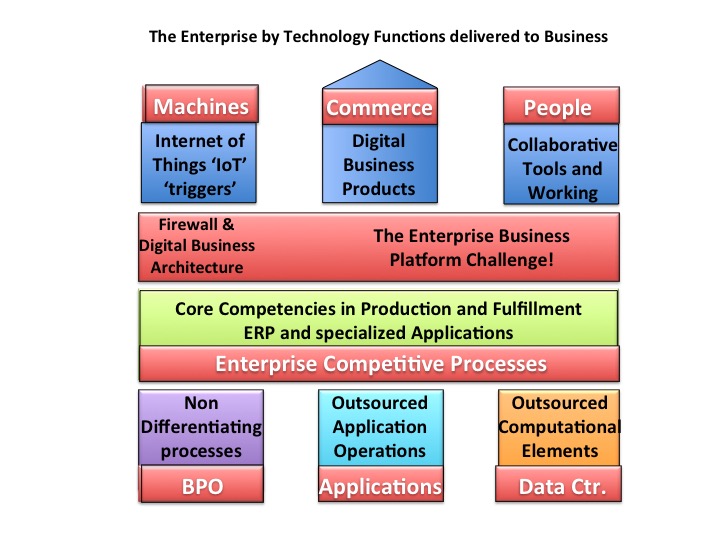
The diagram below outlines eight core functional operating areas each with different business requirements leading to different technologies operations.

In explaining the principle behind this type of functional analysis it is perhaps easiest to start with the three functions in the bottom layer of the diagram working from left to right.

Non-Differentiating Business Processes are those that have to be performed, usually for compliance reasons, but do not provide any competitive differentiation other than by the cost and efficiency with which they are carried out. Invoicing and HR are two common examples where the entire business operation is outsourced with payment based on a business metric such as per invoice, or per employee.

Interestingly Business Process Outsource, or BPO, is an existing example of shifting from CapEx overhead to OpEx operational expenditure and therefore totally aligned to the Digital Business goals of attributable cost, agility and flexibility. New Cloud based service capabilities are widening the range and types of Business Operations that can be outsourced on an OpEx business.

It makes sense to re consider exactly what could or should be moved to Business Process Outsourcing and in particular to think through the whole book to bill cycle and its relationship to your enterprises external digital business. Before doing this it helps to firmly identify exactly what makes up the functional block of ‘Core Competencies in Production and Fulfillment’

These are the activities that actually create the products that make up the enterprises business to sell with associated activities that fulfill orders, and as such are the basic competitive activities that keep an enterprise in business. Whether orders come from existing ‘traditional’ channels, or as part of new ‘digital business’ models.

Some two decades of applying IT expertise to ‘Core Competencies in Production and Fulfillment’ to optimizing processes and integrating data, etc. lie behind the original mission statement of IT, and ERP, in producing Competitive Differentiation. But for many enterprise mission creep’ has led to this vital activity becoming almost obscured behind a morass of other IT services. Hence the need to rethink competitive focus versus distracting operations better outsourced!

Returning to Business Process Outsourcing functions and re considering what to outsource by function against this criteria should result in fresh critical analysis. Add to this a further checklist of questions; should it be directly cost attributable to their activities and volume; is this now competitively available through Cloud based Services; and most significantly, who uses the function defined by where in the Business and Technology model there activities are primarily located.

Digital Business is usually seen in terms of using technology outside the enterprise IT systems and firewall to do business in new ways with Clouds, Mobility, and Services at the heart of the new capabilities. It makes sense to question if non-differentiating activities in support such as Book to Bill, and others, should not be provided in a similar manner as Cloud based BPO functions.

The usual arguments will of course be made as to preservation of the statue quo, and there are of course functions and activities where this is the right action. Here the two traditional outsource functionalities illustrated in the diagram provide the answers, but as the topic of traditional outsourcing has been argued in full in many places it does not necessary to provide a further airing here.

Its tempting to accept the continuation of the current status, but its difficult to see how without some really careful and strategic thinking a transformed Front Office using new technologies and deployment models can be made to work in a new, and reset, competitive market places with out some impacts in the rest of the enterprise and its business functions.

Digital Business Transformation must, by definition, mean a wider consideration of exactly how an enterprise does functional operate when its business model becomes based not only on Technology, but also on external Technology and Services provided by new deployment models.

This is not an argument for the chaos of Enterprise wide transformation in response to the introduction of IT, and PCs and ERP technologies as in the past. Instead it is an argument for managing a graceful change by letting go of non-core activities and re focusing on what will increase competitive differentiation in support of Digital Business.

Part 3 of this series; will focus on examining the functions of the Front Office and its aligned technology model. Part 1 can be found here

Innovation & Product-led Growth Tech Optimization Future of Work AI ML Machine Learning LLMs Agentic AI Generative AI Analytics Automation B2B B2C CX EX Employee Experience HR HCM business Marketing SaaS PaaS IaaS Supply Chain Growth Cloud Digital Transformation Disruptive Technology eCommerce Enterprise IT Enterprise Acceleration Enterprise Software Next Gen Apps IoT Blockchain CRM ERP Leadership finance Customer Service Content Management Collaboration M&A Enterprise Service Chief Information Officer Chief Technology Officer Chief Digital Officer Chief Data Officer Chief Analytics Officer Chief Information Security Officer Chief Executive Officer Chief Operating Officer

Visual Influencer Marketing Is On The Rise, But Is It Worth The Investment?

Visual Influencer Marketing Is On The Rise, But Is It Worth The Investment?

1

Visual Content

Images, videos, infographics, and other visual content have become increasingly popular forms of digital expression for individuals and content marketing fodder for bloggers and marketers.  This content has spurred the growth of social networks in which such content is produced and shared such as Vine, Pinterest, and Instagram.  So it should be no surprise that advertisers and brands are once again seeking to capitalize on perceived “influencers” within these sites despite the fact that these social networks are still in their infancy.  There’s no question that visual influencer marketing is on the rise, but is it worth the investment at this point?

“Beyond YouTube, the new visual influencer marketplace is anything but established or mature,” said Weber Shandwick’s global president of digital Chris Perry. “It’s growing and fragmenting across newer networks like Instagram, Vine and others as we speak. And access to cheap production apps and networks are fueling more content being created and shared.”  Current estimates have the PR firm dedicating approximately 20% of some client’s PR budgets to  engaging social media influencers in these networks.

As with the now largely discredited social scoring platform Klout, there’s a new crop of influence marketing platforms emerging that claim to identify, engage, and in some cases act as talent agents for those people who have amassed large followings in these visual networks. While some agencies like Weber Shandwick build their own relationships with popular social celebrities, many, such as Staples, Clinique, and Nordstrom are turning to third party influencer managers and software for a short cut.

What’s In An App?

According to Wall Street Journal writer Nathalie Tadena, “Social media celebrities can not only help brands generate enormous buzz but can also help advertisers and agencies who are less experienced with a certain platform craft content that will thrive on these specific web sites.”

HelloSociety, for example, is one new firm that focuses on connecting “Pinterest influencers” with brand marketers and/or their agencies.  Another service growing in popularity is Niche. Founded in 2013, this company is expected to generate more than $8 million in revenue this year. One of Niche’s clients is HP, which worked with Niche-identified influencers on Vine to create six-second videos featuring a new HP notebook that could turn into a tablet.

Sponsored Post or Influencer Marketing?

Social networks are businesses and as such, require revenue to keep their investors and shareholders happy. Paid advertising is the fastest way to generate that revenue once the network has accumulated large daily engagement by members. Pinterest, for example, has developed an audience of nearly 70 million unique visitors per month, according to comScore.  Pinterest allows members to “pin” an image of an item, webpage, website, etc. to one of many visual bookmarks (known as “boards”) that they’ve created within their profiles. Other members can search, like, and comment on other people’s boards and pinned images.  Pinterest now allows brands to purchase “promoted pins” on the network in order to have their images displayed to more people on the popular network.

Yet, for the most part, people shun blatant advertising and broadcast messages from advertisers within their social media channels. As a result, it’s not surprising to see more brands attempting to directly engage those with large followings on these networks in hopes that they will promote the brand to their followers. It’s also not surprising to see a new crop of influencer marketing services like Niche and HelloSociety pop up to take advantage of the opportunity.

Influencer marketing is in direct competition with the paid advertising programs that social networks like Twitter, Pinterest and Facebook offer. For example, brands including Tommy Hilfiger, VH1, and Benjamin Moore have all advertised in Pinterest recently, but none of them have purchased promoted pins. These firms – and others like them – have spent from mid-five figures to seven-figure budgets with influencer marketing services like Niche, which get popular and well-followed “pinners” to subtly promote the brands’ wares.

Something New or More of the Same?

Now that social media channels have allowed individuals to amass followings that compete with some popular television programs and magazine circulations, advertisers must pay attention. However, I’m not convinced that those embarking on these paid influencer marketing schemes will meet the expectations of the C-Suite approving the budgets.

I’ve been critical of many social media influencer schemes in the past, including Klout and to a lesser degree Kred and PeerIndex. However, I’ve always seen the value in the concept of influencer marketing, when done well. Danny Brown and I outlined that value in detail when we authored Influence Marketing: How to Create, Manage, and Measure Brand Influencers in Social Media Marketing for Pearson Publishing.

The reality is that while advertisers who engage influencer marketing companies and software in hopes of encouraging socially popular individuals to shill for their brands may be generating buzz, there’s still no correlation between the buzz generated and direct sales made when these brands are engaged. The metrics of mentions and likes are still soft metrics. Further, there’s little connection between the lead generation effort and how they affect customer lifetime value, something that businesses must be increasingly cognizant of in our multi-channel, multi-media, multi-touch world.

We still recommend that agencies turn to social media analytics companies such as Sysomos to first gauge which content creators are the most engaging around a certain topic, how their audiences match up to the demographics of highly convertible prospects, and then generate specific influencer marketing content and campaigns that target those in the buying cycle.  Alternatively, for smaller businesses, we’ve found success in working with social relationship software firms like Nimble, which can identify and monitor the conversations of those who are most likely to buy specific products at a specific time by monitoring social conversations occurring among those targeted in the contact list.

That said, we’re definitely seeing improvement in influencer marketing programs like Niche, which help brands and influencers create content that will most likely engage their target audiences. At the end of the day, even the most engaging content won’t guarantee that the content will be seen by those in the appropriate stage of the buying cycle. If you plan to engage these services, be sure you’re able to segment the audience that will be targeted to be sure they’re your “most likely buyers.” Next, ensure the campaign drives those targeted to brand-owned properties where individual profiles can be captured for better performance tracking.

Marketing Transformation Chief Marketing Officer

For retailers and CPG staying alive means living on the edge

For retailers and CPG staying alive means living on the edge

A common thread I heard last week at the NRF Big Show, was the importance of the edges of the network. "Edge" in retail speak refers to pushing relevant and actionable data closer to the customer touch points – to the edges of the retailer’s network. I wrote in my #NRF15 recap about the importance of pushing data, insights and decision making to the edges of the network, click here for post. There is another aspect of the network edge that wasn’t prevalent last week in New York, but probably isn’t ready for prime time yet, and that is an enhanced ability to execute at the network's edge. When it comes to that extended level of execution, think 3-d printing, better usage of hardware and software to better service customers…at the edges of the retail network.

The one advantage brick and mortar retailers have over the likes of Amazon and Alibaba is also what has been seen as their weakness – their physical stores. Stores offer a host of issues that are well documented – inventory carrying cost, limited SKUs due to the physical constraints of a store, overhead associated with labor as well as having real estate. However this disadvantage may have a silver lining – face to face interaction. The challenge for retailers is how to make that face to face more attractive to consumers than their laptops or mobile devices to transact. That is where being able to offer greater personalized and flexible solutions is paramount for retailers. How can retailers address this?

  • Greater personalization…kind of like your online experience! We all know that the power of transaction online, other than being able to do so in your pajamas, is how customized the experience is tailored for us.  One reason Amazon is so entrenched in our consumer life is that they know what we want…sometimes before we are even aware of it! The power of Google is that they will place those banner ads based on what they know we have been looking at and interested in. Online experiences with the likes of Nordstrom or Banana Republic are littered with suggestions on what else we need. Looking for a a new Peacoat? May we suggest these styles and brands. Oh and if you like that item…you might like this other item that compliments it. Of course this is possible because in the eCommerce world our digital finger prints are everywhere and can be captured with much more ease than in the physical world. This is starting to change. Slowly. As more service providers are focused on helping retailers capture, analyze and provide insights on all the consumer related data sources, physical retail stores will have the potential to be “smarter” in their customer interactions. Companies like Oracle look to offer their retail customers the ability to empower the edges of their network, with the data and consumer persona necessary to transform the in-store experience more on par with the online world. Oracle, like other service providers, realizes for retailers to protect their brand must understand how customers want to research – interact – transact. This can only be achieved with a more complete view of the customer. There is also the need to perform greater levels of analytics at the edge of the network – brick and mortar retailers cannot afford the potential latency associated with having to push data back to a centralized location. For example, Cisco is working on providing the communication hardware, platform and necessary analytics at the edge of the network. Don’t move the data unless you have to. That ensures that the data, and the analytics, are done as close to the customer and execution point as possible. Again, when we transact online there is not much latency when it comes to our profiles and what is being suggested. Retailers are striving to bring some online shopping experience to the store front. But what about getting your product?
  • Fulfillment moved out of the traditional channels and pushed to the edges of the network. Having greater understanding of your customer and more insights at the edges of the network is 3d Key Shows Three Dimensional Printer Or Fontwonderful, but if you cannot offer the inventory diversity or fulfill at that node, what have you gained? If retailers cannot fulfill better their stores not only become showrooms, but your store associates also become pitchmen. Not what you want in the brick and mortar world! I expect retailers to continue to focus on more flexible and intelligent manners to fulfill their customers’ demand. The first step for better fulfillment is being more savvy about your inventory. I was speaking with a former P&G executive while I was at NRF and the one issue he stated is still a headache is understanding inventory positions within a store – what is on the shelf, what is in the stock room and what item is about to have a stock out? All classic issues CPG and retailers struggle with. But to fulfill better, these need to be solved, and they cannot be solved by just looking at inventory data from your POS or warehouse system. Retailers must have greater and more reliable view of their inventory. That means being more digital with the in store management of the inventory. Service providers like Panasonic are bring such shelf level visibility to the market, something I wrote about in my last post. But it is not just about greater visibility of what is available to your customer – what about greater flexibility on delivering the customized product your customer wants? The story of how Coca Cola has rolled out their Freestyle machines, that puts a tremendous amount of control at the edge of the network, with the consumer. Other CPG companies like Maille mustard and vinegar has stores that allow you to come in and fulfill your mustard and vinegar condiments in the store. These are examples of more flexible inventory and product mix being provided at the edge. There is also the infusion of digital technologies such as 3d printing. Confectionery companies like Hersheys are rolling out 3d printing – need a special chocolate for your kid’s birthday party, have it printed in the store. Luxury retailers, such as jewelry stores, can offer on site 3d printed pieces – for customized jewelery. American Pearl is offering consumers the ability to have customized pieces created via their 3d printers. Granted they are doing this via their online channel, but brick and mortar channels could offer consumers the ability to have a design rapidly prototyped in the store and then produced. That would certainly make events like purchasing a wedding ring less stressful…well maybe not.

Whether it is better visibility and greater analytics or being more savvy in product delivery at the edges, retailers must focus here to maintain relevance for their physical stores. Simple truth – at the edges is where you find the customer. Retailers must make sure that they meet customers needs: eliminate the friction between demand, relationship, fulfillment and after sales.


Tagged: CPG, Digital Disruption, Matrix Commerce, NRF15, Retail, Supply Chain

Matrix Commerce Next-Generation Customer Experience Marketing Transformation Revenue & Growth Effectiveness Innovation & Product-led Growth Tech Optimization Data to Decisions B2B B2C CX Customer Experience EX Employee Experience business Marketing eCommerce Supply Chain Growth Cloud Digital Transformation Disruptive Technology Enterprise IT Enterprise Acceleration Enterprise Software Next Gen Apps IoT Blockchain CRM ERP Leadership finance Social Customer Service Content Management Collaboration M&A Enterprise Service AI Analytics Automation Machine Learning Generative AI Chief Information Officer Chief Customer Officer Chief Data Officer Chief Digital Officer Chief Executive Officer Chief Financial Officer Chief Growth Officer Chief Marketing Officer Chief Product Officer Chief Revenue Officer Chief Technology Officer Chief Supply Chain Officer Chief People Officer Chief Human Resources Officer

NRF15: retail looks to streamline customer experience

NRF15: retail looks to streamline customer experience

index

The NRF Big Show once again did not disappoint in terms of the sheer volume of attendees as well velocity of ideas being exchanged. The 104th edition of Retail’s Big Show, saw 33,000 attendees descend on the west side of Manhattan. It seems every January after NRF my head is spinning from 48 hours of back to back meetings, hoofing around the Javits Center and meeting a number of fantastic and interesting people and companies. It felt like the last two years The Big Show was picking up momentum again after hitting some slow downs due to the general economic malaise of a few years ago.

Once again I was impressed with the number of companies on the main floor as well as the lower floors. I recall being at NRF events were the lower levels would be hosting a different conference – no longer. The big idea talks I was able to attend focused on the next generation for retail – many high lighted the new touch points that will be truly customer centric. Of course where I gained the most insights were from my numerous meetings and hallway conversations. Here are the take aways from my time spent in the Big Apple:

  • Push data to the edge of the network. How refreshing it was to not be inundated with Big Data messaging and marketing, okay it did seep its way into some conversations, but fortunately it did not dominate. What was discussed was the ability to push the relevant and actionable data closer to the customer touch points – to the edges of the retailer’s network. Companies like Infosys and Zebra, showcased how they were leveraging a number of devices from handhelds to smart phones to Google glass to bring a higher degree of intelligence and insight at the store level (during the show it was announced that Google glass was being mothballed, whether it is Google glass or another wearable the concept is out of the genies bottle). Think about using an item such as Google glass, or a similar device, to allow your store associates to better service the store shelf. By simply looking and speaking in front of the shelf, the device can give you instant access to see if you have inventory in the backroom or when it will be replenished. Other service providers such as Epicor spoke at length about how they are working to provide a robust front end platform to provide the most complete retailer view, at the edges of the network. By leveraging their platform that ties in all the solutions retailers need to run their commerce, those sitting at the edges of the network have greater intelligence in their hands, or in their tablets and smartphones. Which is crucial for better customer service. Retailers are aware that in order to compete with the online channels, they must empower their brick and mortar presences with the data, analytics and insight to provide the best customer experience. This needs to have information and analytics at the edge of the network – on the ground of the retailer.
  • Hardware is cool again. Think smart mirrors, intelligent store shelves, wearables, RFID and IoT. I was impressed with the hardware Panasonic had on display. From smarter cash registers which employed front facing cameras with facial recognition to sophisticated store cameras and audio devices. What I was really excited about was what they have to transform your store shelves from dumb to smart. Panasonic demonstrated a full turn key solution to bring beacons, shelf sensors, smarter pricing tags and video displays. The solution offers retailers the ability to have a view of what is happening at the store shelf based on a digital signal, not relying on constant human monitoring (which we know is not necessarily accurate or timely). With a smarter store shelf, the retailer and their CPG partners will get closer to a real time view of what is really happening at the shelf. Service provider Checkpoint also displayed their RFID technology, which comes from their OATsystems acquisition. The ability to leverage RFID for better monitoring of shipments is one use case. However, the potential use case for retailers is in more accurate order assembly. As an ever increasing number of consumers are looking to order online and pick up in the store, the need for accurately assembled orders by the store takes on greater degree of importance. There was also the smart mirror that Zebra demonstrated. The mirror brings some online retail functionality to the brick and mortar store. Not only will the mirror allow you to “see” merchandise on the patron, but based on what merchandise you are trying on, the mirror is smart enough to start suggesting other products. Just like the experience when we are online and get suggestions based on what we have on our basket. Talk about cross sell and up sell…and impulse buys! These are a few examples of how hardware is becoming cool again. The evolution in hardware is bringing more flexibility, intelligence and online experience functionality to the brick and mortar stores.
  • Better servicing of the customer life cycle. With customers wanting to engage anywhere and from any devices, the need for a more complete understanding of the customer is paramount. Whether this is from the fulfillment, marketing or personalization point of view. I met with many service providers that were all tackling the customer life cycle from these angles. One of the key impacts of the JDA – IBM partnership is to have a more complete view of how to manage customer fulfillment. The offering from the partnership is tackling more efficient retail fulfillment – ensuring greater customer life cycle management from the fulfillment angle. Other service providers such a Engage.cx tackle the customer life cycle needs from the CRM perspective. I think that the term CRM does not properly describe what the service provider is offering. The basic premise of pulling customer data from the wide source of available information (regardless of where it was created) and offering a richer customer profile – like what we try to do in our legacy CRM systems – is vital for next generation retail. There are also service providers such as MomentFeed that are tackling the customer life cycle from the focused marketing angle. Retailers strive to have a better profile of their customers, but also to have a more precise way in which to target these customers with their marketing efforts. Focusing on targeted campaigns and leveraging mobility, the offering is addressing a key component of the customer life cycle: making it actionable at the most precise touch point. These are just some examples of solutions that address the growing need for richer and more complete view of the entire customer life cycle. Retailers need to be savvy about how the better fulfill, manage and target their consumers. We are truly driving to personalized retail.

These observations and trends I was able to experience during my time at NRF is all driving at the same goal – reduce the friction between demand, fulfillment, relationship and after sales. Retailers must strive to this seamless relationship between themselves and their consumers. The importance is of paramount importance when it comes to competing with online merchants, who, as we all know, have created massive digital disruption in retail. Retail channels with brick and mortar presences are looking to find solutions that will allow them to compete with the eCommerce players but more importantly pivot their position in the retail landscape and dare I say recapture some of their mojo vis-a-vis the likes of Amazon and Alibaba.


Tagged: New York City, NRF, NRF15, Retail, Supply Chain, The Big Show

Matrix Commerce Next-Generation Customer Experience Marketing Transformation Revenue & Growth Effectiveness Innovation & Product-led Growth Tech Optimization Data to Decisions Event Report B2B B2C CX Customer Experience EX Employee Experience business Marketing eCommerce Supply Chain Growth Cloud Digital Transformation Disruptive Technology Enterprise IT Enterprise Acceleration Enterprise Software Next Gen Apps IoT Blockchain CRM ERP Leadership finance Social Customer Service Content Management Collaboration M&A Enterprise Service AI Analytics Automation Machine Learning Generative AI Executive Events Chief Customer Officer Chief Information Officer Chief Procurement Officer Chief Data Officer Chief Digital Officer Chief Executive Officer Chief Financial Officer Chief Growth Officer Chief Marketing Officer Chief Product Officer Chief Revenue Officer Chief Technology Officer Chief Supply Chain Officer Chief People Officer Chief Human Resources Officer

It’s Like Facebook For Work. Wait It Is Facebook For Work

It’s Like Facebook For Work. Wait It Is Facebook For Work

On Jan 14th, Facebook officially announced their much rumoured Facebook at Work offering. This private version of the popular social network is designed to provide employees a place to collaborate securely with their colleagues. This sounds like a great idea, if it were still 2010.


In the late 2000s a shift began taking place that was commonly referred to as Enterprise 2.0, or E20. In E20 companies began adopting "social tools" such as blogs, wikis and activity streams to enable employees to communicate and collaborate more openly than they were doing via email. To explain this shift to potential buyers, early vendors such as Socialtext (where I was Director of Marketing), Yammer, SocialCast, Jive Software and others would use the analogy “It’s like a Facebook for the Enterprise". Even though forums and communities have been around since the 70s (the Well, AOL, Compuserve, etc.) a great deal of credit goes to Facebook, for popularising the modern era of social networking.

Around 2011/12 the theme os “Facebook for the Enterprise” began to evolve, as it was not resonating well with executives. They assumed this type of behaviour at work would be a waste of time, sating things like "Why would I want employees sharing pictures of what they had for lunch?" The lack of understanding of how social network could benefit businesses lead to my introducing of the theme of Purposeful Collaboration, where social features were integrated directly into the business tools people use to get their jobs done. Organizations realised that employees need social to be part of the way people work, not a separate destination to go to. This has led to vendors such as SAP, Oracle, Salesforce, Infor, IBM, Microsoft (who acquired Yammer) and others have made sharing, commenting and liking native features of their CRM, ERP, HR and other business applications.

Fast forward to today, where Google has struggled to gain mainstream enterprise adoption of Google+ and vendors like Slack, Glip, Hall, Unify (formerly Siemens) and Cisco have started to blend collaboration and unified communication. So, is Facebook's announcement too little, too late? Not necessarily. Below are a few of the pros and cons of Facebook at Work.

Opportunities

- Name Recognition: Facebook is "the standard" when it comes to social networking. Like it or not, it's a household name. You know the saying "fish where the fish are", well almost everyone is familiar with Facebook to some degree. Sure the demographics are changing and younger people are avoiding Facebook because it's for old people... but those "old people" are the workers of today so why not provide them Facebook at Work?
- Familiar User Experience: Yes, Facebook has had several hiccups when it comes to the design of their timeline, but they remain one of the key influencers on how people use activity streams/news feeds. Since people are already familiar with it, employers can save time and money by avoiding education and training on a new tool. As my colleague Holger Mueller points out, Facebook's popularity forces other vendors to improve their products, which is a win for users.
- Large Partner Ecosystem: Perhaps the biggest plus Facebook has going is the massive ecosystem of developers than know their API and can build add-on tools. While most of the current apps are games, it's not a far stretch to image a shift from Farmville and Candy Crush integration to add-ons for SAP, Salesforce, file sharing, web-conferencing, and other business tools.
- Bridging Employee to Customer engagement: Today many companies already have a "business relationship" with Facebook via their company's Facebook Page. Facebook could provide a compelling solution that bridges private employees conversations with the ones taking place with customers. So for example, a support team could see a question on the company Facebook page and route it to the right product manager to get an answer. Note: I'm not saying this bridging exists today, I'm saying it could be a useful feature if Facebook delivered it.
- Application Assets: Facebook has several applications outside of the news feed that could provide the foundation for a useful business platform. These include: Messenger (for chatting/voip/video calls), Instagram (photos and videos), Paper (displaying news/content) and Events (calendar).
- Massive Mobile Usage: a very high percentage of Facebook usage comes from mobile devices such as phones and tablets. Facebook's experience in this area could be a strong selling point to organizations who's employees require anytime/anywhere access.


Challenges

- Enterprise Software Is Not Consumer Software: Often when consumer companies try and break into the business world they fail to understand that companies have different requirements than individuals. Organizations have to deal with things like auditing and compliance, accessibility, multiple language support, directory integration, administration of people and groups and billing/usage reports. Facebook will need to show that they can meet these business requirements before business will use them for work.
- No Purposeful Collaboration: As mentioned above, companies have shifted away from just wanting a social networking to wanting collaboration tools that integrate with the tools employees use to do their jobs. For Facebook at Work to be successful, they are going to need to provide integration with CRM, ERP, HR, Customer Service/Support, Marketing, Finance and other business software. They will also need to have integrated with functions such as project/task management, file sharing, and web conferencing. This con can be linked to the pro above of partner ecosystem, as the lack of these things provides opportunity for partners to fill in the gaps. The Facebook Custom Stories platform (Open Graph) already has the framework for these integrations, no people just need to build them.
- Lack of Vertical Expertise: It's not enough to just provide a single collaboration platform and try and have it fit all use-cases. Winning collaboration vendors understand the specific needs of industries such as Healthcare, Finance Services, Legal, Manufacturing, Entertainment, Government, etc.  Facebook will need to build teams in each of these areas if they hope to sell into specific industries.
- Privacy Concerns: Warranted or not, most people have concerns about what Facebook does with their information. While Facebook has stated that you will have to switch IDs between personal and work, they still have a lot of work to do to convince organizations that their sensitive and confidential corporate data will be safe on Facebook's servers. The last thing a company wants is an employee "accidentally" posting something publically that they thought was being posted internally.
- Insufficient Search: One of the most important aspects of enterprise software is search. Employees need to be able to find the people, content and conversations they need to get their jobs done. While Facebook is steadily improving their search, it is still very cumbersome compared to most enterprise software. Contrast that to the type of analytics based search and filtering that companies like Microsoft and IBM are now offering, and Facebook has a lot of catching up to do. That said, Facebook's Graph Search has the potential to be quite powerful, so let's see where Facebook takes this in their At Work offering.
- Go To Market Channel: While many business today are using Facebook for marketing, the people who are paying for those Ads and managing Brand pages are not the same people that will be purchasing enterprise wide collaboration licenses. Facebook will need to find a way to reach people with buying authority, whether they reside in IT, LOB, or the executive office.
- Customer Support:   Today Facebook support is primarily an online help knowledge base. They will need a much more robust support organization in order for organizations to feel comfortable using them for critical business communications.
- Pricing: Currently no pricing has been set, but if organizations are already paying for something like Microsoft Office 365 or Google Apps (both of which include social networking) then they will be weary of spending additional funds.
- Competition: Perhaps the biggest hurdle is that there are already so many collaboration solutions available. The list I maintain of social software vendors contains over 50 companies, and (sadly) it is very out of date. Many of these vendors have a decade or more experience providing collaboration solutions, so Facebook may have a considerable challenge on their hands winning deals against these vendors. On the other hand, even after a decade of tools being available the market is so fragmented and no one vendor dominates the space. So perhaps Facebook can capitalise on their name recognition and win a decent percentage of deals. Time will tell.

MyPOV

Overall, I support Facebook entering the business market. They have a product already used by a billion plus people at home, certainly some percentage of those people will be happy also using it for work. I think they chose the right name, "At Work" versus something like "Facebook for the Enterprise", as I don't predict any large organizations will adopt this. There are just too many other choices for them that are better suited to meet the needs or large companies.  However, the millions of small businesses that don't have IT departments and may already be using Facebook as part of their marketing efforts may be quite happy using Facebook for secure employee collaboration.

My advice to Facebook, spend 2015 partnering with large enterprise software vendors so that you can announce integrations that prove the validity of Facebook at Work as a platform people can really use to get their jobs done.

Constellation Research realises that this is just the first release, and we look forward to working with Facebook and their business customers to help move their collaboration offerings forward.
 

New C-Suite Future of Work Next-Generation Customer Experience Marketing Transformation Revenue & Growth Effectiveness Data to Decisions Innovation & Product-led Growth Digital Safety, Privacy & Cybersecurity Tech Optimization meta Marketing B2B B2C CX Customer Experience EX Employee Experience AI ML Generative AI Analytics Automation Cloud Digital Transformation Disruptive Technology Growth eCommerce Enterprise Software Next Gen Apps Social Customer Service Content Management Collaboration Chief Customer Officer Chief People Officer Chief Information Officer Chief Digital Officer Chief Marketing Officer Chief Revenue Officer Chief Experience Officer

The Brave New World of Information InSecurity: Trade PII not privacy

The Brave New World of Information InSecurity: Trade PII not privacy

Personal information and privacyOriginally published on December 13, 2011. Updated for relevancy January 14, 2014. 

There is an orthodoxy that privacy is willingly traded by people in return for some sort of reward. Try Googling "trade privacy for" (with the quote marks). I got 181,000 hits! Among other things, people are said to trade their "privacy" for convenience, security, safety, cheaper loans and free phones.

Yet there's a category error here, one we really need to be aware of, in the interests of clear thinking and good policy.

Increasingly what consumers are doing is trading their Personal Information for a gain of some sort. And in principle, that's actually fine by me, and by most privacy advocates. Because privacy and Personal Information are not the same kind of stuff.

Amongst the digerati there is a popular view that most people these days are smart enough to know what they're doing when they sign up for loyalty programs or provide their details when they enter a competition. That view may or may not be right, but it is a sensible position. The important thing is people can and should retain their privacy in the process -- because privacy and Personal Information (or PII) are different things. Data privacy is a state where parties that hold information about you respect that information, and are restrained in what they do with it. Privacy means they refrain from knowing more about you than is necessary, and from re-using PII collected for one purpose for some other purpose.

There is no inherent problem in bargaining your PII with others who happen to value it, but to preserve privacy in these transactions, we need greater visibility from retailers et al of what they intend to do with the PII they collect. We need more sophisticated tools so consumers can fully comprehend what's going on in these data transactions. And we need more precision and rigor in the way we talk about privacy. Let's be clear: there can and should be a fair trade in Personal Information, but not in privacy.

By analogy, we trade money for goods without necessarily losing value, unless the trade in question is unfair. So this is all about transparency, negotiation and fairness -- the same things consumers care about in any transaction.

One of the deep gripes privacy advocates have about today's digital businesses is their opacity. Facebook and the like harvest vast amounts of PII, without committing themselves to any Use Limitation at all, and without even telling their users what they're up to. For example, Facebook's privacy policy is silent on what they do with facial recognition in the background and with biometric templates. Infomopolies make inordinate amounts of money on the back of personal data collected from us without ever acknowledging its true value, let alone negotiating the trade.

And that's the sneaky one-sided bargain at the heart of most social media.


Data to Decisions Digital Safety, Privacy & Cybersecurity Security Zero Trust AI ML Machine Learning LLMs Agentic AI Generative AI Robotics Analytics Automation Cloud SaaS PaaS IaaS Quantum Computing Digital Transformation Disruptive Technology Enterprise IT Enterprise Acceleration Enterprise Software Next Gen Apps IoT Blockchain CRM ERP CCaaS UCaaS Collaboration Enterprise Service developer Metaverse VR Healthcare Supply Chain Leadership Chief Customer Officer Chief Information Officer Chief Information Security Officer Chief Privacy Officer Chief Technology Officer Chief Data Officer